Tokyo Tunnels: 15 Fascinating Underground Routes, Hidden Roads, and Engineering Wonders
Tokyo tunnels form an essential part of the city’s transport network, connecting expressways, railway lines, pedestrian routes and underground infrastructure across one of the world’s busiest metropolitan areas. From deep urban road tunnels and subway passages to tunnels beneath Tokyo Bay, these hidden spaces reveal how Japan’s capital manages traffic, limited land and complex geography. Most visitors experience Tokyo through its famous destinations, such as Shibuya Crossing, Tokyo Tower, Shinjuku Station and the streets of Ginza. Yet much of the city’s efficiency depends on infrastructure that remains largely out of sight Tokyo Workshops
Understanding Tokyo’s Underground Tunnel Network
Tokyo’s urban area includes reclaimed waterfront land, river valleys, hills, densely developed commercial districts and residential neighbourhoods. These conditions influence where tunnels can be constructed and how they must be designed.
Tokyo tunnels can be divided into several categories:
- Road tunnels: Underground sections of urban expressways and major roads.
- Railway tunnels: Passages used by metro, commuter and intercity trains.
- Underwater tunnels: Structures passing beneath rivers, harbours or Tokyo Bay.
- Pedestrian tunnels: Underground walkways connecting stations, shopping areas and buildings.
- Utility tunnels: Protected routes for water, electricity, communications and other essential services.
- Historic tunnels: Older railway and road passages reflecting earlier stages of Tokyo’s development.
Some of the most impressive tunnels associated with Tokyo are located in neighbouring prefectures or connect the capital with other parts of Japan. Therefore, it is important to distinguish central Tokyo from the wider metropolitan region when planning a visit.
Yamate Tunnel: One of Tokyo’s Greatest Road Engineering Projects
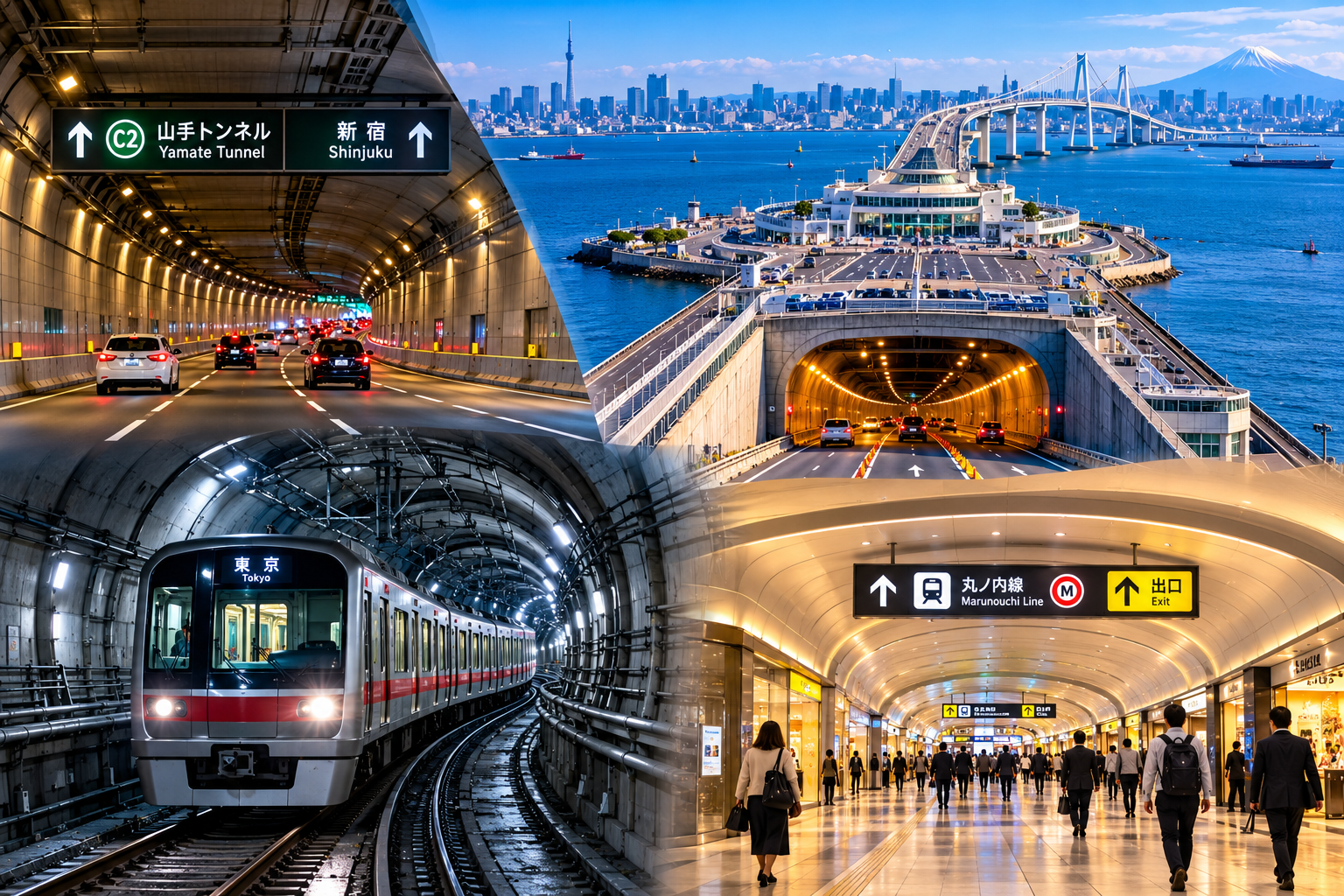
The Yamate Tunnel is among the most important underground road projects in the Tokyo metropolitan area. It forms a major section of the Central Circular Route of the Shuto Expressway, helping vehicles move around the city’s central districts without relying entirely on surface roads.
What Is the Yamate Tunnel?
The Yamate Tunnel runs beneath parts of western Tokyo and connects important urban districts, including areas associated with Shibuya, Shinjuku and Ikebukuro.
Its tunnelled section along the Central Circular Shinjuku Route is approximately 11 kilometres long. It was completed in 2010, while the wider Central Circular Route was completed in 2015.
Why Was It Constructed Underground?
Tokyo has limited space for major new roads in its most developed neighbourhoods. Acquiring land, demolishing buildings and constructing elevated expressways can be expensive and disruptive.
An underground route can help avoid some of these problems.
The Yamate Tunnel provides several benefits:
- Allows through-traffic to bypass selected surface streets.
- Reduces the need for additional elevated road structures in some areas.
- Connects important employment and commercial districts.
- Supports traffic distribution across the wider expressway network.
- Makes use of underground space that would otherwise remain unavailable for transport.
However, an underground road does not automatically eliminate congestion. Queues can still develop near junctions, entrances and exits.
How Does the Tunnel Work?
A long road tunnel requires more than a paved driving surface. Its operating systems may include:
- Mechanical ventilation and jet fans.
- Lighting adjusted for different driving conditions.
- Fire detection and emergency communication equipment.
- Traffic monitoring and incident-management systems.
- Drainage equipment.
- Emergency exits and evacuation facilities.
The exact configuration varies by tunnel and operating section.
Drivers should maintain a safe following distance, pay attention to electronic signs and avoid stopping unless an emergency or official instruction requires it.
Is the Yamate Tunnel a Tourist Attraction?
The Yamate Tunnel is an operating expressway rather than a pedestrian sightseeing destination.
Driving through it may interest people who enjoy transport infrastructure, but walking, stopping or taking photographs inside an active traffic tunnel is unsafe unless specifically permitted in an officially designated area.
Tokyo Bay Aqua-Line: A Road Beneath the Sea
The Tokyo Bay Aqua-Line is one of the most striking examples of large-scale transport engineering associated with Tokyo. It connects Kawasaki in Kanagawa Prefecture with Kisarazu in Chiba Prefecture through a combination of underwater tunnel, artificial island and bridge.
Although it is outside central Tokyo, it is an important part of the wider metropolitan transport system.
How the Tokyo Bay Aqua-Line Works
The route combines two different engineering solutions:
- An underwater tunnel for part of the crossing.
- A bridge across another part of Tokyo Bay.
The transition between these sections is associated with Umihotaru, an artificial island containing a well-known highway service area.
The route opened in 1997. Its underwater tunnel is approximately 9.6 kilometres long, while the complete bridge-and-tunnel route is substantially longer.
Why Build a Tunnel Beneath Tokyo Bay?
A direct road crossing can shorten some journeys between the two sides of the bay. The alternative may involve travelling around the coastline, depending on the starting point and destination.
The project also demonstrates how engineers can combine different structures when a single solution is impractical.
A bridge may be suitable where sufficient clearance and foundations can be accommodated. An underwater tunnel may be preferable where a bridge would create difficulties for shipping or where geographical conditions favour a below-water crossing.
What Makes an Underwater Road Tunnel Difficult?
Construction beneath the sea presents challenges that are not encountered to the same extent on ordinary surface roads.
Water pressure: The tunnel lining and joints must withstand the surrounding pressure.
Waterproofing: Seals and structural joints must limit water ingress throughout the structure’s operating life.
Geology: Engineers must investigate the seabed, soil layers and geological conditions before choosing a construction method.
Ventilation: Vehicles generate heat and exhaust emissions, requiring systems that maintain suitable operating conditions.
Emergency response: Fires, collisions and vehicle breakdowns can be more difficult to manage in an enclosed underwater structure.
Maintenance access: Equipment must remain accessible even when the road is carrying traffic.
These requirements help explain why underwater tunnels are expensive and technically demanding projects.
Umihotaru: A Useful Stop on the Journey
Umihotaru is an artificial island and service area where travellers can stop for food, refreshments, shopping and views of Tokyo Bay.
It appeals to visitors who enjoy seeing infrastructure up close and appreciating the relationship between the bridge, the surrounding sea and the transport facilities serving the route.
Visitors should access the site using authorised transport and follow its traffic rules.
Who Should Explore the Aqua-Line?
This route may appeal to:
- Road-trip enthusiasts.
- Families travelling between Kanagawa and Chiba.
- Civil engineering students.
- Visitors interested in Japanese infrastructure.
- Photographers looking for views of Tokyo Bay.
- Travellers combining coastal destinations with a wider Tokyo itinerary.
Drivers should check current traffic conditions, toll arrangements and weather-related restrictions before travelling.
Tokyo’s Underground Railway Tunnels
Railway tunnels are among the most familiar types of underground infrastructure encountered by ordinary visitors to Tokyo.
People enter underground stations, board trains and travel beneath commercial districts without needing to understand the engineering around them.
Tokyo’s railway tunnels form part of an interconnected system that includes subway lines, underground railway sections and through-running services linking different operators.
A Brief History of Tokyo’s Subway Development
Tokyo’s modern underground railway history began in the early twentieth century.
Construction of the Asakusa–Ueno subway section began in 1925, and the first section opened on 30 December 1927. This marked a major milestone in Japanese underground public transport.
The network expanded over subsequent decades, bringing additional routes, larger stations, improved signalling and connections with suburban railway lines.
Today, passengers can travel between districts using underground and surface railways within the same journey.
Why Are Some Tokyo Railway Tunnels So Deep?
Not every subway tunnel in Tokyo lies at the same depth.
Depth depends on several factors:
- Existing buildings and foundations.
- Other railway lines.
- Underground roads and utilities.
- Rivers and geographical features.
- Geological conditions.
- Station placement and interchange requirements.
- The need to avoid disrupting existing transport services.
An older railway line might pass relatively close to the surface in one district but descend much deeper elsewhere to cross beneath another line.
The Toei Oedo Line illustrates the scale of underground railway engineering. The line extends approximately 40.7 kilometres and includes 38 stations. Roppongi Station reaches a reported depth of 42.3 metres at its deepest point.
For passengers, this means reaching a platform may involve several escalators, lifts and connecting corridors.
How Railway Tunnels Are Constructed
Several construction techniques are used for underground railways, depending on local conditions.
Cut-and-Cover Construction
In cut-and-cover construction, engineers excavate a trench, build the tunnel structure and then cover it.
This method can be suitable for relatively shallow infrastructure, particularly where road closures and surface disruption can be managed.
However, it can be difficult to use in a busy commercial district because excavation affects streets, utilities, businesses and pedestrian movement.
Shield Tunnelling
Shield tunnelling is particularly useful for constructing tunnels beneath developed urban areas.
A tunnelling machine excavates the ground at the front while a protective shield supports the surrounding ground. As the machine advances, workers or automated systems install lining segments behind it.
The method can reduce surface disruption compared with a large open excavation, although it still requires launch shafts, receiving areas, spoil removal and extensive ground monitoring.
Mining Methods
In suitable geological conditions, engineers can use tunnelling methods involving excavation and support installation without the same continuous shield arrangement.
The choice depends on ground strength, groundwater, tunnel dimensions, construction risks and the surrounding environment.
Why Tokyo Has So Many Railway Tunnels
Tokyo’s population and employment patterns create enormous demand for reliable public transport.
Underground railways allow routes to pass through areas where surface rail corridors would be difficult to accommodate. They can also connect busy commercial districts without requiring extensive new land acquisition.
The benefits include:
- High-capacity passenger transport.
- Connections between major employment centres.
- Reduced dependence on private cars for many journeys.
- Efficient use of valuable surface land.
- Integration with shopping complexes and underground pedestrian networks.
The disadvantages include high construction costs, complex maintenance requirements and the difficulty of expanding stations in an already developed city.
What Passengers Should Know
For visitors, railway tunnels are best experienced as part of ordinary travel.
Use official station maps to identify the correct line and platform, check the direction of travel, and allow extra time when transferring between deep-level stations.
A short journey on a map can involve a surprisingly long walk underground, especially at large interchanges.
Tokyo’s Deep Underground Stations and Connecting Passages
Underground stations are not simply holes in the ground with train platforms at the bottom. They are carefully planned buildings below the surface.
Many contain ticket gates, passageways, ventilation equipment, electrical rooms, lifts, escalators and emergency routes. Large interchange stations may connect several railway operators and commercial facilities.
Why Underground Stations Become Complicated
The deeper an interchange is, the more difficult it can be to move passengers between the street and the platform efficiently.
Station planners must consider:
- Passenger flow during peak commuting hours.
- Accessible routes for wheelchair users.
- Emergency evacuation.
- Connections with other train lines.
- Building foundations.
- Ventilation and temperature control.
- Space for electrical and signalling equipment.
A station with many connecting lines may require several underground levels to keep tracks and platforms separate.
Roppongi Station and the Oedo Line
Roppongi is a useful example for anyone interested in deep underground transport.
The Toei Oedo Line’s reported maximum station depth at Roppongi is 42.3 metres. This gives visitors a practical sense of the vertical scale involved in some Tokyo underground structures.
A journey from street level to a platform can require several escalator rides and connecting corridors.
For commuters, this is part of the normal routine. For first-time visitors, it can be surprising to discover how far below the street a train platform may lie.
The Underground City Effect
In some areas of Tokyo, the underground environment functions almost like a second city.
Passengers may move from a railway platform to a shopping arcade and then through an underground passage to another station exit without returning to street level.
This is especially useful in rainy weather, hot summers and crowded business districts.
However, underground connectivity should not be confused with unlimited access. Some passages close at night, some exits serve specific buildings, and some routes may require passengers to pass through ticket gates or shopping facilities.
Practical Advice for Navigating Deep Stations
- Check the station exit number before leaving the platform area.
- Follow signs for the correct railway line rather than assuming all transfers are nearby.
- Look for lifts when travelling with luggage or mobility equipment.
- Leave additional time for large interchange stations.
- Confirm the station’s operating hours if travelling late at night.
These simple habits can make Tokyo’s underground network much easier to navigate.
Historic Tunnels and Tokyo’s Railway Heritage
Tokyo’s underground infrastructure also tells a story about the city’s growth.
The earliest subway routes were built when the capital faced different transport needs, construction limitations and urban planning priorities from those of today.
The Asakusa–Ueno section, opened in 1927, is particularly important because it represents the beginning of Tokyo’s modern subway era.
The Engineering Challenges of Early Subway Construction
Early subway builders had to work with limited technology compared with today’s tunnelling equipment.
They faced difficult ground conditions, dense urban development, funding constraints and the challenge of constructing routes beneath existing streets and infrastructure.
The history of the Ginza Line includes construction beneath waterways such as the Kanda and Nihonbashi rivers.
These projects helped establish the foundations of the modern underground transport network.
Why Historic Tunnels Matter Today
Historic tunnels and railway structures provide evidence of how transport engineering has changed.
They reveal developments in:
- Excavation methods.
- Structural materials.
- Waterproofing.
- Ventilation.
- Electrical systems.
- Passenger safety.
- Urban planning.
They also show how infrastructure can outlast the assumptions of the era in which it was built.
A tunnel originally designed for a smaller railway network may now form part of a major metropolitan system carrying passengers through a very different urban landscape.
Can Visitors Enter Historic Tokyo Tunnels?
Some historic railway structures can be observed through authorised railway services, museums or officially organised tours, depending on the location.
However, ordinary operational tunnels are not public attractions.
Visitors should never enter a railway tunnel, maintenance passage or restricted infrastructure area without explicit authorisation.
For heritage-focused travel, look for official transport museums, railway exhibitions and documented engineering projects rather than attempting to access closed structures.
Underwater Tunnels Beneath Tokyo’s Rivers and Harbours
Tokyo’s relationship with water is one of the reasons its underground infrastructure is so interesting.
The metropolitan area contains numerous rivers, canals, waterfront districts and reclaimed areas. Road and railway routes must cross these geographical features while maintaining connections between densely developed neighbourhoods.
Bridges are an obvious solution, but they are not always the most practical option.
Why Engineers Choose Underwater Tunnels
An underwater tunnel can allow transport routes to pass beneath a river or harbour without placing a bridge deck across the surface.
This may be useful where:
- Shipping requires sufficient clearance.
- A bridge would interfere with nearby port operations.
- Existing buildings limit the space available for a new crossing.
- A road needs to connect directly with underground infrastructure.
- The surrounding transport network favours a tunnel approach.
The choice is rarely based on a single factor. Construction cost, geological conditions, maintenance requirements and environmental impact must all be considered.
River Crossings in Tokyo’s Historic Railway Network
The development of Tokyo’s early subway system involved overcoming obstacles created by waterways. The Ginza Line’s construction history includes tunnelling beneath the Kanda and Nihonbashi rivers.
This illustrates an important point: underground infrastructure can be essential even where the geographical obstacle is relatively small.
A river crossing may appear straightforward on a city map, but an underground route must account for the waterway, its banks, nearby foundations, groundwater and the existing transport network.
Are All Underwater Tunnels Below the Seabed?
No. The exact arrangement depends on the tunnel’s construction method.
Some tunnels are bored through the ground beneath a river or seabed. Others may be constructed from prefabricated sections placed in a prepared trench and then covered.
In either case, engineers must consider buoyancy, water pressure, ground stability, waterproofing and the long-term performance of joints.
The design must also account for maintenance and emergency access throughout the tunnel’s life.
Underground Expressways and Tokyo’s Traffic Management
Tokyo’s road tunnels are part of a broader strategy for managing traffic in a city where space is expensive and demand for transport is high.
The Shuto Expressway network includes elevated roads, surface sections, underground routes and complex interchanges. These different structures allow the network to respond to the constraints of individual districts.
How Underground Expressways Help Distribute Traffic
Imagine a driver travelling across Tokyo to reach a destination on the opposite side of the central business district.
Without an appropriate bypass, that driver might need to travel through surface streets, adding to traffic around shopping areas, pedestrian crossings and commercial buildings.
An underground expressway can provide an alternative route for suitable journeys.
This can improve traffic distribution, although the overall effect depends on network capacity, demand, access points and the availability of alternative routes.
Why Underground Roads Are Not a Complete Solution to Congestion
A tunnel creates road capacity, but it does not eliminate the number of vehicles travelling into the city.
If many drivers use the same tunnel, queues can develop near entrances, exits and connecting roads. An incident inside a tunnel can also affect a large part of the route because there may be fewer opportunities to divert traffic immediately.
Urban transport planning therefore needs to consider more than the tunnel itself.
Useful complementary measures include:
- Reliable public transport.
- Traffic monitoring and route management.
- Efficient freight and delivery planning.
- Safe pedestrian and cycling networks.
- Appropriate management of road access.
- Coordination between neighbouring road authorities.
The broader lesson is that a tunnel is most effective when it forms part of a well-managed transport system.
How Tokyo Tunnels Are Built: Engineering Methods Explained
Tokyo’s tunnels demonstrate how engineers adapt construction methods to different ground conditions and urban constraints.
A tunnel through relatively stable rock presents different challenges from one beneath a river, a busy shopping street or a high-rise district.
Shield Tunnelling in Dense Urban Areas
Shield tunnelling is widely associated with modern urban tunnel construction because the machine provides a protected working environment as excavation progresses.
A typical sequence involves:
- Investigating the ground and groundwater.
- Constructing a launch shaft.
- Positioning the tunnelling machine.
- Excavating the ground at the machine’s front.
- Removing excavated material.
- Installing lining segments as the machine advances.
- Monitoring ground movement and tunnel alignment.
- Completing internal systems and the track or roadway.
The method is valuable where engineers need to limit surface disruption.
However, shield tunnelling does not make a project risk-free. Unexpected geology, groundwater, settlement, equipment failures and difficulties at shafts or junctions can still cause major problems.
Cut-and-Cover Construction for Shallow Tunnels
Cut-and-cover construction can be useful for shallow road tunnels, railway stations and connecting passages.
The basic method is straightforward: excavate an area, construct the underground structure and cover it.
Its greatest disadvantage in central Tokyo is often the disruption required at street level.
Temporary road closures, utility relocation, noise, dust and access restrictions can affect nearby residents and businesses. These impacts must be managed throughout construction.
Immersed-Tube Construction
For some underwater crossings, engineers can use prefabricated tunnel sections.
Sections are constructed separately, transported to the site, lowered into a prepared trench and joined together. The structure is then covered and protected.
This approach can be suitable for certain waterways, depending on depth, seabed conditions, shipping requirements and environmental constraints.
It differs from boring a tunnel through the ground beneath the seabed.
Groundwater Management and Waterproofing
Groundwater is one of the most important considerations in underground construction.
Engineers may need to manage water pressure, control inflows during construction and design permanent drainage or waterproofing systems.
Long-term performance depends on joint quality, structural movement, ground conditions and maintenance.
A small water leak may initially appear insignificant, but repeated leakage can damage equipment, affect finishes or contribute to deterioration if left unaddressed.
Monitoring Ground Movement
Construction below existing buildings requires careful monitoring.
Engineers can use surveying instruments, settlement markers, sensors and other monitoring equipment to detect movement in the surrounding ground.
Monitoring is particularly important where tunnels pass beneath older structures, sensitive utilities or other transport infrastructure.
The aim is not merely to check whether the tunnel itself is being built correctly. It is also to ensure that nearby buildings, roads and services remain within acceptable movement limits.
Earthquake Safety and Disaster Preparedness in Tokyo Tunnels
Tokyo’s tunnels operate in a region where earthquake preparedness is an essential part of infrastructure planning.
Underground structures may experience different earthquake effects from surface buildings, but they are not immune to seismic damage.
Their performance depends on factors such as ground movement, soil conditions, tunnel geometry, construction quality and the characteristics of the earthquake.
How Earthquake Risks Affect Tunnel Design
Tunnel designers need to consider how the surrounding ground may move during a major seismic event.
Potential issues include:
- Ground deformation.
- Differential movement between structures.
- Damage to tunnel linings and joints.
- Ground settlement.
- Disruption to electrical and signalling systems.
- Flooding where underground structures are exposed to water.
Design measures vary by tunnel type and age. Modernisation projects may also address vulnerabilities identified through inspections and updated engineering standards.
What Happens if an Earthquake Occurs Inside a Tunnel?
The correct response depends on the type of tunnel and the instructions issued by the operator.
Road tunnels and railway tunnels have different operating systems, evacuation arrangements and emergency procedures.
Drivers should follow tunnel signs and official instructions, avoid sudden dangerous manoeuvres, and use designated emergency facilities when directed.
Rail passengers should follow announcements and staff instructions rather than attempting to leave a train or walk through a tunnel independently.
Flooding and Heavy Rainfall Tokyo tunnels
Tokyo’s underground environment also requires careful water management.
Heavy rainfall can place pressure on drainage systems, underground entrances and low-lying road sections. Waterfront infrastructure may face additional risks associated with storm surges or other water-related hazards.
Tunnel operators use drainage systems, pumps and monitoring equipment appropriate to the facility. Emergency arrangements may include restrictions or closures when conditions become unsafe.
Visitors should check official transport and road information during severe weather rather than assuming that an underground route will always remain open.
Why Routine Maintenance Matters Tokyo tunnels
Disaster preparedness is not limited to the original construction design.
Inspection, testing, repairs and equipment replacement are also essential.
A tunnel’s safety depends on the continued performance of structural components, lighting, ventilation, communications, drainage and emergency systems.
This is one reason underground infrastructure requires long-term funding even when the tunnel appears to be an ordinary part of daily travel.
Ventilation, Air Quality and Fire Protection Tokyo tunnels
Ventilation is among the most important systems in a long road tunnel.
Inside an enclosed road tunnel, vehicles produce exhaust emissions and heat. The air must be managed to maintain suitable conditions for normal operation and to support emergency response.
Railway tunnels have different ventilation requirements, particularly where trains generate heat and stations experience heavy passenger movement.
How Tunnel Ventilation Works Tokyo tunnels
Depending on the design, a tunnel may use mechanical fans, ventilation shafts, natural air movement or a combination of methods.
Ventilation systems can help control normal operating conditions, while specialised smoke-control arrangements may be needed during a fire.
The correct approach depends on the tunnel’s length, cross-section, traffic volume, geometry and emergency strategy.
Fire Safety in Road Tokyo tunnels
A vehicle fire inside a tunnel can create dangerous heat and smoke. Restricted access can also complicate firefighting and evacuation.
For this reason, road tunnels may include a combination of:
- Fire detection systems.
- Emergency telephones or communication equipment.
- Fire extinguishers and firefighting facilities.
- Emergency exits and connecting passages.
- Traffic signals and closure barriers.
- Smoke-management equipment.
- Control-room monitoring.
Not every tunnel contains the same equipment, and the exact layout matters.
Drivers should familiarise themselves with emergency signs while travelling and never block an emergency access point.
Why Tunnel Lighting Is Different Tokyo tunnels
Drivers moving from bright daylight into a tunnel may initially have difficulty seeing details inside it. This is particularly noticeable near the entrance.
Tunnel lighting is designed to help manage this transition and maintain visibility along the roadway.
Drivers should avoid entering a tunnel with dirty windscreens, defective lights or poor visibility caused by an unsafe following distance.
Pedestrian Tunnels and Tokyo’s Underground Shopping Streets
Not every Tokyo tunnel is designed for vehicles or trains.
Pedestrian passages are a familiar feature of many major station districts. They allow people to move between transport facilities, office buildings, shops and surrounding streets.
These spaces can be especially useful in areas with heavy foot traffic.
Why Pedestrian Tunnels Are Useful Tokyo tunnels
Underground walkways can provide protection from rain, wind and summer heat. They can also help separate pedestrian movement from busy roads.
In a large station area, a well-planned underground passage may make it easier to reach a destination without repeatedly crossing surface streets.
Some passages are integrated with shopping centres or station buildings, creating a connected environment below ground.
The Difference Between a Tunnel and an Underground Arcade Tokyo tunnels
A pedestrian tunnel is primarily a passage connecting places. An underground shopping arcade is a commercial space that may also function as a pedestrian route.
In practice, the two can overlap.
A passage may contain shops and cafés, while a shopping complex may connect directly with several railway entrances.
For visitors, the distinction matters because access arrangements and opening hours may differ. A shopping complex may close earlier than a nearby railway station, and some internal routes may not remain accessible overnight.
How to Navigate Underground Passages Tokyo tunnels
Use the official exit numbers displayed in station signage. In large stations, following the name of a building or neighbourhood can be more reliable than simply choosing the nearest exit.
If the passage becomes confusing, look for a station map or ask staff before walking a long distance in the wrong direction.
Travellers with luggage should also consider whether a route includes stairs. The shortest underground path is not always the easiest accessible route.
Utility Tunnels: The Infrastructure Travellers Rarely See
Some of Tokyo’s most important underground structures are not accessible to ordinary passengers at all.
Utility infrastructure carries services that keep homes, offices, hospitals and transport systems operating.
Depending on the project, these systems may include water supply, drainage, electricity, telecommunications and other essential networks.
Why Place Utilities Underground?
Underground installation can protect some services from weather exposure and make better use of limited surface space.
It can also reduce the need for separate surface corridors and help organise infrastructure within a densely developed urban environment.
However, underground utilities introduce their own challenges.
Repairing a buried pipe or cable may require excavation, traffic restrictions or access through dedicated service passages. Engineers must also ensure that different systems can be inspected and maintained safely.
Utility Tunnels and Urban Resilience
Utility networks are interconnected. A failure in one system can affect other services, particularly when several facilities depend on the same corridor or power supply.
For example, a major power interruption can affect pumps, ventilation, communications and signalling equipment if backup arrangements are inadequate.
Resilient infrastructure therefore requires more than strong physical construction. It also requires redundancy, monitoring, maintenance and well-planned emergency procedures.
Can Tourists Visit Utility Tunnels?
Generally, no. Utility tunnels are operational infrastructure and may contain electrical hazards, confined spaces, pressurised systems or other dangerous conditions.
They should not be treated as urban exploration sites.
People interested in this field can learn more through public engineering exhibitions, official infrastructure publications and authorised educational programmes.
Ten Major Organisations Behind Tokyo’s Tunnel Infrastructure
Tokyo’s tunnel network is not managed by one company. Different organisations are responsible for railways, expressways, public transport, construction, road administration and technical standards.
The following comparison identifies ten relevant organisations and explains their relationship to the wider tunnel and transport ecosystem. It is not a ranking, and these organisations do not all own or operate tunnels directly.
| Organisation Tokyo tunnels | Main role Tokyo tunnels | Relevance to Tokyo tunnels |
|---|---|---|
| 1. Tokyo Metro | Subway operator | Operates underground railway lines and stations. |
| 2. Toei Transportation | Metropolitan public transport | Operates subway services, including the Oedo Line. |
| 3. Metropolitan Expressway Company | Urban expressways | Manages major expressway routes, including important tunnelled sections. |
| 4. East Nippon Expressway Company (NEXCO East) | Expressway management | Manages expressway infrastructure in eastern Japan. |
| 5. Central Nippon Expressway Company (NEXCO Central) | Expressway management | Relevant to wider regional highway connections and tunnel engineering. |
| 6. West Nippon Expressway Company (NEXCO West) | Expressway management | Provides a broader Japanese comparison for road and tunnel operations. |
| 7. East Japan Railway Company (JR East) | Railway operator | Operates extensive commuter and regional railway services, including underground sections. |
| 8. Tokyo Metropolitan Government | Urban administration | Plans and oversees a range of metropolitan infrastructure responsibilities. |
| 9. Ministry of Land, Infrastructure, Transport and Tourism (MLIT) | National transport administration | Publishes road engineering information and supports national infrastructure policy. |
| 10. Taisei Corporation | Construction and engineering | A major Japanese contractor involved in complex civil engineering projects. |
Comparing the Organisations by Purpose Tokyo tunnels
The most useful distinction is between operators and public authorities.
- Railway operators provide information about train services, stations, accessibility and passenger safety.
- Expressway operators provide information about road conditions, restrictions and tunnel operations.
- Government agencies publish planning documents, standards and infrastructure information.
- Construction companies contribute engineering and construction expertise but are not necessarily responsible for operating completed tunnels.
These different roles demonstrate why no single organisation is responsible for every underground structure in Tokyo.
Tokyo Tunnels for Different Types of Travellers
Tokyo’s underground infrastructure has different uses depending on why someone is visiting the city.
The best way to experience it is to choose activities that match your interests, rather than assuming every tunnel can be entered or visited.
Tokyo Tunnels for First-Time Visitors
First-time visitors will probably encounter underground infrastructure through subway journeys and station passages.
The most useful approach is to learn how station exits, transfer corridors and railway lines are organised.
Start with a familiar destination, such as a hotel or major attraction, and examine the station map before leaving the platform. This is often more practical than exploring an unfamiliar underground network without a clear destination.
Tokyo Tunnels for Architecture Enthusiasts
Architecture enthusiasts may be interested in how underground structures fit into dense commercial districts.
Look at the relationship between street-level buildings, station entrances, ventilation structures and underground shopping areas.
The important architectural question is not simply what the tunnel looks like. It is how the surrounding urban environment has been organised to accommodate it.
Tokyo Tunnels for Civil Engineering Students
Engineering students can study several different subjects through Tokyo’s tunnel network:
- Shield tunnelling and ground support.
- Structural design and waterproofing.
- Railway alignment and station depth.
- Road ventilation and fire protection.
- Ground settlement monitoring.
- Earthquake preparedness.
- Maintenance and asset management.
Official transport and government publications are useful starting points for technical research.
Tokyo Tunnels for Families
Families can experience the underground railway system as part of an ordinary city visit.
Choose routes with manageable transfers, allow extra time at major stations and check whether lifts are available where needed.
For younger children, explain that railway tunnels and road tunnels are operating transport facilities, not places to walk around or explore independently.
Tokyo Tunnels for Photographers
Photographers may find interesting compositions in publicly accessible station entrances, underground shopping areas and designated viewpoints near major infrastructure.
Photography restrictions vary by location. Private facilities, railway premises and operational areas may have specific rules.
Avoid photographing from unsafe positions, obstructing commuters or entering restricted areas for a better view.
Tokyo Tunnels for People with Mobility Needs Tokyo tunnels
Accessibility can vary considerably between stations and individual exits.
Before travelling, check official station information for lifts, accessible toilets, step-free routes and interchange arrangements.
A route with fewer train changes may still be inconvenient if it involves long corridors or stairs. Choosing the right station exit can make a substantial difference.
Practical Guide: How to Explore Tokyo’s Underground Infrastructure Safely
If your goal is to understand Tokyo tunnels as a visitor, a little preparation can help you see more while avoiding unnecessary difficulty.
Step 1: Decide What Kind of Tunnel Interests You Tokyo tunnels
Start by choosing between road engineering, railway infrastructure, historic transport or pedestrian passages.
This determines whether you should plan a road trip, use public transport, visit an authorised exhibition or observe publicly accessible facilities.
Step 2: Check Whether the Location Is Publicly Accessible Tokyo tunnels
Never assume that a tunnel mentioned in an engineering article is open to visitors.
Operational road tunnels, railway tunnels, utility passages and maintenance facilities are generally not places for independent exploration.
Look for official visitor information if you are interested in a guided tour or a special access opportunity.
Step 3: Plan the Journey Around the Destination Tokyo tunnels
For an ordinary subway journey, use official route information to identify the nearest station, required transfers and appropriate exit.
For a road trip involving the Tokyo Bay Aqua-Line, check the route, toll information and traffic conditions before setting out.
Step 4: Allow Extra Time for Underground Transfers Tokyo tunnels
Large stations can involve substantial walking distances.
If your itinerary includes a timed attraction, a train connection or a reservation, avoid assuming that the shortest distance shown on a map represents the total time needed.
Step 5: Check Weather and Operating Information Tokyo tunnels
Heavy rainfall, traffic incidents, maintenance work and transport disruptions can affect underground routes.
Use current official information when conditions may change your travel plans.
Step 6: Respect Safety Restrictions Tokyo tunnels
Do not enter restricted areas, cross railway tracks, stop in active road tunnels or attempt to reach closed maintenance facilities.
If you encounter an emergency, follow posted instructions and directions from authorised staff.
Step 7: Record Useful Observations Tokyo tunnels
If you are researching the engineering, note publicly available information such as:
- The tunnel’s purpose.
- Its position within the wider transport network.
- The construction method, if documented.
- The date it opened.
- How it connects with nearby transport.
- Any officially published safety or maintenance information.
This approach turns an ordinary journey into a useful learning experience.
Common Mistakes When Researching Tokyo Tunnels
Tokyo’s tunnel network is extensive, but online information can be confusing when different structures share similar names or when a tunnel forms only one part of a larger transport route.
Mistake 1: Confusing a Tunnel with an Entire Expressway Route Tokyo tunnels
A long expressway may include several tunnels, bridges, ramps and open-air sections.
Solution: Check whether the reported length refers to the tunnel itself, a tunnelled section or the entire road route.
Mistake 2: Assuming Every Tunnel Is a Tourist Attraction Tokyo tunnels
Many impressive structures are closed to public entry because they are essential operational facilities.
Solution: Distinguish between a place that can be viewed, a route that can be travelled through and a facility that offers authorised visits.
Mistake 3: Treating the Whole Tokyo Region as Central Tokyo tunnels
Some well-known infrastructure projects are located in Kanagawa, Chiba or other neighbouring areas.
Solution: Check the actual location before planning a visit, especially when transport connections or travel times matter.
Mistake 4: Assuming All Underground Stations Are Easy to Navigate Tokyo tunnels
Some stations have long connecting passages, multiple levels and numerous exits.
Solution: Use station maps and identify your intended exit before travelling.
Mistake 5: Using Outdated Engineering Figures Tokyo tunnels
Tunnel lengths may differ across sources because projects have been extended, route boundaries have changed or publications use different measurement definitions.
Solution: Prioritise official operator and government documentation, and state clearly which section a figure describes.
Mistake 6: Ignoring the Role of Maintenance Tokyo tunnels
A tunnel’s performance depends on its condition after opening, not just its original engineering design.
Solution: When researching a tunnel, consider inspections, repairs, drainage, ventilation, emergency planning and long-term asset management.
Mistake 7: Exploring Restricted Infrastructure Tokyo tunnels
Entering an operational tunnel without permission creates serious safety risks and may violate local rules or laws.
Solution: Use publicly accessible facilities, official tours and authorised educational resources.
Advantages and Disadvantages of Tokyo’s Tunnel Network
Tokyo’s underground infrastructure provides significant benefits, but it also creates technical and financial obligations.
| Advantages Tokyo tunnels | Disadvantages Tokyo tunnels |
|---|---|
| Makes efficient use of limited urban land | Often expensive to construct |
| Helps connect busy districts | Requires specialised maintenance |
| Supports high-capacity public transport | Can involve complicated construction logistics |
| Allows roads to bypass selected surface areas | May move congestion towards access points |
| Can protect some infrastructure from surface disruption | Can be vulnerable to flooding and equipment failures |
| Supports transport connections beneath waterways | Waterproofing and water management can be challenging |
| Can reduce the need for some elevated structures | Ventilation and emergency systems add complexity |
| Creates opportunities for integrated urban planning | Repairs can disrupt transport operations |
The Environmental Trade-Off Tokyo tunnels
Underground construction can preserve some surface space and reduce the need for certain elevated structures.
However, it is not automatically the most environmentally friendly option.
Excavation, concrete production, steel manufacturing, spoil transport and construction equipment all require resources. Underground facilities also consume energy through lighting, ventilation, pumping and other systems.
The environmental performance of a project depends on its construction impacts, operating requirements and the transport benefits it delivers over time.
The Economic Trade-Off Tokyo tunnels
A tunnel can be expensive to build but valuable over decades if it solves a major transport problem.
The correct comparison is not simply between the cost of a tunnel and the cost of a surface road. Planners must also consider land acquisition, disruption to existing buildings, environmental effects, ongoing maintenance and the value of the transport capacity provided.
The Urban-Planning Trade-Off Tokyo tunnels
Underground transport can free valuable surface space, but it does not automatically make a city more walkable or less congested.
Those outcomes depend on how the surrounding land is used and how effectively public transport, pedestrian routes and road networks work together.
Tokyo’s experience demonstrates that underground infrastructure is most useful when it is treated as part of a complete urban system rather than an isolated engineering achievement.
The Future of Tokyo Tunnels: Technology and Urban Development
Tokyo’s underground infrastructure will continue to face changing demands as the city maintains ageing assets, improves transport efficiency and prepares for environmental and disaster-related challenges.
Future developments are likely to involve both new construction and the modernisation of existing tunnels.
Smarter Tunnel Monitoring Tokyo tunnels
Modern sensors and digital monitoring systems can help engineers observe changes in tunnel conditions.
Depending on the installation, monitoring may cover temperature, vibration, water ingress, air quality, equipment status and structural movement.
The main benefit is earlier identification of developing problems. Instead of relying entirely on periodic visual inspections, operators can combine inspection findings with information gathered during normal operation.
However, sensor data must be interpreted correctly. A warning does not automatically mean a tunnel is unsafe, and a lack of warnings does not eliminate the need for physical inspections.
Digital Twins and Predictive Maintenance Tokyo tunnels
A digital twin is a digital representation of a physical asset that can be updated with engineering, inspection and operating information.
For a tunnel, this may help maintenance teams understand the relationship between structural components, equipment and historical inspection findings.
Predictive maintenance uses data to estimate when a component may require attention.
These techniques could help operators prioritise repairs and reduce unnecessary equipment replacement. Their effectiveness depends on data quality, suitable models and competent engineering oversight.
Energy-Efficient Ventilation and Lighting Tokyo tunnels
Ventilation and lighting can account for important operating requirements in long tunnels.
Improved controls, efficient equipment and better monitoring may help reduce unnecessary energy consumption while maintaining safety.
The challenge is to improve efficiency without compromising visibility, air quality or emergency performance.
Safety requirements must remain the priority.
Resilience Against Flooding and Extreme Weather Tokyo tunnels
Underground infrastructure requires careful planning for intense rainfall, groundwater changes and water-related emergencies.
Future improvements may include more effective monitoring, better drainage controls, upgraded pumps, improved protective barriers and more resilient electrical systems.
The appropriate measures will depend on the location and design of each tunnel.
Better Integration with Public Transport Tokyo tunnels
Future urban transport planning may place greater emphasis on coordinating underground roads, railway networks, pedestrian routes and commercial districts.
This does not mean that every new transport project must be underground. In many situations, improving existing public transport or making better use of current infrastructure may offer better value than building another tunnel.
The key question will remain whether a proposed project provides enough transport, environmental and social benefit to justify its full life-cycle cost.
Automation and Artificial Intelligence Tokyo tunnels
Artificial intelligence may increasingly support tunnel inspection, traffic monitoring, equipment diagnostics and maintenance planning.
For example, computer vision could help identify visible defects in inspection images, while data analysis could help detect unusual equipment behaviour.
These technologies are tools for supporting professional decisions rather than substitutes for engineering responsibility.
Human oversight, cybersecurity, reliable data and clear emergency procedures will remain essential.
What This Means for Visitors Tokyo tunnels
Most future changes will not be obvious to people travelling through Tokyo.
Passengers may notice improved accessibility, updated station equipment or clearer travel information, while road users may benefit from more responsive traffic management.
The most important developments may occur behind the scenes, in the systems that keep underground infrastructure operating safely and reliably.
How Tokyo Tunnels Compare with Underground Infrastructure Worldwide
Tokyo’s tunnels are part of a broader international story about how major cities use underground space.
Cities face different combinations of population density, geology, water, transport demand and historical development. As a result, their underground networks are not directly interchangeable.
London: Historic Underground Railways Tokyo tunnels
London is known for its long-established Underground network, which developed through successive stages of railway construction and urban expansion.
A comparison with Tokyo highlights how underground railway systems can shape commuting patterns, commercial districts and the structure of a city.
Both cities demonstrate the value of connecting busy districts through high-capacity rail transport, although their networks differ in history, design and operating arrangements.
New York: Road and Railway Tunnels
New York uses tunnels to connect parts of its urban region separated by rivers and waterways.
Its experience illustrates the role of underwater transport links in metropolitan mobility and the difficulties of maintaining major infrastructure while keeping daily travel moving.
As in Tokyo, the performance of these connections depends on the wider transport network, not just the tunnel structure.
Singapore: Underground Urban Development Tokyo tunnelsTokyo tunnels
Singapore has invested in underground transport and other subterranean infrastructure as part of its broader approach to managing limited land.
Its experience provides a useful comparison for studying how underground space can support transport, utilities and urban development.
What Makes Tokyo Distinctive?
Tokyo combines extensive rail use, dense commercial development, complex interchanges and a significant road tunnel network.
The city’s underground infrastructure must also operate in a region that requires serious attention to earthquakes, rainfall and groundwater.
The result is not a single engineering model that other cities should copy. It is an example of how underground infrastructure can be adapted to local needs.
FAQs
What Is the Most Famous Tunnel in Tokyo?
The Yamate Tunnel is one of the best-known road tunnel projects associated with Tokyo. It forms part of the Metropolitan Expressway’s Central Circular Route and helps connect major urban districts.
The Tokyo Bay Aqua-Line is another prominent example, although its underwater tunnel lies outside central Tokyo and forms part of a broader crossing between Kanagawa and Chiba.
How Long Is the Yamate Tunnel?
The tunnelled section of the Central Circular Shinjuku Route is approximately 11 kilometres long. The larger Central Circular Route is a different measurement and was completed in 2015.
When comparing published figures, check whether the source refers to one section or the wider route.
Is There a Tunnel Under Tokyo Bay?
Yes. The Tokyo Bay Aqua-Line includes an underwater road tunnel connecting the Kawasaki side of the bay with the artificial island area associated with Umihotaru.
The route also includes a bridge section and opened in 1997.
Can Tourists Visit Tokyo’s Tunnels?
Tourists can experience some tunnels by travelling on authorised roads or railway services. They can also visit publicly accessible station areas and designated viewpoints associated with major infrastructure.
However, operational tunnels, railway maintenance areas and utility passages are generally not open for independent exploration.
Always check official visitor information before planning a specialised infrastructure visit.
Which Tokyo Subway Line Has Deep Underground Stations?
The Toei Oedo Line is notable for its deep underground infrastructure. Roppongi Station reaches a reported maximum depth of 42.3 metres.
Other stations and railway lines have different depths depending on local conditions and the arrangement of connecting infrastructure.
Why Are Tokyo’s Tunnels So Important?
They help the city accommodate transport demand in a densely developed environment.
Road tunnels provide alternative routes for some journeys, railway tunnels support high-capacity public transport, and pedestrian passages connect stations with surrounding districts.
Utility infrastructure also supports the services required for modern urban life.
Are Tokyo’s Underground Tunnels Safe During Earthquakes?
Tunnel safety depends on the structure’s design, geological conditions, maintenance and the severity of the earthquake.
Underground structures can respond differently from surface buildings, but they are not immune to seismic damage.
Operators use engineering measures, inspections and emergency procedures to manage risk. Travellers should follow official instructions during an earthquake rather than attempting to make their own way through restricted areas.
Are Tokyo’s Road Tunnels Free?
Not necessarily. Some tunnels form part of tolled expressway routes, while others are part of different road systems.
The cost depends on the specific route and applicable toll arrangements. Check the current information from the relevant road operator before travelling.
Why Do Some Tokyo Subway Stations Feel Like Underground Cities?
Large interchange stations connect multiple railway lines, ticket gates, corridors, shops and nearby buildings.
These connections allow passengers to move between transport and commercial facilities without always returning to street level.
However, individual passages may have different opening hours and access rules.
What Is the Difference Between a Road Tunnel and a Railway Tunnel?
A road tunnel is designed for vehicles and needs to accommodate vehicle clearances, traffic management, road drainage and vehicle-related ventilation requirements.
A railway tunnel must accommodate tracks, trains, electrical or signalling equipment and railway-specific evacuation arrangements.
Both require structural engineering, inspection, maintenance and emergency planning, but their detailed designs differ.
Can You Walk Through the Yamate Tunnel?
No. The Yamate Tunnel is an operating road tunnel, not a pedestrian route. Walking inside it would be dangerous and is not an appropriate way to explore the infrastructure.
Use authorised road transport or publicly accessible educational resources instead.
Are Tokyo’s Tunnels Open 24 Hours a Day?
Not all underground spaces have the same opening hours.
Some transport routes operate for long periods, while stations, shopping passages and building connections may close at particular times. Maintenance or incidents can also result in temporary restrictions.
Check the relevant operator’s current information before travelling late at night.
Conclusion
Tokyo’s tunnels reveal a side of the city that many visitors never consider. Beneath the familiar streets, railway stations and commercial districts lies a complex network of infrastructure that supports the movement of people, vehicles and essential services. From the Yamate Tunnel and the Tokyo Bay Aqua-Line to deep underground railway stations and historic subway routes, these structures demonstrate how engineering can respond to the challenges of a densely developed metropolitan area.