Tokyo Gardens: 10 Beautiful Japanese Gardens to Visit for Every Season
Tokyo gardens offer a peaceful window into Japan’s history, design, seasons, and cultural traditions, from imperial landscapes and Edo-period daimyo gardens to modern green spaces surrounded by skyscrapers. The best gardens in Tokyo are not simply places to see flowers; they are carefully designed landscapes where ponds, stones, bridges, trees, paths, architecture, and borrowed scenery work together to create an experience that changes throughout the year Tokyo Landmarks
What Makes Tokyo Gardens Different From Ordinary Parks?
A Japanese Garden Is Designed Rather Than Simply Planted
A normal city park may primarily provide open space for recreation.
A traditional Japanese garden usually has a different purpose.
Its designers carefully consider:
- Water
- Stones
- Trees
- Shrubs
- Bridges
- Islands
- Paths
- Buildings
- Viewing points
- Seasonal changes
- Light and shadow
- The surrounding landscape
The objective is not necessarily to show everything at once.
Instead, the garden often reveals itself gradually.
A path may curve around a pond.
A group of trees may hide a building.
A bridge may create a new perspective.
A hill may conceal the next section of the garden.
This creates a sense of discovery.
The Importance of Water
Water is one of the defining features of many historic Tokyo gardens.
Large ponds can represent lakes or seas.
Small islands can represent distant landscapes.
Bridges can symbolize movement between different spaces.
Reflections double the visual impact of trees and buildings.
Hamarikyu Gardens provides an especially interesting example because its large tidal pond historically used seawater. It is now the only one among Tokyo’s former tidal-pond gardens where seawater still actually flows in and out.
Stones Have Their Own Visual Language
Stones in Japanese gardens are not simply decorative objects.
Their size, shape, orientation, grouping, and position can influence the entire composition.
Kiyosumi Gardens is particularly famous for its carefully selected stones. Tokyo’s official garden information describes it as a garden created through the work of three generations of the Iwasaki family and highlights its distinctive collection of landscape stones.
For visitors, this means that slowing down can reveal details that are easy to miss during a fast walk.
A Brief History of Tokyo Gardens
Gardens During the Edo Period
Tokyo was known as Edo during the Tokugawa shogunate.
During this period, powerful feudal lords maintained large residences and gardens in the capital.
These gardens served several purposes.
They were places for:
- Relaxation
- Formal gatherings
- Entertaining guests
- Poetry
- Tea culture
- Landscape appreciation
- Political and social interaction
Koishikawa Korakuen is one of the best surviving examples of this tradition.
Construction began in 1629 under Tokugawa Ieyasu’s son, Tokugawa Yorifusa, and the garden was completed through work associated with the second lord, Mitsukuni. Tokyo’s official information describes it as the oldest surviving daimyo garden in Tokyo.
Gardens and the Meiji Era
Japan’s modernization during the Meiji period changed the relationship between gardens and society.
Former private or aristocratic landscapes could become public spaces.
Western garden design also became increasingly influential.
Shinjuku Gyoen is an excellent example because it combines a traditional Japanese garden with formal French-style and English landscape elements. The Ministry of the Environment describes it as one of the best-known gardens of the Meiji era.
Gardens and Disaster Recovery
Tokyo has experienced devastating earthquakes, fires, and wartime destruction.
Some historic gardens survived because their landscapes provided open areas.
Kiyosumi Gardens has an especially remarkable disaster history. During the Great Kanto Earthquake of 1923 and the 1945 bombing of Tokyo, the garden served as a refuge and helped save lives.
This gives Tokyo gardens another layer of importance.
They are not merely beautiful.
Some have played practical roles in the city’s survival.
The 10 Best Tokyo Gardens Compared
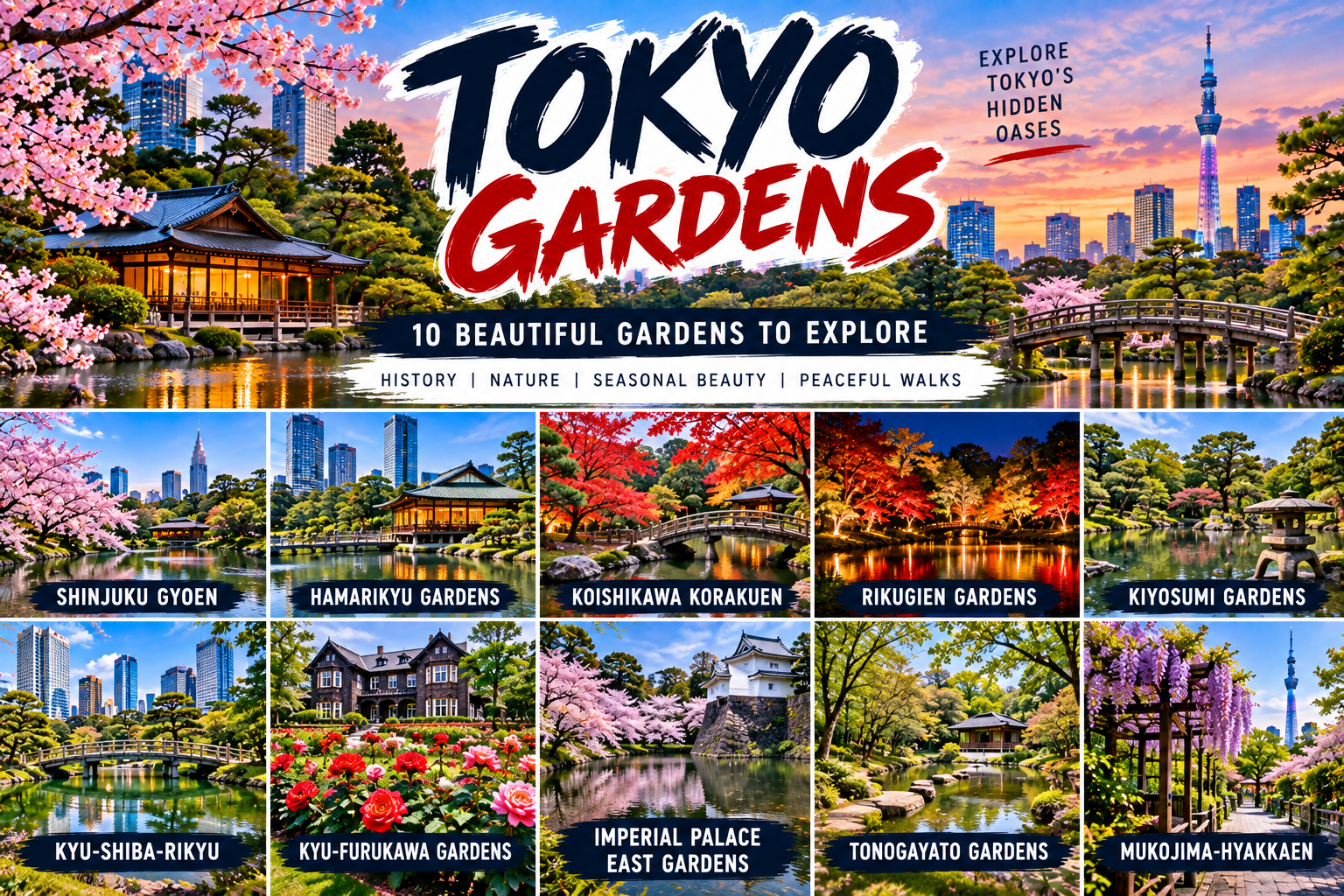
| Tokyo Garden | Main Character | Best Season | Best For | Approx. Experience |
|---|---|---|---|---|
| Shinjuku Gyoen | Large mixed-style landscape | Spring & autumn | First-time visitors, families, photography | Half day |
| Hamarikyu Gardens | Edo daimyo garden beside skyscrapers | Spring & autumn | History, contrast, waterfront | 1.5–3 hours |
| Koishikawa Korakuen | Classic Edo landscape | Autumn & spring | History, traditional design | 1.5–2.5 hours |
| Rikugien Gardens | Literary-inspired strolling garden | Autumn & spring | Couples, photography | 1.5–2.5 hours |
| Kiyosumi Gardens | Pond, stones and wildlife | Spring & autumn | Quiet walks, architecture | 1–2 hours |
| Kyu-Shiba-rikyu Gardens | Compact pond-centered garden | Spring & autumn | Short visits, travelers near Hamamatsucho | 1–1.5 hours |
| Kyu-Furukawa Gardens | Western house + Japanese garden | Spring & autumn | Architecture, roses, photography | 1–2 hours |
| Imperial Palace East Gardens | Former Edo Castle grounds | Spring & autumn | History, free sightseeing | 1.5–2 hours |
| Tonogayato Gardens | Hills, pond and natural atmosphere | Autumn & spring | Quiet exploration | 1–2 hours |
| Mukojima-Hyakkaen | Traditional flower-focused garden | Seasonal blooms | Local atmosphere, plant lovers | 1–2 hours |
Tokyo’s nine metropolitan cultural gardens alone include Hamarikyu, Kyu-Shiba-rikyu, Koishikawa Korakuen, Rikugien, Kyu-Iwasaki-tei, Mukojima-Hyakkaen, Kiyosumi, Kyu-Furukawa, and Tonogayato.
The ten-garden guide below adds Shinjuku Gyoen and the Imperial Palace East Gardens because they provide two very different experiences and are particularly useful for international visitors.
Shinjuku Gyoen National Garden
Why Shinjuku Gyoen Is One of Tokyo’s Most Versatile Gardens
Shinjuku Gyoen is arguably one of the easiest gardens to recommend to a first-time visitor because it combines several garden traditions within one large landscape.
The Ministry of the Environment describes the garden as incorporating a European formal garden, an English landscape garden, and a traditional Japanese garden.
This variety means that a single visit can feel like several different experiences.
One moment you are walking beside an enormous lawn.
A few minutes later you are surrounded by trees.
Then you reach a Japanese landscape with ponds, bridges, and traditional structures.
And beyond the trees, skyscrapers remind you that you are still in the heart of Tokyo.
The Japanese Garden
The Japanese section provides the traditional atmosphere many international visitors imagine when they think about Tokyo gardens.
Look for:
- Ponds
- Bridges
- Curved paths
- Traditional architecture
- Maple trees
- Carefully shaped shrubs
- Reflections
The contrast between these features and the Shinjuku skyline is particularly photogenic.
Cherry Blossom Season
Shinjuku Gyoen is one of Tokyo’s major cherry blossom destinations.
During peak sakura season, the garden can become extremely crowded.
The Ministry of the Environment introduced advance booking for specified high-demand dates during the 2026 cherry blossom period to help manage crowds and safety.
This illustrates a broader trend in Tokyo tourism.
The most beautiful seasonal experiences can also be the busiest.
If cherry blossoms are your priority, planning ahead is important.
Shinjuku Gyoen Opening Information
The garden’s current official schedule varies by season.
From March 15 to September 30, standard opening hours are generally 9:00 a.m. to 6:00 p.m., with a longer 7:00 p.m. closing period from June 11 through July 31. From October 1 to March 14, the garden generally closes at 4:30 p.m.
The standard adult admission is currently ¥500, while children 15 and under are free.
Always check the official schedule before visiting because seasonal rules and special events can affect access.
Why Families Like Shinjuku Gyoen
The large open areas make it easier for families to slow down.
Children can enjoy the scale of the landscape while adults explore the gardens.
The garden also contains cafes and rest areas. The official facility guide lists several food and refreshment facilities, including a tea house and garden cafes.
Best Time to Visit
For photography, early morning can provide softer light and fewer people.
For autumn colors, later morning can work well when the light reaches the trees.
For cherry blossoms, weekday mornings can be preferable when possible.
Hamarikyu Gardens
A Historic Garden Surrounded by Modern Tokyo
Hamarikyu Gardens is one of the most striking examples of old and new Tokyo existing together.
The garden is a former daimyo landscape beside the modern Shiodome district and Tokyo Bay.
Tall skyscrapers rise around traditional ponds and trees.
This visual contrast is one of its greatest strengths.
The Tidal Pond
The garden’s most unusual feature is its tidal pond.
Historically, seawater entered the pond with the tide.
Today, Hamarikyu remains the only one of Tokyo’s former tidal ponds where seawater actually flows in and out.
This is an excellent example of how geography influenced traditional Japanese garden design.
The garden is not merely an artificial landscape.
It is connected to Tokyo Bay.
Why Photographers Love Hamarikyu
Hamarikyu offers a composition that is almost impossible to reproduce elsewhere.
You can frame:
- Traditional pine trees
- A large pond
- Stone paths
- A tea house
- Modern skyscrapers
- Tokyo Bay
The result is an image that communicates Tokyo’s historical transformation in a single frame.
Best Season
Spring brings flowers and fresh greenery.
Autumn creates warm colors.
Winter is excellent for appreciating the garden’s structural design.
Summer produces dense green foliage.
Best For
Hamarikyu works particularly well for:
- Architecture lovers
- History enthusiasts
- Photographers
- First-time visitors
- Couples
- Travelers staying around Ginza or Shiodome
Koishikawa Korakuen Gardens
One of Tokyo’s Most Important Edo Gardens
Koishikawa Korakuen is one of the most historically significant Tokyo gardens.
Construction began in 1629, making it one of the earliest surviving daimyo gardens in Tokyo. The garden is strongly associated with the Mito Tokugawa family.
It also has a fascinating intellectual dimension.
The landscape was influenced by Chinese and Japanese literary traditions.
This means that the garden was designed not only to be beautiful but also to evoke ideas, places, poems, and landscapes.
The Garden as a Miniature Landscape
Traditional Japanese gardens often compress large landscapes into smaller spaces.
A pond can represent a lake.
A hill can represent a mountain.
A bridge can suggest a distant journey.
A carefully positioned tree can become the visual focus of an entire composition.
Koishikawa Korakuen demonstrates this principle exceptionally well.
Seasonal Highlights
Official garden information lists:
- Plum blossoms
- Cherry blossoms
- Wisteria
- Irises
- Hydrangeas
- Spider lilies
- Maples
- Winter flowering plants
as part of its seasonal highlights.
Current Practical Information
Koishikawa Korakuen currently opens from 9:00 a.m. to 5:00 p.m., with last entry at 4:30 p.m.
The current general admission is ¥300.
Why Visit?
This is one of the best Tokyo gardens for travelers who want to understand the intellectual and historical foundations of Japanese landscape design.
It is less about simply taking a beautiful photograph and more about understanding why the landscape was designed the way it was.
Rikugien Gardens
A Garden Inspired by Poetry and Literature
Rikugien is one of Tokyo’s most famous strolling gardens.
Its name and design are associated with the six categories of classical Japanese poetry.
This literary connection makes it different from gardens that focus primarily on natural scenery.
A Garden of Scenes
Rikugien is designed to reveal a sequence of landscape scenes.
As you walk, the relationship between:
- Water
- Hills
- Trees
- Bridges
- Islands
- Paths
changes continuously.
The result is almost like moving through a three-dimensional painting.
Autumn at Rikugien
Rikugien is especially famous for autumn colors.
Maples transform the garden around ponds and paths.
The contrast between red leaves and dark water can be spectacular.
Tokyo’s official garden updates currently list a special nighttime autumn viewing event for November 25 to December 6, 2026.
This illustrates another modern development in Tokyo garden tourism: seasonal night openings.
Garden Tours
Rikugien generally offers garden tours on weekends and public holidays, with English garden tours usually offered on the first and third Sundays of the month. However, tours can be cancelled during periods of high heat.
For travelers who want more context rather than simply walking around, these tours can add significant value.
Kiyosumi Gardens
A Garden Built Around Stones and Water
Kiyosumi Gardens is one of the best choices for travelers looking for a quieter and more contemplative garden.
Its central pond, islands, trees, and carefully selected stones create a strong visual rhythm.
Tokyo’s official description emphasizes the garden’s pond, famous stones, greenery, and birds.
The Iwasaki Connection
Kiyosumi’s modern garden development is strongly associated with Iwasaki Yataro and the Iwasaki family.
The garden was developed in the Meiji period, including the construction of a large pond and the placement of stones brought from different parts of Japan.
A Garden With a Disaster Story
Kiyosumi is particularly important because it served as a refuge during both the Great Kanto Earthquake and the 1945 bombing of Tokyo.
This is one of the most overlooked stories in Tokyo garden tourism.
The garden was not simply an aesthetic landscape.
Its open space became a survival resource.
Current Visitor Information
Kiyosumi Gardens generally opens from 9:00 a.m. to 5:00 p.m., with last entry at 4:30 p.m.
The current general admission is ¥150.
The garden is also close to Kiyosumi-Shirakawa Station, making it easy to combine with the neighborhood’s cafe culture.
Best For
Kiyosumi is especially suitable for:
- Quiet travelers
- Architecture lovers
- Photography
- Garden enthusiasts
- Repeat Tokyo visitors
- Travelers interested in disaster history
Kyu-Shiba-rikyu Gardens
A Compact Historic Garden Near the City Center
Kyu-Shiba-rikyu is an excellent option when you want a traditional garden but have limited time.
The garden was developed as a feudal-era clan garden and is centered around a pond with carefully designed landforms and stones.
Why It Is Convenient
Its location near Hamamatsucho makes it particularly easy to add to a busy Tokyo itinerary.
You do not need to dedicate an entire afternoon.
A short visit can provide:
- Pond scenery
- Traditional landscaping
- Bridges
- Stone arrangements
- Seasonal flowers
- Historic atmosphere
A Garden With a Reconstruction Story
Kyu-Shiba-rikyu suffered severe damage during the Great Kanto Earthquake and subsequent fires.
The garden was restored and opened to the public in 1924.
This gives it another connection to Tokyo’s broader story of destruction and reconstruction.
Current Practical Information
The official garden information lists opening hours of 9:00 a.m. to 5:00 p.m., with last entry at 4:30 p.m., and general admission of ¥150.
Kyu-Furukawa Gardens
Where Western and Japanese Garden Design Meet
Kyu-Furukawa Gardens provides one of Tokyo’s most interesting combinations of architectural styles.
The garden combines a Western-style garden and residence with a Japanese landscape.
The Tokyo Metropolitan Park Association describes the garden as a place where Japanese and Western garden styles are harmonized.
Why the Architecture Matters
Many visitors focus exclusively on the plants.
But the Western-style residence is an essential part of the composition.
The building creates a European atmosphere, while the Japanese garden below it introduces a completely different visual language.
This combination reflects the cultural changes of modernizing Japan.
Roses and Seasonal Interest
The Western-style garden is particularly attractive when roses are in season.
The Japanese garden becomes more compelling during autumn when the foliage changes.
This makes Kyu-Furukawa useful for travelers who want both architecture and seasonal gardening.
Current Visitor Information
The garden generally opens from 9:00 a.m. to 5:00 p.m., with last entry at 4:30 p.m.
The current general garden admission is ¥150, while the Western-style house has separate admission arrangements.
Imperial Palace East Gardens
Walking Through the Former Edo Castle Grounds
The East Gardens of the Imperial Palace provide a completely different garden experience.
They occupy parts of the former Honmaru, Ninomaru, and Sannomaru areas of Edo Castle.
The Imperial Household Agency states that the gardens have been open to the public since 1968.
This means visitors are not simply walking through a garden.
They are walking through the historic center of the Tokugawa shogunate’s castle complex.
Why History Is the Main Attraction
Important features include:
- Former castle grounds
- Stone walls
- Moats
- Historic foundations
- Japanese garden landscapes
- Seasonal flowers
- Wide open spaces
The garden allows visitors to connect Tokyo’s modern political center with its feudal past.
Admission
Entry to the East Gardens is free.
The official Imperial Household Agency currently lists seasonal opening hours, generally beginning at 9:00 a.m., with closing times ranging from 4:00 p.m. to 6:00 p.m. depending on the month.
The garden is generally closed on Mondays and Fridays, along with specific holiday periods and occasions when closure is required for official reasons.
Best For
The East Gardens are particularly good for:
- History lovers
- Budget travelers
- First-time visitors
- Architecture enthusiasts
- Travelers already exploring Tokyo Station
Tonogayato Gardens
A Quiet Garden Away From Central Tokyo
Tonogayato Gardens is located in Kokubunji, western Tokyo.
Its relative distance from the city’s most famous tourist districts is actually part of its appeal.
The garden has a more spacious and natural feeling than some compact central gardens.
Why Repeat Visitors Should Consider It
First-time visitors usually focus on:
- Shinjuku
- Shibuya
- Asakusa
- Ginza
- Tokyo Station
Repeat visitors can go further.
Tonogayato offers a chance to experience a different rhythm of Tokyo.
It is especially attractive for travelers who prefer:
- Quiet walking
- Less crowded gardens
- Local neighborhoods
- Natural scenery
- Seasonal photography
A Different Kind of Tokyo
One of the most valuable lessons from visiting western Tokyo is that the metropolis is not only skyscrapers and commercial centers.
There are neighborhoods where the landscape becomes greener and the pace slower.
Tonogayato helps reveal this side of the city.
Mukojima-Hyakkaen
A Garden Focused on Flowers
Mukojima-Hyakkaen has a different personality from the grand daimyo gardens.
It is especially associated with seasonal plants and flowers.
The name itself suggests a garden containing a hundred kinds of flowers.
Why Plant Lovers Should Visit
Mukojima-Hyakkaen can be particularly interesting for visitors who want to pay attention to individual plants rather than only broad landscape design.
Look for:
- Seasonal flowers
- Shrubs
- Vines
- Traditional plant arrangements
- Small landscape details
A More Local Experience
The garden is located in eastern Tokyo, away from some of the city’s most concentrated tourist areas.
It can therefore be paired with other eastern Tokyo attractions rather than treated as an isolated destination.
Tokyo Gardens by Season
Spring Gardens in Tokyo
Spring is one of the most popular seasons for Tokyo gardens.
Visitors can encounter:
- Plum blossoms
- Cherry blossoms
- Azaleas
- Wisteria
- Irises
- Fresh green leaves
Shinjuku Gyoen is especially famous for cherry blossoms.
Koishikawa Korakuen provides a more historically focused garden experience.
Hamarikyu offers the dramatic contrast between blossoms and modern skyscrapers.
Summer Gardens in Tokyo
Summer is greener and often more humid.
The gardens can feel lush and dense.
Look for:
- Hydrangeas
- Irises
- Lotus
- Water plants
- Deep green foliage
Morning visits can be more comfortable during hot weather.
Autumn Gardens in Tokyo
Autumn may be the most rewarding season for travelers who prefer rich colors.
Rikugien is particularly famous for autumn foliage.
Koishikawa Korakuen is another excellent option.
Kiyosumi and Hamarikyu also provide attractive seasonal contrasts.
Winter Gardens in Tokyo
Winter is often overlooked.
But it can be an excellent time to study garden structure.
Without dense foliage, you can see:
- Pine forms
- Branch structures
- Stone arrangements
- Bridges
- Ponds
- Architecture
Winter also tends to provide cleaner visual compositions.
Tokyo Gardens for Cherry Blossoms
Shinjuku Gyoen
One of the city’s most famous sakura locations.
Koishikawa Korakuen
Excellent for combining historical garden design with spring flowers.
Kiyosumi Gardens
Offers a quieter alternative with seasonal blossoms.
Hamarikyu Gardens
Useful for travelers who want to combine cherry blossoms with Tokyo’s modern waterfront skyline.
Sakura Strategy
Do not automatically choose the most famous garden.
Consider:
- Crowd levels
- Weather
- Bloom timing
- Your hotel location
- Transportation
- Photography goals
Cherry blossom dates vary every year.
Tokyo Gardens for Autumn Foliage
Rikugien
A major autumn destination, especially during special evening illumination periods.
Koishikawa Korakuen
Offers colorful trees alongside historic garden architecture.
Kiyosumi Gardens
Provides a quieter alternative.
Shinjuku Gyoen
Its enormous scale means autumn colors can be experienced across several different landscape styles.
Tokyo Gardens for Photography
Use Reflections
Ponds are one of the most powerful tools available to garden photographers.
Look for reflections of:
- Trees
- Bridges
- Buildings
- Clouds
- Seasonal colors
Photograph Through Layers
A strong garden photograph often contains three layers:
Foreground:
A stone, plant, bridge, or path.
Middle:
The pond or central garden.
Background:
Trees, buildings, hills, or architecture.
This creates depth.
Photograph Details
Do not photograph only the entire garden.
Look for:
- Moss
- Stone textures
- Pine branches
- Water ripples
- Lanterns
- Bridge railings
- Leaves
- Tea-house architecture
These smaller images can tell a more intimate story.
Tokyo Gardens for Couples
Best Romantic Atmosphere
Rikugien is especially attractive for couples who enjoy traditional scenery.
Hamarikyu offers a unique urban contrast.
Kiyosumi is better for a quieter experience.
Shinjuku Gyoen works well when couples want a large garden combined with cafes and nearby city attractions.
Make the Garden Part of a Full Day
Rather than visiting a garden and immediately leaving, combine it with:
- Tea
- Lunch
- A neighborhood walk
- A museum
- Shopping
- Sunset photography
This makes the experience feel less like checking an attraction off a list.
Tokyo Gardens for Families
Shinjuku Gyoen
The large open spaces make it easier for families to spend several hours.
Imperial Palace East Gardens
The historical setting provides educational value.
Hamarikyu
The combination of ponds, bridges, boats, and skyline views can keep children interested.
Family Garden Tips
Bring:
- Water
- Comfortable shoes
- Sun protection
- Snacks where permitted
- A small camera or phone
Check garden rules before bringing food, sports equipment, or other items.
Tokyo Gardens for Solo Travelers
Gardens can be particularly rewarding alone.
There is no pressure to move quickly.
You can stop at a pond for ten minutes.
You can photograph one tree repeatedly.
You can sit quietly.
You can read.
You can sketch.
Solo garden visits are also an excellent way to recover from several busy days in central Tokyo.
Tokyo Gardens for Budget Travelers
Free Gardens
The Imperial Palace East Gardens are free.
Some gardens also participate in special free-admission days.
For example, Tokyo’s nine metropolitan gardens have special free admission on Tokyo Citizens’ Day, October 1. The 2026 official announcement confirms that all visitors can enter the participating gardens free on that date.
Low-Cost Gardens
Several metropolitan gardens have modest admission fees.
Koishikawa Korakuen currently charges ¥300 for general admission.
Kiyosumi and Kyu-Furukawa currently list general admission at ¥150.
This makes garden tourism one of the more affordable cultural experiences in Tokyo.
Tokyo Gardens for Architecture Lovers
Kyu-Furukawa Gardens
Best for the relationship between Western architecture and Japanese landscaping.
Kiyosumi Gardens
Best for traditional garden structures such as the Ryotei.
The official information identifies the Ryotei as a sukiya-style building extending over the pond and originally constructed to welcome Field Marshal Kitchener during his 1909 visit to Japan.
Imperial Palace East Gardens
Best for castle foundations and historic stonework.
Hamarikyu
Best for traditional garden architecture framed by modern skyscrapers.
Tokyo Gardens for History Lovers
If history is your main reason for visiting gardens, prioritize:
- Imperial Palace East Gardens
- Koishikawa Korakuen
- Hamarikyu Gardens
- Kyu-Shiba-rikyu Gardens
- Kiyosumi Gardens
- Rikugien
Each reflects a different period or social context.
Tokyo Gardens and Japanese Garden Design
Strolling Gardens
Many historic Tokyo gardens are designed as strolling landscapes.
The experience changes as you move.
There is no single perfect viewpoint.
Instead, the garden is a sequence of views.
Borrowed Scenery
Japanese garden design can incorporate scenery beyond the garden itself.
In modern Tokyo, this concept becomes especially fascinating.
A traditional pine tree may be framed against a skyscraper.
A pond may reflect a modern building.
A garden path may end with a glimpse of the city.
Tokyo therefore creates an unusual form of borrowed scenery: the historic landscape can incorporate the modern metropolis around it.
Negative Space
One of the most overlooked features of Japanese gardens is empty space.
Not every part of the garden is filled with plants.
Open water, gravel, sky, lawns, and carefully maintained gaps provide visual breathing room.
This is one reason gardens can feel calm even inside a huge city.
Practical Tips for Visiting Tokyo Gardens
Check Opening Hours
Garden schedules vary.
Shinjuku Gyoen has seasonal opening times, while Imperial Palace East Gardens have different hours depending on the month.
Check Weather
Heavy rain, typhoons, extreme heat, and storms can affect garden access.
Tokyo’s official garden notices have recorded temporary closures and path restrictions during typhoons.
Wear Comfortable Shoes
Even a compact garden can involve considerable walking.
Arrive Early
Morning is particularly useful during:
- Cherry blossom season
- Autumn foliage
- Weekends
- Public holidays
Respect Garden Rules
Historic gardens are cultural assets.
Visitors may encounter restrictions on:
- Photography
- Drones
- Food
- Pets
- Touching plants
- Climbing structures
- Tripods
- Commercial photography
The Tokyo Metropolitan Park Association specifically notes that certain locations may prohibit photography or sketching to protect buildings and landscapes.
Common Mistakes When Visiting Tokyo Gardens
Mistake 1: Visiting Only During Cherry Blossom Season
Cherry blossoms are spectacular, but they are only one part of the garden calendar.
Autumn, summer, and winter can provide equally interesting experiences.
Mistake 2: Rushing Through
A garden is not a train station.
Give yourself time.
Sit beside the pond.
Look at the stones.
Observe the changing reflections.
Mistake 3: Looking Only at Flowers
Japanese gardens are about relationships.
The composition of water, rocks, paths, buildings, and plants matters as much as the individual flowers.
Mistake 4: Ignoring History
A garden becomes much more meaningful when you understand who created it and why.
Mistake 5: Assuming Every Garden Is the Same
Shinjuku Gyoen and Koishikawa Korakuen are very different.
Kiyosumi and Hamarikyu are also very different.
Choose gardens according to the experience you want.
Pros and Cons of Visiting Tokyo Gardens
Advantages
- Rich historical context
- Excellent photography opportunities
- Seasonal beauty
- Affordable admission
- Quiet environments
- Cultural education
- Family-friendly options
- Easy integration into city itineraries
- Opportunities for slow travel
- Strong contrast with Tokyo’s urban landscape
Potential Challenges
- Some gardens close relatively early
- Seasonal crowds can be substantial
- Weather can affect access
- Some paths may not be fully accessible
- Certain gardens have limited facilities
- Peak flower periods can require planning
- Night access is usually limited except during special events
Ten Tokyo Gardens Compared for Different Travelers
| Garden | History | Photography | Families | Couples | Budget | Seasonal Highlights | City Contrast |
|---|---|---|---|---|---|---|---|
| Shinjuku Gyoen | High | Very High | Very High | High | Medium | Sakura, autumn | Very High |
| Hamarikyu | Very High | Very High | High | Very High | Medium | Spring, autumn | Exceptional |
| Koishikawa Korakuen | Very High | Very High | High | High | High | Plum, autumn | High |
| Rikugien | Very High | Very High | High | Very High | High | Autumn | Medium |
| Kiyosumi | Very High | Very High | Medium | Very High | Very High | Flowers, autumn | Medium |
| Kyu-Shiba-rikyu | Very High | High | High | High | Very High | Spring, autumn | High |
| Kyu-Furukawa | High | Very High | Medium | High | Very High | Roses, autumn | Medium |
| Imperial Palace East Gardens | Exceptional | High | High | High | Exceptional | Spring, autumn | High |
| Tonogayato | High | High | Medium | High | High | Autumn, spring | Low |
| Mukojima-Hyakkaen | High | Very High | Medium | High | High | Seasonal flowers | Low |
This is a comparison by characteristics rather than an overall ranking. Different travelers will value history, flowers, architecture, accessibility, quietness, or location differently.
Best Tokyo Garden Itineraries
One-Day Traditional Garden Route
Start with Imperial Palace East Gardens in the morning.
Continue toward Koishikawa Korakuen.
Finish in Rikugien.
This route is best suited to travelers who want to concentrate on historic Japanese landscape design.
One-Day Modern Tokyo and Gardens Route
Start at Shinjuku Gyoen.
Explore Shinjuku.
Travel toward Hamarikyu in the afternoon.
Finish around Tokyo Bay or Ginza.
This route creates a dramatic contrast between gardens and skyscrapers.
Quiet Tokyo Garden Route
Visit Kiyosumi Gardens in the morning.
Explore Kiyosumi-Shirakawa.
Continue toward eastern Tokyo.
Finish around Mukojima-Hyakkaen.
This itinerary is useful for travelers who have already seen the major tourist districts.
Photography Garden Route
Start early at Shinjuku Gyoen.
Visit Hamarikyu around late afternoon.
Photograph Rikugien during autumn illumination if a special event is operating.
This provides three distinct photographic environments.
Tokyo Gardens and Slow Travel
Why Gardens Encourage Slower Tourism
Many Tokyo itineraries are built around movement.
Station.
Attraction.
Restaurant.
Shopping district.
Station.
Another attraction.
Gardens interrupt that pattern.
They encourage visitors to stay in one place.
This is one reason gardens are particularly useful during a longer trip.
A Garden Can Reset Your Travel Pace
After several hours in Shibuya or Shinjuku, entering a garden can feel like changing cities.
The sounds become softer.
The visual field becomes greener.
The pace becomes slower.
That psychological contrast is part of the garden experience.
Tokyo Gardens and Wellness
Nature Inside a Megacity
Gardens provide access to natural environments without requiring travelers to leave Tokyo.
This is especially valuable for visitors who enjoy:
- Walking
- Photography
- Quiet observation
- Meditation
- Reading
- Sketching
- Bird watching
The Health Value of Walking
Garden visits naturally encourage gentle walking.
Instead of treating sightseeing as a race between attractions, travelers can move at a comfortable pace.
The result can be both culturally enriching and physically refreshing.
Tokyo Gardens and Sustainability
Preservation Matters
Historic gardens require constant maintenance.
Trees must be pruned.
Ponds must be managed.
Paths must be repaired.
Historic structures must be protected.
Seasonal plants must be maintained.
This means that admission fees are not simply payment for access.
They help support the preservation of landscapes and cultural assets.
Climate Challenges
Tokyo’s climate presents new challenges.
Extreme heat can affect visitors and staff.
Typhoons can damage trees and paths.
Heavy rainfall can affect drainage.
Changing seasonal temperatures can influence flowering times.
Tokyo’s garden authorities already publish notices concerning heat, typhoons, temporary closures, and maintenance.
Future garden management will increasingly need to balance visitor access with climate resilience.
Future Trends for Tokyo Gardens
More Seasonal Night Events
Traditional gardens are increasingly experimenting with special nighttime openings.
Rikugien’s 2026 autumn nighttime viewing is one current example.
Koishikawa Korakuen is also scheduled to host a special nighttime autumn event in November 2026.
Night openings can provide new ways to experience familiar landscapes while spreading tourism beyond daylight hours.
More Digital Garden Guides
Digital maps, multilingual information, QR codes, audio guides, and mobile tickets are making gardens easier for international travelers to navigate.
The Imperial Palace East Gardens currently provides a free audio guide app to help visitors understand its features and history.
Better Accessibility
Tokyo’s garden operators are increasingly providing barrier-free maps, accessible information, and digital services.
However, historic landscapes naturally contain slopes, stones, narrow paths, and uneven surfaces.
Future improvements will need to increase accessibility without destroying historic character.
Climate-Adaptive Gardening
Future garden management is likely to place greater emphasis on:
- Heat resilience
- Storm protection
- Water management
- Tree health
- Changing bloom periods
- Visitor safety
This could gradually change how Tokyo’s historic gardens are maintained.
Gardens as Cultural Learning Spaces
Gardens can also become classrooms.
Visitors can learn about:
- Japanese landscape design
- Edo history
- Botany
- Architecture
- Tea culture
- Poetry
- Disaster preparedness
- Traditional horticulture
This educational role could become increasingly important as international tourism grows.
How to Photograph Tokyo Gardens Responsibly
Do Not Sacrifice the Garden for the Photograph
Avoid stepping into restricted areas.
Do not touch historic structures.
Do not climb rocks or trees.
Do not block narrow paths.
Avoid Excessive Editing
Japanese gardens often look beautiful because of subtle colors.
Over-processing can remove the atmosphere.
Try to preserve:
- Natural greens
- Water reflections
- Soft shadows
- Seasonal colors
- Atmospheric depth
Look for Human Scale
A person walking across a bridge can sometimes communicate the scale of the garden.
However, respect privacy and photography rules.
Tokyo Gardens for Different Travel Problems
If You Have Only One Hour
Choose Kyu-Shiba-rikyu or Kiyosumi depending on your location.
If You Want Cherry Blossoms
Consider Shinjuku Gyoen or Koishikawa Korakuen.
If You Want Autumn Colors
Consider Rikugien or Koishikawa Korakuen.
If You Want Architecture
Choose Kyu-Furukawa or Hamarikyu.
If You Want History
Choose Imperial Palace East Gardens or Koishikawa Korakuen.
If You Want Quietness
Consider Kiyosumi, Tonogayato, or Mukojima-Hyakkaen.
If You Want Skyscraper Contrast
Choose Hamarikyu or Shinjuku Gyoen.
If You Want Free Entry
Imperial Palace East Gardens are free, and some public gardens have designated free-admission days.
FAQs
What is the most famous garden in Tokyo?
Shinjuku Gyoen is among Tokyo’s best-known gardens, particularly for its large landscape, cherry blossoms, Japanese garden, and location in central Tokyo.
What is the best Japanese garden in Tokyo?
There is no single best garden for every traveler. Koishikawa Korakuen and Rikugien are excellent for traditional strolling-garden design, while Kiyosumi is particularly interesting for stones and pond scenery.
What is the best Tokyo garden for cherry blossoms?
Shinjuku Gyoen is one of the city’s most famous cherry blossom gardens. Koishikawa Korakuen and Hamarikyu Gardens are also useful alternatives.
What is the best Tokyo garden for autumn leaves?
Rikugien is particularly well known for autumn foliage and sometimes holds special nighttime autumn viewing events.
Are Tokyo gardens expensive?
Many are relatively inexpensive compared with major paid attractions. Several metropolitan gardens have admission fees of only a few hundred yen, while some important gardens, such as the Imperial Palace East Gardens, are free.
Is Shinjuku Gyoen worth visiting?
Yes, especially if you want a large garden with several landscape styles, seasonal flowers, cherry blossoms, traditional Japanese scenery, and a dramatic contrast with Shinjuku’s skyscrapers.
How much does Shinjuku Gyoen cost?
The current standard adult admission is ¥500, while children aged 15 and under are free. Prices and admission arrangements can change, so check the official information before visiting.
Is the Imperial Palace East Garden free?
Yes. The Imperial Household Agency currently lists admission to the East Gardens as free.
Which Tokyo gardens are best for couples?
Rikugien, Hamarikyu, and Kiyosumi are attractive choices for couples who enjoy peaceful scenery, walking, photography, and traditional Japanese landscapes.
Which Tokyo gardens are best for families?
Shinjuku Gyoen, Hamarikyu Gardens, and the Imperial Palace East Gardens can work well for families because they combine open spaces with cultural and historical interest.
Can I take photographs in Tokyo gardens?
Photography is generally possible, but individual gardens may restrict photography or sketching in certain locations to protect buildings and landscapes. Always follow posted rules.
Can I use a tripod in Tokyo gardens?
Rules vary by garden and by location within the garden. If you are carrying professional photography equipment, check the garden’s current rules before setting up.
Are Tokyo gardens open at night?
Most gardens operate primarily during daylight hours. However, some hold special seasonal nighttime events, particularly during autumn foliage or cultural programs. Rikugien and Koishikawa Korakuen are examples of gardens that have scheduled special evening events in 2026.
What is the best season to visit Tokyo gardens?
Spring is excellent for blossoms, summer for lush greenery and water-related scenery, autumn for colorful foliage, and winter for quiet landscapes and garden structure.
Are Tokyo gardens open during rainy weather?
Many remain open in ordinary rain, but severe weather can cause temporary closures or restricted paths. Tokyo’s garden authorities publish updates when typhoons or other conditions affect access.
What should I wear when visiting Tokyo gardens?
Comfortable walking shoes are essential. In summer, lightweight clothing, water, and sun protection are useful. In autumn and winter, layers can make longer garden walks more comfortable.
How long should I spend in a Tokyo garden?
A small garden can take around one hour, while larger gardens such as Shinjuku Gyoen can easily occupy half a day if you want to explore slowly.
Which Tokyo garden is best for history lovers?
The Imperial Palace East Gardens and Koishikawa Korakuen are particularly valuable for history-focused travelers because of their connections to Edo Castle, the Tokugawa period, and feudal-era garden culture.
Which Tokyo garden is best for architecture?
Kyu-Furukawa Gardens is especially interesting because it combines a Western-style residence and garden with a Japanese landscape. Kiyosumi is another strong choice for traditional garden architecture.
Which Tokyo garden is best for quiet walking?
Kiyosumi Gardens, Tonogayato Gardens, and Mukojima-Hyakkaen can provide a more relaxed experience than Tokyo’s busiest tourist attractions.
Can I combine Tokyo gardens with other attractions?
Absolutely. Hamarikyu can be combined with Ginza and Shiodome, Shinjuku Gyoen with Shinjuku, Kyu-Shiba-rikyu with Hamamatsucho, and the Imperial Palace East Gardens with Tokyo Station and Marunouchi.
Do Tokyo gardens have English information?
Many major gardens provide English maps, information, or guided services. For example, the Imperial Palace East Gardens provides a free audio guide app, while Rikugien offers English garden tours on selected Sundays.
Are Tokyo gardens suitable for solo travelers?
Yes. Gardens are particularly suitable for solo travelers because they allow visitors to move at their own pace and spend as much or as little time as they want at individual viewpoints.
What makes Japanese gardens different from Western gardens?
Japanese gardens generally emphasize carefully composed relationships between water, stones, vegetation, pathways, structures, and scenery. Many are designed as journeys where the view changes as you walk rather than presenting one symmetrical landscape.
Conclusion
Tokyo gardens offer something that many travelers do not expect from one of the world’s largest metropolitan areas: silence, space, history, and carefully controlled natural beauty.But their greatest value goes beyond relaxation. A garden such as Koishikawa Korakuen can introduce you to the landscape culture of the Edo period. The Imperial Palace East Gardens connect modern Tokyo with the former grounds of Edo Castle. Hamarikyu demonstrates how an historic waterfront garden can exist beside some of the city’s tallest modern buildings.