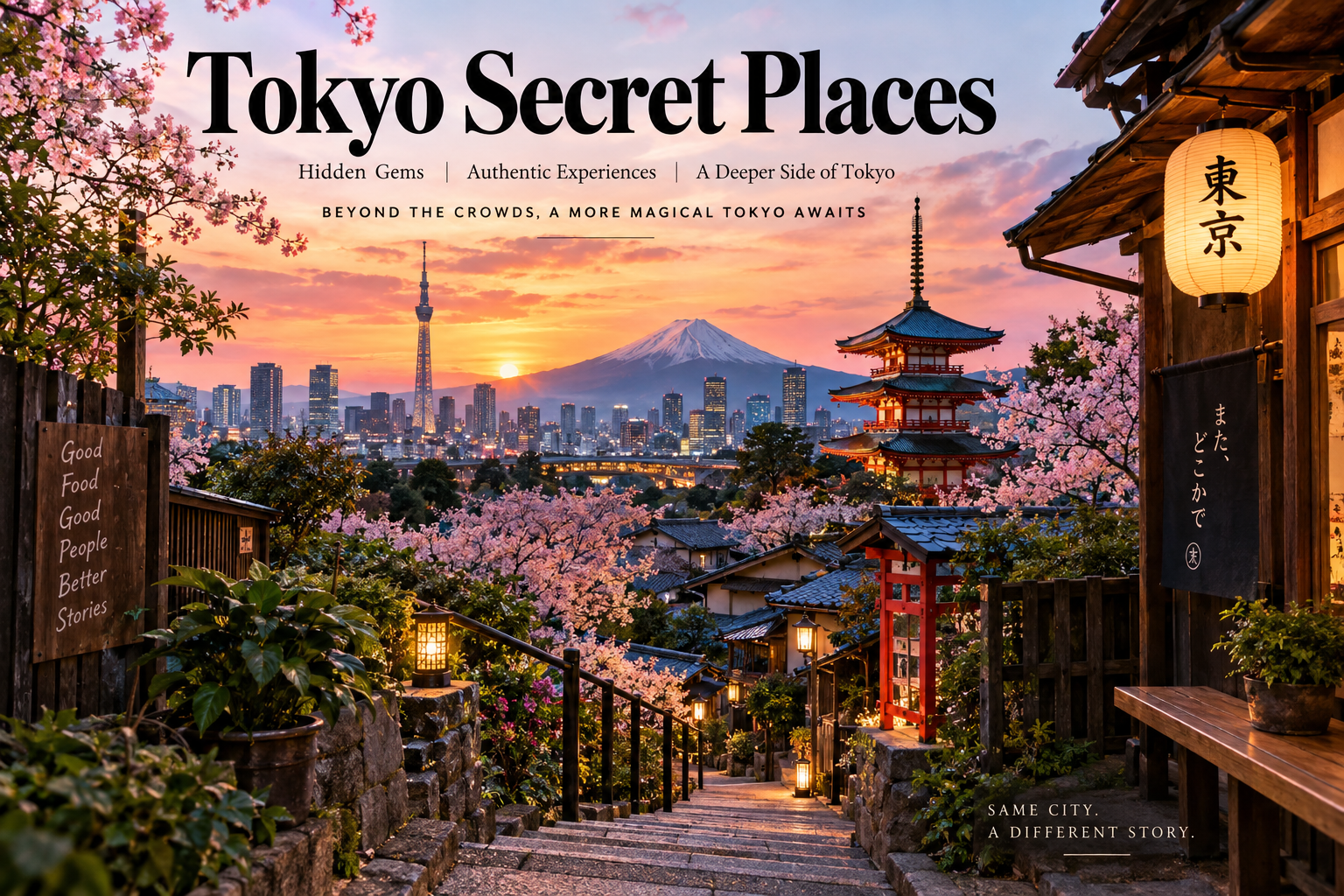
Tokyo Secret Places: 3Hidden Gems Most Tourists Miss
Have you ever wondered whether Tokyo has another side beyond Shibuya Crossing, Tokyo Skytree, Shinjuku, and the famous temples that appear in almost every travel guide? Tokyo secret places offer a quieter and more intimate way to experience the city, from hidden temple gardens and atmospheric backstreets to peaceful neighborhoods, tiny museums, local shopping streets, and scenic corners that many international visitors overlook. The best Tokyo secret places are not necessarily completely unknown; they are often places where you can slow down, observe everyday life, and experience a different side of Japan without following the standard sightseeing route Tokyo Street Food
What Are Tokyo Secret Places?
The phrase “Tokyo secret places” does not necessarily mean locations that are completely undiscovered or officially hidden.
In practical travel terms, it usually refers to places that receive less international attention than Tokyo’s major attractions.
These locations may include:
- Quiet temples and shrines
- Traditional residential neighborhoods
- Small gardens
- Historic streets
- Independent bookstores
- Local shopping arcades
- Small museums
- Scenic viewpoints
- Hidden cafés
- Riverside paths
- Old railway neighborhoods
- Traditional craft districts
- Peaceful parks
- Architectural landmarks
- Narrow pedestrian streets
- Less-visited cultural attractions
Some may be only a short train ride from a major tourist destination.
Others require more planning.
The important point is that “secret” does not always mean “far away.”
Sometimes the most interesting hidden place is only ten minutes from somewhere you already planned to visit.
Why Tokyo Has So Many Hidden Places
Tokyo Developed Through Layers of History
Tokyo was not built as one unified modern city.
Its present-day landscape developed through centuries of political, cultural, commercial, industrial, and residential growth.
The result is a remarkable mixture of:
- Historic districts
- Postwar neighborhoods
- Modern skyscrapers
- Traditional homes
- Buddhist temples
- Shinto shrines
- Shopping streets
- Rail corridors
- Waterfront areas
- Contemporary architecture
A traveler can therefore move from a modern business district into a neighborhood that feels dramatically different within minutes.
Tokyo’s Railway Network Creates Micro-Destinations
Tokyo’s extensive railway system is one reason hidden neighborhoods are relatively accessible.
Major stations often receive most of the attention, while smaller stations can serve as gateways to quieter communities.
This creates an excellent strategy for travelers:
Instead of asking only, “What is the most famous place near me?”
Ask:
“What interesting neighborhood is one or two stations away?”
This simple change can transform a Tokyo itinerary.
Small Neighborhoods Often Receive Less International Coverage
International travel content naturally concentrates on recognizable attractions.
That makes sense for first-time visitors.
However, the same concentration means thousands of smaller places receive less attention.
A neighborhood may be highly meaningful to residents while remaining relatively unfamiliar to overseas tourists.
That creates opportunities for travelers who enjoy exploration.
Best Tokyo Secret Places to Explore
Yanaka: A Slower Side of Old Tokyo
Yanaka is one of the most rewarding areas for travelers interested in traditional Tokyo.
The neighborhood survived significant portions of the city’s twentieth-century destruction and retains an atmosphere that feels different from central Tokyo’s commercial districts.
Why Yanaka Is Special
Yanaka is particularly interesting because it combines:
- Temples
- Cemeteries
- Traditional homes
- Small galleries
- Independent shops
- Cafés
- Narrow lanes
- Local businesses
Walking through the neighborhood can feel more like exploring a historic town than visiting a global megacity.
Yanaka Ginza and the Surrounding Streets
Yanaka Ginza is better known than some other locations in the neighborhood, but the surrounding lanes are where the deeper experience begins.
Rather than rushing through the shopping street, walk slowly into nearby residential areas.
Look for small architectural details, traditional entrances, gardens, and local businesses.
Always remember that these are living neighborhoods rather than open-air museums.
Nezu: Traditional Tokyo Without the Same Intensity
Nezu is another excellent choice for travelers looking for traditional scenery.
The area is associated with historic streets, temples, shrines, and older residential architecture.
Nezu Shrine
Nezu Shrine is not completely secret, but it often receives less international attention than Tokyo’s most famous temples.
Its traditional architecture and atmospheric pathways make it especially attractive for photographers and travelers interested in Japanese religious architecture.
Best Time to Explore Nezu
Morning is particularly useful for travelers seeking a quieter experience.
The earlier you arrive, the more likely you are to experience the neighborhood before it becomes busy.
Sendagi: Tokyo’s Quiet Residential Character
Sendagi forms part of the broader Yanesen area together with Yanaka and Nezu.
The neighborhood is ideal for travelers who want to see Tokyo through everyday streets rather than major attractions.
What to Look For
Instead of searching for one specific landmark, explore:
- Narrow lanes
- Small shrines
- Local bakeries
- Traditional houses
- Tiny cafés
- Independent stores
- Residential architecture
Sendagi is particularly good for slow photography walks.
Koishikawa Korakuen: A Historic Garden Near the City Center
Koishikawa Korakuen is not completely unknown, but it can feel surprisingly peaceful compared with nearby commercial areas.
The garden demonstrates how carefully designed landscapes can create a sense of distance from the surrounding metropolis.
Why Garden Lovers Should Visit
The attraction is particularly suitable for:
- Couples
- Photographers
- Architecture enthusiasts
- Garden enthusiasts
- Solo travelers
- Travelers seeking quiet spaces
Its value is not simply visual.
The garden demonstrates a traditional Japanese approach to landscape composition, where pathways, water, rocks, plants, bridges, and views work together.
Kiyosumi-Shirakawa: Art, Coffee, and Local Atmosphere
Kiyosumi-Shirakawa has become more popular in recent years, especially among coffee lovers and design-conscious travelers.
Even with its growing reputation, it offers an alternative to Tokyo’s most commercial districts.
Why Visit Kiyosumi-Shirakawa?
The neighborhood combines:
- Contemporary cafés
- Traditional streets
- Galleries
- Small businesses
- Parks
- Warehouses
- Creative spaces
It is particularly suitable for travelers interested in Tokyo’s modern creative culture.
Kiyosumi Gardens
Kiyosumi Gardens provides an opportunity to combine neighborhood exploration with a traditional landscape.
The contrast between the garden and the surrounding city illustrates Tokyo’s unusual ability to place calm environments directly beside dense urban development.
Jimbocho: A Hidden World for Book Lovers
Jimbocho is one of Tokyo’s most fascinating destinations for people interested in books, publishing, history, and intellectual culture.
The neighborhood is famous for its concentration of bookstores.
Why Jimbocho Feels Different
While areas such as Shibuya are dominated by fashion, entertainment, and technology, Jimbocho has a slower intellectual atmosphere.
You can spend hours browsing:
- Used books
- Art books
- Japanese literature
- Historical publications
- Academic material
- Maps
- Photography books
- Vintage magazines
Who Should Visit?
Jimbocho is particularly suitable for:
- Writers
- Students
- Researchers
- Photographers
- History enthusiasts
- Book collectors
- Travelers who enjoy slow exploration
Kagurazaka: A Different Kind of Tokyo Evening
Kagurazaka is one of the city’s most interesting neighborhoods for travelers who want atmospheric streets without relying on major tourist landmarks.
The area has historic connections with entertainment and traditional dining culture.
Explore the Side Streets
The main road is only part of the experience.
Walk carefully into the smaller lanes, where stone pathways, restaurants, residences, and traditional architectural details create a distinctive atmosphere.
Best For
Kagurazaka works particularly well for:
- Couples
- Evening walks
- Food-focused travelers
- Photographers
- Architecture enthusiasts
Shimokitazawa: Independent Tokyo
Shimokitazawa is no longer a secret among younger travelers, but it remains useful for discovering a different side of Tokyo.
The area is associated with:
- Vintage clothing
- Independent music
- Small theaters
- Cafés
- Record stores
- Second-hand shops
- Creative businesses
Why It Still Belongs on a Hidden-Tokyo List
The secret is not one landmark.
The experience comes from exploring the neighborhood’s collection of small businesses.
Instead of visiting one attraction, spend several hours walking without a rigid schedule.
Sangenjaya: Local Neighborhood Energy
Sangenjaya provides another opportunity to experience Tokyo away from the biggest tourist centers.
The neighborhood has a strong local atmosphere and a dense collection of small restaurants, bars, shops, and residential streets.
Why Explore Sangenjaya?
It is useful for travelers who want to understand how Tokyo functions as a place where people actually live.
Rather than being designed around sightseeing, the neighborhood evolved around everyday life.
Todoroki Valley: A Green Surprise Inside Tokyo
Todoroki Valley is one of the city’s more surprising natural spaces.
The idea that a relatively peaceful green environment can exist inside Tokyo’s enormous urban area is itself part of the attraction.
Why Visit Todoroki?
It offers:
- Walking trails
- Greenery
- Water
- Small bridges
- A break from dense city streets
It is particularly appealing during seasons when vegetation is at its most attractive.
Important Consideration
Natural areas can be affected by weather and maintenance conditions.
Check local access information before making a special trip.
Himonya: Quiet Streets and Local Life
Himonya is not typically the first place international visitors associate with Tokyo sightseeing.
That is exactly why it can be interesting.
Travelers who enjoy residential neighborhoods can explore the area at a slower pace.
The key is to avoid treating residential streets as attractions themselves.
Walk respectfully, keep noise low, and avoid photographing private homes or residents without permission.
Jiyugaoka: Elegant Local Tokyo
Jiyugaoka is more developed and popular than truly hidden neighborhoods, but it offers a calmer alternative to the city’s major commercial centers.
It is known for:
- Stylish cafés
- Small boutiques
- Dessert shops
- Residential streets
- European-inspired design elements
Best For
Jiyugaoka works well for:
- Couples
- Families
- Café lovers
- Shoppers
- Travelers seeking a relaxed afternoon
Kichijoji’s Quieter Corners
Kichijoji is famous, particularly because of Inokashira Park, but the broader neighborhood contains quieter areas that reward exploration.
Inokashira Park
The park provides a natural counterpoint to Tokyo’s dense urban landscape.
Rather than simply visiting the central areas, explore the paths around the park and nearby streets.
Beyond the Main Shopping Streets
The real opportunity lies in moving beyond the busiest commercial zones.
Small shops, cafés, residential streets, and local businesses can create a more personal experience.
Setagaya’s Traditional Neighborhoods
Setagaya is one of the most useful areas for travelers who want to experience Tokyo beyond its tourist core.
It contains numerous residential communities with very different personalities.
Why Setagaya Is Interesting
The ward demonstrates that Tokyo is not one uniform city.
Instead, it contains many small urban worlds.
Travelers can encounter:
- Quiet streets
- Small shrines
- Independent stores
- Parks
- Traditional homes
- Local cafés
- Railway neighborhoods
Gotokuji Temple and the Cat Connection
Gotokuji Temple has gained international attention because of its association with the beckoning cat tradition.
Although social media has made it more popular, the temple and surrounding neighborhood still offer a more relaxed experience than Tokyo’s largest tourist attractions.
How to Experience It Responsibly
Do not visit only to take photographs.
Observe the temple environment respectfully and understand that it remains a religious and cultural space.
The surrounding neighborhood can also be explored on foot.
Nezu Backstreets
Nezu Shrine may attract visitors, but its surrounding streets deserve equal attention.
This is one of the recurring themes of discovering Tokyo secret places:
The attraction may not be the final destination.
The journey between destinations can be more revealing.
Sugamo: Tokyo for a Different Demographic
Sugamo is sometimes described in relation to older residents, but this should not make younger travelers ignore it.
The neighborhood provides a fascinating example of how different generations use Tokyo’s urban environment.
Why Visit Sugamo?
It can be interesting for travelers researching:
- Japanese daily life
- Local shopping culture
- Traditional foods
- Intergenerational communities
- Neighborhood commerce
This makes Sugamo especially useful for travelers who want cultural context rather than just scenic photographs.
Yanaka Cemetery: History and Quiet Landscapes
Yanaka Cemetery offers a different perspective on Tokyo.
It is not a conventional tourist attraction, but it provides historical context and quiet scenery.
Why It Matters
Cemeteries in Japan can offer insight into:
- Japanese history
- Religious traditions
- Family structures
- Urban development
- Architecture
Visitors should behave respectfully and avoid treating active religious or memorial spaces as entertainment venues.
Hongo: Academic Tokyo
Hongo is closely associated with academic life and historic institutions.
The neighborhood offers a different atmosphere from entertainment-heavy areas.
What Makes Hongo Interesting?
Travelers may encounter:
- University architecture
- Old bookstores
- Quiet cafés
- Historic streets
- Small temples
- Residential neighborhoods
It is particularly suitable for people interested in education, history, architecture, and intellectual culture.
Ochanomizu’s Hidden Architectural Details
Ochanomizu is often treated as a transport connection rather than a destination.
That can be a mistake.
Its bridges, waterways, churches, educational institutions, music stores, and surrounding streets create a distinctive urban landscape.
A Photographer’s Perspective
Try looking beyond street-level storefronts.
Tokyo often reveals interesting architectural relationships when viewed from bridges, elevated streets, station approaches, and riverside areas.
Jimbocho’s Side Streets
The famous book district becomes even more interesting when you leave the largest bookstores.
Small specialist stores can reveal entire subcultures around:
- Art
- History
- Maps
- Literature
- Design
- Photography
- Academic subjects
For book lovers, this can become one of the most memorable Tokyo secret places experiences.
Akasaka’s Quiet Historic Corners
Akasaka is associated with business, hotels, restaurants, and entertainment, but quieter streets and religious sites provide a contrasting experience.
Why Explore It?
Akasaka demonstrates how Tokyo can place modern corporate districts next to historic cultural spaces.
This contrast is one of the city’s defining characteristics.
Shibamata: A Historic Neighborhood Outside the Standard Route
Shibamata offers a particularly useful alternative for travelers who want a more traditional neighborhood experience.
It is associated with:
- Traditional streets
- Temple culture
- Local food
- Historic atmosphere
- Old-fashioned entertainment culture
Why It Feels Different
Shibamata is physically within Tokyo but psychologically feels far removed from Shibuya’s modern intensity.
That difference is precisely what makes it valuable.
Fukagawa: Riverside Tokyo and Traditional Culture
Fukagawa offers an interesting mixture of waterways, traditional culture, temples, and local neighborhoods.
Why Water Matters in Tokyo’s History
Tokyo’s waterways historically influenced:
- Commerce
- Transportation
- Industry
- Neighborhood development
Exploring these areas provides context that is often missing from conventional tourist itineraries.
Monzen-Nakacho: Traditional Streets Near Modern Tokyo
Monzen-Nakacho is useful for travelers interested in older Tokyo neighborhoods.
The area combines religious landmarks with local restaurants and residential streets.
It is particularly good for an evening walk when the streets begin to change character.
Omori: Discovering Everyday Tokyo
Omori is not normally included in short Tokyo itineraries, which makes it useful for travelers who have already visited the major landmarks.
Its appeal is largely based on ordinary urban life.
That may sound simple, but observing how people shop, commute, eat, and socialize can be one of the most valuable cultural experiences in Tokyo.
Oji and the Northern Side of Tokyo
Northern Tokyo is frequently overlooked by first-time international visitors.
Oji offers parks, shrines, historical connections, and a more relaxed neighborhood atmosphere.
Why Explore Northern Tokyo?
Travelers can find:
- Less tourist-focused streets
- Local restaurants
- Green spaces
- Historic sites
- Small shopping areas
It is an excellent region for repeat visitors.
Akabane’s Local Atmosphere
Akabane is another northern Tokyo area that offers a glimpse into everyday neighborhood life.
It is better suited to travelers who want to observe local urban culture than visitors looking for monumental sightseeing attractions.
Best Approach
Arrive without expecting a checklist.
Walk.
Observe.
Eat at appropriate local establishments.
Explore shopping streets.
Pay attention to architecture.
That is the essence of slow Tokyo travel.
Tokyo’s Secret Places for Photographers
Tokyo is an extraordinary city for photography because visual contrasts appear almost everywhere.
Best Subjects
Photographers can look for:
- Narrow alleys
- Train crossings
- Traditional entrances
- Temple gates
- Small gardens
- Utility infrastructure
- Reflections
- Bridges
- Riverside paths
- Old shopfronts
- Modern buildings beside traditional structures
Respectful Photography
Avoid photographing people without consent when the situation is personal or sensitive.
Do not enter private property.
Avoid blocking narrow streets.
Follow signs at temples, shrines, museums, and residential areas.
Good street photography requires observation and restraint.
Tokyo Secret Places for Couples
Couples do not necessarily need famous romantic attractions.
Quieter Tokyo can often create more memorable experiences.
Recommended Experiences
Consider:
- A garden walk
- A quiet neighborhood café
- An evening in Kagurazaka
- A walk around Yanaka
- A riverside stroll
- A bookshop afternoon in Jimbocho
- A relaxed visit to Kiyosumi-Shirakawa
The advantage is that these activities encourage conversation rather than constant sightseeing.
Tokyo Secret Places for Solo Travelers
Solo travelers have a major advantage when exploring hidden Tokyo.
You can change direction instantly.
Best Solo Activities
Try:
- Neighborhood photography
- Independent bookstores
- Small museums
- Local shopping streets
- Garden visits
- Café hopping
- Architecture walks
- Train-based exploration
Solo travelers can also dedicate an entire afternoon to one neighborhood instead of trying to cover multiple attractions.
Tokyo Secret Places for Families
Families should prioritize locations where children can move comfortably and where the experience is not overly dependent on long lines.
Family-Friendly Ideas
Consider:
- Large parks
- Gardens
- Neighborhood shopping streets
- Interactive museums
- Riverside walks
- Traditional districts
Always consider walking distances, restroom availability, weather, and children’s energy levels.
Tokyo Secret Places for Older Travelers
Older travelers may prefer areas that provide cultural depth without requiring extremely long walks.
Useful Planning Strategy
Choose one neighborhood and explore it slowly rather than attempting several distant destinations in one day.
Gardens, museums, traditional districts, and cafés can create a comfortable balance between sightseeing and rest.
Tokyo Secret Places for Budget Travelers
Exploring hidden neighborhoods can also be financially practical.
Many of Tokyo’s best experiences involve simply walking and observing.
Low-Cost Activities
You can:
- Walk through traditional neighborhoods
- Visit public parks
- Explore shopping streets
- Browse bookstores
- Discover architecture
- Visit selected temples and shrines
- Photograph public scenery
The cost of transportation and food remains, but the sightseeing component can be inexpensive.
Tokyo Secret Places for Luxury Travelers
Luxury travelers can also benefit from hidden Tokyo.
Instead of spending the entire day at high-profile attractions, consider building a private-feeling itinerary around:
- Historic neighborhoods
- Private guides
- Gardens
- Architecture
- Craft experiences
- High-quality local dining
- Boutique shopping
The key is personalization rather than simply spending more money.
Tokyo Secret Places for First-Time Visitors
First-time visitors should not completely avoid famous attractions.
A better strategy is to combine major landmarks with hidden neighborhoods.
For example, a traveler might spend the morning at a famous destination and the afternoon exploring a quieter neighborhood nearby.
This provides both recognition and discovery.
Tokyo Secret Places for Repeat Visitors
Repeat visitors can go further.
Instead of asking, “What have I not seen?”
Ask:
“What part of Tokyo have I not experienced?”
That shift can lead toward:
- Residential Tokyo
- Northern Tokyo
- Eastern Tokyo
- Traditional shopping streets
- Local cultural districts
- Smaller gardens
- Independent creative neighborhoods
How to Find Your Own Tokyo Secret Places
Start With a Small Station
Choose a station that is not already one of Tokyo’s biggest tourist hubs.
Then identify:
- A park
- A temple
- A shopping street
- A café
- A historic site
Connect them into a walking route.
Follow Neighborhood Boundaries
Tokyo’s neighborhoods often change character gradually.
A major street may feel modern while a side street only a few minutes away feels residential.
Walk across these boundaries.
Look for Local Shopping Streets
Shopping streets can reveal much more about daily life than major commercial centers.
Look for signs indicating traditional shopping arcades and neighborhood markets.
Use Maps as a Starting Point
Digital maps are useful, but they should not dictate every minute.
Mark several points and leave gaps between them.
Those gaps are where discovery happens.
How to Build a Tokyo Secret Places Day
Morning
Start with a quiet temple, shrine, garden, or traditional neighborhood.
Morning light can be excellent for photography and streets are often calmer.
Midday
Choose a local shopping street or neighborhood café.
Use the middle of the day to experience local commerce.
Afternoon
Move toward a museum, garden, bookstore district, or creative neighborhood.
Evening
Finish with a slower neighborhood walk.
Kagurazaka, Monzen-Nakacho, or another atmospheric district can work well depending on your itinerary.
How to Visit Hidden Tokyo Without Disrespecting Locals
Remember That Residential Areas Are Homes
A quiet street is not automatically a tourist attraction.
People live there.
Keep noise low and avoid blocking entrances.
Do Not Enter Restricted Areas
Traditional buildings, temples, shrines, cemeteries, gardens, and businesses may have areas that are not open to visitors.
Follow signs and staff instructions.
Ask Before Photographing People
If someone is clearly identifiable and the photograph is personal rather than a broad street scene, permission is the respectful approach.
Avoid Turning Quiet Places Into Crowded Social Media Spots
A place can lose its peaceful character if visitors arrive in large numbers simply because it appeared in a viral post.
Responsible discovery protects the character that made the place attractive.
Common Mistakes When Searching for Tokyo Secret Places
Mistake 1: Expecting Every Hidden Place to Be Completely Empty
Tokyo is a huge city.
A place described as “secret” online may already be popular.
The solution is to focus on timing and surrounding streets rather than expecting total solitude.
Mistake 2: Visiting Only Because of Instagram
A photograph captures one moment.
A neighborhood is an entire environment.
Instead of asking whether a place looks good in a photograph, ask whether it offers an experience you genuinely enjoy.
Mistake 3: Ignoring Opening Hours
Small museums, gardens, shops, and cultural attractions can have limited schedules.
Always verify operating information before traveling a long distance.
Mistake 4: Planning Too Many Neighborhoods
Tokyo’s transportation system makes it tempting to visit many places in one day.
That can turn exploration into commuting.
Three meaningful neighborhoods are often more rewarding than eight rushed stops.
Mistake 5: Treating Residential Streets Like Tourist Attractions
This can make locals uncomfortable.
Explore respectfully and prioritize public spaces.
Mistake 6: Forgetting Seasonal Conditions
Tokyo changes dramatically through the year.
Rain, heat, humidity, autumn foliage, winter daylight, and spring crowds can all affect the experience.
Pros and Cons of Exploring Tokyo Secret Places
Advantages
The biggest advantage is depth.
Hidden neighborhoods allow visitors to experience:
- Local architecture
- Everyday life
- Small businesses
- Traditional culture
- Quiet landscapes
- Neighborhood history
They can also make a trip feel more personal.
Disadvantages
There are also challenges.
Some places:
- Have limited English information
- Close earlier than major attractions
- Require more walking
- Are less accessible by direct train
- Have fewer facilities for tourists
- May not justify a long journey on their own
The solution is careful itinerary planning.
The Best Way to Balance Famous and Secret Tokyo
The strongest Tokyo itinerary does not need to choose between famous attractions and hidden places.
Use both.
A first-time visitor might combine:
- One major landmark
- One historic neighborhood
- One garden
- One local shopping street
- One quiet evening district
This creates a balanced experience.
A Sample 3-Day Hidden Tokyo Plan
Day One: Historic Tokyo
Start in Yanaka.
Continue toward Nezu.
Explore nearby streets.
Spend part of the afternoon around Sendagi.
Finish with a relaxed dinner in a neighborhood restaurant.
Day Two: Gardens and Creative Tokyo
Start at a traditional garden.
Continue toward Kiyosumi-Shirakawa.
Explore cafés and creative spaces.
Finish with an evening walk through Fukagawa or another nearby neighborhood.
Day Three: Books, Culture, and Local Life
Begin in Jimbocho.
Spend time browsing specialist bookstores.
Continue toward Hongo or Ochanomizu.
End the day in Kagurazaka.
This type of itinerary reduces the pressure to cross Tokyo repeatedly.
A Sample Tokyo Secret Places Itinerary for Photographers
Morning
Yanaka and Nezu.
Late Morning
Historic lanes and traditional architecture.
Afternoon
Kiyosumi-Shirakawa or Hongo.
Golden Hour
Riverside or bridge locations.
Evening
Kagurazaka or another atmospheric neighborhood.
The most important photography strategy is to slow down.
Tokyo rewards patience.
A Sample Tokyo Secret Places Itinerary for Food Lovers
Morning
Visit a traditional neighborhood shopping street.
Lunch
Try a small local restaurant rather than an international chain.
Afternoon
Explore cafés and specialty food shops.
Evening
Choose a neighborhood known for small independent restaurants.
Food travelers should always check dietary requirements and restaurant policies in advance.
A Sample Tokyo Secret Places Itinerary for Architecture Lovers
Start in Hongo Tokyo secret places
Explore historic educational architecture.
Continue to Ochanomizu
Observe bridges, waterways, churches, and modern structures.
Visit Jimbocho Tokyo secret places
Study the relationship between old commercial buildings and contemporary businesses.
Finish in Kagurazaka Tokyo secret places
Explore traditional streets and modern architecture existing side by side.
10 Travel Brands and Services for Planning Tokyo Secret Places
Different travel brands serve different planning needs. No single platform is perfect for every traveler, so the most useful choice depends on whether you need maps, hotel information, transportation, attractions, or itinerary planning.
| Brand Tokyo secret places | Main Use Tokyo secret places | Useful for Hidden Tokyo | Best For Tokyo secret places | Limitation Tokyo secret places |
|---|---|---|---|---|
| Google Maps | Maps and navigation | Very useful | Independent travelers | Can encourage route-by-route travel |
| Tripadvisor | Reviews and attractions | Useful | First-time planning | Popular places can dominate results |
| Booking.com | Accommodation | Useful | Hotel planning | Not designed primarily for neighborhood discovery |
| Expedia | Travel planning | Useful | Flights and hotels | Broader travel focus |
| Agoda | Accommodation | Useful | Hotel and accommodation searches | Stronger accommodation focus |
| Airbnb | Stays and experiences | Useful | Neighborhood-based trips | Availability and experience quality vary |
| Japan Travel by NAVITIME | Japan transport planning | Highly useful | Rail and route planning | More useful when you understand the transport network |
| Rakuten Travel | Japan travel services | Useful | Domestic-style travel planning | Less familiar to some international users |
| GO | Taxi transportation | Useful | Short urban transfers | Primarily transportation focused |
| Japan Guide | Japan travel information | Useful | Independent research | Information depth varies by destination |
The important lesson is not to depend on one platform.
Use mapping tools to understand geography, travel resources to research neighborhoods, and official attraction information to confirm opening times and visitor rules.
Tokyo Secret Places by Traveler Problem
If You Hate Crowds Tokyo secret places
Focus on residential neighborhoods, gardens, small museums, and early-morning exploration.
If You Have Already Seen Tokyo’s Famous Attractions Tokyo secret places
Explore northern and eastern Tokyo, traditional neighborhoods, specialist shopping districts, and smaller cultural sites.
If You Have Only One Day Tokyo secret places
Choose one compact area rather than attempting to see the entire city.
If You Are Traveling on a Budget Tokyo secret places
Prioritize walking routes, parks, public areas, neighborhood exploration, and selected cultural attractions.
If You Want Better Photography Tokyo secret places
Explore early mornings, side streets, traditional districts, bridges, gardens, and areas where modern and historic architecture meet.
If You Are Traveling With Children Tokyo secret places
Choose parks, gardens, interactive museums, shopping streets, and attractions with convenient facilities.
If You Want Local Culture Tokyo secret places
Spend more time in neighborhoods and less time moving between famous landmarks.
Why “Secret” Tokyo Is Becoming More Important
Modern tourism is changing.
Travelers increasingly want experiences that feel personal rather than standardized.
This does not mean famous attractions are becoming irrelevant.
Instead, visitors increasingly want to combine major landmarks with:
- Local neighborhoods
- Independent businesses
- Cultural experiences
- Slow travel
- Food discovery
- Architecture
- Nature
- Creative communities
Tokyo is particularly suited to this trend because of its enormous geographic and cultural diversity.
Future Trends in Tokyo Hidden-Place Tourism
More Interest in Neighborhood Travel Tokyo secret places
Travelers are likely to spend more time exploring complete neighborhoods instead of collecting individual attractions.
This benefits districts with strong local identities.
Growth of Slow Travel Tokyo secret places
Slow travel encourages visitors to spend longer in fewer places.
Instead of visiting five districts in a day, travelers may spend an entire day in one neighborhood.
Greater Demand for Authentic Cultural Context Tokyo secret places
Visitors increasingly want to understand why a place matters rather than simply photograph it.
This creates opportunities for:
- Local guides
- Cultural workshops
- Neighborhood tours
- Craft experiences
- Historical walking tours
Technology Will Improve Discovery Tokyo secret places
Digital maps, translation tools, travel applications, and personalized itinerary systems will make smaller destinations easier to discover.
However, technology should support exploration rather than eliminate spontaneity.
Responsible Tourism Will Become More Important Tokyo secret places
As social media increases awareness of lesser-known locations, some previously quiet neighborhoods may experience sudden visitor growth.
Responsible tourism will therefore become increasingly important.
How to Create a Truly Personal Tokyo Secret Places Experience
The best hidden Tokyo experience is not necessarily the one with the fewest visitors.
It is the one that matches your interests.
If you love history, explore historic neighborhoods.
If you love books, spend hours in Jimbocho.
If you love photography, search for architectural contrasts.
If you love gardens, build an itinerary around landscapes.
If you love food, explore local shopping streets and neighborhood restaurants.
If you want peace, travel early and prioritize green spaces.
The secret is personalization.
Why Walking Is the Best Tool for Discovering Hidden Tokyo
Trains are essential for covering Tokyo’s enormous distance.
But walking reveals details that trains cannot.
When you walk, you notice:
- Small shrines
- Traditional entrances
- Tiny gardens
- Independent shops
- Street signs
- Architecture
- Local businesses
- Seasonal decorations
- Neighborhood interactions
A train gets you to the neighborhood.
Walking helps you understand it.
The 15-Minute Rule for Tokyo Exploration
One useful strategy is the 15-minute rule.
After reaching a destination, walk approximately 15 minutes away from the most obvious attraction.
Look for public streets, local shops, parks, and cultural sites.
Then return to your planned route.
This simple method can reveal a surprising amount of Tokyo.
The “One Neighborhood, One Story” Method
Instead of collecting places, collect stories.
For example:
Yanaka can tell a story about old Tokyo and neighborhood continuity.
Jimbocho can tell a story about books and intellectual culture.
Kiyosumi-Shirakawa can tell a story about creative transformation.
Fukagawa can tell a story about waterways and traditional urban development.
Shibamata can tell a story about historic neighborhood culture.
This approach makes travel more meaningful.
Tokyo Secret Places and Seasonal Travel
Spring Tokyo secret places
Spring is beautiful but can also be busy.
Quiet neighborhood gardens and less famous parks can provide alternatives to the most crowded viewing areas.
Summer Tokyo secret places
Heat and humidity can make long walking routes difficult.
Start early, take regular breaks, and choose shaded destinations.
Autumn Tokyo secret places
Autumn can be one of the most rewarding seasons for gardens and historic neighborhoods.
However, popular foliage locations can become busy.
Winter Tokyo secret places
Winter offers shorter daylight but often provides clearer visibility and quieter streets.
Plan outdoor walks around daylight hours.
Practical Safety Tips for Exploring Hidden Tokyo
Tokyo is generally highly organized and convenient for travelers, but normal urban precautions still matter.
Keep valuables secure.
Carry essential travel information.
Know the last train situation if traveling late.
Pay attention to weather.
Respect local rules.
Keep emergency contact information available.
If you are exploring unfamiliar residential areas, remain in public spaces and avoid restricted areas.
What to Pack for a Tokyo Secret Places Day
A useful day-exploration kit can include:
- Comfortable walking shoes
- Portable phone charger
- Water
- Small umbrella
- Weather-appropriate clothing
- Transit card
- Small amount of cash
- Translation tools
- Offline map access
- Compact camera if desired
Comfort is more important than carrying excessive equipment.
How Long Should You Spend at Hidden Tokyo Places?
There is no universal answer.
A small shrine might take 20 minutes.
A historic neighborhood could require several hours.
A book district could easily occupy an afternoon.
A garden might be worth revisiting at different times of year.
The important factor is not the number of places visited.
It is the quality of the experience.
Are Tokyo Secret Places Worth Visiting?
Yes, particularly for travelers who want more than a checklist of famous attractions.
The greatest advantage is perspective.
You begin to see Tokyo not as a collection of landmarks but as a network of communities.
You notice how old and new architecture coexist.
You see how neighborhoods change around railway stations.
You discover how local businesses survive beside global brands.
You begin to understand why Tokyo can feel both enormous and intimate.
FAQs
What are the best Tokyo secret places for first-time visitors?
Yanaka, Nezu, Kiyosumi-Shirakawa, Kagurazaka, Jimbocho, and selected gardens are strong choices because they provide cultural variety without requiring visitors to travel extremely far from central Tokyo.
What is the most peaceful hidden place in Tokyo?
There is no single universally quietest location because crowd levels vary by time, season, weather, and day of the week. Smaller gardens, residential neighborhoods, and less-visited cultural areas are generally better choices for travelers seeking a peaceful atmosphere.
Are Tokyo secret places really secret?
Not always. Many places described online as secret or hidden are known among Japanese travelers and local residents. The term usually means that they receive less attention from international tourists.
Can I visit Tokyo secret places without speaking Japanese?
Yes. Tokyo is highly accessible to international visitors, although English information is less common in some smaller neighborhoods. Translation tools and offline maps can make independent exploration easier.
Are hidden Tokyo places free to visit?
Some are completely free, while gardens, museums, and certain attractions charge admission. Neighborhood walking itself is generally free.
What is the best time to explore Tokyo secret places?
Early morning is often useful for quieter streets and photography. Weekdays can also be calmer than weekends, although conditions vary by location.
Which Tokyo secret places are best for photography?
Yanaka, Nezu, Kagurazaka, Jimbocho, Kiyosumi-Shirakawa, Hongo, and various riverside areas can offer excellent photography opportunities.
Where can couples find quiet places in Tokyo?
Gardens, historic neighborhoods, quiet cafés, riverside paths, and atmospheric streets can be more relaxing than the city’s busiest entertainment districts.
What are the best hidden Tokyo places for families?
Parks, gardens, museums, neighborhood shopping streets, and areas with convenient transportation and facilities are generally practical choices for families.
Are Tokyo secret places suitable for solo travelers?
Yes. Solo travelers can explore at their own pace and easily adapt their route according to weather, energy, and personal interests.
Can I explore hidden Tokyo on a budget?
Yes. Walking neighborhoods, visiting public parks, exploring shopping streets, and discovering architecture can provide memorable experiences without expensive admission fees.
How many hidden places should I visit in one day?
Rather than setting a fixed number, choose one to three connected areas. This allows enough time for walking, food, photography, and unexpected discoveries.
What should I avoid when visiting residential Tokyo?
Avoid entering private property, blocking narrow streets, photographing people without appropriate consent, making excessive noise, and treating private homes as tourist attractions.
Are Tokyo secret places open all year?
Many outdoor areas are accessible year-round, but museums, gardens, shops, temples, and other attractions can have seasonal schedules or temporary closures. Always check current information before traveling.
Is Tokyo better explored by train or walking?
Both are important. Trains are ideal for covering long distances, while walking is usually the best way to discover the small details that make hidden neighborhoods interesting.
What makes Tokyo different from other large cities for hidden-place tourism?
Tokyo combines an enormous modern metropolitan system with traditional neighborhoods, temples, gardens, small businesses, waterways, and residential communities. This creates unusual contrasts within relatively short distances.
Can famous Tokyo neighborhoods still contain secret places?
Absolutely. Even well-known districts can contain quiet streets, small temples, independent businesses, gardens, architectural details, and local communities that receive less attention than the headline attractions.
Conclusion
Tokyo secret places reveal a side of Japan’s capital that is easy to miss when an itinerary is built entirely around famous landmarks. The real appeal of hidden Tokyo is not simply finding somewhere that nobody else knows; it is discovering neighborhoods where history, everyday life, architecture, nature, food, and modern culture exist together. The most rewarding approach is to slow down. Choose a neighborhood instead of chasing a checklist. Walk beyond the obvious attraction. Spend time in local shopping streets. Visit gardens and cultural sites respectfully. Leave space in your itinerary for unexpected discoveries.