
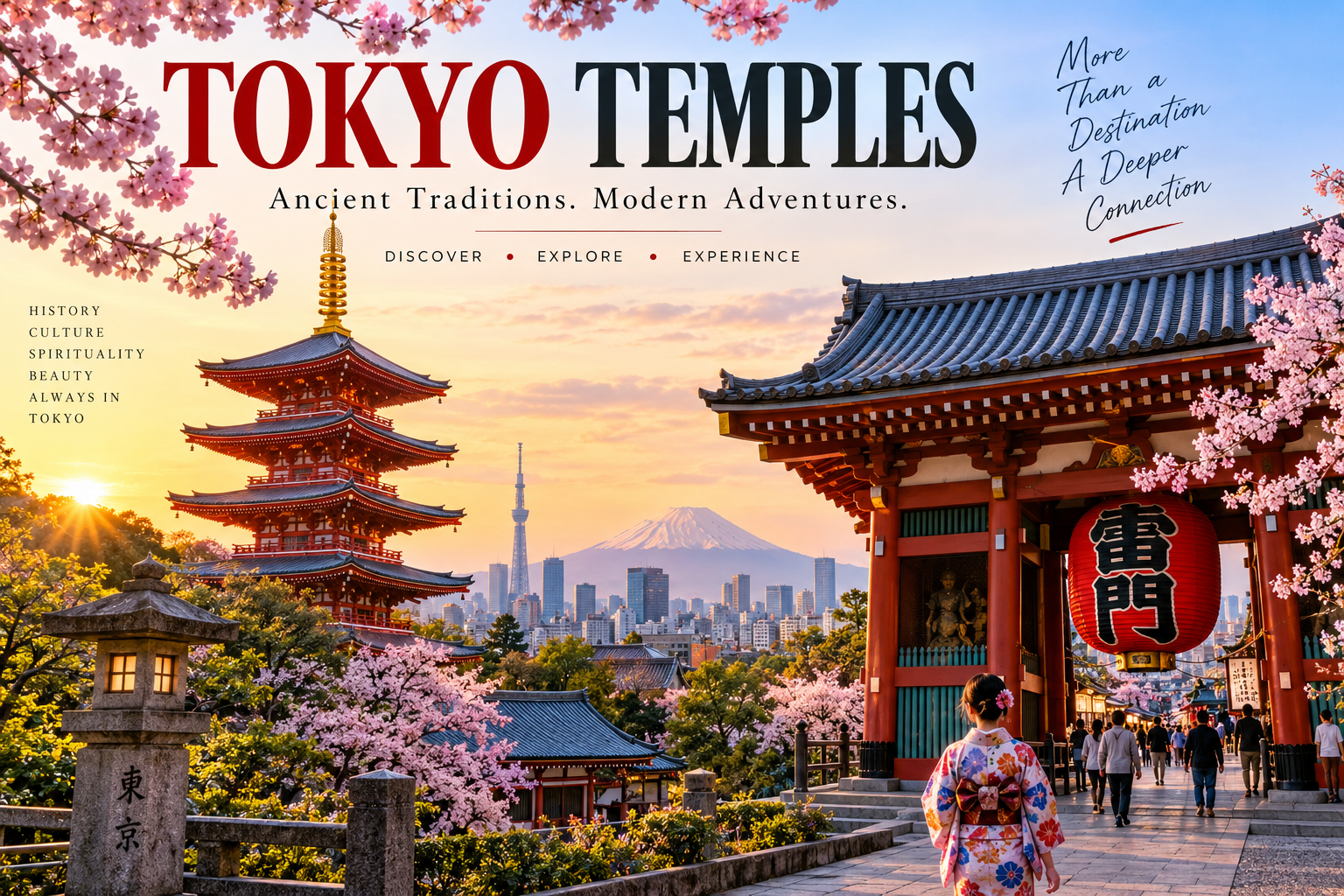
Tokyo Temples: 10 Amazing Historic Places to Visit in 2026
Tokyo temples offer far more than beautiful buildings and photo opportunities: they are living places of Buddhist worship where centuries of Japanese history, art, architecture, festivals, and everyday spirituality continue to meet modern Tokyo. From the famous Senso-ji in Asakusa to quieter temples hidden among residential streets, visiting these sacred places can reveal a side of Tokyo that busy sightseeing itineraries often miss Tokyo Streets
Imagine stepping away from one of Tokyo’s busiest train stations and, within minutes, hearing the soft sound of a temple bell instead of traffic. Incense rises near a Buddhist hall, visitors quietly make offerings, and an old wooden gate stands against a skyline filled with glass towers.
That contrast is one of the most fascinating things about Tokyo.
Tokyo is often introduced through neon streets, shopping districts, sushi restaurants, anime, technology, and skyscrapers. Yet temples are just as important to understanding the city. They preserve connections to Buddhism, the Edo period, samurai history, traditional architecture, memorial customs, seasonal celebrations, and local communities.
Some Tokyo temples are enormous and internationally famous. Others are small neighborhood temples that tourists can easily walk past without realizing what they are seeing.
This guide explores the best Tokyo temples for different types of travelers, explains how temples differ from Shinto shrines, provides practical etiquette, compares ten notable temples, and looks at why temple tourism is likely to become even more important as travelers search for slower and more meaningful experiences.
Why Tokyo Temples Are Worth Visiting
Tokyo’s temples are not simply historical attractions.
They are places where history remains connected to daily life.
A temple may contain a centuries-old tradition while simultaneously sitting beside a convenience store, office tower, railway station, or modern apartment building. That combination gives Tokyo’s religious sites a character that is different from isolated historic monuments.
The best Tokyo temple experiences often happen when travelers slow down.
Instead of rushing from one famous landmark to another, visitors can observe the architecture, listen to bells, notice incense rituals, explore a cemetery, discover seasonal flowers, or simply sit quietly for a few minutes.
Tokyo temples combine history and modern life
Tokyo has changed dramatically over the centuries. Fires, earthquakes, wars, redevelopment, and rapid modernization have repeatedly transformed the city.
Religious institutions have also experienced these changes.
Some temples were destroyed and rebuilt. Others moved locations. Some survived major disasters and preserved important architectural elements. Their histories therefore provide another way to understand Tokyo itself.
Zojoji, for example, has a particularly strong connection with the Tokugawa shogunate. The temple’s history includes its relationship with the Tokugawa family, and six Tokugawa shoguns are buried there. Its location beside Tokyo Tower creates one of the city’s clearest visual contrasts between old and new Japan.
Tokyo temples are different from museums
A museum generally presents objects for visitors to observe.
A temple is different.
It is fundamentally a religious institution. Visitors may encounter people praying, monks performing religious activities, memorial practices, funerals, ceremonies, or other forms of worship.
That distinction matters.
A respectful traveler does not treat every temple as a photo studio. The best experience comes from recognizing that tourism is secondary to the site’s religious purpose.
Understanding the Difference Between Tokyo Temples and Shrines
One of the most common questions for first-time visitors is the difference between a Japanese temple and shrine.
The basic distinction is religious.
Temples are associated with Buddhism, while shrines are associated with Shinto.
This sounds simple, but the visual differences are not always obvious to international visitors because Japanese religious history includes long periods of interaction between Buddhist and Shinto traditions.
How to recognize a Buddhist temple
A Buddhist temple may have features such as:
- A Buddhist hall
- Buddhist statues
- Incense burners
- A temple bell
- A pagoda
- Cemetery areas
- Buddhist memorial services
- A gate associated with temple architecture
Many temples also have distinctive Buddhist imagery.
Senso-ji, for example, is dedicated to Kannon, the Bodhisattva of compassion. The temple describes itself as Tokyo’s oldest temple and traces its traditional origin to the discovery of a Kannon statue in 628.
How to recognize a Shinto shrine
Shrines often feature:
- Torii gates
- Shimenawa ropes
- Shinto prayer halls
- Purification fountains
- Shinto symbols
- Offerings associated with kami
Nezu Shrine and Hie Shrine are examples of major Tokyo shrines rather than temples. Nezu Shrine is particularly notable for its traditional architecture, greenery, ponds, and torii-lined pathways.
Why the distinction matters for travelers
Knowing whether you are entering a temple or shrine makes it easier to understand the etiquette.
The basic principle is simple:
Observe what local worshippers do and follow the site’s posted instructions.
You do not need to become an expert in Japanese religion before visiting.
Respect, quiet behavior, and awareness are more important than memorizing every ritual.
The 10 Best Tokyo Temples to Visit
Tokyo has many temples, so choosing only a few can be difficult.
The following ten provide a balanced introduction. Together they cover famous landmarks, historical sites, quieter experiences, Buddhist traditions, architecture, local festivals, and different areas of the city.
Senso-ji Temple in Asakusa
Senso-ji is the obvious starting point for many first-time visitors to Tokyo.
Located in Asakusa, it is one of the city’s most recognizable religious landmarks and is officially described by the temple as Tokyo’s oldest temple. Its traditional history begins with the discovery of a Kannon statue in 628.
The famous Kaminarimon Gate provides the dramatic entrance most visitors recognize from photographs.
From there, visitors move toward Nakamise, the traditional shopping approach, before reaching the temple’s main area.
Why Senso-ji stands out
Senso-ji is ideal for travelers who want a strong first impression of traditional Tokyo.
It combines:
- Historic Buddhist culture
- Traditional architecture
- Shopping
- Street food
- Photography
- Festivals
- Easy transportation
- Neighborhood sightseeing
The surrounding Asakusa area also provides opportunities to explore old-style streets, restaurants, small shops, and other historic attractions.
Best experience at Senso-ji
The biggest mistake is visiting only at the busiest part of the day.
Early morning can provide a dramatically different atmosphere.
The architecture is still impressive, but the experience becomes less about fighting through crowds and more about appreciating the temple grounds.
The official temple site notes that Senso-ji attracts tens of millions of worshippers annually, demonstrating just how significant it remains.
Who should visit Senso-ji?
Senso-ji is especially suitable for:
- First-time Tokyo visitors
- Families
- Photographers
- History lovers
- Travelers staying in Asakusa
- Visitors interested in traditional Japan
If you only have time for one famous Tokyo temple, Senso-ji is an obvious choice.
Zojoji Temple Near Tokyo Tower
Zojoji offers one of the most memorable contrasts in Tokyo.
On one side is an important Buddhist temple with a long history. On the other side is Tokyo Tower.
The result is an image that feels almost symbolic of the entire city: traditional Japan standing alongside modern Japan.
Zojoji was founded in 1393 and later became closely associated with the Tokugawa family. The temple’s official history identifies its selection as the Tokugawa family’s family temple in 1590.
Why Zojoji is special
The temple complex includes the tombs of six Tokugawa shoguns.
Its Sangedatsumon Gate is also historically important. GO TOKYO notes that it is the only temple structure at the site to have survived the World War II bombings.
The temple therefore provides more than architecture. It connects visitors with the political history of Edo-period Japan.
Zojoji and Tokyo Tower
For photographers, the temple and tower combination is one of the strongest visual opportunities in central Tokyo.
The composition works especially well because the traditional architecture provides a foreground or frame for the modern tower.
However, travelers should remember that the site is a functioning Buddhist temple.
Photography should never interfere with worship.
Current conservation consideration
Visitors should also check current conditions before visiting.
GO TOKYO currently reports that the Sangedatsumon Gate is undergoing conservation and repair, with work scheduled to continue until November 2032.
This is a useful reminder that historic sites are not static objects. Conservation is part of keeping them alive for future generations.
Kan’ei-ji Temple in Ueno
Kan’ei-ji is particularly interesting for travelers who want to explore Tokyo’s Edo history.
The temple is in the Ueno area, close to major cultural institutions including the Tokyo National Museum.
GO TOKYO describes Kan’ei-ji as having once been the main temple of the Tendai Buddhist tradition and notes that six shoguns are buried there.
Why Kan’ei-ji is different
Kan’ei-ji helps explain how religious institutions once influenced the physical organization of Edo.
Today, Ueno is known for museums, parks, transportation, shopping, and cultural attractions.
But beneath that modern identity is a much older religious landscape.
That makes Kan’ei-ji particularly valuable for travelers who want to connect multiple Tokyo attractions into a historical story rather than treating each location as an isolated sightseeing stop.
Who should visit Kan’ei-ji?
It is especially good for:
- History enthusiasts
- Museum visitors
- Edo-period researchers
- Architecture lovers
- Travelers exploring Ueno
A temple visit here pairs naturally with the cultural attractions around Ueno Park.
Gokokuji Temple
Gokokuji is one of the more rewarding choices for travelers who want a quieter temple experience.
Located in Bunkyo City, the temple is known for its architecture from the Genroku era.
GO TOKYO identifies its main hall as one of Tokyo’s notable examples of Genroku-era architecture and notes that the temple’s main devotional statue of Kannon can be viewed on the 18th of the month.
Why Gokokuji deserves more attention
The appeal of Gokokuji is partly its relative calm.
Not every traveler needs another crowded landmark.
For someone who has already visited the most famous Tokyo attractions, a quieter temple can feel more personal and rewarding.
The experience is less about checking a landmark off a list and more about observing the space.
Best for slow travel
Gokokuji works particularly well for:
- Slow travelers
- Architecture enthusiasts
- Repeat visitors
- Travelers avoiding large crowds
- Visitors interested in Edo-era culture
Bishamonten Zenkoku-ji Temple in Kagurazaka
Kagurazaka has a distinct atmosphere, and Bishamonten Zenkoku-ji fits naturally into the neighborhood.
The temple was first established in 1595 by Tokugawa Ieyasu and later moved to its present location.
Why visit Zenkoku-ji?
The temple provides a useful example of how religious sites can be integrated into ordinary city neighborhoods.
Rather than standing in a huge isolated complex, it forms part of a lively urban district.
Visitors can therefore combine:
- Temple sightseeing
- Traditional streets
- Cafés
- Restaurants
- Local shopping
- Evening walks
The result is a more complete neighborhood experience.
A seasonal reason to visit
February 3 is particularly notable because the temple hosts a bean-throwing festival associated with driving away evil spirits.
If your trip coincides with such a festival, the experience can be very different from a normal sightseeing visit.
Jindaiji Temple in Chofu
Jindaiji is an excellent option for travelers willing to move beyond central Tokyo.
It offers a different atmosphere from Senso-ji.
The area around the temple has a more traditional, relaxed character, and Jindaiji is strongly associated with its famous soba culture and seasonal events.
The Jindaiji Daruma Fair
One of the temple’s most distinctive events is the Jindaiji Daruma Fair.
GO TOKYO describes the event as a spring tradition with roughly 150 booths, many selling Daruma dolls. The 2026 event took place on March 3 and 4.
Daruma are traditional good-luck figures associated with perseverance and goal setting.
The festival demonstrates an important point about Tokyo temples: their cultural importance extends beyond buildings.
They can serve as centers for crafts, festivals, food traditions, local commerce, community gatherings, and seasonal rituals.
Why Jindaiji is good for families
Families may enjoy Jindaiji because the experience can be combined with:
- Temple exploration
- Traditional food
- Seasonal events
- Local walking
- Cultural learning
Children may find Daruma dolls particularly interesting because they are visually distinctive and connected to a simple story of persistence.
Zuishoji Temple in Shirokanedai
Zuishoji offers a different kind of Tokyo temple experience.
It is located in the Shirokanedai area and is known for its peaceful atmosphere.
GO TOKYO notes that the temple’s main hall is designated an Important Cultural Property and that its kitchen was designed by architect Kengo Kuma.
Traditional architecture meets contemporary design
This combination makes Zuishoji particularly interesting for architecture enthusiasts.
A temple does not have to represent only the past.
Modern architects and designers can also contribute to the ongoing life of Japanese religious spaces.
That creates a useful question for travelers:
What does traditional architecture mean when it exists inside a modern global city?
Zuishoji provides one possible answer.
Who should visit Zuishoji?
It is a strong choice for:
- Architecture lovers
- Design enthusiasts
- Travelers seeking quiet
- Repeat Tokyo visitors
- People exploring Shirokanedai
Toyokawa Inari Tokyo Betsuin
Toyokawa Inari Tokyo Betsuin is one of the more visually distinctive religious sites in central Tokyo.
The temple is famous for its many fox statues, red flags, and lanterns.
GO TOKYO notes that the site contains hundreds of fox statues and attracts visitors praying for areas such as wealth, entertainment, and safe childbirth.
Why it is visually different
The repeated fox statues create a very different visual experience from the large open spaces of Senso-ji.
The site is compact, detailed, and atmospheric.
For photographers, it provides opportunities to focus on smaller compositions rather than relying on a single monumental building.
A useful cultural lesson
Toyokawa Inari also demonstrates why visitors should avoid assuming that every religious symbol has the same meaning.
Fox imagery in Japan can have complex cultural associations, particularly around Inari traditions.
Visitors should appreciate the imagery without automatically translating it into a Western religious equivalent.
Myohoji Temple in Koenji
Myohoji Temple is an excellent choice for travelers interested in Buddhist traditions beyond the most famous tourist sites.
GO TOKYO identifies it as the head temple of the Nichiren School of Buddhism and notes its association with yakuyoke, or practices intended to ward off misfortune.
Why Myohoji is worth visiting
Koenji is already known for its alternative culture, music, vintage shopping, and lively neighborhood identity.
A temple visit adds another layer to the area.
It demonstrates that Tokyo’s spiritual life is not confined to traditional sightseeing districts.
Best for independent travelers
Myohoji can work particularly well for:
- Repeat visitors
- Culture-focused travelers
- People exploring Koenji
- Travelers interested in Buddhist traditions
- Visitors who prefer less obvious attractions
Ekoin in Ryogoku
Ekoin is particularly important for understanding Tokyo’s relationship with death, remembrance, disaster, and compassion.
The temple belongs to the Pure Land Buddhist tradition and was established after the Great Meireki Fire of 1657, which devastated Edo. GO TOKYO notes that the temple has historically provided memorial services for victims of disasters and for many other deceased people and animals.
Why Ekoin tells an important story
Travel guides often focus on beautiful buildings.
Ekoin encourages a different form of historical reflection.
Tokyo has repeatedly experienced disasters, including fires, earthquakes, and wartime destruction.
Memorial temples preserve memories of those events.
This makes religious sites valuable historical sources even when they are not traditionally presented as museums.
Who should visit Ekoin?
Ekoin is particularly meaningful for:
- History travelers
- Cultural researchers
- Visitors exploring Ryogoku
- Travelers interested in Buddhist memorial traditions
- People seeking deeper historical context
10 Tokyo Temples Compared at a Glance
The user experience at each temple can vary significantly. Rather than treating these sites as “brands,” it is more accurate to compare them as temple experiences and destinations.
| Temple | Area | Best For | Atmosphere | History | Photography | Crowds |
|---|---|---|---|---|---|---|
| Senso-ji | Asakusa | First-time visitors | Lively | Exceptional | Excellent | High |
| Zojoji | Minato | History + Tokyo Tower | Grand and peaceful | Exceptional | Excellent | Medium |
| Kan’ei-ji | Ueno | Edo history | Quiet | Exceptional | Good | Lower |
| Gokokuji | Bunkyo | Architecture | Calm | Very strong | Good | Low |
| Bishamonten Zenkoku-ji | Kagurazaka | Neighborhood culture | Urban and traditional | Strong | Good | Medium |
| Jindaiji | Chofu | Families + culture | Relaxed | Strong | Excellent during events | Medium |
| Zuishoji | Shirokanedai | Architecture and design | Peaceful | Strong | Good | Low |
| Toyokawa Inari | Akasaka | Symbolism + photography | Atmospheric | Strong | Excellent | Medium |
| Myohoji | Koenji | Buddhist traditions | Local and calm | Strong | Good | Low |
| Ekoin | Ryogoku | Memorial history | Reflective | Strong | Moderate | Low to medium |
Which Tokyo Temple Is Best for First-Time Visitors?
For most first-time travelers, Senso-ji is the easiest recommendation.
It provides a recognizable introduction to Tokyo’s Buddhist heritage while also connecting visitors with Asakusa’s streets, shops, food, and transportation.
However, there is an important difference between best-known and best experience.
If you dislike crowds, Senso-ji may not be the most comfortable choice during peak hours.
In that case, Gokokuji, Kan’ei-ji, Myohoji, or Zuishoji may provide a calmer introduction.
Which Tokyo Temple Is Best for Photography?
Senso-ji is probably the strongest choice for classic Tokyo temple photography.
Its gates, lanterns, traditional buildings, crowds, and surrounding streets create many compositions.
Zojoji is arguably more distinctive if you want a photograph that combines traditional Japanese architecture with Tokyo’s modern skyline.
Toyokawa Inari offers a different visual style because of its dense collection of statues, flags, and religious details.
Jindaiji can be particularly rewarding during seasonal events.
Photography should remain secondary to worship
Even when photography is permitted, travelers should remain aware of other visitors.
Avoid:
- Blocking entrances
- Standing in prayer areas
- Using large equipment in narrow spaces
- Photographing people without permission
- Using flash where prohibited
- Ignoring signs
The strongest travel photograph is never worth disrupting someone’s religious practice.
Which Tokyo Temple Is Best for History Lovers?
Zojoji and Kan’ei-ji stand out for travelers interested in the Tokugawa era.
Zojoji’s relationship with the Tokugawa family makes it especially significant, while Kan’ei-ji provides another major connection to shogunal history.
Ekoin offers a different historical perspective by connecting religious practice with disasters and memorial traditions.
Which Tokyo Temples Are Best for Families?
Families may enjoy Senso-ji because there is plenty to see within a compact area.
Jindaiji is another strong option because its seasonal Daruma event and surrounding food culture can make the visit more interactive.
The best temple for children is not necessarily the biggest.
A smaller temple can sometimes be more educational because parents can slow down and explain what children are seeing.
Which Tokyo Temples Are Best for Quiet Experiences?
If peace and atmosphere matter more than famous landmarks, consider:
- Gokokuji
- Zuishoji
- Myohoji
- Kan’ei-ji
- Ekoin
The word “quiet” should not be interpreted as guaranteed silence.
Temples are living institutions. Events, ceremonies, visitors, construction, and local activities can change the atmosphere.
For the calmest experience, visit early on a weekday when practical.
Best Time to Visit Tokyo Temples
There is no single perfect time for every temple.
The best timing depends on your goal.
Early morning for peace
Early morning is generally one of the best choices if you want:
- Fewer crowds
- Softer light
- A calmer atmosphere
- Better photography
- More space for reflection
Senso-ji in particular can feel dramatically different early in the day compared with the busiest afternoon period.
Late afternoon for atmosphere
Late afternoon can offer beautiful light and a gradual transition toward evening.
However, travelers should pay attention to temple closing times and whether specific areas remain accessible.
Seasonal visits
Tokyo temples can be rewarding throughout the year.
Spring can bring cherry blossoms and other flowers.
Summer brings festivals and humid weather.
Autumn provides changing foliage and cooler temperatures.
Winter often creates a quieter atmosphere.
Seasonal festivals can completely change a temple’s character.
The key is to verify event schedules directly before traveling.
Tokyo Temple Etiquette for Beginners
You do not need extensive religious knowledge to visit a Japanese temple respectfully.
A few basic habits make a major difference.
Speak quietly
Temples are places of worship.
Even when hundreds of tourists are present, avoid shouting, loud conversations, or disruptive behavior.
Follow photography signs
Some areas may prohibit photography.
Never assume that because one part of a temple allows photography, every area does.
Do not touch religious objects
Statues, offerings, architectural elements, and ceremonial objects should not be treated as souvenirs or props.
Dress respectfully
Tokyo is generally casual, but religious sites are not the place for deliberately provocative clothing.
Comfortable, modest clothing is a safe choice.
Follow local instructions
Signs may be provided in Japanese and sometimes English.
If a particular temple has different rules, follow those rules.
How to Pray at a Tokyo Buddhist Temple
There is no single universal temple ritual that visitors must perform.
Buddhist traditions differ, and individual temples may have their own practices.
For visitors, the safest approach is observation.
Watch how worshippers behave and follow the temple’s instructions.
If you are unsure, you can simply stand respectfully and observe.
You do not have to imitate every action to appreciate the site.
Temple Bells and Their Meaning
Temple bells are an important part of Japanese Buddhist culture.
You may hear a large bell at certain temples or during particular occasions.
Do not assume that every bell can be rung by visitors.
If a temple provides instructions allowing visitors to participate, follow them.
Otherwise, admire the bell as part of the temple’s religious environment.
Incense at Tokyo Temples
Incense is another feature that many international visitors notice immediately.
At temples where incense is offered to visitors, people may place incense according to local custom.
The smoke can be deeply associated with Buddhist practice and temple atmosphere.
Do not treat it simply as a tourist attraction.
If you participate, watch others or follow posted instructions.
Omamori, Goshuin, and Temple Souvenirs
Japanese temples can offer religious or cultural items that visitors may purchase.
These can include protective amulets, charms, Buddhist goods, and calligraphic temple stamps.
Goshuin
Goshuin are calligraphic records associated with visits to temples and shrines.
They are more than ordinary souvenirs.
Travelers collecting them should approach the practice respectfully and understand that they have religious significance.
Omamori
Omamori are protective charms associated with Japanese religious traditions.
Different types can have different purposes.
Rather than treating them as generic lucky souvenirs, take a moment to understand what the charm represents.
Common Mistakes Tourists Make at Tokyo Temples
Even respectful travelers can make mistakes when they are unfamiliar with Japanese customs.
Mistake: treating a temple like a museum
A temple may contain historical architecture, but it remains a religious place.
The solution is simple: observe worshippers and give religious activities priority.
Mistake: visiting only famous temples
Senso-ji is famous for good reason, but Tokyo has many other temples.
Exploring smaller sites can provide a deeper sense of local life.
Mistake: rushing
Temple visits do not need to take hours.
But walking in, taking one photograph, and immediately leaving can mean missing much of the experience.
Spend a few minutes observing.
Mistake: ignoring neighborhood context
A temple is often part of a larger historical district.
Asakusa, Ueno, Kagurazaka, Ryogoku, Koenji, and Shirokanedai all offer different perspectives.
Combine the temple with its surrounding neighborhood.
Mistake: assuming all temples are open like tourist attractions
Some temple areas have specific hours.
Some religious halls may have restricted access.
Some ceremonies are private.
Always check current information before building an itinerary around a particular event.
Pros and Cons of Visiting Tokyo Temples
Temple tourism has many advantages, but it is not perfect for every traveler.
Advantages of visiting Tokyo temples
Historical depth: Temples provide direct connections to Japanese history and Buddhist traditions.
Architectural interest: Wooden halls, gates, gardens, statues, bells, and decorative details offer significant visual variety.
Cultural understanding: Temple visits can help explain Japanese traditions that may otherwise seem unfamiliar.
Slow travel: They create opportunities to pause between busy sightseeing activities.
Photography: Many temples provide beautiful compositions, especially during seasonal changes.
Neighborhood exploration: Temples often sit inside older or culturally interesting districts.
Low-cost sightseeing: Many temple grounds can be visited without a large admission fee, although specific museums, gardens, exhibitions, or activities may have separate costs.
Disadvantages and challenges
Crowds: Famous sites such as Senso-ji can become extremely busy.
Tourism pressure: Heavy visitor numbers can affect the atmosphere and create pressure on historic sites.
Cultural misunderstanding: Visitors may accidentally treat religious practices as entertainment.
Limited access: Certain halls or religious areas may be restricted.
Weather: Outdoor temple grounds can be uncomfortable during Tokyo’s hot and humid summer.
Accessibility differences: Historic buildings may not always provide the same accessibility features as modern attractions.
The best strategy is not to avoid famous temples.
Instead, balance major landmarks with quieter sites.
A Better Tokyo Temple Strategy
A useful approach is to divide temple visits into three categories.
Category one: iconic temple
Choose one internationally famous site.
For example:
Senso-ji.
This gives you the classic Tokyo temple experience.
Category two: historical temple
Choose a temple that helps you understand Japanese history.
Zojoji or Kan’ei-ji are strong options.
Category three: quiet or specialized temple
Choose somewhere that offers a different atmosphere.
Gokokuji, Zuishoji, Myohoji, or Ekoin can fill this role.
This three-part strategy is better than trying to visit ten temples in a single day.
How to Build a Tokyo Temple Itinerary
A thoughtful itinerary should consider geography.
Tokyo is enormous, and unnecessary cross-city travel can waste time.
One-day temple itinerary
A first-time traveler might focus on Asakusa.
Start with Senso-ji in the morning.
Explore the surrounding streets afterward.
Continue toward nearby attractions and enjoy lunch in the area.
This creates a manageable cultural day without excessive transportation.
Two-day temple itinerary
On the second day, visit Zojoji.
Combine it with Shiba Park and Tokyo Tower.
This gives you a dramatically different environment from Asakusa.
Three-day cultural itinerary
Add Ueno and Kan’ei-ji.
You can combine temple history with museums and cultural institutions in the area.
Longer trip
For travelers staying longer, explore quieter temples in Bunkyo, Shirokanedai, Koenji, Chofu, and other neighborhoods.
This is where Tokyo becomes particularly interesting.
Tokyo Temples for Different Traveler Demographics
Different travelers can enjoy the same temple in different ways.
Tokyo temples for solo travelers
Solo travelers can benefit from the contemplative atmosphere of quieter temples.
Instead of following a rigid sightseeing schedule, allow time for walking and observation.
Tokyo temples for couples
Zojoji can be particularly appealing for couples because the surrounding area combines temple scenery, gardens, city views, and Tokyo Tower.
Tokyo temples for families
Senso-ji and Jindaiji provide more varied surroundings and opportunities to combine temple visits with food and neighborhood exploration.
Tokyo temples for photographers
Consider Senso-ji, Zojoji, Toyokawa Inari, and Jindaiji.
Each offers a different photographic language.
Tokyo temples for seniors
Travelers who prefer a slower pace may appreciate quieter temples and shorter itineraries.
Avoid trying to visit too many distant locations in one day.
Tokyo temples for first-time Japan visitors
Start with Senso-ji.
Then add Zojoji for contrast.
That simple combination introduces both traditional Tokyo and the city’s modern skyline.
Tokyo temples for repeat visitors
Move beyond the famous landmarks.
Explore Kan’ei-ji, Gokokuji, Zuishoji, Myohoji, Jindaiji, or Ekoin.
The goal should be discovering a side of Tokyo you did not see during your first visit.
How Tokyo Temples Support Slow Travel
One of the biggest travel trends is the movement away from checklist tourism.
Travelers increasingly want experiences that feel meaningful rather than simply impressive.
Temples fit naturally into this model.
A temple visit encourages travelers to:
- Walk more slowly
- Observe details
- Spend time in one neighborhood
- Learn historical context
- Experience seasonal culture
- Disconnect briefly from digital distractions
This does not mean every temple visit must become a spiritual retreat.
It simply means the traveler can resist the pressure to constantly move.
The Future of Tokyo Temple Tourism
Tokyo’s temples are likely to remain important tourist destinations, but the way visitors experience them may change.
More demand for authentic cultural experiences
Travelers are increasingly interested in experiences that feel connected to local culture.
That could benefit smaller temples.
Instead of visiting only famous landmarks, travelers may seek neighborhood temples, seasonal festivals, cultural workshops, and guided historical walks.
Greater focus on sustainable tourism
Heavy visitor numbers can create challenges.
Popular temples need to balance accessibility with preservation.
Future tourism strategies are likely to place more emphasis on:
- Visitor management
- Conservation
- Responsible photography
- Local community needs
- Clear multilingual information
- Accessibility
- Preservation funding
Digital information will improve
Technology can make historic sites easier to understand.
Multilingual digital guides, location-based information, virtual interpretation, and improved online visitor information can help international travelers understand what they are seeing.
The challenge will be using technology without turning sacred places into purely digital attractions.
Quiet temples may become more popular
As famous tourist districts become increasingly crowded, travelers may search for less obvious alternatives.
That could increase interest in temples such as Gokokuji, Zuishoji, Myohoji, and other neighborhood sites.
How to Have a More Meaningful Tokyo Temple Experience
The most valuable improvement is simple:
Spend less time trying to photograph everything and more time understanding what you are seeing.
Before visiting, learn three things:
- What Buddhist tradition or historical background is associated with the temple?
- What is the temple known for?
- What etiquette applies to visitors?
During the visit, notice three things:
- Architecture
- Religious activity
- Relationship with the surrounding neighborhood
Afterward, ask yourself what the temple revealed about Tokyo.
This approach transforms a sightseeing stop into a cultural experience.
Frequently Asked Questions About Tokyo Temples
What is the most famous temple in Tokyo?
Senso-ji in Asakusa is arguably the most famous and internationally recognizable temple in Tokyo. It is officially described by the temple as Tokyo’s oldest temple and is dedicated to Kannon.
How many temples are there in Tokyo?
Tokyo contains a very large number of Buddhist temples, ranging from major historic complexes to small neighborhood temples. There is no need to focus on an exact total to plan a trip because the city offers many choices across different districts and Buddhist traditions.
Are Tokyo temples free to visit?
Many temple grounds can be entered without an admission fee, but individual museums, gardens, exhibitions, or special activities may charge separately. Always check the temple’s current visitor information.
Can tourists enter Tokyo temples?
Yes, many temples welcome visitors, but access can vary. Some religious halls or areas may be restricted, and visitors should follow posted rules.
Can I take photos inside Tokyo temples?
Photography rules vary by temple and location. Always check signs and follow instructions. Some sacred or exhibition areas may prohibit photography.
What should I wear to a Tokyo temple?
Comfortable and respectful clothing is appropriate. You do not normally need formal clothing, but extremely revealing or disruptive clothing should be avoided.
Do I need to know Buddhism before visiting?
No. Basic awareness and respectful behavior are enough for a tourist visit. Learning a little about the temple’s history can make the experience more meaningful.
Is Senso-ji worth visiting if Tokyo is crowded?
Yes. Its historical importance and architecture make it worthwhile, but visiting early can provide a calmer experience than arriving during the busiest hours.
Which Tokyo temple is best for Tokyo Tower views?
Zojoji is one of the best-known temple locations for combining traditional Buddhist architecture with views of Tokyo Tower. GO TOKYO specifically highlights the temple’s location beside Tokyo Tower.
Which Tokyo temple is best for history?
Zojoji and Kan’ei-ji are excellent choices for travelers interested in Tokugawa and Edo history. Zojoji has six Tokugawa shogun tombs, while Kan’ei-ji also contains the graves of six shoguns.
Which Tokyo temple is best for a quiet visit?
Gokokuji, Zuishoji, Myohoji, Kan’ei-ji, and Ekoin can offer calmer experiences than Tokyo’s most crowded landmarks, although conditions vary by time and day.
Are Tokyo temples suitable for children?
Yes. Children can learn about Japanese architecture, Buddhism, festivals, statues, gardens, and traditional customs. Jindaiji’s Daruma-related traditions can be particularly engaging for families.
What is the difference between Senso-ji and Meiji Shrine?
Senso-ji is a Buddhist temple, while Meiji Shrine is a Shinto shrine. Their architecture, religious traditions, and rituals therefore differ.
What should I avoid doing at a Tokyo temple?
Avoid loud behavior, touching religious objects, ignoring photography restrictions, blocking worshippers, entering restricted areas, and treating ceremonies as entertainment.
Can I buy souvenirs at Tokyo temples?
Many temples have shops or areas where visitors can obtain religious and cultural items. Depending on the site, these may include charms, incense, calligraphy, books, or other traditional items.
Final Thoughts on Tokyo Temples
Tokyo temples reveal a side of the city that is easy to overlook.
The skyscrapers tell one story.
The railway network tells another.
The shopping districts show Tokyo’s modern energy.
But the temples preserve another layer: centuries of faith, memory, architecture, community, disaster, political history, artistic traditions, and everyday life.
Senso-ji provides the iconic introduction.
Zojoji connects Buddhist tradition with the Tokugawa family and modern Tokyo Tower.
Kan’ei-ji opens a window into Edo history.
Gokokuji demonstrates the beauty of quieter historic architecture.
Jindaiji introduces travelers to seasonal culture and Daruma traditions.
Zuishoji demonstrates the relationship between historic religious spaces and modern design.
Toyokawa Inari offers a distinctive visual and symbolic experience.
Myohoji reveals a different Buddhist tradition within a lively neighborhood.
Ekoin shows how temples can preserve memories of disasters and the deceased.
Together, these sites demonstrate that there is no single Tokyo temple experience.
The best choice depends on what you want from your trip.
If you are visiting Tokyo for the first time, begin with one iconic temple. Then deliberately choose one quieter or less obvious site. That contrast can be more rewarding than visiting several famous locations back-to-back.



2 Comments