35 Travel Essentials You Actually Need for Every Trip: The Ultimate Packing Guide
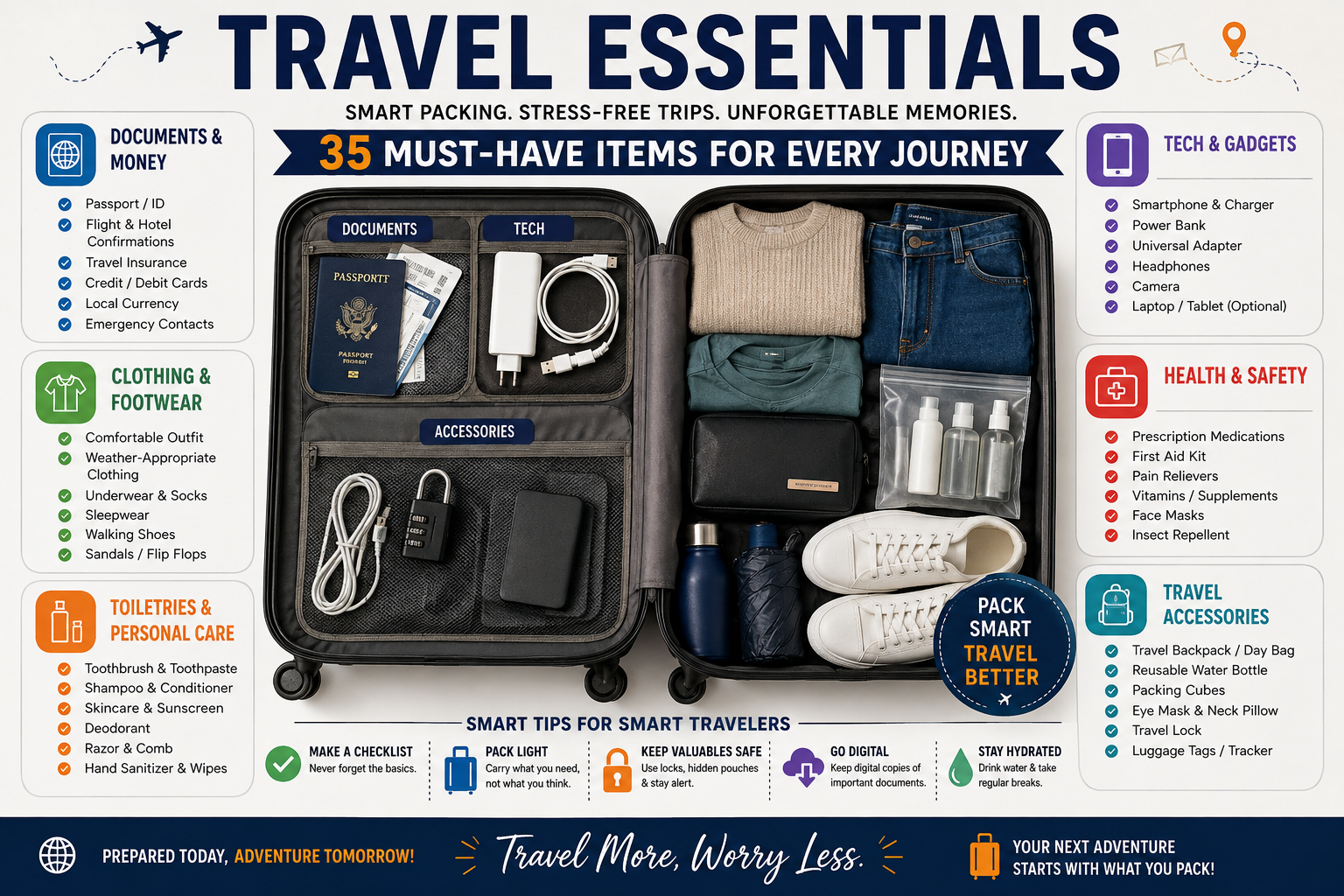
The best travel essentials are not the items that fill your suitcase; they are the items that solve real problems, save time, improve comfort, and help you stay prepared when plans change. A smart travel packing list should cover documents, money, clothing, toiletries, technology, health, safety, and destination-specific needs without encouraging unnecessary overpacking. Travel essentials look different for a weekend city break, a family holiday, an international business trip, a beach vacation, a road trip, or a long backpacking journey. The challenge is knowing what deserves space in your luggage and what can safely be left at home Taiwan Travel
What Are Travel Essentials?
Travel essentials are the practical items, documents, equipment, clothing, personal supplies, and technology that help a traveler complete a journey comfortably, safely, and efficiently.
Some travel essentials are nearly universal.
A passport is essential for many international trips. A phone is useful for communication and navigation. Basic clothing is obviously necessary. Payment methods are critical.
Other items depend entirely on the destination.
A universal travel adapter can be important on an international trip but unnecessary for domestic travel. A rain jacket may be essential during a wet-season journey but excessive for a short desert trip. Hiking equipment makes sense in the mountains but has little value on a business trip.
This leads to an important packing principle:
An essential is not defined by popularity. It is defined by usefulness for your specific journey.
Why Choosing the Right Travel Essentials Matters
Packing is often treated as a simple task: put everything you might need into a suitcase.
That approach creates problems.
An overloaded suitcase increases weight, makes organization harder, slows you down at airports, and encourages travelers to bring items they never use.
At the same time, extreme minimalism can create its own problems.
Forgetting essential medication, documentation, chargers, appropriate clothing, or basic hygiene products can be much more inconvenient than carrying an extra kilogram of useful equipment.
The goal is therefore not to pack the least.
The goal is to pack intelligently.
The Problem-Solving Approach to Packing
Before putting an item into your suitcase, ask three questions:
- Will I realistically use this?
- Would replacing it at my destination be difficult or expensive?
- Would not having it create a serious problem?
If the answer to the second or third question is yes, the item deserves more consideration.
If the item is cheap, widely available, rarely used, and taking up significant space, it may not belong in your luggage.
The Four Types of Travel Essentials
A useful way to organize travel essentials is to divide them into four groups.
Critical Essentials
These are items that can seriously disrupt a trip if forgotten.
Examples include passports, visas where required, essential medication, payment methods, and important travel documentation.
Comfort Essentials
These make travel easier but may not be absolutely necessary.
Examples include neck pillows, eye masks, compression organizers, reusable water bottles, and comfortable travel clothing.
Convenience Essentials
These save time or reduce minor frustrations.
Examples include packing cubes, cable organizers, luggage trackers, and portable chargers.
Destination-Specific Essentials
These depend on climate, activities, culture, and location.
Examples include hiking shoes, swimwear, rain gear, modest clothing for certain religious sites, cold-weather layers, or water filtration equipment for appropriate remote travel.
This classification helps prevent one of the biggest packing mistakes: treating every useful item as equally important.
Essential Travel Documents
Documents should receive priority because many cannot easily be replaced during a trip.
Passport
For international travel, your passport is often one of the most important items you carry.
Check its validity well before departure because some destinations impose passport-validity requirements beyond the actual travel dates.
Keep the passport secure throughout your journey.
Visa and Entry Documents
Depending on your nationality and destination, you may need a visa, electronic travel authorization, residence documentation, or other entry approval.
Never assume that having a flight reservation automatically means you can enter a country.
Check requirements before departure.
Flight and Transportation Information
Keep important booking information accessible.
This may include:
- Flight reservations
- Train tickets
- Bus reservations
- Car rental information
- Airport transfer details
- Hotel confirmations
Digital copies are convenient, but offline access is useful when internet service is unreliable.
Travel Insurance Information
If you purchase travel insurance, keep the policy details and emergency assistance contact information accessible.
Do not rely only on an email that may be difficult to locate during an emergency.
Copies of Important Documents
Secure copies of important documents can be valuable if originals are lost or stolen.
Consider keeping copies of:
- Passport identification page
- Visa
- Insurance policy
- Identification
- Important reservations
- Emergency contacts
Do not store sensitive information carelessly or share it publicly.
Money and Payment Essentials
Travelers should avoid depending on a single payment method.
Primary Payment Card
Carry a reliable card for normal purchases.
Before departure, check whether your card issuer requires travel notifications or offers international usage.
Backup Payment Method
A second payment method can be extremely valuable if your primary card is lost, blocked, damaged, or declined.
Keep it separately from your main wallet.
Local Currency
A small amount of local cash can be useful for transportation, small businesses, tips, markets, or situations where cards are unavailable.
You generally do not need to carry large amounts of cash.
Emergency Funds
An emergency reserve can help with unexpected transportation, accommodation, medical, or communication expenses.
The exact amount depends on the destination, trip length, and access to financial services.
Travel Essentials for Clothing
Clothing should be selected around activities rather than imagined possibilities.
Comfortable Travel Outfit
Your travel-day clothing should allow movement and temperature changes.
Comfortable pants or equivalent clothing, breathable layers, and practical footwear are often more useful than dressing entirely for appearance.
Layering System
Layers are one of the most efficient ways to pack.
A basic system might include:
- Lightweight base layer
- Mid-layer
- Outer layer
This gives you flexibility across changing temperatures without carrying bulky clothing.
Versatile Clothing
Choose pieces that can be combined in multiple ways.
A neutral shirt that works for sightseeing, casual dining, and travel days is more valuable than a highly specialized item that works for only one occasion.
Underwear and Socks
These are simple but essential.
A common strategy is to pack enough for the planned trip while considering laundry access.
Sleepwear
Depending on personal preference and accommodation, comfortable sleepwear can improve rest.
Weather-Appropriate Outerwear
Research the destination climate before departure.
Depending on conditions, this may mean:
- Rain jacket
- Light sweater
- Warm coat
- Windbreaker
- Sun-protective layer
Shoes as Travel Essentials
Shoes are among the easiest items to overpack.
Comfortable Walking Shoes
For many trips, comfortable walking shoes are more valuable than fashionable footwear that becomes painful after several hours.
Activity-Specific Shoes
Bring specialized footwear only when your itinerary genuinely requires it.
For example, hiking footwear may make sense for a mountain trip but may be unnecessary on a city vacation.
The Two-Shoe Strategy
For many travelers, one comfortable everyday pair plus one secondary pair is enough.
This reduces weight while maintaining flexibility.
Toiletries and Personal Care Essentials
Toiletries can consume surprising amounts of luggage space.
Basic Toiletries
Common essentials include:
- Toothbrush
- Toothpaste
- Deodorant
- Hair-care products
- Face-care products
- Razor
- Comb or brush
- Personal hygiene products
The exact list depends on personal needs and destination.
Travel-Size Containers
Reusable travel-size containers can reduce unnecessary packaging and help control the amount of liquid you carry.
Always follow the current baggage and airport security rules that apply to your departure airport and airline.
Sunscreen
Sunscreen can be useful for destinations with significant sun exposure.
Choose a product appropriate for your skin and activities.
Hand Hygiene Supplies
Hand sanitizer or other appropriate hygiene products can be useful during long journeys, particularly when access to soap and water is limited.
Health Travel Essentials
Health-related items deserve special attention because replacing them may not always be easy.
Prescription Medication
Carry necessary prescription medication according to applicable travel rules.
Keep medication properly labeled and stored.
If traveling internationally, check whether your medication is subject to import restrictions in the destination country.
Basic First-Aid Supplies
A small travel first-aid kit may contain practical items such as:
- Adhesive bandages
- Antiseptic supplies
- Gauze
- Blister protection
- Appropriate over-the-counter medication
Do not create a massive medical kit unless your destination or activity requires one.
Personal Health Information
If relevant, keep accessible information about:
- Allergies
- Medications
- Emergency contacts
- Important medical conditions
- Healthcare provider details
Technology Travel Essentials
Technology has become central to modern travel.
A smartphone can function as a map, boarding pass, translator, camera, communication device, booking tool, payment method, and information source.
That makes technology useful, but it also creates dependence.
Smartphone
A reliable phone should be one of your highest-priority travel items.
Before leaving, update it and make sure essential applications work.
Charging Cable
A phone without a charging cable can quickly become a serious inconvenience.
Bring the correct cable for your devices.
Wall Charger
A compact charger can reduce the number of adapters and cables you need.
Power Bank
A power bank can provide backup power during long flights, road trips, sightseeing days, or transportation delays.
When flying, check your airline and applicable aviation rules regarding power banks and spare lithium batteries. These items are commonly subject to restrictions and are generally treated differently from ordinary checked baggage.
Universal Travel Adapter
International travelers should check the electrical outlet and voltage standards of their destination.
A universal adapter can be useful when visiting multiple countries.
An adapter changes the plug shape; it does not automatically convert voltage.
That distinction is important.
Headphones
Headphones can make flights, trains, airports, and long journeys more comfortable.
Noise-canceling models can be particularly useful in loud environments, although they should not prevent you from hearing important safety announcements.
Digital Travel Essentials
Modern packing lists should include digital preparation.
Offline Maps
Download important maps before leaving reliable internet access.
Offline maps can help when cellular service is weak, roaming is expensive, or your connection fails.
Offline Travel Documents
Keep important reservations and information available offline when possible.
Password Security
Use strong passwords and appropriate multi-factor authentication.
Avoid storing sensitive information in unsecured notes.
Device Backup
Back up important information before departure.
Losing a phone is inconvenient.
Losing irreplaceable photographs or important documents can be much worse.
Luggage Essentials
The suitcase itself is part of your travel system.
Carry-On Bag
A good carry-on should hold the items you cannot afford to lose or urgently need during transit.
Depending on your airline and itinerary, this may include:
- Documents
- Medication
- Electronics
- Chargers
- Basic toiletries
- One change of clothing
- Important valuables
Always follow your airline’s current baggage size and weight restrictions.
Checked Luggage
Use checked luggage for items that are permitted but unnecessary during the flight.
Do not put critical documents, essential medication, valuable electronics, or irreplaceable items in checked luggage when you can safely keep them with you.
Personal Item
Many airlines allow a smaller personal item, subject to their rules.
A small backpack or compact bag can provide convenient access to essentials.
Packing Cubes
Packing cubes are organizational tools rather than mandatory travel equipment.
They can help separate:
- Shirts
- Underwear
- Electronics
- Sleepwear
- Activity clothing
Their biggest benefit is organization rather than magically creating more suitcase space.
Luggage Tracker
A luggage tracker can help travelers locate compatible luggage or personal belongings through an associated tracking network.
It should be considered an additional layer of awareness rather than a guarantee that lost luggage will be recovered.
Reusable Water Bottle
A reusable bottle can be convenient during airport transfers, sightseeing, hiking, and road trips.
Before filling it from a local water source, make sure the water is considered safe for drinking.
Travel Essentials for Air Travel
Air travel creates its own packing priorities.
Keep Critical Items in Your Carry-On
Your carry-on should contain items you cannot easily replace.
Wear Comfortable Clothing
Long flights can be physically tiring.
Comfortable clothing and layers can make temperature changes easier to manage.
Keep Important Electronics Accessible
Laptops and other electronics may need to be removed or handled differently during security screening depending on the airport.
Carry Basic Comfort Items
Useful items can include:
- Eye mask
- Earplugs
- Headphones
- Neck support
- Empty reusable bottle for filling after security where permitted
- Moisturizer
- Basic hygiene supplies
Not everyone needs every item.
Choose according to your flight duration and personal comfort.
Travel Essentials for Road Trips
Road trips require a different packing strategy.
Navigation Backup
Do not depend exclusively on cellular navigation.
Download maps and understand your route.
Vehicle Emergency Supplies
Depending on the journey, consider:
- First-aid kit
- Flashlight
- Water
- Basic emergency supplies
- Phone charger
- Power bank
- Appropriate vehicle tools
Food and Snacks
Long stretches between services can make snacks useful.
Choose foods that travel well and match your dietary requirements.
Weather Preparation
Road conditions can change quickly.
Check the forecast and local road conditions before traveling through remote or mountainous areas.
Travel Essentials for Beach Vacations
Beach trips usually require fewer specialized items than travelers expect.
Swimwear
Pack enough for your itinerary without bringing unnecessary variations.
Sun Protection
Useful items can include:
- Sunscreen
- Sunglasses
- Hat
- Light cover-up
- Reusable water bottle
Waterproof Protection
A waterproof pouch can help protect phones and small valuables around water.
Do not assume that a waterproof accessory makes every device completely waterproof.
Check manufacturer specifications.
Travel Essentials for Cold Destinations
Cold-weather packing is primarily about managing layers.
Thermal Base Layer
A good base layer can help regulate body temperature without requiring extremely bulky clothing.
Insulating Layer
A sweater, fleece, or similar insulating layer can provide warmth.
Outer Shell
A windproof or waterproof outer layer can protect against environmental conditions.
Cold-Weather Accessories
Depending on the destination:
- Gloves
- Hat
- Scarf
- Warm socks
- Appropriate footwear
Travel Essentials for Tropical Destinations
Hot and humid destinations require breathable clothing and careful hydration.
Lightweight Clothing
Choose breathable fabrics appropriate for the climate.
Rain Protection
Tropical weather can change quickly, so compact rain protection may be worthwhile.
Insect Protection
Depending on the destination, appropriate insect-repellent measures may be important.
Travelers should research destination-specific health advice rather than assuming every tropical destination presents the same risks.
Travel Essentials for Hiking
Hiking requires more careful preparation than ordinary sightseeing.
Navigation
Carry appropriate navigation equipment.
For remote trips, consider backup navigation rather than depending on a single electronic device.
Water
Carry enough water for the planned route and conditions.
For remote areas, research whether water sources are available and whether treatment is required.
First Aid
A hiking first-aid kit should match the environment and duration of the trip.
Lighting
A small headlamp or flashlight can become extremely important if a hike takes longer than expected.
Weather Protection
Weather can change rapidly in mountains and remote environments.
Check forecasts and carry appropriate layers.
Travel Essentials for Solo Travelers
Solo travelers need to think carefully about communication and redundancy.
Emergency Contact Information
Keep trusted contacts accessible.
Backup Payment Method
Do not rely on a single card.
Communication Backup
A charged phone is important, but remote travelers may need additional communication equipment depending on the environment.
Personal Safety Items
A personal alarm or other lawful personal-safety equipment may be appropriate depending on the destination.
The best safety tool, however, is usually awareness and preparation rather than equipment alone.
Travel Essentials for Families
Family travel creates additional packing categories.
Child Clothing
Children may need more changes of clothing because spills and accidents are common.
Snacks
Familiar snacks can be useful during transportation and unexpected delays.
Entertainment
Age-appropriate books, games, headphones, or downloaded media can make long journeys easier.
Child Health Supplies
Carry necessary medication and health supplies that your child regularly needs.
Comfort Items
A familiar toy or blanket can help younger children adjust to unfamiliar surroundings.
Travel Essentials for Older Travelers
Older travelers may benefit from additional planning around comfort, mobility, medication, and access to healthcare.
Medication Organization
Use a reliable organization system and carry essential medication according to applicable rules.
Comfortable Footwear
Foot comfort becomes particularly important when a trip involves substantial walking.
Rest Planning
Packing cannot solve exhaustion.
Build rest periods into the itinerary.
Travel Essentials for Business Travelers
Business travel requires a combination of professional equipment and personal essentials.
Laptop and Charger
Keep essential work equipment secure and accessible.
Presentation or Meeting Materials
Download important files before traveling.
Professional Clothing
Choose clothing that can serve multiple meetings where possible.
Portable Organization
A compact cable organizer can keep chargers, adapters, and accessories together.
How to Choose Travel Essentials Without Overpacking
The biggest packing improvement often comes from removing items rather than buying new ones.
Use the One-Week Rule
For longer trips, do not automatically pack a separate outfit for every day.
If laundry is accessible, clothing can often be reused.
Follow the Three-Question Test
Before packing something, ask:
Is it essential?
Can I reasonably replace it at my destination?
Will I actually use it?
If an item is not essential and can easily be replaced, it may not deserve valuable luggage space.
The 5-Category Packing Framework
A simple framework can make packing easier.
Documents
Passport, visa, reservations, insurance, identification, and copies.
Body
Clothing, shoes, toiletries, medication, and personal-care items.
Technology
Phone, chargers, adapter, power bank, headphones, and essential devices.
Money
Cards, cash, emergency funds, and payment backups.
Destination
Items specifically required by climate, activities, culture, or location.
This framework is flexible enough for almost any journey.
Common Travel Packing Mistakes
Packing Too Many Clothes
Travelers often prepare for imaginary situations.
They bring clothing for every possible event even when the itinerary contains mostly casual activities.
Solution: build a small interchangeable wardrobe.
Packing Too Many Shoes
Shoes are heavy and take up space.
Solution: choose versatile footwear and add specialized shoes only when necessary.
Forgetting Chargers
A traveler may remember every electronic device but forget the cable that powers it.
Solution: keep a dedicated travel charging kit.
Putting Essentials in Checked Luggage
A checked suitcase can be delayed.
Solution: keep critical documents, essential medication, valuables, and important electronics with you where appropriate.
Ignoring Destination Weather
Weather apps and forecasts make this mistake easy to prevent.
Solution: check the forecast close to departure and adjust your packing.
Buying Every Travel Gadget
Travel influencers often showcase dozens of accessories.
Not every gadget solves a real problem.
Solution: identify your travel problems first, then buy equipment.
Pros and Cons of Minimalist Packing
Minimalist packing can make travel easier, but it is not perfect for everyone.
Advantages
A smaller bag is easier to carry.
Airport transfers become simpler.
Packing and unpacking take less time.
There is less risk of losing belongings.
Laundry becomes easier to manage.
Disadvantages
You may need to wash clothes more often.
Unexpected weather can create challenges.
Specialized activities may require additional equipment.
Some travelers simply prefer having more options.
The best packing strategy depends on the journey.
Pros and Cons of Carrying Travel Gadgets
Technology can improve convenience.
However, every additional device introduces another charger, battery, cable, and potential failure point.
Benefits
Travel gadgets can improve:
- Navigation
- Communication
- Entertainment
- Organization
- Charging
- Tracking
- Photography
Drawbacks
They add:
- Weight
- Cost
- Charging requirements
- Complexity
- Security concerns
A useful gadget should solve a problem you genuinely expect to encounter.
Ten Travel Brands to Consider
The following brands are widely associated with travel, luggage, outdoor equipment, organization, or travel accessories. They serve different needs, so the comparison is about positioning rather than declaring one brand universally superior.
| Brand | Main Strength | Best For | Typical Travel Use | Key Advantage |
|---|---|---|---|---|
| Samsonite | Luggage | General travelers | Suitcases and carry-ons | Broad luggage range |
| Travelpro | Travel luggage | Frequent travelers | Carry-ons and checked luggage | Designed around frequent travel |
| Osprey | Backpacks | Adventure travelers | Hiking and travel packs | Strong outdoor orientation |
| Patagonia | Outdoor clothing | Adventure travelers | Jackets and outdoor layers | Outdoor-focused clothing |
| Eagle Creek | Travel organization | Organized travelers | Packing and luggage accessories | Travel-focused organization |
| Pacsafe | Travel security | Security-conscious travelers | Anti-theft bags and accessories | Security-oriented designs |
| Thule | Travel and outdoor gear | Active travelers | Bags, packs, vehicle travel | Outdoor and transport focus |
| Bellroy | Everyday carry | Urban travelers | Wallets, bags, organizers | Compact organization |
| Cabeau | Travel comfort | Air travelers | Neck pillows and comfort products | Flight-focused accessories |
| LifeStraw | Water equipment | Outdoor travelers | Water filtration | Portable water-focused products |
The right brand depends on what you need rather than the popularity of the name.
How to Match Travel Essentials to Your Traveler Type
Different travelers need different packing systems.
Travel Essentials for Beginners
Beginners should prioritize simplicity.
Start with:
- Documents
- Money
- Clothing
- Toiletries
- Medication
- Phone
- Charger
- Travel adapter where needed
- Basic safety supplies
Avoid buying large quantities of specialized gear before you understand your travel style.
Travel Essentials for Frequent Travelers
Frequent travelers benefit from standardization.
Keep a dedicated travel kit containing items such as:
- Charger
- Adapter
- Toiletries
- Cable organizer
- Earphones
- Basic medicine
- Document organizer
This reduces repeated packing mistakes.
Travel Essentials for Budget Travelers
Budget travelers should prioritize versatility.
Choose clothing that can be reused.
Use affordable organizational tools.
Avoid paying for equipment that does not solve a real problem.
Travel Essentials for Luxury Travelers
Luxury travel may require less gear rather than more.
High-quality versatile clothing, compact technology, premium personal-care products, and reliable luggage can create a streamlined setup.
Travel Essentials for Backpackers
Backpackers should prioritize weight and versatility.
Every item must justify its space.
Choose multifunctional equipment whenever possible.
Travel Essentials for Digital Nomads
Digital nomads need redundancy.
Consider:
- Laptop
- Charger
- Phone
- Backup power
- Connectivity options
- Secure storage
- Work accessories
- Document backups
Travel Essentials for Different Problems
Sometimes it is easier to pack based on the problem you need to solve.
Problem: My Phone Battery Dies
Pack a power bank and appropriate charging cable.
Problem: My Clothes Get Disorganized
Use packing cubes or separate compartments.
Problem: I Lose Small Electronics
Use a dedicated cable and electronics organizer.
Problem: My Bag Gets Delayed
Keep critical medication, documents, valuables, basic clothing, and essential technology in your carry-on where appropriate.
Problem: I Cannot Find My Luggage
Consider a compatible luggage tracker and clearly identify your bag.
Problem: I Overpack
Use a written checklist and remove items that do not serve a clear purpose.
Problem: I Forget Important Documents
Create a pre-departure document checklist and keep digital copies securely accessible.
A Complete Travel Essentials Checklist
Use the following checklist as a starting point.
Documents
- Passport
- Visa or entry authorization if required
- Identification
- Flight tickets
- Accommodation confirmation
- Travel insurance
- Driving documents if needed
- Copies of important documents
- Emergency contacts
Money
- Primary payment card
- Backup payment card
- Local cash
- Emergency funds
Clothing
- Shirts
- Pants or equivalent
- Underwear
- Socks
- Sleepwear
- Light layer
- Weather-appropriate outer layer
- Activity-specific clothing
- Comfortable shoes
Toiletries
- Toothbrush
- Toothpaste
- Deodorant
- Hair-care products
- Skin-care products
- Razor
- Personal hygiene products
- Sunscreen
- Hand hygiene supplies
Health
- Prescription medication
- Basic first-aid supplies
- Personal health information
- Destination-specific health supplies
Technology
- Smartphone
- Charging cable
- Wall charger
- Power bank
- Travel adapter
- Headphones
- Laptop if needed
- Camera if needed
Organization
- Packing cubes
- Toiletry bag
- Cable organizer
- Document pouch
- Luggage identification
- Optional tracker
Destination-Specific Items
- Rain gear
- Swimwear
- Hiking equipment
- Cold-weather gear
- Sun protection
- Insect protection
- Religious or culturally appropriate clothing
- Activity-specific equipment
How to Pack Travel Essentials Efficiently
Packing order matters.
Pack Heavy Items Near the Bottom
When using wheeled luggage, placing heavier items toward the lower portion can help with balance.
Use Empty Space
Small items can fit inside suitable gaps between larger pieces.
Roll or Fold Strategically
There is no single universally superior method.
Rolling can make some clothing easier to organize, while folding may work better for structured garments.
Keep Frequently Used Items Accessible
Items needed during transit should not be buried underneath everything else.
Separate Clean and Used Clothing
A simple laundry bag can prevent worn clothing from mixing with clean items.
How to Create a Travel Essentials Checklist That Works
A checklist should be reusable.
Create sections rather than writing one enormous list.
The 48-Hour Checklist
Two days before departure, check documents, money, medication, weather, luggage, and transportation.
The Night-Before Checklist
Check electronics, chargers, clothing, toiletries, and carry-on items.
The Door Checklist
Immediately before leaving home, confirm:
- Passport
- Phone
- Wallet
- Keys
- Medication
- Essential documents
- Travel bags
This final check can prevent the most painful packing mistake of all: leaving a critical item behind.
How Travel Essentials Change With Trip Length
One-Day Trip
A small personal bag may be enough.
Prioritize documents, money, phone, charger, medication, and weather-appropriate clothing.
Weekend Trip
Focus on versatile clothing, toiletries, technology, and basic health supplies.
One-Week Trip
Add more clothing flexibility and plan for laundry.
Long-Term Travel
Prioritize durability, redundancy, document organization, health preparation, and adaptable clothing.
Trip length changes quantity, but it does not necessarily change the categories.
Travel Essentials and Sustainability
Travel packing also has an environmental dimension.
Buying disposable products for every trip can create unnecessary waste.
Choose Reusable Items Travel Essentials
Reusable bottles, toiletry containers, shopping bags, and other practical items can reduce repeated purchases.
Buy Durable Gear Travel Essentials
A durable product used for years can be more useful than repeatedly replacing cheap products.
Avoid Overpacking Travel Essentials
Carrying unnecessary weight can increase transportation demands and make travel less efficient.
The most sustainable travel kit is often the one you already own and genuinely use.
The Future of Travel Essentials
Travel gear is becoming lighter, more connected, and increasingly multifunctional.
Smart Luggage Travel Essentials
Future luggage will likely continue incorporating tracking, charging, digital identification, and organizational features.
However, travelers should always consider airline restrictions and battery requirements before flying with connected luggage.
Multifunctional Travel Gear Travel Essentials
Travelers increasingly want products that perform multiple roles.
A jacket might provide weather protection and secure storage.
A backpack might work for flights, sightseeing, and hiking.
A device might combine navigation and communication.
Smaller Technology Travel Essentials
Electronics continue to become more compact and capable.
This makes it possible to travel with fewer physical items while maintaining significant functionality.
Personalized Packing Travel Essentials
Travel planning tools can increasingly adapt packing lists based on destination, weather, trip length, activities, and traveler preferences.
This could reduce both overpacking and forgotten essentials.
The Biggest Future Trend: Fewer, Better Items Travel Essentials
The future of travel essentials is unlikely to be about carrying more equipment.
It is more likely to focus on fewer products that perform multiple useful functions.
A traveler may prefer one reliable backpack rather than several specialized bags.
One versatile jacket may replace multiple outer layers.
One compact charging system may replace several bulky accessories.
This is not just minimalist philosophy.
It is practical travel engineering.
Every item has a cost in money, weight, space, attention, and maintenance.
A Practical Travel Essentials Formula
A useful formula is:
Essential Value = Frequency of Use × Consequence of Not Having It ÷ Space and Weight
This is not a scientific measurement.
It is a decision-making framework.
A passport scores extremely high because it is critical and difficult to replace.
A spare decorative accessory scores low because its absence creates almost no problem.
Medication may score extremely high because its importance can be personal and destination-specific.
This framework encourages travelers to think rather than simply copy someone else’s packing list.
What Not to Pack Travel Essentials
Travel Essentials Knowing what to leave behind is as important as knowing what to bring.
Avoid unnecessary:
- Duplicate electronics
- Excessive shoes
- Too many formal outfits
- Full-size toiletries when smaller quantities are sufficient
- Items easily purchased at your destination
- Unused travel gadgets
- Excessive paper documents
- Clothing unsuitable for the actual itinerary
Always consider destination rules before bringing food, medication, plants, or other restricted items across international borders.
Travel Essentials for a Stress-Free Departure Travel Essentials
The best packing system ends before you reach the airport.
A calm departure usually comes from preparation rather than rushing.
Prepare your documents.
Check your flight.
Confirm transportation.
Check the weather.
Charge your devices.
Verify your luggage.
Keep essential items accessible.
Then leave enough time to handle unexpected delays.
The objective is not to control everything.
It is to remove the problems you can reasonably prevent.
FAQs
What are the most important travel essentials?
The most important travel essentials usually include your required travel documents, payment methods, essential medication, phone, charger, appropriate clothing, toiletries, and destination-specific items. The exact list depends on the trip.
What should I pack for international travel?
International travelers should prioritize passports, visas or entry authorizations where required, payment methods, travel insurance information, medication, appropriate clothing, charging equipment, travel adapters, and destination-specific supplies.
What should always be in a travel carry-on?
Important documents, essential medication, valuables, necessary electronics, chargers, payment methods, and items needed during transit should generally remain accessible rather than being placed in checked luggage.
How do I avoid overpacking?
Build your packing list around your actual itinerary. Choose versatile clothing, limit shoes, use laundry when practical, and remove items that do not solve a meaningful problem.
Are packing cubes necessary?
No. Packing cubes are optional organizational tools. They can make luggage easier to manage, but travelers can pack efficiently without them.
Do I need a universal travel adapter?
You may need an adapter when your device plugs do not match the destination’s outlets. Check the electrical standards of every country you will visit.
Does a travel adapter convert voltage?
Usually, no. An adapter changes the physical plug connection. Voltage conversion requires appropriate equipment designed for that purpose.
Should I pack a power bank?
A power bank can be useful for long travel days and unexpected delays. If flying, check current airline and aviation rules because spare lithium batteries and power banks are subject to transportation restrictions.
How many clothes should I pack?
There is no universal number. Base the quantity on trip length, climate, activities, laundry access, and personal needs. Versatile clothing usually provides better value than packing a separate outfit for every possible situation.
What toiletries should I take when traveling?
Basic toiletries commonly include a toothbrush, toothpaste, deodorant, hair-care products, skin-care products, shaving supplies, and personal hygiene products. Reduce quantities by using suitable travel-size containers when appropriate.
Should I take a first-aid kit?
A small first-aid kit can be useful, particularly for outdoor trips, family travel, remote destinations, and longer journeys. Keep it proportional to the destination and activities.
What travel essentials are best for a weekend trip?
A weekend trip generally requires documents, money, phone and charger, basic toiletries, versatile clothing, medication, comfortable shoes, and weather-appropriate items.
What are the best travel essentials for backpackers?
Backpackers should prioritize lightweight clothing, durable footwear, navigation, communication, health supplies, secure document storage, payment redundancy, and equipment appropriate for their activities.
What are the best travel essentials for families?
Families should prioritize documents, medication, clothing, hygiene products, snacks, communication tools, child-specific supplies, and comfort items.
What are the best travel essentials for business trips?
Business travelers usually need professional clothing, a laptop or other work device, chargers, travel documents, payment methods, toiletries, and secure digital access.
What should I pack for a beach vacation?
Beach travelers commonly need swimwear, sun protection, comfortable clothing, suitable footwear, toiletries, a reusable water bottle, and appropriate protection for electronics around water.
What should I pack for cold weather travel?
Use a layering system consisting of a base layer, insulating layer, and weather-resistant outer layer. Add gloves, a hat, warm socks, and suitable footwear when conditions require them.
Are expensive travel accessories worth buying?
Not automatically. A more expensive product is worthwhile when it provides meaningful improvements in durability, comfort, reliability, security, or functionality that match your travel needs.
How can I protect my travel documents?
Keep originals secure and carry them according to local requirements. Secure copies can provide useful backup information if an original is lost or stolen.
Should I bring cash when traveling?
A modest amount of local cash can be useful, but carrying large amounts increases the potential impact of loss or theft. Combining cash with cards and a backup payment method provides greater flexibility.
What should I do if my luggage is lost?
Contact the airline or transportation provider promptly, report the missing luggage, provide the required baggage information, and follow their claim procedure. Keeping critical items in your carry-on reduces the impact of delayed or lost checked luggage.
How can I make packing easier?
Create a reusable checklist, keep a dedicated travel kit, pack by category, prepare early, and remove items that do not serve a clear purpose.
What is the biggest travel packing mistake?
One of the biggest mistakes is failing to distinguish between things that are useful and things that are essential. Travelers often pack too many low-value items while forgetting critical documents, medication, chargers, or destination-specific equipment.
Conclusion
Travel essentials are not about creating the longest possible packing list. They are about making thoughtful decisions before you leave home so that the journey becomes easier, safer, and more comfortable. A passport may be more important than an expensive suitcase. A reliable charging cable may be more useful than a collection of travel gadgets. Comfortable shoes may contribute more to a city trip than an extra outfit. A backup payment method may become invaluable when a primary card stops working. The best travel essentials are therefore highly practical. They help you solve problems involving documents, money, health, communication, comfort, weather, transportation, technology, and organization. Your destination should determine your final packing choices.