Tokyo Districts: 25+ Best Areas to Explore for Culture, Food, Shopping & Travel
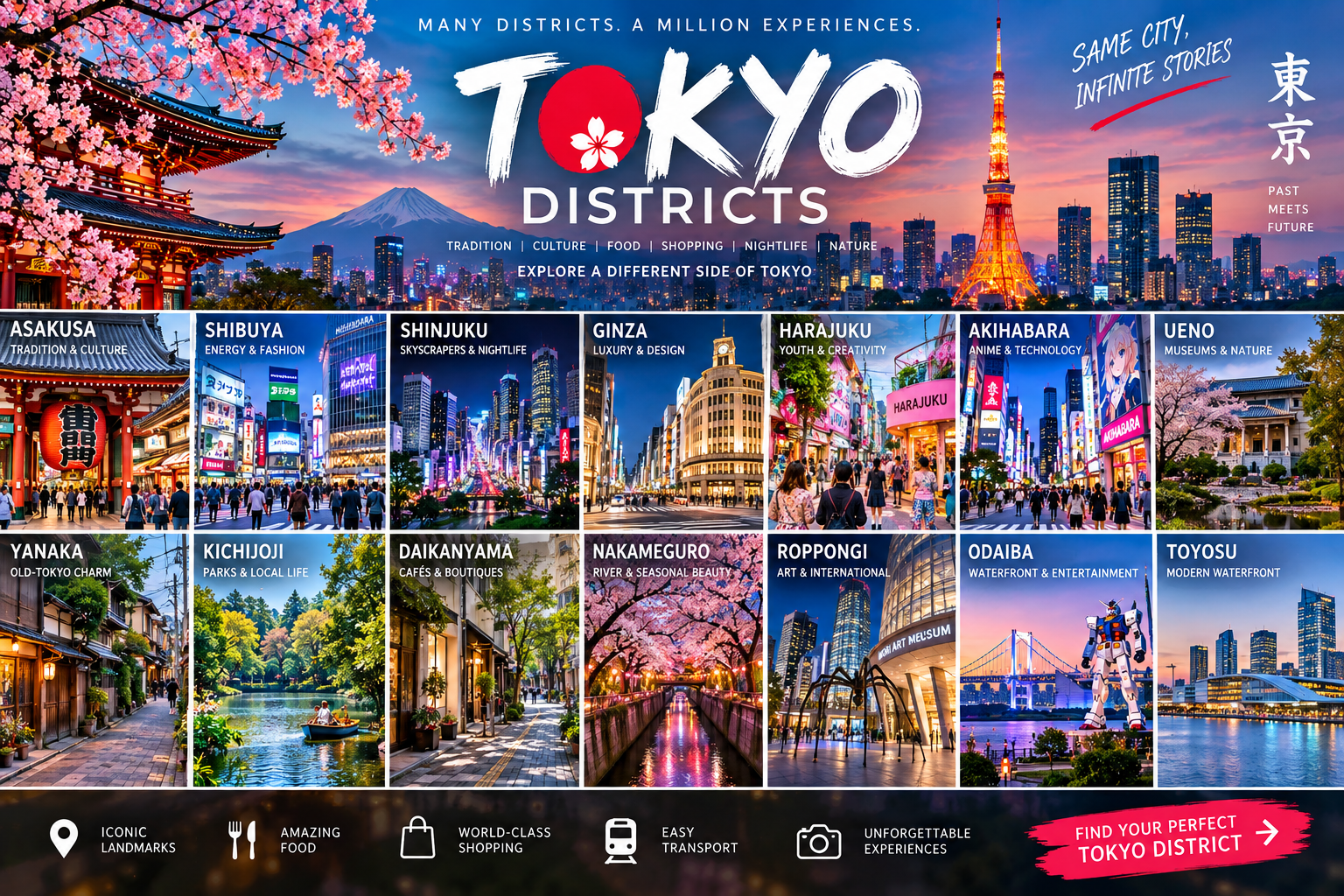
Tokyo districts offer completely different travel experiences, from the historic streets of Asakusa and Yanaka to the futuristic energy of Shibuya, the business architecture of Marunouchi, the specialist culture of Akihabara, and the relaxed neighbourhood atmosphere of Kichijoji. Choosing the right Tokyo district can change the entire character of a trip because each area has its own food, architecture, shopping, transport connections, history, and local atmosphere Tokyo Neighborhoods
Why Tokyo Has So Many Distinct Districts
Tokyo Developed as a Collection of Urban Centres
Tokyo did not become a giant modern city by developing one uniform downtown.
Different areas grew around castles, temples, railway stations, waterways, commercial streets, industrial areas, government institutions, universities and later redevelopment projects.
That history is still visible today.
A district built around an old temple naturally has a different character from an area built around a railway interchange.
A luxury commercial district develops differently from a residential neighbourhood.
A technology and specialist retail cluster develops differently from a waterfront redevelopment zone.
This layered development explains why Tokyo can feel like several cities connected together.
Railways Helped Shape Tokyo Districts
Railway stations are among the most important organising elements of modern Tokyo.
Major stations became commercial centres.
Retail followed commuters.
Offices followed transport connections.
Hotels followed business and tourism demand.
Restaurants followed pedestrians.
Entertainment followed population density.
Over time, this created districts with strong identities around major stations.
Shibuya, Shinjuku, Ueno, Ikebukuro and Tokyo Station are good examples of how transportation and urban development interact.
Tokyo’s Districts Are Not All the Same Type
Some areas are primarily commercial.
Others are residential.
Some are historic.
Others are strongly associated with contemporary fashion, technology, art or business.
There are also districts where multiple identities overlap.
This is why travellers should choose areas according to interests rather than simply searching for a universal “best area.”
The Best Way to Understand Tokyo Districts
Think in Terms of Travel Personality
Instead of asking which district is best, ask which district fits your trip.
For example:
- History: Asakusa, Yanaka, Ueno
- Modern city life: Shibuya, Shinjuku
- Luxury: Ginza, Marunouchi, Omotesando
- Anime and gaming culture: Akihabara, Ikebukuro
- Fashion: Harajuku, Omotesando, Shibuya
- Relaxed neighbourhoods: Kichijoji, Koenji, Shimokitazawa
- Waterfront: Odaiba, Toyosu
- Architecture: Ginza, Marunouchi, Omotesando
- Family travel: Ueno, Odaiba, Kichijoji
- Traditional atmosphere: Asakusa, Yanaka, Nezu
- Food exploration: Tsukiji, Ueno, Shinjuku, Asakusa
- Business travel: Marunouchi, Shinjuku, Shinagawa
- Photography: Shibuya, Asakusa, Yanaka, Tokyo Station
- First-time visitors: Shibuya, Asakusa, Shinjuku, Ginza, Tokyo Station
These combinations are not rigid rules.
A district can serve multiple types of travellers.
Shibuya: Tokyo’s Contemporary Urban Showcase
What Makes Shibuya Different
Shibuya is one of the most recognisable Tokyo districts and one of the city’s strongest examples of modern urban culture.
It combines shopping, fashion, technology, restaurants, entertainment, offices, pedestrian spaces and major transportation connections.
The famous Shibuya Crossing is only the beginning.
The wider district reveals how Tokyo continuously rebuilds itself.
Modern towers, shopping complexes, railway infrastructure and pedestrian routes have changed the area substantially.
Why Tourists Visit Shibuya
Shibuya is particularly attractive to:
- First-time visitors
- Young travellers
- Fashion enthusiasts
- Photographers
- Shopping enthusiasts
- Architecture lovers
- Visitors interested in modern Tokyo
Tokyo’s 2025 foreign-tourist survey found that Shibuya had the highest visitation rate among surveyed areas at 66.1%, ahead of the Tokyo Station/Marunouchi/Nihonbashi area, Ginza, Shinjuku/Okubo and Asakusa.
What to Do in Shibuya
Walk around the major pedestrian areas.
Explore shopping streets.
Look at contemporary architecture.
Visit observation spaces where available.
Explore side streets.
Try local cafés and restaurants.
Spend time beyond the famous crossing.
The side streets are often more useful for understanding the district than simply taking a photograph of the intersection.
Shibuya for First-Time Visitors
Shibuya works well early in a Tokyo trip because it immediately demonstrates the scale and energy of the modern city.
However, it can also be overwhelming.
Give yourself enough time to navigate the station and surrounding buildings.
Shinjuku: Tokyo’s Vertical City
Why Shinjuku Is Important
Shinjuku is one of Tokyo’s most significant transportation and commercial centres.
It combines offices, department stores, restaurants, hotels, entertainment, public spaces and major railway infrastructure.
For urban tourism, Shinjuku is fascinating because of its vertical character.
Different activities occupy different floors.
Shinjuku for Business Travellers
The district has a strong business identity, making it convenient for visitors with meetings or corporate travel.
Its transportation connections also make it useful as a base for exploring other parts of Tokyo.
Shinjuku for Tourists
Visitors can combine:
- Shopping
- Architecture
- Parks
- Restaurants
- Observation areas
- Department stores
- Neighbourhood walking
The district is large enough that it deserves more than a quick station visit.
Shinjuku and Okubo
The wider Shinjuku and Okubo area offers a more diverse cultural environment.
Tokyo’s 2025 data showed that Shinjuku and Okubo remained among the five most visited areas by foreign tourists, with a visitation rate of 54.8%.
Asakusa: Traditional Tokyo
Why Asakusa Stands Out
Asakusa is one of the most useful Tokyo districts for visitors who want to experience the city’s historic side.
Its streets, temples, traditional shops and cultural landmarks provide a very different atmosphere from Shibuya or Shinjuku.
Asakusa for History Lovers
Visitors interested in Tokyo’s historical development should spend time walking rather than moving directly between attractions.
Look at traditional shopfronts.
Observe street layouts.
Explore smaller lanes.
Study the relationship between tourism and local commerce.
Asakusa for First-Time Visitors
Asakusa is particularly valuable because it provides an immediate contrast to modern Tokyo.
A traveller can experience traditional architecture in the morning and reach a modern commercial district later the same day.
Asakusa’s Continued Popularity
Asakusa remains a major international tourism area.
The Tokyo Tourism Data Catalog found a 2025 foreign-visitor visitation rate of 49.3%, while its visitation rate had increased compared with 2019.
Ueno: Museums, Parks and Culture
Why Visit Ueno
Ueno offers a combination of cultural institutions, green space, transportation and traditional urban life.
It is particularly suitable for travellers who want to combine museums with outdoor exploration.
Ueno for Families
Families can benefit from the concentration of attractions around the area.
Instead of crossing Tokyo repeatedly, visitors can spend several hours exploring the neighbourhood.
Ueno for Culture Lovers
Museums and cultural institutions make Ueno a useful destination for visitors interested in Japanese history, art and science.
The surrounding area also provides opportunities for food and shopping.
Ginza: Luxury, Design and Established Tokyo
What Makes Ginza Different
Ginza represents a polished commercial side of Tokyo.
The district is associated with luxury retail, department stores, restaurants, design and architecture.
Ginza for Luxury Travellers
Ginza is a natural choice for travellers interested in:
- Luxury shopping
- Fine dining
- Premium hotels
- Architecture
- Japanese craftsmanship
- Department stores
Ginza for Architecture Lovers
Even visitors who are not interested in luxury shopping can enjoy walking through Ginza.
The district’s buildings demonstrate how commercial architecture has evolved over generations.
Tokyo’s 2025 tourism analysis recorded Ginza among the most visited areas by foreign travellers, with a 55.6% visitation rate in the mobile-data/survey analysis.
Tokyo Station, Marunouchi and Nihonbashi
Tokyo Station
Tokyo Station is both a transportation hub and a destination.
Its architecture, surrounding commercial district and connections make it an excellent starting point for central Tokyo exploration.
Marunouchi
Marunouchi has a strong business and corporate identity.
Large office buildings coexist with retail, restaurants and public spaces.
Nihonbashi
Nihonbashi provides a connection to Tokyo’s commercial history.
It is particularly interesting for travellers who want to see how older commercial traditions have been incorporated into contemporary Tokyo.
Why This Area Is Growing in Tourism Importance
Tokyo’s tourism data shows a notable increase in foreign visitation to the Tokyo Station, Marunouchi and Nihonbashi area.
Compared with 2019, the 2025 visitation rate rose by 19.4 percentage points, from 36.3% to 55.7%, moving the area from seventh to second in the cited comparison.
That change suggests that international visitors are increasingly including central business and architectural areas in their sightseeing plans.
Harajuku: Fashion and Youth Culture
Why Harajuku Is Famous
Harajuku has long been associated with youth fashion, creative culture and distinctive street styles.
The area demonstrates how fashion can shape an entire urban identity.
Harajuku for Young Travellers
The district is particularly attractive to visitors interested in:
- Fashion
- Street culture
- Photography
- Design
- Youth trends
- Shopping
Harajuku and Omotesando Together
Harajuku and Omotesando can be explored as one itinerary.
Harajuku provides a more youth-oriented atmosphere, while Omotesando offers major retail architecture and established luxury brands.
GO TOKYO describes the Harajuku-Omotesando area as an important centre for fashion, culture and contemporary architecture.
Omotesando and Aoyama: Architecture and Sophisticated Shopping
Why Visit Omotesando
Omotesando is particularly interesting for architecture enthusiasts.
Major buildings by well-known architects create a streetscape that functions almost like an open-air architecture exhibition.
Aoyama for Design Lovers
Aoyama combines design, fashion, restaurants, galleries and contemporary urban development.
It can be a strong choice for visitors who want a quieter alternative to the intensity of Shibuya.
Akihabara: Electronics, Anime and Specialist Culture
What Makes Akihabara Unique
Akihabara has developed a distinctive identity around electronics, gaming, anime, manga and specialist retail.
The area demonstrates how a commercial district can build a global identity around specialised consumer culture.
Akihabara for Enthusiasts
Visitors interested in:
- Gaming
- Electronics
- Anime
- Manga
- Collectibles
- Technology
may find the district particularly engaging.
Look Beyond the Main Streets
The most famous streets provide only part of the experience.
Explore smaller shops and surrounding streets to understand how specialist retail operates within the district.
GO TOKYO specifically features Akihabara as a destination for exploring Tokyo’s specialist popular culture.
Ikebukuro: Entertainment, Shopping and Accessibility
Why Ikebukuro Deserves Attention
Ikebukuro is sometimes overlooked by first-time visitors who concentrate on Shibuya and Shinjuku.
That can be a mistake for travellers whose interests align with the district.
Ikebukuro combines major transportation connections, shopping, entertainment, restaurants and cultural attractions.
Ikebukuro for Families
The area has attractions that can work well for families and younger visitors.
Its transportation connections also make it practical as a base.
Ikebukuro for Repeat Visitors
Travellers who have already experienced central Tokyo’s most famous districts can use Ikebukuro as an alternative urban centre.
Tokyo’s tourism data showed a 7.3-percentage-point increase in foreign visitation to Ikebukuro compared with 2019 in the cited analysis.
Yanaka and Nezu: Old-Tokyo Atmosphere
Why Yanaka Feels Different
Yanaka offers a slower urban rhythm.
Traditional streets, temples, small businesses and residential areas create an atmosphere that differs substantially from major commercial centres.
Yanaka for Slow Travel
This is an ideal type of district for travellers who prefer walking over rushing.
Spend time looking at details.
Visit small shops.
Explore traditional streets.
Take photographs respectfully.
Yanaka for Repeat Visitors
Yanaka is particularly valuable after a first trip to Tokyo because it provides a different understanding of the city.
Instead of Tokyo as a futuristic megacity, visitors experience Tokyo as a collection of communities.
GO TOKYO specifically highlights Yanaka and Nezu as areas with an old-town atmosphere.
Koenji: Alternative Neighbourhood Tokyo
Why Koenji Is Interesting
Koenji offers a more local neighbourhood atmosphere with independent businesses, cafés, music-related culture and shopping streets.
It is useful for travellers who want to move away from the most internationally recognised tourist districts.
Koenji for Repeat Visitors
Koenji works especially well for people who have already visited Shibuya, Shinjuku and Asakusa.
The experience is less about checking off famous landmarks and more about exploring.
Shimokitazawa: Independent Culture and Creative Energy
What Makes Shimokitazawa Different
Shimokitazawa has a reputation for independent shops, vintage fashion, cafés, music and creative culture.
The district demonstrates how smaller commercial streets can create strong identities.
Shimokitazawa for Young Adults
It is particularly suitable for travellers interested in:
- Vintage fashion
- Independent retail
- Cafés
- Music
- Creative culture
- Photography
Daikanyama: Relaxed Contemporary Tokyo
Why Visit Daikanyama
Daikanyama offers a calmer alternative to Shibuya while remaining relatively close to the major commercial centre.
Its cafés, boutiques, design-focused businesses and streets make it suitable for travellers who want modern Tokyo without the intensity of a major transport hub.
Daikanyama for Couples
The district can work well for couples looking for a slower walking and dining experience.
Ebisu: Dining and Neighbourhood Life
Why Ebisu Is Popular
Ebisu combines restaurants, cafés, shopping and residential streets.
It is useful for visitors who want a more relaxed evening environment without leaving central Tokyo.
Ebisu for Food Lovers
The district is particularly suitable for travellers who want to explore restaurants and smaller food businesses.
Nakameguro: Riverfront Walking and Cafés
Why Nakameguro Stands Out
Nakameguro is strongly associated with its riverside environment, cafés, boutiques and residential character.
It is especially attractive during seasonal periods when the riverside scenery changes.
Nakameguro for Photographers
The combination of water, bridges, streets, buildings and seasonal vegetation provides varied photographic opportunities.
Roppongi: Art, Business and International Tokyo
Why Visit Roppongi
Roppongi combines contemporary art, international business, shopping, dining and large-scale urban development.
Roppongi for Art Lovers
The district is useful for visitors interested in museums, galleries and modern cultural institutions.
Roppongi for Business Travellers
Its international business environment also makes it relevant for corporate visitors.
Azabu and Azabu-Juban: Food and Residential Tokyo
Why Explore Azabu-Juban
Azabu-Juban offers a more residential experience while remaining close to central Tokyo’s premium districts.
Its restaurants and local businesses provide opportunities to experience a different side of the city.
Tokyo Tower Area: Iconic Skyline Experiences
Why Tokyo Tower Still Matters
Tokyo Tower remains one of the city’s recognisable landmarks.
The surrounding area combines parks, temples, offices and residential streets.
Look Beyond the Tower
Instead of simply visiting the tower, walk around the wider neighbourhood.
This reveals how major landmarks interact with ordinary urban life.
Odaiba: Waterfront Tokyo
What Makes Odaiba Different
Odaiba represents a very different model of urban development.
It is a waterfront district with large public spaces, modern buildings, entertainment facilities and views across Tokyo Bay.
Odaiba for Families
Families can find attractions and open spaces that are difficult to replicate in denser central districts.
Changing Visitor Patterns
Tokyo’s 2025 tourism analysis found that the Odaiba and Tokyo Bay area’s foreign visitation rate was 16.1%, down from 23.8% in the comparable 2019 data.
This is a useful reminder that tourist popularity changes over time.
An area that was highly fashionable several years ago may not necessarily be where current visitors are concentrating.
Toyosu: Modern Waterfront Development
Why Visit Toyosu
Toyosu provides a useful perspective on Tokyo’s modern waterfront development.
The district combines residential development, commercial facilities, public spaces and food-related tourism.
Toyosu for Families
Its spacious modern environment can appeal to families who prefer contemporary facilities and wider pedestrian areas.
Kiyosumi-Shirakawa: Coffee and Creative Neighbourhoods
Why Kiyosumi-Shirakawa Is Interesting
Kiyosumi-Shirakawa has developed a reputation for cafés, galleries, warehouses converted into creative spaces and a calmer neighbourhood environment.
Kiyosumi-Shirakawa for Coffee Lovers
It can be a good destination for travellers who want to explore Tokyo’s specialty coffee culture away from the largest tourist centres.
Ryogoku: Sumo and Traditional Culture
Why Visit Ryogoku
Ryogoku is strongly associated with sumo culture and traditional Tokyo.
It is an excellent choice for travellers interested in Japanese sports history and cultural traditions.
Ryogoku for Culture Travellers
The district can be combined with nearby eastern Tokyo areas to create a broader cultural itinerary.
Kichijoji: Parks and Neighbourhood Comfort
Why Kichijoji Is Popular
Kichijoji is frequently associated with a more relaxed urban lifestyle.
It combines shopping streets, cafés, restaurants and access to Inokashira Park.
Kichijoji for Families
The combination of green space and urban amenities makes Kichijoji attractive for families.
Kichijoji for Repeat Visitors
It is also useful for visitors who want to explore beyond central Tokyo.
GO TOKYO includes Kichijoji among the western Tokyo areas covered by its neighbourhood guides.
Mitaka: Museums and Green Space
Why Visit Mitaka
Mitaka provides access to cultural attractions and green environments while offering a different pace from central Tokyo.
It can work well as part of a western Tokyo itinerary.
Shinagawa: Transport and Business
Why Shinagawa Matters
Shinagawa is particularly important for travellers who value transportation convenience.
The area combines business, hotels, restaurants and railway connections.
Shinagawa for Business Travellers
It can be practical for visitors whose trips involve corporate meetings or travel beyond central Tokyo.
Haneda Area: Airport-Connected Tokyo
Why the Haneda Area Matters
Haneda is important for international and domestic travellers because of its airport connections.
Rather than treating the airport only as a place of arrival or departure, travellers with sufficient time can explore parts of the surrounding area.
The 23 Wards and the Greater Tokyo Experience
Tokyo Is Bigger Than the Famous Tourist Core
One of the most important things to understand about Tokyo districts is that the famous tourist core represents only a portion of the metropolitan area.
GO TOKYO’s current destination guide includes areas ranging from central Tokyo to northern, eastern, western and southern districts, as well as Tama and the Tokyo islands.
This creates enormous possibilities for repeat visitors.
Northern Tokyo
Northern areas include places such as:
- Ueno
- Yanaka
- Nezu
- Sugamo
- Nippori
- Akabane
- Kita-Senju
- Shibamata
These areas can be useful for travellers seeking traditional neighbourhoods, local commerce and alternatives to central tourist centres.
Eastern Tokyo
Eastern Tokyo includes:
- Asakusa
- Ryogoku
- Tokyo Skytree area
- Toyosu
- Kiyosumi-Shirakawa
- Fukagawa
These areas combine traditional culture, waterfront development and modern attractions.
Western Tokyo
Western Tokyo includes:
- Shinjuku
- Shibuya
- Harajuku
- Omotesando
- Shimokitazawa
- Daikanyama
- Kichijoji
- Nakano
- Koenji
- Okubo
This side of Tokyo is particularly diverse, combining major commercial districts with creative neighbourhoods.
Southern Tokyo
Southern Tokyo includes:
- Odaiba
- Shinagawa
- Tennozu
- Nakameguro
- Roppongi
- Azabu
- Tokyo Tower area
- Ebisu
- Haneda
- Jiyugaoka
These districts provide combinations of business, luxury, art, waterfront development and neighbourhood experiences.
Tokyo Districts for First-Time Visitors
Best Strategy for a First Tokyo Trip
First-time visitors should avoid trying to cover every district.
A balanced first trip could combine:
- Asakusa for history
- Ueno for culture
- Tokyo Station and Marunouchi for central Tokyo
- Shibuya for modern Tokyo
- Shinjuku for the metropolitan experience
- Harajuku and Omotesando for fashion
- One quieter neighbourhood for contrast
This creates a broad introduction without requiring constant cross-city travel.
Tokyo Districts for Families
Family-Friendly Planning Principles
Families should consider:
- Shorter transportation journeys
- Parks
- Museums
- Spacious shopping centres
- Rest areas
- Accessible facilities
- Food options suitable for different ages
Ueno, Odaiba, Kichijoji and selected central districts can work well depending on the family’s interests.
Tokyo also publishes an accessibility-focused sightseeing guide with routes covering the 23 wards, Tama and island areas, including accessibility information and travel-time details.
Tokyo Districts for Solo Travellers
Why District-Based Travel Works Well Alone
Solo travellers can change plans more easily.
Instead of creating a strict schedule, choose a district and explore it on foot.
This allows time for:
- Cafés
- Museums
- Shopping
- Photography
- Local restaurants
- Architecture
- Small parks
Shibuya and Shinjuku offer high-energy experiences, while Yanaka, Kiyosumi-Shirakawa and Daikanyama provide slower alternatives.
Tokyo Districts for Couples
Romantic District Choices
Couples may prefer districts that support slower walking and dining.
Possible choices include:
- Nakameguro
- Daikanyama
- Ginza
- Marunouchi
- Odaiba
- Kiyosumi-Shirakawa
The best choice depends on whether the couple prefers food, architecture, waterfront scenery, shopping or quieter neighbourhoods.
Tokyo Districts for Food Lovers
Tsukiji
Tsukiji remains important for food-oriented travel, particularly for visitors interested in seafood, markets and Japanese culinary culture.
Shinjuku
Shinjuku provides a huge range of dining options across different price levels.
Asakusa
Asakusa offers traditional food experiences alongside its cultural attractions.
Ueno
Ueno is useful for combining food exploration with museums and parks.
Ginza
Ginza is particularly suitable for premium dining.
Tokyo Districts for Budget Travellers
Look Beyond Central Luxury Areas
Budget travellers can often benefit from exploring neighbourhoods outside the most premium commercial zones.
Areas with extensive railway connections can provide practical access to attractions without requiring travellers to stay in the most expensive locations.
Focus on Experiences Rather Than Admission Fees
Walking neighbourhoods, exploring public parks, viewing architecture and visiting many temples and shrines can create a rich itinerary without requiring expensive attractions every day.
Tokyo Districts for Luxury Travellers
Ginza
Ginza is strongly associated with luxury retail and premium dining.
Marunouchi
Marunouchi combines luxury hotels, high-end retail, restaurants and corporate architecture.
Omotesando and Aoyama
These areas provide fashion, design and premium shopping.
Roppongi
Roppongi combines luxury, art, business and contemporary urban development.
Tokyo Districts for Photographers
Shibuya
Best for modern city energy and pedestrian scenes.
Asakusa
Best for traditional architecture and cultural imagery.
Yanaka
Best for quieter streets and neighbourhood scenes.
Tokyo Station
Best for architecture.
Odaiba
Best for modern waterfront views.
Nakameguro
Best for riverside and seasonal photography.
Tokyo Districts for Architecture Lovers
Marunouchi
Corporate architecture and public spaces.
Ginza
Commercial architecture and design.
Omotesando
Contemporary architecture and fashion retail.
Shibuya
Large-scale redevelopment and vertical urbanism.
Tokyo Station
Historic railway architecture combined with modern surrounding development.
How to Choose Where to Stay in Tokyo
Stay Near a Well-Connected Station
Transportation convenience is usually more important than staying next to a particular attraction.
A well-connected station can save time throughout a multi-day trip.
Match the District to Your Travel Style
If you enjoy nightlife and high-energy city life, consider areas around Shibuya or Shinjuku.
If you prefer history, consider Asakusa or Yanaka.
If you want luxury, consider Ginza or Marunouchi.
If you want quieter neighbourhoods, look toward Kichijoji, Daikanyama or similar areas.
Think About Your Morning and Evening Plans
A hotel can appear inexpensive but become inconvenient if you spend an hour travelling to your preferred districts every day.
Calculate the overall time cost, not just the room price.
How to Explore Tokyo Districts Efficiently
Use a Two-District Rule
For a normal sightseeing day, choose one main district and one nearby or easily connected secondary area.
This reduces unnecessary travel.
Use Walking as Transportation
Tokyo is often best understood between stations.
Walk when distances are reasonable.
Visit Popular Places Early
If a famous attraction is essential to your itinerary, consider visiting early and using the rest of the day for neighbourhood exploration.
Create Theme-Based Days
Instead of jumping randomly between districts, create themes.
For example:
History day.
Architecture day.
Food day.
Fashion day.
Neighbourhood day.
Waterfront day.
This creates a more coherent travel experience.
Common Mistakes When Visiting Tokyo Districts
Trying to Visit Too Many Districts in One Day
Tokyo’s transportation system is efficient, but efficiency does not mean instant travel.
Stations can be large.
Transfers can take time.
Walking between exits can take longer than expected.
Staying Only in Famous Areas
Famous districts deserve attention, but they are not the complete Tokyo experience.
Confusing Administrative Wards With Tourism Districts
A ward can contain several very different neighbourhoods.
“Shibuya” can refer to a ward and a specific district.
The same principle applies throughout Tokyo.
Ignoring the Station Exit
Large stations can have many exits.
Choosing the correct exit can save significant walking time.
Overplanning Meals
Some of Tokyo’s best food experiences can happen spontaneously.
Leave some flexibility.
Challenges of Tokyo District Tourism
Crowding
Popular areas can become crowded, particularly around major stations and famous attractions.
Concentration of Visitors
Tokyo’s current tourism data shows that international visitors are concentrated in a relatively small number of central areas. The five leading wards for foreign travellers in the 2025 mobile-data analysis accounted for 56.9% of aggregate foreign traveller stays.
Language Differences
Major tourist districts generally provide more multilingual information, but smaller businesses may operate primarily in Japanese.
Accessibility
Tokyo has made substantial efforts to provide accessibility information, but the size and complexity of some stations can still make navigation challenging for travellers with mobility requirements.
Planning routes in advance can help.
Advantages and Disadvantages of Tokyo District Tourism
Advantages
Tokyo district-based travel offers:
- Huge variety
- Strong public transportation
- Distinct neighbourhood identities
- Historic and modern environments
- Extensive food choices
- Diverse accommodation
- Excellent shopping
- Cultural institutions
- Architecture
- Seasonal experiences
- Options for almost every travel style
Disadvantages
Potential challenges include:
- Crowded popular areas
- Long walking distances
- Large railway stations
- Complex transport networks
- Higher accommodation prices in premium districts
- Language barriers in smaller businesses
- Difficulty seeing the entire city in a short trip
Ten Major Travel Brands and Services for Exploring Tokyo Districts
The following table compares major tourism, transport, navigation and travel-planning brands relevant to exploring Tokyo. It is a functional comparison rather than a ranking.
| Brand / Service | Category | Useful For | Tokyo District Application |
|---|---|---|---|
| GO TOKYO | Official tourism guide | Destination research | District guides and attractions |
| JNTO | National tourism organisation | Japan-wide planning | Tokyo plus other Japanese destinations |
| JR East | Railway operator | Train travel | Major stations and regional connections |
| Tokyo Metro | Subway operator | Central Tokyo transport | Connecting many central districts |
| Suica | IC transport service | Everyday travel | Convenient rail and transit payments |
| PASMO | IC transport service | Public transport | Rail and bus travel |
| NAVITIME | Navigation | Route planning | Detailed transport journeys |
| Google Maps | Maps/navigation | Walking and directions | District-level exploration |
| Tripadvisor | Travel research | Reviews and attractions | Visitor opinions and planning |
| Booking.com | Accommodation platform | Hotels and stays | Comparing accommodation by district |
GO TOKYO currently provides district information covering central, northern, eastern, western and southern Tokyo, as well as Tama and the Tokyo islands.
Its 2026 Tokyo Travel Guide is also organised across central Tokyo, northern Tokyo, eastern Tokyo, western Tokyo, southern Tokyo, Tama and the island areas, demonstrating the breadth of Tokyo’s tourism geography.
Tokyo Districts Compared by Travel Purpose
| Travel Purpose | Districts to Consider | Main Reason |
|---|---|---|
| First Tokyo trip | Shibuya, Asakusa, Shinjuku | Broad introduction to modern and historic Tokyo |
| History | Asakusa, Yanaka, Ueno | Traditional streets and cultural attractions |
| Food | Tsukiji, Shinjuku, Asakusa, Ueno | Diverse dining and food culture |
| Luxury | Ginza, Marunouchi, Omotesando | Premium shopping and dining |
| Families | Ueno, Odaiba, Kichijoji | Museums, parks and family attractions |
| Solo travel | Shibuya, Shinjuku, Yanaka | Flexible activities and transport |
| Fashion | Harajuku, Omotesando, Shibuya | Retail and street culture |
| Technology | Akihabara, Shibuya | Electronics, technology and modern culture |
| Art | Roppongi, Ueno, Kiyosumi-Shirakawa | Museums, galleries and creative spaces |
| Architecture | Ginza, Marunouchi, Omotesando | Distinctive buildings and urban design |
| Quiet exploration | Yanaka, Kichijoji, Daikanyama | Slower neighbourhood atmosphere |
| Waterfront | Odaiba, Toyosu | Modern bay-area development |
| Photography | Asakusa, Shibuya, Yanaka | Contrasting visual environments |
| Business | Marunouchi, Shinjuku, Shinagawa | Offices and transport connections |
| Repeat visitors | Koenji, Shimokitazawa, Yanaka | Alternative neighbourhood experiences |
The Changing Popularity of Tokyo Districts
Shibuya’s Continued Dominance
Current tourism data shows that Shibuya remains particularly strong among foreign visitors.
The Tokyo Metropolitan Government’s 2025 foreign traveller behaviour survey reported Shibuya as the most visited destination at 60.3%, followed by Ginza at 54.1% and the Tokyo Station/Marunouchi/Nihonbashi area at 51.8%.
Another Tokyo tourism analysis using a different methodology reported a 66.1% Shibuya visitation rate in 2025. The difference illustrates an important point: tourism percentages depend on the survey population, question design and measurement method, so figures should not automatically be treated as interchangeable.
Central Tokyo Is Becoming More Diverse
The rise of the Tokyo Station, Marunouchi and Nihonbashi area is particularly notable.
Visitors increasingly appear interested in business districts, architecture and central-city development rather than only traditional tourist attractions.
Repeat Visitors Are Important
Tokyo’s 2025 foreign-tourist behaviour survey found that 54.6% of respondents were repeat visitors, meaning they had visited Tokyo at least twice.
That has major implications for district tourism.
First-time visitors often prioritise famous landmarks.
Repeat visitors have more reason to explore less familiar neighbourhoods.
Tokyo Districts and Responsible Tourism
Spread Visitor Spending
One practical approach to responsible tourism is to explore districts beyond the most crowded locations.
This can distribute visitor spending across more neighbourhood businesses.
Respect Residential Streets
A residential district is not an attraction simply because it appears on social media.
Keep noise low.
Avoid blocking entrances.
Do not enter private property.
Follow photography restrictions.
Support Local Businesses
Independent restaurants, cafés, shops and craft businesses can benefit directly from thoughtful tourism.
Avoid Treating Every District as a Photo Set
Tokyo’s neighbourhoods are living communities.
The best traveller is not necessarily the person who takes the most photographs.
It is the person who understands the place they are visiting.
Tokyo Districts and Future Tourism Trends
Neighbourhood Tourism Will Become More Important
As famous attractions become more crowded, visitors are likely to search for alternatives.
This does not mean famous districts will disappear from itineraries.
Instead, travellers may combine iconic areas with lesser-known neighbourhoods.
Data Will Influence Tourism Management
Tokyo is already using mobile data and tourism surveys to understand where visitors go.
The Tokyo Tourism Data Catalog provides dashboards and raw tourism statistics, and its current materials include detailed analysis of where domestic and foreign travellers stay and visit.
This information can help tourism planners understand visitor concentration and potentially improve destination management.
Technology Will Make District Exploration Easier
Navigation, digital maps, translation tools, contactless payments and mobile travel information will continue reducing the friction associated with exploring Tokyo.
But technology cannot replace local awareness.
A map can tell you where a street is.
It cannot automatically tell you why that street matters.
Accessibility Will Become Increasingly Important
Tokyo already provides dedicated accessibility information covering multiple regions and sightseeing courses.
As international tourism grows, accessible tourism planning is likely to become increasingly important for families, older travellers and visitors with mobility requirements.
A Seven-Day Tokyo District Itinerary
Day One: Asakusa and Ueno
Start with traditional Tokyo.
Explore Asakusa’s historic streets before continuing toward Ueno.
This creates an introduction to Tokyo’s cultural and historical side.
Day Two: Shibuya and Harajuku
Experience contemporary Tokyo.
Walk from Shibuya toward Harajuku and Omotesando where practical.
This allows you to compare different forms of fashion, architecture and commercial culture.
Day Three: Shinjuku
Spend most of the day exploring Shinjuku.
Do not restrict yourself to the station.
Explore parks, department stores, architecture and surrounding streets.
Day Four: Tokyo Station, Marunouchi and Ginza
Start around Tokyo Station.
Explore Marunouchi before walking toward Ginza.
This is an excellent day for architecture, shopping and central Tokyo.
Day Five: Akihabara and Ryogoku
Combine specialist popular culture with traditional Japanese sports culture.
This demonstrates the contrast between different forms of Tokyo identity.
Day Six: Yanaka and Neighbourhood Tokyo
Slow down.
Explore Yanaka, Nezu and nearby streets.
Use the day for walking rather than collecting attractions.
Day Seven: Odaiba or Kichijoji
Choose based on your interests.
Select Odaiba for modern waterfront development.
Choose Kichijoji for parks and neighbourhood exploration.
A Three-Day Tokyo District Itinerary
Day One Tokyo districts
Shibuya, Harajuku and Omotesando.
Day Two Tokyo districts
Asakusa, Ueno and Tokyo Station.
Day Three Tokyo districts
Shinjuku and one nearby neighbourhood.
This provides a practical balance of modern, traditional and metropolitan Tokyo.
A Tokyo District Itinerary for Repeat Visitors
Day One Tokyo districts
Yanaka and Nezu.
Day Two Tokyo districts
Kiyosumi-Shirakawa and Fukagawa.
Day Three Tokyo districts
Koenji and Nakano.
Day Four Tokyo districts
Shimokitazawa and Daikanyama.
Day Five Tokyo districts
Kichijoji and Mitaka.
Day Six Tokyo districts
Toyosu and Odaiba.
Day Seven Tokyo districts
Choose a neighbourhood you enjoyed and explore it more deeply.
Practical Tips for Exploring Tokyo Districts
Wear Comfortable Shoes Tokyo districts
Tokyo district travel is often walking-intensive.
Carry a Small Bag Tokyo districts
Crowded trains and narrow streets make large luggage inconvenient.
Keep Your Itinerary Flexible Tokyo districts
Allow room for unexpected discoveries.
Check Opening Hours Tokyo districts
Museums and smaller attractions may have specific closing days.
Learn Basic Japanese Expressions Tokyo districts
Even simple greetings and thank-you phrases can make interactions easier.
Use Public Transportation Strategically Tokyo districts
Choose trains and subways for longer distances and walking for shorter neighbourhood connections.
Avoid Rush-Hour Travel When Possible Tokyo districts
If your itinerary is flexible, travelling outside the busiest commuting periods can make journeys more comfortable.
FAQs
What are the best Tokyo districts for first-time visitors?
Shibuya, Shinjuku, Asakusa, Ueno, Ginza and the Tokyo Station/Marunouchi area provide a broad introduction to Tokyo’s modern, traditional, cultural and commercial sides.
How many districts are there in Tokyo?
Tokyo has 23 special wards along with 26 cities, five towns and eight villages. However, tourism districts and neighbourhood names do not always correspond directly to administrative boundaries.
What is the most popular Tokyo district for tourists?
Current Tokyo tourism data identifies Shibuya as one of the most visited areas by foreign travellers. In the 2025 tourism analysis, Shibuya recorded the highest visitation rate among the listed areas.
Is Shibuya or Shinjuku better for tourists?
They provide different experiences. Shibuya focuses strongly on contemporary fashion, shopping and youth-oriented urban culture, while Shinjuku combines major transportation infrastructure, offices, shopping, dining and large-scale city development.
Which Tokyo district is best for history?
Asakusa and Yanaka are particularly useful for travellers interested in historic streets, traditional architecture and cultural heritage.
Which Tokyo district is best for shopping?
Ginza, Shibuya, Harajuku, Omotesando and Shinjuku all offer substantial shopping opportunities, although the type of shopping varies considerably.
Which Tokyo district is best for luxury shopping?
Ginza, Omotesando, Aoyama and Marunouchi are strong choices for premium shopping and luxury-oriented experiences.
Which Tokyo district is best for families?
Ueno, Odaiba and Kichijoji can work well for families because of their combination of parks, museums, attractions and accessible urban facilities.
Which Tokyo district is best for food?
There is no single best food district. Tsukiji, Shinjuku, Asakusa, Ueno, Ginza and many smaller neighbourhoods offer different styles of dining and food experiences.
Which Tokyo district is best for anime and gaming?
Akihabara is one of Tokyo’s most internationally recognised destinations for anime, manga, gaming, electronics and specialist retail.
Is Akihabara only for anime fans?
No. Akihabara also has electronics, technology-related retail, restaurants and interesting examples of specialised commercial development.
Which Tokyo district is best for a quiet experience?
Yanaka, Kiyosumi-Shirakawa, Daikanyama and selected parts of Kichijoji can provide a slower experience than the major commercial centres.
Which Tokyo district is best for photography?
Asakusa, Shibuya, Yanaka, Tokyo Station, Odaiba and Nakameguro offer very different photographic environments.
Which Tokyo district is best for architecture?
Ginza, Marunouchi, Omotesando, Tokyo Station and Shibuya are particularly interesting for visitors focused on architecture and urban design.
Is Tokyo easy to explore by train?
Yes. Tokyo has an extensive railway and subway network, and many of its major tourism districts are built around major transport hubs.
Should I stay in Shibuya?
Shibuya can be a convenient base for travellers who want contemporary city life, shopping and access to western and central Tokyo, but other districts may be more suitable depending on your interests and accommodation budget.
Should I stay in Shinjuku?
Shinjuku can be useful for travellers who prioritise transportation, restaurants, shopping and access to different parts of Tokyo.
Is Asakusa a good area to stay?
Asakusa can suit travellers who prefer a historic atmosphere and easy access to eastern Tokyo attractions.
Is Ginza expensive?
Ginza is strongly associated with premium retail and dining, so it can be expensive, although visitors can still explore the area without making luxury purchases.
Can I visit multiple Tokyo districts in one day?
Yes, but it is better to combine districts that are geographically close or well connected rather than repeatedly crossing the entire metropolitan area.
How many Tokyo districts should I visit in a week?
There is no fixed number. A balanced seven-day trip might explore six to ten main areas while allowing time for walking and spontaneous discoveries.
Are Tokyo districts safe for tourists?
Tokyo is generally considered a well-organised destination for visitors, but normal travel precautions remain appropriate. Travellers should respect local rules and remain aware of their belongings and surroundings.
Which Tokyo district is best for solo travellers?
Shibuya, Shinjuku, Asakusa, Yanaka and several central neighbourhoods can all work well for solo travellers, depending on whether they prefer busy urban environments or slower exploration.
Which Tokyo district is best for couples?
Nakameguro, Daikanyama, Ginza, Marunouchi and Odaiba can work well for couples interested in dining, shopping, architecture or waterfront experiences.
Which Tokyo district is best for repeat visitors?
Repeat visitors may enjoy neighbourhoods such as Yanaka, Koenji, Shimokitazawa, Kiyosumi-Shirakawa, Daikanyama, Kichijoji and Nakano because they provide experiences beyond the most famous tourist centres.
Are Tokyo districts crowded?
Some are extremely busy, particularly major commercial and transportation areas. Tokyo’s tourism data shows that international visitors are concentrated in a relatively small number of central districts.
How can I avoid crowds in Tokyo?
Visit major attractions early, travel outside peak periods where possible, explore alternative neighbourhoods and avoid concentrating every day around the busiest stations.
What is the difference between Tokyo wards and districts?
Wards are administrative divisions. Tourism districts and neighbourhoods are often informal geographic or cultural areas that can cross or sit within administrative boundaries.
Is Tokyo good for neighbourhood tourism?
Yes. Tokyo’s enormous variety of neighbourhoods is one of its strongest characteristics. Official tourism resources themselves organise Tokyo into numerous areas across central, northern, eastern, western and southern Tokyo.
Are Tokyo districts changing?
Yes. Redevelopment, changing visitor behaviour, new commercial projects, transportation improvements and tourism growth continually change the character and popularity of different areas.
Why is Shibuya so popular?
Shibuya combines major transport connections, shopping, fashion, entertainment, technology, contemporary architecture and internationally recognisable urban scenery. Current Tokyo tourism data places it among the most visited areas by foreign travellers.
Why should tourists explore smaller Tokyo neighbourhoods?
Smaller neighbourhoods can provide a slower and more local perspective on Tokyo, including independent shops, cafés, residential streets, parks and community businesses that may be missed on conventional sightseeing routes.
Conclusion
Tokyo districts are the key to understanding why the city remains such a compelling destination for international travellers. Tokyo is not one uniform urban environment. It is a huge network of neighbourhoods, each shaped by different histories, transportation systems, commercial activities, communities, architectural styles and cultural traditions. For a first-time visitor, districts such as Shibuya, Shinjuku, Asakusa, Ueno, Ginza and Tokyo Station provide an excellent introduction to the city’s major identities. Shibuya demonstrates contemporary urban culture, Shinjuku reveals Tokyo’s enormous commercial and transportation scale, Asakusa provides a connection to traditional Tokyo, Ueno combines culture and green space, Ginza showcases premium commercial development, and Marunouchi and Tokyo Station demonstrate the relationship between business, architecture and transportation.