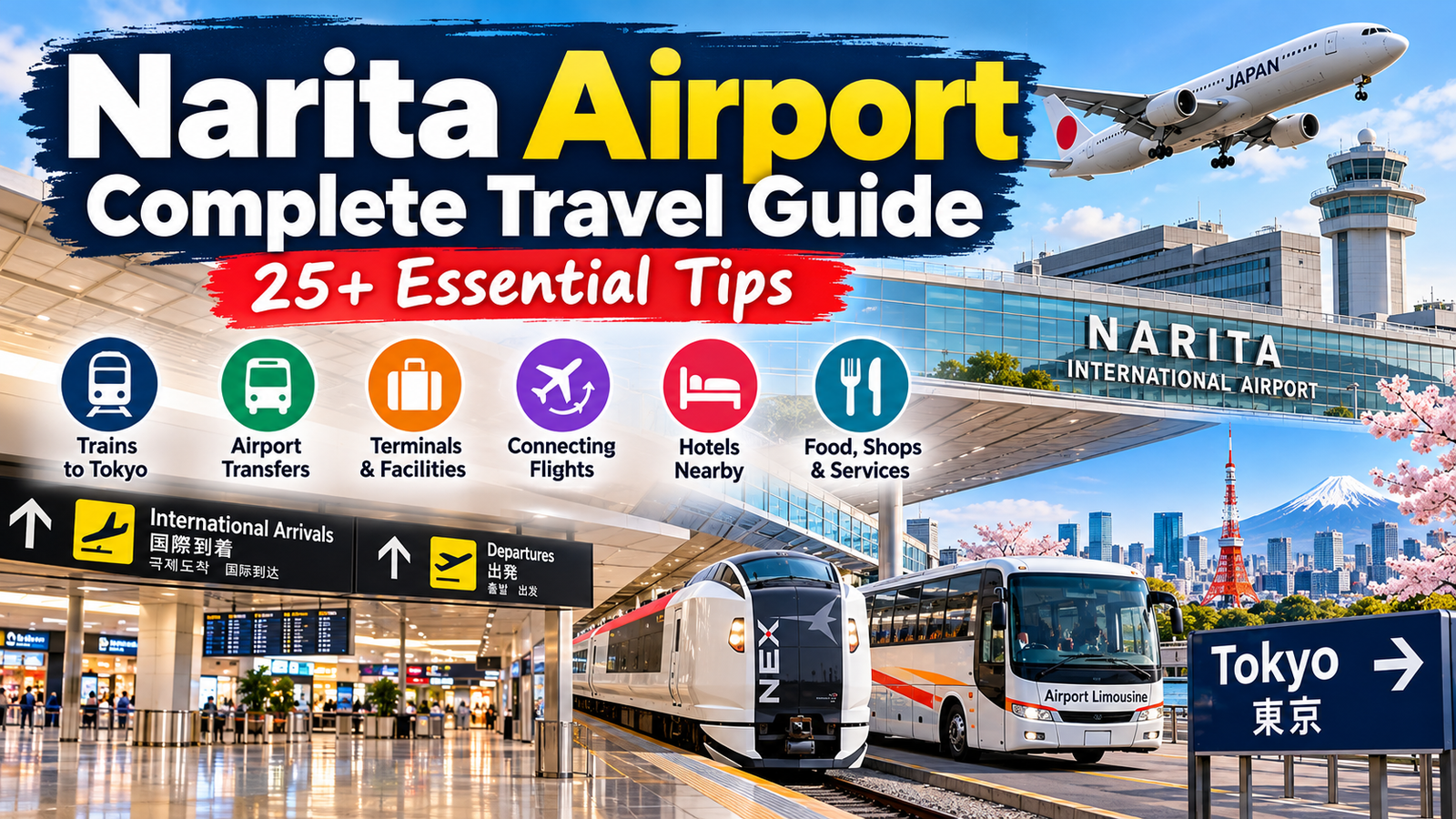
Narita Airport: The Ultimate 2026 Travel Guide 25+ Essential Tips for Terminals, Trains, Transfers and Tokyo Travel
Planning a trip to Japan can be exciting, but knowing how to navigate the airport, choose the right train and reach your accommodation can make your journey much easier. Narita International Airport is one of Japan’s major international gateways, connecting travellers with Tokyo and destinations throughout the country. Whether you are visiting Japan for the first time, travelling with family, attending a business meeting or connecting to another flight, understanding the airport’s terminals, transportation options and passenger facilities can save you time and reduce unnecessary stress Tokyo Luggage
What Is Narita International Airport?
Narita International Airport is a major aviation gateway serving the Tokyo metropolitan area and the wider Kanto region of Japan. It opened in 1978 and has developed into an important centre for international passenger travel and air cargo.
Although many travellers associate the airport directly with Tokyo, it is situated in Chiba Prefecture. This distinction matters when planning ground transportation because reaching central Tokyo requires additional travel after landing.
The airport provides facilities for international and domestic passengers, including check-in areas, baggage claim, restaurants, shops, passenger assistance and access to public transportation.
Why Is It Important for International Travellers?
The airport connects Japan with destinations across Asia, Europe, North America and other international markets. It also supports domestic journeys and connections to other Japanese cities.
Travellers may use it for several reasons:
- Visiting Tokyo for sightseeing.
- Exploring Japanese culture and historical attractions.
- Attending business meetings and conferences.
- Connecting to another international flight.
- Continuing to another destination within Japan.
- Beginning a longer holiday around the country.
Its combination of international flights and ground transportation makes it useful for many different travel plans.
Narita Airport vs Haneda Airport
Tokyo is served by two major airports: Narita International Airport and Haneda Airport.
Narita is located in Chiba Prefecture, while Haneda is within Tokyo. Haneda is generally closer to many central districts, whereas Narita often involves a longer journey by road or rail.
The better option depends on your airfare, flight schedule, final destination and preferred transportation.
For example, a traveller staying near a railway station served by an express service may find Narita convenient. Someone travelling to a hotel close to Haneda may prefer the shorter ground journey offered by the other airport.
When comparing flights, consider the total cost of your journey rather than looking only at the airfare.
Understanding the Three Passenger Terminals
The airport has three passenger terminals, each serving particular airlines and flights. Checking your terminal before leaving for the airport is one of the simplest ways to avoid unnecessary problems.
Terminal 1 Narita airport
Narita airport Terminal 1 handles international and domestic operations. It includes passenger check-in facilities, departure areas, dining options, shops and access to railway services.
Travellers departing from this terminal should confirm their airline’s check-in area and allow enough time for baggage drop, security screening and boarding.
The railway station serving this terminal is Narita Airport Station.
Terminal 2 Narita airport
Narita airportTerminal 2 accommodates a range of international and domestic flights. It includes passenger services, restaurants, retail outlets and access to public transportation.
Airport Terminal 2·3 Station serves passengers using both Terminal 2 and Terminal 3.
Passengers connecting between airlines should confirm their baggage arrangements and whether they need to complete immigration procedures before proceeding to another flight.
Terminal 3 Narita airport
Narita airportTerminal 3 is primarily associated with low-cost carriers and handles international and domestic services.
Its layout differs from the other terminals, so travellers should follow the airport’s signs carefully when moving between check-in, security screening and boarding areas.
Passengers can reach the terminal from the railway station serving Terminals 2 and 3 by using the designated walking corridor or the airport shuttle service.
How to Transfer Between Terminals Narita airport
Narita airport Free shuttle buses connect the passenger terminals. A designated walking route also connects Terminals 2 and 3.
Although the shuttle journeys themselves can be relatively short, the total transfer time may be longer because of waiting, walking and locating the correct departure area.
Before travelling:
- Confirm the terminal for your arriving flight.
- Check the terminal for your departing flight.
- Identify the correct transfer route.
- Allow extra time for queues and walking.
- Follow the current airport signs.
Do not assume that all flights operated by one airline always use the same terminal.
How to Travel from the Airport to Tokyo
Narita airport Choosing the right transportation option depends on your destination, budget, luggage and arrival time.
Some travellers prioritise speed, while others prefer the lowest fare or a direct connection to their accommodation.
Option 1: Narita Express Narita airport
The Narita Express, commonly called N’EX, is an airport express train operated by JR East.
It connects the airport with several major railway stations, including Tokyo, Shibuya, Shinjuku and Shinagawa on relevant services.
Advantages
- Direct connections to selected major stations.
- Reserved seating is available.
- Convenient for travellers carrying luggage.
- Useful for visitors whose accommodation is close to a served station.
Disadvantages
- May cost more than conventional railway services.
- Does not provide direct access to every Tokyo neighbourhood.
- Additional transportation may be necessary after arrival.
This service is worth considering if you want a relatively straightforward railway journey and your destination is convenient for its route.
Option 2: Keisei Skyliner Narita airport
The Keisei Skyliner is an express railway service connecting the airport with Nippori and Keisei Ueno.
It is particularly useful for travellers staying in the Ueno area or connecting to other railway services from these stations.
Advantages
- Fast connections to selected parts of Tokyo.
- Reserved seating.
- Convenient for travellers heading towards Ueno and Nippori.
- Useful connections to other urban railway routes.
Disadvantages
- Not a direct service to every central Tokyo destination.
- Additional transfers may be necessary.
- It is operated separately from JR East services.
Choose this option when its route matches your accommodation or onward journey.
Option 3: Airport Limousine and Other Buses Narita airport
Airport buses connect the airport with selected destinations, including transport hubs and certain hotels.
They can be convenient for families and travellers who prefer not to change trains while carrying several bags.
Advantages
- Direct access to selected destinations.
- Less need to carry luggage through railway stations.
- Useful for some hotel locations.
- Can be practical for groups.
Disadvantages
- Road congestion can increase journey times.
- Routes and departure times vary.
- Not every hotel or neighbourhood is served.
Before purchasing a ticket, confirm the destination, departure point, luggage allowance and expected arrival time.
Option 4: Conventional Railway Services Narita airport
Conventional trains can provide a lower-cost alternative to dedicated airport express services.
They may involve more stops, crowded carriages or additional transfers, depending on the route and time of day.
Budget-conscious travellers should compare the complete journey rather than focusing only on the first ticket.
Consider the total fare, onward connections, walking distances and the convenience of handling luggage.
Option 5: Taxi or Private Transfer Narita airport
Taxis and pre-booked private vehicles provide a more direct journey to a hotel or other destination.
They may be particularly useful for families, groups, travellers with bulky luggage or passengers arriving at inconvenient times.
However, private transport can be considerably more expensive than public transportation.
Before booking, check:
- Whether the fare is fixed or metered.
- Whether tolls and additional charges are included.
- Vehicle capacity and luggage space.
- Driver meeting arrangements.
- Procedures for delayed flights.
- Availability of child seats or accessibility assistance.
For a group, dividing the total cost between passengers may make a private transfer more attractive.
Transportation Comparison
| Transport option Narita airport | Best suited to Narita airport | Main disadvantage Narita airport |
|---|---|---|
| Narita Express | Major JR-connected destinations | Fare and onward connections |
| Keisei Skyliner | Ueno and Nippori | Additional transfers for other areas |
| Airport bus | Selected hotels and transport hubs | Road traffic |
| Conventional train | Budget-conscious travellers | Stops and possible crowding |
| Taxi or private transfer | Families and door-to-door travel | Higher cost |
Which Option Should You Choose?
- For Tokyo Station or other major JR-connected destinations: Compare the Narita Express with alternative routes.
- For Ueno or Nippori: Consider the Keisei Skyliner.
- For several suitcases: Check direct buses and private transfers.
- For a limited budget: Compare conventional rail fares and onward connections.
- For families or passengers with reduced mobility: Consider transfers, lifts, walking distances and luggage handling.
Always check current schedules, fares and service conditions before departure.
How Much Does Transportation Cost?
There is no single fare for travelling from the airport to Tokyo. Prices depend on the destination, transport operator, ticket type and date of travel.
A reserved express train, a conventional railway service and a private vehicle offer different levels of convenience and operate under different pricing arrangements.
Factors That Affect the Total Cost Narita airport
Destination: The fare depends on the station or neighbourhood you want to reach.
Service type: Express trains, conventional rail and buses have different fares and travel times.
Ticket eligibility: Some rail passes cover qualifying services, but supplements or separate operator tickets may be required.
Group size: A private vehicle may be expensive for one passenger but more competitive when shared among several people.
Onward travel: You may need another train, bus or taxi after reaching your first destination.
How to Compare Prices Properly Narita airport
Calculate the total journey cost by adding:
- Airport transportation.
- Onward railway or bus fares.
- Applicable ticket supplements.
- Relevant baggage or transfer charges.
- Any additional local transportation.
For a group, divide the total private transfer cost by the number of passengers before comparing it with public transportation.
The cheapest ticket is not always the best value. A slightly more expensive direct service may save time, reduce stress and eliminate additional transfers.
Arrival Procedures: Step-by-Step Guide
Arriving in Japan for the first time can feel complicated, especially after a long international flight. Understanding the order of the main procedures helps you move through the airport more confidently.
Step 1: Follow the Arrival Signs Narita airport
After leaving the aircraft, follow the signs for international arrivals and immigration.
Passengers continuing to another flight should follow their airline’s transfer instructions rather than automatically proceeding through the standard arrival route.
Step 2: Complete Immigration Narita airport
Present the documents required for your circumstances and follow the instructions of Japanese immigration officials.
Entry requirements depend on nationality, passport validity, visa status and the purpose and duration of your visit.
Review the current official requirements before departure. Do not assume that rules applying to another traveller also apply to you.
Step 3: Collect Your Baggage Narita airport
Proceed to the baggage claim area and locate the carousel assigned to your flight.
If your luggage does not arrive, contact your airline or its handling representative before leaving the baggage area.
Keep your baggage tag and boarding pass available in case you need to provide information.
Step 4: Complete Customs Procedures Narita airport
Follow the customs instructions applicable to your belongings.
Check Japanese rules concerning restricted or prohibited items, including food, plants, animal products, medicines and commercial goods.
An item permitted in your home country may still be restricted when entering Japan.
Step 5: Enter the Arrivals Area Narita airport
After completing the required procedures, you can enter the public arrivals area.
Depending on your needs, you may then:
- Find railway stations and ticket counters.
- Locate airport bus stops.
- Meet a pre-booked driver.
- Obtain Japanese yen.
- Arrange mobile connectivity.
- Find restaurants, toilets and other passenger facilities.
Step 6: Confirm Your Transportation Narita airport
Before leaving the airport, check the destination station, timetable, platform and transfer requirements.
Late-night arrivals require particular attention because some railway and bus services may have stopped operating.
If your intended service is unavailable, consider an alternative route, suitable accommodation or a pre-arranged transfer.
International Flight Connections Narita airport
Connecting flights require careful planning because the procedures depend on your ticket, baggage arrangements, airline and destination.
The first question is whether you will remain in the international transit area or enter Japan before continuing your journey.
International-to-International Connections Narita airport
Passengers arriving internationally and departing on another international flight should follow the airport’s transfer signs and their airline’s instructions.
Depending on the itinerary, you may need to pass through transfer security or use a terminal shuttle.
Before departure, confirm:
- Whether both flights are on one booking.
- Whether baggage is checked through to the final destination.
- Whether you must collect and recheck luggage.
- Which terminals the flights use.
- Whether your transit arrangements require entry permission.
- Whether your airline accepts the proposed connection time.
A shared airport does not guarantee that every connection is straightforward.
International-to-Domestic Connections Narita airport
Travellers connecting from an international flight to a domestic service within Japan generally need to complete immigration and customs procedures before proceeding to the domestic departure process.
If the next flight leaves from another terminal, a shuttle or designated walking route may be necessary.
Allow time for immigration queues, baggage collection, customs, terminal transfers, check-in and security screening.
Domestic-to-International Connections Narita airport
Passengers arriving on a domestic flight and continuing internationally must reach the correct departure area and complete the required international check-in and departure procedures.
Check your airline’s terminal arrangements and allow sufficient time for baggage, security and boarding.
How Much Connection Time Is Enough?
There is no universally safe connection time for every itinerary.
A passenger with a protected booking and through-checked luggage may have a different process from someone travelling on two separate tickets.
To reduce the risk of missing your flight:
- Check the minimum connection time accepted by your airline.
- Confirm whether immigration is required.
- Check terminal transfer arrangements.
- Allow for baggage and security delays.
- Consider a longer connection when travelling on separate tickets.
If missing the onward flight would be costly, a more generous connection is usually the safer choice.
Airport Facilities and Passenger Services Narita airport
The airport offers a range of services intended to help travellers prepare for their journeys, manage practical needs and spend time comfortably before departure.
Availability and opening hours vary by terminal and provider.
Restaurants and Food Options Narita airport
Airport dining can be useful for passengers who need a meal before a long flight or have time to spare before boarding.
Depending on the terminal, options may include Japanese cuisine, international meals, snacks, drinks and takeaway food.
Before choosing a restaurant, consider:
- Time remaining before boarding.
- Whether the outlet is before or after security.
- Dietary requirements.
- Whether you prefer takeaway or table service.
- Opening hours.
Travellers with specific dietary needs should confirm ingredients and preparation arrangements directly with the relevant restaurant.
Shopping and Souvenirs Narita airport
Airport shops can be convenient for purchasing gifts, snacks, travel essentials and Japanese souvenirs.
The range of products depends on the terminal and individual retailers.
Shopping at the airport can save a separate trip into the city, but remember to consider hand-luggage restrictions and the customs rules of your destination.
Currency Exchange and Cash Narita airport
Japan uses the Japanese yen. Visitors may need cash for transport, smaller purchases or businesses that do not accept their preferred payment method.
Before travelling:
- Check whether your bank card works internationally.
- Review foreign transaction and withdrawal fees.
- Compare exchange rates and charges.
- Carry a reasonable amount of cash for immediate needs.
- Keep a backup payment method separate from your main wallet.
You do not necessarily need to exchange all your money at the airport.
SIM Cards, eSIMs and Pocket Wi-Fi Narita airport
Internet access helps travellers navigate rail networks, check reservations, translate signs and communicate with accommodation providers.
Three common options are available to international visitors.
Physical SIM: A card inserted into a compatible phone.
eSIM: A digital mobile plan installed on a compatible device.
Pocket Wi-Fi: A portable device that provides wireless internet access for multiple devices.
An eSIM can be convenient because it eliminates the need to change physical SIM cards. However, the phone must support the technology and be compatible with the chosen plan.
Before purchasing a service, check data limits, coverage, activation instructions and whether your phone is unlocked.
ATMs and Banking Narita airport
Check which ATMs accept your payment card and what fees apply.
Do not assume that every machine accepts every international card. If you depend on cash withdrawals, have another payment method available.
Luggage Storage and Delivery Narita airport
Travellers with several hours between hotel checkout and departure may prefer to store their bags rather than carry them around.
Storage lockers, luggage counters and delivery services may be available depending on the terminal, provider and operating hours.
Check the accepted bag sizes, prices, storage period and collection deadlines.
Avoid leaving passports, essential medication, valuables or items needed during the day in inaccessible luggage.
Aircraft Viewing Narita airport
Airport observation facilities can provide opportunities to watch aircraft and take aviation photographs where access is available.
They can be enjoyable for families, aviation enthusiasts and travellers who arrive early.
Opening hours, weather conditions, photography rules and access arrangements should be confirmed before making a special visit.
Hotels Near the Airport
Not every traveller needs to travel directly into Tokyo after landing. Depending on the arrival time, departure time and final destination, staying near the airport may be a sensible option.
When Should You Stay Nearby?
An overnight stay may be useful when:
- Your flight arrives late.
- Your next flight departs early.
- You have a long layover.
- You are travelling with children.
- You need to attend a meeting in the surrounding area.
- You want to avoid a late-night journey into Tokyo.
The main benefit is reducing travel pressure after a long flight.
Staying in Narita City Narita airport
Narita City offers alternatives to hotels immediately beside the airport.
Travellers with extra time may explore local restaurants, traditional streets and cultural attractions.
However, a hotel in Narita City is not necessarily convenient for someone who plans to spend most of the trip in central Tokyo.
How to Choose Accommodation
| Factor | What to check |
|---|---|
| Airport access | Shuttle, train or taxi arrangements |
| Shuttle schedule | First and last departures |
| Flight timing | Availability before early departures |
| Luggage | Storage and room capacity |
| Meals | Breakfast and nearby restaurants |
| Family needs | Bed arrangements and child-friendly facilities |
| Cancellation | Conditions for flight changes |
| Total cost | Room, transport and meals |
Do not rely solely on a hotel’s description. Check its actual address, nearest station and transfer arrangements.
Travelling with Children and Family
Family travel requires additional planning because children may need food, rest and toilet breaks during transfers.
The most convenient route is often the one that minimises uncertainty rather than the one with the shortest advertised journey time.
Choose Transport Around Your Luggage
A family travelling with a stroller and several suitcases may find multiple railway transfers difficult.
Consider a direct bus or suitable private transfer if it serves your destination. If using trains, identify lifts, accessible entrances and the correct platforms before moving your luggage.
Prepare a Small Arrival Bag
Keep the following items accessible:
- Passports and essential travel documents.
- Phone chargers.
- Necessary medication.
- Children’s snacks, subject to import rules.
- A change of clothes for young children.
- Hotel details and destination address.
- Payment cards and local currency.
This avoids repeatedly opening large suitcases in crowded public areas.
Allow Extra Time
A transfer that looks manageable for a solo adult may be difficult with young children.
Allow additional time for immigration, baggage collection, walking and boarding.
If you are travelling with very young children, consider whether an overnight stay would be more comfortable than immediately continuing to another city.
Check Family Facilities
Review the terminal’s current facilities for families, including baby-care areas, accessible toilets, lifts and suitable dining options.
Use current airport information because facility locations and arrangements can change.
Accessibility and Passenger Assistance
Travellers with disabilities, reduced mobility or temporary injuries may require additional support when navigating a large airport.
Before departure, contact your airline if you need wheelchair arrangements, boarding assistance or help during connections.
Ask specific questions about:
- Assistance between the aircraft and arrivals area.
- Lifts and step-free routes.
- Accessible ground transportation.
- Terminal transfer assistance.
- Distances between arrival areas and railway platforms.
- Accessible toilets.
- Space for mobility equipment.
Do not assume that every train, bus or taxi will meet your requirements.
Confirm vehicle accessibility, boarding arrangements and luggage space in advance. If your journey involves multiple operators, check the entire route rather than just the first part.
For passengers with limited mobility, a direct journey may be preferable to a faster route involving stairs or several transfers.
Advice for Muslim Travellers and Dietary Requirements
International visitors have different dietary, religious and cultural needs. Planning ahead helps reduce uncertainty when choosing food and arranging personal routines.
Finding Halal Food
Travellers should check current restaurant information to identify suitable dining options.
A directory search or general description should not be treated as proof of certification or suitability for every dietary standard.
Confirm ingredients, preparation methods, cross-contamination risks and certification where relevant.
Vegetarian Food
Vegetarian options may be available at selected outlets, but travellers should confirm that meals meet their individual requirements.
This is especially important for people who avoid particular animal-derived ingredients.
Prayer Planning
Travellers who require a dedicated prayer space should check the airport’s current facilities directory or contact airport information to confirm its location and availability.
Avoid relying on outdated travel articles for the location of specific facilities.
Planning During Ramadan
If travelling during Ramadan, consider meal timing in relation to your flight and the availability of suitable food.
For any dietary or religious requirement, confirm relevant services before travelling and prepare an appropriate backup where permitted.
Business Travel and Airport Efficiency
Business travellers often prioritise predictability, connectivity and efficient use of time.
A cheaper route involving several uncertain connections may be unsuitable when an important meeting begins shortly after arrival.
Plan the Complete Journey
Before departure, confirm:
- Your airline’s terminal.
- Arrival and baggage procedures.
- Your preferred train or bus.
- The time needed to reach your final destination.
- A backup route in case of disruption.
- Whether you need a quiet place to work.
Connectivity and Meetings
Reliable internet access helps you coordinate with colleagues, check calendars and communicate with drivers or hotels.
However, do not rely exclusively on airport Wi-Fi for a critical meeting. Consider mobile data and keep essential documents available offline.
Managing Arrival Fatigue
A long-haul arrival followed by an immediate business meeting can be demanding.
If your schedule permits, allow time for food, hydration and recovery. A direct transfer or overnight stay may be more valuable than a small transport saving.
Budget Travel and Backpacking
Travellers on a limited budget can use public transportation to avoid unnecessary private transfer expenses.
The key is comparing the total cost rather than assuming that the cheapest ticket always offers the best value.
Practical Ways to Reduce Spending
- Compare conventional railway fares with airport express services.
- Check whether a rail pass covers the exact journey.
- Choose accommodation close to a suitable station.
- Consider a bus when its destination and fare suit your plans.
- Avoid unnecessary transfers caused by poorly located accommodation.
- Check the last service before choosing a late arrival.
- Keep essential documents and payment methods secure.
Why a Cheap Flight Can Cost More Overall
Consider two hypothetical itineraries.
The first has a cheaper airfare but arrives at an inconvenient time, requires an expensive transfer and involves a hotel far from public transportation.
The second costs slightly more for the flight but arrives when public transportation is convenient and provides a straightforward route to the hotel.
The second itinerary may produce a lower overall trip cost, even though the airfare is higher.
This is why travellers should evaluate the complete journey rather than comparing only flight prices.
Common Mistakes and How to Avoid Them
Even experienced travellers can make avoidable mistakes when navigating a large international airport.
Mistake 1: Confusing Narita with Haneda
Both airports serve the Tokyo region, but they are in different locations.
Solution: Check the three-letter airport code on your booking. NRT refers to Narita, while HND refers to Haneda.
Mistake 2: Going to the Wrong Terminal
Airlines use different terminals, and assignments should not be assumed.
Solution: Check the airport’s airline directory and your specific flight details.
Mistake 3: Assuming Every Train Goes Everywhere
Different services serve different stations and destinations.
Solution: Identify your final destination first, then select the most suitable route.
Mistake 4: Ignoring the Last Train
Late arrivals can limit transportation choices.
Solution: Check current timetables and prepare an alternative plan.
Mistake 5: Underestimating Terminal Transfers
The bus journey may be short, but waiting, walking and navigating another terminal take additional time.
Solution: Follow airport signs and allow a generous transfer buffer.
Mistake 6: Assuming Baggage Will Reach the Final Destination
Baggage arrangements depend on your ticket and airline.
Solution: Confirm whether luggage is checked through, especially when travelling on separate tickets.
Mistake 7: Buying the Wrong Rail Ticket
Some services require specific express tickets or supplements.
Solution: Confirm the complete ticket requirements before boarding.
Mistake 8: Choosing a Hotel Based Only on Its Name
A hotel described as being near the airport may still require a shuttle or taxi.
Solution: Check the actual address, nearest station and transfer schedule.
Mistake 9: Ignoring Entry and Customs Rules Narita airport
Entry requirements and restrictions vary according to nationality and the items being carried.
Solution: Review current official Japanese requirements before departure.
Mistake 10: Forgetting the Onward Journey Narita airport
Reaching a major railway station does not necessarily mean reaching your hotel.
Solution: Include the final train, subway, bus or taxi in your route and budget.
Ten Brands and Transport Services to Know
Travellers researching their journey may encounter airlines, railway operators, bus providers and vehicle rental companies.
These organisations serve different purposes and should be compared according to the service they provide.
| Brand or service Narita airport | Main role Narita airport | Best suited to Narita airport | Important consideration Narita airport |
|---|---|---|---|
| Japan Airlines | Airline | International and domestic flights | Confirm terminal and baggage rules |
| All Nippon Airways | Airline | International and domestic flights | Check flight-specific arrangements |
| Jetstar Japan | Low-cost airline | Budget-conscious air travel | Review baggage allowances and fees |
| Peach Aviation | Low-cost airline | Lower-cost air travel | Check fare conditions and terminal |
| JR East | Railway operator | Narita Express and JR connections | Verify pass eligibility |
| Keisei Electric Railway | Railway operator | Skyliner and other railway services | Select the route that matches your destination |
| Airport Limousine | Airport bus service | Selected hotels and city destinations | Confirm stops and timetables |
| Keisei Bus | Bus operator | Selected airport and regional routes | Routes and ticket arrangements vary |
| Toyota Rent a Car | Vehicle rental | Independent regional travel | Check licence and insurance requirements |
| Nippon Rent-A-Car | Vehicle rental | Flexible road travel | Confirm vehicle availability and return arrangements |
These services are not interchangeable. Airlines provide flights, railway operators provide rail connections, bus companies operate specific routes, and rental companies provide vehicles under their own terms.
Which Service Should You Choose?
For flights, compare airlines according to route, total fare, baggage requirements and schedule.
For railway travel, compare the Narita Express with the Keisei Skyliner and other suitable services.
For hotel access, check whether an airport bus stops near your accommodation.
For regional road trips, compare rental conditions and confirm that your driving licence and any required documentation are accepted in Japan.
Comparing Narita and Haneda Airports
Choosing between the two major airports serving Tokyo can affect the convenience and cost of your trip.
| Comparison factor Narita airport | Narita airport | Haneda Narita airport |
|---|---|---|
| Location | Chiba Prefecture | Tokyo’s Ota area |
| Distance from central Tokyo | Approximately 50–60 km | Generally closer to central districts |
| Main transport options | Express trains, conventional rail, buses and taxis | Rail, monorail, buses and taxis |
| Main advantage | International gateway with several transport choices | Convenient access to many Tokyo destinations |
| Potential disadvantage | Longer ground journey for many central Tokyo hotels | Flight schedules and fares may not suit every itinerary |
| Best choice depends on | Flight, destination and total travel cost | Flight, destination and total travel cost |
Is Narita a Bad Choice for a Tokyo Holiday?
No. It can be a practical arrival airport when the flight, fare and onward transportation suit your itinerary.
The more useful question is whether the complete journey makes sense.
A flight arriving at Narita may be ideal for a traveller staying near a convenient railway connection, while another traveller may benefit from arriving at Haneda.
Compare the full itinerary before making a decision.
Future Trends in Narita airport
Airport development is shaped by passenger demand, airline networks, transport technology, sustainability objectives and changing traveller expectations.
The following are reasonable trends to watch rather than guarantees about specific projects.
More Digital Passenger Services Narita airport
Airports and airlines increasingly use digital tools to help passengers check flight information, locate facilities and manage travel documents.
These services can improve access to timely information, although passengers must still carry valid documents and follow official instructions.
Smarter Transportation Planning Narita airport
Mobile route planners and real-time travel information can make it easier to compare trains, buses and onward connections.
Better information about disruptions, terminal changes, transfer times and accessibility can improve the overall passenger experience.
Sustainability and Efficient Operations Narita airport
Airports face pressure to reduce environmental impacts, improve energy efficiency and manage passenger demand.
Possible areas of continued development include more efficient terminal systems, improved ground transportation coordination and lower-emission vehicles.
Actual benefits depend on implementation and measurable results.
Greater Emphasis on Accessibility Narita airport
Accessible transport information benefits passengers with disabilities, older travellers, families with strollers and anyone carrying heavy luggage.
Clearer information about lifts, walking distances, step-free routes and accessible vehicles can make journeys easier to plan.
Personalised Travel Information Narita airport
Digital services may increasingly provide information tailored to passengers’ flights, terminals and transportation preferences.
For these services to be useful, they must remain accurate, explain limitations clearly and protect personal information.
What Travellers Should Do Narita airport
Rather than relying on predictions, check current airport information before departure for confirmed changes to terminals, transportation, facilities and passenger procedures.
For most travellers, preparation remains the most valuable way to reduce uncertainty.
Practical Itineraries for Different Travellers
The best airport plan depends on your arrival time, budget and next destination.
Itinerary A: First-Time Visitor Staying in Central Tokyo Narita airport
- Complete immigration, baggage collection and customs.
- Check the hotel address and nearest railway station.
- Compare the Narita Express with other suitable routes.
- Purchase the correct ticket.
- Follow station signs and complete the onward journey.
Itinerary B: Budget Traveller Narita airport
- Check your terminal and arrival time.
- Compare conventional railway fares and express services.
- Select accommodation near a convenient station.
- Include all onward transportation costs.
- Confirm the last available service if arriving late.
Itinerary C: Family with Luggage Narita airport
- Keep essential documents and supplies accessible.
- Check lifts and accessible routes.
- Compare direct buses with suitable private transfers.
- Allow extra time for children and luggage.
- Confirm hotel check-in and transportation arrangements.
Itinerary D: Connecting Passenger Narita airport
- Confirm whether the flights are on the same booking.
- Check baggage arrangements and immigration requirements.
- Identify the departure terminal.
- Follow the correct transfer route.
- Allow sufficient time for security, terminal transfers and boarding.
FAQs
Is Narita the Same as Tokyo Airport?
No. Narita International Airport and Haneda Airport are separate airports serving the Tokyo region. Narita is located in Chiba Prefecture, while Haneda is within Tokyo.
How Far Is the Airport from Tokyo?
It is approximately 50–60 km from central Tokyo, depending on the destination. Actual travel time depends on the transportation option, route and operating conditions.
What Is the Fastest Train to Tokyo?
The best train depends on your destination. The Keisei Skyliner is a fast option for Ueno and Nippori, while the Narita Express serves several major stations, including Tokyo, Shibuya and Shinjuku on relevant services.
How Many Passenger Terminals Are There?
There are three passenger terminals: Terminal 1, Terminal 2 and Terminal 3.
Can Passengers Walk Between Terminals?
A designated walking corridor connects Terminals 2 and 3. Free shuttle buses connect the terminals, but passengers should follow current airport instructions.
Are Terminal Shuttle Buses Free?
Free terminal shuttle buses operate between the terminals. Routes, schedules and journey times vary.
Is the Airport Open 24 Hours?
Do not assume that every terminal facility or transportation service operates around the clock. Individual services have their own schedules and restrictions.
Can I Sleep at the Airport During a Long Layover?
Available options depend on the terminal, facility opening hours and access restrictions. Check current facilities and consider a nearby hotel if you need proper rest.
Can I Leave the Airport During a Layover?
That depends on your nationality, entry permission, visa requirements, layover length and onward flight arrangements. Transit permission does not automatically authorise entry into Japan.
Does the Japan Rail Pass Cover the Narita Express?
Eligible passes can cover qualifying journeys, subject to their terms and any applicable reservation requirements. Confirm the conditions of your particular pass before boarding.
Which Terminal Is Used by Low-Cost Airlines?
Terminal 3 is primarily associated with low-cost carriers, but travellers must check the actual terminal for their airline and flight.
Is Halal Food Available?
Suitable dining options may be available, but travellers should confirm current restaurant information, ingredients and certification directly.
Is the Airport Suitable for First-Time Visitors?
Yes. It offers several transportation choices and passenger services. First-time visitors should confirm their terminal, plan their route and keep their accommodation details accessible.
Should I Exchange Money at the Airport?
Exchanging a modest amount for immediate expenses can be convenient. Compare exchange rates and fees before exchanging a large amount.
How Early Should I Arrive for Departure?
Follow your airline’s recommended arrival and check-in time. Your requirements may depend on the flight, baggage, security procedures and seasonal passenger demand.
Conclusion
Narita International Airport is an important gateway to Japan, offering international and domestic flights, three passenger terminals, railway connections, airport buses and a range of passenger facilities. Although it is located outside central Tokyo, several practical transportation options make it possible to reach the capital and surrounding destinations. The best choice depends on your budget, final destination, luggage, arrival time and travel preferences. An express train may suit one passenger, while a family may benefit from a direct bus or private transfer.