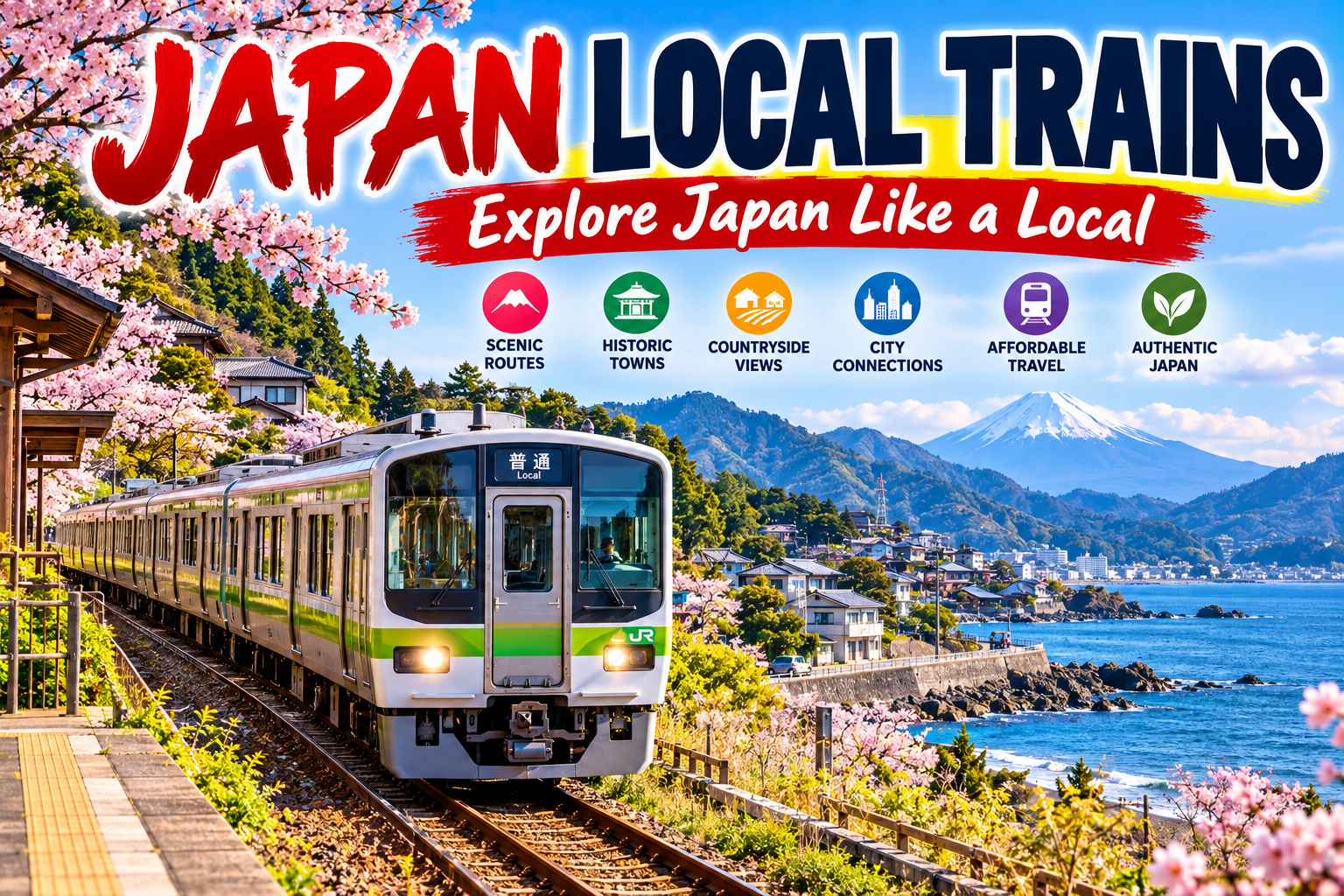
Japan Local Trains: 10 Best Railway Operators, Routes and Essential Travel Tips
Have you ever wanted to experience Japan beyond its famous bullet trains, crowded city centres and popular tourist attractions? Japan local trains offer a different way to discover the country, connecting historic neighbourhoods, small towns, coastal villages, mountain destinations and everyday places that many visitors miss. Japan local trains are conventional passenger trains that connect cities, suburbs, towns and rural communities, often making frequent stops along the way. They are useful for budget-conscious travellers, first-time visitors, families, commuters and anyone who wants to experience Japanese life at a slower pace Tokyo Playground
What Are Japan Local Trains?
Japan local trains are passenger services that generally stop at every station or at most stations along a particular railway line. They operate on conventional railway networks rather than the high-speed Shinkansen network.
The word local describes the stopping pattern, not necessarily the size or comfort of the train. A local service might run through the centre of Tokyo, connect suburban communities around Osaka or travel across a quiet rural region.
Local trains versus bullet trains
The main difference is speed, distance and stopping frequency.
| Feature | Local trains | Shinkansen bullet trains |
|---|---|---|
| Main purpose | Short and regional journeys | Fast intercity travel |
| Stops | Frequent | Fewer major stations |
| Typical journey | Neighbourhoods, suburbs and towns | Major cities and regional hubs |
| Ticket cost | Often lower for short trips | Usually higher for comparable long-distance journeys |
| Reservations | Often unnecessary on ordinary services | Depend on train and seat type |
| Travel experience | More stops and everyday local scenery | Fast, comfortable long-distance travel |
Local trains are not always the cheapest option for every journey. On a long route, multiple local services may take several hours, and the total fare can sometimes compare less favourably with a discount ticket or other transport option. Compare the complete journey rather than assuming that the train with the slowest service is automatically the best value.
Are local trains the same as regional trains?
Not exactly. In everyday travel discussions, the terms can overlap, but railway operators use several service categories.
- Local: Usually stops at every station on its route.
- Rapid: Skips selected stations to reduce journey time.
- Special Rapid: A faster service category used by certain operators.
- Express: A category whose meaning and ticket requirements depend on the railway company.
- Limited Express: Often requires a limited-express supplement in addition to the basic fare.
- Commuter services: Trains designed around daily travel between residential areas and employment centres.
The exact definitions differ between operators. Always check the service name, stopping pattern, destination and ticket requirements displayed for your particular train.
How Japan’s Local Railway Network Works
Japan does not operate one single national passenger railway system with a universal fare for every journey. Instead, travellers use a mixture of railway companies, private railways, metro networks and regional transport operators.
Understanding this structure is one of the most useful steps for planning a trip.
JR Group railway companies
The Japan Railways Group, commonly called JR, consists of regional passenger railway companies alongside other related businesses. The passenger operators serve different parts of the country.
The major regional JR passenger companies are:
- JR Hokkaido
- JR East
- JR Central
- JR West
- JR Shikoku
- JR Kyushu
JR lines cover many urban, suburban and regional journeys. Some routes are busy commuter corridors, while others provide access to rural destinations and scenic areas.
However, not every train in Japan belongs to JR. Private railway companies operate extensive networks, especially around major metropolitan areas.
Private railway companies
Private railways are especially important in and around Tokyo, Osaka, Kyoto, Nagoya, Kobe and Fukuoka.
Companies such as Tokyu, Keio, Odakyu, Tobu, Seibu, Kintetsu, Hankyu and Nankai operate routes serving commuter districts, residential areas, tourist destinations and regional cities.
For example, a traveller visiting Kyoto may use JR for one journey, a private railway for another and the municipal subway for a third. These systems can connect conveniently, but fares and ticket rules may differ.
Subway networks
Subways primarily serve urban areas and are particularly useful for getting around large cities.
Tokyo has several subway operators, while Osaka, Kyoto, Nagoya and other cities also have urban subway networks. Some subway services continue directly onto private railway tracks, allowing passengers to travel without changing trains even though the operating company changes.
This arrangement is known as through-service operation. It can be convenient, but passengers should pay attention to destinations and route information because the train may continue beyond the subway line.
Rural and independent railways
Outside major cities, smaller railway companies connect local communities and tourism areas. Some operate short lines with limited services, while others run through scenic landscapes.
These routes can be memorable parts of a holiday, but they may have less frequent departures than urban services. In some locations, buses provide essential connections where railway coverage is limited.
10 Major Railway Operators to Know in Japan
The following comparison introduces ten important railway operators and groups. It is not a ranking of the ten largest networks, and the best operator for your trip depends on your destination.
1. JR East
JR East is a major railway operator in eastern Japan, including Tokyo and surrounding regions. Its network serves many commuter journeys as well as regional destinations.
Travellers commonly encounter JR East when travelling around Tokyo, visiting nearby prefectures or exploring parts of northeastern Japan.
Best for: Tokyo-area JR services and regional journeys in eastern Japan.
Useful tip: Check whether your destination is served by JR East or a private railway before purchasing a pass. A pass covering JR services does not automatically cover every private train or subway.
2. JR Central
JR Central operates important railway services in central Japan. It is widely associated with the Tokaido Shinkansen, but its conventional railway network also serves regional and commuter travel.
Its local and regional services can be useful when exploring areas around Nagoya and other parts of central Japan.
Best for: Conventional rail travel in parts of central Japan, depending on the route.
Useful tip: Do not confuse the company’s high-speed services with its conventional lines. Different services have different ticketing requirements and journey times.
3. JR West
JR West serves western Honshu, including important travel areas around Osaka, Kyoto, Kobe and other regional destinations.
Its conventional lines are valuable for journeys between cities and for shorter trips within the Kansai region.
Best for: Regional and suburban journeys around Kansai and western Japan.
Useful tip: Check the station names carefully when using major stations shared by multiple railway companies. Two services departing from the same broad station complex may use different gates or platforms.
4. JR Hokkaido
JR Hokkaido operates conventional railway services across Hokkaido, Japan’s northernmost main island.
Because towns and attractions can be spread over large distances, train schedules are particularly important when travelling around the region.
Best for: Selected intercity and regional journeys across Hokkaido.
Useful tip: Check seasonal conditions, service notices and onward transport before travelling to rural destinations. Some areas have limited train frequency, and a missed connection can significantly affect your plans.
5. JR Kyushu
JR Kyushu serves the island of Kyushu, including major urban centres and regional destinations.
Its network is useful for travellers exploring cities such as Fukuoka and travelling to other parts of the island. Some services are designed around sightseeing, while ordinary local trains serve everyday transport needs.
Best for: Regional exploration across Kyushu.
Useful tip: Check whether your intended journey uses a regular local service or a special sightseeing train. Special trains may have separate reservation rules and different fares.
6. Tokyu Corporation
Tokyu operates a network of private railway lines in the Tokyo metropolitan area, serving numerous residential and commercial districts.
It is particularly relevant for travellers staying outside the immediate central railway hubs or visiting areas served by its lines.
Best for: Suburban Tokyo travel and selected urban destinations.
Useful tip: When planning a journey, compare the route shown by your navigation app with the actual station entrance. Large stations can have several entrances, and some transfers require walking through connected facilities.
7. Odakyu Electric Railway
Odakyu operates private railway services in the Tokyo region, including routes commonly used for travel towards areas such as Hakone and western suburban districts.
Its network can be useful for visitors combining Tokyo sightseeing with a regional excursion.
Best for: Selected journeys from Tokyo towards western suburban and tourism areas.
Useful tip: Some destinations can be reached using ordinary services, while faster or sightseeing-oriented services may have additional ticket requirements. Confirm what your ticket includes before boarding.
8. Tobu Railway
Tobu operates private railway services in the Kanto region. It is known for routes connecting Tokyo with destinations in parts of Saitama, Tochigi and other surrounding areas.
Some of its services are useful for regional sightseeing and trips outside central Tokyo.
Best for: Selected journeys from the Tokyo area to regional destinations.
Useful tip: Check whether the service you select is an ordinary train or a reserved-seat limited express. The basic fare alone may not cover every service category.
9. Kintetsu Railway
Kintetsu operates an extensive private railway network in the Kansai and surrounding regions, serving destinations across parts of western and central Japan.
It can be useful for travellers visiting areas around Osaka, Nara and other destinations within its network.
Best for: Selected regional journeys around Kansai and nearby areas.
Useful tip: Compare Kintetsu with JR and other private railway options. The most convenient route may depend on the precise station, fare, transfer time and destination entrance.
10. Hankyu Railway
Hankyu operates private railway services around Osaka, Kyoto and Kobe. It is an important option for travellers moving between these urban areas and their surrounding neighbourhoods.
Its services can be particularly convenient for certain journeys within the Kansai region.
Best for: Selected journeys between Osaka, Kyoto, Kobe and nearby districts.
Useful tip: Kyoto and Osaka have several railway stations with similar city names but different locations. Check the exact destination station instead of relying only on the city name.
Comparison table: 10 Japanese railway operators
| Operator | Main service area | Useful for | What to check |
|---|---|---|---|
| JR East | Eastern Japan, including Tokyo | Urban and regional journeys | Pass coverage and line |
| JR Central | Central Japan | Local and regional travel | Conventional versus Shinkansen service |
| JR West | Western Honshu, including Kansai | City-to-city and suburban trips | Station and operator |
| JR Hokkaido | Hokkaido | Regional exploration | Frequency and onward connections |
| JR Kyushu | Kyushu | Island-wide regional travel | Train type and reservations |
| Tokyu | Tokyo metropolitan area | Suburban and urban travel | Station entrance and through-service |
| Odakyu | Tokyo and surrounding regions | Regional excursions | Limited-express supplements |
| Tobu | Kanto region | Regional sightseeing | Reserved-seat requirements |
| Kintetsu | Kansai and nearby regions | Selected regional trips | Fare and service category |
| Hankyu | Osaka, Kyoto and Kobe areas | Kansai city travel | Exact destination station |
Important: This table is a practical overview, not a complete list of Japanese railway companies. Routes, fares, service patterns and pass eligibility can change, so verify details with the relevant operator before departure.
Understanding Train Tickets and Fares
Buying a ticket in Japan is generally straightforward once you understand the main options. The right choice depends on your journey length, railway operator, number of trips and whether you expect to travel again during your stay.
Single-journey tickets
A standard ticket is often a good option for an occasional local train ride.
You can usually purchase one at a ticket machine or staffed ticket counter. Machines commonly offer language options, though the layout and available features differ by station and operator.
Before buying a ticket, identify your destination station and check the fare shown on the route map or ticket machine.
At some stations, fares are calculated according to the distance travelled. If you accidentally buy a ticket for a lower fare, you may be able to pay the difference at a fare-adjustment machine or ticket counter before exiting.
IC cards
Rechargeable transport IC cards are widely used for convenient travel on participating railway, subway and bus networks. Examples include Suica, PASMO, ICOCA and other regional cards.
Rather than buying a separate paper ticket for every journey, a traveller can generally tap the card at the entry gate and tap again at the exit gate.
The system calculates the applicable fare where the card is accepted.
However, IC cards are not a universal solution for every train in Japan. Some long-distance, rural or special services may require separate tickets or additional supplements. A card may also have limitations when travelling across certain operator areas or using particular routes.
Practical advice: Check acceptance for your intended journey, especially if it involves rural stations, multiple operators, reserved seating or a long-distance trip.
Day passes and regional passes
Some operators sell day passes or regional passes that cover selected routes for a defined period.
These can be useful if you plan several journeys in the same area. However, a pass is only good value if the included trips justify its price.
To compare options:
- List the journeys you expect to make.
- Check the individual fares.
- Identify which operator runs each service.
- Confirm the exact routes covered by a proposed pass.
- Compare the total fare with the pass price.
- Check exclusions, validity dates and any reservation requirements.
Do not purchase a pass solely because it is advertised as convenient. A few short journeys may cost less with an IC card or individual tickets.
Japan Rail Pass considerations
The Japan Rail Pass is intended for eligible travel on specified JR services under its current conditions. It does not automatically cover every railway, subway, bus or private operator.
For a trip focused on local journeys within one city, a national pass may not be the most economical choice. It is more useful to compare your planned routes with the current pass rules and price.
Before buying, confirm eligibility, validity, covered services and whether any supplementary charges apply to the trains you intend to use.
Limited-express supplements
Some trains require a basic fare ticket plus an additional limited-express ticket. Reserved seats, premium seating and special sightseeing services may also involve separate charges.
This is an important distinction because the train might appear on a regular route map even though its ticket requirements differ from those of an ordinary local service.
When in doubt, use the operator’s official booking or fare information for the exact train.
How to Use Japan Local Trains Step by Step
Japan’s railway stations can seem complicated at first, especially in large cities. A simple routine makes the process much easier.
Step 1: Find the correct route
Use a reliable route-planning app or the operator’s journey planner to identify:
- Departure station
- Destination station
- Train line and direction
- Departure time
- Number of transfers
- Estimated fare
- Platform information, when available
For more complicated journeys, check the operator’s official website as well. Journey-planning apps are useful, but they may not explain every ticket restriction or service disruption.
Step 2: Confirm the train’s destination
Do not board a train simply because it arrives at the correct platform.
Check the destination displayed on the train and the departure board. Several services may use the same platform while heading to different destinations.
Also confirm whether the service is local, rapid or another category. A faster train may skip the station you need.
Step 3: Buy or prepare your ticket
Choose the correct ticket or make sure your IC card is ready.
If you are using a paper ticket, keep it accessible because you may need it at both the entry and exit gates. Some tickets must be inserted into the gate rather than tapped.
If you are travelling on a special service, confirm that you have all required tickets before boarding.
Step 4: Enter through the correct gate
Follow the signs for your railway operator and platform. At large stations, separate operators may have separate ticket gates even when their facilities are connected.
If your route includes a transfer between operators, follow the transfer signs and check whether you need to pass through another gate or purchase an additional ticket.
Step 5: Wait in the correct place
Look for platform markings and passenger queues. At many busy stations, designated boarding positions help passengers line up in an orderly way.
Allow people to exit before boarding, and keep bags close to your body during crowded periods.
Step 6: Check the station announcements
Station displays and announcements can provide information about the next stop, destination, platform changes and service delays.
Listen for announcements where possible, but do not worry if you do not understand Japanese. Displays, route maps and smartphone navigation can help.
Step 7: Exit correctly
If you used an IC card, tap it at the exit gate. If you used a paper ticket, insert it as instructed.
If the gate does not open, do not force your way through. Ask station staff for help or use a fare-adjustment machine if one is available.
Reading Japanese Train Signs and Station Information
Station signs often combine Japanese text, English translations, line symbols and station codes. Learning a few common terms can reduce confusion.
Useful Japanese railway terms
| Japanese term | Meaning | Why it matters |
|---|---|---|
| 駅 (eki) | Station | Helps identify railway stations |
| 入口 (iriguchi) | Entrance | Useful for finding station access |
| 出口 (deguchi) | Exit | Helps you leave the station |
| 乗換 (norikae) | Transfer | Indicates a connection to another line |
| 普通 (futsū) | Local or ordinary | Often indicates a train that stops frequently |
| 快速 (kaisoku) | Rapid | Usually skips some stations |
| 急行 (kyūkō) | Express | Service meaning varies by operator |
| 特急 (tokkyū) | Limited express | May require an extra ticket |
| 改札 (kaisatsu) | Ticket gate | Marks the entry or exit area |
| 運休 (unkyū) | Service suspended or cancelled | Important during disruptions |
The English translation may differ slightly between operators. Use the station code, destination name and route map together rather than relying on one word alone.
Understanding station codes
Some railway networks use alphanumeric station codes. These can help visitors identify stations when names are difficult to pronounce or several lines share similar names.
A code is not necessarily shared across all operators. A station served by multiple lines may have separate codes for each network.
Why station names can be confusing
Large Japanese cities often have several stations with similar names, and some station complexes cover a wide area.
For example, a journey described as travelling to a particular city centre might end at a JR station, a private railway station or a subway station that is not immediately adjacent to the others.
Before leaving your hotel, check the exact station name and the walking distance to your final destination.
Local Trains in Tokyo: A Practical Guide
Tokyo has one of the world’s most extensive urban rail environments, combining JR lines, private railways, subway routes and through-service connections.
For visitors, the challenge is not usually finding a train. It is choosing the correct line, station and exit.
JR lines and Tokyo’s urban network
JR East operates several useful lines in the Tokyo area. The Yamanote Line is especially familiar to visitors because it loops around many major districts.
Other JR routes connect central Tokyo with surrounding suburbs and neighbouring regions.
However, the Yamanote Line is not the only way to move around central Tokyo. In some cases, a subway or private railway route may be faster or involve less walking.
Tokyo subway travel
Tokyo’s subway network includes Tokyo Metro and Toei Subway services. These systems connect many business districts, residential neighbourhoods, shopping areas and tourist attractions.
Some services continue onto other railway networks, which means the train may travel beyond the line shown on the platform map.
Always check the final destination and station announcements. A direct train can be convenient, but it may not stop at every station you expect.
Avoiding Tokyo station mistakes
- Check the line colour and station code.
- Confirm the direction of travel.
- Read the final destination on the platform display.
- Follow transfer signs instead of exiting the station unnecessarily.
- Allow extra time when changing between distant platforms.
- Check the exit number for attractions located near large stations.
A route with one extra stop can sometimes be easier than a route requiring a long underground transfer.
Local Trains in Kyoto and Osaka
The Kansai region offers several railway networks, including JR West, Hankyu, Kintetsu, Keihan, Nankai and local subway operators.
These networks are useful for visiting temples, shopping districts, historic neighbourhoods and regional attractions.
Why operator choice matters in Kyoto
Kyoto’s main railway options serve different areas of the city. The nearest station to a destination may depend on whether you are travelling by JR, subway or a private railway.
For example, one operator may provide the most convenient access to a central shopping district, while another may be more useful for reaching a particular suburban attraction.
Do not assume that all stations serving Kyoto are interchangeable. Compare the station location with the entrance of the attraction you want to visit.
Moving around Osaka
Osaka has an extensive subway system and several private railways. JR services are also useful for journeys within the city and to surrounding destinations.
For short trips, the fastest route is not always the simplest. A direct train with a short walk may be preferable to a journey involving multiple transfers.
Planning a Kyoto–Osaka journey
Before choosing a train, compare:
- The exact departure and arrival stations
- Total journey time
- Number of transfers
- Fare
- Walking distance at both ends
- Whether the route is covered by your pass or IC card
Several operators may connect the same broad areas, but their stations and routes can differ.
Rural Japan: Local Trains Beyond the Big Cities
One of the most rewarding uses of Japan local trains is exploring destinations outside the main metropolitan areas.
Rural railway travel can offer a more relaxed view of the country, but it requires additional planning.
Why rural train journeys need more preparation
Urban services may run every few minutes, whereas a rural line may have a much smaller number of departures throughout the day.
If you miss the last convenient train, there may be no easy alternative until much later. Buses, taxis and accommodation options may also be limited in remote areas.
Before travelling, confirm the timetable for both the outward and return journeys.
Rural station facilities
Small stations may have fewer ticket machines, limited staffing hours or no staffed ticket office at certain times.
Some stations have gates that work differently from those at major urban terminals. On some routes, passengers may board through designated doors or pay onboard, depending on the operator and service.
Follow the instructions displayed at the station and on the train. Do not assume that procedures at a major Tokyo station apply everywhere.
Combining local trains with buses
Railways do not reach every village, hiking trail, hot-spring area or mountain attraction.
A practical itinerary may use a local train to reach a regional hub, followed by a bus to the final destination.
Check whether the bus stop is outside the station, across the road or in a separate terminal. Allow enough time for the connection, particularly when services are infrequent.
Scenic Local Train Journeys and Regional Experiences
Local railway travel can be an attraction in its own right. The journey may reveal landscapes and communities that are easy to miss when travelling by highway or bullet train.
Coastal railway experiences
Coastal lines can provide views of bays, fishing communities, harbours and beaches. Depending on the route, some trains travel close to the water, while others pass through inland areas before reaching the coast.
For better views, research the route in advance and check whether the railway actually runs beside the sea for the section you plan to travel.
Do not assume that every coastal train has panoramic windows or guaranteed sea views.
Mountain and countryside routes
Railways in mountainous regions may pass through tunnels, valleys, forests and small settlements.
These journeys can be particularly appealing during autumn foliage or spring, but the exact scenery depends on the route and season.
Weather can also affect visibility. A mountain trip may be beautiful in clear conditions but less scenic during heavy rain or fog.
Historic railways and sightseeing trains
Some regional operators run heritage-themed services, sightseeing trains or specially designed excursion services.
These trains may feature traditional interiors, observation areas, regional food or cultural themes. They are different from ordinary local services and may require reservations or special tickets.
If a particular train is a major part of your itinerary, confirm operating dates, reservation rules and seasonal schedules before arranging the rest of your trip around it.
Japan Local Trains for Different Types of Travellers
The best railway strategy depends on your travel style, budget and mobility needs.
First-time visitors
For first-time visitors, the priority should be simplicity and confidence rather than saving a very small amount on every journey.
Useful habits include:
- Start with short, straightforward journeys.
- Save hotel and attraction locations on your phone.
- Learn the station names you will use most often.
- Keep enough battery power for navigation.
- Allow extra time for transfers.
- Ask station staff for help when unsure.
After a few trips, ticket gates, platform signs and route maps usually become much less intimidating.
Budget travellers
Travellers watching their spending should compare single fares, IC card fares where applicable, day passes and regional passes.
Avoid buying a broad transport pass without calculating the likely savings. A pass may be convenient but poor value if you make only a few short journeys.
Also consider the cost of reaching the station, airport transfers and buses needed to complete the trip.
Families with children
Families may benefit from routes with fewer transfers and stations that have elevators or escalators.
Allow extra time for toilets, snacks, ticket gates and boarding. During busy periods, keep children close and establish a simple meeting plan in case anyone becomes separated.
Check current child-fare rules with the relevant operator. Age categories and ticket conditions can vary by service and ticket type.
Older travellers and passengers with mobility needs
Accessibility varies by station, route and train. Major stations may have elevators, accessible toilets and staff assistance, but smaller stations may have limited facilities.
Before travelling, check the operator’s accessibility information and the facilities at both the departure and arrival stations.
A route with fewer stairs and a longer travel time may be more comfortable than the nominally fastest route.
Digital nomads and business travellers
For business travellers, reliability and predictable arrival times are often more important than choosing the absolute cheapest route.
Allow a buffer before important meetings, especially when the journey involves several railway operators or transfers.
If travelling during peak commuting periods, consider whether an earlier train would reduce crowding and stress.
Travellers visiting Japan for the first time from overseas
International visitors should check current entry arrangements, payment options and transport pass eligibility before arrival.
Do not assume every ticket machine accepts foreign bank cards or that every railway accepts the same transport card. Having a backup payment method can be helpful.
Using IC Cards and Mobile Payments
IC cards reduce the need to buy individual tickets, but they work best when you understand their limits.
Physical IC cards Japan local trains
A physical card can be convenient if you prefer not to rely on your phone. You can normally add value at supported machines or other designated locations.
Keep the card separate from other contactless cards if your wallet or phone case contains several payment cards, because this can sometimes interfere with gate readers.
Mobile IC cards Japan local trains
Some compatible smartphones support digital versions of transport cards. Availability and setup requirements depend on the phone model, region, payment configuration and current service conditions.
Before relying on a digital card, check that your device supports it and that you can add value while travelling.
Keep a backup payment option available, especially when visiting smaller towns.
What if the card does not work?
Common causes include insufficient balance, a card that was not tapped correctly at entry, a previous journey that did not close properly, or a route that is not supported by the card.
If the exit gate rejects your card, ask staff for help. They can often identify the issue and explain how to complete the journey correctly.
How to Plan a Japan Local Train Itinerary
A good itinerary balances travel time, sightseeing, rest and the availability of transport.
Step 1: Group destinations by area Japan local trains
Instead of crossing a large city repeatedly, group nearby attractions together.
For example, you could spend one part of the day in a particular district, then travel to another area later. This reduces unnecessary transfers and gives you more time at each destination.
Step 2: Choose the right railway network Japan local trains
Identify which railway serves each destination. Compare the available routes rather than automatically selecting JR or a subway.
The best option depends on where you start, where you finish and how far you must walk.
Step 3: Check the timetable Japan local trains
Confirm departure times, the final return service and any scheduled changes.
For rural trips, check the complete day’s timetable rather than only the first train. This is particularly important when you need to connect with a bus.
Step 4: Estimate the real journey time Japan local trains
The displayed train time may not include walking through the station, waiting for the next departure, navigating a transfer or walking to the attraction.
For a more realistic estimate, add a buffer for each transfer and allow additional time at unfamiliar stations.
Step 5: Check ticket coverage Japan local trains
Review the exact terms of your IC card, day pass or regional pass. Confirm whether private railway sections and special trains are included.
If a route uses multiple operators, make sure you understand whether the ticket covers the full journey.
Step 6: Keep a backup plan Japan local trains
Save the destination address, station name and a screenshot of the route if helpful.
If a service is delayed, use the operator’s disruption information or ask station staff about alternatives.
Common Mistakes When Using Japan Local Trains
Even experienced travellers can make railway mistakes when dealing with unfamiliar station layouts or ticket rules.
Mistake 1: Boarding the wrong service Japan local trains
A train may arrive at the right platform but skip the station you need.
Solution: Check the train category, destination and stopping pattern before boarding.
Mistake 2: Assuming every railway accepts the same pass Japan local trains
JR, private railway and subway coverage can differ.
Solution: Check the exact route and operator against the pass conditions before purchasing.
Mistake 3: Confusing similar station names Japan local trains
Some cities have multiple stations with similar names or large complexes separated by long walking routes.
Solution: Save the complete station name and verify the location on a map.
Mistake 4: Underestimating transfer times Japan local trains
A transfer between platforms can involve stairs, corridors, ticket gates and long walks.
Solution: Allow more time at unfamiliar stations, particularly when travelling with luggage.
Mistake 5: Forgetting the return journey Japan local trains
Rural services may be infrequent, and the final convenient train may depart earlier than expected.
Solution: Check return times before leaving the departure station.
Mistake 6: Assuming a limited-express train is covered by a basic ticket Japan local trains
Some services require additional supplements or reservations.
Solution: Confirm the fare rules for the specific service.
Mistake 7: Travelling during the busiest period without a plan Japan local trains
Commuter trains in large cities can become crowded, especially during weekday peak periods.
Solution: If your schedule allows, travel outside peak commuting times and keep luggage compact.
Mistake 8: Not checking for disruptions Japan local trains
Weather, maintenance, accidents and other incidents can affect service.
Solution: Check current railway information before important journeys and leave a buffer for time-sensitive appointments.
Mistake 9: Assuming every station is fully accessible Japan local trains
Some rural stations have limited step-free access.
Solution: Verify accessibility at both ends of the journey and along transfer routes.
Mistake 10: Treating every journey as a sightseeing trip Japan local trains
A local train may be crowded, fast-paced or focused on commuter transport rather than scenery.
Solution: Choose a dedicated scenic route when the journey itself is a major part of your travel plans.
Railway Etiquette: How to Travel Respectfully
Japanese train etiquette is generally based on consideration for other passengers and keeping shared spaces orderly.
Keep your voice low Japan local trains
Speak quietly on trains, especially in crowded commuter carriages. Avoid loud phone calls and keep audio at a level that does not disturb other passengers.
Queue before boarding Japan local trains
Follow platform markings where present and allow passengers to exit before entering the carriage.
Manage luggage carefully Japan local trains
Keep bags close to you and avoid blocking doors, aisles or priority seating areas.
If you have large luggage, check whether the train or service has specific luggage rules.
Give priority seating appropriate space Japan local trains
Priority seats are intended for passengers who may need them, including older people, pregnant passengers, people with disabilities and those travelling with small children.
Be aware of your surroundings and offer a seat when appropriate.
Follow local rules for food and drink Japan local trains
Practices differ between commuter trains, long-distance services and sightseeing trains. On ordinary urban trains, avoid food or drinks that create strong smells, spills or inconvenience.
On some longer-distance trains, eating may be more common. Use the service type and posted rules as a guide.
Respect quiet areas and local customs Japan local trains
Some trains request reduced mobile-phone use near priority seating or in designated areas. Follow posted instructions and announcements.
Pros and Cons of Japan Local Trains
Local trains are useful, but they are not the ideal choice for every journey.
Advantages Japan local trains
- Frequent services in many urban areas: Busy networks can make spontaneous travel easy.
- Access to neighbourhoods: Local trains reach places that may not have Shinkansen stations.
- Lower fares for many short journeys: Individual local trips can be economical.
- Regional discovery: Trains connect visitors with towns, markets and attractions beyond major tourist centres.
- No need to drive: Travellers can avoid parking, unfamiliar road rules and rental-car logistics.
- Useful for daily travel: Local trains serve commuters, students, families and residents.
- Flexible route choices: Multiple operators can provide alternatives for some journeys.
Disadvantages Japan local trains
- Longer travel times: Frequent stops make local services slower over long distances.
- Complex networks: Multiple operators can complicate ticketing and transfers.
- Crowding: Some urban services are busy during peak periods.
- Limited rural frequency: Smaller lines may have fewer departures.
- Variable accessibility: Facilities differ between stations and operators.
- Potential ticket supplements: Special services may cost more than the basic fare.
- Disruption risks: Weather and operational incidents can affect connections.
Are Japan local trains worth using?
For most visitors, yes. They are particularly useful for city exploration, regional excursions and reaching places that do not have high-speed rail service.
The key is to match the transport method to the journey. Use a bullet train when speed over a long distance matters, local trains for shorter regional trips and buses where rail coverage is limited.
Costs and Budget Planning for Local Train Travel
Transport spending depends on the distance, railway operator, number of journeys and ticket type.
Rather than relying on one estimated daily budget, calculate your likely routes individually.
A simple fare comparison method Japan local trains
Create a list of your expected journeys and record the fare for each one. Then compare the total with available day passes or regional passes.
Include any supplements or reservation charges required by your planned services.
If you will travel only within one city, a regional or national pass may be unnecessary. If you plan several long regional journeys, a pass may be worth investigating.
Hidden transport costs to consider Japan local trains
- Transfers between different railway operators
- Travel to and from airports
- Buses required for attractions outside the railway network
- Limited-express or reserved-seat supplements
- Luggage-related costs on services with special rules
- Extra journeys caused by choosing a less convenient station
How to save money without wasting time Japan local trains
The cheapest route is not always the best value. A route that saves a small amount but adds a long transfer or substantial walking may not suit every traveller.
Compare the fare, journey time, convenience and reliability together. For a short holiday, saving time may be worth a modest additional fare.
Safety and Accessibility on Japan Local Trains
Japan’s railway system is generally well organised, but travellers should still take ordinary precautions.
Stay behind platform markings Japan local trains
Keep a safe distance from the platform edge and follow the instructions shown at each station.
Never enter the tracks to retrieve a dropped item. Ask station staff for assistance.
Watch your belongings Japan local trains
Keep wallets, passports, phones and bags secure, especially in crowded stations and during transfers.
If you lose an item, contact the railway operator’s lost-property service or station staff as soon as possible.
Check weather-related disruptions Japan local trains
Heavy rain, snow, strong winds and other weather conditions can disrupt some routes. This is particularly relevant to regional and rural travel.
Check service announcements before departing and reconsider the itinerary if conditions could make the journey unsafe or unreliable.
Accessibility planning Japan local trains
Passengers who need step-free access should verify the entire route, not just the departure station.
Check for elevators, accessible ticket gates, platform gaps, staff assistance and accessible toilets. Some stations may require advance arrangements for particular assistance services.
Technology and the Future of Japan Local Trains
Japan’s railways continue to adapt to changing passenger expectations, labour needs and regional population patterns.
The future of local train travel is likely to involve both technological improvements and difficult decisions about service frequency in less populated areas.
More digital travel planning Japan local trains
Mobile route planners, digital tickets and real-time service information can reduce the uncertainty of unfamiliar journeys.
These tools are especially helpful when several operators share a corridor or when a trip involves both trains and buses.
However, passengers should still know how to find the operator’s official disruption information and what to do if a phone battery runs out.
Contactless and mobile ticketing Japan local trains
Digital transport cards and ticketing systems can make entry and exit faster. Adoption and compatibility vary by operator and service.
Travellers should expect a mix of modern digital options and conventional ticketing arrangements rather than one identical system throughout the country.
Accessibility improvements Japan local trains
Railway operators continue to face demand for easier access, clearer signage and better support for passengers with mobility needs.
The pace and extent of improvements differ by location, and older or rural stations may face physical constraints.
Regional population changes Japan local trains
Some rural communities face declining populations and fewer daily passengers. Maintaining frequent train services can therefore be challenging.
Possible responses include timetable adjustments, improved bus connections, local tourism initiatives and other transport arrangements. These decisions involve trade-offs between cost, access and community needs.
Sustainable transport Japan local trains
Railways can help reduce dependence on private cars for many journeys, especially where services are frequent and stations are convenient.
Their environmental benefits depend on factors such as passenger demand, energy sources, infrastructure and how travellers reach stations. Rail is not automatically the most convenient option for every remote destination, but it remains an important part of Japan’s transport network.
Ten Practical Tips for a Smoother Train Journey
- Plan the route before leaving: Confirm the exact station names and destinations.
- Check the service category: Local, rapid and limited-express trains may stop at different stations.
- Use a suitable payment method: Confirm whether your IC card or pass is accepted.
- Keep a backup payment option: This is useful if a card or mobile wallet cannot be used.
- Allow time for transfers: Large stations can involve considerable walking.
- Check the return timetable: Essential for rural excursions and evening trips.
- Keep your ticket accessible: Paper tickets may be needed at both entry and exit gates.
- Watch platform displays: The platform number or stopping pattern may change.
- Travel light where possible: Smaller bags are easier to manage in crowded carriages.
- Check official service information: Particularly before long or time-sensitive journeys.
FAQs
Are Japan local trains easy for tourists to use?
Yes. Many major stations provide English signage, and route-planning apps can help identify trains, platforms and fares. Rural stations may have fewer facilities, so extra preparation is useful.
Are local trains cheaper than bullet trains?
For many short journeys, local trains cost less. However, a long trip using multiple local services can take much longer, and the total cost should be compared with available high-speed or discounted options.
Can I use an IC card on all Japan local trains?
No. IC cards are accepted across many urban and regional networks, but coverage is not universal. Some rural routes, special services and cross-region journeys may require other tickets or supplements.
Do I need to reserve a seat on a local train?
Ordinary local services generally do not require seat reservations. Special sightseeing trains, limited-express services and certain premium services may have different rules.
What is the difference between local and rapid trains?
A local train usually stops at every station on its route. A rapid train skips selected stations to reduce travel time. Exact stopping patterns vary by operator.
Are local trains in Japan safe?
Japan’s railways are widely used by residents and visitors. Nevertheless, follow platform safety rules, secure your belongings and pay attention to announcements and service instructions.
Can I take luggage on local trains?
Ordinary luggage is commonly carried on local trains, but space can be limited during busy periods. Keep bags out of doorways and aisles, and check any special rules for large luggage or specific services.
Are Japan local trains suitable for families?
Yes, but families should consider crowding, transfer distances, station accessibility and child-fare rules. Routes with fewer transfers may be more comfortable than the fastest itinerary.
How do I know which platform to use?
Check the departure board, platform signs and destination displayed on the train. Use the railway operator’s route information if several services share the same platform.
What happens if I miss my train?
On many urban lines, another train may arrive soon. On less frequent regional lines, the next departure may be much later. Check the timetable and confirm the last return service before travelling.
Do local trains operate late at night?
Operating hours vary by line and location. Do not assume that a train will be available late at night, particularly in rural areas. Check the final departure for your route.
Can I use a Japan Rail Pass on private railways?
Generally, a JR Pass covers only the services specified in its current conditions. Private railway and subway services are not automatically included. Some exceptions or special arrangements may exist, so check the exact route and pass rules.
Are local trains good for sightseeing?
Yes. They connect visitors with neighbourhoods, regional attractions, historic towns and scenic routes. However, ordinary commuter trains are primarily transport services, so choose a dedicated sightseeing train when the journey itself is the main attraction.
Should I buy a transport pass before arriving in Japan?
That depends on your itinerary. Compare the pass price and coverage with the individual fares for your planned journeys. A pass is not necessarily cheaper for short urban trips.
What should I do if I get on the wrong train?
Stay calm and check the next station and available return options. If necessary, get off at a safe station and ask railway staff for help. Avoid crossing tracks or entering restricted areas to correct your route.
Conclusion
Japan local trains are one of the most practical ways to explore the country at street level. They connect busy city districts, suburban communities, historic towns and rural destinations, offering a travel experience that differs from high-speed rail. For first-time visitors, the most important skills are identifying the correct operator, understanding local and rapid services, choosing suitable tickets and allowing enough time for transfers. Once these basics become familiar, the railway network can make independent travel much easier.