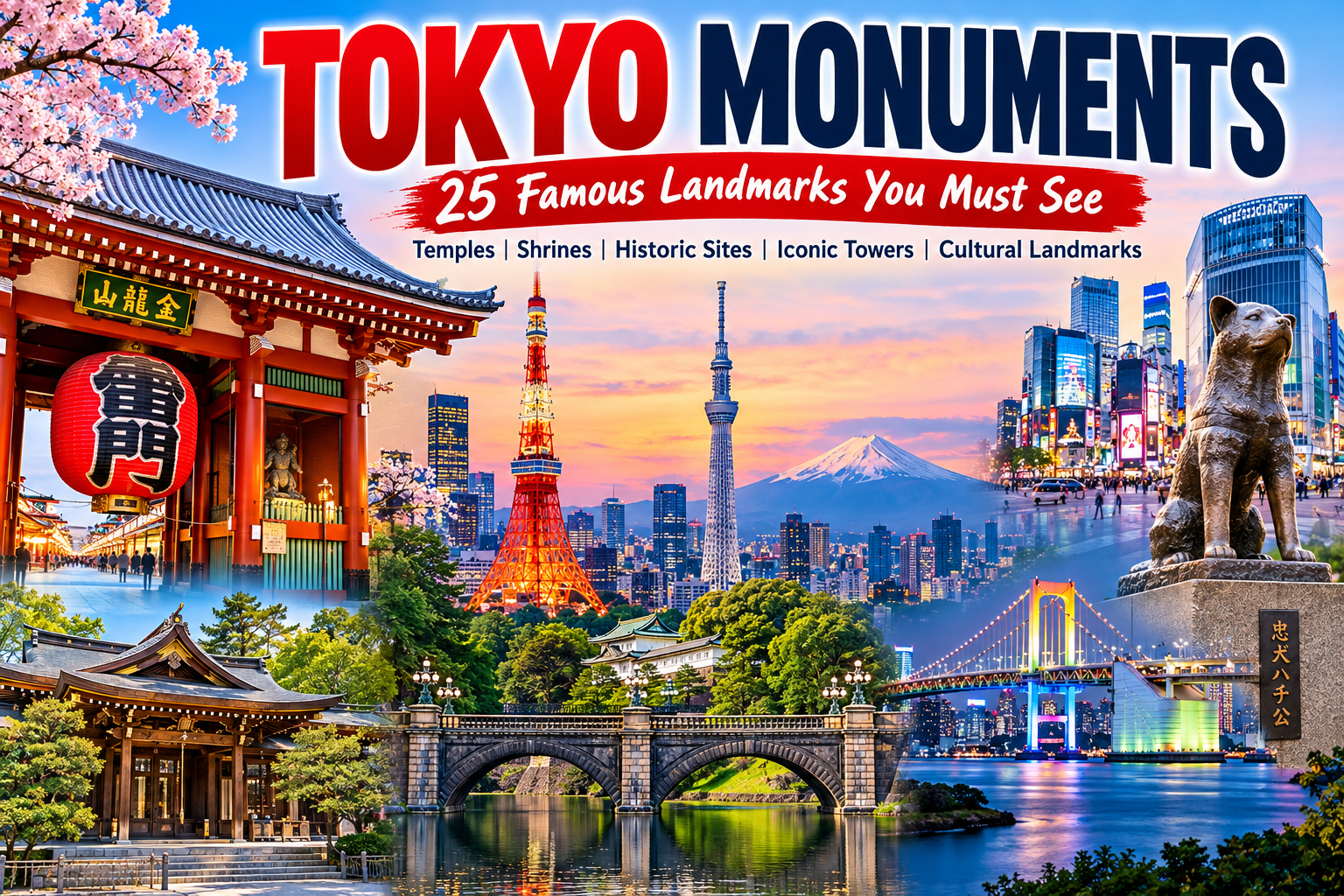
Tokyo Monuments: 25 Must-See Historic Landmarks, Famous Towers and Cultural Sites
What makes Tokyo such an extraordinary destination for history and culture lovers? It is the remarkable contrast between centuries-old temples, imperial landmarks, historic bridges and modern architectural achievements that define this fascinating Japanese capital. Tokyo monuments reveal the city’s journey from the political centre of the Edo period to a modern global metropolis. These historic landmarks, religious sites, memorials and architectural attractions help visitors understand Japanese culture, national history and the evolution of Tokyo’s distinctive identity Tokyo Photography
What Are Tokyo Monuments?
Tokyo monuments include historic buildings, religious structures, statues, memorials, bridges and important architectural landmarks that represent the city’s cultural or historical development.
The term monument has a broad meaning in travel writing. Some people use it to describe any important landmark, while historians may distinguish monuments from temples, shrines, museums and ordinary buildings.
For this guide, Tokyo monuments include notable places that help explain the city’s past, its religious traditions and its modern identity.
Historic monuments
Historic monuments preserve evidence of earlier periods, including the Edo era, when the Tokugawa shogunate governed Japan from Edo, the city now known as Tokyo.
Examples include the Imperial Palace grounds, historic bridges, traditional temple complexes and structures associated with the Tokugawa family.
Religious monuments
Tokyo’s religious landmarks reflect Buddhist and Shinto traditions. Buddhist temples and Shinto shrines have different histories, architectural features and religious practices.
Many remain active places of worship rather than simply tourist attractions. Visitors may encounter people praying, participating in festivals or observing traditional ceremonies.
Memorials and statues
Memorials commemorate people, events and collective experiences. Tokyo contains statues celebrating historical figures, monuments associated with loyalty and remembrance, and sites connected to war and historical tragedy.
Understanding the stories behind these monuments can make a visit more meaningful than simply taking photographs.
Modern architectural landmarks
Modern Tokyo landmarks include observation towers, railway buildings, civic architecture and major bridges.
These structures reflect the city’s technological development, urban expansion and changing architectural ambitions. They also demonstrate that monuments can represent modern achievements as well as ancient traditions.
The 25 Best Tokyo Monuments and Famous Landmarks
The following landmarks are organised to help visitors understand their historical significance and practical value when planning a trip.
Senso-ji Temple: Tokyo’s Historic Buddhist Landmark
Location: Asakusa, Taito
Senso-ji is one of Tokyo’s most recognisable religious landmarks and an essential destination for anyone interested in traditional Japanese architecture.
According to temple tradition, its origins date to 628, when a Buddhist statue was reportedly discovered in the Sumida River. The temple developed into an important centre of worship, and the surrounding neighbourhood became closely associated with traditional Tokyo culture.
Over the centuries, the temple suffered damage and was rebuilt several times. Much of the complex was destroyed during the Second World War, and its subsequent reconstruction became part of the wider revival of the surrounding district.
What makes Senso-ji special?
The famous Kaminarimon, or Thunder Gate, marks the entrance to the temple approach. Its enormous lantern and traditional architectural details make it one of the city’s most photographed landmarks.
Beyond the gate, Nakamise-dori is lined with shops selling traditional snacks, souvenirs and crafts. The approach leads towards the main temple grounds, where visitors can observe Buddhist architecture and learn about religious customs.
Practical visitor tips
- Visit early in the morning for a quieter experience.
- Explore Nakamise-dori for traditional Japanese snacks and souvenirs.
- Allow time to walk through the surrounding Asakusa streets.
- Follow posted rules when photographing religious spaces.
Best for: First-time visitors, cultural travellers, photographers and families.
Senso-ji is especially rewarding because its history remains connected to everyday life. The surrounding streets demonstrate how a traditional religious district continues to function within a modern city.
Meiji Jingu: A Monument to Japan’s Imperial History
Location: Shibuya, near Harajuku
Meiji Jingu is one of Tokyo’s most important Shinto shrines. It is dedicated to Emperor Meiji and Empress Shoken, who are associated with a period of profound change in Japanese history.
Emperor Meiji’s reign, from 1868 to 1912, coincided with Japan’s transformation from a feudal political order into a modern state.
The shrine opened in 1920. Its original buildings were destroyed during the Second World War, and the complex was subsequently reconstructed.
Why is Meiji Jingu important?
The approach through its wooded grounds creates a striking contrast with the busy shopping streets of Harajuku.
The shrine’s forest contains trees donated from different parts of Japan. The landscape encourages visitors to slow down and experience the site as a place of reflection rather than merely another tourist attraction.
What can visitors experience?
Visitors can walk through the large torii gates, admire traditional Shinto architecture and learn about Japanese shrine etiquette.
Depending on the season, traditional ceremonies and wedding processions may also take place.
Best for: Culture enthusiasts, couples, nature lovers and travellers seeking a peaceful experience.
A useful planning tip is to combine Meiji Jingu with Harajuku and Omotesando. This makes it possible to experience traditional Japanese spirituality alongside contemporary urban culture.
Tokyo Tower: A Symbol of Modern Japan
Location: Minato
Tokyo Tower is one of Japan’s best-known modern landmarks. Completed in 1958, the 333-metre structure became a prominent symbol of the country’s postwar development.
Its design was inspired by the Eiffel Tower, although Tokyo Tower has its own distinctive proportions, colours and engineering history.
The tower was built to support broadcasting as television became increasingly important in Japanese households. It also represented Japan’s technological ambitions during a period of rapid economic growth.
What makes Tokyo Tower worth visiting?
The orange-and-white structure is especially striking after dark, when its illumination stands out against the surrounding skyline.
Its observation decks provide panoramic views of Tokyo’s neighbourhoods, transport networks and modern architecture. On clear days, distant views may include Mount Fuji.
Practical visitor tips
- Consider an evening visit to experience the illuminated skyline.
- Check visibility conditions if distant mountain views are important.
- Allow time to explore the surrounding Shiba Park area.
- Review observation-deck options before purchasing tickets.
Best for: First-time visitors, photographers, architecture enthusiasts and couples.
Tokyo Tower is more than an observation attraction. It represents the confidence and technological progress that helped shape Japan’s postwar identity.
Tokyo Skytree: A Landmark of Contemporary Engineering
Location: Sumida
Tokyo Skytree is one of the most prominent structures in the Japanese capital. Standing 634 metres tall, it opened in 2012 and became a major broadcasting and observation landmark.
Its height and distinctive form make it visible from many parts of the city. Unlike Tokyo Tower, which reflects the design language of the 1950s, Skytree demonstrates a newer approach to large-scale urban engineering.
Why is Tokyo Skytree significant?
The tower was developed to support broadcasting in an increasingly tall urban environment. Its height helps broadcasting signals reach across a complex cityscape.
Its architecture also incorporates elements of traditional Japanese design while using modern engineering methods to address structural and seismic challenges.
What can you see there?
The observation decks provide elevated views across Tokyo. The surrounding commercial complex includes shopping, dining and other visitor facilities.
For photography, compare daytime visibility with the city lights after sunset. Weather conditions can substantially change the experience.
Best for: Families, architecture enthusiasts, panoramic photography and modern-city sightseeing.
Tokyo Skytree and Tokyo Tower offer different experiences. Skytree provides a particularly high viewpoint, while Tokyo Tower remains closely associated with Japan’s postwar development.
The Imperial Palace: A Landmark of Japan’s Imperial Heritage
Location: Chiyoda
The Imperial Palace occupies the grounds of the former Edo Castle, which served as a major centre of political power during the Tokugawa shogunate.
When the political capital shifted to Tokyo in 1868, the imperial residence moved from Kyoto to the new capital. The palace area subsequently became a powerful symbol of Japan’s changing political order.
Today, the Imperial Palace is associated with the Japanese Imperial Family and is surrounded by moats, stone walls, gardens and carefully maintained grounds.
What makes the Imperial Palace distinctive?
The contrast between the palace grounds and the surrounding business district is striking. Tall office buildings rise beyond historic stone walls, while landscaped gardens create a peaceful environment in central Tokyo.
The East Gardens contain historic castle remains and provide insight into the former defensive landscape.
Visitor advice
Public access differs between the outer grounds, gardens and inner palace areas. Some locations may close on particular days or during official events.
Check current access arrangements before travelling, especially if you want to join a guided tour.
Best for: History enthusiasts, garden lovers, architecture fans and travellers interested in Japanese government and imperial history.
The Imperial Palace helps explain how Tokyo evolved from Edo, a castle-centred political city, into a modern national capital.
Zojo-ji Temple: A Buddhist Landmark Beside Tokyo Tower
Location: Shiba Park, Minato
Zojo-ji Temple is a major Buddhist temple historically associated with the Tokugawa family, the ruling dynasty of the Edo period.
Its proximity to Tokyo Tower creates one of the city’s most recognisable visual contrasts: traditional religious architecture framed by a modern broadcasting landmark.
Why should you visit?
The temple grounds provide an opportunity to explore Buddhist architecture and learn about the religious and political connections that shaped Edo-era Tokyo.
Visitors may also encounter rows of small Jizo statues, often decorated with colourful clothing and pinwheels. These figures are associated with prayers and remembrance, including remembrance for children.
Best way to experience Zojo-ji
Consider visiting in the late afternoon, when the surrounding light can create attractive views of the temple and tower.
Combine the visit with Shiba Park and Tokyo Tower to explore several contrasting landmarks without travelling across the city.
Best for: Cultural travellers, photographers and visitors interested in Buddhist traditions.
Yasukuni Shrine: A Historically Contested Memorial
Location: Chiyoda
Yasukuni Shrine was established in 1869 and commemorates people who died in service to Japan in conflicts covered by the shrine’s religious and historical framework.
The site is notable for its monumental torii gates, shrine buildings and associated museum. It also occupies a sensitive place in discussions about Japanese history, war remembrance and international relations.
Why is Yasukuni significant?
The shrine illustrates how memorials can carry different meanings for different communities.
For some visitors, it is a place of remembrance. For others, its association with Japan’s wartime history and the enshrinement of convicted wartime leaders makes it politically controversial.
Understanding this context is essential for a balanced visit.
What should visitors consider?
Approach the site with historical awareness and respect. If you are interested in the wider history of Japan’s conflicts, consider learning about different perspectives before visiting.
Best for: History enthusiasts, students and travellers interested in memorial culture and modern Japanese history.
Yasukuni demonstrates that monuments do not always communicate a single, universally accepted story. Their meaning can change according to historical interpretation and contemporary politics.
The Hachiko Statue: A Monument to Loyalty
Location: Shibuya Station
The statue of Hachiko is among Tokyo’s best-known small monuments. It commemorates an Akita dog remembered for waiting near Shibuya Station for his owner long after the owner had died.
Hachiko’s story became a national symbol of loyalty and devotion. Today, the statue serves as a popular meeting point for residents and visitors.
Why does this small monument matter?
Unlike a palace or tower, the Hachiko statue does not impress through size or elaborate architecture. Its significance comes from the human emotions associated with the story.
It also demonstrates how monuments can become part of everyday urban life. People use the statue as a meeting point, take photographs and share its story with new generations.
Visitor tips
- Expect crowds because the statue is near a busy station.
- Visit outside peak periods if you want a clearer photograph.
- Combine it with Shibuya Scramble Crossing and nearby modern architecture.
Best for: Families, animal lovers, solo travellers and first-time visitors.
The Hachiko statue reminds visitors that a monument’s cultural value does not depend on its physical scale.
The Statue of Saigo Takamori: Remembering a Samurai-Era Figure Tokyo monuments
Location: Ueno Park, Taito
The statue of Saigo Takamori is one of Tokyo’s most recognisable historical sculptures. It depicts the influential nineteenth-century samurai and political figure accompanied by a dog.
Saigo played an important role in the events surrounding the Meiji Restoration and later became associated with the Satsuma Rebellion of 1877.
Why is the statue important Tokyo monuments?
Saigo’s life reflects the tensions that emerged as Japan moved away from the traditional samurai political order.
The reforms of the Meiji period transformed government, military organisation and social structures. Some former samurai adapted to the new system, while others resisted the loss of their traditional status.
Saigo’s story therefore represents both the end of an era and the complicated legacy of political change.
Visiting the monument Tokyo monuments
The statue stands in Ueno Park, an area with museums, temples, gardens and other cultural attractions.
Allow time to explore the wider park rather than treating the statue as an isolated stop.
Best for: History enthusiasts, photography lovers and visitors exploring Japan’s samurai heritage.
Ueno Toshogu Shrine: A Monument to the Tokugawa Era Tokyo monuments
Location: Ueno Park, Taito
Ueno Toshogu Shrine honours Tokugawa Ieyasu, the military leader who established the Tokugawa shogunate in the early seventeenth century.
The shrine is known for its richly decorated architecture and rows of stone and bronze lanterns. Its appearance differs from the simpler wooden forms found at some other religious sites.
Why is Ueno Toshogu worth visiting?
The shrine offers insight into how political power and religious commemoration were connected during the Edo period.
Its ornate details, carefully maintained grounds and seasonal flowers make it particularly interesting for visitors who appreciate traditional Japanese craftsmanship.
Practical advice Tokyo monuments
Combine the shrine with Ueno Park’s museums, ponds and other historic sites. The surrounding area is especially attractive during cherry blossom season, although crowds can be substantial.
Best for: Architecture enthusiasts, cultural travellers and photographers.
Tokyo Station: A Monument to Railway History
Location: Marunouchi, Chiyoda
Tokyo Station is more than a transport hub. Its distinctive red-brick Marunouchi building is an important architectural landmark that reflects Japan’s development of modern railway infrastructure.
The station opened in 1914 and became a major gateway connecting the capital with destinations across the country. Its location beside the Imperial Palace area also makes it a useful starting point for exploring central Tokyo.
What makes Tokyo Station special Tokyo monuments?
The restored historic façade contrasts with the station’s extensive modern interior, busy platforms and surrounding office towers.
The building demonstrates how transport infrastructure can become part of a city’s cultural identity. For many visitors, arriving by train offers a first impression of Tokyo’s scale, organisation and architectural variety.
What can visitors explore Tokyo monuments?
- The historic Marunouchi façade.
- The surrounding business district.
- Public spaces and plazas outside the station.
- Nearby gardens and the Imperial Palace surroundings.
Best for: Architecture enthusiasts, railway fans, photographers and visitors interested in urban history.
Nihonbashi Bridge: The Historic Starting Point of Japanese Roads
Location: Nihonbashi, Chuo
Nihonbashi Bridge is one of Tokyo’s most historically significant bridges. Its name means Japan Bridge, and the site has long been associated with transport, commerce and connections between Edo and other parts of Japan.
The bridge became a key reference point for the country’s historic road network during the Edo period.
Why is Nihonbashi important?
In earlier centuries, roads linked the political centre of Edo with regional cities and important commercial destinations. Nihonbashi became an important starting point for measuring distances along these routes.
The current bridge is a modern structure, but its location preserves the importance of this historic crossing.
What can you experience?
Visitors can explore the bridge, observe its stone construction and discover the surrounding district’s blend of historic commercial traditions and modern financial activity.
The neighbourhood also provides an opportunity to understand how transport routes helped shape the city’s economic geography.
Best for: History enthusiasts, architecture lovers and travellers interested in Japanese trade.
Kaminarimon Gate: The Iconic Entrance to Asakusa Tokyo monuments
Location: Asakusa, Taito
Kaminarimon, or Thunder Gate, is the famous outer gate associated with Senso-ji Temple. Its enormous lantern and traditional architecture make it one of the most recognisable photographic locations in Tokyo.
The gate is associated with the guardian deities Fujin and Raijin, traditionally linked with wind and thunder.
Why should you visit?
The gate establishes the atmosphere of the historic Asakusa district before visitors reach the temple itself.
It is also an example of how traditional architecture can become a symbol of a modern city through tourism, photography and popular culture.
Photography and visitor advice Tokyo monuments
The area can become crowded, especially during holidays and busy sightseeing periods. Visit early if you want a photograph with fewer people in the background.
Remember that the gate is part of a religious site, so respectful behaviour is appropriate.
Best for: First-time visitors, photographers, families and travellers interested in traditional Japanese architecture.
Hie Shrine: A Historic Shrine in Central Tokyo monuments
Location: Nagatacho, Chiyoda
Hie Shrine is an important Shinto shrine in central Tokyo. It is known for its traditional architecture and a distinctive approach featuring rows of red torii gates.
The shrine’s location near government offices and modern commercial buildings creates a striking contrast between spiritual tradition and contemporary political life.
What makes Hie Shrine distinctive?
Its compact urban setting demonstrates how religious landmarks remain integrated into Tokyo’s everyday environment.
Visitors can experience a quieter atmosphere than in some of the city’s largest tourist districts, although the shrine can be busy during ceremonies and festivals.
What should visitors know before visiting?
Approach the shrine respectfully and observe any instructions regarding photography or ceremonies.
The shrine can be combined with nearby central Tokyo districts for a short cultural excursion.
Best for: Travellers interested in Shinto traditions, photographers and visitors looking for a smaller shrine experience.
Kanda Myojin Shrine: A Monument to Tradition and Modern Tokyo
Location: Chiyoda, near Akihabara
Kanda Myojin is a historic Shinto shrine with longstanding connections to local communities and the development of Edo.
Its location near Akihabara, a district associated with electronics, technology retail and popular culture, creates an interesting meeting point between tradition and modern urban life.
Why is Kanda Myojin significant?
The shrine has long served local religious and community functions. Its festivals are part of the cultural traditions associated with the surrounding neighbourhoods.
It also demonstrates that traditional Japanese religious sites can remain relevant in districts known for contemporary technology and entertainment.
What can visitors experience?
Explore the shrine grounds, admire its architecture and observe the contrast between the religious complex and nearby commercial streets.
If visiting during a festival, expect a livelier atmosphere and potentially larger crowds.
Best for: Culture enthusiasts, technology fans and visitors exploring Akihabara.
Yebisu Garden Place: Exploring Tokyo’s Industrial Heritage
Location: Ebisu, Shibuya
Ebisu’s urban development is closely associated with the history of beer production and industrial activity in Tokyo.
Although the modern district contains commercial buildings, restaurants and public spaces rather than a single grand historical monument, its built environment helps illustrate how former industrial areas can be transformed into contemporary destinations.
Why include this area in a monument guide?
Tokyo’s history is not preserved only through shrines, statues and palace walls. Industrial heritage and urban redevelopment also tell important stories about the city’s economic development.
Ebisu demonstrates how a neighbourhood can retain traces of its past while adopting a new identity centred on dining, retail and public spaces.
What can visitors do?
Explore the district’s architecture, public spaces and cultural facilities while learning about its industrial background.
Best for: Urban explorers, architecture enthusiasts and visitors interested in the evolution of Tokyo’s neighbourhoods.
Kiyomizu Kannon-do: A Historic Buddhist Temple in Ueno
Location: Ueno Park, Taito
Kiyomizu Kannon-do is a historic Buddhist temple within Ueno Park. Its design draws inspiration from Kyoto’s famous Kiyomizu-dera Temple, creating a connection between Tokyo and one of Japan’s most celebrated religious destinations.
Why is this temple worth visiting?
The temple demonstrates how religious architecture and cultural traditions have travelled between Japanese cities.
Its elevated wooden platform and surrounding greenery make it an interesting stop for visitors exploring Ueno’s collection of historic and cultural sites.
What should visitors know?
Allow time to explore the nearby pond, shrines and museum district. Ueno Park offers enough variety for a half-day cultural itinerary.
Best for: Architecture lovers, history enthusiasts and travellers seeking quieter cultural experiences.
Bentendo Hall: A Distinctive Landmark Beside Shinobazu Pond
Location: Ueno Park, Taito
Bentendo Hall stands on an island-like area associated with Shinobazu Pond. The pond and its surrounding religious structures create a landscape that feels different from Tokyo’s dense commercial districts.
The hall is associated with Benzaiten, a Buddhist-associated deity linked in Japanese tradition with qualities including music, learning and good fortune.
Why visit Bentendo Hall?
The setting combines religious architecture, water and seasonal scenery.
In warmer months, the surrounding pond is known for lotus plants, while other seasons bring different colours and atmospheric conditions.
Practical advice
Bring comfortable walking shoes and allow time to explore the pond’s perimeter.
For photographers, early morning can provide a calmer setting, although light and seasonal conditions will influence the view.
Best for: Nature lovers, photographers and visitors exploring Ueno’s religious heritage.
Yoyogi National Stadium: A Monument to Modern Architecture
Location: Shibuya, near Yoyogi Park
Yoyogi National Stadium was designed by architect Kenzo Tange for the 1964 Tokyo Olympic Games. Its distinctive suspended roof forms made it an influential example of modern sports architecture.
The stadium illustrates a period when Japan was demonstrating its reconstruction and technological capabilities to an international audience.
Why is the stadium historically important?
The 1964 Olympics were widely associated with Japan’s postwar recovery and growing international presence.
The stadium’s design is particularly notable for its expressive structure, which differs from conventional rectangular sports buildings.
Can tourists visit?
Access depends on events, facility schedules and the rules in place at the time of your visit. It is worth appreciating the architecture from accessible public areas while checking whether interior visits or events are available.
Best for: Architecture enthusiasts, sports fans and travellers interested in modern Japanese history.
Rainbow Bridge: A Modern Engineering Landmark
Location: Tokyo Bay, connecting the Shibaura area with Odaiba
Rainbow Bridge is one of Tokyo’s most recognisable modern infrastructure landmarks. The suspension bridge carries road traffic and transport connections across Tokyo Bay and is particularly striking when illuminated after dark.
Why is Rainbow Bridge significant?
The bridge represents the engineering required to connect busy urban districts across the waterfront.
It also demonstrates how infrastructure can become part of a city’s visual identity rather than serving only a practical function.
Best ways to experience it Tokyo monuments
Visitors can enjoy views from suitable waterfront locations around Odaiba and the surrounding bay area. Depending on access arrangements, walking routes may also be available.
Check current pedestrian access and weather conditions before planning a dedicated walk.
Best for: Night photography, architecture enthusiasts and visitors interested in Tokyo’s waterfront development.
Statue of Liberty Replica: An International Landmark in Odaiba
Location: Odaiba waterfront
Tokyo’s Statue of Liberty replica is a well-known waterfront attraction in Odaiba. It offers a recognisable photographic subject with Rainbow Bridge and the surrounding skyline in the background.
Although it is not an ancient Japanese monument, it reflects the international influences that shape Tokyo’s contemporary identity.
Why does it attract visitors?
The statue combines a familiar international symbol with a distinctly Tokyo waterfront setting.
The surrounding area includes modern commercial facilities, open spaces and views across the bay.
Visitor tips Tokyo monuments
Consider visiting around sunset or after dark when the skyline and bridge lighting can create an attractive backdrop.
Check the weather if you want clear views across the water.
Best for: Families, couples, casual photographers and visitors exploring Odaiba.
Tokyo Metropolitan Government Building: A Monument to Civic Architecture
Location: Shinjuku
The Tokyo Metropolitan Government Building is a major example of contemporary civic architecture. Designed by architect Kenzo Tange, it became a prominent feature of Shinjuku’s high-rise district.
Its twin-tower design and large scale reflect the administrative importance of Tokyo as a major metropolitan centre.
Why should visitors include it?
The building’s observation facilities have made it a popular destination for visitors seeking elevated views of the city.
It also provides an opportunity to understand the role of civic architecture in expressing the identity and ambitions of a modern metropolis.
Practical advice Tokyo monuments
Observation facility schedules and access conditions can change, so check current information before visiting.
Allow time to explore Shinjuku’s surrounding public spaces and architecture.
Best for: Architecture enthusiasts, city photographers and travellers interested in civic landmarks.
The National Diet Building: A Landmark of Japanese Government
Location: Nagatacho, Chiyoda
The National Diet Building is the home of Japan’s national legislature. Its formal architecture and prominent position make it an important civic landmark.
The building represents the country’s modern constitutional political system and the institutions responsible for national legislation.
Why is it worth understanding?
Tokyo’s monuments are not limited to religious or imperial history. Government buildings help explain the development of modern political institutions.
The National Diet Building is especially relevant for visitors interested in Japanese governance, public administration and modern history.
Can tourists enter?
Access depends on arrangements for tours, parliamentary activities and security. Check current visitor information before planning an interior visit.
Even when interior access is unavailable, the building remains a useful landmark to understand when exploring central Tokyo.
Best for: Students, political history enthusiasts and visitors interested in civic architecture.
Memorials to the Victims of the Tokyo Air Raids
Location: Memorial sites and museums in different parts of Tokyo
Tokyo suffered devastating air raids during the Second World War, particularly in 1945. The destruction caused extensive civilian casualties and transformed large parts of the city.
Various memorials and museums across Tokyo preserve the memory of those affected by wartime bombing.
Why are these memorials important?
They provide a perspective on Tokyo’s history that differs from its temples, imperial structures and modern skyscrapers.
Memorial sites encourage visitors to consider the human consequences of conflict, the destruction of urban communities and the long process of reconstruction.
How to approach a visit Tokyo monuments
Read the historical context before visiting and allow time to reflect on the exhibits or memorial inscriptions.
Because relevant memorials are located in different areas, identify the particular site you want to visit and confirm its access arrangements.
Best for: History students, educators and travellers interested in wartime remembrance.
Yushukan Museum: A Museum Connected to War History
Location: Near Yasukuni Shrine, Chiyoda
The Yushukan Museum presents historical material related to Japan’s military history and conflicts. Its subject matter makes it a significant but sensitive place for visitors interested in understanding Japan’s modern past.
Why should visitors research it beforehand?
Museums and memorial institutions interpret history through their collections, exhibitions and curatorial choices. The subject of war remembrance in Japan is especially complex, and different audiences may interpret the same historical events differently.
Reading multiple historical perspectives can help visitors develop a more informed understanding.
Practical visitor advice Tokyo monuments
Check current opening information, exhibition details and photography rules before visiting.
If you are studying Japan’s wartime history, consider comparing the museum’s presentation with academic histories and other historical institutions.
Best for: History enthusiasts, students and travellers interested in historical interpretation.
How Tokyo’s Monuments Reflect Its History
Tokyo’s landmarks are easier to understand when viewed as parts of a larger historical story.
The Edo Period: A City Shaped by Political Power Tokyo monuments
During the Edo period, the Tokugawa shogunate governed Japan from Edo. The city grew into a major political and commercial centre, with castle grounds, roads, temples and shrines shaping its urban structure.
Several landmarks preserve connections to this period, including the Imperial Palace grounds, Nihonbashi Bridge and religious sites associated with the Tokugawa family.
The legacy of Edo can still be seen in the organisation of neighbourhoods, the location of historic religious institutions and the relationship between transport routes and commercial areas.
The Meiji Period: A Changing Capital Tokyo monuments
The Meiji Restoration of 1868 brought significant political changes. Edo became Tokyo, and the imperial residence moved to the city.
Japan pursued extensive reforms affecting government, industry, education and international relations.
Monuments associated with this period, including Meiji Jingu and statues of historical figures, help visitors understand the transformation of Japanese society.
The Twentieth Century: Destruction and Reconstruction Tokyo monuments
The Second World War brought extensive destruction to Tokyo. Many historic buildings were lost, and the city underwent major reconstruction.
Some monuments that appear traditional today are reconstructed structures rather than untouched survivals from earlier centuries.
This distinction matters because historical authenticity can take different forms: an original surviving structure, a carefully reconstructed building or a memorial preserving the memory of something that no longer exists.
Postwar Growth and Modern Architecture Tokyo monuments
Tokyo’s rapid postwar development produced major infrastructure projects, new commercial districts and modern architectural landmarks.
Tokyo Tower and structures associated with the 1964 Olympics represent different aspects of this transformation.
They show how modern monuments can embody national aspirations just as historic temples and castles once represented religious or political authority.
Tokyo Today: Preserving the Past While Developing the Future Tokyo monuments
Contemporary Tokyo continues to evolve. Historic neighbourhoods coexist with new transport infrastructure, skyscrapers and large commercial developments.
This creates a challenge for urban planning: how can the city accommodate growth while protecting its cultural heritage?
The answer involves conservation, restoration, adaptive reuse and public education. Each approach helps preserve different aspects of the city’s identity.
Best Areas to Explore Tokyo’s Monuments
One of the easiest ways to see more landmarks without wasting time is to organise sightseeing by neighbourhood.
Asakusa: Traditional Tokyo monuments
Explore Senso-ji Temple, Kaminarimon Gate and Nakamise-dori. This area is ideal for visitors interested in traditional architecture, religious culture and historic shopping streets.
Suggested time: 2–3 hours.
Ueno: History and Culture Tokyo monuments
Visit Ueno Toshogu Shrine, Saigo Takamori’s statue, Kiyomizu Kannon-do and Bentendo Hall. Museums and gardens make this district suitable for a longer cultural excursion.
Suggested time: 3–5 hours.
Chiyoda: Imperial and Civic History Tokyo monuments
Explore the Imperial Palace surroundings, the National Diet Building area and nearby central Tokyo architecture. Check access rules for restricted facilities.
Suggested time: 2–4 hours.
Minato: Old and New Tokyo Tokyo monuments
Combine Zojo-ji Temple, Tokyo Tower and Shiba Park. The area provides excellent opportunities to photograph traditional religious architecture against a modern skyline.
Suggested time: 3–4 hours.
Shibuya and Harajuku: Modern Culture Tokyo monuments
Visit the Hachiko statue, Shibuya Scramble Crossing and Meiji Jingu. This combination reveals the contrast between busy commercial streets and a peaceful religious forest.
Suggested time: 3–5 hours.
Odaiba: Modern Infrastructure Tokyo monuments
Explore waterfront viewpoints, the Rainbow Bridge area and the Statue of Liberty replica. This district is particularly attractive for modern architecture and evening photography.
Suggested time: 2–4 hours.
These timings are approximate planning suggestions rather than fixed visit durations. Transport, seasonal crowds, opening arrangements and individual interests will affect how much you can see.
A Practical Three-Day Tokyo Monuments Itinerary
If you have three days in Tokyo, you can explore many important landmarks without spending the entire trip on trains.
Day 1: Historic Tokyo monuments
Begin at Senso-ji Temple and Kaminarimon Gate in Asakusa. Explore the temple grounds, browse traditional shops and enjoy the surrounding neighbourhood.
Continue to Ueno Park to discover its historic religious sites, statues and museums.
This day introduces you to the city’s Buddhist heritage, traditional streets and cultural institutions.
Day 2: Imperial and Cultural Tokyo monuments
Start around the Imperial Palace grounds, allowing time to explore accessible gardens and historic walls.
Continue to Meiji Jingu, where the forested approach offers a different atmosphere from central Tokyo.
Finish in Shibuya to see the Hachiko statue and the famous crossing. The contrast between the shrine and the busy commercial district is one of the most memorable parts of the itinerary.
Day 3: Modern Tokyo monuments
Begin with Zojo-ji Temple and Tokyo Tower. Explore the temple before heading to the tower’s observation facilities if you want a panoramic view.
Visit Tokyo Skytree at another point during the day if you would like to compare the city’s two famous towers. Because they are in different districts, allow time for transport.
Finish at the Odaiba waterfront if you have sufficient time. You may prefer to give Odaiba a separate afternoon rather than rushing between every landmark.
Planning tip: This itinerary is a flexible framework, not a guarantee that every attraction can be visited in one day. Check opening hours and access conditions, and choose your priorities in advance.
How to Visit Tokyo Monuments on a Budget
Exploring Tokyo’s historic sites does not require an expensive sightseeing package. Many shrines, temple grounds, statues and public spaces can be visited without paying an admission fee, although some buildings, gardens, museums and observation decks charge separately.
Prioritise Free Public Landmarks Tokyo monuments
The Hachiko statue, many public monuments and accessible areas around the Imperial Palace can provide worthwhile experiences without a substantial entrance budget.
However, free outdoor access does not mean every building or garden within a larger complex is free.
Spend Money Where It Improves the Experience Tokyo monuments
A paid observation deck can be worthwhile if panoramic views are important to you. A guided tour may also add value at a historic site where the context is difficult to understand independently.
Avoid paying for experiences that duplicate something you have already done unless you particularly enjoy the subject.
Use Public Transport Strategically Tokyo monuments
Tokyo’s railway and subway networks make it practical to visit different neighbourhoods. Grouping nearby monuments reduces unnecessary journeys and helps you spend more time exploring.
Compare individual fares, day passes and attraction-specific transport offers before purchasing a pass. The cheapest option depends on the routes you actually take.
Allow Time for Free Experiences Tokyo monuments
Walking around historic districts, observing traditional architecture and exploring public spaces can be just as rewarding as visiting paid attractions.
A good itinerary balances a few major ticketed experiences with free cultural exploration.
The Best Time of Year to Visit Tokyo Monuments
Tokyo’s landmarks can be visited throughout the year, but each season changes the atmosphere and practical considerations.
Spring: Cherry Blossom Season Tokyo monuments
Spring is popular for its mild weather and cherry blossoms. Parks such as Ueno can become particularly busy during peak bloom.
Historic buildings and shrines can look especially attractive against flowering trees, but exact flowering dates vary each year.
Best for: Photography, gardens and seasonal scenery.
Summer: Festivals and Lush Greenery Tokyo monuments
Summer brings long daylight hours and a lively festival calendar. However, Tokyo can be hot and humid, with periods of heavy rain.
Carry water, plan shaded breaks and avoid scheduling long outdoor walks during the hottest part of the day.
Best for: Travellers interested in festivals and energetic city life.
Autumn: Colourful Gardens Tokyo monuments
Autumn can bring attractive foliage to parks, temple grounds and landscaped gardens.
The timing of autumn colours varies with the weather and location, so check seasonal conditions when planning.
Best for: Photography, architecture and comfortable walking.
Winter: Clear Views and Illuminations Tokyo monuments
Winter often provides crisp air and attractive evening illuminations. Clear conditions may improve the chance of seeing distant mountains from observation decks, although visibility is never guaranteed.
Outdoor visits can be cold, particularly after sunset.
Best for: Night photography, city views and quieter sightseeing periods outside major holidays.
Photography Tips for Tokyo’s Monuments
Tokyo’s landmarks offer very different photographic opportunities, from elaborate temple gates to modern skyscrapers.
Visit Early for Quieter Photographs Tokyo monuments
Popular monuments can attract crowds throughout the day. Early visits often provide more space to appreciate architectural details and photograph public areas.
Some sites have limited access hours, so confirm when you can enter.
Photograph Monuments From Different Perspectives Tokyo monuments
A tower may look impressive from its observation deck, but photographs taken from nearby streets can reveal its relationship with surrounding buildings.
For historic temples, consider details such as rooflines, gates, lanterns and the arrangement of the grounds.
Use Contrasting Architecture Creatively Tokyo monuments
Tokyo’s visual identity often comes from the contrast between old and new. A photograph of Zojo-ji Temple with Tokyo Tower in the background, for example, illustrates how the city’s different historical periods coexist.
Respect Religious and Memorial Spaces Tokyo monuments
Photography rules differ between sites. Some buildings restrict photography, and ceremonies may require additional consideration.
Avoid blocking entrances, disturbing worshippers or photographing people in sensitive situations without appropriate permission.
Check Weather and Light Tokyo monuments
Rain can create reflective streets and atmospheric photographs, while clear mornings may provide sharper distant views.
Do not assume every landmark will look best at sunset. Some historic sites are more rewarding in daylight, particularly when architectural details are the main attraction.
Tokyo Monuments for Different Types of Travellers
The most suitable landmarks depend on your interests, available time and travel companions.
For Families With Children Tokyo monuments
Senso-ji, Tokyo Tower, Tokyo Skytree and the Hachiko statue offer a mix of cultural learning, memorable views and accessible sightseeing.
Plan shorter walking segments and allow breaks for food and rest.
For History Enthusiasts Tokyo monuments
Prioritise the Imperial Palace grounds, Nihonbashi, Zojo-ji Temple, Ueno Toshogu Shrine and selected memorials.
Read about the historical period before visiting. A little preparation can make architectural details and commemorative symbols easier to understand.
For Architecture Students Tokyo monuments
Tokyo offers a wide range of structures to compare, including historic religious buildings, modern towers, railway architecture and civic institutions.
Look at how each building responds to its setting, intended function, construction period and cultural context.
For Solo Travellers Tokyo monuments
Tokyo’s public transport makes independent sightseeing practical. Choose a manageable group of monuments each day and keep the itinerary flexible.
Historic districts such as Asakusa can be particularly rewarding for travellers who prefer walking and exploring at their own pace.
For Older Visitors or Travellers With Limited Mobility Tokyo monuments
Consider transport distances, stairs, uneven surfaces and seating availability before choosing a route.
Some historic sites have steps or restricted wheelchair access, while modern attractions may provide lifts and accessible facilities. Check current accessibility information for each location.
For Budget Travellers Tokyo monuments
Focus on public monuments, shrine grounds, accessible gardens and historic neighbourhoods. Reserve paid admission for attractions that offer a specific experience you cannot easily obtain elsewhere.
For Repeat Visitors Tokyo monuments
Explore landmarks outside the most familiar tourist areas. Smaller shrines, historic bridges, neighbourhood memorials and civic architecture can reveal aspects of Tokyo that a standard sightseeing itinerary overlooks.
Ten Travel and Culture Organisations to Know When Planning Landmark Visits
When researching Tokyo’s cultural attractions, travellers may encounter organisations and brands that provide destination information, transport services, accommodation or guided experiences.
The following comparison identifies ten useful options to investigate. It is not a ranking of monument quality, and availability depends on the particular service and booking conditions.
| Brand or organisation Tokyo monuments | Main focus Tokyo monuments | Potential use for monument visitors Tokyo monuments |
|---|---|---|
| Japan National Tourism Organization | National tourism information | Learning about Japanese destinations and cultural sites |
| GO TOKYO | Tokyo destination information | Exploring landmarks and neighbourhoods |
| Tokyo Metro | Urban subway transport | Planning journeys between central districts |
| JR East | Railway services | Reaching Tokyo districts and travelling beyond the city |
| Tokyo Skytree | Observation attraction | Viewing the city from an elevated landmark |
| Tokyo Tower | Observation and broadcasting landmark | City views and modern architectural history |
| Klook | Travel activity booking platform | Comparing eligible attraction tickets and tours |
| GetYourGuide | Tours and experiences platform | Researching guided sightseeing experiences |
| Viator | Tours and activity marketplace | Comparing guided walks and cultural excursions |
| Tripadvisor | Travel information and reviews | Reading traveller feedback and comparing experiences |
How should you choose between these options?
Start by deciding what you need.
If you want historical context, look for a guide with relevant knowledge of Japanese history and cultural etiquette. If your priority is transport, use official railway information to confirm routes and service details.
For ticketed attractions, compare the total price, entry conditions, cancellation rules and inclusions before booking.
Review platforms can help you discover experiences, but traveller reviews are subjective and may not reflect current operating conditions. Verify important details before making a purchase.
Common Mistakes When Visiting Tokyo Monuments
Trying to See Too Much in One Day Tokyo monuments
Tokyo is geographically extensive, and travelling between distant districts can take longer than expected.
Solution: Group nearby attractions and allow extra time for transport, meals and unexpected delays.
Confusing a Shrine With a Temple Tokyo monuments
Shinto shrines and Buddhist temples have different religious traditions, architectural features and customs.
Solution: Learn the basic distinction before visiting and observe how people behave at each site.
Assuming Every Historic Building Is Original Tokyo monuments
Many structures in Tokyo have been reconstructed after fires, earthquakes, wartime destruction or other damage.
Solution: Read about a monument’s history to understand which parts are original and which have been rebuilt.
Ignoring Access Restrictions Tokyo monuments
Palace grounds, museums and religious sites may have different public access arrangements.
Solution: Check opening times, closures, tour requirements and photography rules before travelling.
Visiting Only Famous Attractions Tokyo monuments
Major landmarks are worthwhile, but they cannot explain every aspect of Tokyo’s history.
Solution: Include a smaller neighbourhood monument, historic bridge or local shrine in your itinerary.
Underestimating the Weather Tokyo monuments
Heat, rain and seasonal crowds can make outdoor sightseeing tiring.
Solution: Carry water, dress appropriately and plan indoor alternatives where practical.
Treating Memorials as Ordinary Photo Stops Tokyo monuments
Some monuments commemorate war, death or politically sensitive events.
Solution: Learn the historical context and approach memorials respectfully.
Pros and Cons of Exploring Tokyo’s Monuments
| Advantages Tokyo monuments | Challenges Tokyo monuments |
|---|---|
| Provides insight into Japanese history and culture | Popular landmarks can be crowded |
| Offers a wide variety of architectural styles | Sites are spread across a large metropolitan area |
| Includes many free or low-cost experiences | Some attractions require paid admission |
| Combines historic districts with modern city views | Weather can affect outdoor sightseeing |
| Suitable for families, students and solo travellers | Access rules differ between sites |
| Offers opportunities for photography and learning | Historical interpretation can be complex |
The best way to experience Tokyo’s monuments is to balance major attractions with quieter places and give yourself time to understand what you are seeing.
The Future of Tokyo’s Monuments and Cultural Heritage
Tokyo continues to develop, but preserving its historic landmarks remains important to the city’s cultural identity.
Several trends are likely to shape how visitors experience these sites in the coming years.
Digital Guides and Augmented Reality Tokyo monuments
Digital interpretation tools can help visitors understand the history of a building, explore how a neighbourhood changed over time and identify architectural details that might otherwise go unnoticed.
Augmented reality may also allow visitors to compare present-day streets with historical reconstructions.
However, technology works best when it supports, rather than replaces, the experience of being physically present at a historic site.
Conservation and Disaster Preparedness Tokyo monuments
Tokyo’s history includes earthquakes, fires and extensive wartime destruction. Protecting historic structures requires careful maintenance, disaster planning and, where necessary, restoration.
Conservation teams must balance public access with the need to protect fragile materials and traditional construction methods.
Future improvements may include better monitoring systems, improved disaster preparedness and more accessible interpretation of restoration work.
More Accessible Cultural Tourism Tokyo monuments
Museums, religious institutions and public attractions face increasing expectations to provide information for visitors with different mobility, language and sensory needs.
Potential improvements include multilingual interpretation, accessible routes, clearer visitor information and digital resources.
The extent of these facilities varies from site to site, so travellers should check individual arrangements.
Sustainable Tourism Tokyo monuments
Popular monuments can experience pressure from crowds, litter, noise and disruption to local communities.
Responsible tourism involves spreading visits across different times and locations, respecting residents and supporting local businesses without treating historic neighbourhoods as merely photographic backdrops.
Visitors can help by following site rules, avoiding restricted areas and considering lesser-known cultural destinations.
Preserving Tokyo’s Identity Amid Urban Development Tokyo monuments
Tokyo’s future will involve continued redevelopment, new infrastructure and changing urban needs.
The challenge is to preserve the historical layers that make the city distinctive while allowing it to remain a functioning, modern metropolis.
Historic monuments, contemporary architecture and public spaces can all contribute to this balance when conservation and urban planning are carefully coordinated.
FAQs
What Is the Most Famous Monument in Tokyo?
Tokyo has several internationally recognised landmarks. Senso-ji Temple is among its best-known historic religious sites, while Tokyo Tower and Tokyo Skytree are major modern landmarks. The best choice depends on whether you are interested in history, religion, architecture or panoramic views.
How Many Days Do You Need to See Tokyo’s Monuments?
Three days can provide a good introduction to many major landmarks, provided you group attractions by neighbourhood. A longer stay allows more time for museums, smaller shrines, memorials and less familiar districts.
Which Tokyo Monuments Are Free to Visit?
Many public statues, outdoor memorials, shrine grounds and accessible areas around historic districts can be visited without an entrance fee. However, certain buildings, gardens, museums and observation decks charge admission. Check the specific attraction before visiting.
What Is the Oldest Famous Landmark in Tokyo?
Senso-ji Temple is traditionally dated to 628 and is widely recognised as Tokyo’s oldest temple. However, its buildings have been reconstructed over time, so the site’s traditional founding date should not be confused with the age of every structure standing there today.
Is Tokyo Tower a Historical Monument?
Tokyo Tower is a modern architectural and engineering landmark completed in 1958. It is important to Japan’s postwar history and broadcasting development, although it differs from older religious and historical monuments.
Is Tokyo Skytree Worth Visiting?
Tokyo Skytree is worth considering if you enjoy architecture and elevated city views. Its observation decks offer a different perspective from street-level monuments, and the surrounding complex provides dining and shopping options.
Can You Visit the Imperial Palace in Tokyo?
Some areas around the Imperial Palace, including designated garden spaces, are accessible to the public under specific rules. Access to inner areas is restricted or arranged through particular visits. Check current opening information before travelling.
What Is the Difference Between Senso-ji and Meiji Jingu?
Senso-ji is a Buddhist temple in Asakusa, while Meiji Jingu is a Shinto shrine near Harajuku. They represent different religious traditions and offer contrasting architectural and visitor experiences.
Which Tokyo Monuments Are Best for Photography?
Popular choices include Kaminarimon Gate, Senso-ji Temple, Tokyo Tower, Tokyo Skytree, the Hachiko statue and the Imperial Palace surroundings. Photography opportunities depend on weather, lighting, crowd levels and access restrictions.
Are Tokyo’s Monuments Suitable for Children?
Many are suitable for families. Temples, towers, statues and public parks can provide a mixture of cultural learning and sightseeing. Choose shorter routes, allow rest breaks and check accessibility arrangements.
When Is the Best Time to Photograph Tokyo Monuments?
Early morning is often useful for quieter photographs of popular landmarks. Spring offers cherry blossoms, autumn can bring colourful foliage, and winter may provide clear views and attractive illuminations. Weather and seasonal conditions vary.
Are All Tokyo Monuments Original Historical Structures?
No. Some landmarks have survived for centuries, while others have been rebuilt after fires, earthquakes or wartime destruction. Modern structures also form an important part of Tokyo’s architectural heritage.
Which Tokyo Monuments Are Best for History Enthusiasts?
The Imperial Palace grounds, Nihonbashi Bridge, Zojo-ji Temple, Ueno Toshogu Shrine and selected war memorials offer valuable insights into different periods of Japanese history.
Can You Explore Tokyo’s Monuments Using Public Transport?
Yes. Tokyo’s railway and subway networks make it practical to visit many landmarks. Planning by neighbourhood helps reduce unnecessary travel and leaves more time for exploring each site.
Are Tokyo’s Memorials Politically Sensitive?
Some memorials are associated with complex or contested historical events. Visitors should learn the relevant context, consider multiple historical perspectives and behave respectfully at remembrance sites.
Conclusion
Tokyo’s monuments reveal far more than the city’s famous skyline. They tell stories of political change, religious traditions, wartime destruction, national remembrance, technological progress and the everyday lives of the people who shaped the capital. From the historic grounds of Senso-ji Temple and the Imperial Palace to the modern heights of Tokyo Tower and Tokyo Skytree, each landmark offers a different perspective on Japan’s past and present.