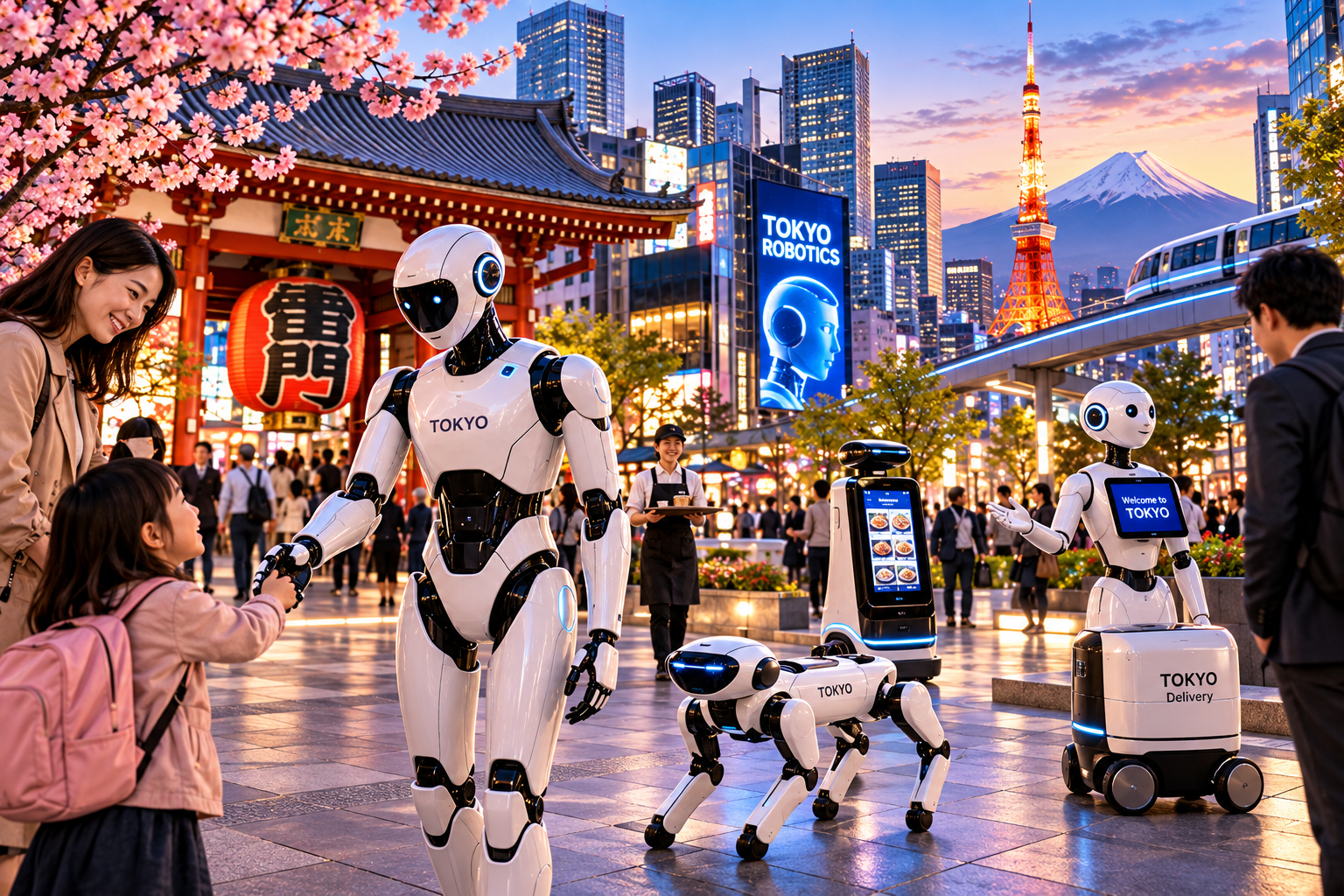
Tokyo Robotics: The Ultimate Guide to Robots, AI Innovation, Companies, Attractions & Future Trends
What happens when one of the world’s largest cities becomes a living laboratory for robotics? Tokyo robotics represents one of the world’s most advanced combinations of artificial intelligence, industrial automation, humanoid machines, service robots, logistics technology, healthcare robotics, and smart-city innovation. From factory robots and autonomous delivery systems to humanoids designed to work alongside people, Tokyo is increasingly focused on making robots useful in real-world environments rather than keeping them confined to laboratories Tokyo Wildlife
What Is Tokyo Robotics?
Tokyo robotics refers broadly to the robotics research, companies, technologies, applications, startups, demonstrations, education, and commercial activities connected with Tokyo.
It includes both traditional industrial robots and emerging AI-powered machines.
The ecosystem can be divided into several major categories.
Industrial robotics
Industrial robots perform highly repetitive or precise tasks such as:
- Welding
- Painting
- Assembly
- Packaging
- Palletizing
- Material handling
- Inspection
- Machine tending
Japan has been a major force in industrial robotics for decades.
Service robotics
Service robots are designed to interact with people or support services outside traditional factory environments.
Examples include robots used for:
- Hospitality
- Cleaning
- Delivery
- Retail
- Restaurants
- Healthcare
- Security
- Customer assistance
Humanoid robotics
Humanoid robots have a body structure that resembles humans to some degree.
They can include:
- Two arms
- Two legs
- A torso
- A head
- Human-like sensors
- Human-compatible manipulation systems
The attraction of humanoids is straightforward: much of the human world is designed around human bodies.
Doors, stairs, shelves, tools, kitchens, warehouses, and workplaces were built for people.
A machine capable of navigating these environments using human-like movements could potentially perform tasks without requiring every environment to be redesigned.
Mobile robotics
Mobile robots move through environments using wheels, legs, or other locomotion systems.
They are increasingly relevant to:
- Warehouses
- Hospitals
- Factories
- Airports
- Offices
- Delivery
- Infrastructure
AI robotics
The biggest change in modern robotics is the integration of artificial intelligence.
Traditional robots often perform precisely programmed actions.
AI-powered robots can increasingly use:
- Computer vision
- Machine learning
- Natural-language interaction
- Reinforcement learning
- Sensor fusion
- Tactile sensing
- Generative AI
- Simulation
This shift is moving robotics from pre-programmed automation toward adaptive physical intelligence.
Why Tokyo Became a Robotics Powerhouse
Tokyo’s robotics strength did not appear overnight.
It developed through decades of interaction between manufacturing, engineering education, electronics, automotive production, research institutions, and consumer technology.
Japan’s manufacturing culture
Japan developed exceptional expertise in precision manufacturing.
That matters because robotics requires extremely reliable mechanical systems.
A robot may have:
- Motors
- Gearboxes
- Sensors
- Controllers
- Cameras
- Actuators
- Software
- Batteries
- Communication systems
Every component has to work reliably.
Automotive manufacturing
Automotive factories were among the earliest large-scale environments for industrial robotics.
Welding, painting, assembly, and material handling became increasingly automated.
This created an ecosystem of engineering expertise that later expanded into other applications.
Electronics and sensors
Modern robots depend heavily on sensors.
A robot must know:
- Where it is
- What is around it
- How fast it is moving
- What it is touching
- Whether something is blocking its path
- Whether a human is nearby
Japan’s electronics and sensor industries have therefore contributed significantly to robotics.
Universities and research laboratories
Tokyo has a dense network of universities and research institutions.
Waseda University, the University of Tokyo, Tokyo Institute of Technology and other institutions have contributed to robotics research across areas including:
- Humanoid systems
- Manipulation
- Artificial intelligence
- Human-robot interaction
- Control engineering
- Medical robotics
- Mobility
Tokyo’s startup ecosystem also increasingly connects academic research with commercialization.
The Tokyo Metropolitan Government’s startup database includes robotics, AI, autonomous mobility, drones, R&D, and related technologies among its ecosystem categories.
Tokyo Robotics and the Aging Society
One of the strongest reasons robotics matters in Japan is demographics.
Japan has an aging population and faces labor shortages across multiple sectors.
That creates an unusual economic environment.
A company may want to expand but struggle to find enough workers.
A hospital may need staff to transport materials.
A warehouse may require repetitive movement of goods.
A construction company may face difficulty finding workers for dangerous tasks.
Robotics can potentially address some of these problems.
Robots as labor support
The important distinction is that robots do not necessarily need to replace entire occupations.
They can take over specific tasks.
For example:
- Carrying supplies
- Moving materials
- Repetitive lifting
- Inspection
- Cleaning
- Monitoring
- Sorting
- Transporting objects
This allows human workers to concentrate on tasks requiring judgment, communication, empathy, creativity, and responsibility.
Human-centered robotics
Toyota’s current robotics research provides a useful example of this philosophy.
The company describes its approach as developing robots that work with people and support human agency rather than simply replacing humans. Its research includes humanoid robots, reinforcement learning, human-support robots, and hospital transport systems.
This is an important direction for Tokyo robotics.
The future may be less about “robots versus humans” and more about robots extending human capabilities.
Industrial Robotics in Tokyo
Industrial robotics remains one of the foundations of Japan’s robotics strength.
Factories require consistency.
A robot can repeat the same movement thousands of times without fatigue.
Automotive robotics
Automotive factories use robots for:
- Welding
- Painting
- Assembly
- Inspection
- Handling
- Transportation
Robotic systems can work in environments that may be uncomfortable or dangerous for humans.
Electronics manufacturing
Electronics production requires precision.
Robots can help with:
- Component placement
- Inspection
- Assembly
- Material movement
Food manufacturing
Food production presents a more difficult challenge because products can be soft, irregular, slippery, or easily damaged.
This is where modern sensing becomes increasingly important.
A robot that can identify an object visually may still struggle to pick it up correctly.
This leads to one of the most important emerging areas in Tokyo robotics.
The Rise of Tactile Robotics
Seeing is not enough.
Humans use vision and touch together.
Imagine picking up a ripe peach.
Your eyes tell you its size and location.
Your fingers tell you whether it is soft.
Your brain combines both signals and adjusts your grip.
Robots traditionally struggle with this.
Giving robots a sense of touch
Tokyo-based XELA Robotics is developing tactile sensing systems that allow robots to detect pressure and shear forces.
Its technology is designed to help machines understand physical contact in real time.
At SusHi Tech Tokyo 2026, the company demonstrated how tactile sensing could help robots handle delicate objects such as eggs and fruit.
This represents a major shift.
The future of robotics is not only about better cameras.
It is also about better physical understanding.
Why tactile sensing matters
Tactile robotics could improve:
- Food handling
- Agriculture
- Medical robotics
- Warehouse picking
- Assembly
- Household assistance
- Elderly care
- Packaging
A robot that can feel how much force it is applying can potentially operate much more safely around people and fragile objects.
Humanoid Robots in Tokyo
Humanoid robots receive enormous public attention.
Their appearance makes robotics easy to understand.
But the engineering challenge is enormous.
A useful humanoid must solve several difficult problems simultaneously.
Balance
Walking on two legs is difficult.
The robot must constantly adjust its body position.
Manipulation
Hands must be able to interact with objects of different sizes, shapes, textures, and weights.
Perception
The robot needs to understand its environment.
Planning
It must determine what action should happen next.
Safety
The machine needs to operate around humans without causing harm.
Energy
Motors, sensors, processors, and actuators consume power.
A humanoid that can perform a task for only a short period may have limited practical value.
Tokyo’s New Humanoid Era
Tokyo’s robotics ecosystem is increasingly focused on making humanoids practical rather than purely entertaining.
At SusHi Tech Tokyo 2026, donut robotics demonstrated humanoid systems including the cinnamon 1, a compact humanoid concept, and a dog-type robot. Tokyo Robotics demonstrated a semi-humanoid performing desk-clearing through teleoperation while collecting movement logs that could potentially be used as AI training data.
That last point is particularly interesting.
It illustrates a transition from:
robot → programmed machine
toward:
robot → physical AI platform capable of learning from human demonstrations.
Teleoperation and Robot Training
Teleoperation means a human controls a robot remotely.
This may seem like a step backward.
It is actually potentially important.
A human can perform a complicated physical task.
Sensors can record:
- Arm movement
- Hand position
- Object interaction
- Force
- Timing
- Environmental context
AI can then potentially learn patterns from those demonstrations.
Why this matters
Teaching a robot every possible situation manually would be extremely difficult.
Human demonstrations offer a way to generate training data.
A robot might learn:
- How a person approaches an object
- How the object is grasped
- How much force is applied
- How the object is moved
- How the task changes when the environment changes
This could accelerate the development of adaptable robots.
Physical AI: The Next Stage of Robotics
Artificial intelligence has become extremely good at processing digital information.
Robotics adds a difficult requirement:
AI must act in the physical world.
A chatbot can generate text.
A physical AI system must deal with:
- Gravity
- Friction
- Weight
- Collisions
- Noise
- Lighting
- Human movement
- Unpredictable objects
This makes physical AI much more complicated.
Simulation and real-world learning
Toyota is researching reinforcement learning and Sim2Real approaches, where robots can train extensively in simulated environments before transferring learned behavior to physical machines.
This could become one of the defining technologies of future robotics.
Instead of training every robot entirely in the physical world, engineers can create virtual environments where millions of simulated movements can be tested.
Tokyo Robotics and Healthcare
Healthcare is one of the most promising applications.
Hospitals involve many repetitive transport tasks.
A nurse may need to move:
- Medicines
- Samples
- Equipment
- Documents
- Supplies
These activities consume time without necessarily requiring clinical expertise.
Hospital delivery robots
Toyota’s Potaro hospital transport robot is an example of this approach.
Toyota reports that Potaro units have been operating at Toyota Memorial Hospital since 2023, transporting medicines, specimens, and other items.
The broader lesson is important.
A hospital robot does not need to look human.
It simply needs to solve a specific problem reliably.
Robots in Elderly Care
Japan’s demographic situation makes elderly care particularly important.
Robots could potentially support:
- Mobility
- Monitoring
- Object retrieval
- Communication
- Rehabilitation
- Transportation
- Exercise
- Medication logistics
However, care robotics must be approached carefully.
A robot can carry something.
It cannot automatically replace human empathy.
The human side of care robots
Older people may need:
- Conversation
- Emotional support
- Judgment
- Compassion
- Medical expertise
Robots may support caregivers rather than replace them.
This is likely to be a more realistic and socially acceptable path.
Tokyo Robotics in Logistics
Tokyo’s enormous urban economy depends on logistics.
Millions of objects move through warehouses, distribution centers, stores, restaurants, hospitals, and homes.
Robotics can reduce repetitive work.
Warehouse robots
Robots can:
- Move shelves
- Carry packages
- Sort goods
- Pick items
- Transport containers
- Scan inventory
Last-mile delivery
Last-mile delivery is more difficult because environments are unpredictable.
A warehouse is controlled.
A city street is not.
Robots must deal with:
- Pedestrians
- Bicycles
- Cars
- Stairs
- Uneven surfaces
- Weather
- Construction
- Crowds
This makes urban robotics particularly challenging.
Rapyuta Robotics and Cloud Robotics
Tokyo-based Rapyuta Robotics is an important example of the city’s logistics robotics ecosystem.
The company developed cloud-based robotics technology and autonomous systems aimed at logistics and warehouse environments.
The broader concept is significant.
Instead of thinking about each robot as an isolated machine, cloud robotics treats robots as connected systems.
Why cloud robotics matters
Connected robots can potentially:
- Share data
- Receive software updates
- Coordinate tasks
- Learn from collective experience
- Be monitored remotely
This could make large robotic fleets easier to manage.
Robotics and Tokyo’s Smart City Future
Tokyo is not simply trying to build better robots.
It is also experimenting with how robots fit into cities.
A smart city could eventually connect:
- Robots
- Autonomous vehicles
- Drones
- Sensors
- Buildings
- Traffic systems
- Hospitals
- Logistics networks
- Artificial intelligence
The result would be a much larger system.
Robot-friendly infrastructure
Future cities may need:
- Charging stations
- Robot lanes
- Autonomous delivery zones
- Sensor networks
- Safe pedestrian interaction
- Robot elevators
- Standardized communication systems
The infrastructure surrounding robots may become just as important as the robots themselves.
Tokyo Robotics and Autonomous Mobility
Robotics and autonomous vehicles increasingly overlap.
An autonomous vehicle is essentially a mobile robotic system.
Tokyo’s innovation ecosystem is exploring:
- Autonomous driving
- Delivery vehicles
- Mobile robots
- Drones
- Robotic transport
At SusHi Tech Tokyo 2026, TIER IV was among the organizations showcasing autonomous-driving technology and the open-source Autoware ecosystem.
This illustrates how Tokyo robotics is expanding beyond machines with arms and legs.
Construction Robotics
Construction is another area where robotics can provide major benefits.
Construction sites are:
- Unstructured
- Dangerous
- Variable
- Physically demanding
Unlike a factory, the environment changes continuously.
Potential applications
Robots can assist with:
- Inspection
- Heavy lifting
- Drilling
- Painting
- Surveying
- Infrastructure maintenance
- High-altitude work
SusHi Tech Tokyo 2026 also featured heavy robotic machinery designed for high-altitude infrastructure work and intuitive human operation.
Agricultural Robotics
Tokyo itself is highly urbanized, but Tokyo-based robotics technology can serve agriculture elsewhere in Japan.
Robots can help with:
- Harvesting
- Fruit handling
- Weed detection
- Crop inspection
- Sorting
- Precision agriculture
Tactile sensing could be especially useful here.
A robot harvesting delicate fruit needs more than a camera.
It needs to understand physical resistance.
Robotics in Restaurants and Hospitality
Japan’s reputation for service makes hospitality robotics particularly interesting.
Potential applications include:
- Food delivery
- Cleaning
- Reception
- Information services
- Inventory transport
- Kitchen assistance
Why hospitality robots are difficult
Human service is unpredictable.
A customer may ask a question that the robot was not programmed to answer.
A table may be blocked.
A child may suddenly walk into the robot’s path.
A human employee can adapt instantly.
Robots need much more sophisticated perception and decision-making to behave naturally.
Social and Communication Robots
Japan has also explored robots designed primarily for social interaction.
These systems may use:
- Speech
- Facial expressions
- Movement
- Gestures
- Conversation
- Voice recognition
The goal is not always productivity.
Sometimes it is interaction.
Where social robots could help
Potential applications include:
- Education
- Museums
- Hotels
- Airports
- Healthcare
- Customer service
- Entertainment
Tokyo Robotics and Education
Robotics is increasingly important in education.
Students can learn:
- Programming
- Mechanical engineering
- AI
- Electronics
- Control systems
- Computer vision
- Design
A robot provides an excellent physical demonstration of abstract concepts.
Robotics for children
Educational robotics can teach:
- Problem solving
- Logical thinking
- Collaboration
- Creativity
- Engineering
The most effective robotics education does not simply teach students how to build robots.
It teaches them how to solve problems with technology.
Robotics Attractions and Experiences in Tokyo
Tokyo can be a fascinating destination for technology enthusiasts.
Visitors may encounter robotics through:
- Technology exhibitions
- Science museums
- Robot demonstrations
- University events
- Innovation conferences
- Company showrooms
- Interactive entertainment
SusHi Tech Tokyo
SusHi Tech Tokyo has become an important platform for seeing emerging technologies.
The 2026 edition included robotics demonstrations ranging from humanoids and tactile technology to robotic arms and autonomous systems.
For travelers interested in the future of Tokyo, events like this can provide more insight than simply visiting a technology-themed retail store.
Tokyo Robotics for Tourists
If your primary interest is tourism, you do not need an engineering background.
A robotics-focused Tokyo trip can be designed around experiences.
For first-time visitors
Focus on:
- Major technology districts
- Science museums
- Robotics exhibitions
- Innovation events
- Interactive technology attractions
For engineers
Add:
- University research
- Industry exhibitions
- Robotics conferences
- Company demonstrations
- Technical museums
For families
Prioritize:
- Interactive exhibits
- Educational robotics
- Demonstration robots
- Hands-on activities
For photographers
Look for:
- Humanoids
- Robotic arms
- Neon-lit technology environments
- Interactive machines
- Futuristic architecture
Tokyo Robotics for Professionals
Professionals should think beyond entertainment.
Tokyo offers opportunities to study:
- Industrial automation
- AI integration
- Human-robot collaboration
- Autonomous mobility
- Robotics startups
- Manufacturing systems
- Healthcare technology
The Tokyo Metropolitan Government’s innovation ecosystem actively supports startups working in robotics and related fields. Its database currently identifies more than 1,000 startups across the broader ecosystem, with robotics, AI, IoT, drones, R&D, and other categories available for exploration.
Ten Major Robotics Brands and Companies to Know
The following comparison focuses on influential robotics companies and technology organizations relevant to Japan and Tokyo’s broader robotics ecosystem. They vary considerably: some are industrial automation leaders, while others focus on AI, humanoids, logistics, mobility, or service robotics.
| FANUC | Industrial robotics | Factory automation | Precision and reliability | Manufacturers |
| Yaskawa | Industrial & collaborative robots | MOTOMAN systems | Motion control | Industrial users |
| Kawasaki Robotics | Industrial robots | Welding, handling, assembly | Long robotics history | Factories |
| Toyota | Partner & humanoid robotics | HSR, T-HR3, robotics research | Human-centered robotics | Research & mobility |
| Sony | Entertainment & consumer robotics | AIBO heritage | AI, sensors, consumer experience | Consumers |
| Honda | Humanoid robotics | ASIMO heritage | Humanoid mobility | Robotics researchers |
| SoftBank Robotics | Service robotics | Pepper and service robots | Human interaction | Service businesses |
| Rapyuta Robotics | Cloud robotics & logistics | Warehouse automation | Connected robot systems | Logistics |
| Tokyo Robotics | AI and robotics | Semi-humanoid and robotic systems | AI-driven manipulation | Advanced robotics |
| XELA Robotics | Tactile sensing | uSkin technology | Robot touch and physical sensing | AI/robotics developers |
FANUC
FANUC is one of Japan’s best-known industrial robotics companies.
Its strength is automation at industrial scale.
Its systems are particularly relevant to:
- Automotive manufacturing
- Electronics
- Welding
- Handling
- Machine tending
- Assembly
For anyone interested in the industrial foundation of Japanese robotics, FANUC is essential to understand.
Yaskawa
Yaskawa is another major robotics and motion-control company.
Its MOTOMAN robotics systems are used in industrial environments around the world.
The company’s strength extends beyond robots themselves into motors, drives, motion control, and automation.
Kawasaki Robotics
Kawasaki has an especially long history in Japanese robotics.
The company began producing industrial robots in Japan in 1969 and has supplied robots for welding, assembly, handling, painting, and palletizing.
Kawasaki also maintains a Tokyo Robot School and Tokyo showroom, demonstrating the importance of training and public-facing robotics infrastructure.
Toyota
Toyota’s robotics strategy is particularly interesting because it connects robotics with mobility, manufacturing, healthcare, and human support.
Its current research includes humanoid robotics, reinforcement learning, hospital transport, and human-support robots.
Toyota’s philosophy emphasizes cooperation between humans and machines.
Sony
Sony is important historically because AIBO helped popularize the idea of consumer robotics.
Its contribution demonstrates that robotics can be about emotional interaction as well as industrial productivity.
Honda
Honda’s ASIMO became one of the world’s most recognizable humanoid robots.
Although robotics strategies evolve over time, ASIMO’s legacy remains important because it helped advance public understanding of bipedal robotics.
SoftBank Robotics
SoftBank Robotics became globally known for Pepper.
Pepper demonstrated the potential of robots designed specifically for human-facing environments.
Its development helped normalize the idea of robots operating in stores, offices, educational settings, and public spaces.
Rapyuta Robotics
Rapyuta Robotics represents the startup side of Tokyo’s robotics economy.
Its focus on cloud robotics and logistics demonstrates that the future of robotics is not limited to mechanical hardware.
Software infrastructure can be equally important.
Tokyo Robotics
Tokyo Robotics Inc. is headquartered in Bunkyo, Tokyo and was founded in 2015. Its business includes development and sales of robots and AI, and it is wholly owned by Yaskawa Electric.
Its presence is especially relevant to the emerging relationship between AI, manipulation, and practical robotics.
XELA Robotics
XELA Robotics represents one of the most interesting emerging technology directions: tactile intelligence.
Instead of simply improving robotic vision, it focuses on giving machines a sense of physical contact.
That may prove crucial for robots operating in unpredictable human environments.
Tokyo Robotics Versus Traditional Automation
Traditional automation generally works best when the environment is predictable.
For example:
A factory robot can weld the same component thousands of times because the component arrives in a predictable position.
But a household is unpredictable.
A cup could be:
- On the table
- In a sink
- Half-filled
- Upside down
- Behind another object
The robot needs to adapt.
This is why the next generation of robotics requires AI.
The Importance of Computer Vision
Computer vision allows robots to interpret camera data.
A robot can potentially identify:
- Objects
- People
- Walls
- Floors
- Obstacles
- Text
- Colors
- Shapes
But vision alone is insufficient.
A robot may see an apple without knowing exactly how hard it should grip it.
That is why vision plus tactile sensing is such a powerful combination.
The Importance of Robot Hands
A robotic arm is not necessarily the hardest part.
The hand can be.
Human hands are incredibly sophisticated.
They can:
- Grip
- Pinch
- Twist
- Push
- Pull
- Rotate
- Feel texture
- Detect resistance
Humanoid robots therefore need increasingly capable manipulation systems.
Dexterity is the real challenge
Walking attracts attention.
Manipulation creates usefulness.
A robot that can walk beautifully but cannot reliably pick up a cup may have limited practical value.
A robot that can manipulate objects intelligently could transform industries.
Tokyo Robotics and Generative AI
Generative AI may become an important layer in robotics.
Instead of programming a robot with thousands of specific instructions, users may eventually describe goals using natural language.
For example:
“Clear the table and place the dishes in the kitchen.”
A future robot could potentially interpret the instruction, identify relevant objects, plan actions, and execute them.
This remains a major technical challenge.
But the direction is clear.
Robotics is becoming increasingly connected to AI systems that can interpret high-level instructions.
The Challenge of Robot Safety
Robots operate in the real world.
Errors can cause physical damage.
Safety therefore requires multiple layers.
Hardware safety
Machines need:
- Emergency stops
- Force limits
- Collision detection
- Mechanical safeguards
Software safety
AI systems need:
- Decision boundaries
- Monitoring
- Fail-safe behavior
- Error detection
Human safety
Robots must understand that people are unpredictable.
A child may run into the robot.
A worker may suddenly reach into its workspace.
A patient may lose balance.
Human-aware robotics therefore requires much more than simple obstacle avoidance.
Common Problems Facing Tokyo Robotics
High Development Costs
Robotics hardware is expensive.
A sophisticated robot requires:
- Mechanical engineering
- Electronics
- Sensors
- AI
- Software
- Testing
- Maintenance
Solution
Modular hardware and shared software platforms can reduce development costs.
Battery Limitations
Mobile robots and humanoids consume significant energy.
Solution
Better batteries, efficient motors, energy-aware AI, charging infrastructure, and task optimization will be important.
Data Requirements
AI robots need training data.
Physical data is harder to collect than text.
Solution
Simulation, teleoperation, synthetic data, and shared datasets can help.
Human Acceptance
People may not automatically trust robots.
Solution
Robots need predictable behavior, transparent design, clear safety systems, and intuitive interaction.
Maintenance
A robot is not simply purchased and forgotten.
It requires:
- Software updates
- Hardware maintenance
- Calibration
- Replacement parts
- Technical support
This means robotics companies increasingly need service businesses, not just hardware sales.
The Pros of Tokyo Robotics
Increased productivity
Robots can perform repetitive tasks continuously.
Improved workplace safety
Machines can handle dangerous environments.
Support for aging societies
Robots can assist where labor shortages exist.
Precision
Robots can perform highly controlled movements.
Consistency
Automation can improve repeatability.
New industries
Robotics can create entirely new businesses and careers.
Human augmentation
Robots can help people perform tasks they could not easily accomplish alone.
The Cons of Tokyo Robotics
High initial cost
Advanced robots can require substantial investment.
Technical complexity
Integration can be difficult.
Maintenance requirements
Robotic systems require specialized expertise.
Employment concerns
Some jobs may change or disappear as automation expands.
Safety risks
Failures can have physical consequences.
Social acceptance
People may resist robots in certain environments.
Privacy
Robots equipped with cameras and microphones can collect sensitive environmental information.
Robotics and Employment
The question “Will robots take everyone’s jobs?” is too simplistic.
A better question is:
Which tasks will become automated, and which new tasks will humans perform?
Historically, technology often changes jobs rather than eliminating every occupation.
Robotics may reduce demand for:
- Repetitive manual work
- Certain inspection tasks
- Simple transport activities
But it may increase demand for:
- Robot technicians
- AI engineers
- Data specialists
- Safety engineers
- Robot trainers
- Maintenance professionals
- Human-robot interaction designers
New Jobs Created by Tokyo Robotics
Future careers may include:
- Robotics engineer
- Physical AI engineer
- Robot behavior designer
- Tactile sensing engineer
- Robot safety specialist
- Autonomous systems engineer
- Robot fleet manager
- Human-robot interaction researcher
- Simulation engineer
- Robotics technician
This makes robotics education increasingly important.
How to Learn Robotics in Tokyo
A beginner can start with basic programming and electronics.
Step one: Learn programming
Python is particularly useful for AI and robotics research.
Step two: Learn electronics
Understand:
- Sensors
- Motors
- Controllers
- Power systems
Step three: Learn mechanics
Understand:
- Gears
- Torque
- Actuators
- Kinematics
Step four: Learn AI
Study:
- Machine learning
- Computer vision
- Reinforcement learning
Step five: Build projects
Start small.
A simple mobile robot can teach more than hours of theoretical reading.
Tokyo Robotics for Students
Students can specialize in:
- Mechanical engineering
- Electrical engineering
- Computer science
- AI
- Control systems
- Biomedical engineering
Interdisciplinary skills are particularly valuable.
The best modern robotics engineers understand both hardware and software.
Tokyo Robotics for Hobbyists
You do not need a laboratory to start.
A hobbyist can build:
- Line-following robots
- Obstacle-avoidance robots
- Robotic arms
- Camera robots
- Small autonomous vehicles
- AI-controlled systems
The key is to begin with a manageable problem.
How Businesses Can Adopt Robotics
Companies should not begin with:
“We need a robot.”
They should begin with:
“What problem are we trying to solve?”
Identify repetitive tasks Tokyo robotics
Find tasks that are:
- Repetitive
- Physically demanding
- Dangerous
- Time-consuming
- Predictable
Measure the economics Tokyo robotics
Calculate:
- Labor cost
- Robot cost
- Maintenance
- Training
- Downtime
- Expected productivity
Start with a pilot Tokyo robotics
Do not automate an entire operation immediately.
Test one process.
Measure results Tokyo robotics
Track:
- Productivity
- Error rates
- Worker satisfaction
- Safety
- Maintenance
- Return on investment
Common Mistakes When Understanding Tokyo Robotics
Mistake: Thinking every robot is humanoid Tokyo robotics
Most useful robots are not humanoid.
Mistake: Assuming AI automatically makes robots intelligent Tokyo robotics
Physical environments remain extremely difficult.
Mistake: Focusing only on appearance Tokyo robotics
A beautiful robot can be less useful than a simple warehouse machine.
Mistake: Ignoring maintenance Tokyo robotics
Robotics is an operational system, not just a product purchase.
Mistake: Underestimating safety Tokyo robotics
Physical AI requires stricter safety thinking than software-only AI.
Mistake: Assuming automation happens instantly Tokyo robotics
Real-world deployment often takes years.
How Tokyo Robotics Differs From Science Fiction
Science fiction often imagines robots as fully autonomous beings.
Real robotics is more incremental.
A practical robot may:
- Do one task extremely well
- Work under human supervision
- Use remote control
- Operate in a limited environment
- Require charging
- Need regular maintenance
This may sound less exciting.
But it is more realistic.
And practical robots can have a much larger economic impact than spectacular prototypes.
The Future of Tokyo Robotics
The next decade could be particularly important.
Several trends deserve attention.
Humanoids will become more practical Tokyo robotics
The goal will shift from demonstrations to measurable work.
Companies will ask:
- Can it carry something?
- Can it pick objects?
- Can it work eight hours?
- Can it operate safely?
- Does it reduce costs?
Tactile intelligence will grow Tokyo robotics
Robots will increasingly combine:
- Vision
- Touch
- Force
- Sound
- Position
- Environmental sensing
AI will move from software into machines Tokyo robotics
Large AI models will increasingly influence physical systems.
This could create a new category of physical AI.
Robot training will become data-driven Tokyo robotics
Teleoperation and simulation may generate massive training datasets.
Robots will become collaborative Tokyo robotics
Rather than replacing entire teams, robots may increasingly work alongside humans.
Healthcare robotics will expand Tokyo robotics
Japan’s demographic conditions create strong incentives.
Logistics automation will accelerate Tokyo robotics
E-commerce and labor shortages make logistics an obvious robotics market.
Smart cities will become robot-aware Tokyo robotics
Urban infrastructure may increasingly accommodate autonomous machines.
Tokyo Robotics and the Global Market
Tokyo’s robotics ecosystem has global significance.
Japanese companies already supply robotics technology internationally.
At the same time, Tokyo is attracting international startups and technology companies.
The Tokyo Metropolitan Government’s investment programs have included robotics and AI companies establishing or planning research and development operations in Tokyo. Examples include RGo Robotics, whose planned Tokyo center focuses on robotic perception for logistics, autonomous robots, industrial machinery, and related applications.
This suggests an increasingly international robotics ecosystem.
Tokyo as a Robotics Laboratory
Perhaps the most interesting way to think about Tokyo is as a living laboratory.
The city has:
- Dense urban environments
- Aging demographics
- Advanced infrastructure
- High technology adoption
- World-class manufacturing
- Strong universities
- Large consumer markets
- Major logistics networks
That combination creates ideal conditions for testing practical robotics.
What Tokyo Robotics May Look Like in 2030
By 2030, it is reasonable to expect robotics to become less visually spectacular but more useful.
Instead of seeing robots everywhere, people may simply stop noticing them.
A hospital robot quietly moves supplies.
A warehouse robot moves packages.
A construction robot performs dangerous inspection.
A service robot cleans a facility at night.
An AI-powered machine assists a worker.
A tactile robot handles fragile produce.
This is arguably the real goal of robotics.
Not spectacle.
Utility.
What Tokyo Robotics May Look Like Beyond 2030
Further into the future, robots could become more general-purpose.
Instead of one machine performing one task, a single physical AI system could potentially learn many tasks.
A robot might be able to:
- Clean
- Carry
- Sort
- Inspect
- Assist
- Communicate
- Learn new procedures
However, achieving this reliably remains a major scientific and engineering challenge.
The Most Important Robotics Trend to Watch
If only one trend should be watched, it is not humanoid appearance.
It is general-purpose physical intelligence.
The biggest breakthrough would occur when robots can reliably understand unfamiliar environments and adapt without extensive reprogramming.
That requires combining:
- AI
- Vision
- Touch
- Manipulation
- Mobility
- Language
- Memory
- Planning
- Safety
Tokyo is actively developing pieces of this puzzle.
Tokyo Robotics and Human-Robot Collaboration
The most realistic future is likely collaborative.
Imagine a factory where:
A human decides what needs to be done.
A robot performs repetitive lifting.
Another robot handles inspection.
AI monitors the production process.
A technician supervises the robotic fleet.
Humans remain responsible for decisions requiring judgment.
This is a very different vision from science-fiction stories about robots taking over.
It is closer to distributed teamwork between people and machines.
Tokyo Robotics and Accessibility
Robotics can also improve accessibility.
People with mobility limitations may benefit from:
- Robotic assistance
- Rehabilitation systems
- Object retrieval
- Mobility support
- Smart home robotics
Toyota’s research into human-support robotics illustrates this direction, particularly its work around supporting people who cannot easily move independently.
The goal should not be technology for technology’s sake.
The goal should be greater independence.
Tokyo Robotics and Sustainability
Robotics can contribute to sustainability through:
- Precision manufacturing
- Reduced material waste
- Efficient logistics
- Automated recycling
- Infrastructure maintenance
- Precision agriculture
But robotics also consumes energy and materials.
Therefore, sustainable robotics requires considering the entire lifecycle:
Manufacturing → operation → maintenance → repair → recycling.
How to Choose a Robotics Experience in Tokyo
If you are visiting Tokyo specifically for robotics, ask yourself what you want.
Want entertainment?
Choose interactive robot experiences.
Want education?
Choose science museums and technology exhibitions.
Want industrial knowledge?
Look for robotics exhibitions and professional demonstrations.
Want startups?
Explore Tokyo’s innovation ecosystem and technology events.
Want AI?
Look for demonstrations involving computer vision, physical AI, autonomous systems, and humanoids.
Want manufacturing?
Focus on industrial robotics.
A One-Day Tokyo Robotics Experience
Morning Tokyo robotics
Start with a science or technology-focused attraction.
Learn the fundamentals.
Afternoon Tokyo robotics
Explore an innovation exhibition or robotics demonstration.
Focus on how machines interact with people.
Evening Tokyo robotics
Visit a technology-focused neighborhood and observe Tokyo’s broader relationship with automation.
The objective is not to see the largest number of robots.
It is to understand how robotics fits into everyday life.
A Three-Day Tokyo Robotics Experience
Day One: Consumer robotics
Explore:
- Interactive robots
- AI demonstrations
- Technology retail
- Digital entertainment
Day Two: Industrial robotics
Focus on:
- Automation
- Manufacturing
- Professional exhibitions
- Robotics companies
Day Three: Future robotics
Explore:
- Humanoids
- AI
- Startups
- Smart-city technology
- Autonomous mobility
This provides a balanced picture of the industry.
FAQs About Tokyo Robotics
Why is Tokyo famous for robotics?
Tokyo is a major center for Japanese technology, research, manufacturing, AI, startups, and automation. Its robotics ecosystem includes industrial machines, service robots, humanoids, logistics systems, healthcare technology, and emerging physical-AI companies.
What types of robots are common in Tokyo?
Tokyo’s robotics ecosystem includes industrial robots, autonomous mobile robots, service robots, humanoids, robotic arms, healthcare robots, logistics robots, drones, and AI-powered machines.
Is Tokyo the robotics capital of Japan?
Tokyo is one of Japan’s most important robotics centers, particularly for research, startups, AI, investment, demonstrations, and business development. Japan’s broader robotics industry is distributed across many cities and industrial regions.
Are humanoid robots common in Tokyo?
Humanoid robots are still an emerging technology rather than an ordinary part of daily life, but Tokyo is an important location for demonstrations, research, and commercialization efforts.
What is the future of humanoid robots in Tokyo?
The focus is increasingly moving from demonstrations toward practical applications such as logistics, manufacturing, infrastructure, service work, and human assistance.
What is physical AI?
Physical AI refers broadly to artificial intelligence that operates through physical systems such as robots, allowing machines to perceive, reason, learn, and act in the real world.
Why do robots need tactile sensors?
Tactile sensors allow robots to detect physical contact, pressure, and forces. This can help machines handle fragile or unpredictable objects more effectively. Tokyo-based XELA Robotics is developing technology in this area.
What is XELA Robotics?
XELA Robotics is a Tokyo-based robotics startup developing tactile sensing technology intended to give robots a sense of touch and improve physical interaction with objects.
What is Tokyo Robotics Inc.?
Tokyo Robotics Inc. is a Tokyo-based company founded in 2015 that develops and sells robots and AI technologies. It is wholly owned by Yaskawa Electric.
What is Kawasaki Robotics known for?
Kawasaki Robotics is known for industrial robots used in areas including welding, assembly, handling, painting, and palletizing. Kawasaki began producing industrial robots in Japan in 1969.
Does Toyota make robots?
Toyota has developed and researched multiple types of robots, including partner robots, humanoid robots, hospital transport robots, and rehabilitation-related systems. Its current research also includes reinforcement learning for humanoid robotics.
What is Toyota’s approach to robotics?
Toyota emphasizes human-centered robotics and collaboration between people and machines. Its research explores robots that support people and address issues such as labor shortages and an aging society.
What is Potaro?
Potaro is a hospital transport robot developed by Toyota. It has been used at Toyota Memorial Hospital to transport medicines, specimens, and other items.
Can tourists see robots in Tokyo?
Yes. Depending on current exhibitions and schedules, visitors can encounter robotics at science attractions, innovation events, technology exhibitions, company demonstrations, and public showcases.
What is SusHi Tech Tokyo?
SusHi Tech Tokyo is a Tokyo innovation event focused on technologies and solutions for future sustainable cities. Its 2026 program included extensive robotics demonstrations and experiences.
Can children enjoy Tokyo robotics?
Yes. Interactive robotics exhibitions and educational technology experiences can be particularly engaging for children interested in science, engineering, programming, and AI.
Is Tokyo robotics only about humanoid robots?
No. Industrial robots, autonomous mobile robots, robotic arms, warehouse systems, tactile sensors, drones, healthcare machines, and autonomous vehicles are equally important.
What are industrial robots used for?
Industrial robots are commonly used for welding, assembly, painting, handling, palletizing, inspection, packaging, and machine tending.
What are service robots used for?
Service robots can assist with cleaning, hospitality, delivery, customer interaction, healthcare logistics, security, and other non-industrial tasks.
What are logistics robots?
Logistics robots transport, sort, pick, or organize goods in warehouses and distribution systems.
Can robots help Japan’s aging population?
Potentially. Robots can support transportation, rehabilitation, logistics, monitoring, mobility, and other tasks, although human caregivers remain essential for many aspects of care.
Will robots replace human workers in Tokyo?
Some tasks are likely to become increasingly automated, but many roles will remain human-centered. Robotics may also create new jobs in engineering, maintenance, programming, AI, safety, data, and robot operations.
What skills are useful for a robotics career?
Useful skills include programming, mechanical engineering, electronics, AI, computer vision, control systems, mathematics, simulation, and human-robot interaction.
Is robotics difficult to learn?
Professional robotics can be highly technical, but beginners can start with simple programmable robots, electronics kits, coding projects, and basic computer vision.
What programming language is useful for robotics?
Python is widely useful for AI and robotics development. Other languages, particularly C and C++, are also important in many robotics systems.
What is teleoperation in robotics?
Teleoperation means a human controls a robot remotely. It can be used for difficult tasks, robot testing, data collection, and training AI systems.
Why is teleoperation important for humanoid robots?
Human operators can demonstrate complicated physical tasks. Sensors can record these demonstrations and potentially create useful training data for AI-powered robot learning.
What is Sim2Real robotics?
Sim2Real refers to training or testing robots in simulation and then transferring the learned behavior to physical robots. Toyota is researching this approach in humanoid robotics and reinforcement learning.
What is robot perception?
Robot perception is the ability of a machine to interpret information from sensors such as cameras, depth sensors, tactile systems, microphones, and other devices.
What is tactile robotics?
Tactile robotics focuses on enabling machines to detect and interpret physical contact, pressure, force, and texture.
Can robots work safely around humans?
They can be designed with multiple safety systems, but safe human-robot collaboration remains an important engineering challenge. Robots need reliable perception, force control, collision detection, software safeguards, and appropriate operating procedures.
What is the biggest challenge facing humanoid robots?
There is no single challenge. Major issues include dexterity, balance, perception, energy consumption, safety, reliability, cost, training data, and the ability to adapt to unpredictable environments.
Are Japanese robotics companies still important globally?
Yes. Japanese companies remain significant in industrial automation, robotics components, manufacturing technology, mobility, and research.
What is the future of Tokyo robotics?
The future is likely to involve more AI-powered robots, humanoid systems, tactile sensing, autonomous mobility, healthcare robotics, logistics automation, collaborative robots, and physical AI.
Conclusion
Tokyo robotics is no longer simply a story about futuristic humanoid machines. It has become a broad and rapidly evolving ecosystem that connects artificial intelligence, industrial automation, healthcare, logistics, autonomous mobility, manufacturing, tactile sensing, and human-centred technology. The most important transformation is the move from robots that simply follow fixed instructions toward machines that can perceive their surroundings, learn from experience, adapt to changing situations, and collaborate with people. Tokyo is particularly important because its robotics industry is closely connected to real-world challenges.