Tokyo Railways: The Ultimate Guide to Japan’s Railway Network, Trains, Routes, Tickets and Travel Tips
Tokyo railways are the backbone of transportation in Tokyo, connecting major districts, residential neighbourhoods, airports, shopping areas, business centres and tourist attractions through an extensive network of trains and subway lines. For visitors, understanding Tokyo railways means learning how to choose the right line, use IC cards, recognise train services, transfer efficiently and avoid common station mistakes Tokyo Accessibility
Understanding Tokyo Railways
What Are Tokyo Railways?
Tokyo railways refer to the interconnected network of railway and subway services operating throughout Tokyo and the wider metropolitan area.
The network includes several different types of operators:
- JR East
- Tokyo Metro
- Toei Subway
- Tokyu
- Keio
- Odakyu
- Seibu
- Tobu
- Keisei
- Other regional and private railway companies
This is one of the most important things for first-time visitors to understand.
Tokyo does not have one single railway company controlling every train. Instead, multiple operators run different lines, stations and services. These networks often connect with each other, which makes travelling around Tokyo extremely convenient but can also make railway maps appear complicated.
Why Tokyo Railways Are So Important
Tokyo is one of the world’s largest metropolitan areas. Millions of residents, workers, students and tourists depend on railways every day.
Tokyo railways support:
- Daily commuting
- Tourism
- Airport travel
- Business travel
- Shopping
- Education
- Entertainment
- Intercity travel
- Suburban transportation
- Access to residential areas
For tourists, Tokyo railways are particularly important because many major attractions are located close to railway stations.
How the Tokyo Railway System Is Organised
JR East
JR East is one of the most important railway operators for visitors exploring Tokyo.
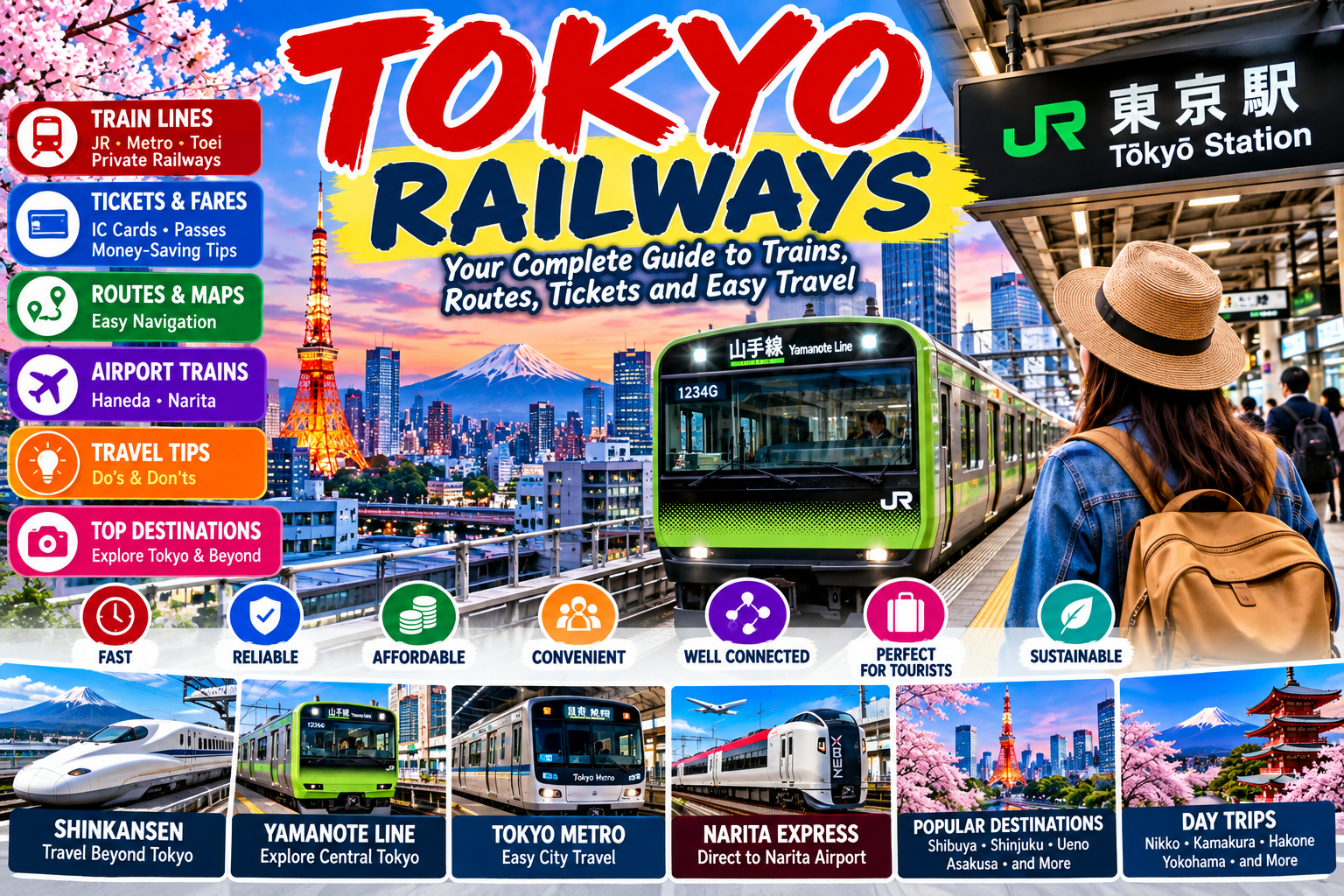
Several well-known routes are associated with JR East, including the Yamanote Line, Chuo Line, Keihin-Tohoku Line and other services connecting Tokyo with surrounding areas.
The Yamanote Line is particularly useful for tourists because it forms a loop around many central Tokyo districts.
Major destinations served by JR services include:
- Tokyo Station
- Shinjuku
- Shibuya
- Ueno
- Ikebukuro
- Shinagawa
- Akihabara
Tokyo Metro
Tokyo Metro operates several subway lines throughout central Tokyo.
Tokyo Metro is particularly useful when travelling between central neighbourhoods where underground routes can be faster than surface railway routes.
Important Tokyo Metro destinations include:
- Ginza
- Shibuya
- Shinjuku
- Asakusa
- Ueno
- Omotesando
- Akihabara area
- Roppongi area
- Tokyo Station area
Toei Subway
The Tokyo Metropolitan Bureau of Transportation operates Toei Subway services.
Toei Subway is another major part of Tokyo’s underground transportation network.
The Toei network includes:
- Asakusa Line
- Mita Line
- Shinjuku Line
- Oedo Line
Understanding the difference between Tokyo Metro and Toei Subway can help visitors avoid purchasing the wrong ticket or accidentally choosing a less convenient transfer.
Private Railways
Private railway companies play a major role in Tokyo transportation.
Companies such as Tokyu, Keio, Odakyu, Seibu and Tobu connect central Tokyo with suburban areas and popular destinations outside the central districts.
These railways are especially useful for:
- Suburban travel
- Day trips
- Theme parks
- Shopping districts
- Mountain destinations
- Beaches
- Historic areas
- Airport connections
Tokyo Railways and the Yamanote Line
Why the Yamanote Line Is Popular With Tourists
The Yamanote Line is one of the best-known railway services in Tokyo.
It operates as a loop around central Tokyo and connects several major districts.
For first-time visitors, the Yamanote Line can be an easy starting point because many famous areas are directly connected.
Important stations include:
- Shibuya
- Shinjuku
- Ikebukuro
- Ueno
- Tokyo
- Shinagawa
- Hamamatsucho
- Akihabara
When to Use the Yamanote Line
The Yamanote Line is particularly useful when your journey involves two major central Tokyo districts.
For example, a tourist staying near Shinjuku may use the Yamanote Line to reach Shibuya, Ueno or Tokyo Station without needing to understand a complicated combination of different subway lines.
However, the Yamanote Line is not automatically the fastest option for every journey.
Sometimes a subway route or another JR service can reduce travel time.
Tokyo Railway Stations You Should Know
Tokyo Station
Tokyo Station is one of the most important railway hubs in Japan.
It serves local, regional and high-speed railway services and is surrounded by major business and shopping areas.
Tokyo Station is also important for visitors travelling beyond Tokyo.
Shinjuku Station
Shinjuku is famous for its enormous passenger volume and complex station environment.
The surrounding area includes:
- Hotels
- Restaurants
- Shopping centres
- Department stores
- Entertainment venues
- Business districts
- Observation attractions
For visitors, the main challenge is not usually finding a train but identifying the correct exit.
Shibuya Station
Shibuya Station provides access to one of Tokyo’s most famous entertainment and shopping districts.
It connects several railway and subway services, making it a major transport hub.
Visitors should allow extra time when transferring because Shibuya has multiple levels, corridors and exits.
Ueno Station
Ueno is important for visitors interested in museums, parks, markets and traditional Tokyo.
It is also useful for travelling toward northern parts of Tokyo and nearby destinations.
Shinagawa Station
Shinagawa is a major transport hub on the southern side of central Tokyo.
It is particularly useful for travellers moving between Tokyo and destinations outside the city.
Ikebukuro Station
Ikebukuro is another major transport centre with extensive shopping, entertainment and dining options.
It is especially useful for visitors staying in northwest Tokyo.
Tokyo Railways for Tourists
Tokyo Railways for First-Time Visitors
First-time visitors should avoid trying to memorise the entire Tokyo railway map.
Instead, focus on understanding four things:
- Your departure station
- Your destination station
- The railway operator
- The direction and train service
This simple approach makes Tokyo railways much easier to understand.
Tokyo Railways for Families
Families should consider:
- Walking distances inside stations
- Elevator locations
- Stroller accessibility
- Toilet locations
- Transfer complexity
- Peak commuting times
- Luggage space
- Children’s travel needs
A route involving one additional stop but a simple transfer may be easier than a theoretically faster route requiring multiple station changes.
Tokyo Railways for Senior Travellers
Older travellers may benefit from choosing routes with:
- Fewer transfers
- Shorter walking distances
- Elevators
- Escalators
- Clearly marked platforms
- Convenient seating opportunities
The fastest route is not always the most comfortable route.
Tokyo Railways for Solo Travellers
Solo travellers can usually move efficiently through Tokyo railway stations by using an IC card and checking the platform information before boarding.
A useful habit is to confirm the destination displayed on the train before entering.
Tokyo Railways for Budget Travellers
Budget travellers can reduce transportation expenses by:
- Comparing railway routes
- Avoiding unnecessary backtracking
- Using suitable day passes
- Staying near a convenient station
- Grouping attractions geographically
- Using one transport card for multiple journeys
Tokyo Railway Tickets
Single Journey Tickets
Traditional paper tickets can still be useful, especially when travelling occasionally.
The fare depends on the journey and operator.
However, tourists often find IC cards more convenient because they eliminate the need to calculate the exact fare for every trip.
IC Cards
IC cards are rechargeable transportation cards used for many railway, subway and bus journeys.
They are especially convenient because passengers can generally tap in and out rather than purchasing a separate ticket for each journey.
Commonly used IC card systems include:
- Suica
- PASMO
The availability and purchasing process for physical cards can change, so travellers should check current conditions before their trip.
Mobile Transportation Cards
Many travellers can use compatible smartphones or smart devices for transport payments.
This can reduce the need to carry a physical card and makes railway travel particularly convenient for frequent journeys.
Railway Passes
Tokyo offers several types of transport passes.
A pass can be useful when you plan several eligible journeys during a limited period.
However, buying a pass simply because it sounds convenient does not guarantee savings.
Calculate your expected journeys before choosing a pass.
How to Use Tokyo Railways Step by Step
Step 1: Find Your Starting Station
Begin by identifying the station closest to your hotel or current location.
Do not assume the nearest station is always the best station for your journey.
Sometimes walking an additional five or ten minutes to another station can significantly simplify the route.
Step 2: Identify Your Destination
Search for the exact destination station.
Large attractions can have several nearby stations, and choosing the right one can reduce walking time.
Step 3: Check the Railway Operator
Look at whether the journey uses:
- JR
- Tokyo Metro
- Toei Subway
- Private railway
- Multiple operators
This matters because tickets and passes may not work identically across all networks.
Step 4: Check the Direction
Japanese railway platforms usually provide detailed information about destinations and directions.
Check:
- Line name
- Destination
- Platform number
- Train type
- Direction
Step 5: Check the Train Type
Some routes have different train categories.
Depending on the line, you may see services such as:
- Local
- Rapid
- Express
- Limited Express
A faster train may skip smaller stations.
Step 6: Board the Correct Train
Before boarding, confirm the destination displayed on the train and platform signs.
If you are uncertain, wait for the next train rather than rushing onto the wrong service.
Step 7: Exit Correctly
After arriving, follow signs for your destination or the appropriate exit.
Large stations may have many exits.
This is one of the biggest differences between a simple railway journey and a stressful one.
Tokyo Railways and Train Types
Local Trains
Local trains stop at every station on their route.
They are useful when your destination is a smaller station.
Rapid Trains
Rapid trains skip some stations and can reduce travel time.
However, always confirm whether your station is included.
Express Trains
Express services generally stop at fewer stations than local services.
They can be useful for longer journeys.
Limited Express Trains
Limited Express services can provide faster travel over certain routes but may have different ticket or reservation requirements.
Reserved Seat Trains
Some services offer reserved seating.
These can be particularly useful for:
- Long journeys
- Airport travel
- Intercity trips
- Travelling with children
- Travelling with substantial luggage
Tokyo Railways for Airport Travel
Tokyo Railways From Haneda Airport
Haneda Airport has strong railway connections with Tokyo.
Depending on your destination, travellers may use railway and subway services to reach areas such as:
- Shinagawa
- Shibuya
- Shinjuku
- Asakusa
- Tokyo
- Yokohama
The best route depends heavily on your accommodation.
Tokyo Railways From Narita Airport
Narita Airport is farther from central Tokyo than Haneda.
Several railway services connect Narita with Tokyo and surrounding areas.
Popular options include services associated with:
- Narita Express
- Keisei Skyliner
- Keisei railway services
The best choice depends on your destination, luggage and budget.
Airport Railway Travel With Large Luggage
Large suitcases can make Tokyo railway travel more difficult during crowded periods.
Try to avoid peak commuting times if possible.
Consider:
- Travelling outside rush hour
- Using luggage delivery
- Choosing routes with fewer transfers
- Using airport-specific services
- Checking luggage restrictions in advance
Tokyo Railways During Rush Hour
When Is Tokyo Railway Rush Hour?
Tokyo’s busiest railway periods generally occur during weekday commuting periods.
Morning and evening commuter peaks can be particularly crowded.
For tourists, avoiding the busiest periods can make a major difference.
Why Rush Hour Matters
Crowded trains can create problems for visitors carrying:
- Large suitcases
- Strollers
- Shopping bags
- Camera equipment
- Children
If your schedule allows flexibility, travel during quieter periods.
Tokyo Railway Etiquette During Busy Times
Passengers should:
- Queue behind marked lines
- Allow passengers to exit first
- Avoid blocking doors
- Keep luggage close
- Keep voices low
- Avoid unnecessary phone conversations
- Follow platform instructions
Tokyo Railway Etiquette
Queue Correctly
Tokyo railway platforms commonly have marked boarding areas.
Stand behind the appropriate line and allow passengers to exit before boarding.
Keep Your Luggage Under Control
Avoid placing large bags where they block other passengers.
Backpacks can be moved to the front or held carefully in crowded conditions.
Avoid Blocking Railway Doors
If you are not getting off, move away from the doorway when possible.
This makes boarding easier for everyone.
Keep Noise Low
Railway travel in Tokyo is generally quieter than public transportation in many other major cities.
Use headphones at a considerate volume.
Follow Priority Seating Guidance
Priority seating is intended for passengers who may need it, including elderly people, pregnant passengers and people with disabilities or other needs.
Tokyo Railways and Railway Maps
Why Tokyo Railway Maps Look Complicated
A Tokyo railway map combines multiple operators and lines.
Different colours, symbols and line codes help distinguish services.
The map can look overwhelming because it represents a very large transportation network.
How to Read a Tokyo Railway Map
Focus on:
- Your current station
- Your destination
- Line colour
- Line symbol
- Transfer station
- Direction
- Number of stops
You do not need to understand every line on the map.
Station Codes
Many Tokyo railway lines use station codes alongside station names.
These codes can help international visitors confirm that they are at the correct station.
Tokyo Railways and Popular Tourist Areas
Tokyo Railways to Shibuya
Shibuya is easily accessible through multiple railway and subway services.
It is ideal for:
- Shopping
- Food
- Fashion
- Nightlife
- Photography
- Modern Tokyo culture
Tokyo Railways to Shinjuku
Shinjuku is one of the most useful transport hubs for exploring western central Tokyo.
It provides access to:
- Shopping
- Restaurants
- Entertainment
- Hotels
- Business areas
- Parks
Tokyo Railways to Asakusa
Asakusa is famous for traditional Tokyo scenery and cultural attractions.
Railway access makes it easy to combine Asakusa with other sightseeing areas.
Tokyo Railways to Ueno
Ueno is useful for visitors interested in:
- Museums
- Parks
- Traditional markets
- Cultural attractions
- Family activities
Tokyo Railways to Akihabara
Akihabara is strongly associated with:
- Electronics
- Anime
- Manga
- Gaming
- Pop culture
Several railway services make Akihabara easy to reach.
Tokyo Railways to Ginza
Ginza is one of Tokyo’s most famous shopping and dining districts.
Subway services provide convenient access from many parts of central Tokyo.
Tokyo Railways for Day Trips
Tokyo Railways to Nikko
Nikko is a popular destination for travellers interested in history, temples, shrines and nature.
Railway travel provides a practical alternative to driving.
Tokyo Railways to Kamakura
Kamakura is known for temples, traditional streets and coastal scenery.
Rail services make it possible to visit from Tokyo as a day trip.
Tokyo Railways to Hakone
Hakone is famous for hot springs, mountain landscapes and views toward Mount Fuji.
Railway travel can form part of a larger multi-transport journey.
Tokyo Railways to Yokohama
Yokohama is close enough to Tokyo for a convenient day trip.
Railways connect Tokyo with major Yokohama areas efficiently.
Tokyo Railways to Kawagoe
Kawagoe offers a historic atmosphere and is another destination that can be reached by railway from Tokyo.
Ten Major Tokyo Railway Operators and Services Compared
| Railway Operator / Service | Main Role | Useful For | Typical Traveller |
|---|---|---|---|
| JR East | Major regional railway network | Central Tokyo and wider Japan | Tourists and commuters |
| Tokyo Metro | Subway network | Central Tokyo sightseeing | Tourists and commuters |
| Toei Subway | Metropolitan subway | Central and eastern Tokyo | Tourists and residents |
| Tokyu | Private railway | Southern Tokyo and suburbs | Tourists and commuters |
| Keio | Private railway | Western Tokyo | Tourists and residents |
| Odakyu | Private railway | Western Tokyo and Hakone area | Tourists and day-trippers |
| Seibu | Private railway | Northwest Tokyo and suburbs | Residents and tourists |
| Tobu | Private railway | Northern/eastern Tokyo and regional destinations | Tourists and commuters |
| Keisei | Private railway | Narita Airport and eastern Tokyo | Airport travellers |
| Yurikamome | Automated transit | Odaiba and Tokyo Bay | Tourists and families |
Tokyo Railways and Smart Travel Planning
Stay Near a Railway Station
One of the smartest decisions a visitor can make is choosing accommodation near a convenient railway station.
Being within walking distance of a station can reduce:
- Walking time
- Taxi expenses
- Transfer stress
- Morning travel time
Group Attractions by Area
Instead of travelling across Tokyo repeatedly, group attractions geographically.
For example:
Day 1: Asakusa and Ueno
Day 2: Shibuya and Harajuku
Day 3: Shinjuku and surrounding areas
Day 4: Tokyo Station, Marunouchi and Ginza
This approach reduces unnecessary railway journeys.
Plan Around Railway Closing Times
Tokyo railway services do not operate 24 hours a day.
If you plan to stay out late, check the final train for your route.
Missing the final train can turn a cheap railway journey into an expensive taxi trip.
Tokyo Railways for International Tourists
Language Can Be Less Difficult Than Expected
Major railway stations generally provide information in multiple languages.
Visitors can also rely on station numbers, line symbols and destination signs.
Learning a few basic Japanese railway terms can still be helpful.
Useful terms include:
- Eki = station
- Norikae = transfer
- Kippu = ticket
- Deguchi = exit
- Iriguchi = entrance
- Homu = platform
- Kaisatsu = ticket gate
Keep Your Hotel Address Available
If you become confused, having your hotel name and address available can make it easier to ask for assistance.
A screenshot can be useful when your phone connection is unreliable.
Tokyo Railway Accessibility
Wheelchair Access
Many major stations provide accessible facilities, including elevators and accessible routes.
However, large stations can still require significant walking.
Travellers with mobility needs should plan routes carefully.
Elevators
Elevators may not always be located near the platform area you initially expect.
Allow additional time when using accessible routes.
Travelling With Strollers
Families with young children should identify accessible exits and elevators before travelling.
Avoiding unnecessary transfers can make a major difference.
Tokyo Railways With Children
Make Railway Travel Fun
Children may enjoy watching:
- Different train designs
- Railway platforms
- Station announcements
- Railway maps
- High-speed trains
- Special liveries
Tokyo railway travel itself can become part of the holiday experience.
Avoid Peak Crowds
Families with young children should consider travelling outside the busiest commuter periods.
This can make boarding, seating and transfers easier.
Plan Food and Toilet Breaks
Large stations can be excellent places for food and facilities, but navigating them can take time.
Do not wait until the last minute to find a toilet or food option when travelling with children.
Tokyo Railways for Photographers and Railway Enthusiasts
Railway Photography
Tokyo offers extensive opportunities for railway enthusiasts.
Photographers can find:
- Modern trains
- Historic railway areas
- Busy stations
- Urban railway scenes
- Railway bridges
- Train depots viewed from public areas
- Scenic suburban routes
Always respect railway safety rules and station restrictions.
Railway Museums
Japan has a strong railway culture, and Tokyo and the surrounding region offer railway-related attractions and museums.
These can provide additional context for understanding how Japan developed one of the world’s most sophisticated railway systems.
Tokyo Railways and Food
Station Food
Many major Tokyo railway stations contain restaurants, cafés, convenience stores and food halls.
This makes railway stations more than transport facilities.
A traveller can often:
- Have breakfast
- Buy snacks
- Pick up lunch
- Purchase drinks
- Buy souvenirs
without leaving the station complex.
Ekiben and Railway Food Culture
Japan is famous for railway meals known as ekiben.
These meals are strongly associated with long-distance railway travel and can turn a journey into part of the travel experience.
Tokyo Railways and Shopping
Major stations often connect directly to large commercial areas.
Shopping can be particularly convenient around:
- Tokyo Station
- Shinjuku
- Shibuya
- Ueno
- Ikebukuro
- Shinagawa
This allows tourists to combine transport and shopping without adding significant travel time.
Common Tokyo Railway Mistakes
Mistake 1: Choosing the Fastest Route Only
The fastest route may involve several transfers.
For travellers with luggage or children, a slightly longer direct journey may be easier.
Mistake 2: Confusing Station Names
Tokyo can have multiple stations with similar names.
Always check the exact railway station and operator.
Mistake 3: Using the Wrong Exit
A major station may have numerous exits.
Choosing the wrong one can add substantial walking time.
Mistake 4: Boarding Without Checking the Train Type
Some trains skip stations.
Always check whether your destination is served.
Mistake 5: Travelling During Peak Hours With Large Luggage
This can make an otherwise easy journey uncomfortable.
Mistake 6: Assuming Every Pass Works Everywhere
Railway passes have specific coverage.
Always confirm which operators and lines are included.
Mistake 7: Forgetting the Last Train
Late-night travellers should check the final train before going out.
Mistake 8: Planning Too Many Districts in One Day
Tokyo is large.
Trying to visit too many distant neighbourhoods can mean spending much of the day inside trains.
How to Make Tokyo Railway Travel Easier
Use One Reliable Route-Planning Method
Instead of switching between several different sources, choose one reliable journey-planning method and learn how to read it.
Add Extra Time for Major Stations
Large stations such as Shinjuku and Tokyo can require more walking than expected.
Allow extra time for transfers.
Save Important Stations
Save your hotel station, nearest station and major destinations on your phone.
Screenshot Important Directions
Screenshots can help if your internet connection disappears.
Travel Light
A smaller suitcase or backpack is much easier to manage on Tokyo railways.
Pros and Cons of Tokyo Railways
Advantages of Tokyo Railways
Tokyo railways offer many benefits:
- Extensive network
- Frequent services
- Excellent connectivity
- Convenient tourist access
- Strong links with suburban areas
- Multiple railway operators
- Convenient airport connections
- Reliable urban transportation
- Extensive station facilities
- Useful connections for day trips
Disadvantages of Tokyo Railways
There are also challenges:
- Large stations can be confusing
- Multiple operators can complicate transfers
- Rush hours can be extremely crowded
- Some journeys involve long walks
- Railway passes can be confusing
- Last-train times matter
- Large luggage can be inconvenient
- Some stations have complicated exits
The important point is that most difficulties are manageable once travellers understand the structure of the system.
Tokyo Railways Versus Taxis
When Railways Are Better
Railways are usually particularly useful when travelling between major Tokyo districts.
They can reduce exposure to road traffic and are often more predictable for urban travel.
When a Taxi May Be Better
A taxi can be more practical when:
- Travelling with heavy luggage
- Travelling late at night
- Travelling with several people
- Visiting an area far from a railway station
- Managing mobility limitations
The best transportation method depends on the situation.
Tokyo Railways Versus Buses
Advantages of Trains
Trains generally provide:
- Faster long-distance urban travel
- More predictable travel times
- Easy access to major hubs
- Frequent services
Advantages of Buses
Buses can provide:
- Local neighbourhood access
- Short connections
- Routes not directly served by railways
- Convenient access to some attractions
Using trains and buses together can provide a more complete Tokyo transportation strategy.
Tokyo Railways During Rain
Tokyo weather can change quickly.
Railways remain one of the most useful ways to travel during rainy conditions because much of the journey can take place inside stations and trains.
However, station entrances and transfers may still involve outdoor walking.
Carry a compact umbrella and allow additional walking time.
Tokyo Railways During Winter
Winter travel can be comfortable because Tokyo railways provide reliable urban connectivity.
Tourists should still consider:
- Earlier sunsets
- Cold weather
- Crowded holiday periods
- Extra layers
- Potential weather-related disruptions
Tokyo Railways During Summer
Summer can be hot and humid.
Railway stations may involve substantial walking, particularly during transfers.
Keep water available and allow extra time when carrying luggage.
Tokyo Railways During Major Holidays
Major Japanese holidays can significantly change travel patterns.
Tourists should expect:
- Increased passenger numbers
- Busy stations
- Higher demand on popular routes
- Crowded tourist destinations
Advance planning can reduce stress.
Tokyo Railways and Sustainable Travel
Railways are an important part of Tokyo’s urban mobility strategy.
High-capacity public transportation allows large numbers of people to move through the city without requiring each passenger to use an individual car.
For tourists, choosing railways can also make it easier to explore Tokyo without renting a vehicle.
The Future of Tokyo Railways
Smarter Railway Stations
Technology is expected to continue improving railway stations through:
- Digital information displays
- Better navigation
- Mobile ticketing
- Automated services
- Real-time travel information
- Improved accessibility
Contactless Transportation
Digital payments and mobile transportation systems are becoming increasingly important.
This can make the passenger experience smoother, particularly for international visitors.
Better Multilingual Support
As international tourism continues to develop, railway systems are expected to continue improving multilingual information.
More Accessible Stations
Accessibility remains an important area of development.
Future railway improvements are likely to focus increasingly on:
- Elevators
- Barrier-free routes
- Accessible toilets
- Platform safety
- Better passenger information
Sustainable Urban Transportation
Railways are likely to remain central to Tokyo’s transportation strategy because of their ability to move large numbers of passengers efficiently.
Lesser-Known Insights About Tokyo Railways
The Station Can Be Part of the Destination
A major Tokyo station is not simply a place where you catch a train.
Many stations function almost like miniature cities, with restaurants, shops, offices, hotels and underground commercial areas.
The Best Route Depends on Your Energy
A route that saves three minutes may require several long transfers.
For a tourist who has already walked 20,000 steps, the simpler route may be much more valuable.
Railway Planning Can Improve Your Entire Itinerary
Instead of planning attractions first and transportation later, experienced travellers can reverse the process.
Choose a convenient railway area and build several nearby attractions into the same day.
Station Exit Planning Is an Underrated Skill
For large stations, knowing the correct exit can sometimes save more time than choosing a theoretically faster train.
Tokyo Railways Are Part of the Travel Experience
The railway system provides a unique window into Tokyo life.
Commuters, students, shoppers, tourists and workers all share the same transportation network, making railway travel one of the most authentic everyday experiences available to visitors.
A Sample Tokyo Railway Travel Plan
Day One: Traditional Tokyo
Start around Asakusa and explore nearby cultural attractions.
Continue toward Ueno and spend the afternoon exploring parks, museums and surrounding streets.
This reduces unnecessary cross-city travel.
Day Two: Modern Tokyo
Travel between Shibuya, Harajuku and nearby districts.
Because these areas are geographically closer, visitors can combine several attractions without spending excessive time on trains.
Day Three: Central Tokyo
Explore Tokyo Station, Marunouchi and Ginza.
This creates an efficient central Tokyo day.
Day Four: Western Tokyo
Focus on Shinjuku and surrounding areas.
Avoid adding a distant eastern Tokyo destination unless there is a strong reason.
Tokyo Railway Budget Planning
Low-Budget Traveller
A budget-conscious visitor should focus on:
- Accommodation near a station
- IC card travel
- Free attractions
- Walking between nearby districts
- Avoiding unnecessary backtracking
Mid-Range Traveller
A mid-range traveller can combine railway travel with occasional taxis when convenience matters.
Luxury Traveller
Luxury travellers may prefer private transfers or taxis for selected journeys while still using railways for convenient central-city travel.
The railway system remains useful regardless of travel budget.
Tokyo Railway Safety Tips
Stay Behind Platform Safety Lines
Always follow station markings and announcements.
Watch Children Carefully
Busy stations can become overwhelming for children.
Keep Valuables Secure
Tokyo is generally known for being safe, but travellers should still maintain normal awareness in crowded environments.
Do Not Enter Restricted Areas
Railway infrastructure includes areas that passengers must not access.
Follow all signs and staff instructions.
Tokyo Railways for Business Travellers
Business travellers often benefit from staying near major railway hubs.
Important business-oriented areas include:
- Tokyo Station
- Shinagawa
- Shinjuku
- Shibuya
- Marunouchi
- Nihombashi
Reducing daily transfer time can improve the efficiency of a business trip.
Tokyo Railways for Students
Students and younger travellers can benefit from the railway network because it connects universities, entertainment districts, shopping areas and residential neighbourhoods.
Learning the network can also make independent travel around Tokyo easier.
Tokyo Railways for Couples
Couples can use the railway network to combine different experiences in one day.
For example:
- Morning cultural sightseeing
- Afternoon shopping
- Evening dining
- Night-time city views
The key is to choose destinations that minimise unnecessary travel.
Tokyo Railways for Solo Travellers
Solo travellers often find railways particularly convenient because there is no need to coordinate driving, parking or group transportation.
A simple route, an IC card and basic station awareness can be enough for most urban journeys.
Tokyo Railways for First-Time International Visitors
First-time visitors should remember one important principle: do not try to understand all of Tokyo railways at once.
Learn the route you need today.
Then learn another route tomorrow.
After a few journeys, station signs, line colours and railway terminology start becoming familiar.
Tokyo Railway Checklist Before Leaving Your Hotel
Before starting your day, check:
- Destination station
- Railway operator
- Line name
- Direction
- Number of transfers
- Estimated journey time
- Last train if staying out late
- Weather
- Luggage requirements
- Nearest station exit
A two-minute check can prevent a major travel mistake.
Tokyo Railway Checklist for Airport Departure
Before travelling to the airport:
- Confirm the airport terminal
- Confirm the railway service
- Check departure time
- Allow extra time for luggage
- Check whether a reservation is required
- Check the final station-to-terminal connection
- Leave extra time for unexpected delays
Airport journeys deserve more planning than ordinary sightseeing journeys.
Tokyo Railways Keyword Guide for Travellers
Visitors researching Tokyo railways may encounter related terms such as:
- Tokyo train system
- Tokyo railway network
- Tokyo train map
- Tokyo subway
- Tokyo Metro
- JR Tokyo
- JR East
- Tokyo train tickets
- Tokyo railway stations
- Tokyo train fares
- Tokyo IC card
- Tokyo train pass
- Tokyo transport
- Tokyo public transportation
- Tokyo airport train
- Tokyo railway routes
- Tokyo commuter trains
- Tokyo train lines
- Tokyo railway travel
- Tokyo train guide
- Tokyo railway map
- Tokyo station guide
- Tokyo subway map
- Tokyo train etiquette
- Tokyo railway tips
These terms all connect to the wider topic of Tokyo railways and help travellers understand different parts of the transportation system.
FAQs
What Are Tokyo Railways?
Tokyo railways are the extensive network of JR, subway and private railway services connecting Tokyo’s central districts, suburbs, airports and surrounding destinations.
Is Tokyo Railway Travel Difficult for Tourists?
Tokyo railways can look complicated initially, but most visitors can learn the system quickly by focusing on their departure station, destination, railway operator, line and direction.
What Is the Best Railway Line for Tourists in Tokyo?
There is no single railway line that is best for every tourist. The most suitable line depends on your hotel, destination and planned attractions.
Is the Yamanote Line Useful for Tourists?
Yes. The Yamanote Line connects many important central Tokyo districts and can be particularly convenient for first-time visitors.
Can Tourists Use One IC Card on Tokyo Railways?
IC cards can be used across many compatible railway and public transportation services, although coverage and current availability can vary.
Are Tokyo Railways Expensive?
Tokyo railway fares vary according to distance, operator and route. For many urban journeys, railways are a practical and relatively economical transportation option.
Should I Buy a Tokyo Railway Pass?
A railway pass can be useful if your planned journeys match its coverage and provide enough travel to justify the cost. An IC card can be simpler for visitors with flexible itineraries.
Are Tokyo Railways Safe?
Tokyo’s railway network is extensively used by residents and visitors. Passengers should still follow normal transport safety rules and obey station instructions.
Can I Travel on Tokyo Railways With Luggage?
Yes, but large luggage can be inconvenient during crowded periods. Travelling outside peak times or using luggage delivery can make the experience easier.
What Is the Busiest Tokyo Railway Station?
Several stations are extremely busy, with Shinjuku being particularly well known for its enormous passenger traffic and complex network of connections.
Can I Use Tokyo Railways From Haneda Airport?
Yes. Haneda Airport has railway connections that can take travellers toward several parts of Tokyo and the surrounding metropolitan area.
Can I Use Tokyo Railways From Narita Airport?
Yes. Narita Airport is connected to Tokyo by railway services including routes associated with JR East and Keisei.
Are Tokyo Railway Signs Available in English?
Major stations generally provide substantial multilingual information, including English, although smaller stations may provide less information.
What Happens If I Take the Wrong Train?
Do not panic. Check the next station, get off at a suitable station if necessary and use the railway network to return toward your intended route.
Do Tokyo Trains Run All Night?
No. Tokyo railway services generally have operating hours rather than running continuously throughout the night. Always check the final train when travelling late.
What Is the Difference Between Tokyo Metro and JR?
JR is a major railway network operated by JR East in the Tokyo region, while Tokyo Metro operates subway lines. They are separate operators with different networks and ticketing arrangements.
What Is the Difference Between Tokyo Metro and Toei Subway?
Tokyo Metro and Toei Subway are separate subway networks operated by different organisations, although their lines connect at numerous points across Tokyo.
Can I Take a Train to Tokyo Attractions?
Yes. Many of Tokyo’s major attractions are within walking distance of railway or subway stations.
Is Tokyo Railway Travel Suitable for Families?
Yes. Families can use Tokyo railways extensively, although planning around crowds, elevators, toilets, transfers and luggage can make journeys more comfortable.
Is Tokyo Railway Travel Suitable for Senior Travellers?
Yes. Senior travellers can use Tokyo railways effectively by choosing routes with fewer transfers, accessible facilities and manageable walking distances.
Can I Travel Around Tokyo Without Renting a Car?
Yes. Tokyo’s extensive railway and public transportation network makes it possible to explore most major tourist districts without renting a car.
What Is the Best Way to Learn Tokyo Railways?
Start with a few important stations near your hotel and the attractions you want to visit. Gradually expand your understanding instead of trying to memorise the entire network.
Conclusion
Tokyo railways are far more than a transportation system; they are one of the foundations of everyday life and tourism in the world’s enormous metropolitan capital. For first-time visitors, the network can initially appear intimidating because several operators, railway lines, subway systems, train categories and large interchange stations work together. However, once travellers understand the basic structure of Tokyo railways, use an appropriate IC card, check their railway operator and direction, learn how to navigate major stations and plan journeys around neighbourhoods, travelling around Tokyo becomes significantly easier. The real advantage of Tokyo railways is not simply speed