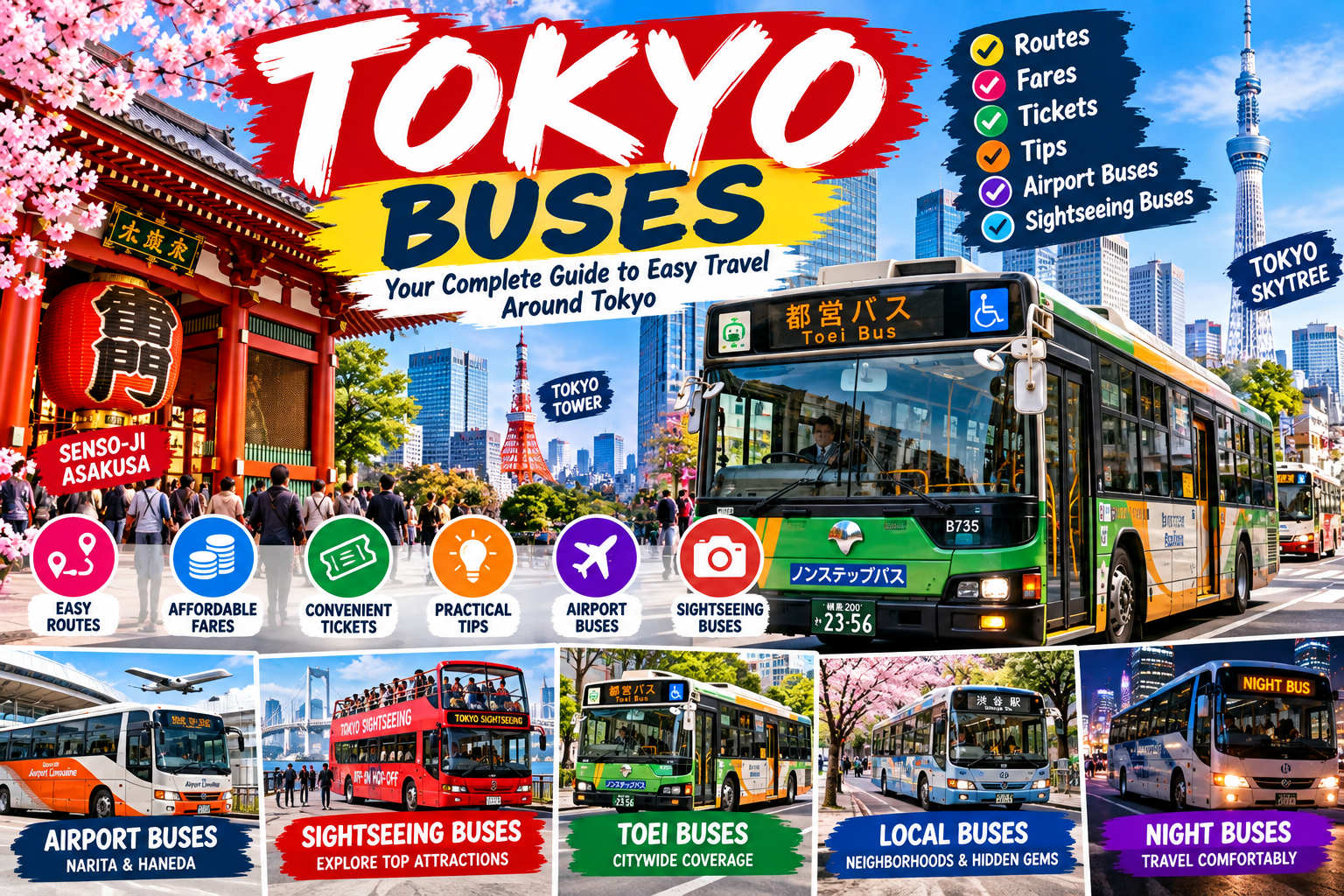
Tokyo Buses: The Complete Guide to Routes, Fares, Tickets, Tips and Easy Travel
Have you ever looked at a Tokyo map and wondered whether there is an easier way to reach a neighborhood without navigating a huge train station? Tokyo buses provide an important part of the city’s public transportation network, connecting railway stations, residential neighborhoods, tourist attractions, shopping districts, and areas that are not directly beside a train or subway station. For visitors, understanding Tokyo buses can make sightseeing more flexible, especially when a bus provides a direct connection that would otherwise require several train transfers and a long walk Tokyo Exhibitions
Understanding the Tokyo Bus System
Tokyo does not have one single bus company operating every route.
Instead, the city has several operators and different types of bus services.
For visitors, the most important categories include:
- Toei buses
- Private railway-company buses
- Community buses
- Airport limousine buses
- Sightseeing buses
- Highway buses
- Night buses
- Specialized tourist transportation
The distinction is important because fares, payment methods, routes, stops and ticketing arrangements can vary.
Toei Buses
Toei buses are operated by the Tokyo Metropolitan Bureau of Transportation.
They form one of the most recognizable parts of Tokyo’s municipal bus network.
Toei buses serve many parts of central and eastern Tokyo and can be particularly useful around neighborhoods where subway stations are not close to every attraction.
For visitors, Toei buses can connect areas around:
- Asakusa
- Ueno
- Tokyo Station
- Ginza
- Nihonbashi
- Shinjuku
- Shibuya
- Ikebukuro
- Minato
- Sumida
- Koto
The exact routes and service patterns vary, so travelers should always check the route information for their particular journey.
Private Bus Companies
Tokyo also has extensive private bus networks.
Many railway companies operate or are associated with bus services that complement their train networks.
This creates a useful pattern.
A railway may bring you close to a neighborhood, while a local bus takes you the final distance.
Private bus operators are particularly important outside the busiest central districts.
Community Buses
Some Tokyo neighborhoods operate smaller community-oriented bus services.
These routes can be extremely useful for residents and visitors who want to reach:
- Local shopping streets
- Residential neighborhoods
- Hospitals
- Public facilities
- Parks
- Smaller railway stations
Community buses are often less useful for first-time visitors who are staying entirely within the main tourist districts, but they can become valuable for longer stays.
Why Tokyo Buses Matter to Tourists
A common first-time Tokyo mistake is assuming that trains are always the best transportation option.
They are often excellent.
But they are not always the simplest.
Tokyo buses can offer several advantages.
Buses Can Reduce Walking
A railway station may be several hundred meters or more from your final destination.
A bus stop may be much closer.
This can be especially useful when traveling with:
- Children
- Older adults
- Heavy luggage
- Mobility limitations
- Shopping bags
Buses Can Reduce Transfers
A journey requiring two trains and a walk may sometimes be possible using one direct bus.
The trip may take slightly longer, but the reduced complexity can be worth it.
Buses Show More of Tokyo
A train can take you beneath the city.
A bus takes you through it.
From a bus window, you can see:
- Residential streets
- Local businesses
- Schools
- Parks
- Small temples
- Neighborhood shopping streets
- Office districts
- Architecture
- Everyday Japanese life
This makes Tokyo buses interesting for travelers who want to experience the city rather than simply move between attractions.
Tokyo Buses Versus Tokyo Trains
The most useful question is not whether buses or trains are better.
The useful question is:
Which transportation method is best for this specific journey?
Tokyo Trains
Trains are generally excellent for:
- Long distances
- Major tourist districts
- Airport connections
- Cross-city journeys
- Fast travel
- High-frequency routes
Tokyo Buses
Buses can be excellent for:
- Shorter distances
- Neighborhood travel
- Station-to-attraction connections
- Residential areas
- Areas with limited railway access
- Direct journeys that avoid transfers
- Scenic urban travel
A Practical Rule
Use trains for the main part of a journey and buses for the final connection when that makes sense.
This hybrid approach can make Tokyo transportation easier.
Tokyo Bus Routes and How to Find Them
One of the biggest challenges for international visitors is understanding bus routes.
A bus route can look confusing because:
- Several routes may use the same road
- Stops can have similar names
- Japanese and English names may differ slightly
- The same destination may be served by multiple routes
- Buses may operate in different directions
- Some routes have limited schedules
The easiest strategy is to search for the complete journey rather than trying to understand the entire bus network.
Search From Your Current Location
Enter:
Current location → destination
rather than searching only for the attraction.
Your navigation application can then show:
- Walking distance to the bus stop
- Bus number
- Direction
- Departure time
- Arrival stop
- Estimated journey time
- Alternative routes
Confirm the Direction
Before boarding a Tokyo bus, check the destination information displayed on the vehicle.
A bus number alone may not be enough.
The direction or final destination is important.
Check the Bus Stop
Bus stops can serve multiple routes.
Look at:
- Route number
- Destination
- Operator
- Timetable
- Direction
- Stop name
If uncertain, compare the information on your navigation application with the information at the physical stop.
How Tokyo Bus Stops Work
Tokyo bus stops can look different depending on the operator and neighborhood.
A typical bus stop may contain:
- Stop name
- Route information
- Timetable
- Direction
- Operator information
- Destination information
Some stops are located directly beside major roads.
Others may be positioned on smaller streets.
Bus Stop Names
Names may be written in Japanese and sometimes English.
Pay attention to the exact spelling.
Two stops may have similar names but serve completely different locations.
Stop Numbers
Some bus systems use stop numbers or route identifiers.
If your navigation application gives you a specific stop, compare that information with the physical signage.
How to Board a Tokyo Bus
Boarding procedures can vary between bus operators and routes.
For many local Tokyo bus services, passengers should follow the instructions displayed at the entrance.
The general process is:
- Wait at the marked bus stop.
- Confirm the route and destination.
- Allow passengers to exit first.
- Board through the appropriate entrance.
- Follow the fare or ticket instructions.
- Take a seat or hold a handrail.
- Prepare to exit before reaching your stop.
- Follow the driver’s instructions if necessary.
Do not assume every bus in Tokyo uses exactly the same boarding system.
Tokyo Bus Fares
Tokyo bus fares vary according to the operator and service.
Many standard local bus services use relatively straightforward fare systems, but the exact amount and payment procedure can differ.
Travelers should not assume that every bus journey costs the same.
Flat-Fare Bus Services
Some urban routes use a flat fare structure.
This can make short trips simple because you do not need to calculate the distance.
Distance-Based Bus Services
Other services may calculate fares according to the distance traveled.
These systems can involve different boarding and payment procedures.
Special Bus Services
Airport buses, sightseeing buses, highway buses and other specialized services normally use separate fare structures.
Always check the specific service before boarding.
Paying for Tokyo Buses
One of the easiest ways to make bus travel more convenient is to use a rechargeable transportation IC card where the particular bus accepts it.
Common Japanese IC card systems include:
- Suica
- PASMO
- Other compatible IC cards
Depending on the service and current payment arrangements, passengers may also encounter:
- Cash
- IC cards
- Mobile IC cards
- Advance tickets
- Special passes
The key is to confirm the accepted payment method before boarding.
Using IC Cards on Tokyo Buses
IC cards can make local transportation much easier.
Instead of preparing exact cash for every journey, passengers can tap the card according to the system used by that bus.
This can be particularly convenient for tourists making several short journeys.
Why IC Cards Help
They can reduce:
- Boarding confusion
- Cash handling
- Fare calculation
- Queueing time
They are particularly useful when using both trains and buses during the same trip.
Can Tourists Use Suica and PASMO on Tokyo Buses?
Compatible transportation IC cards are widely useful for public transportation in Tokyo, including many bus services.
However, acceptance is not universal across every specialized or unusual service.
Airport buses, highway buses and certain local services can have different payment rules.
Always check the specific service.
Tokyo Bus Passes
Some travelers consider transportation passes to be the easiest way to control transportation costs.
However, a pass is only financially useful if your travel pattern matches the routes included.
Before purchasing a Tokyo bus pass, consider:
- How many bus journeys you will make
- Which operators you will use
- Whether your destinations are included
- Whether trains will also be required
- Whether individual fares would cost less
Do not buy a transportation pass simply because it is marketed as a convenience product.
Calculate the likely value first.
Tokyo Bus Timetables
Tokyo buses operate according to published schedules, but frequency varies.
Some major routes have frequent services.
Smaller neighborhood routes may operate less frequently.
Why Timetable Planning Matters
Missing a bus that operates every few minutes may not matter.
Missing a bus that operates every twenty or thirty minutes can change your itinerary.
This is particularly important during:
- Early mornings
- Late evenings
- Sundays
- Public holidays
- Rural or suburban journeys
Tokyo Buses at Night
Night transportation requires additional planning.
Tokyo is famous for having a large and efficient transportation network, but not every bus route operates late into the night.
If you plan to stay out late, check the final bus and train services before beginning your evening.
A taxi may become necessary if public transportation has stopped.
Avoid the Last-Minute Problem
Do not wait until midnight to think about how you will return to your accommodation.
Before going out, check:
- Last train
- Last bus
- Alternative route
- Taxi availability
- Walking distance
This is especially important when visiting a neighborhood far from your hotel.
Tokyo Airport Buses
Airport buses are different from ordinary local Tokyo buses.
They are designed to transport passengers between airports and major hotels, stations and districts.
The two major airports serving the Tokyo region are:
- Haneda Airport
- Narita International Airport
Haneda Airport Buses
Haneda is relatively close to central Tokyo, and travelers can choose among several transportation options.
Airport buses can be convenient when:
- You have large luggage
- Your hotel is served directly
- You prefer not to transfer trains
- You arrive with children
- You are unfamiliar with Tokyo’s railway system
Narita Airport Buses
Narita is considerably farther from central Tokyo.
Airport buses can be attractive for travelers who prefer a direct ride to a hotel or major district.
However, compare:
- Price
- Travel time
- Traffic
- Luggage
- Arrival time
A train can sometimes be faster, particularly when road traffic is heavy.
Tokyo Limousine Bus
The term “limousine bus” in Tokyo does not mean a luxury limousine.
It generally refers to an airport coach service designed to connect airports with Tokyo destinations.
These buses typically provide:
- Luggage storage
- Comfortable seating
- Direct airport connections
- Major hotel stops
- Station-area connections
For travelers with multiple suitcases, the convenience can be valuable.
Tokyo Sightseeing Buses
Sightseeing buses are different from ordinary public buses.
They are designed primarily for tourists.
Instead of simply taking passengers from one local stop to another, sightseeing buses may provide:
- Landmark-focused routes
- Guided commentary
- Open-top seating
- Tourist itineraries
- Hop-on hop-off services
They can be useful for first-time visitors who want an overview of Tokyo.
When a Sightseeing Bus Makes Sense
A sightseeing bus may be useful if:
- You have limited time
- You prefer guided travel
- You want to see many landmarks
- You want less itinerary planning
- You have mobility concerns
When a Sightseeing Bus May Not Be Ideal
Independent travelers may prefer ordinary public transportation because it provides:
- More flexibility
- Lower costs
- More local experiences
- Greater freedom to change plans
Tokyo Bus Tours for First-Time Visitors
A bus tour can provide an easy introduction to Tokyo.
A typical sightseeing route may include areas such as:
- Tokyo Station
- Ginza
- Asakusa
- Tokyo Tower
- Odaiba
- Shibuya
- Shinjuku
The exact route depends on the tour operator.
The main advantage is efficiency.
You can observe many parts of the city without repeatedly navigating train stations.
Tokyo Buses for Tourists Visiting Asakusa
Asakusa is one of Tokyo’s most popular traditional districts.
Visitors can combine buses with:
- Senso-ji
- Kaminarimon
- Nakamise
- Sumida River
- Tokyo Skytree
Buses can be particularly useful when connecting Asakusa with other eastern Tokyo neighborhoods.
Instead of returning to a railway station after every attraction, a bus may offer a direct neighborhood connection.
Tokyo Buses for Ueno
Ueno is famous for:
- Ueno Park
- Museums
- Ueno Zoo
- Ameyoko
- Cultural attractions
Visitors can use buses to connect Ueno with surrounding districts.
However, because Ueno is a major railway hub, trains may often be more efficient for longer journeys.
Tokyo Buses for Shibuya
Shibuya is heavily connected by rail.
For this reason, trains are often the obvious transportation choice.
However, buses can be useful for nearby neighborhoods and destinations that are not directly connected to Shibuya Station.
They can also provide an alternative when stations are crowded.
Tokyo Buses for Shinjuku
Shinjuku is one of Tokyo’s largest transportation hubs.
The district has extensive railway connections, but buses also serve surrounding areas.
Travelers staying outside the immediate station district may find local bus services convenient.
Tokyo Buses for Ginza and Tokyo Station
Central Tokyo has a mixture of trains, subways and buses.
Buses can be useful for shorter journeys between:
- Ginza
- Marunouchi
- Nihonbashi
- Tokyo Station
- Tsukiji
- Nearby business districts
For tourists, these routes can save walking time.
Tokyo Buses for Odaiba
Odaiba is a waterfront district with large attractions and broad pedestrian spaces.
Depending on the starting point, visitors can use trains, buses and water transportation.
Because Odaiba is spread out, choosing transportation based on your exact destination can save time.
Tokyo Community Buses
Community buses are often overlooked by international tourists.
They can be particularly useful for travelers staying in residential areas.
A community bus may connect:
- A neighborhood
- A railway station
- A shopping street
- A public facility
- A hospital
- A local attraction
These routes can provide a more authentic view of Tokyo.
Tokyo Buses for Families
Families should consider buses when they reduce walking and transfers.
Advantages for Families
Buses can:
- Reduce station transfers
- Reduce underground walking
- Bring you closer to attractions
- Make neighborhood travel easier
Challenges for Families
Peak-hour buses can become crowded.
Parents should also consider stroller access and available space.
When traveling with a stroller, check the operator’s rules and be prepared to follow driver instructions.
Tokyo Buses for Senior Travelers
Buses can be useful for senior travelers because they can reduce walking between stations and destinations.
However, crowded periods can make boarding and seating difficult.
Plan travel outside the busiest periods when possible.
Choose accommodation and attractions that minimize repeated transfers.
Tokyo Buses for Travelers With Disabilities
Tokyo’s transportation network has made significant progress in accessibility, but accessibility can vary by route, vehicle and stop.
Travelers with mobility needs should check:
- Low-floor bus availability
- Wheelchair space
- Ramp procedures
- Accessible stops
- Station alternatives
- Staff assistance
It is useful to allow extra time.
Accessible transportation sometimes requires more detailed planning than simply selecting the fastest route.
Tokyo Buses for Travelers With Luggage
Large luggage is one of the situations where buses require careful consideration.
A crowded local bus may not be comfortable with multiple large suitcases.
For airport transfers, dedicated airport buses often provide better luggage arrangements.
For local sightseeing, consider leaving large luggage at:
- Hotel
- Station luggage storage
- Approved luggage facilities
Then explore with a smaller day bag.
Tokyo Buses During Rush Hour
Rush hour is one of the most important factors for bus travelers.
Tokyo roads can become busy, and buses share roads with other traffic.
Unlike trains, buses are affected directly by:
- Traffic congestion
- Road construction
- Accidents
- Weather
- Events
If you need to arrive somewhere at a fixed time, leave a buffer.
Tokyo Bus Travel During Rain
Rain can change bus travel considerably.
Advantages:
- You stay mostly covered while traveling.
- A bus can reduce walking.
Disadvantages:
- Roads can become slower.
- Bus stops can become crowded.
- Boarding may take longer.
- Umbrellas can make waiting areas uncomfortable.
On rainy days, a bus route with fewer walking segments can be more valuable than a theoretically faster train route.
Tokyo Buses During Snow or Severe Weather
Snow is less common than rain but can disrupt transportation.
Road-based services may experience delays.
If severe weather is forecast, check transportation updates before leaving.
Do not assume a normal timetable will remain perfectly accurate during unusual conditions.
Tokyo Bus Etiquette
Japanese public transportation has a strong culture of consideration.
Queue Properly
Wait in the designated area.
Do not push toward the door.
Let Passengers Exit
Allow passengers to leave before boarding.
Keep Your Voice Low
Avoid loud conversations.
Avoid Blocking the Aisle
Place bags where they do not obstruct other passengers.
Give Priority Seats Their Intended Purpose
If someone needs a priority seat, make it available.
Keep Phone Calls Quiet
Avoid loud phone conversations.
Do Not Eat Messy Food
Simple drinks may be acceptable in some circumstances, but avoid creating mess or strong odors.
Follow the Driver’s Instructions
If the driver asks passengers to move or adjust luggage, follow the instruction.
Tokyo Bus Etiquette for Tourists
Visitors do not need to know every cultural rule before boarding.
Basic consideration goes a long way.
Watch what local passengers do.
Queue.
Keep noise low.
Do not block doors.
Move toward the rear when appropriate.
Have your payment ready.
This makes the journey smoother for everyone.
Common Tokyo Bus Mistakes
Mistake One: Boarding the Wrong Direction
A bus may use the same route number in opposite directions.
Always confirm the destination.
Mistake Two: Assuming Every Bus Uses the Same Fare System
Different operators can use different fare arrangements.
Check before boarding.
Mistake Three: Waiting Until the Last Second to Prepare Payment
Prepare your IC card or cash before reaching the front.
Mistake Four: Ignoring Traffic
A bus may take longer than expected during congestion.
Mistake Five: Carrying Huge Luggage Onto a Crowded Local Bus
Use luggage storage or a dedicated airport service when practical.
Mistake Six: Missing the Stop
Monitor your route using a navigation application.
Mistake Seven: Assuming English Is Available Everywhere
Major tourist routes may have multilingual information, but smaller local services can be less tourist-oriented.
How to Avoid Missing Your Tokyo Bus Stop
One of the easiest solutions is to use your smartphone.
Before boarding:
- Confirm the destination.
- Check the expected number of stops.
- Track your journey.
- Watch the map as the bus moves.
- Prepare to exit before arrival.
You can also note the Japanese name of your destination.
Showing the destination name can help when asking for assistance.
How to Read Tokyo Bus Information
You do not need to understand Japanese fluently.
Look for:
- Route number
- Destination
- Bus stop name
- Departure time
- Arrival direction
- Operator
- Platform or stop position
Navigation apps can fill in much of the missing information.
Tokyo Buses and Navigation Apps
Navigation applications have transformed bus travel for international visitors.
A good route planner can show:
- Walking directions
- Bus stop location
- Departure time
- Route number
- Transfer instructions
- Arrival time
- Alternative routes
However, technology is not perfect.
Always compare the digital route with physical signs at the bus stop.
Why Bus Travel Can Be Better Than Google-Map-Style Navigation Alone
Navigation applications usually optimize for travel time.
But travelers do not always want the absolute fastest route.
Suppose:
Route A: Two trains, one transfer, 12 minutes of walking.
Route B: One bus, 25 minutes, 4 minutes of walking.
Route A may technically be faster.
Route B may be much more comfortable for someone with luggage.
Transportation planning should therefore consider:
- Time
- Cost
- Walking
- Transfers
- Comfort
- Luggage
- Weather
Tokyo Bus Travel for Budget Travelers
Buses can support a budget itinerary when they replace unnecessary taxi rides.
The savings can become significant over several days.
However, do not choose buses simply because they are cheaper.
If a bus takes substantially longer and forces you to miss an attraction, the apparent saving may not be worthwhile.
Tokyo Buses Versus Taxis
Buses
Advantages:
- Lower cost
- Local experience
- Useful neighborhood coverage
- Good for daytime travel
Disadvantages:
- Traffic
- Limited luggage space
- Fixed routes
- Crowding
Taxis
Advantages:
- Door-to-door travel
- Convenient with luggage
- Useful late at night
- Helpful for groups
Disadvantages:
- Higher cost
- Traffic
- Less useful for strict budgets
A good Tokyo traveler uses both strategically.
Tokyo Buses Versus Walking
Walking is free and can be enjoyable.
But Tokyo is much larger than it appears on a map.
A destination that looks nearby may involve:
- Multiple blocks
- Large intersections
- Hills
- Station complexes
- Crowded sidewalks
A short bus ride can sometimes preserve energy for sightseeing.
Tokyo Buses Versus Subway
The subway is excellent for speed and predictable travel.
The bus can be better when:
- You want fewer stairs
- You want fewer transfers
- Your destination is away from a station
- You want to see the neighborhood
- You want a direct route
Ten Major Tokyo Bus Brands, Operators and Service Types
The following comparison is intended to help travelers understand the different types of bus services they may encounter rather than to rank them.
| Brand / Service Type | Main Role | Best For | Typical Strength | Main Consideration |
|---|---|---|---|---|
| Toei Bus | Municipal urban bus network | Central Tokyo travel | Extensive city coverage | Route details vary |
| Tokyo Metro-area private buses | Local and regional transport | Neighborhood connections | Complements rail networks | Operator-specific rules |
| Tokyu Bus | Local bus services | Southern and western Tokyo | Strong neighborhood coverage | Route familiarity helps |
| Keio Bus | Local and suburban services | Western Tokyo | Useful rail connections | Some routes are outside tourist core |
| Seibu Bus | Local and suburban services | Northwestern Tokyo | Useful residential connections | Less relevant for central sightseeing |
| Odakyu Bus | Local services | Areas around Odakyu network | Useful station connections | Route-specific |
| Kanto Bus | Local and suburban services | Western Tokyo | Neighborhood connectivity | Less tourist-focused |
| Airport Limousine Bus | Airport transportation | Haneda and Narita travelers | Luggage-friendly | Traffic can affect travel time |
| Highway Buses | Intercity transportation | Travel outside Tokyo | Can connect Tokyo with other regions | Reservations often required |
| Sightseeing Buses | Tourist transportation | First-time visitors | Guided landmark sightseeing | Less flexible than local buses |
How to Choose Between Tokyo Bus Services
When you see several options, ask five questions:
- Where exactly is the bus going?
- How much walking is required?
- How much does it cost?
- How long is the journey likely to take?
- Is the service suitable for my luggage or mobility needs?
This simple checklist prevents many transportation mistakes.
Tokyo Buses and Intercity Travel
Tokyo buses are not limited to local transportation.
Highway buses connect Tokyo with many other parts of Japan.
They can be useful for travelers visiting destinations such as:
- Mount Fuji region
- Hakone area
- Nagano
- Osaka
- Kyoto
- Nagoya
- Tohoku
- Other regional destinations
For longer journeys, highway buses can sometimes be considerably less expensive than other transportation options.
Tokyo Night Buses for Long-Distance Travel
Night buses can save travelers the cost of one night of accommodation.
For example, instead of:
Hotel in Tokyo + daytime transportation
a traveler might use:
Night bus + transportation to destination
However, comfort varies.
Consider:
- Seat design
- Legroom
- Privacy
- Rest stops
- Journey duration
- Luggage rules
A cheap night bus is not automatically good value if you arrive exhausted.
Tokyo Buses for Mount Fuji Trips
Some travelers use buses when traveling from Tokyo toward the Mount Fuji area.
This can be convenient because certain destinations are directly connected by highway or tourist buses.
The important point is to distinguish:
Tokyo city buses
from
long-distance buses leaving Tokyo.
They serve very different purposes.
Tokyo Bus Tours and Photography
Buses can be excellent for photography because they provide moving perspectives.
Instead of repeatedly photographing the same landmark from a standard viewpoint, a bus journey can reveal:
- Street-level architecture
- Bridges
- Neighborhoods
- Commercial signs
- Residential streets
- Skyline transitions
However, photographing through bus windows can produce reflections.
For better results:
- Sit near the window
- Avoid touching the glass with the camera
- Shoot when the bus is stopped
- Use faster shutter speeds
- Avoid disturbing other passengers
Tokyo Buses for Food Travelers
Food-focused travelers can use buses to explore neighborhoods beyond famous restaurant districts.
Tokyo’s food culture is not limited to Ginza or Shibuya.
Local neighborhoods can offer:
- Ramen shops
- Soba restaurants
- Bakeries
- Izakaya
- Curry restaurants
- Cafés
- Family restaurants
- Traditional sweets
A bus can become part of the food itinerary.
Tokyo Buses and Neighborhood Tourism
One of the strongest reasons to use buses is neighborhood discovery.
A train often moves you from one major station to another.
A bus shows the spaces between them.
You may notice:
- Small shrines
- Local schools
- Tiny restaurants
- Independent stores
- Residential architecture
- Community parks
This makes bus travel particularly valuable for repeat visitors.
Tokyo Bus Travel for First-Time Visitors
First-time visitors should not attempt to master the entire Tokyo bus system.
Start small.
Choose one direct bus journey.
Learn:
- Where to board
- How to pay
- How to identify your stop
- How to exit
After one successful journey, other routes become much easier.
Tokyo Buses for Repeat Visitors
Repeat visitors can use buses to go beyond the standard tourist circuit.
Instead of returning to:
- Shibuya
- Shinjuku
- Ginza
every day, consider exploring neighborhoods where bus services connect smaller attractions.
This can reveal a different Tokyo.
How to Plan a Tokyo Bus Day
A practical bus-focused day might look like this:
Morning
Choose a neighborhood with several attractions.
Midday
Use a local bus to reach a second area.
Afternoon
Walk between nearby destinations.
Evening
Take another bus or train back toward your hotel.
The goal is not to spend the entire day sitting on buses.
The goal is to use buses where they improve the itinerary.
A Sample Tokyo Bus-Based Itinerary
Day One: Traditional Tokyo
Start around Asakusa.
Explore Senso-ji.
Walk through surrounding streets.
Use a local bus toward another eastern Tokyo destination.
Finish near a major railway station.
Day Two: Central Tokyo
Explore Tokyo Station and Marunouchi.
Walk toward nearby attractions.
Use a bus for a short central connection.
Finish in Ginza.
Day Three: Shibuya and Western Tokyo
Explore Meiji Jingu.
Walk toward Shibuya.
Use a local bus to explore a nearby district rather than immediately returning underground.
Tokyo Bus Travel During Peak Tourist Seasons
Peak tourism can increase pressure on transportation.
Popular buses near major tourist attractions may become crowded.
Travelers should consider:
- Early departures
- Off-peak hours
- Alternative routes
- Walking
- Train alternatives
If a bus is extremely crowded, another transportation option may provide a better experience.
Tokyo Bus Travel During Festivals
Large festivals and events can cause temporary traffic restrictions.
Bus routes may be:
- Delayed
- Rerouted
- Crowded
- Temporarily suspended
If you are visiting Tokyo during a major event, check transportation information on the day.
Tokyo Buses and Environmental Travel
Public transportation can support lower-impact urban travel compared with relying heavily on private vehicles.
Buses also connect neighborhoods without requiring every traveler to use an individual car or taxi.
For travelers interested in sustainable tourism, combining:
- Walking
- Rail
- Bus
- Cycling where appropriate
- Water transportation
can reduce dependence on private vehicles.
Pros of Tokyo Buses
Tokyo buses offer several major advantages.
Strong Neighborhood Coverage
They reach places that trains do not directly serve.
Direct Connections
Some routes can reduce transfers.
Better Street-Level Views
Travelers can observe the city while moving.
Useful for Short Journeys
They can connect stations with attractions efficiently.
Helpful for Accessibility
Certain buses can reduce walking and station transfers.
Useful for Budget Travelers
They can be less expensive than taxis.
Cons of Tokyo Buses
Traffic Delays
Road congestion can make arrival times unpredictable.
Crowding
Peak periods can be uncomfortable.
More Difficult for Beginners
Bus routes can initially seem more confusing than train lines.
Luggage Limitations
Local buses are not always suitable for large suitcases.
Different Operators
Rules and fare systems are not completely uniform.
The Biggest Tokyo Bus Challenge: Complexity
Tokyo’s bus system feels complicated because it is designed primarily for residents, not tourists.
That is actually a positive sign.
A complicated network means the system is serving thousands of destinations.
You do not need to understand all of it.
You only need to understand the route you are taking.
How to Make Tokyo Buses Easier
Use this five-step method:
Step One
Search your destination.
Step Two
Select a bus route with a clear destination.
Step Three
Save the bus stop location.
Step Four
Check the payment method.
Step Five
Track your journey after boarding.
This method turns an intimidating system into a manageable process.
Future Trends in Tokyo Buses
Tokyo’s bus network is likely to evolve alongside broader changes in urban transportation.
Potential developments include:
- More electric buses
- Improved accessibility
- Better real-time information
- Digital ticketing
- Smarter route planning
- Integrated mobility applications
- Greater connection with railway networks
- Improved tourist information
Electric and Low-Emission Buses
Urban transportation systems worldwide are moving toward cleaner vehicle technologies.
Tokyo is also part of this broader transition.
Electric and other low-emission buses can potentially reduce local pollution and noise.
Better Digital Information
Real-time information can make buses easier for international visitors.
Future systems are likely to improve:
- Arrival predictions
- Multilingual information
- Digital tickets
- Route planning
- Accessibility information
Mobility as One System
The future of Tokyo transportation is likely to be less about choosing “bus versus train.”
Instead, passengers will increasingly use one integrated journey.
For example:
Walk → train → bus → walk
The technology behind transportation planning can make this combination feel like one journey rather than four separate systems.
Tokyo Buses and Smart Tourism
As Tokyo becomes increasingly accessible to international travelers, bus information is likely to become easier to understand.
Travelers can already use digital navigation to combine different transportation modes.
The future will likely place greater emphasis on:
- Multilingual signs
- Real-time updates
- Contactless payment
- Accessible route planning
- Personalized journey recommendations
Tokyo Buses and the Future of Neighborhood Tourism
There is another important possibility.
As major attractions become crowded, travelers may increasingly look for less crowded neighborhoods.
Buses can support this type of tourism because they reach areas that do not always appear on first-time visitor itineraries.
This could encourage travelers to spread their spending across a larger part of Tokyo.
FAQs
Are Tokyo buses easy for tourists to use?
Yes. Tokyo buses can initially look complicated, but navigation applications, multilingual information and transportation IC cards make many routes relatively easy to use.
Are Tokyo buses cheaper than trains?
Not necessarily in every situation. Fares depend on the operator and route. The main advantage of buses is that they may provide a direct connection that reduces transfers or walking.
Can I use an IC card on Tokyo buses?
Many local bus services accept compatible Japanese transportation IC cards, but specialized services may have different rules. Check the specific operator before traveling.
Can tourists use Suica on Tokyo buses?
Compatible Suica services can be used on many participating bus routes. Acceptance can vary for specialized services, so travelers should confirm before boarding.
Can tourists use PASMO on Tokyo buses?
PASMO and compatible IC systems are accepted on many public transportation services, including participating bus routes. Specific operators and services can have different arrangements.
Do Tokyo buses accept cash?
Many bus services provide cash payment options, but payment procedures differ. Travelers should check the instructions at the bus stop or on the vehicle.
Do Tokyo buses have English signs?
Many major routes and tourist-oriented services provide multilingual information. However, smaller local routes may provide less English information.
How do I know which Tokyo bus to take?
Use a reliable navigation application and enter your exact starting point and destination. Confirm the route number, destination and bus stop before boarding.
How do I know when to get off a Tokyo bus?
Track the route using your navigation application and watch the stop information. It is helpful to prepare before reaching your destination.
Are Tokyo buses good for tourists with luggage?
Local buses can be difficult with large luggage during busy periods. Airport buses and dedicated long-distance buses are generally more suitable for substantial luggage.
Are Tokyo buses wheelchair accessible?
Many modern buses are designed with accessibility features, but conditions can vary by vehicle and route. Travelers with specific mobility needs should check the service in advance.
Are Tokyo buses stroller friendly?
Some buses can accommodate strollers, but space and operating procedures vary. Follow the driver’s instructions and avoid peak periods when possible.
Are Tokyo buses crowded?
They can be crowded, especially during commuter periods and around popular tourist districts.
What time do Tokyo buses stop running?
There is no single closing time for all Tokyo buses. Each route has its own timetable, and some routes finish earlier than major railway services.
Are there buses from Haneda Airport to Tokyo?
Yes. Airport bus services connect Haneda with various parts of the Tokyo metropolitan area.
Are there buses from Narita Airport to Tokyo?
Yes. Airport coach services connect Narita with various Tokyo districts and hotels.
Is the Tokyo Limousine Bus a normal city bus?
No. Airport limousine buses are dedicated airport transportation services and operate differently from ordinary local Tokyo buses.
Are Tokyo sightseeing buses worth using?
They can be useful for first-time visitors who want a guided overview of major attractions. Independent travelers may prefer local buses and trains for greater flexibility.
Can I use Tokyo buses at night?
Some routes operate in the evening, but service frequency and operating hours vary. Always check the final departure for your specific route.
Are Tokyo buses good for budget travel?
Yes. They can be useful for replacing taxi journeys and reaching attractions without expensive private transportation.
Can Tokyo buses take me to Senso-ji?
Various bus routes serve the Asakusa area around Senso-ji. The best route depends on your starting location.
Can Tokyo buses take me to Tokyo Skytree?
Bus services connect the Tokyo Skytree area with surrounding neighborhoods, although trains may be more convenient depending on your starting point.
Are buses better than trains for sightseeing?
Not always. Trains are generally faster for long journeys, while buses can be better for neighborhood exploration and shorter direct connections.
What should I do if I miss my Tokyo bus?
Check the next scheduled service or use a navigation application to find an alternative route. Major areas usually have several transportation options.
What happens if a Tokyo bus is delayed?
Traffic, weather and road conditions can cause delays. If you have a fixed appointment, allow extra time.
Should I use a bus or taxi with children?
It depends on distance, luggage and crowd levels. Buses can be economical, while taxis may be more convenient for door-to-door travel.
Should I use a bus or train with elderly travelers?
Consider walking distance and station transfers. A direct bus may be more comfortable when it reduces stairs and walking.
Are Tokyo buses safe?
Tokyo’s public transportation system is generally well organized, and buses are widely used by residents. Travelers should still follow normal personal-safety practices.
Can I eat on Tokyo buses?
Avoid eating messy or strong-smelling food. Follow local etiquette and observe what other passengers do.
Can I drink on Tokyo buses?
Rules and social expectations can vary, but travelers should avoid creating mess or disturbing other passengers.
Can I talk loudly on Tokyo buses?
It is better to keep conversations quiet, particularly on crowded public transportation.
Can I bring a large backpack on a Tokyo bus?
Small and medium backpacks are generally more practical than large luggage. Keep bags out of aisles and avoid obstructing other passengers.
Is Tokyo bus transportation confusing?
It can be at first, particularly because several operators use different routes and fare systems. After learning the basics, navigation becomes much easier.
Conclusion
Tokyo buses are an important and often overlooked part of exploring Japan’s capital. While trains and subways are usually the fastest way to cover long distances, buses provide something different: direct neighborhood connections, shorter walking distances, flexible local travel, street-level views and access to destinations that may not sit directly beside a railway station. For first-time visitors, the Tokyo bus system can appear complicated because different operators, routes, fares and payment methods exist, but travelers do not need to understand the entire network