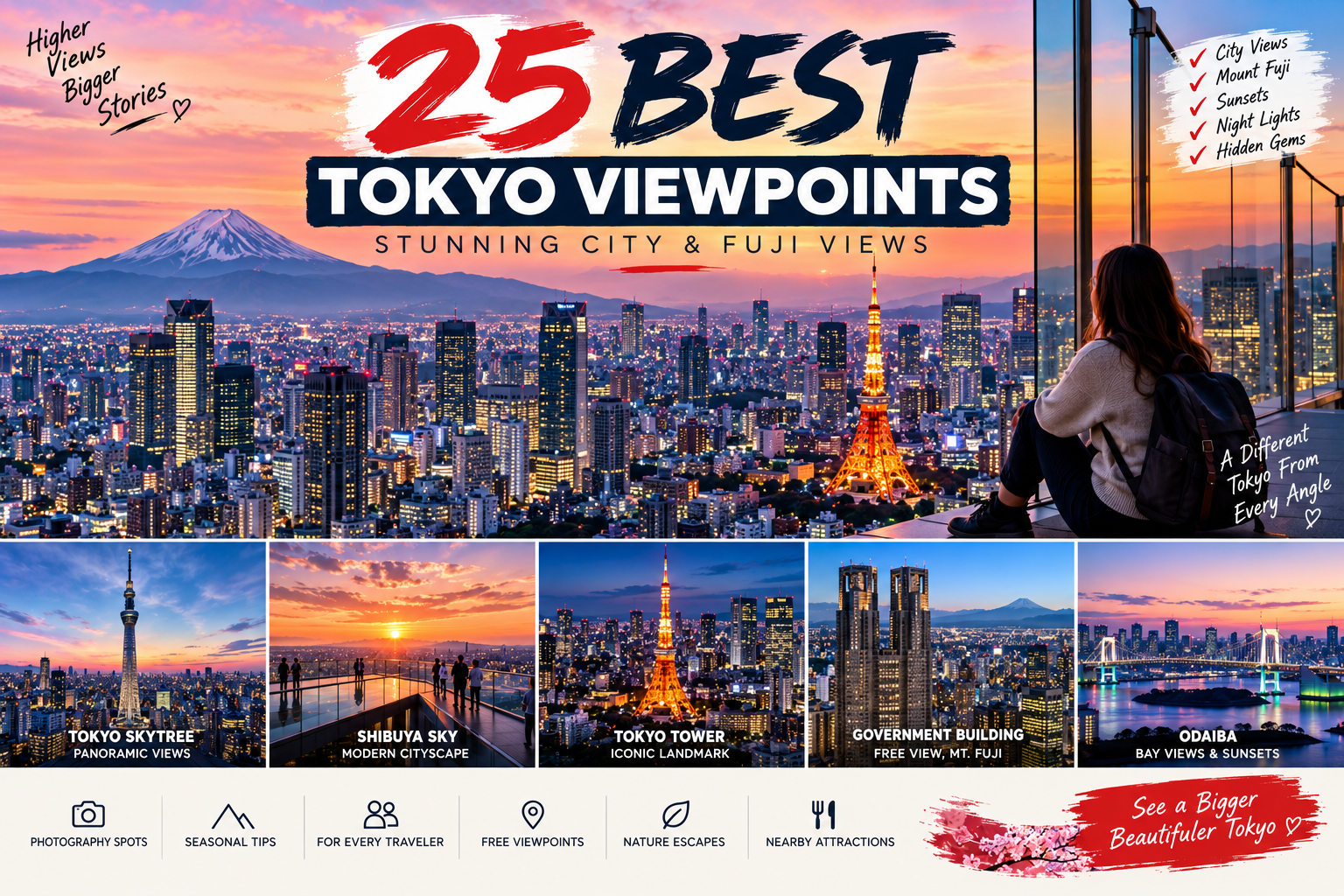
25 Best Tokyo best viewpoints for Stunning City & Fuji Views
The best Tokyo viewpoints range from famous observation decks such as TOKYO SKYTREE, Tokyo Tower and SHIBUYA SKY to free government observatories, rooftop gardens, waterfront locations and quieter neighbourhood viewpoints. The right viewpoint depends on whether you want panoramic city views, Tokyo Tower photographs, Mount Fuji visibility, sunset scenery, night views or a more relaxed experience Travel Planning
Why Tokyo Has So Many Extraordinary Viewpoints
Tokyo’s geography creates an unusual combination of urban and natural scenery.
The metropolitan area is not simply a flat collection of skyscrapers. Official Tokyo information describes a landscape extending from low-lying areas to hills, plateaus and mountainous regions, while the wider Tokyo area also includes islands in the Pacific.
This geographical variety creates several distinct types of viewpoints.
High Observation Decks
These provide the classic panoramic experience.
From a tall observation deck, you can understand the enormous scale of Tokyo and identify major landmarks from above.
Rooftop Viewpoints
Rooftop observation spaces can feel more immersive because there is less separation between you and the skyline.
SHIBUYA SKY is a notable example, located on the roof of Shibuya Scramble Square and offering a high-level perspective directly above one of Tokyo’s busiest districts.
Free Viewpoints
Not every impressive view requires an expensive ticket.
The Tokyo Metropolitan Government Building’s observatories are free, making them particularly useful for budget-conscious travellers.
Street-Level Viewpoints
Some of the best photographs are not taken from hundreds of metres above Tokyo.
A bridge, elevated walkway, riverside park or hill can frame the city in a more intimate way.
Mount Fuji Viewpoints
These are especially weather-dependent.
GO TOKYO notes that winter provides some of the best opportunities for seeing Mount Fuji from Tokyo because cooler conditions can improve visibility.
The 25 Best Tokyo Viewpoints
TOKYO SKYTREE
TOKYO SKYTREE is the obvious starting point for travellers searching for the Tokyo best viewpoints.
At 634 metres, it is Japan’s tallest structure and has two major observation areas: the Tembo Deck at 350 metres and the Tembo Galleria at 450 metres.
The scale is the main attraction.
From this height, Tokyo stops looking like a collection of individual neighbourhoods and starts looking like a vast urban landscape.
On clear days, views can extend toward distant mountains and Mount Fuji.
The official SKYTREE information explains that the 350-metre Tembo Deck provides 360-degree views through large glass windows, while the 450-metre Tembo Galleria creates a higher, more open feeling as visitors move through its glass-enclosed corridor.
What You Can See From TOKYO SKYTREE
Depending on visibility and direction, views can include:
- Tokyo’s dense eastern districts
- Sumida River
- Tokyo Tower
- Tokyo Bay
- Shinjuku
- Shibuya
- Mount Fuji
- Surrounding mountains
- Major transport corridors
- Senso-ji and Asakusa
- Distant suburban areas
The official SKYTREE guide identifies numerous landmarks visible from the observation areas, including Tokyo Tower, Shibuya, Ginza, the Imperial Palace area, Mount Fuji and Nikko-related mountain scenery.
Best Time for TOKYO SKYTREE
Daytime is useful when your priority is geographic scale and distant landmarks.
Sunset can provide changing colours across the city.
Night is ideal if your priority is Tokyo’s illuminated skyline.
The official SKYTREE FAQ notes that daytime provides views toward Tokyo’s streets, Sumida River and surrounding mountains, while nighttime offers a different experience centred on Tokyo’s night scenery.
Who Should Visit TOKYO SKYTREE?
It works particularly well for:
- First-time visitors
- Families
- Couples
- Photographers
- Architecture enthusiasts
- Mount Fuji watchers
- Travellers who want the highest perspective
Potential Drawbacks
The experience is highly popular, so crowds and ticket costs can be factors.
It is also possible to feel that the city looks somewhat abstract from this height.
If you want to see individual buildings and neighbourhoods more clearly, a lower viewpoint may actually be more satisfying.
SHIBUYA SKY
SHIBUYA SKY offers one of the most recognisable modern views of Tokyo.
It sits above Shibuya Scramble Square, directly connected with Shibuya Station, and provides a rooftop observation experience above one of Tokyo’s most energetic districts. GO TOKYO identifies it as the highest skyscraper observation experience in the Shibuya area.
The location is what makes it special.
Instead of viewing Tokyo from a distant tower, you are looking directly down toward one of the city’s busiest urban environments.
Why SHIBUYA SKY Is Different
The surrounding landscape includes:
- Shibuya Crossing
- Shinjuku
- Tokyo Tower
- Roppongi
- Yoyogi
- Harajuku
- Tokyo Bay in the distance
- Dense urban neighbourhoods
The viewpoint is particularly compelling around sunset because the city transitions from daylight to illuminated streets.
Best For
SHIBUYA SKY is particularly attractive to:
- Young travellers
- Couples
- Photographers
- First-time visitors
- Social-media creators
- Architecture enthusiasts
- Travellers interested in modern Tokyo
What Makes the View Special?
The answer is proximity.
Tokyo does not look distant from SHIBUYA SKY.
It feels immediately below you.
That creates a different visual experience from TOKYO SKYTREE.
Tokyo Tower
Tokyo Tower remains one of the city’s most recognisable observation landmarks.
Completed in 1958, the tower has become a visual symbol of Tokyo, and GO TOKYO identifies it as one of the city’s major lookout points.
There is also an important psychological advantage to viewing Tokyo from Tokyo Tower:
you cannot see Tokyo Tower itself when you are standing inside it.
For many travellers, the tower’s greatest photographic value therefore comes from viewing it from somewhere else.
Why Visit Tokyo Tower?
It provides:
- Central Tokyo views
- Roppongi-area scenery
- Shinjuku views
- Tokyo Bay perspectives
- Urban night photography
- A classic Tokyo landmark experience
Tokyo Tower Versus TOKYO SKYTREE
TOKYO SKYTREE provides greater elevation.
Tokyo Tower provides stronger symbolic context.
If your priority is seeing the city from the greatest height, SKYTREE has the advantage.
If your priority is experiencing one of Tokyo’s classic landmarks while looking across central Tokyo, Tokyo Tower is particularly appealing.
Tokyo Metropolitan Government Building Observatories
The Tokyo Metropolitan Government Building is one of the most useful viewpoints for travellers who want an impressive view without paying an observation-deck admission fee.
The observatories are located approximately 202 metres above the ground, and admission is free.
There are north and south observation areas.
Why This Is One of Tokyo’s Best Viewpoints
The biggest advantage is value.
You can obtain a panoramic view of Tokyo without buying a traditional tower ticket.
The official Tokyo Metropolitan Government information states that the observatories provide views from 202 metres and that both north and south observatories are available, subject to operating conditions.
Mount Fuji From the Government Building
The west-facing view is particularly interesting for Mount Fuji.
Tokyo’s official information says that the mountain is most often visible during colder months, particularly December through February, when visibility tends to be better.
GO TOKYO similarly identifies winter as the strongest season for Mount Fuji visibility from the building.
Who Should Visit?
This viewpoint is excellent for:
- Budget travellers
- First-time visitors
- Families
- Photographers
- Mount Fuji hunters
- Travellers staying around Shinjuku
Practical Consideration
The observation areas can have queues.
Tokyo Metropolitan Government information currently warns that visitors may wait around 20–30 minutes depending on conditions and that weather can cause unexpected closures.
Bunkyo Civic Center Observation Lounge
The Bunkyo Civic Center provides another perspective on Tokyo that differs from the famous towers.
Its location allows views toward the Tokyo Dome area, Shinjuku and other parts of the city.
The advantage is perspective.
Because you are not at the very top of Tokyo’s tallest towers, surrounding buildings can appear closer and more detailed.
Best For
This viewpoint can suit:
- Budget travellers
- Repeat visitors
- Photographers
- Travellers interested in Tokyo neighbourhoods
- People seeking a quieter alternative
Sunshine 60 Observatory TENBOU-PARK
Sunshine 60 in Ikebukuro offers a different angle over northern and central Tokyo.
The observation facility is listed by Tokyo’s official unique-venue directory among the city’s observatories.
The surrounding Ikebukuro district provides an interesting contrast with Shibuya and Shinjuku.
Why Consider It?
If your itinerary already includes Ikebukuro, visiting a viewpoint nearby can save transportation time.
This illustrates an important viewpoint-planning principle:
the best viewpoint is often the one that fits naturally into your itinerary.
Telecom Center Observatory
The Telecom Center Observatory in Odaiba provides a waterfront-oriented perspective.
Rather than focusing only on dense central Tokyo, it gives visitors an opportunity to see:
- Tokyo Bay
- Rainbow Bridge
- Odaiba
- Waterfront architecture
- Central Tokyo in the distance
Tokyo’s official unique-venue directory lists the Telecom Center among the city’s observation venues.
Who Should Visit?
It can be particularly interesting for:
- Architecture enthusiasts
- Waterfront photographers
- Families
- Repeat visitors
- Travellers exploring Odaiba
Tokyo City View
Tokyo City View in Roppongi offers another central perspective.
The Roppongi location is particularly useful because the surrounding skyline contains many recognisable landmarks.
The viewpoint can work well as part of a broader cultural itinerary involving museums, galleries, restaurants and Roppongi attractions.
Best For
- Couples
- Art lovers
- Night photographers
- Luxury travellers
- Travellers exploring Roppongi
Odaiba Waterfront
Not every viewpoint needs an observation deck.
Odaiba provides broad waterfront views and opportunities to photograph the Tokyo skyline from ground level.
GO TOKYO specifically recommends Odaiba for its waterfront atmosphere and evening views of the illuminated Rainbow Bridge.
Why Ground-Level Views Matter
From Odaiba, you can photograph:
- Rainbow Bridge
- Tokyo Tower
- Central Tokyo skyline
- Tokyo Bay
- Waterfront architecture
The perspective is wider and more cinematic than a high-rise observation deck.
Rainbow Bridge
Rainbow Bridge itself is one of Tokyo’s most interesting visual structures.
Rather than simply photographing it, consider viewing it from the waterfront.
At night, illumination can create strong reflections and layered compositions.
Best Photography Position
Instead of standing directly underneath the bridge, look for angles that combine:
- Bridge structure
- Water
- Tokyo skyline
- Boats
- Evening light
This creates a stronger sense of depth.
Tokyo Metropolitan Government Building Night View
The Tokyo Metropolitan Government Building deserves separate consideration for nighttime photography.
The official Tokyo government venue information notes that the north observatory provides a panoramic night view that includes TOKYO SKYTREE and other parts of the city.
Why Night Views Work Here
Shinjuku contains one of Tokyo’s densest collections of skyscrapers.
From above, illuminated towers create a dramatic urban texture.
For travellers who want night photography without paying for a premium rooftop experience, this is especially attractive.
Haneda Airport Observation Decks
Haneda Airport is an unusual but highly practical viewpoint.
GO TOKYO identifies Haneda Airport as one of Tokyo’s useful locations for Mount Fuji views. It notes that winter mornings can offer better visibility and that Mount Fuji can be seen from observation areas at Terminal 1 and Terminal 3.
Why Haneda Is Interesting
It combines:
- Aircraft
- Runways
- Tokyo skyline
- Tokyo Bay
- Mount Fuji on suitable days
- Sunset opportunities
This makes it particularly attractive to aviation enthusiasts and photographers.
Best For
- Aviation enthusiasts
- Photographers
- Travellers with long airport layovers
- Mount Fuji watchers
- Families
Shibuya Scramble Crossing Viewpoints
You do not have to pay to experience a famous Tokyo view.
Buildings around Shibuya Crossing provide elevated perspectives toward the intersection.
What Makes the View Special?
Shibuya Crossing is not visually impressive because of its physical height.
It is impressive because of movement.
Hundreds or thousands of people crossing simultaneously create a visual pattern that represents modern Tokyo.
For photography, a slightly elevated position can turn the crossing into a geometric composition.
Tokyo Station and Marunouchi Views
Tokyo Station provides one of the city’s most recognisable architectural scenes.
From surrounding buildings and pedestrian areas, you can frame:
- Tokyo Station’s historic facade
- Marunouchi skyscrapers
- Street activity
- Seasonal illuminations
- Modern and historic architecture together
Best For Architecture Photography
Tokyo Station is particularly effective because of contrast.
The historic red-brick station building sits against a modern business district.
That relationship tells a story about Tokyo’s development better than a generic skyline.
Tokyo International Forum
The Tokyo International Forum area offers architectural viewpoints rather than a conventional panoramic skyline.
Its large glass structure creates unusual perspectives involving:
- Reflections
- Steel architecture
- Human movement
- Geometric lines
- Urban surroundings
It is a useful addition for travellers interested in architecture photography.
Shinjuku Skyscraper District
Even without entering an observation deck, Shinjuku itself offers numerous elevated perspectives.
Walk around the skyscraper district and look for:
- Pedestrian bridges
- High-level restaurants
- Hotel viewpoints
- Public spaces
- Street-level compositions
The important difference is that these locations show Tokyo at a human scale.
Roppongi Hills Area
Roppongi provides several opportunities to combine skyline views with dining, art and nightlife.
The area is particularly effective at sunset because Tokyo Tower becomes visually prominent from many angles.
Why Tokyo Tower Looks Different From Roppongi
The tower is close enough to remain a strong foreground subject while the rest of Tokyo stretches behind it.
This is very different from viewing Tokyo Tower from TOKYO SKYTREE, where it becomes a much smaller element.
Shinjuku Gyoen Area Views
Shinjuku Gyoen is primarily a garden rather than a viewpoint.
However, the surrounding skyline creates interesting compositions.
From inside the garden, skyscrapers can appear behind trees and seasonal foliage.
This creates one of Tokyo’s strongest combinations of nature and urban architecture.
Best Seasons
Spring provides blossoms.
Autumn provides foliage.
Winter can provide clearer distant views.
The viewpoint is therefore less about altitude and more about framing.
Tokyo Bay Waterfront
Tokyo Bay provides some of the city’s widest ground-level perspectives.
Possible viewing areas include:
- Odaiba
- Harumi
- Toyosu
- waterfront parks
- promenades
- bridges
Why Waterfront Views Are Different
Buildings are no longer packed tightly around you.
The open water creates visual space, allowing the skyline to become the subject.
This is particularly useful for sunset and long-exposure photography.
Mount Takao
Mount Takao is not a traditional urban observation deck, but it deserves inclusion among the Tokyo best viewpoints.
GO TOKYO describes it as approximately 50 minutes from Shinjuku and highlights its seasonal scenery.
From higher trails and viewpoints, visitors can look across western Tokyo and surrounding mountain landscapes.
Why Mount Takao Is Different
You exchange glass observation decks for:
- Forest
- Hiking trails
- Mountain air
- Natural viewpoints
- Seasonal foliage
- Outdoor photography
This makes it particularly attractive to travellers who want to see Tokyo from a completely different environment.
Okutama Mountain Viewpoints
Okutama represents another side of Tokyo.
The area lies in western Tokyo and includes mountains, forests, valleys, rivers and outdoor recreation.
GO TOKYO and JNTO both identify western Tokyo as an important area for hiking and nature experiences.
Why Include Okutama?
If you have already visited Tokyo’s major skyscrapers, Okutama provides a powerful contrast.
Instead of looking down at Tokyo, you experience the landscape that forms part of the metropolitan region.
Best Tokyo Viewpoints for Mount Fuji
Mount Fuji is one of the most searched-for visual targets among Tokyo visitors.
However, there is an important misconception:
Being at a very high viewpoint does not guarantee a Fuji view.
Atmospheric clarity matters more than simply being high.
GO TOKYO specifically recommends TOKYO SKYTREE, the Tokyo Metropolitan Government Building and Haneda Airport as strong Tokyo-area Mount Fuji viewpoints.
TOKYO SKYTREE for Mount Fuji
The official Tokyo SKYTREE material identifies Mount Fuji among the distant landmarks visible from its observation areas.
Tokyo Metropolitan Government Building for Mount Fuji
The west-facing direction is useful, and official Tokyo government information notes that December through February often provides better visibility.
Haneda Airport for Mount Fuji
GO TOKYO recommends clear winter mornings for the best chance of seeing Mount Fuji from Haneda.
Best Tokyo Viewpoints for Sunset
Sunset changes the character of Tokyo.
During the day, buildings dominate the scene.
As the sun falls, glass towers reflect warm light before the city gradually illuminates.
Good candidates include:
- SHIBUYA SKY
- Tokyo Tower
- TOKYO SKYTREE
- Odaiba
- Tokyo Bay
- Roppongi
- Haneda Airport
How to Plan a Sunset View
Arrive earlier than sunset.
This provides three photographic stages:
- Daylight skyline
- Golden-hour skyline
- Blue-hour city lights
Leaving immediately after sunset means missing the third stage.
Best Tokyo Viewpoints at Night
For nighttime views, consider:
- TOKYO SKYTREE
- Tokyo Tower
- SHIBUYA SKY
- Tokyo Metropolitan Government Building
- Tokyo City View
- Odaiba
- Tokyo Bay
- Roppongi
Why Blue Hour Can Be Better Than Full Darkness
Blue hour occurs around the transition between sunset and night.
The sky retains colour while the city’s lights become visible.
This creates more contrast and depth than a completely black sky.
Best Tokyo Viewpoints for Photography
Photography requires a different approach from ordinary sightseeing.
For Wide Skyline Photos
Choose:
- TOKYO SKYTREE
- SHIBUYA SKY
- Tokyo Tower
- Tokyo Metropolitan Government Building
For Tokyo Tower Photos
Choose:
- Roppongi
- Shibuya-area viewpoints
- Odaiba
- Tokyo City View
- Street-level central Tokyo locations
For Mount Fuji Photos
Choose:
- TOKYO SKYTREE
- Tokyo Metropolitan Government Building
- Haneda Airport
- Fuji-facing western Tokyo locations
For Waterfront Photos
Choose:
- Odaiba
- Rainbow Bridge surroundings
- Tokyo Bay
- Toyosu
- Harumi
For Street-Level Urban Photography
Choose:
- Shibuya
- Shinjuku
- Tokyo Station
- Ginza
- Roppongi
Best Tokyo Viewpoints for Couples
Couples often want more than maximum height.
Atmosphere matters.
SHIBUYA SKY
Excellent for sunset and modern city scenery.
Tokyo Tower
Strong choice for a classic Tokyo experience.
Tokyo City View
Useful when combined with museums and dining around Roppongi.
Odaiba
Good for waterfront walks and evening skyline views.
TOKYO SKYTREE
Suitable for travellers who want a major landmark experience.
Best Tokyo Viewpoints for Families
Families may prioritise accessibility and convenience.
Good choices include:
- TOKYO SKYTREE
- Tokyo Metropolitan Government Building
- Tokyo Tower
- Sunshine 60
- Haneda Airport
TOKYO SKYTREE is especially easy to combine with shopping, restaurants and the Sumida Aquarium at Tokyo Solamachi. GO TOKYO notes the shopping and aquarium facilities at the base of the tower.
Best Tokyo Viewpoints for Budget Travelers
Budget travellers should start with free or low-cost locations.
Tokyo Metropolitan Government Building
Free admission makes it particularly valuable.
Odaiba Waterfront
Ground-level views provide excellent scenery without requiring an observation ticket.
Tokyo Station Area
The surrounding streets and public spaces can provide impressive architecture photography without a paid attraction.
Shibuya Street-Level Viewpoints
You can experience the visual energy of Shibuya without necessarily purchasing a rooftop ticket.
Best Tokyo Viewpoints for First-Time Visitors
For a first visit, a combination works better than visiting several expensive towers.
Consider:
One Very High View
TOKYO SKYTREE.
One Central Tokyo View
Tokyo Tower or Tokyo City View.
One Free View
Tokyo Metropolitan Government Building.
One Waterfront View
Odaiba.
This gives you four different perspectives.
Best Tokyo Viewpoints for Repeat Visitors
Repeat visitors can move beyond the obvious observation decks.
Consider:
- Bunkyo
- Ikebukuro
- Odaiba
- Haneda
- Mount Takao
- Okutama
- Tokyo Station architecture
- Smaller rooftop viewpoints
- Waterfront parks
This approach reveals Tokyo’s visual diversity rather than repeating the same skyline.
Best Tokyo Viewpoints for Older Travelers
Older travellers may prefer locations with:
- Elevators
- Comfortable seating
- Restaurants nearby
- Easy railway access
- Limited stairs
- Indoor facilities
The major observation towers and government building are therefore practical choices.
For outdoor locations such as Mount Takao, assess the walking route and elevation before departure.
Best Tokyo Viewpoints for Solo Travelers
Solo travellers have an advantage because they can adjust their schedule easily.
Consider visiting:
- Tokyo Metropolitan Government Building
- TOKYO SKYTREE
- SHIBUYA SKY
- Tokyo Tower
- Haneda Airport
- Odaiba
Photography can also be easier alone because you can spend as long as necessary at one viewpoint.
Best Tokyo Viewpoints by Weather
Weather is one of the most important variables.
Clear Winter Day
Excellent for distant views and Mount Fuji.
Sunny Summer Day
Good for bright cityscapes, although haze can affect distant visibility.
Cloudy Day
Closer landmarks may still look impressive, but distant mountains may disappear.
Rainy Day
Outdoor viewpoints become less attractive, but indoor observation decks can still provide atmosphere.
Strong Wind
High outdoor observation areas may have restrictions or closures.
Always check official operating information before travelling.
Best Tokyo Viewpoints by Time of Day
| Time | Best View Style | Suitable Locations |
|---|---|---|
| Early morning | Clear distant views | Haneda, Government Building |
| Late morning | Detailed skyline | SKYTREE, Tokyo Tower |
| Afternoon | Bright urban landscape | SHIBUYA SKY, SKYTREE |
| Sunset | Golden-hour views | SHIBUYA SKY, Tokyo Tower |
| Blue hour | City + coloured sky | SKYTREE, Odaiba |
| Night | Illuminated skyline | Tokyo Tower, SKYTREE |
| Winter morning | Fuji potential | Haneda, Government Building |
This is not a universal ranking. Weather, season and visibility can change the result.
10 Tokyo Viewpoint Brands and Venues Compared
The word “brand” is interpreted here as a named viewpoint, observation venue or tourism operator rather than suggesting that all ten are equivalent products.
| Viewpoint / Venue | Area | View Type | Approx. Height / Setting | Best For | Cost Style |
|---|---|---|---|---|---|
| TOKYO SKYTREE | Sumida | Panoramic | 350m / 450m decks | Maximum elevation | Paid |
| SHIBUYA SKY | Shibuya | Rooftop panorama | High-rise rooftop | Modern Tokyo | Paid |
| Tokyo Tower | Minato | Tower panorama | Major landmark tower | Classic Tokyo | Paid |
| Tokyo Metropolitan Government Building | Shinjuku | Panoramic | 202m | Budget + Fuji | Free |
| Tokyo City View | Roppongi | Urban panorama | High-rise | Skyline + culture | Paid |
| Sunshine 60 Observatory | Ikebukuro | City panorama | High-rise | Families + Ikebukuro | Paid |
| Telecom Center | Odaiba | Waterfront panorama | High-rise | Bay views | Paid |
| Haneda Airport | Ota | Airport + skyline | Observation decks | Aviation + Fuji | Generally accessible |
| Odaiba Waterfront | Tokyo Bay | Ground-level | Waterfront | Rainbow Bridge | Free/public areas |
| Mount Takao | Western Tokyo | Mountain panorama | Natural elevation | Hiking + nature | Low-cost/varies |
The Tokyo metropolitan government itself lists venues including Tokyo Metropolitan Government Observatory, Tokyo Skytree Town, Tokyo Tower, Telecom Center and Sunshine 60 Observatory among Tokyo’s observation facilities.
How to Choose Between Tokyo SKYTREE and SHIBUYA SKY
This is one of the most common viewpoint comparisons.
Choose TOKYO SKYTREE If
You want:
- Maximum elevation
- Huge panoramic scale
- Distant mountains
- Multiple viewing levels
- Family-friendly surrounding attractions
Choose SHIBUYA SKY If
You want:
- Rooftop atmosphere
- Shibuya views
- Modern architecture
- Sunset
- A closer relationship with the city below
The two viewpoints are not interchangeable.
One emphasises scale.
The other emphasises urban immersion.
How to Choose Between Tokyo Tower and Tokyo SKYTREE
TOKYO SKYTREE
The city’s scale becomes the subject.
Tokyo Tower
The city becomes the background to a historic Tokyo landmark.
If you want to photograph Tokyo Tower itself, choose another viewpoint.
If you want to stand inside an iconic Tokyo landmark and look outward, Tokyo Tower makes more sense.
How to Choose Between Paid and Free Viewpoints
Paid viewpoints often provide:
- Higher elevation
- Better facilities
- Controlled access
- Dedicated observation spaces
- Special photography angles
Free viewpoints provide:
- Lower cost
- Flexibility
- Often shorter commitments
- Strong value
The Tokyo Metropolitan Government Building is a particularly strong example because its observation areas are free while still providing panoramic views from 202 metres.
How to Plan a Tokyo Viewpoint Day
Do not visit four observation decks in one day.
The views can start to feel repetitive.
Instead, combine different perspectives.
Morning
Visit a neighbourhood attraction.
Afternoon
Choose one high observation deck.
Sunset
Move toward a waterfront or rooftop location.
Evening
Photograph the illuminated skyline.
This gives you variety.
A Sample Tokyo Viewpoint Itinerary
Morning: Shinjuku
Begin around Shinjuku.
Visit the Tokyo Metropolitan Government Building for a free panoramic perspective.
Midday: Central Tokyo
Travel toward Tokyo Station or Ginza.
Explore the architecture and streets.
Afternoon: Roppongi
Visit a museum or cultural attraction.
Sunset: SHIBUYA SKY
Watch the city transition from daylight to evening.
Night: Shibuya
Explore the streets and photograph the illuminated district.
This itinerary provides several types of viewpoints without repeatedly paying for observation decks.
A Budget Tokyo Viewpoint Itinerary
Morning
Tokyo Metropolitan Government Building.
Afternoon
Tokyo Station and Marunouchi.
Evening
Odaiba waterfront.
Night
Shibuya street-level viewpoint.
This can provide an entire day of visual experiences without requiring several observation tickets.
A Luxury Tokyo Viewpoint Itinerary
Luxury travellers can combine:
- Premium observation decks
- High-floor restaurants
- Hotel rooftop experiences
- Tokyo Tower
- Roppongi
- Waterfront dining
The advantage is not simply the height.
It is the ability to combine views with food, architecture and service.
A Photography-Focused Tokyo Viewpoint Itinerary
Morning
Tokyo Metropolitan Government Building.
Afternoon
Tokyo Station.
Golden Hour
SHIBUYA SKY.
Blue Hour
Odaiba.
Night
Tokyo Tower area.
This creates different photographic compositions throughout one day.
Tokyo Viewpoints for Mount Fuji Photography
If Fuji is your primary goal, preparation matters.
Check Visibility Tokyo best viewpoints
Clouds and haze can obscure Mount Fuji even when Tokyo itself looks sunny.
Prefer Cooler Conditions Tokyo best viewpoints
GO TOKYO specifically identifies winter as a strong period for Tokyo-based Fuji viewing.
Go Early Tokyo best viewpoints
Morning conditions can sometimes provide better visibility than later in the day.
Do Not Depend on One Location Tokyo best viewpoints
If Fuji photography is extremely important, consider having an alternative viewpoint.
How to Photograph Tokyo From Observation Decks
Avoid Shooting Directly Through Glass When Possible
Reflections can reduce contrast.
Keep Your Lens Close to the Glass Tokyo best viewpoints
This can reduce reflections, but do not press equipment against restricted surfaces.
Remove Bright Clothing From the Immediate Lens Area Tokyo best viewpoints
Dark surroundings can reduce reflections.
Use Manual Focus When Necessary Tokyo best viewpoints
Glass can confuse autofocus.
Photograph More Than the Skyline Tokyo best viewpoints
Include:
- Roads
- Rivers
- Bridges
- Buildings
- Parks
- Trains
- People
- Boats
A skyline without context can look generic.
Common Mistakes When Visiting Tokyo best viewpoints
Visiting at the Wrong Time Tokyo best viewpoints
A great viewpoint during poor visibility may produce disappointing photographs.
Assuming the Tallest View Is the Best Tokyo best viewpoints
Higher is not always better.
Tokyo Tower may be more visually useful than a taller building if your goal is to photograph central Tokyo.
Visiting Too Many Observation Decks Tokyo best viewpoints
One or two are usually enough.
Ignoring Weather Tokyo best viewpoints
Visibility is critical.
Forgetting Sunset Crowds Tokyo best viewpoints
Popular sunset viewpoints can become busy.
Arriving Exactly at Sunset Tokyo best viewpoints
You may miss golden hour.
Ignoring Closure Information Tokyo best viewpoints
Weather, maintenance and operational conditions can affect observation decks.
Tokyo Metropolitan Government information explicitly warns that observatories can close unexpectedly because of bad weather or other reasons.
How to Avoid Crowds at Tokyo best viewpoints
Arrive Early Tokyo best viewpoints
Morning can be quieter.
Visit on Weekdays Tokyo best viewpoints
Where practical, weekdays can provide a different atmosphere from weekends.
Avoid Major Holiday Periods Tokyo best viewpoints
Japanese holidays can significantly change crowd levels.
Consider Secondary Tokyo best viewpoints
Instead of always choosing the most famous observation deck, consider:
- Government Building
- Bunkyo
- Telecom Center
- Haneda
- Odaiba
Tokyo best viewpoints and Accessibility
Accessibility varies by venue.
Before visiting, check:
- Elevator access
- Accessible toilets
- Seating
- Queue arrangements
- Wheelchair access
- Outdoor versus indoor areas
- Weather-related restrictions
Major observation facilities generally provide more controlled environments than mountain viewpoints.
Tokyo best viewpoints With Children
Children often enjoy viewpoints more when the experience includes something else.
TOKYO SKYTREE is particularly convenient because Tokyo Solamachi includes shops, restaurants and the Sumida Aquarium. GO TOKYO identifies these attractions at the base of the tower.
Other useful combinations include:
- Tokyo Tower + nearby parks
- Haneda + aircraft viewing
- Odaiba + waterfront attractions
- Sunshine 60 + Ikebukuro attractions
Tokyo best viewpoints for Seniors
Choose locations with minimal walking between transportation and the viewpoint.
The major towers and government building can be easier than outdoor mountain locations.
For Mount Takao or other hiking areas, choose shorter routes and check current conditions.
Tokyo best viewpoints for Solo Travelers
Solo travellers can use viewpoints strategically.
Visit one during daylight and another after dark.
For example:
Daytime: Tokyo Metropolitan Government Building
Sunset: SHIBUYA SKY
Night: Odaiba
This gives three different visual experiences without needing a complicated itinerary.
Tokyo best viewpoints for Couples
Couples often benefit from choosing one major observation experience rather than several.
A sunset viewpoint followed by dinner creates a more complete experience.
Good combinations include:
- SHIBUYA SKY + Shibuya dinner
- Tokyo Tower + Roppongi
- TOKYO SKYTREE + Asakusa
- Odaiba + waterfront dining
Tokyo best viewpoints for First-Time Visitors
If you have never visited Tokyo, avoid trying to see every skyline.
Choose one high viewpoint and one ground-level viewpoint.
For example:
TOKYO SKYTREE + Asakusa
or
SHIBUYA SKY + Shibuya
or
Tokyo Tower + Roppongi
This gives you a visual understanding of Tokyo without overloading your itinerary.
Tokyo best viewpoints for Repeat Visitors
Returning travellers can focus on unusual angles.
Try:
- Haneda Airport
- Odaiba
- Bunkyo
- Mount Takao
- Okutama
- Tokyo Station
- Smaller waterfront parks
The goal becomes discovering a new relationship between familiar parts of Tokyo.
Pros and Cons of Tokyo’s Major Viewpoints
TOKYO SKYTREE
Advantages: exceptional height, broad views, multiple observation levels, family-friendly surrounding area.
Limitations: paid admission and popularity.
SHIBUYA SKY
Advantages: modern rooftop atmosphere, strong urban perspective, excellent sunset potential.
Limitations: popular and weather-sensitive.
Tokyo Tower
Advantages: iconic landmark, central location, classic Tokyo experience.
Limitations: surrounding skyline can sometimes be more visually compelling from outside the tower.
Tokyo Metropolitan Government Building
Advantages: free, panoramic, central, strong Mount Fuji potential in good conditions.
Limitations: queues and occasional closure.
Odaiba Tokyo best viewpoints
Advantages: free/public waterfront perspectives, Rainbow Bridge, wide skyline.
Limitations: not a high-altitude viewpoint.
The Most Important Viewpoint Insight: Perspective Beats Height
Travel guides often rank observation decks by elevation.
That is convenient but incomplete.
A viewpoint should instead be evaluated according to four dimensions:
Height Tokyo best viewpoints
How much of Tokyo can you see?
Proximity Tokyo best viewpoints
How close do landmarks appear?
Direction Tokyo best viewpoints
What landmarks are actually in your field of view?
Context Tokyo best viewpoints
What surrounds the viewpoint?
This explains why a lower viewpoint can sometimes produce a better photograph.
For example, seeing Tokyo Tower from another high-rise can create a much stronger composition than seeing the tower from above.
Why Tokyo Looks Different From East and West
Tokyo’s skyline is not evenly distributed.
Western and central areas contain major clusters of skyscrapers around places such as Shinjuku and Shibuya.
Eastern areas provide perspectives toward TOKYO SKYTREE, Asakusa and the Sumida River.
Waterfront areas create open compositions.
This is why moving around the city can be more rewarding than repeatedly looking from the same direction.
The Role of Seasonality Tokyo best viewpoints
Spring Tokyo best viewpoints
Cherry blossoms can transform ordinary viewpoints.
The combination of:
- Skyline
- Blossoms
- Blue sky
- Historic architecture
creates strong seasonal compositions.
Summer Tokyo best viewpoints
Longer daylight hours provide extended sightseeing time, but humidity can reduce distant visibility.
Autumn Tokyo best viewpoints
Autumn foliage can make mountain and garden viewpoints particularly attractive.
Winter Tokyo best viewpoints
Winter is particularly useful for distant views and Mount Fuji.
GO TOKYO identifies winter as a strong period for Fuji visibility from Tokyo best viewpoints
Future Trends in Tokyo best viewpoints Experiences
Tokyo’s viewpoint culture is evolving beyond traditional observation decks.
More Rooftop Experiences Tokyo best viewpoints
Modern buildings increasingly integrate open-air or semi-open observation spaces with shopping, restaurants and entertainment.
Greater Interest in Photography Tokyo best viewpoints
Travellers increasingly plan trips around specific photographic conditions rather than simply visiting landmarks.
This makes sunset, blue hour, seasonal foliage and Mount Fuji visibility increasingly important.
More Free and Public Viewing Spaces Tokyo best viewpoints
Free government and public spaces provide alternatives to expensive observation decks.
Viewpoints Combined With Other Experiences Tokyo best viewpoints
The future of urban viewpoints is likely to be less about simply standing at a window.
Travellers increasingly want:
- Food
- Architecture
- Shopping
- Culture
- Events
- Photography
- Digital experiences
in the same location.
Weather-Aware Travel Planning Tokyo best viewpoints
Real-time weather information can help travellers decide when to visit high viewpoints.
This is particularly important for Mount Fuji.
Sustainable Urban Tourism
As Tokyo manages visitor numbers and congestion, alternative viewpoints and less-crowded districts can become increasingly useful.
How to Create Your Own Tokyo best viewpoints Checklist
Before visiting a viewpoint, ask:
What Do I Want to See?
Tokyo skyline?
Mount Fuji?
Tokyo Tower?
Tokyo Bay?
Sunset?
Night lights?
When Should I Go?
Morning?
Afternoon?
Sunset?
Night?
How Much Am I Comfortable Spending?
Free?
Low-cost?
Premium observation deck?
How Much Walking Is Acceptable?
Minimal?
Moderate?
Hiking?
What Else Is Nearby?
Restaurant?
Museum?
Shopping?
Temple?
Park?
This turns viewpoint selection into practical travel planning.
A Quick Tokyo best viewpoints Comparison
| Viewpoint | Skyline | Fuji Potential | Night View | Photography | Budget | Family Friendly |
|---|---|---|---|---|---|---|
| TOKYO SKYTREE | Excellent | Excellent on clear days | Excellent | Excellent | Paid | Excellent |
| SHIBUYA SKY | Excellent | Possible | Excellent | Excellent | Paid | Good |
| Tokyo Tower | Excellent | Possible | Excellent | Excellent | Paid | Excellent |
| Government Building | Excellent | Strong in winter | Good | Excellent | Free | Excellent |
| Tokyo City View | Excellent | Possible | Excellent | Excellent | Paid | Good |
| Sunshine 60 | Excellent | Possible | Good | Good | Paid | Good |
| Telecom Center | Good | Limited | Good | Excellent | Paid | Good |
| Haneda | Good | Strong in winter | Good | Excellent | Accessible | Excellent |
| Odaiba | Excellent | Limited | Excellent | Excellent | Free/public areas | Excellent |
| Mount Takao | Mountain | Possible | Limited | Excellent | Low-cost/varies | Depends on route |
The table is intended as a planning framework rather than an objective ranking. Visibility, weather, operating conditions and personal preferences can change the experience.
A Practical One-Day Tokyo best viewpoints Route
For travellers who want several perspectives in one day, this route is relatively logical:
Morning: Tokyo Metropolitan Government Building
Start with the free observation area in Shinjuku.
Late Morning: Shinjuku Tokyo best viewpoints
Explore the surrounding skyscraper district.
Afternoon: Shibuya Tokyo best viewpoints
Travel to Shibuya and explore the neighbourhood.
Sunset: SHIBUYA SKY Tokyo best viewpoints
Watch the city transition from day to evening.
Evening: Odaiba Tokyo best viewpoints
If energy allows, travel toward the waterfront for a different night perspective.
This route intentionally avoids visiting several expensive towers.
A Two-Day Tokyo best viewpoints Plan
Day One Tokyo best viewpoints
TOKYO SKYTREE
Asakusa
Sumida River
Tokyo Station
Day Two Tokyo best viewpoints
Tokyo Metropolitan Government Building
Shinjuku
SHIBUYA SKY
Odaiba
This provides eastern, western, central and waterfront perspectives.
FAQs
What are the best Tokyo best viewpoints?
The most notable options include TOKYO SKYTREE, SHIBUYA SKY, Tokyo Tower, the Tokyo Metropolitan Government Building, Tokyo City View, Sunshine 60, Telecom Center, Haneda Airport and Odaiba. Official Tokyo tourism resources identify several of these as major city-view locations.
Which is the highest viewpoint in Tokyo?
TOKYO SKYTREE is the standout high-elevation option, with observation areas at 350 and 450 metres. The tower itself is 634 metres tall.
What is the best free viewpoint in Tokyo?
The Tokyo Metropolitan Government Building is one of the strongest free options. Its observation areas are approximately 202 metres high and admission is free.
Where can I see Mount Fuji from Tokyo?
TOKYO SKYTREE, the Tokyo Metropolitan Government Building and Haneda Airport are among the viewpoints officially highlighted by GO TOKYO for Mount Fuji views.
What is the best viewpoint for Mount Fuji?
There is no single guaranteed viewpoint because visibility depends heavily on weather and atmospheric conditions. The Tokyo Metropolitan Government Building and TOKYO SKYTREE are strong options within the city, while clearer winter conditions generally improve the chances.
What is the best Tokyo best viewpoints for sunset?
SHIBUYA SKY, Tokyo Tower, TOKYO SKYTREE and Tokyo Bay viewpoints can all work well. Arriving before sunset allows you to experience daylight, golden hour and blue hour rather than arriving only after the sun has disappeared.
What is the best Tokyo best viewpoints at night?
TOKYO SKYTREE, Tokyo Tower, SHIBUYA SKY and the Tokyo Metropolitan Government Building can all provide strong nighttime views. The best choice depends on which part of Tokyo you want to see.
Is Tokyo Metropolitan Government Building really free?
Yes. The official Tokyo Metropolitan Government information lists admission to the observatories as free.
Is TOKYO SKYTREE worth visiting?
It can be particularly valuable for travellers who want the largest-scale panoramic perspective of Tokyo. Its two observation levels also provide different visual experiences.
Is SHIBUYA SKY better during the day or at night?
Both periods provide different experiences. Daylight gives clearer geographic detail when conditions are good, while sunset and night provide illuminated urban scenery. The ideal time depends on whether photography, city detail or atmosphere is your priority.
Can I see Tokyo Tower from TOKYO SKYTREE?
Yes. Official SKYTREE viewing information identifies Tokyo Tower among the landmarks visible from its observation areas.
Can I see Mount Fuji from TOKYO SKYTREE?
Yes, Mount Fuji can be visible on clear days. GO TOKYO specifically lists TOKYO SKYTREE as a Mount Fuji viewpoint, and official SKYTREE materials identify Mount Fuji among distant landmarks visible from the tower.
What is the best Tokyo best viewpoints for photographers?
The answer depends on the subject. TOKYO SKYTREE and SHIBUYA SKY are strong for broad skyline photography, Tokyo Tower is useful for classic landmark compositions, Odaiba works well for waterfront photography, and Haneda is especially interesting for aviation photography.
What is the best Tokyo best viewpoints for couples?
SHIBUYA SKY, Tokyo Tower, TOKYO SKYTREE and Odaiba can all work well for couples, particularly around sunset and evening.
What is the best Tokyo best viewpoints for families?
TOKYO SKYTREE is convenient because its surrounding Tokyo Solamachi complex includes shops, restaurants and Sumida Aquarium.
What is the best viewpoint for budget travellers?
The Tokyo Metropolitan Government Building is the obvious starting point because its observatories are free. Odaiba and other public waterfront locations can also provide strong views without a traditional observation-deck ticket.
How long should I spend at a Tokyo best viewpoints?
Around 60–90 minutes is usually enough for a dedicated observation-deck visit, although sunset experiences may require more time because you will want to arrive before sunset and remain through blue hour.
Should I visit more than one Tokyo observation deck?
You can, but visiting too many can become repetitive. A better strategy is often to combine one high observation deck with one free viewpoint and one waterfront or street-level viewpoint.
What is the best viewpoint for Tokyo skyline photography?
TOKYO SKYTREE and SHIBUYA SKY provide broad high-level views, while Odaiba provides a wider waterfront composition. The best choice depends on whether you want an aerial cityscape or a skyline framed by water.
Where can I get a good view of Tokyo at night for free?
The Tokyo Metropolitan Government Building is a strong option because its observation facilities are free, while public waterfront areas such as Odaiba can provide free ground-level night views.
What is the best viewpoint near Shinjuku?
The Tokyo Metropolitan Government Building is one of the most convenient options. Mount Takao is another option for travellers willing to leave central Shinjuku and seek a natural mountain perspective. GO TOKYO describes Mount Takao as approximately 50 minutes from Shinjuku.
What is the best viewpoint near Shibuya?
SHIBUYA SKY is the most direct choice because it is located within Shibuya Scramble Square and directly connected with Shibuya Station.
What is the best viewpoint near Asakusa?
TOKYO SKYTREE is a natural choice because it is located nearby and provides a dramatically elevated perspective toward eastern Tokyo. The area around SKYTREE also connects the modern tower experience with historic Asakusa and Sumida-area attractions.
What is the best Tokyo best viewpoints for aviation enthusiasts?
Haneda Airport’s observation decks provide a particularly interesting combination of aircraft, runways, Tokyo Bay and skyline views. GO TOKYO also identifies Haneda as a Mount Fuji viewing location.
Can I visit Tokyo best viewpoints in winter?
Yes. Winter can actually be particularly rewarding because colder air can improve distant visibility. GO TOKYO specifically identifies December through February as a favourable period for Mount Fuji views from Tokyo.
Can I visit Tokyo best viewpoints when it rains?
Indoor observation decks may still be open, but distant visibility will often be reduced. Check operating information because bad weather can occasionally cause closures. The Tokyo Metropolitan Government specifically warns that its observatories may close at short notice because of weather or other reasons.
What should I bring to a Tokyo best viewpoints?
Bring a fully charged phone or camera, portable charger, comfortable clothing, and a light layer if you are visiting an outdoor rooftop. For photography, a microfiber cloth can help with fingerprints or glass reflections.
What is the biggest mistake when visiting Tokyo best viewpoints?
Choosing a viewpoint solely because it is the tallest. The best viewpoint depends on what you want to see. A lower location can be more effective for photographing Tokyo Tower, Shibuya or Tokyo Bay.
Conclusion
The Tokyo best viewpoints are not limited to one tower or observation deck. TOKYO SKYTREE provides an enormous sense of scale from its 350- and 450-metre observation areas, SHIBUYA SKY places you directly above one of Tokyo’s most recognisable modern districts, Tokyo Tower provides a classic landmark experience, and the Tokyo Metropolitan Government Building offers an impressive panoramic view without an admission charge. Beyond the famous towers, Tokyo becomes even more interesting when you look for different perspectives. Odaiba brings water and skyline together, Haneda combines aviation with distant views, Tokyo Station reveals the contrast between historic and modern architecture, while Mount Takao and Okutama demonstrate that Tokyo’s visual identity extends far beyond skyscrapers.