Cultural Travel: The Ultimate Guide to Authentic Experiences, Local Culture, Heritage, and Responsible Tourism
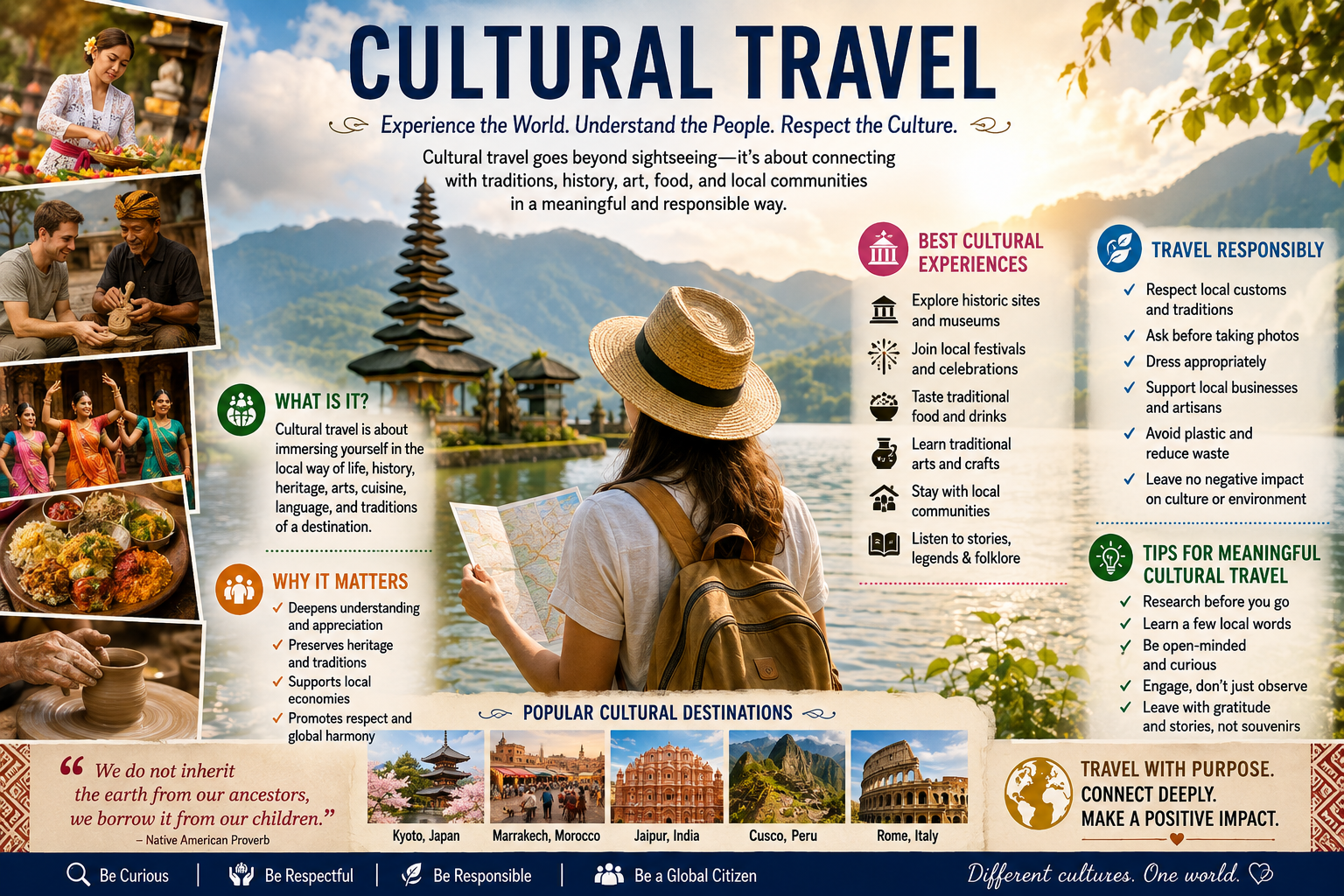
Cultural travel is a form of tourism centered on experiencing, understanding, and respecting the culture, history, heritage, traditions, arts, food, people, and everyday life of a destination. The best cultural travel does not treat local culture as a performance for visitors; it creates meaningful encounters while helping communities protect heritage, earn income, and maintain control over how their culture is represented Sara International Travel
What Is Cultural Travel?
Cultural travel is travel motivated partly or largely by the desire to understand and experience the culture of a destination.
It can involve:
- Historic sites
- Museums
- Archaeological locations
- Traditional architecture
- Local food
- Festivals
- Music
- Dance
- Religious heritage
- Traditional crafts
- Indigenous culture
- Literature
- Art
- Local markets
- Languages
- Traditional lifestyles
- Cultural landscapes
- Community-based experiences
- Historic neighborhoods
- Local storytelling
Cultural travel can happen almost anywhere.
You do not need to visit a famous UNESCO World Heritage Site.
A small neighborhood bakery, family-owned workshop, village market, local music performance, or conversation with a knowledgeable resident can provide a cultural experience.
The key is engagement rather than observation alone.
Cultural Travel vs Traditional Tourism
Traditional tourism often focuses on attractions.
Cultural travel focuses more heavily on meaning.
A conventional itinerary might say:
“Visit the old city.”
A cultural traveler might ask:
- Who built it?
- Why was it built?
- How did people use it?
- Which communities lived here?
- What traditions remain?
- What has changed?
- What do residents think about tourism?
- How can visitors contribute positively?
This difference may appear small, but it changes the entire travel experience.
Instead of simply photographing a historic building, you begin to understand the society that produced it.
Why Cultural Travel Matters
Cultural travel has become important for several reasons.
It Creates Deeper Travel Experiences
Many travelers eventually become tired of simply moving between attractions.
They want stories.
They want context.
They want meaningful interactions.
They want to return from a trip knowing something they did not know before.
Cultural travel provides that depth.
It Supports Cultural Heritage
Tourism can create economic reasons to protect cultural places, traditions, crafts, museums, and historic neighborhoods.
UNESCO highlights the potential of sustainable cultural tourism to create employment, generate income, support creative enterprises, and strengthen heritage management.
However, the relationship only works when tourism is managed responsibly.
It Supports Local Economies
Cultural travel can distribute visitor spending among:
- Local restaurants
- Independent guides
- Artisans
- Family businesses
- Museums
- Cultural organizations
- Local accommodation providers
- Transport operators
- Performers
- Food producers
This can be especially valuable in rural and less-visited areas.
It Encourages Cross-Cultural Understanding
Travel can challenge assumptions.
A visitor may arrive with one idea about a country and discover a much more complicated reality.
That is one of cultural travel’s greatest strengths.
The Core Elements of Cultural Travel
Cultural Heritage
Heritage includes both physical and living culture.
Physical heritage can include:
- Monuments
- Historic buildings
- Archaeological sites
- Traditional architecture
- Artifacts
Living heritage can include:
- Language
- Music
- Food traditions
- Rituals
- Storytelling
- Crafts
- Dance
- Traditional knowledge
The two are often connected.
A historic marketplace may still function because local traditions remain alive.
A traditional craft may survive because workshops operate in historic neighborhoods.
Local Food
Food is one of the most accessible forms of cultural travel.
A local dish can reveal:
- Geography
- Climate
- Agriculture
- Religion
- Migration
- Trade
- Family traditions
- Economic history
A food-focused cultural trip might involve:
- Cooking classes
- Local markets
- Food walks
- Family restaurants
- Farm visits
- Traditional bakeries
- Regional food festivals
The important point is to go beyond “trying exotic food.”
Learn the story behind the food.
Traditional Arts and Crafts
Crafts offer an unusually direct connection to cultural knowledge.
A visitor who learns pottery from a local artisan is not merely purchasing an object.
They are learning about:
- Materials
- Techniques
- Design
- History
- Local symbolism
- Skills passed through generations
Responsible cultural travel should prioritize authentic relationships with practitioners rather than mass-produced “traditional” products.
Music and Performing Arts
Music can reveal cultural history in ways that written descriptions cannot.
A performance can contain:
- Language
- Memory
- Religious meaning
- Social identity
- Historical events
- Community traditions
Travelers should learn when photography, recording, or participation is appropriate.
Not every performance exists for tourists.
Festivals and Celebrations
Festivals can be powerful cultural experiences.
They may reflect:
- Religion
- Seasonal cycles
- Historical events
- Agriculture
- Community identity
- National traditions
But travelers should remember that a festival can be a deeply meaningful event for residents rather than an entertainment product.
Respect should come before photography.
Cultural Travel and Everyday Life
One of the most overlooked parts of cultural travel is ordinary life.
Tourists often search for spectacular experiences.
But culture is also visible in:
- How people eat breakfast
- How markets operate
- How families gather
- How public spaces are used
- How people commute
- How neighborhoods interact
- How shops are organized
- How local businesses operate
- How people celebrate ordinary occasions
A traveler who spends an afternoon observing daily life respectfully may learn more than someone who visits ten attractions in one day.
Authenticity: What Does “Authentic” Really Mean?
“Authentic” is one of the most overused words in travel marketing.
But authenticity is complicated.
Cultures change.
People adopt new technologies.
Restaurants modify recipes.
Artists experiment.
Traditional clothing evolves.
Festivals incorporate modern elements.
A tradition does not become fake simply because it changes.
UNESCO’s approach to living heritage recognizes that cultural practices can be traditional, contemporary, and continuously recreated. This is an important concept when thinking about cultural travel.
Authenticity should therefore not mean:
“Nothing has changed.”
Instead, it can mean:
“This experience genuinely represents how the community understands, practices, or interprets its culture.”
Why Cultural Travel Should Be Community-Led
The people who live in a destination should not become background characters in their own culture.
This principle is increasingly emphasized in professional heritage-tourism guidance.
The updated ICOMOS International Cultural Heritage Tourism Charter calls for host communities, including Indigenous and traditional custodians, to be engaged in planning and managing tourism at heritage places.
That principle has practical consequences.
Tourism planners should ask:
- What do residents want?
- What should remain private?
- What should be shared?
- Who receives tourism income?
- Who controls cultural interpretation?
- How many visitors can the place handle?
- What traditions are sensitive?
- How can tourism strengthen rather than weaken community life?
The Economic Side of Cultural Travel
Cultural travel can generate income across an extensive local supply chain.
A traveler might spend money on:
- A local guide
- A family restaurant
- A craft workshop
- A local hotel
- Public transportation
- Museum tickets
- Local products
- Cultural performances
That means one traveler can support multiple local businesses.
The economic benefit is stronger when spending remains local.
If nearly all tourism revenue flows to large external companies, the cultural community may receive much less value.
The OECD’s 2026 tourism analysis emphasizes local value creation and stronger community participation as important elements of more balanced tourism development.
Cultural Travel in Cities
Cities are some of the world’s richest cultural travel destinations.
A city can contain:
- Historic districts
- Museums
- Religious buildings
- Markets
- Contemporary art
- Street food
- Music
- Architecture
- Design
- Literature
- Neighborhood cultures
But cities also face some of tourism’s biggest challenges.
Tourism can contribute to:
- Congestion
- Housing pressure
- Rising prices
- Gentrification
- Infrastructure strain
- Resident frustration
The OECD notes that concentrated visitor flows can place pressure on infrastructure and communities, while less-visited regions may receive fewer tourism benefits.
This means a good cultural traveler should sometimes move beyond the famous central attraction.
Cultural Travel in Rural Areas
Rural cultural travel can provide opportunities for communities that receive fewer visitors.
Experiences can include:
- Farm stays
- Traditional cooking
- Village crafts
- Agricultural festivals
- Local architecture
- Indigenous knowledge
- Rural museums
- Traditional music
- Nature-based cultural experiences
Rural tourism can diversify local economies when managed properly.
The OECD identifies tourism as a potential tool for rural economic diversification, heritage promotion, infrastructure development, and community resilience.
However, rural destinations also need to avoid becoming artificial “living museums.”
Residents need normal lives, not permanent performances for tourists.
Cultural Travel and Indigenous Communities
Indigenous cultural tourism requires particular care.
Indigenous communities may have unique:
- Languages
- Land relationships
- Stories
- Ecological knowledge
- Art
- Food traditions
- Ceremonies
- Crafts
Not all knowledge is public.
Some cultural information may be sacred, private, gender-specific, community-controlled, or restricted.
A responsible traveler should never assume that access is automatically granted because something is interesting.
The right to say “no” is part of cultural respect.
Cultural Travel and Religion
Religious heritage is a major part of cultural travel worldwide.
Travelers may visit:
- Mosques
- Churches
- Temples
- Synagogues
- Monasteries
- Shrines
- Sacred landscapes
But religious sites are not simply attractions.
They remain places of worship.
Travelers should research:
- Dress requirements
- Photography rules
- Prayer times
- Entry restrictions
- Gender-specific areas
- Silence requirements
- Ritual expectations
A respectful visitor behaves more like a guest than a spectator.
Cultural Travel and Language
Language can transform the travel experience.
Learning even a few local phrases can communicate:
- Respect
- Curiosity
- Willingness to participate
- Appreciation
Useful phrases might include:
- Hello
- Thank you
- Please
- Excuse me
- How much?
- Where is…?
- May I take a photograph?
- Do you speak English?
Language also provides cultural clues.
Place names, greetings, humor, family terms, and expressions often reveal how people understand relationships and place.
Cultural Travel Through Food
Eat Where Locals Eat
Restaurants filled exclusively with tourists are not necessarily bad, but they may not provide the strongest cultural experience.
Consider:
- Neighborhood restaurants
- Markets
- Family-owned businesses
- Local bakeries
- Food stalls
- Traditional cafés
Learn the Story
Ask:
- Where did the dish originate?
- Is it regional?
- When is it traditionally eaten?
- Is it connected to a festival?
- How is it prepared?
- What ingredients are local?
Take a Cooking Class
Cooking classes can be excellent cultural experiences because they combine:
- Food
- Language
- History
- Technique
- Family knowledge
- Social interaction
Cultural Travel Through Markets
Markets are cultural laboratories.
They reveal:
- What people eat
- What people produce
- What they import
- How they negotiate
- How they socialize
- What local crafts remain commercially relevant
A good market visit is not simply shopping.
Watch.
Listen.
Ask questions.
Observe how residents use the market.
And avoid photographing people without permission.
Cultural Travel Through Architecture
Architecture tells stories about:
- Climate
- Religion
- Security
- Wealth
- Technology
- Family structure
- Politics
- Trade
- Materials
A traditional courtyard house, for example, can reveal how architecture responds to heat, privacy, family life, and local materials.
Historic architecture is therefore not simply visually attractive.
It is evidence.
Cultural Travel and Museums
Museums can provide context that is difficult to obtain while walking through a city.
Before visiting, check whether a museum offers:
- Local collections
- Community-curated exhibitions
- Guided tours
- Workshops
- Audio guides
- Temporary exhibitions
- Historical archives
Do not assume that the largest museum is automatically the best.
A small local museum may tell a more focused and personal story.
Cultural Travel and Storytelling
A destination becomes more meaningful when you understand its stories.
Consider hiring local guides who can explain:
- Neighborhood history
- Family traditions
- Architecture
- Migration
- Local food
- Historical events
- Cultural change
A guide is not merely someone who knows where the attractions are.
A great guide provides context.
How to Plan a Cultural Travel Trip
Step 1: Choose a Cultural Theme
Instead of trying to experience everything, select a focus.
Examples:
- Food
- Architecture
- History
- Music
- Art
- Religion
- Traditional crafts
- Literature
- Indigenous culture
- Local markets
Step 2: Research Before You Go
Read about:
- Local history
- Social customs
- Religion
- Dress
- Photography rules
- Food etiquette
- Basic language
- Cultural sensitivities
Step 3: Mix Famous and Local Experiences
A strong itinerary can combine:
- One major landmark
- One museum
- One local neighborhood
- One food experience
- One artisan experience
- One community activity
Step 4: Leave Empty Time
Do not fill every hour.
Unstructured time creates opportunities for unexpected cultural discoveries.
Step 5: Spend Locally
Prioritize locally owned businesses when practical.
Step 6: Reflect
After the trip, ask:
- What did I learn?
- Which assumptions changed?
- Who benefited from my spending?
- Did I respect local rules?
- What do I still not understand?
That final question is particularly valuable.
How to Travel Respectfully
Ask Before Photographing People
A camera can feel intrusive.
Especially when photographing:
- Children
- Religious ceremonies
- Craftspeople
- Indigenous communities
- Private events
Ask first.
Learn Dress Expectations
Clothing norms vary dramatically.
Research before visiting religious or conservative communities.
Avoid Treating Poverty as Tourism
Do not photograph hardship simply because it looks “authentic.”
People deserve dignity.
Buy Ethically
Support legitimate artisans.
Avoid suspicious antiquities and cultural objects with unclear origins.
Do Not Touch Sacred Objects
Even if other tourists do it.
Follow Local Rules
Rules are part of the cultural landscape.
Cultural Travel for Families
Cultural travel can be especially valuable for children.
Instead of simply explaining history, parents can give children direct experiences.
Try:
- Children’s museums
- Cooking workshops
- Craft classes
- Local markets
- Storytelling sessions
- Historical walking tours
- Traditional music
- Farm experiences
Children often learn better when culture becomes something they can see, hear, touch, taste, and discuss.
Cultural Travel for Solo Travelers
Solo travelers can have advantages in cultural exploration.
They may find it easier to:
- Talk to locals
- Join small tours
- Eat at communal tables
- Attend workshops
- Adjust plans
- Spend more time in one neighborhood
However, solo travelers should also consider safety and local cultural norms.
Cultural Travel for Couples
Couples can build trips around shared cultural experiences.
Examples include:
- Cooking classes
- Museum evenings
- Local food tours
- Historic walking tours
- Artisan workshops
- Traditional performances
These activities often create stronger memories than simply visiting another landmark.
Cultural Travel for Students
Students can use travel as field research.
A student interested in:
- History can explore archives.
- Architecture can study historic buildings.
- Sociology can observe community spaces.
- Food studies can examine cuisine.
- Art students can visit workshops.
- Environmental students can study traditional resource practices.
The important thing is to combine observation with ethical research.
Cultural Travel for Older Travelers
Older travelers may prefer slower cultural experiences.
Good options include:
- Small-group tours
- Museum programs
- Scenic heritage railways
- Food experiences
- Craft workshops
- Cultural lectures
- Accessible historic sites
Slow travel can create more meaningful encounters while reducing the pressure to see everything.
Cultural Travel for Budget Travelers
Cultural travel does not have to be expensive.
Budget travelers can:
- Walk historic neighborhoods
- Visit free museums
- Explore local markets
- Attend public cultural events
- Use public transport
- Eat at local restaurants
- Join free walking tours
- Learn basic local history independently
- Visit community spaces
Often, the most meaningful experiences cost very little.
Cultural Travel for Luxury Travelers
Luxury travel can also become culturally meaningful.
Instead of focusing only on expensive accommodation, travelers can prioritize:
- Private museum access
- Expert historians
- Local chefs
- Artisan workshops
- Heritage properties
- Small community experiences
- High-quality local products
The principle remains the same:
Luxury should not mean cultural isolation.
Common Cultural Travel Mistakes
Mistake 1: Trying to See Everything
More attractions do not necessarily mean more cultural understanding.
Solution: Slow down and focus.
Mistake 2: Visiting Only Famous Places
Famous landmarks can be valuable, but they rarely tell the whole story.
Solution: Add neighborhood-level experiences.
Mistake 3: Treating Culture as Entertainment
Not every tradition exists for tourists.
Solution: Learn the context.
Mistake 4: Searching for a “Perfectly Authentic” Experience
Cultures are living systems.
Solution: Look for genuine community participation rather than artificial historical purity.
Mistake 5: Ignoring Residents
A destination belongs to residents too.
Solution: Consider how tourism affects daily life.
Mistake 6: Spending Only With Global Chains
Large companies can offer convenience, but local spending often keeps more value within the destination.
Solution: Include local businesses where appropriate.
Mistake 7: Taking Too Many Photos
Photography can become a barrier to experiencing the moment.
Solution: Put the camera away sometimes.
Mistake 8: Assuming Every Local Person Is a Cultural Representative
One person cannot speak for an entire culture.
Solution: Seek multiple perspectives.
The Benefits of Cultural Travel
Cultural Understanding
Travel can challenge stereotypes and encourage curiosity.
Heritage Preservation
Tourism revenue can support conservation when properly managed.
Local Economic Development
Cultural experiences can create opportunities for local entrepreneurs.
Personal Education
Travel can become experiential learning.
Community Connection
Meaningful interaction can create human relationships across borders.
Support for Traditional Skills
Craft workshops and local markets can create demand for traditional skills.
Broader Travel Experiences
Cultural travel can turn an ordinary trip into a deeper learning experience.
The Risks of Cultural Travel
Overcrowding
Popular cultural sites can receive more visitors than they can comfortably handle.
Commercialization
Traditions may be simplified for tourist demand.
Gentrification
Tourism can contribute to rising costs and displacement in pressured destinations.
Cultural Misrepresentation
Travel marketing can present simplified or stereotyped versions of culture.
Environmental Pressure
Tourism generates transportation demand, waste, and resource consumption.
Unequal Economic Benefits
Large tourism companies may capture more value than local communities.
The OECD’s current tourism work emphasizes that tourism can generate economic and social benefits while also creating tensions when growth is concentrated or value is not captured locally.
How to Make Cultural Travel More Sustainable
Stay Longer
Longer stays can reduce the pressure of rapid tourism and allow deeper local spending.
Travel During Less Busy Periods
Off-season travel can help distribute demand.
Explore Beyond Major Attractions
Spread spending across neighborhoods and regions.
Choose Local Providers
Use local guides, restaurants, artisans, and accommodation when possible.
Respect Capacity Limits
If a site has visitor restrictions, follow them.
Avoid Disposable Consumption
Reduce unnecessary waste.
Learn About Local Conservation
Some destinations have community-led conservation programs that visitors can support.
Overtourism and Cultural Destinations
Overtourism occurs when visitor pressure becomes excessive relative to the capacity of a destination, site, community, or infrastructure.
Its effects can include:
- Crowding
- Noise
- Waste
- Infrastructure stress
- Higher prices
- Resident frustration
- Damage to heritage
- Reduced visitor satisfaction
The solution is not always to stop tourism.
Possible strategies include:
- Timed tickets
- Visitor caps
- Dynamic pricing
- Alternative routes
- Dispersing attractions
- Promoting less-visited destinations
- Off-season campaigns
- Better public transport
- Community participation
Cultural Travel and Climate Change
Cultural tourism also faces climate risks.
Extreme weather can affect:
- Historic buildings
- Archaeological sites
- Museums
- Roads
- Cultural landscapes
- Festivals
- Outdoor performances
Tourism planning therefore needs to consider climate resilience.
The OECD’s 2026 tourism analysis specifically highlights extreme weather risks and the need for early warning systems, risk assessment, resilient infrastructure, and adaptive capacity.
Cultural Travel and Digital Technology
Technology is changing how people discover culture.
Travelers now use:
- Digital maps
- Translation apps
- Audio guides
- Virtual tours
- AI travel assistants
- Online museum collections
- Digital ticketing
- Augmented reality
These tools can make cultural travel easier.
But convenience should not replace curiosity.
A translation app can tell you what someone said.
It cannot necessarily explain why they said it.
AI and Cultural Travel
AI can help travelers:
- Research historical context
- Build itineraries
- Translate basic phrases
- Identify architecture
- Discover museums
- Find cultural events
- Compare neighborhoods
- Understand historical timelines
But AI-generated cultural information can contain errors.
Travelers should verify sensitive historical, religious, political, and cultural claims through authoritative sources or local experts.
Augmented Reality and Cultural Sites
Augmented reality could allow travelers to see:
- Historical reconstructions
- Former buildings
- Ancient street layouts
- Historical clothing
- Past landscapes
- Architectural details
This can make heritage interpretation more engaging.
But digital reconstructions should distinguish documented evidence from speculation.
Cultural Travel and Social Media
Social media has made cultural destinations more visible.
This can help:
- Local businesses
- Artisans
- Museums
- Small destinations
- Cultural events
But viral exposure can also create sudden visitor surges.
A place can go from relatively quiet to overcrowded because of one viral video.
Travelers should therefore think about the consequences of sharing exact locations of fragile or sensitive places.
The Rise of Slow Cultural Travel
Slow travel is increasingly attractive to people who want deeper experiences.
Instead of visiting five cities in one week, a traveler might stay in one city for five days.
They can:
- Learn local transportation
- Return to the same café
- Shop at the same market
- Attend a workshop
- Meet residents
- Explore different neighborhoods
Repeated exposure creates familiarity.
And familiarity often produces better cultural understanding.
The Rise of Creative Tourism
Creative tourism goes beyond observing culture.
Travelers participate in it.
Examples include:
- Painting workshops
- Pottery
- Cooking
- Textile making
- Music
- Dance
- Photography
- Writing
- Traditional crafts
UNESCO has highlighted cultural and creative tourism as a way to connect tradition with innovation while creating opportunities for communities and creative industries.
Cultural Tourism and the “Experience Economy”
Modern travelers increasingly buy experiences rather than physical products.
That creates opportunities for cultural entrepreneurs.
A local artisan might offer:
- A workshop
- A studio visit
- A cultural demonstration
- A storytelling session
- A guided neighborhood walk
This can provide higher-value tourism without requiring mass visitor numbers.
Ten Major Cultural Travel and Tourism Brands Compared
The following brands represent different approaches to travel discovery, tours, cultural experiences, and destination services. They are not identical competitors, so the comparison focuses on their typical role in the cultural travel ecosystem.
| Brand | Primary Model | Cultural Travel Strength | Best For | Key Consideration |
|---|---|---|---|---|
| Intrepid Travel | Small-group tours | Local experiences and responsible travel | Travelers wanting structured cultural trips | Group format may limit flexibility |
| G Adventures | Small-group adventure tours | Community and local experiences | Younger and active travelers | Experience varies by itinerary |
| Trafalgar | Guided group tours | Heritage-focused itineraries and organized sightseeing | First-time international travelers | Less independent than self-guided travel |
| Context Travel | Expert-led tours | Deep historical and cultural interpretation | Travelers seeking academic-level context | Usually more premium |
| GetYourGuide | Experience marketplace | Wide range of museums, tours, food, and activities | Flexible travelers | Quality varies by individual provider |
| Viator | Experience marketplace | Large selection of cultural activities | Travelers comparing many experiences | Provider quality should be checked |
| Airbnb | Accommodation and experiences | Local hosts and neighborhood experiences | Independent travelers | Availability and experience quality vary |
| Booking.com | Travel booking platform | Accommodation access in cultural destinations | Travelers planning independently | Primarily a booking platform rather than cultural specialist |
| Evaneos | Local-expert trip planning | Customized local itineraries | Travelers seeking tailored cultural trips | Custom planning can cost more |
| Culture Trip | Travel content and discovery | Destination inspiration and cultural storytelling | Travelers researching destinations | Content is best used as inspiration alongside primary sources |
The strongest choice depends on the traveler.
Someone seeking an expert historian may prefer a specialist guide.
Someone wanting flexibility may prefer an experience marketplace.
Someone wanting a fully organized trip may prefer a guided tour operator.
Someone wanting maximum local control may build the itinerary independently.
How to Choose a Cultural Travel Company
Before booking, ask:
Who Operates the Experience?
Is the guide local?
Is the company locally owned?
Does it employ local practitioners?
Who Benefits Financially?
Look for transparency around local partnerships.
How Large Is the Group?
Smaller groups can sometimes enable deeper interaction and reduce pressure on sites.
Does the Experience Respect Local Culture?
Read the description carefully.
Avoid experiences that treat communities as spectacles.
Is the Experience Educational?
A good cultural experience should provide context rather than simply entertainment.
Are Reviews Specific?
Look for reviews that mention:
- Guide knowledge
- Local interaction
- Organization
- Respect
- Group size
- Authenticity
- Cultural sensitivity
How to Compare Cultural Travel Experiences
A useful scoring framework is the CULTURE test.
C — Community
Does the local community participate meaningfully?
U — Understanding
Will you learn cultural context?
L — Local Value
Does spending reach local businesses or practitioners?
T — Tradition
Does the experience respect cultural heritage?
U — Uniqueness
Does it provide something genuinely connected to the destination?
R — Responsibility
Are environmental and social impacts considered?
E — Ethics
Are people, knowledge, images, and cultural materials treated respectfully?
A tour that scores well across these categories is generally more attractive than one that simply promises an “authentic” photo opportunity.
A Seven-Day Cultural Travel Example
Day 1: Understand the City
Visit a major historical area.
Do not rush.
Learn the basic timeline of the destination.
Day 2: Explore a Local Neighborhood
Walk beyond the main tourist district.
Visit local cafés and markets.
Day 3: Learn Through Food
Take a cooking class or food tour.
Day 4: Study Heritage
Visit a museum or heritage site with a knowledgeable guide.
Day 5: Meet a Cultural Practitioner
Join a craft, music, or artistic workshop.
Day 6: Explore Beyond the Center
Visit a nearby town, village, or less-visited cultural district.
Day 7: Reflect and Revisit
Return to a favorite place.
Talk to people you met.
Buy directly from local producers.
This itinerary is deliberately slower.
The objective is not to maximize attractions.
It is to maximize understanding.
What Makes a Cultural Travel Experience Excellent?
An excellent cultural experience usually has five characteristics.
It Has Context
You understand what you are seeing.
It Involves Real People
You interact with people connected to the culture.
It Respects Boundaries
Not everything is available for tourism.
It Creates Local Value
The community benefits.
It Changes Your Perspective
You leave with a deeper understanding than you arrived with.
That final point is perhaps the most important.
If an experience changes how you see a place, it has accomplished something that a simple sightseeing checklist cannot.
Future Trends in Cultural Travel
More Personalized Cultural Itineraries
Travel platforms are increasingly capable of matching travelers with highly specific interests.
Instead of searching for “things to do,” people may search for:
- Traditional architecture for beginners
- Local food for families
- Indigenous cultural experiences
- Art workshops for solo travelers
- Heritage travel for photographers
- Historical experiences for students
This type of intent-based travel could make cultural tourism more relevant.
AI-Powered Cultural Discovery
AI may become a travel research layer that explains:
- Historical context
- Local etiquette
- Cultural vocabulary
- Neighborhood history
- Museum collections
But trustworthy systems will need reliable sources and careful cultural interpretation.
Growth of Community-Based Tourism
Community-led tourism is likely to become increasingly important because travelers are becoming more interested in meaningful local experiences.
More Demand for Responsible Tourism
Travelers are increasingly aware that tourism affects residents, heritage, and ecosystems.
The future traveler may ask not only:
“Is this experience good?”
but:
“Is this experience good for the place?”
Greater Visitor Management
Destinations facing crowding are likely to rely more heavily on:
- Reservation systems
- Timed entry
- Visitor caps
- Alternative routes
- Off-season promotion
- Better data
Cultural Travel Beyond Famous Cities
As major destinations become crowded, travelers may explore:
- Secondary cities
- Rural areas
- Smaller heritage towns
- Regional food destinations
- Lesser-known cultural landscapes
This can distribute economic benefits more widely.
Digital Heritage Experiences
Virtual museums, 3D reconstruction, augmented reality, and interactive archives are likely to become more common.
These technologies can enhance physical travel rather than replace it.
The Biggest Challenge for the Future
The biggest challenge is not attracting travelers.
Tourism already has enormous demand.
The challenge is managing cultural travel so that visitor interest does not destroy the cultural qualities that attracted visitors in the first place.
That creates a paradox.
A destination becomes popular because it has a distinctive identity.
Tourism increases because of that identity.
Tourism can then change the identity.
If the process continues unchecked, the destination may lose what made it special.
This is why cultural travel must be managed as a long-term relationship between:
- Visitors
- Residents
- Businesses
- Governments
- Cultural organizations
- Heritage professionals
- Local practitioners
A Practical Responsible Cultural Travel Checklist
Before leaving home:
- Research local history.
- Learn basic cultural etiquette.
- Learn a few local words.
- Research photography rules.
- Check religious-site requirements.
- Identify locally owned businesses.
During the trip:
- Ask before photographing people.
- Follow local rules.
- Spend locally.
- Respect sacred places.
- Avoid illegal cultural objects.
- Listen more than you speak.
- Do not treat poverty as entertainment.
- Avoid damaging heritage.
- Support local practitioners.
After the trip:
- Leave honest reviews.
- Recommend responsible local businesses.
- Share accurate cultural information.
- Avoid stereotypes.
- Continue learning.
- Consider supporting heritage organizations
FAQs
What is cultural travel?
Cultural travel is travel focused on understanding and experiencing the history, heritage, traditions, food, arts, language, people, architecture, and everyday life of a destination.
What is the difference between cultural travel and cultural tourism?
The terms are often used interchangeably. Cultural tourism generally describes the tourism sector and activities connected to culture, while cultural travel is often used more broadly to describe a travel style centered on cultural exploration and learning.
What are examples of cultural travel?
Examples include visiting historic neighborhoods, learning traditional cooking, attending cultural festivals, exploring museums, taking craft workshops, visiting religious heritage sites respectfully, learning local history, and meeting community-based guides.
Why is cultural travel important?
Cultural travel can promote cross-cultural understanding, support local economies, create demand for heritage preservation, encourage learning, and provide communities with opportunities to share their culture on their own terms.
Is cultural travel expensive?
It can be expensive, but it does not have to be. Walking tours, local markets, public museums, neighborhood exploration, community events, and self-guided historical research can provide meaningful cultural experiences at relatively low cost.
How can I travel more authentically?
Instead of searching for a supposedly “unchanged” culture, look for experiences genuinely connected to local communities. Eat at local businesses, learn about history, use local guides, participate respectfully in workshops, and spend time observing everyday life.
How can travelers support local culture?
Travelers can support locally owned businesses, artisans, museums, guides, cultural organizations, restaurants, and community-based tourism projects. They can also respect local customs and avoid buying questionable cultural artifacts.
What is responsible cultural travel?
Responsible cultural travel seeks to minimize harm while maximizing benefits for host communities, heritage, and the environment. It includes respectful behavior, local spending, appropriate visitor numbers, ethical photography, and awareness of cultural boundaries.
Can cultural travel harm local communities?
Yes. Poorly managed tourism can contribute to overcrowding, rising living costs, gentrification, cultural commercialization, environmental pressure, and resident frustration. Current OECD research emphasizes the importance of community participation and better distribution of tourism benefits.
What is sustainable cultural tourism?
Sustainable cultural tourism attempts to balance visitor experiences with economic, social, environmental, and cultural needs. UNESCO and international heritage organizations emphasize protecting heritage and supporting host communities as important parts of sustainable tourism.
Is visiting UNESCO World Heritage Sites cultural travel?
Yes, visiting World Heritage Sites can be cultural travel, especially when travelers learn about their history, significance, communities, and conservation challenges rather than simply taking photographs.
Should cultural travelers avoid popular destinations?
Not necessarily. Popular destinations can be culturally valuable. The better approach is to travel responsibly, follow visitor-management rules, consider less busy periods, and explore beyond overcrowded attractions when appropriate.
How can I respect local culture while traveling?
Research before you go, dress appropriately, ask permission before photographing people, respect religious practices, learn basic local etiquette, avoid stereotypes, and listen to local perspectives.
Is local food part of cultural travel?
Absolutely. Food can reveal a destination’s geography, history, religion, agriculture, trade connections, migration, and family traditions.
Why are local guides important?
Local guides can provide context, personal knowledge, historical interpretation, and perspectives that may not be available through generic travel information. They can also help tourism spending remain within the local economy.
What is creative tourism?
Creative tourism involves active participation in local culture rather than simply observing it. Examples include cooking, pottery, painting, textile work, music, dance, photography, and other creative activities. UNESCO has highlighted creative tourism as a way of connecting cultural traditions with innovation and community opportunities.
Can cultural travel help preserve traditions?
It can, when tourism creates fair economic opportunities and supports communities and practitioners. However, tourism should not be the only reason a tradition survives, and communities should retain control over how traditions are shared.
What is the future of cultural travel?
The future is likely to include slower travel, community-based tourism, personalized itineraries, creative experiences, AI-assisted research, digital heritage, improved visitor management, and greater attention to local economic and social benefits.
Conclusion
Cultural travel offers something that ordinary sightseeing often cannot: the opportunity to understand a destination through the people, stories, traditions, food, architecture, history, art, language, and everyday experiences that give it meaning. The strongest cultural journeys are not built around collecting attractions. They are built around curiosity, patience, respect, and genuine engagement.