Tokyo Tea Ceremony: 15 Unforgettable Experiences to Discover Traditional Japanese Tea Culture
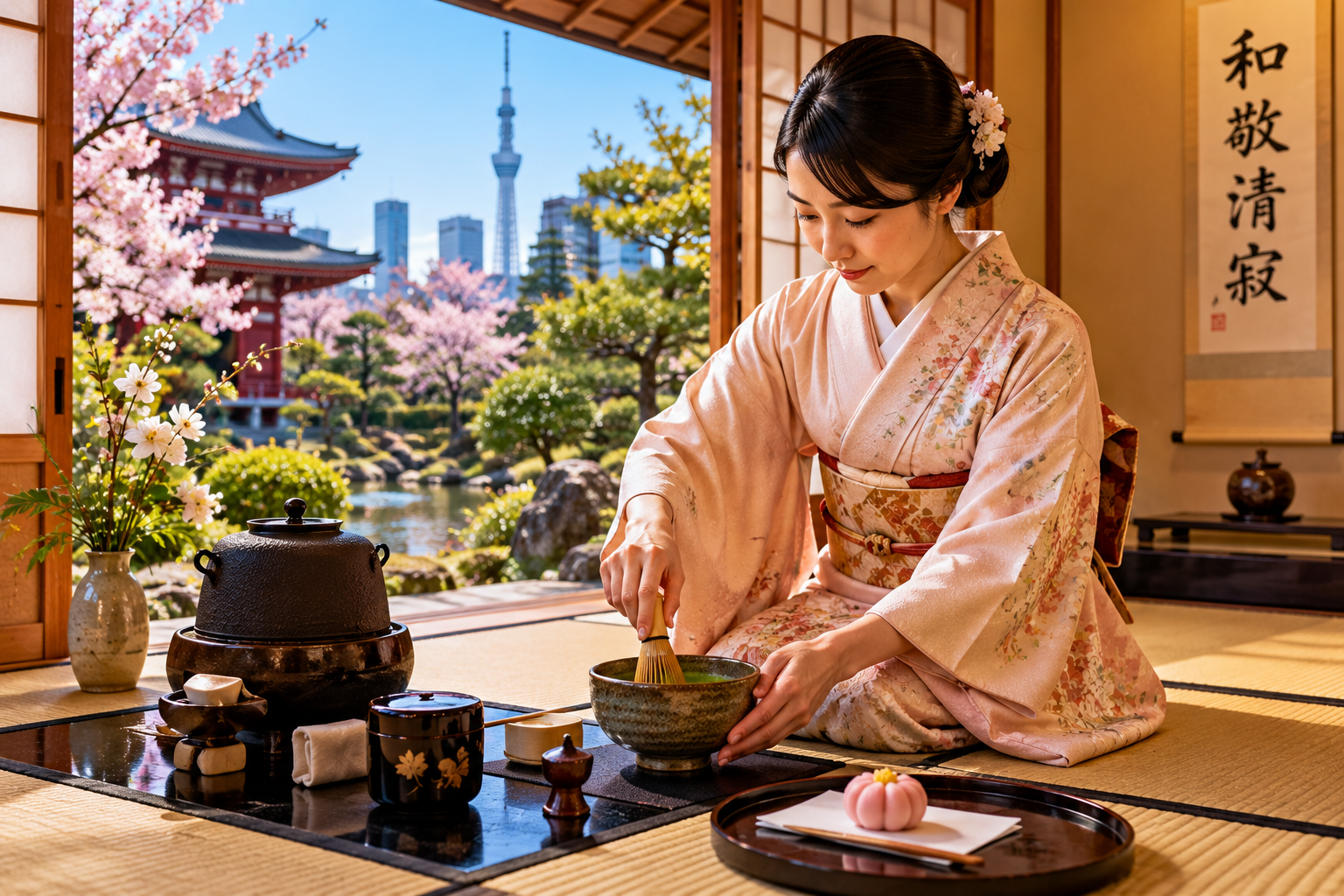
What if one of the most memorable experiences in Tokyo involved slowing down rather than rushing between attractions? Imagine entering a peaceful Japanese tea room, sitting beside a low table, watching a host prepare bright green matcha with a bamboo whisk, and tasting a traditional sweet before taking your first sip. Outside, the city moves at its usual pace, but inside, every movement has a purpose. A Tokyo tea ceremony is a cultural experience in which a host prepares and serves Japanese matcha through carefully considered movements, hospitality and traditional etiquette Tokyo Street Food
What Is a Japanese Tea Ceremony?
Understanding Chanoyu, Chado and Sado
The Japanese tea ceremony is a structured way of preparing and serving matcha, powdered green tea. Unlike ordinary tea service, it places considerable emphasis on the relationship between the host, the guest, the utensils and the setting.
Three terms are commonly used to describe this tradition:
- Chanoyu: Literally associated with hot water for tea, this term commonly refers to the tea gathering and its practices.
- Chado: Often translated as “the way of tea,” it describes tea as a broader discipline involving practice, hospitality and personal development.
- Sado: Another reading of the characters used for the way of tea, commonly used in the same general sense as chado.
The terminology can vary according to context and tea school, but all three terms point toward an approach in which preparing tea is treated as a thoughtful cultural practice rather than an ordinary beverage service.
A formal tea gathering may involve specific utensils, carefully selected sweets, a seasonal theme and a sequence of movements learned through practice. Introductory experiences for tourists are usually shorter and less demanding, allowing guests to observe or participate without needing years of training.
Why Matcha Is Central to the Ceremony
Matcha is a finely powdered green tea traditionally whisked with hot water. Unlike loose-leaf tea, where the leaves are generally removed after steeping, matcha is consumed as a suspension of powdered tea in water.
Its flavour can range from sweet and mellow to vegetal, bitter and deeply savoury, depending on the tea, preparation and grade. The quality of the water, water temperature, amount of powder and whisking technique all affect the final bowl.
In a tea ceremony, matcha is not simply selected for its taste. The tea is part of a complete experience that includes the bowl, the room, the host’s movements and the relationship between host and guest.
The Four Principles of Tea
The Urasenke school of tea commonly expresses four central principles as wa, kei, sei and jaku. They are often translated as follows:
- Wa — Harmony: Creating a balanced relationship among the host, guests, utensils and surroundings.
- Kei — Respect: Treating people, objects and the occasion with consideration.
- Sei — Purity: Maintaining physical and spiritual cleanliness, including the careful handling of tea utensils.
- Jaku — Tranquillity: Developing a calm state of mind through sustained practice.
These principles help explain why the ceremony places such importance on small details. The host is not merely demonstrating a recipe; the host is creating an atmosphere of welcome and attentiveness.
Is a Tokyo Tea Ceremony Religious?
The tea ceremony developed in a cultural environment influenced by Zen Buddhism, aesthetics, hospitality and the traditions of Japanese elites. However, a visitor does not need to be Buddhist or religious to participate.
Many introductory experiences focus on cultural learning. Guests can appreciate the movements, utensils, tea and setting without adopting a spiritual belief or mastering the philosophy behind the practice.
It is best to approach the experience with curiosity and respect rather than assuming that every ceremony is a religious ritual.
A Brief History of the Japanese Tea Ceremony
Early Tea Culture in Japan
Tea drinking became established in Japan through cultural exchange with China, particularly through Buddhist connections. Over time, tea developed from a beverage associated with religious and elite settings into a practice with wider social and cultural significance.
The forms of tea preparation changed across different periods. Tea competitions, the appreciation of expensive utensils and gatherings among powerful patrons all influenced the evolution of tea culture.
Sen no Rikyu and the Development of Wabi-Cha
One of the most influential figures in the history of Japanese tea was Sen no Rikyu, a sixteenth-century tea master associated with the development of wabi-cha.
Wabi-cha emphasised simplicity, restraint, natural materials and a sense of beauty that did not depend on extravagant objects. A small, carefully arranged room or an imperfect ceramic bowl could be valued for its character rather than its luxury.
This approach helped shape the aesthetics associated with many Japanese tea traditions. It also explains why an apparently simple tea room can be more meaningful than an elaborate decorative space.
The Development of Major Tea Schools
Over time, different tea lineages developed their own methods, teaching systems and stylistic preferences. Three well-known schools associated with the Sen family are:
- Urasenke
- Omotesenke
- Mushanokoji-senke
They share important historical roots, but their approaches to preparation, utensils and formal practice can differ.
For a tourist attending a single introductory session, these distinctions may not be immediately noticeable. However, they matter to students who want to pursue tea ceremony training over months or years.
Tea Culture in Modern Tokyo
Tokyo’s tea culture includes formal schools, cultural organisations, historic gardens, traditional tea rooms and modern matcha businesses. These settings offer different ways to engage with the same broad tradition.
Some venues prioritise formal practice and traditional etiquette. Others provide introductory workshops designed for visitors who have limited time or no previous knowledge of Japanese customs.
Neither format needs to be treated as inherently superior. A short workshop can be an excellent introduction, while a more formal gathering may be better for visitors who want to observe the details of the tradition.
What Happens During a Tokyo Tea Ceremony?
A tea ceremony experience can vary considerably from one venue to another. Some sessions involve observing the host prepare matcha, while others invite guests to whisk their own tea. More formal gatherings may include several stages, specific utensils and a longer sequence of traditional procedures.
Understanding the basic structure will help you know what to expect.
1. Arrival and Welcome
When you arrive, the host or staff member may explain where to leave your shoes, where to sit and how the session will proceed. Traditional tea rooms often use tatami flooring, so guests may be asked to remove their shoes before entering.
You may be seated on the floor, on a cushion or on a chair, depending on the venue. Some traditional settings offer seating alternatives for guests who have difficulty kneeling.
If you have a mobility concern, ask about seating before booking rather than assuming that every venue can accommodate the same arrangement.
2. Introduction to the Tea Room
The host may explain the room’s layout, the significance of the utensils and any seasonal decorations. A traditional tea room is usually arranged with care, and the objects displayed in it may have a particular aesthetic or seasonal purpose.
Some settings feature a tokonoma, a recessed alcove used to display a hanging scroll, flowers or another carefully chosen object.
The display is not necessarily intended to be impressive in a conventional decorative sense. It may be designed to create a quiet mood, reflect the season or establish a theme for the gathering.
3. Serving a Japanese Sweet
A traditional sweet, called wagashi, is often served before matcha. The sweetness complements the tea’s bitterness and provides a contrast in flavour and texture.
The sweet may be made with ingredients such as sweet bean paste, rice flour or sugar, although recipes vary widely. Some are shaped and coloured to reflect seasonal flowers, leaves or other natural motifs.
Your host may explain when to eat the sweet and whether a small pick or utensil should be used. Follow the instructions provided, as practices can differ between settings.
4. Preparing Matcha
The host typically measures powdered tea into a bowl, adds hot water and uses a bamboo whisk called a chasen to mix it.
This step is often the centre of a beginner’s experience. The host’s movements may look simple, but consistent preparation requires practice. The aim is to combine the powder and water appropriately while producing a smooth drink with a suitable texture.
Some workshops invite visitors to prepare their own bowl after a demonstration. This can be a useful way to understand the process rather than merely watching it.
5. Receiving and Drinking the Tea
In many traditional settings, the bowl is presented to the guest with care. Guests may be shown how to receive it, turn it slightly before drinking and return it appropriately.
The details depend on the ceremony’s style. Do not worry if you cannot remember every movement immediately. A good introductory host will usually demonstrate the essential steps and help guests through them.
Take a moment to notice the bowl, the colour of the tea and its flavour. The point is not to finish as quickly as possible, but to experience the preparation and hospitality as a whole.
6. Appreciating the Bowl and Utensils
Some ceremonies include an opportunity to appreciate the tea bowl and other utensils. A bowl may be valued for its shape, glaze, texture, maker or relationship to the season.
You may be invited to examine a bowl closely, but never assume that you can pick up or handle an object without permission. Some utensils are valuable, delicate or used only according to particular procedures.
7. Closing the Session
The host may conclude with a short explanation, a question-and-answer period or an opportunity to take photographs. The format varies by venue.
A short tourist session may last around 30–60 minutes, while a more elaborate gathering can take considerably longer. Check the advertised duration when booking.
15 Best Ways to Experience a Tokyo Tea Ceremony
Rather than assuming that every tea ceremony is the same, choose an experience based on the kind of visit you want. These options include formal practice, historic settings, beginner workshops and tea-focused outings.
1. Traditional Tea Ceremony in a Tatami Room Tokyo tea ceremony
A tatami tea room provides a classic setting for experiencing Japanese tea culture. Tatami is a traditional flooring material made from woven rush over a supporting core, and it contributes to the distinctive look and feel of many Japanese interiors.
The room may contain a hanging scroll, seasonal flowers and carefully arranged utensils. Its relative simplicity can help guests focus on the host’s movements and the preparation of tea.
Best for: First-time visitors, culture enthusiasts and travellers who want a traditional setting.
What to check: Whether the session involves floor seating, whether English explanations are available and whether the ceremony includes hands-on participation.
2. Tea Ceremony in a Japanese Garden Tokyo tea ceremony
A garden setting can connect tea culture with the seasonal landscape. Depending on the venue, the experience may take place in a dedicated tea house, a historic building overlooking a garden or a cultural facility within a larger park.
The surroundings can be especially attractive during spring and autumn, although weather and seasonal conditions affect the experience.
Best for: Couples, photographers and travellers interested in Japanese gardens.
Practical tip: Do not assume the garden entrance includes the tea ceremony. Some venues require separate reservations or charge an additional fee for tea service.
3. Tea Ceremony With a Kimono Experience Tokyo tea ceremony
Some visitor experiences combine a tea ceremony with wearing a kimono or another form of traditional Japanese dress. This can create an enjoyable cultural outing, particularly for travellers who want to learn about several aspects of Japanese customs in one session.
However, kimono dressing and tea preparation are separate skills. A combined package may provide a brief introduction to each rather than an in-depth lesson in either one.
Best for: Couples, groups of friends and visitors celebrating a special occasion.
Practical tip: Ask how much time is allocated to dressing, whether accessories are included and whether the tea ceremony takes place in the same location.
4. Matcha-Making Workshop for Beginners Tokyo tea ceremony
A matcha-making workshop usually focuses on the practical steps of preparing tea. You may learn how to measure the powder, add water, handle a bamboo whisk and produce a bowl of matcha.
This format is often more accessible to beginners than a formal gathering because it allows questions and hands-on practice.
Best for: Curious travellers, families with older children and people who want to learn a practical skill.
Practical tip: Confirm whether you will prepare your own matcha or only watch a demonstration.
5. Tea Ceremony in a Historic Cultural Building Tokyo tea ceremony
Some historic buildings and cultural facilities host tea events or workshops. These can provide an opportunity to understand how tea culture relates to Japanese architecture, design and the preservation of traditional spaces.
A historic venue does not necessarily offer a daily ceremony. Events may be scheduled on particular dates, so check the programme before travelling.
Best for: Architecture lovers, history enthusiasts and visitors who prefer quieter cultural experiences.
Practical tip: Confirm whether the event is a public introductory session, a special exhibition or a gathering intended for experienced participants.
6. Tea Experience Near Asakusa Tokyo tea ceremony
Asakusa is a practical area for combining a tea ceremony with a visit to traditional shops, historic streets and Senso-ji Temple.
A tea session can provide a calmer counterpoint to the busy streets around major attractions. This is particularly useful if you are planning a day of sightseeing and want to include a cultural activity without travelling across the city.
Best for: First-time visitors and travellers staying in eastern Tokyo.
Practical tip: Choose a venue based on its actual location and booking details rather than assuming all tea experiences advertised as “Asakusa” are within walking distance of the temple.
7. Tea Ceremony Near Ueno Tokyo tea ceremony
Ueno is useful for travellers who want to combine cultural activities with museums, parks and historic neighbourhoods.
A tea experience in this part of Tokyo may fit into a day that includes a museum visit or a walk toward Yanaka. However, the exact route depends on the venue.
Best for: Museum visitors, families and travellers planning a full cultural day.
Practical tip: Leave a buffer between activities. A tea session may start at a fixed time, and museum visits can take longer than expected.
8. Matcha Tasting and Japanese Sweets Tokyo tea ceremony
Some tea experiences focus on the relationship between matcha and traditional sweets rather than the full sequence of a formal ceremony.
You may taste different matcha preparations, learn how flavour varies and discover why a sweet is served at a particular point in the experience.
Best for: Food lovers, tea beginners and visitors interested in Japanese confectionery.
Practical tip: Ask whether the tasting includes several teas or just one bowl of matcha with a sweet.
9. A More Formal Tea Gathering Tokyo tea ceremony
A formal tea gathering may include a more structured sequence of hospitality, utensils and tea preparation. Depending on the format, it can be longer and more detailed than a tourist workshop.
Guests may be expected to follow instructions about seating, receiving tea and interacting with utensils. A beginner can still attend an introductory formal gathering if the host welcomes newcomers, but it is sensible to check expectations first.
Best for: Travellers with a strong interest in Japanese culture and visitors who want a deeper introduction.
Practical tip: Read the description carefully. A formal gathering is not necessarily the best choice if you want a casual, hands-on activity with extensive English instruction.
10. Tea Ceremony for Families Tokyo tea ceremony
A family-friendly tea session can introduce children to matcha, traditional sweets and Japanese hospitality. The best format usually includes clear explanations, a manageable duration and opportunities to participate.
Not all traditional tea rooms are designed for young children, and some formal settings expect quiet attention throughout the session.
Best for: Families with school-age children.
Practical tip: Ask about minimum ages, child pricing, seating arrangements and whether the session allows hands-on participation.
11. Private Tea Ceremony Tokyo tea ceremony
A private session allows a group to experience tea together with more personal attention from the host. Depending on the provider, the session may include questions, a demonstration and a chance to prepare matcha.
Private sessions may cost more than shared workshops, but they can be useful for families, couples or small groups who want a quieter experience.
Best for: Couples, small groups, families and travellers seeking a more personalised activity.
Practical tip: Confirm the maximum group size, total price and whether the fee covers all participants.
12. Tea Ceremony for Solo Travellers Tokyo tea ceremony
Solo travellers can enjoy a tea ceremony without needing to organise a private booking. Shared introductory sessions may provide opportunities to meet other visitors, while some venues welcome individual reservations.
The experience can also be a welcome pause in a busy sightseeing itinerary.
Best for: Independent travellers, cultural learners and people seeking a calm activity.
Practical tip: Check whether individual bookings are accepted on your chosen date. Some sessions operate only when a minimum number of participants have registered.
13. Tea Ceremony for Couples Tokyo tea ceremony
For couples, a tea ceremony can offer a quieter alternative to a crowded attraction. A garden setting, traditional room or combined kimono experience may make the activity feel especially memorable.
Choose a session based on shared interests. One person may prefer historical detail, while the other may be more interested in the food, aesthetics or practical preparation.
Best for: Couples, anniversaries and travellers seeking a cultural activity together.
Practical tip: If photographs are important, confirm when and where photography is allowed instead of assuming it will be permitted throughout the ceremony.
14. Tea Ceremony for Serious Learners Tokyo tea ceremony
Some visitors want more than a single cultural activity. They may be interested in learning tea preparation as an ongoing practice, studying etiquette or understanding the distinctions between tea schools.
For these visitors, a one-off workshop can serve as an introduction, but it should not be mistaken for professional instruction or formal certification.
Best for: Tea enthusiasts, students of Japanese culture and long-term visitors.
Practical tip: Ask whether the instructor offers regular lessons, what school or lineage informs the teaching and whether instruction is available in your preferred language.
15. Tea and Contemporary Japanese Culture Tokyo tea ceremony
Modern tea businesses may present matcha through tastings, tea bars, workshops or contemporary interpretations of traditional tea service. These experiences can help visitors understand how tea remains relevant in present-day Japan.
They may be less formal than a traditional ceremony, but they can still be valuable when the aim is to explore tea flavour, preparation and contemporary Japanese design.
Best for: Younger travellers, food enthusiasts and visitors who prefer informal cultural experiences.
Practical tip: Distinguish between a matcha drink served in a café and a tea ceremony. Both may be enjoyable, but they are different experiences.
Tokyo Tea Ceremony Prices: What Should You Budget?
The cost of a Tokyo tea ceremony depends on the venue, duration, group size, instructor, location and what is included. A short group workshop is usually a different product from a private ceremony with kimono dressing or a special historic setting.
The following figures are illustrative planning ranges, not verified current prices. Check the provider’s booking page for the exact price before making a reservation.
| Experience type Tokyo tea ceremony | Illustrative budget per person Tokyo tea ceremony | What may be included Tokyo tea ceremony |
|---|---|---|
| Basic matcha-making workshop | ¥1,500–¥3,000 | Matcha preparation and instruction |
| Introductory tea ceremony | ¥2,000–¥5,000 | Demonstration, matcha and a sweet |
| Traditional tea-room experience | ¥3,000–¥7,000 | Tea service and explanation of etiquette |
| Garden or special-location experience | ¥3,000–¥8,000 | Tea session and access to a designated setting, if included |
| Tea ceremony with kimono | ¥5,000–¥12,000 or more | Tea experience and some form of kimono service |
| Private group experience | ¥8,000–¥20,000 or more per group | Private instruction, depending on group size and inclusions |
| Extended or specialist lesson | Varies considerably | Longer instruction, more formal practice or specialist teaching |
What Can Make a Tea Ceremony More Expensive?
Several factors affect the price:
- Private instruction: A dedicated instructor costs more than a shared group session.
- Kimono rental: Dressing assistance, accessories and return arrangements may be charged separately.
- Venue: A historic building or special garden setting may have additional fees.
- Duration: Longer sessions may include more detailed explanations or additional tea.
- Group size: Some providers set a minimum booking price rather than charging only per person.
- Language support: The availability of an English-speaking instructor can affect the options available.
- Cancellation terms: Flexible cancellation policies may differ from cheaper non-refundable bookings.
How to Choose Good Value Tokyo tea ceremony
Do not compare experiences by price alone. A low-cost workshop may be excellent if you want to learn how to whisk matcha, while a more expensive session may be worthwhile if you value the traditional setting and detailed explanation.
Before booking, confirm:
- The length of the experience.
- Whether matcha and sweets are included.
- Whether you will participate or only observe.
- The language of instruction.
- The seating arrangement.
- Whether kimono dressing, venue admission or photographs cost extra.
- The cancellation and refund policy.
Ten Japanese Tea Brands to Know
A Tokyo tea ceremony and a Japanese tea brand serve different purposes. A ceremony is a cultural experience, while a tea brand sells tea or tea-related products. The following ten names are useful if you want to explore matcha and Japanese tea before, during or after your visit.
Availability varies by product and shop. Not every brand offers ceremony bookings, and a brand’s presence in Tokyo should not be taken as confirmation of a particular branch’s current stock.
| Brand Tokyo tea ceremony | Known for Tokyo tea ceremony | Best for Tokyo tea ceremony | How it relates to tea culture Tokyo tea ceremony |
|---|---|---|---|
| Ippodo Tea | Japanese green tea and matcha | Tea enthusiasts and home preparation | Learning about matcha and traditional tea |
| Marukyu Koyamaen | Matcha and Japanese green tea | Serious matcha enthusiasts | Exploring tea quality and preparation |
| Fukujuen | Japanese tea and tea-related products | Tea gifts and tasting | Discovering traditional tea products |
| Yamamotoyama | Japanese tea and seaweed products | Everyday tea and souvenirs | Understanding everyday Japanese tea culture |
| Tsujiri | Matcha-focused products and sweets | Matcha drinks and desserts | Exploring modern matcha culture |
| Nakamura Tokichi | Japanese tea and matcha-based offerings | Tea and confectionery enthusiasts | Connecting tea with Japanese sweets |
| LUPICIA | A broad range of teas | Beginners and gift buyers | Comparing Japanese and international tea styles |
| Ito En | Green tea and ready-to-drink tea | Everyday tea drinkers | Understanding contemporary tea consumption |
| Hoshino Seichaen | Japanese green tea and matcha | Home tea preparation | Exploring tea products from a specialist producer |
| Gion Tsujiri | Matcha and Japanese tea sweets | Matcha dessert lovers | Experiencing the relationship between tea and confectionery |
Which Tea Brand Should You Choose Tokyo tea ceremony?
If you want to learn about matcha preparation, prioritise a specialist tea retailer that provides clear information about its products. If you want an easy souvenir, packaged tea from a reputable retailer may be more convenient.
For a traditional tea ceremony, the most important factor is the quality of the host’s instruction and the nature of the experience—not whether the session uses a particular retail brand.
Matcha Grades and Their Uses Tokyo tea ceremony
Matcha products are often marketed using terms such as ceremonial grade and culinary grade. These labels can be useful, but there is no single universal grading system applied consistently by every producer.
Instead of relying on the label alone, consider the intended use:
- For traditional-style tea preparation: Choose matcha specifically recommended by the seller for whisking and drinking with water.
- For lattes: A matcha intended for drinks with milk may be suitable, depending on your taste.
- For baking: A product marketed for culinary use may be more economical.
- For gifts: Look for freshness information, packaging quality and clear storage instructions.
Matcha can lose freshness through exposure to air, light, heat and moisture. Keep it sealed and follow the storage guidance on the package.
Essential Tokyo Tea Ceremony Etiquette
You do not need to memorise every traditional rule before attending a beginner session. The most important thing is to be respectful, listen to the host and follow the instructions provided.
How to Enter a Traditional Tea Room Tokyo tea ceremony
If the room has tatami flooring, you will usually be asked to remove your shoes before entering. Wear clean socks, as guests may be sitting or moving on the floor.
Avoid stepping carelessly on the edges of tatami mats, and follow the host’s directions about where to sit.
What to Wear Tokyo tea ceremony
For most introductory experiences, neat, comfortable clothing is appropriate. You do not need to wear a kimono unless the experience specifically includes it or you choose to rent one.
Avoid clothing that makes kneeling or sitting on the floor uncomfortable. If the venue has a dress code, follow it.
How to Receive the Tea Bowl Tokyo tea ceremony
The host may demonstrate how to receive the bowl with both hands and turn it slightly before drinking. This practice is commonly taught in formal tea settings, but the exact sequence can vary.
Watch the demonstration and ask questions when appropriate. You are not expected to know every movement before your first ceremony.
Should You Finish All the Matcha Tokyo tea ceremony?
Follow the host’s instructions. In many settings, guests are expected to drink the portion served, but the amount and serving style vary.
If you have a dietary, caffeine or other concern, mention it before the session. Do not force yourself to consume something that makes you uncomfortable.
Can You Take Photos Tokyo tea ceremony?
Photography rules depend on the venue and the ceremony. Some introductory workshops allow photographs at designated moments, while more formal gatherings may restrict them.
Ask before taking pictures, especially inside a traditional room. Avoid interrupting the host’s movements or photographing other guests without their consent.
How Should You Thank the Host Tokyo tea ceremony?
A simple, sincere expression of thanks is appropriate. You do not need to perform elaborate gestures or use Japanese phrases perfectly.
If you wish to learn a phrase, arigatou gozaimasu is a polite way to say thank you. The host will generally appreciate a respectful attitude more than perfect pronunciation.
Common Mistakes to Avoid During a Tokyo Tea Ceremony
Mistake 1: Treating the Ceremony Like a Performance Tokyo tea ceremony
A tea ceremony can be beautiful to watch, but it is not simply a stage show. Its movements are connected to preparation, hospitality and attention to the guest.
Solution: Watch carefully, listen to explanations and take part when invited.
Mistake 2: Assuming Matcha Is Always Sweet Tokyo tea ceremony
Matcha prepared with water may taste grassy, bitter, savoury or slightly sweet, depending on the tea and preparation. Sweetness often comes from the accompanying confectionery rather than added sugar.
Solution: Expect a different flavour from a sweetened matcha latte. If you are uncertain, ask the host to explain the tea’s character.
Mistake 3: Booking Without Checking the Format Tokyo tea ceremony
A listing may use the phrase “tea ceremony” for a formal gathering, a beginner workshop or a simple matcha demonstration.
Solution: Read the description carefully and confirm whether the experience includes traditional etiquette, hands-on preparation or just a drink.
Mistake 4: Arriving Late Tokyo tea ceremony
Tea sessions may begin at a fixed time, and arriving late can disrupt the host and other participants.
Solution: Plan to arrive early enough to find the venue, remove your shoes if required and settle in before the session begins.
Mistake 5: Assuming a Kimono Is Required Tokyo tea ceremony
Many tea experiences welcome visitors in ordinary clothing. A kimono is often an optional addition rather than a requirement.
Solution: Check the booking details and choose clothing that is respectful and comfortable.
Mistake 6: Overlooking Dietary Needs Tokyo tea ceremony
Traditional sweets may contain ingredients such as beans, rice, sugar or other components that are not obvious from their appearance. Matcha also contains caffeine.
Solution: Tell the venue about allergies or dietary restrictions in advance. Ask about ingredients rather than assuming a sweet is suitable.
Mistake 7: Comparing Every Venue as Though It Offers the Same Service Tokyo tea ceremony
A brief tourist workshop and a formal gathering may have different goals. One focuses on accessibility and participation; the other may emphasise tradition and precise procedure.
Solution: Choose the format that matches your interests rather than automatically choosing the longest or most expensive session.
Pros and Cons of a Tokyo Tea Ceremony
| Advantages Tokyo tea ceremony | Potential disadvantages Tokyo tea ceremony |
|---|---|
| Provides a practical introduction to Japanese culture | Formal etiquette can feel unfamiliar to beginners |
| Offers a calm break from busy sightseeing | Some sessions are short and introductory |
| Combines tea, sweets, design and hospitality | Traditional settings may involve floor seating |
| Suitable for solo travellers and couples | Popular sessions may require advance reservations |
| Can be adapted for beginners and families | English explanations are not available everywhere |
| Creates an opportunity to learn a practical skill | Some experiences cost more when kimono rental is added |
| Can be combined with gardens and historic areas | A single session cannot cover the full depth of tea practice |
Is a Tokyo Tea Ceremony Worth It?
For most travellers interested in Japanese culture, a tea ceremony can be worthwhile because it offers an experience that is different from simply visiting a landmark or shopping district.
The best choice depends on what you want to learn. If you are curious about matcha, a hands-on workshop may be enough. If you are interested in architecture, etiquette and traditional hospitality, look for a session in a traditional room or historic setting.
It is also worth recognising the limitations of a short visitor experience. One workshop will not teach the full depth of the tradition, but it can provide a meaningful introduction and help you appreciate the details you encounter elsewhere in Japan.
Tokyo Tea Ceremony for Different Types of Travellers
Tokyo Tea Ceremony for First-Time Visitors
If this is your first visit to Japan, choose a beginner-friendly session with an English explanation. A 30–60-minute introductory experience may fit easily into a sightseeing day.
Look for a venue that explains the history, demonstrates matcha preparation and provides guidance on receiving the tea bowl. You do not need to understand every traditional custom beforehand.
Tokyo Tea Ceremony for Couples
A garden-based session or a tea ceremony combined with kimono dressing may be suitable if you want a memorable shared activity.
Check the group size before booking. A small-group or private experience may feel more personal, while a larger group can be a good way to keep costs manageable.
Tokyo Tea Ceremony for Families With Children
Choose a session that welcomes children and includes clear demonstrations. A hands-on workshop may hold their attention better than a long, formal gathering.
Before booking, confirm the minimum age, session duration, seating arrangements and whether children can prepare their own matcha.
Tokyo Tea Ceremony for Solo Travellers
Solo travellers can often join group sessions, depending on the venue’s booking policy. This is a useful option if you want cultural interaction without organising a private activity.
If you prefer a quieter setting, check whether the venue offers individual reservations or smaller groups.
Tokyo Tea Ceremony for Older Travellers
Traditional tea rooms may require sitting on the floor or kneeling for extended periods. This can be uncomfortable for some visitors.
Ask whether chairs or alternative seating are available. A venue that offers a comfortable arrangement can make the experience more enjoyable without reducing its cultural value.
Tokyo Tea Ceremony for Tea Enthusiasts
If you already drink matcha regularly, look for a session that explains tea selection, whisking technique, utensils and the relationship between tea and traditional sweets.
For a deeper commitment, investigate regular lessons offered by a tea school or experienced instructor. A one-off tourist workshop can be a starting point, but sustained practice is necessary to learn more formal procedures.
Tokyo Tea Ceremony for Travellers on a Budget
You do not need to book the most expensive experience to appreciate Japanese tea culture.
- Compare the duration and inclusions of group workshops.
- Check whether the price includes sweets and tea.
- Choose a venue that does not require additional kimono rental.
- Combine the experience with nearby free attractions.
- Avoid booking a private session unless you value the additional privacy or instruction.
The goal is to find a session that offers genuine learning and hospitality within your budget.
The Future of Tokyo Tea Ceremony Experiences
Japanese tea culture continues to balance tradition with changing visitor expectations. Tokyo is well positioned to introduce the practice to international audiences because it combines established cultural institutions with a large tourism sector and contemporary food culture.
More Beginner-Friendly Cultural Experiences Tokyo tea ceremony
Introductory workshops help people who have never experienced Japanese tea understand the basic steps without committing to long-term study.
In the future, more venues may offer sessions tailored to different interests, such as matcha preparation, tea utensils, Japanese sweets or the history of tea rooms. The challenge will be to keep these experiences informative without reducing the ceremony to a checklist of tourist activities.
Greater Accessibility and Inclusive Seating Tokyo tea ceremony
Traditional practices often involve sitting on the floor, but not all guests can do so comfortably. Venues that provide clear accessibility information and suitable seating can make tea culture available to a broader audience.
Accessibility does not require abandoning every traditional element. Thoughtful adjustments can preserve the central values of hospitality and respect while allowing more people to participate.
Sustainability and Traditional Craftsmanship Tokyo tea ceremony
Tea ceremonies depend on objects such as bowls, bamboo whisks, tea containers and textiles. Many are connected with specialised craftsmanship and long-standing production traditions.
Greater interest in handmade objects, repair, reuse and responsible purchasing may help visitors appreciate the skill behind tea utensils. However, genuine sustainability depends on practical choices, including material sourcing, product lifespan and transport.
Digital Booking and Cultural Learning Tokyo tea ceremony
Online reservations make it easier for international visitors to compare sessions, check languages and understand what is included. Digital explanations may also help guests prepare for etiquette before arriving.
However, online convenience cannot replace the value of observing the host, handling utensils appropriately and experiencing the tea in person.
Traditional Schools and Modern Tea Businesses Tokyo tea ceremony
Formal tea schools and contemporary matcha businesses may appeal to different audiences, but both contribute to the visibility of Japanese tea.
A café selling matcha drinks is not the same as a formal tea ceremony, and a short workshop is not equivalent to years of study. Clear descriptions will help visitors choose experiences that match their expectations.
The future of Tokyo tea culture will depend partly on maintaining this distinction while welcoming people who want to learn about the tradition for the first time.
FAQs
What Is a Tokyo Tea Ceremony?
A Tokyo tea ceremony is an experience in which a host prepares and serves Japanese matcha using methods influenced by traditional tea culture. Sessions may include etiquette, an explanation of utensils, traditional sweets and opportunities for guests to prepare tea themselves.
How Much Does a Tokyo Tea Ceremony Cost?
Prices vary by venue and format. As an initial planning estimate, a basic workshop may cost around ¥1,500–¥3,000 per person, while some traditional or kimono-inclusive experiences may cost considerably more. These figures are illustrative, so confirm current prices directly with the provider.
Do I Need to Wear a Kimono?
No. Most introductory experiences do not require a kimono. Some venues offer kimono rental as an optional addition or as part of a package.
How Long Does a Japanese Tea Ceremony Last?
A short introductory experience may last approximately 30–60 minutes. More elaborate gatherings or lessons can take longer. Check the advertised duration before booking.
Is the Tokyo Tea Ceremony Suitable for Beginners?
Yes. Many visitor experiences are designed for people who have never participated in a tea ceremony. Choose a session that includes an explanation of the process and guidance on basic etiquette.
Can I Make My Own Matcha During the Ceremony?
Some workshops invite participants to prepare their own matcha using a bamboo whisk. Others focus on watching the host. Confirm which format is offered before booking.
What Should I Wear to a Tea Ceremony in Tokyo?
Neat, comfortable clothing is generally suitable for introductory sessions. If the venue has tatami flooring, clean socks are a good idea. Wear clothing that allows you to sit comfortably, and check any specific dress requirements.
Is Matcha Served With Food?
Many traditional-style experiences include a Japanese sweet called wagashi. The sweet provides a flavour contrast to matcha, although the exact menu depends on the venue.
Can I Take Photos During a Tea Ceremony?
Photography policies vary. Some venues allow pictures during designated moments, while others restrict photography during the ceremony. Ask the host before taking photographs.
Is the Japanese Tea Ceremony Religious?
The tradition has historical connections with Zen Buddhism and other aspects of Japanese culture, but visitors do not need to follow a religion to participate. Many sessions focus on cultural learning, hospitality and tea preparation.
What Is the Difference Between a Tea Ceremony and a Matcha Café?
A matcha café generally serves tea or matcha-based drinks as refreshments. A tea ceremony involves a more deliberate approach to preparation, hospitality and etiquette. Some modern experiences combine elements of both, but they are not interchangeable.
Can Children Participate in a Tokyo Tea Ceremony?
Some venues welcome children, particularly for introductory workshops. Check age restrictions and the length of the session before booking. A hands-on format may be more engaging for younger participants.
Do I Need to Book in Advance?
Advance booking is advisable for popular sessions, private experiences and activities that include kimono dressing. Some venues may accept walk-ins, but availability should not be assumed.
What Is the Best Area in Tokyo for a Tea Ceremony?
There is no single best area for everyone. Choose based on the venue’s setting, language support, accessibility and proximity to your other plans. Asakusa and Ueno can be convenient when combining a tea experience with traditional neighbourhoods and cultural attractions.
Can I Learn Tea Ceremony Properly During One Visit?
One session can introduce the basic concepts, but formal tea practice involves much more than learning to whisk matcha. Developing a deeper understanding requires continued study, observation and practice.
Conclusion
A Tokyo tea ceremony offers a meaningful way to experience Japanese culture beyond the city’s busy shopping streets and famous landmarks. Through the preparation of matcha, the appreciation of traditional sweets, the handling of utensils and the host’s hospitality, visitors can discover how small details contribute to a larger cultural tradition. Whether you choose a beginner workshop, a garden setting, a kimono-inclusive experience or a more formal gathering, the best session is the one that matches your interests and comfort level.