Tokyo Customs: 25 Essential Japanese Etiquette Rules Every Visitor Should Know
Have you ever wondered why people in Tokyo speak quietly on trains, carefully sort their rubbish, or bow when greeting someone? These everyday behaviours reveal how Japanese customs influence social interactions, public spaces, and daily life. Tokyo customs reflect Japanese values such as respect, consideration for others, cleanliness, and social harmony. Understanding these traditions helps international visitors navigate restaurants, public transport, homes, shops, temples, and business settings with greater confidence Tokyo Boating
What Are Tokyo Customs?
Tokyo customs are the social practices, cultural expectations, and everyday behaviours commonly encountered in Japan’s capital.
They include traditional rituals, modern social etiquette, public manners, communication styles, and habits associated with homes, workplaces, restaurants, and community life.
Some customs have historical roots, while others developed in response to modern urban living.
For example, removing outdoor shoes before entering many Japanese homes reflects a longstanding distinction between outdoor and indoor spaces. By contrast, orderly boarding on crowded trains is closely connected to the practical demands of a large metropolitan transport network.
The Importance of Respect in Japanese Culture
Respect is a central concept in many Japanese social interactions. It can be expressed through language, posture, listening, punctuality, and consideration for another person’s position or circumstances.
In everyday situations, respect might mean allowing someone to leave a train before boarding, avoiding loud phone conversations, or following instructions at a shrine.
These behaviours are not simply about following rules. They help people share limited space and interact with fewer unnecessary conflicts.
The Meaning of Wa: Social Harmony
The Japanese concept of wa is often associated with harmony and cooperative relationships.
In practice, this may involve considering group needs, communicating tactfully, and avoiding unnecessary disruption.
For example, someone who wants to make a phone call on a crowded train may step onto the platform or wait until reaching a quieter location.
However, harmony does not mean that Japanese people never disagree. People have different opinions and may express them directly in appropriate settings. The important distinction is often how disagreement is communicated.
Omotenashi: Thoughtful Hospitality
Omotenashi is a Japanese concept associated with attentive, thoughtful hospitality.
It can be seen in the way a restaurant prepares a table, a hotel employee anticipates a guest’s needs, or a shopkeeper carefully handles a purchase.
The concept is sometimes described as service that considers what a guest may need without making the interaction feel transactional.
Not every business delivers the same level of service, but thoughtful hospitality remains an important part of Japan’s tourism and service culture.
Why Tokyo Customs Matter to Visitors
Understanding local etiquette can make everyday experiences easier.
It helps you:
-
Travel comfortably on public transport.
-
Order food and interact politely with restaurant staff.
-
Enter traditional homes and accommodation appropriately.
-
Visit temples and shrines respectfully.
-
Understand when tipping may be unnecessary.
-
Avoid misunderstandings in shops and public spaces.
-
Communicate more comfortably with Japanese colleagues and residents.
The most useful approach is to observe what people around you do, read posted instructions, and ask politely when you need clarification.
Bowing: A Common Japanese Greeting
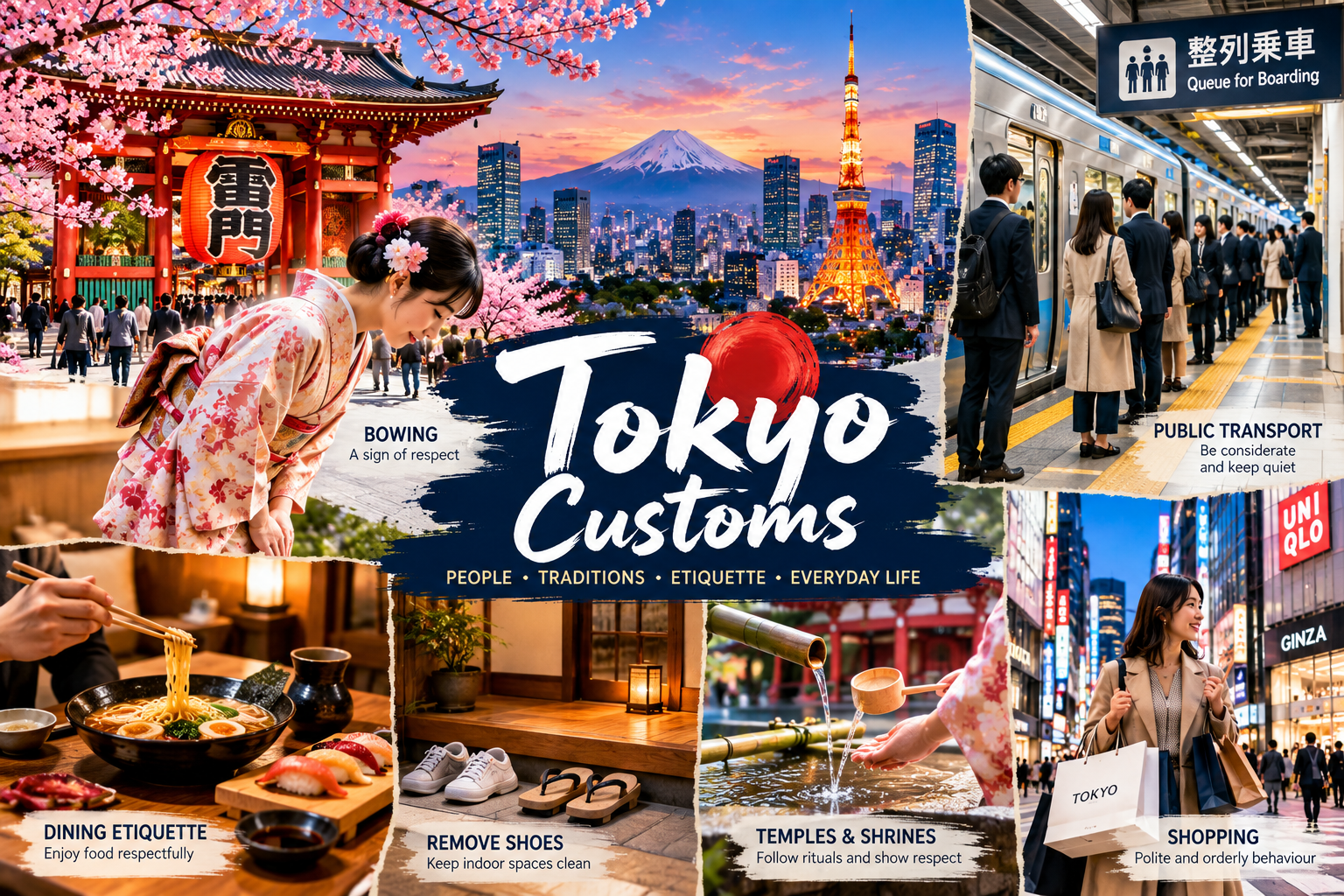
Bowing is one of the best-known Japanese customs. It can express a greeting, gratitude, respect, apology, or acknowledgement.
In Tokyo, bowing is common in workplaces, shops, formal introductions, and many other social settings.
How to Bow Correctly
For most visitors, a small, natural bow accompanied by a polite greeting is sufficient.
A simple approach is to:
-
Stand comfortably.
-
Keep your posture natural.
-
Lower your head and upper body slightly.
-
Return to an upright position without exaggeration.
The depth and duration of a bow vary according to the situation. A casual greeting does not require the same formality as a serious apology or a formal business introduction.
Should Tourists Bow Instead of Shaking Hands?
Either may be appropriate depending on the interaction.
Japanese people may bow when greeting one another, while handshakes also occur, particularly in international business settings.
If someone offers a handshake, accepting it naturally is perfectly reasonable. If they bow, a small reciprocal bow is a polite response.
There is no need to perform a complicated bow every time you speak to someone.
Common Bowing Mistakes
Avoid exaggerated bows that make the interaction uncomfortable or theatrical.
Do not assume that every bow has the same meaning. A quick nod may simply acknowledge another person, while a deeper bow can express greater formality.
For visitors, naturalness and sincerity matter more than perfect technique.
Removing Shoes Before Entering Certain Buildings
Removing outdoor shoes is an important custom in many Japanese homes and some traditional accommodation, temples, schools, and other facilities.
The practice helps keep indoor spaces clean and reflects the distinction between outdoor footwear and areas intended for indoor use.
Where Should You Remove Your Shoes?
Common situations include:
-
Private homes.
-
Many traditional Japanese inns, known as ryokan.
-
Some temples and historic buildings.
-
Certain restaurants with tatami rooms.
-
Some changing rooms and other designated indoor areas.
Not every Japanese building requires shoes to be removed. Follow the entrance layout and posted instructions.
How to Identify the Entrance Area
In many homes, the entrance contains a lower floor area called the genkan, where outdoor shoes are removed.
The raised floor beyond the entrance marks the transition to the indoor area.
Place your outdoor shoes neatly where indicated, and use any slippers provided.
What About Toilet Slippers?
Some homes, ryokan, and traditional establishments provide separate slippers for the toilet.
If these are available, use them only in the designated area and change back into indoor slippers when leaving.
This small detail is an example of how Japanese etiquette often relies on respecting distinctions between different spaces.
What Should You Do at a Restaurant?
If you see shelves for shoes, a raised seating area, or a designated shoe-removal point, check with the staff if the procedure is unclear.
Never assume that every restaurant requires shoe removal simply because it serves Japanese food.
Public Transport Etiquette in Tokyo
Tokyo’s trains and metro services are essential to daily life. Because large numbers of people use them, small acts of consideration can make journeys more comfortable for everyone.
Queue Before Boarding
Passengers commonly form orderly lines near platform markings.
Wait behind the marked boarding area and allow passengers to exit before entering the train.
Avoid standing directly in front of the doors while people are trying to leave.
Keep Your Voice Low
Quiet conversation is generally appreciated on trains, especially during busy commuting periods.
Avoid shouting, playing music through speakers, or conducting loud video calls.
If you need to speak with someone, use a moderate volume and remain aware of the people around you.
Put Your Phone on Silent
Many passengers keep their phones on silent or vibration mode.
Phone conversations are discouraged on many commuter trains, particularly in crowded carriages. Follow announcements and local instructions.
Using your phone for maps, messages, reading, or quiet browsing is generally different from speaking loudly on a call.
Give Priority Seats to Those Who Need Them
Priority seating is intended for passengers who may need additional assistance, including older people, pregnant passengers, and people with disabilities or injuries.
If someone appears to need a seat more than you do, offer yours when appropriate.
Remember that not every disability is visible. Avoid making assumptions about whether another passenger has a legitimate need for assistance.
Manage Large Bags and Luggage
Keep bags close to your body and avoid blocking doors or aisles.
On crowded trains, a large backpack worn on your back may inconvenience other passengers. Carrying it in front of you or placing it where permitted can reduce the problem.
For suitcases, use luggage spaces where available and avoid occupying multiple seats.
Escalators and Platform Safety
Escalator customs can vary between locations and may change according to safety campaigns or local guidance.
Follow station signs and staff instructions rather than assuming that one side should always be left open.
Do not run for a departing train, cross safety lines, or stop suddenly at the top of an escalator.
4. Japanese Dining Etiquette in Tokyo
Eating in Tokyo is an opportunity to experience Japanese cuisine and the customs that accompany it.
Restaurant etiquette varies according to the type of establishment, from casual ramen shops to formal multi-course dining.
Say Itadakimasu Before Eating
Itadakimasu is a common expression said before a meal.
It conveys gratitude associated with receiving food, including the ingredients and the people involved in preparing it.
You may hear it at home, in restaurants, and among groups of friends.
Visitors can use the expression if comfortable, but it is not necessary to perform it dramatically or insist that every person at the table says it.
Say Gochisousama Deshita After Eating
Gochisousama deshita is commonly said after finishing a meal.
It expresses appreciation for the food and the effort involved in preparing and serving it.
Using the expression with restaurant staff can be a polite gesture, although a simple thank-you is also appropriate.
Is It Rude to Eat All Your Food?
Generally, finishing your meal is perfectly acceptable and may show appreciation.
However, expectations vary depending on the establishment and situation. At formal meals, follow the host’s lead and avoid wasting large amounts of food.
Do not feel pressured to finish something that makes you unwell or conflicts with your dietary needs.
Chopstick Etiquette
Chopsticks are used widely in Japanese dining, and several customs are worth learning.
Avoid:
-
Sticking chopsticks upright into a bowl of rice.
-
Passing food directly from one pair of chopsticks to another.
-
Pointing at people with chopsticks.
-
Using chopsticks to pull dishes towards you when serving utensils are available.
-
Rubbing disposable chopsticks together in an obvious way that could suggest poor quality.
The first two practices are particularly important because they resemble actions associated with Japanese funeral rituals.
When shared serving utensils are provided, use them rather than your personal chopsticks.
If you struggle with chopsticks, asking for a fork is generally acceptable.
Is Slurping Noodles Rude?
Eating ramen or soba noisily is often more accepted in Japan than in some other countries.
A gentle slurp is not generally considered a major breach of etiquette when eating noodles.
However, you do not need to exaggerate the sound. Eat in a way that feels comfortable and follow the atmosphere of the restaurant.
Drinking Etiquette
When drinking with colleagues or friends, some groups observe the custom of saying kanpai before taking the first sip together.
You may also encounter situations where people pour drinks for one another, particularly in traditional business or group settings.
These practices are not universal requirements. In casual situations, people often order and drink independently.
Should You Tip in Tokyo?
Tipping is generally not expected in ordinary Japanese restaurants, cafés, taxis, or shops.
Service charges may apply in certain establishments, and some hotels or specialist services may have different arrangements.
If you wish to express gratitude, a sincere verbal thank-you is usually sufficient. Do not leave cash behind without understanding the establishment’s policy, as staff may assume you forgot it.
Temple and Shrine Etiquette
Tokyo contains Buddhist temples and Shinto shrines that serve religious, cultural, historical, and community purposes.
Visitors are welcome at many of these places, but respectful behaviour is important because they are not simply tourist attractions.
Understanding the Difference Between Temples and Shrines
Buddhist temples are associated with Buddhism, while Shinto shrines are associated with Japan’s indigenous religious tradition.
Their architecture, rituals, symbols, and visitor practices can differ.
For example, shrines often have a torii gate marking an entrance to sacred space, while Buddhist temples may contain Buddha images, incense areas, and other religious features.
How to Behave at a Shinto Shrine
Practices vary, but a typical shrine visit may involve:
-
Entering through the torii gate respectfully.
-
Following any indicated route along the approach.
-
Using a purification fountain if it is available and visitors are permitted to do so.
-
Approaching the main worship area.
-
Following the shrine’s instructions for prayer or offerings.
A commonly taught form of shrine prayer involves bowing twice, clapping twice, offering a prayer, and bowing once more. However, procedures can vary, so follow the specific shrine’s guidance.
How to Behave at a Buddhist Temple
At a Buddhist temple, visitors may encounter incense, prayer areas, Buddha statues, and designated spaces for worship.
Remain quiet in areas where people are praying. Do not touch religious objects unless permitted, and follow photography restrictions.
Some temples require visitors to remove shoes before entering particular buildings.
Photography at Religious Sites
Photography rules vary widely.
Outdoor grounds may permit photography while indoor halls, sacred objects, or ceremonies may prohibit it.
Look for signs and ask staff if necessary. Avoid photographing people during private prayer without their permission.
Visiting During Festivals
Religious festivals can attract large crowds and include food stalls, performances, processions, and community activities.
Follow crowd-control instructions, keep access routes clear, and avoid treating ceremonies as performances staged solely for tourists.
Participating respectfully is often a better way to understand a festival than simply taking photographs.
Rubbish Disposal and Cleanliness
Tokyo is widely associated with clean public spaces, but maintaining them requires cooperation between residents, businesses, public services, and visitors.
Waste-sorting rules vary by municipality and location, so there is no single disposal system that applies everywhere.
Why Are Public Bins Sometimes Difficult to Find?
Public rubbish bins are less common in some parts of Tokyo than visitors may expect.
Some people carry their rubbish until they find an appropriate bin or return to their accommodation.
Do not assume that a shop or restaurant will accept rubbish purchased elsewhere.
How to Dispose of Rubbish Properly
Follow the labels on available bins. You may see separate categories for burnable waste, cans, bottles, and plastic bottles.
Some locations use different arrangements, and recycling requirements can be more detailed than the categories shown in public spaces.
If no suitable bin is available, keep your rubbish with you until you can dispose of it appropriately.
Sorting Waste at Accommodation Tokyo customs
If you stay in an apartment, guesthouse, or longer-term accommodation, ask the host about local rubbish collection rules.
Some areas specify different collection days for particular waste categories. Large items and certain household products may require special disposal arrangements.
Why Cleanliness Matters Tokyo customs
Clean public spaces improve comfort, reduce litter, and support the shared use of crowded streets and transport facilities.
Visitors can contribute by carrying a small reusable bag for rubbish, keeping food waste contained, and following local disposal instructions.
Gift-Giving Customs in Tokyo
Gift-giving is an established part of many Japanese social relationships. Gifts may mark visits, seasonal occasions, business relationships, or expressions of gratitude.
The meaning of a gift depends on the circumstances, relationship, and expectations of the recipient.
Omiyage: Souvenirs for Others Tokyo customs
Omiyage commonly refers to souvenirs or gifts brought back from a trip, often for colleagues, family, or friends.
Food items in individual packaging are a popular option because they can be shared easily.
For visitors, bringing a small gift from your home country can be a thoughtful gesture when visiting someone’s home or meeting a business contact, but it is not compulsory in every situation.
How Should You Present a Gift?
Present a gift neatly and with a polite expression of appreciation.
In more formal situations, two hands may be used when presenting or receiving a gift, although the practice varies.
The presentation should feel natural rather than ceremonial if the occasion is casual.
Should You Open a Gift Immediately?
Practices vary. Some recipients open gifts in front of the giver, while others may wait.
Follow the recipient’s lead, and do not insist that someone opens a gift immediately.
Choosing an Appropriate Gift Tokyo customs
Useful considerations include:
-
The recipient’s preferences.
-
Dietary restrictions and allergies.
-
Whether the gift is appropriate for the occasion.
-
Practicality and ease of carrying.
-
Any relevant workplace or organisational policies.
In business settings, expensive gifts may create discomfort or conflict with company rules. A modest, thoughtful item is often more suitable.
Communication Customs and Japanese Politeness
Communication in Tokyo can involve subtle differences in tone, formality, and the way requests or disagreement are expressed.
Japanese has several levels of politeness, and language choices may change according to the relationship between speakers.
Use Polite Language With Strangers Tokyo customs
A visitor does not need to master formal Japanese to behave respectfully.
Simple greetings, polite requests, and expressions of thanks are a useful starting point.
For example, sumimasen can be used to get someone’s attention, apologise for a minor inconvenience, or express thanks in certain situations.
Does Silence Mean Disagreement?
Not necessarily.
Silence may indicate that someone is thinking, listening, or waiting for an appropriate moment to respond.
However, it is important not to interpret silence through a single cultural explanation. Individuals communicate differently, and context matters.
If a decision is important, ask a clear follow-up question rather than assuming that a lack of response means agreement.
Saying No Politely Tokyo customs
Some speakers may use indirect language when declining a request, especially in formal or sensitive situations.
A response that sounds uncertain may indicate hesitation, a practical obstacle, or a polite refusal, depending on the context.
International visitors should avoid relying on stereotypes. If a commitment matters, clarify the next step respectfully.
Personal Space and Physical Contact Tokyo customs
People differ in their comfort with physical contact.
A formal bow or verbal greeting is a safe starting point when meeting someone for the first time.
Avoid assuming that everyone welcomes hugs, back-patting, or other familiar gestures.
Shopping Customs and Retail Etiquette
Tokyo offers everything from department stores and luxury boutiques to convenience stores, markets, and small specialist shops.
Shopping customs are usually straightforward, but small details can improve the experience.
Cash Trays at Checkout Tokyo customs
Some shops and restaurants provide a small tray for cash payments.
If a tray is available, placing your money on it is a convenient and polite way to complete the transaction.
However, payment systems differ, and direct hand-to-hand exchanges are also common.
Handling Products Tokyo customs
Avoid opening sealed packaging or handling delicate goods without permission.
In specialist stores, ask staff before testing expensive equipment or touching fragile objects.
Many retailers welcome customers who browse carefully, so there is no need to feel that every product must be purchased.
Tax-Free Shopping Tokyo customs
Eligible visitors may encounter tax-free shopping arrangements at participating retailers.
Eligibility, documentation, purchase requirements, and procedures depend on current Japanese rules and the store’s arrangements.
Ask the retailer what documentation is required and retain relevant receipts. Do not assume that every shop offers tax-free purchases.
Bargaining in Tokyo customs
Bargaining is not generally expected in ordinary department stores, supermarkets, convenience stores, and fixed-price retail shops.
Some markets, second-hand sellers, or specialist businesses may have different practices, but visitors should not assume negotiation is welcome.
Check the environment and the retailer’s policy before attempting to negotiate a price.
Onsen, Sento, and Bathing Etiquette Tokyo customs
Traditional Japanese bathing facilities offer a relaxing cultural experience, but they have important hygiene and usage rules.
An onsen uses naturally heated mineral spring water, while a sento is a public bathhouse that is not necessarily supplied by a natural hot spring.
Wash Before Entering the Bath Tokyo customs
Visitors generally wash and rinse themselves thoroughly before entering a communal bath.
Seating, showers, and washing facilities are usually provided for this purpose.
The communal bath is intended for soaking rather than washing with soap or shampoo.
Keep Towels Out of the Bathwater Tokyo customs
Small towels may be used for modesty or drying, but they should not be placed in the communal bathwater.
Some people fold a small towel and place it on their head, while others leave it nearby.
Follow the facility’s instructions.
Understand Tattoo Policies Tokyo customs
Tattoo policies vary between bathing facilities.
Some establishments allow tattoos, while others restrict entry or offer private bathing arrangements. Policies may distinguish between small and extensive tattoos, but there is no universal rule.
Check before visiting rather than assuming you will be admitted.
Follow the Facility’s Rules Tokyo customs
Other important considerations may include:
-
Keeping voices low.
-
Avoiding splashing.
-
Securing valuables appropriately.
-
Following rules regarding swimwear.
-
Respecting gender-separated facilities where applicable.
-
Asking about accessibility or special requirements before arrival.
These rules help maintain hygiene, privacy, and comfort for all visitors.
Smoking, Drinking, and Public Behaviour
Tokyo has specific rules and local restrictions concerning smoking and other public activities. Requirements vary by area and establishment.
Smoking Areas
Smoking may be restricted to designated areas, including in parts of the city where outdoor smoking is prohibited or controlled.
Look for signs and use designated smoking spaces where permitted.
Do not assume that a quiet side street is an acceptable place to smoke.
Drinking Alcohol in Public
Rules and local expectations differ by location and occasion.
Some festivals and public gatherings include drinking, while other areas may impose restrictions or have specific guidance.
Even where public drinking is permitted, excessive noise, littering, harassment, and disruptive behaviour are inappropriate.
Photography and Filming
Tokyo is a popular destination for photography, but busy streets and commercial areas require consideration.
Avoid blocking pedestrian routes while taking photographs. Respect signs prohibiting photography and obtain consent before taking close-up photographs of identifiable people in situations where permission is appropriate.
Commercial photography may require additional authorisation.Business Etiquette in Tokyo
Visitors travelling to Tokyo for work may encounter more formal etiquette than they would in casual social situations.
Practices vary by company, industry, and generation, but punctuality, preparation, and respectful communication are generally valuable.
Be Punctual
Arriving on time is important for meetings and scheduled appointments.
Plan for possible train delays, unfamiliar station exits, and the time required to reach the meeting location.
If you are running late, notify the other person as soon as possible.
Exchanging Business Cards
Business-card exchange, known as meishi kōkan, remains common in some formal business settings.
When exchanging cards:
-
Present the card with the text facing the recipient.
-
Use a polite, composed manner.
-
Take a moment to look at the card you receive.
-
Keep received cards accessible rather than immediately putting them away carelessly.
Digital contact sharing is also used, and practices vary between workplaces.
Meetings and Introductions
Introductions may be more formal in some Japanese workplaces than in others.
Listen carefully, avoid interrupting unnecessarily, and clarify unfamiliar terms or expectations.
Do not assume that a particular seating arrangement or greeting ritual applies to every company.
Hierarchy and Decision-Making
Some organisations place importance on seniority, consultation, and internal consensus.
A decision may involve discussions with several people rather than a single immediate approval.
However, organisational culture varies considerably. International businesses in Tokyo may use communication and management practices similar to those found elsewhere in the world.
Punctuality and Making Reservations
Tokyo is a city where transport, appointments, restaurant bookings, and scheduled activities often operate within tight timeframes.
Being punctual helps other people plan their time and reduces unnecessary inconvenience.
Arriving at Restaurants Tokyo customs
If you have a reservation, arrive at the agreed time and notify the restaurant if you expect to be late.
Some establishments may release a table if a customer does not arrive within the permitted period.
Read booking instructions carefully, especially for small restaurants or special dining experiences.
Cancelling Plans Tokyo customs
If you cannot attend an appointment, cancel as early as possible.
Some restaurants charge cancellation fees, particularly for fixed menus or large groups.
Checking the cancellation policy is a practical way to avoid both financial penalties and inconvenience to the business.
Public Events and Attractions Tokyo customs
Popular museums, exhibitions, and attractions may use timed entry or advance booking.
Arrive with enough time to find the correct entrance and follow instructions for queues, bags, and photography.
Tokyo Customs for Families and Children
Families travelling with children may need to adapt to crowded transport, smaller dining spaces, and quieter public environments.
Japanese customs are not intended to exclude children, but consideration for other people remains important.
Using Public Transport With Children Tokyo customs
Keep children close in crowded stations and avoid allowing them to run on platforms or escalators.
Use lifts where needed and follow station guidance when travelling with strollers.
On crowded trains, be prepared to fold a stroller if necessary and safe, while considering the child’s comfort and the operator’s instructions.
Dining With Children Tokyo customs
Many restaurants welcome families, but seating arrangements and available facilities differ.
Ask whether high chairs or children’s menus are available when needed.
In very small restaurants, busy ramen shops, or establishments with limited seating, space may be restricted. Choosing a suitable venue makes the experience easier for everyone.
Teaching Children About Local Customs
Explain a few simple rules before travelling:
-
Wait for passengers to leave the train.
-
Speak quietly in crowded public spaces.
-
Remove shoes when instructed.
-
Follow signs at religious sites.
-
Dispose of rubbish properly.
-
Ask before touching unfamiliar objects.
These simple habits help children participate respectfully without feeling overwhelmed by unfamiliar expectations.
Tokyo Customs for Solo Travellers
Solo travel offers opportunities to explore Tokyo at your own pace, and many everyday customs are easy to follow independently.
Dining Alone Tokyo customs
Eating alone is common in many Tokyo restaurants, including some ramen shops, cafés, and casual dining establishments.
Counter seating and individual ordering systems can make solo dining convenient.
However, some small restaurants have limited seating or specific reservation arrangements. Check the conditions if you plan to visit a popular establishment.
Asking for Directions Tokyo customs
If you need help, approach someone who appears available rather than interrupting a person who is rushing to catch a train.
A short, polite question is usually more effective than a long explanation.
Not everyone will speak English, so having the destination written in Japanese or saved on a map can be useful.
Respecting Shared Accommodation Tokyo customs
In hostels, guesthouses, and shared accommodation, follow rules about quiet hours, kitchen use, rubbish, footwear, and common spaces.
Be considerate when returning late at night, and avoid conversations or phone calls that disturb sleeping guests.
Common Mistakes Visitors Make About Tokyo Customs
Assuming Everyone Follows Identical Rules Tokyo customs
Japanese etiquette varies between people, places, and situations.
Solution: Treat general customs as guidance rather than absolute laws. Follow posted instructions and observe local behaviour.
Overthinking Every Interaction Tokyo customs
Some visitors become so worried about making mistakes that ordinary interactions feel stressful.
Solution: Focus on the essentials: be polite, respect personal space, follow instructions, and apologise briefly if you inconvenience someone.
Speaking Too Loudly in Public Tokyo customs
Loud conversations can be disruptive in quiet train carriages, small restaurants, and shared accommodation.
Solution: Adjust your volume to the setting and move to a suitable place for longer phone calls.
Assuming Tipping Is Required Tokyo customs
Visitors from countries where tipping is standard may leave money without realising that it is often unnecessary in Japan.
Solution: Check whether a service charge applies and follow the establishment’s payment process.
Treating Temples as Ordinary Tourist Attractions Tokyo customs
Visitors sometimes overlook the fact that religious sites are places of worship.
Solution: Read signs, keep a respectful distance from worshippers, and follow instructions about photography and access.
Wearing Shoes Indoors Tokyo customs
Entering a home or designated shoe-free area with outdoor footwear can create avoidable inconvenience.
Solution: Look for a genkan, shoe shelves, signs, or slippers, and ask if you are unsure.
Misunderstanding Indirect Communication Tokyo customs
A hesitant response may be interpreted too quickly as agreement or refusal.
Solution: Ask a clear, polite follow-up question when the decision matters.
Taking Photographs Without Considering Others Tokyo customs
A photograph may inconvenience pedestrians or intrude on someone’s privacy.
Solution: Avoid blocking walkways, observe restrictions, and seek consent where appropriate.
Trying to Follow Every Tradition Perfectly Tokyo customs
Attempting to memorise every possible custom can make travel unnecessarily complicated.
Solution: Learn the most relevant practices for your planned activities and remain willing to adapt.
Advantages and Challenges of Following Tokyo Customs
Advantages Tokyo customs
Smoother interactions: Understanding local etiquette can reduce uncertainty in shops, restaurants, and transport settings.
Greater cultural understanding: Everyday practices provide insight into Japanese social relationships and public life.
Respectful travel: Following local guidance helps protect religious sites, shared spaces, and community environments.
Improved business communication: Awareness of punctuality, introductions, and formal language can support professional relationships.
Better travel planning: Knowing about shoe removal, rubbish disposal, and reservation practices can prevent practical difficulties.
Challenges Tokyo customs
Different expectations: A custom may be appropriate in one setting but unnecessary in another.
Language barriers: Visitors may struggle to understand signs, menus, or spoken instructions.
Changing local rules: Smoking restrictions, waste procedures, and visitor policies can differ between municipalities and businesses.
Fear of making mistakes: Too much focus on etiquette can reduce enjoyment and confidence.
Cultural generalisations: Assuming that all Japanese people behave identically can create misunderstandings of its own.
A Balanced Approach to Japanese Etiquette Tokyo customs
The most useful approach is to distinguish between practical rules and flexible social conventions.
For example, a building’s shoe-removal requirement or a posted photography prohibition should be followed. By contrast, the depth of a casual bow or the exact phrasing of a thank-you may be more flexible.
Prioritise safety, explicit instructions, consideration for others, and sincere communication. This will help you navigate most everyday situations without needing to memorise an exhaustive list of customs.
18. The Future of Tokyo Customs
Tokyo’s customs continue to evolve as the city responds to tourism, technology, demographic changes, and international connections.
Traditional practices remain important, but the ways people follow them can change.
International Tourism and Cultural Exchange Tokyo customs
As visitors encounter Tokyo’s cultural traditions, businesses and public institutions increasingly need to communicate expectations clearly across languages.
Multilingual signs, translated menus, digital guides, and visitor information can help reduce misunderstandings.
Tourism also creates challenges, particularly in crowded neighbourhoods where residents and visitors share limited space.
Clear guidance and considerate behaviour can help protect local quality of life while allowing people to enjoy the city.
Digital Payments and Changing Retail Practices Tokyo customs
Digital payment systems have changed the way people shop, travel, and manage everyday transactions.
Cash remains useful in Japan, but visitors may encounter contactless payments, mobile wallets, ticketing applications, and other digital services.
The etiquette of payment is likely to become more varied as different technologies coexist.
Regardless of the payment method, the practical principle remains the same: follow the instructions, prepare your payment when possible, and avoid blocking other customers.
Changing Workplace Etiquette Tokyo customs
Remote work, international business, and changing employment expectations are influencing workplace practices.
Some companies retain formal introductions and traditional communication styles, while others use less hierarchical approaches.
Professional etiquette in Tokyo will continue to reflect the differences between industries, organisations, and generations.
Accessibility and Inclusive Public Spaces Tokyo customs
Tokyo’s transport systems, commercial buildings, and public facilities continue to face the challenge of serving people with different mobility, sensory, and communication needs.
Clearer signs, barrier-free routes, accessible facilities, and improved visitor information can make everyday experiences easier for residents and tourists alike.
Inclusive design also reinforces the principle that consideration should extend to people whose needs may not be immediately visible.
Sustainable Tourism and Community Respect Tokyo customs
Popular destinations can experience crowding, litter, noise, and pressure on local infrastructure.
Future tourism practices will need to balance visitor experiences with the needs of residents and the preservation of cultural sites.
Travellers can contribute by spreading visits across different areas, following local instructions, supporting responsible businesses, and treating residential neighbourhoods as living communities rather than attractions created solely for visitors.
Ten Japanese Brands That Reflect Different Aspects of Japanese Culture
The following brands are not a definitive representation of Tokyo customs. Instead, they offer examples of Japanese approaches to hospitality, design, food, retail, and everyday life.
1. MUJI Tokyo customs
MUJI is known for household goods, stationery, clothing, and furniture with a restrained visual identity.
Its products provide examples of practical simplicity and organised everyday living.
2. UNIQLO Tokyo customs
UNIQLO is a Japanese clothing retailer known for everyday apparel and functional clothing ranges.
Its stores illustrate how retail organisation, product presentation, and customer service support a consistent shopping experience.
3. Toyota Tokyo customs
Toyota is a Japanese automotive manufacturer whose history reflects industrial development, manufacturing systems, and global business relationships.
It offers an example of Japanese corporate culture, although practices vary between individual offices and international subsidiaries.
4. Sony Tokyo customs
Sony operates across electronics, entertainment, imaging, and related technology fields.
Its products and customer experiences illustrate the interaction between Japanese manufacturing heritage and global consumer culture.
5. Nintendo Tokyo customs
Nintendo is a Japanese entertainment company known for video games and interactive experiences.
Its work provides an example of how Japanese creative industries influence global popular culture.
6. Shiseido Tokyo customs
Shiseido is a Japanese beauty company associated with cosmetics, skincare, product presentation, and retail experiences.
Its history offers a perspective on Japanese beauty culture and visual communication.
7. Isetan Mitsukoshi Tokyo customs
Isetan Mitsukoshi is a Japanese department-store group with a strong presence in Tokyo.
Its retail environments demonstrate formal customer service, product presentation, and the role of department stores in urban shopping culture.
8. Lawson Tokyo customs
Lawson is a convenience-store chain operating across Japan.
Convenience stores provide useful examples of everyday urban services, from packaged meals and drinks to payment and other customer services.
9. FamilyMart Tokyo customs
FamilyMart is another major convenience-store chain in Japan.
Its stores illustrate how convenience retail serves commuters, residents, workers, and visitors through accessible locations and quick transactions.
10. 7-Eleven Japan Tokyo customs
7-Eleven Japan operates a large convenience-store network with products and services tailored to local customers.
Its stores are useful examples of the role convenience retail plays in everyday urban life.
Comparison Table: Ten Japanese Brands Tokyo customs
|
Brand Tokyo customs |
Main Industry Tokyo customs |
What Visitors Can Learn Tokyo customs |
|---|---|---|
| MUJI | Household goods and retail | Practical simplicity |
| UNIQLO | Clothing | Everyday retail etiquette |
| Toyota | Automotive | Manufacturing and corporate culture |
| Sony | Technology and entertainment | Product innovation |
| Nintendo | Gaming and entertainment | Japanese popular culture |
| Shiseido | Beauty and cosmetics | Product presentation |
| Isetan Mitsukoshi | Department stores | Retail service culture |
| Lawson | Convenience retail | Everyday urban convenience |
| FamilyMart | Convenience retail | Quick shopping transactions |
| 7-Eleven Japan | Convenience retail | Urban retail operations |
These examples should be understood as commercial illustrations rather than official guides to Japanese etiquette. Individual branches, services, and customer expectations may vary.
Essential Tokyo Customs by Situation
The following table provides a practical reference for common travel situations.
|
Situation Tokyo customs |
Recommended Behaviour Tokyo customs |
Important Note Tokyo customs |
|---|---|---|
| Greeting someone | Use a polite greeting and a small bow if appropriate | Handshakes are also common |
| Entering a home | Remove outdoor shoes when expected | Follow the host’s instructions |
| Riding a train | Keep your voice low and allow passengers to exit first | Follow station guidance |
| Eating ramen | Eat comfortably and avoid unnecessary disruption | Slurping noodles is generally acceptable |
| Using chopsticks | Avoid sticking them upright in rice | Use serving utensils when provided |
| Visiting a shrine | Follow worship and photography instructions | Rituals can vary |
| Paying in a shop | Use the payment method provided | Cash trays are common in some settings |
| Disposing of rubbish | Follow local sorting instructions | Collection rules vary |
| Visiting an onsen | Wash before entering the bath | Check tattoo and swimwear policies |
| Attending a meeting | Arrive on time and communicate politely | Formality varies by workplace |
| Giving a gift | Choose something appropriate and present it neatly | Expensive gifts may be unsuitable |
| Taking photographs | Respect privacy and posted restrictions | Some places prohibit photography |
| Smoking outdoors | Use designated areas where permitted | Local restrictions vary |
| Cancelling a reservation | Notify the business promptly | Cancellation fees may apply |
| Travelling with children | Keep children safe and considerate of others | Facilities vary by location |
FAqs
What Are the Most Important Customs to Know Before Visiting Tokyo?
The most useful customs are keeping your voice low on public transport, following shoe-removal instructions, disposing of rubbish properly, respecting religious sites, and being considerate of other people in crowded spaces.
Is It Rude to Tip in Tokyo?
Tipping is generally not expected in ordinary restaurants, cafés, shops, or taxis. Some businesses may charge service fees, and specialised services can have different arrangements. A polite thank-you is usually sufficient.
Do You Have to Bow in Japan?
No. Bowing is common, but visitors are not expected to master every formal gesture. A small bow, polite greeting, or appropriate handshake is usually enough for ordinary interactions.
Can Tourists Eat While Walking in Tokyo?
It depends on the location. Some market streets and festival areas accommodate eating while standing or walking, while other places discourage it. Follow posted signs and the vendor’s instructions.
Do You Need to Remove Shoes in Tokyo Restaurants?
Some restaurants require shoe removal, particularly those with tatami rooms or traditional seating. Many modern restaurants do not. Look for signs, shoe shelves, or staff instructions.
Is It Acceptable to Talk on a Phone on Tokyo Trains?
Quiet phone use, such as reading messages or checking maps, is generally acceptable. Voice calls are discouraged on many trains, especially during crowded periods. Follow announcements and local instructions.
Is Slurping Ramen Considered Rude?
Slurping noodles is generally more accepted in Japan than in some other cultures. It is not necessary to exaggerate the sound, and normal dining manners still apply.
Are Tattoos Allowed in Tokyo Onsen?
Policies vary. Some facilities welcome guests with tattoos, while others restrict entry or offer private bathing options. Check the specific facility’s rules before visiting.
Should You Bring a Gift When Visiting a Japanese Home?
A small gift can be a thoughtful gesture, particularly when invited to someone’s home, but it is not compulsory in every situation. Choose something appropriate to the relationship and occasion.
Is Tokyo Safe for Solo Travellers?
Tokyo is generally regarded as a convenient destination for solo travel, but no city is free from risk. Follow ordinary travel precautions, protect your belongings, and seek help from appropriate staff or authorities when needed.
What Does Itadakimasu Mean?
Itadakimasu is commonly said before eating and expresses gratitude associated with receiving food. It is a familiar part of Japanese dining culture.
What Does Gochisousama Deshita Mean?
Gochisousama deshita is commonly said after a meal to express appreciation for the food and the effort involved in preparing it.
Are Japanese People Always Formal?
No. Communication styles vary considerably. Some settings are formal, while interactions among friends, family members, and colleagues may be relaxed. The appropriate level of politeness depends on context.
Can You Take Photos at Tokyo Temples and Shrines?
Photography is permitted in many outdoor areas but restricted in some buildings, ceremonies, and sacred spaces. Follow signs and ask staff when uncertain.
Is Cash Still Useful in Tokyo?
Yes. Digital payments are widely used, but some businesses may still prefer or accept only cash. Carrying a reasonable amount of yen can be helpful.
What Should You Do If You Accidentally Break a Custom?
Remain calm, apologise briefly if you have inconvenienced someone, and follow any instructions. Most ordinary mistakes can be handled politely without turning the situation into a major issue.
Conclusion
Tokyo customs offer an important window into the city’s everyday culture. They reveal how people share crowded spaces, communicate respectfully, preserve religious traditions, and make ordinary interactions more comfortable. From bowing and removing shoes to riding trains quietly, handling chopsticks, and following temple rules, many Japanese customs are easier to understand when viewed through the principle of consideration for others. Visitors do not need to behave perfectly or memorise every traditional practice. A willingness to observe, learn, and respond politely is far more useful than worrying about every small detail.