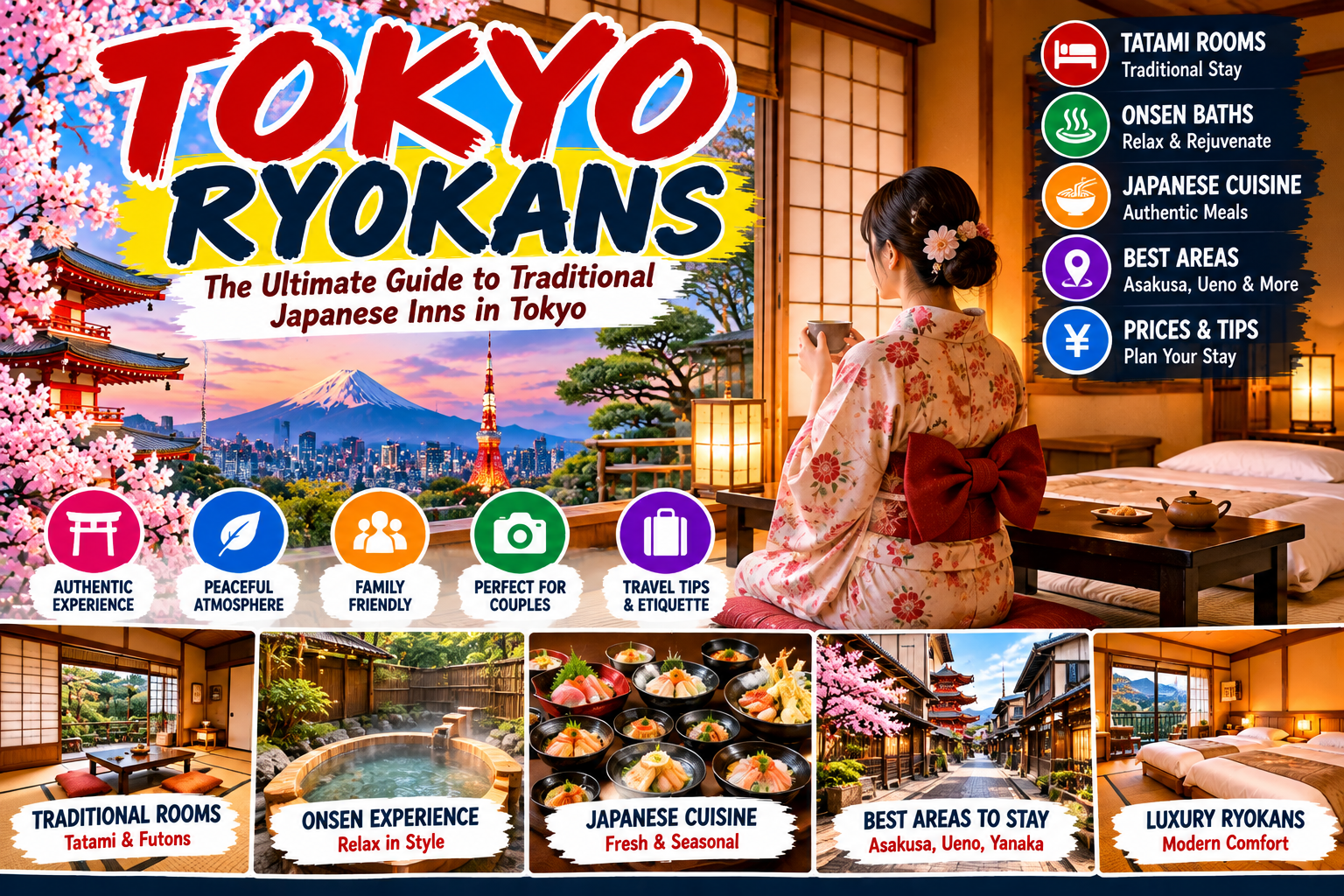
Tokyo Ryokans: The Ultimate Guide to Traditional Japanese Inns, Tatami Rooms, Prices, Etiquette and Authentic Stays
Tokyo ryokans are traditional Japanese inns that combine tatami rooms, futon bedding, Japanese hospitality, cultural design and, in some properties, traditional meals and bathing facilities. For travellers who want a deeper cultural experience, staying at a Tokyo ryokan can provide a completely different perspective on accommodation compared with a conventional Tokyo hotel Tokyo Exhibitions
What Is a Tokyo Ryokan?
Understanding the Meaning of Ryokan
A ryokan is a traditional Japanese-style inn.
The experience is based on Japanese hospitality and traditional accommodation practices rather than the standard international hotel model.
A traditional ryokan may feature:
- Tatami flooring
- Futon bedding
- Low tables
- Japanese-style seating
- Sliding doors
- Traditional decorations
- Yukata robes
- Japanese meals
- Shared or private bathing facilities
- Japanese hospitality
- Quiet communal spaces
Not every ryokan contains all of these features, however.
Modern Tokyo ryokans may combine traditional design with:
- Private bathrooms
- Air conditioning
- Wi-Fi
- Modern toilets
- Western-style facilities
- Contemporary furniture
- Modern security
- Digital booking systems
Why Tokyo Ryokans Are Different From Hotels
A conventional hotel generally focuses on efficiency, privacy and standardised accommodation.
A ryokan often focuses more heavily on atmosphere, hospitality and cultural experience.
For example, instead of walking into a bedroom with a permanently installed bed, you may enter a tatami room where the sleeping area is created by arranging futons.
The room itself may serve several purposes throughout the day.
Are All Japanese Inns Ryokans?
No.
Japan has many different types of accommodation.
You may encounter:
- Ryokan
- Minshuku
- Business hotels
- Capsule hotels
- Western-style hotels
- Guesthouses
- Traditional houses
- Luxury resorts
A minshuku is generally a smaller, more family-oriented lodging style, while ryokans can range from simple inns to highly luxurious properties.
The History of Tokyo Ryokans
Origins of Traditional Japanese Inns
Japanese inns developed alongside travel routes connecting cities, temples, commercial centres and regional destinations.
Traditional accommodation evolved to provide travellers with food, rest and hospitality during journeys.
Over time, the ryokan became associated with distinctive elements of Japanese architecture, food and service.
Ryokans and the Development of Modern Japan
As Japan modernised, Western-style hotels became increasingly common in major cities.
Tokyo developed into a global business and tourism centre with international hotel brands, modern skyscrapers and high-rise accommodation.
Despite this transformation, traditional inns survived.
Their continued popularity reflects the fact that a ryokan offers something a standard hotel cannot easily reproduce: an immersive Japanese cultural environment.
Tokyo Ryokans in the Modern Era
Today’s Tokyo ryokans exist in several forms.
Some preserve traditional architecture and practices.
Others reinterpret the ryokan concept for modern travellers.
This has created an interesting middle ground between:
traditional Japanese hospitality + modern urban accommodation
That combination is particularly attractive in Tokyo.
What Makes Tokyo Ryokans Special?
Tatami Flooring
Tatami is one of the most recognisable elements of traditional Japanese interiors.
Tatami mats create a distinctive texture, smell and atmosphere.
Guests generally remove their shoes before entering tatami areas.
Futon Bedding
Instead of a permanent Western-style bed, traditional ryokan rooms often use futons.
Depending on the property, staff may prepare the futon while guests are dining or during another part of their stay.
This transformation is one of the experiences that makes a traditional ryokan feel different from a hotel.
Japanese Hospitality
Ryokan hospitality is often associated with careful attention to guests.
This may include:
- Welcoming guests
- Explaining the room
- Preparing futons
- Serving meals
- Providing yukata
- Explaining bathing facilities
- Assisting with luggage
The level of service varies considerably between properties.
Japanese-Style Architecture
Traditional Tokyo ryokans may include:
- Wooden details
- Sliding doors
- Japanese artwork
- Small gardens
- Low furniture
- Paper screens
- Traditional lighting
Modern ryokans may reinterpret these elements using contemporary architecture.
Tokyo Ryokan Room Types
Traditional Tatami Room
A classic ryokan room usually features tatami flooring and low furniture.
The room may initially appear spacious because there is no permanent bed.
The sleeping area is created later using futons.
Japanese-Western Room
Some modern Tokyo ryokans combine:
- Tatami
- Japanese furniture
- Western beds
This can be an excellent compromise for travellers who want traditional design but prefer a standard bed.
Private Bathroom Room
A private bathroom provides greater convenience and privacy.
This option can be particularly useful for:
- Couples
- Families
- Long stays
- Older travellers
- Visitors unfamiliar with shared bathing facilities
Shared Bathroom Room
Some traditional or budget Tokyo ryokans use shared bathrooms.
This can reduce accommodation costs but may not suit every traveller.
Family Room
Family-friendly Tokyo ryokans may offer larger tatami rooms where several guests can sleep on futons.
The arrangement can be convenient for parents travelling with children.
Luxury Ryokan Suite
High-end properties may offer large Japanese-style suites with:
- Private bathrooms
- Separate living areas
- Premium meals
- Private baths
- Gardens
- High-quality furnishings
- Personalised service
These rooms can provide a highly immersive luxury experience.
Tokyo Ryokans by Traveller Type
Tokyo Ryokans for Couples
A ryokan can be particularly memorable for couples because the accommodation itself becomes part of the trip.
Couples may enjoy:
- Private tatami rooms
- Traditional dining
- Japanese baths
- Quiet surroundings
- Cultural atmosphere
- Special occasions
Tokyo Ryokans for Families
Families should look for:
- Larger rooms
- Family sleeping arrangements
- Private bathrooms
- Child-friendly policies
- Convenient transport
- Flexible meal options
A traditional futon room can sometimes provide more usable floor space than a small hotel room.
Tokyo Ryokans for Solo Travellers
Solo travellers can enjoy the cultural atmosphere without needing to book a large room.
Small ryokans can also provide a more personal experience than large international hotels.
Tokyo Ryokans for Senior Travellers
Senior travellers should pay attention to:
- Stairs
- Bathroom arrangements
- Futon height
- Floor seating
- Accessibility
- Walking distance
- Elevator availability
A beautiful traditional property may not be comfortable for every traveller.
Tokyo Ryokans for Business Travellers
A traditional inn may not be the first choice for business travel, particularly when a traveller needs a desk and standard hotel services.
However, modern Japanese-style properties can provide an interesting alternative for short business stays.
Best Areas for Tokyo Ryokans
Tokyo Ryokans in Asakusa
Asakusa is one of the most popular areas for travellers seeking traditional Tokyo.
The neighbourhood is known for:
- Historic streets
- Temples
- Traditional shops
- Japanese restaurants
- Riverside scenery
- Cultural attractions
Staying in a ryokan in Asakusa can make the traditional atmosphere continue after you return from sightseeing.
Tokyo Ryokans in Ueno
Ueno provides a useful combination of culture, transportation and neighbourhood life.
It is close to:
- Museums
- Parks
- Markets
- Cultural attractions
- Railway connections
Budget-conscious travellers may find traditional accommodation options around this part of Tokyo.
Tokyo Ryokans in Yanaka
Yanaka is particularly interesting for travellers who want a slower, more traditional neighbourhood atmosphere.
The area has:
- Narrow streets
- Traditional homes
- Small temples
- Local shops
- Historic character
A ryokan here can feel very different from staying near the skyscrapers of Shinjuku.
Tokyo Ryokans Near Nippori
Nippori offers convenient transportation while retaining access to older neighbourhoods.
It can be useful for travellers who want:
- Traditional atmosphere
- Railway access
- Airport connections
- Local shopping
- A quieter environment
Tokyo Ryokans in Kagurazaka
Kagurazaka has a distinctive blend of traditional Japanese streets and modern urban life.
It is known for:
- Restaurants
- Narrow lanes
- Historic atmosphere
- Japanese and international influences
Tokyo Ryokans in Nihombashi
Nihombashi is a historic commercial district with excellent access to central Tokyo.
It can suit travellers who want a traditional atmosphere while remaining close to major business and shopping districts.
Tokyo Ryokans Around Tokyo Station
Some Japanese-style accommodations can be found within practical reach of Tokyo Station.
This is useful for travellers making day trips or combining Tokyo with wider Japan travel.
Tokyo Ryokan Meals
Traditional Japanese Breakfast
A traditional ryokan breakfast may include:
- Rice
- Miso soup
- Grilled fish
- Pickles
- Vegetables
- Tofu
- Egg-based dishes
The exact menu varies by property and season.
Traditional Japanese Dinner
Some ryokans offer multi-course Japanese dining.
A traditional dinner can introduce guests to different ingredients, textures and presentation styles.
Seasonal Food
Seasonality is an important concept in Japanese cuisine.
Ryokan dining may reflect seasonal ingredients and regional traditions.
This can make the meal feel like part of the cultural experience rather than simply a service provided by the accommodation.
Should You Book Meals?
It depends on your travel style.
Meal-inclusive stays can be valuable if you specifically want a traditional Japanese dining experience.
Room-only accommodation may be better for travellers who want maximum flexibility.
Tokyo Ryokan Bathing Experiences
What Is a Ryokan Bath?
Traditional ryokans may provide communal bathing facilities.
Some properties also offer private baths.
Public Bath Etiquette
Guests using shared Japanese baths generally need to wash thoroughly before entering the bathing area.
The bathing pool is intended for soaking rather than washing.
Towels and Bathing
Guests generally use towels appropriately and avoid placing large towels directly into shared bathing water.
Private Baths
Private bathing facilities can be a good option for travellers who prefer privacy.
They may be particularly suitable for:
- Couples
- Families
- First-time visitors
- Travellers with privacy concerns
Is Every Tokyo Ryokan an Onsen Ryokan?
No.
This is an important distinction.
An onsen refers to a hot spring bathing experience, while a ryokan refers to an accommodation style.
A ryokan may have a bath without being an onsen property.
Travellers should check whether the water is genuinely sourced from a hot spring if an onsen experience is important to them.
Tokyo Ryokan Etiquette
Remove Your Shoes
Shoes are generally removed before entering tatami areas.
Look for the designated entrance area.
Treat Tatami Carefully
Tatami flooring should be treated respectfully.
Avoid dragging heavy luggage across it.
Wear Slippers Correctly
Some properties provide slippers.
There may be different footwear rules for rooms, bathrooms and toilets.
Respect Quiet Hours
Many traditional properties have a peaceful atmosphere.
Keep noise low, particularly at night.
Follow Bathing Rules
If the ryokan has shared bathing facilities, follow the property’s instructions.
Respect Check-In Times
Traditional inns may have more structured schedules than large hotels.
Arriving very late without prior communication can create problems.
Tokyo Ryokan Check-In Experience
Why Check-In Can Feel Different
A traditional ryokan may involve more personal interaction than a modern hotel.
Staff may explain:
- Room facilities
- Yukata
- Bathing arrangements
- Meal times
- House rules
- Futon arrangements
This is part of the ryokan experience.
Be Prepared for Earlier Meal Times
Some traditional properties have fixed dinner and breakfast schedules.
If you plan to stay out late sightseeing, check meal arrangements before booking.
Tokyo Ryokan Pricing
What Determines the Price?
Tokyo ryokan prices can vary significantly depending on:
- Location
- Room size
- Season
- Meal inclusion
- Private bathroom
- Bath facilities
- Luxury level
- Property reputation
- Number of guests
- Length of stay
Budget Tokyo Ryokans
Budget properties may offer:
- Simple tatami rooms
- Shared facilities
- Basic amenities
- No meals
- Smaller rooms
These can provide a traditional atmosphere without the cost associated with luxury accommodation.
Mid-Range Tokyo Ryokans
Mid-range properties often provide:
- Private rooms
- Better facilities
- More comfortable bedding
- Improved bathrooms
- More detailed service
Luxury Tokyo Ryokans
Luxury ryokans may offer:
- Premium rooms
- Exceptional dining
- Private baths
- Large suites
- High-end Japanese furnishings
- Personalised hospitality
The accommodation becomes an experience rather than simply a place to sleep.
How to Choose a Tokyo Ryokan
Decide How Traditional You Want to Be
Ask yourself:
Do you want:
A fully traditional experience?
Or:
A modern hotel with Japanese design?
These are different experiences.
Decide Whether You Need a Private Bathroom
If you prefer privacy, prioritise a room with a private bathroom.
Decide Whether You Want Meals
Traditional meals can add significant cultural value but may reduce flexibility.
Check the Bedding
If you strongly prefer a Western bed, choose a Japanese-Western room.
Check the Room Size
Japanese rooms may use floor-based measurements or descriptions that differ from what international travellers expect.
Check Accessibility
Traditional architecture can sometimes mean:
- Stairs
- Narrow corridors
- Low furniture
- Floor-level sleeping
Check the property carefully if accessibility matters.
Tokyo Ryokans Versus Hotels
Tokyo Ryokan Advantages
Ryokans can provide:
- Cultural immersion
- Traditional architecture
- Japanese hospitality
- Unique dining
- Tatami rooms
- Futon experience
- Traditional bathing
- Quiet atmosphere
Tokyo Hotel Advantages
Hotels often provide:
- Standard beds
- Private bathrooms
- 24-hour reception
- Larger international facilities
- Business amenities
- More predictable room layouts
The Best of Both Worlds
Some travellers choose both.
For example:
3 nights in a modern Tokyo hotel + 1 or 2 nights in a ryokan
This provides convenience and cultural immersion in the same trip.
Tokyo Ryokans Versus Airbnb-Style Accommodation
Ryokan Experience
A ryokan generally provides hospitality and structured services.
Private Apartment Experience
A private apartment may offer:
- Kitchen
- Washing machine
- More independence
- Longer-stay convenience
However, it may lack the cultural service experience of a ryokan.
Tokyo Ryokans Versus Capsule Hotels
Capsule Hotel Experience
Capsule hotels focus on compact, efficient sleeping spaces.
Ryokan Experience
Ryokans focus on traditional rooms, hospitality and cultural atmosphere.
They serve very different purposes.
Ten Notable Tokyo Ryokan and Japanese-Style Accommodation Brands or Properties
| Ryokan / Japanese-Style Property | Area | Style | Best For | Distinctive Feature |
|---|---|---|---|---|
| Hoshinoya Tokyo | Otemachi | Luxury modern ryokan | Couples and luxury travellers | High-end Japanese hospitality |
| Sawanoya Ryokan | Yanaka | Traditional | Cultural travellers | Local neighbourhood atmosphere |
| Kamogawa Asakusa | Asakusa | Traditional | Families and couples | Convenient traditional stay |
| Sadachiyo | Asakusa | Traditional | Culture-focused travellers | Historic Japanese atmosphere |
| Ryokan Kamogawa | Asakusa | Traditional | Families and first-time visitors | Central location |
| Andon Ryokan | Arakawa | Modern traditional | Budget-conscious travellers | Contemporary ryokan concept |
| Homeikan | Bunkyo | Historic traditional | Architecture enthusiasts | Historic Japanese character |
| Cyashitsu Ryokan Asakusa | Asakusa | Traditional-inspired | Couples and leisure travellers | Japanese design and atmosphere |
| Onyado Nono Asakusa | Asakusa | Modern Japanese | Travellers wanting modern comfort | Japanese-style interiors and bathing |
| Hotel Ryumeikan Tokyo | Tokyo Station area | Japanese-inspired hotel | Business and leisure travellers | Central location with Japanese influence |
Property features, availability and room configurations can change, so travellers should confirm current details before booking.
Tokyo Ryokans for Different Budgets
Budget Tokyo Ryokan Strategy
For budget travellers, prioritise:
- Location near a station
- Room-only rates
- Shared facilities if comfortable
- Simple traditional rooms
- Smaller properties
- Weekday stays
Mid-Range Tokyo Ryokan Strategy
Look for:
- Private bathrooms
- Breakfast options
- Larger rooms
- Better accessibility
- Strong transport connections
Luxury Tokyo Ryokan Strategy
Focus on:
- Dining
- Private baths
- Service
- Architecture
- Room design
- Seasonal experiences
At this level, the location is important, but the property itself becomes the destination.
Tokyo Ryokans for First-Time Japan Visitors
Why a First-Time Visitor Should Consider a Ryokan
A first visit to Japan often involves famous attractions and modern city experiences.
A ryokan introduces a different side of Japan.
You may learn:
- How tatami rooms work
- How futons are arranged
- How Japanese bathing etiquette works
- How traditional meals are served
- How Japanese hospitality differs from international hotels
The Ideal Length of Stay
One or two nights can be enough to experience the concept without making the entire trip dependent on traditional accommodation.
Tokyo Ryokans for Families With Children
Are Ryokans Family-Friendly?
Many can be, but the experience depends heavily on the property.
Families should check:
- Child policies
- Room capacity
- Futon arrangements
- Meal options
- Bathing facilities
- Noise policies
- Bathroom arrangements
Why Tatami Rooms Can Help Families
A larger tatami room may give children more space to move around compared with a compact hotel room.
Potential Family Challenges
Some children may find:
- Floor sleeping unfamiliar
- Shared baths uncomfortable
- Quiet environments restrictive
- Traditional meals unfamiliar
Prepare children before arrival.
Tokyo Ryokans for Couples
Romantic Atmosphere
The quietness of a traditional room can create a different atmosphere from a busy city hotel.
Couples may enjoy:
- Private meals
- Japanese baths
- Seasonal decorations
- Traditional rooms
- Quiet evenings
Special Occasions
A ryokan can be suitable for:
- Anniversaries
- Honeymoons
- Birthdays
- First Japan trips
- Cultural experiences
Check whether the property offers special arrangements before booking.
Tokyo Ryokans for Solo Travellers
A More Personal Experience
Solo travellers may appreciate the personal attention available at smaller inns.
Meeting Japanese Culture
A ryokan can also encourage travellers to slow down.
Instead of rushing through a checklist of attractions, the accommodation itself becomes part of the itinerary.
Tokyo Ryokans for Senior Travellers
Important Questions Before Booking
Ask:
- Is there an elevator?
- Are there stairs?
- Is the bathroom private?
- Is the sleeping area on the floor?
- How far is the station?
- Is there a Western bed?
- Are accessible facilities available?
Comfort Over Tradition
There is no need to choose the most traditional property simply because it looks authentic.
A modern Japanese-style hotel may provide a better experience if physical comfort is important.
Tokyo Ryokans for Long-Stay Travellers
Are Ryokans Good for Long Stays?
Traditional ryokans can be excellent for short cultural stays but may not suit everyone for extended visits.
For long stays, travellers may prefer:
- Larger rooms
- Laundry facilities
- Kitchens
- Flexible meal arrangements
- Workspaces
A combination of accommodation types can work better.
Tokyo Ryokan Food Etiquette
Try the Food With an Open Mind
Japanese ryokan meals may include ingredients unfamiliar to international visitors.
Approach the meal as part of the cultural experience.
Inform the Property About Dietary Needs
If you have allergies or dietary restrictions, contact the ryokan before arrival.
Do not assume that every property can accommodate every dietary requirement.
Breakfast Can Be Very Different
A traditional Japanese breakfast may not resemble a Western hotel buffet.
Expect foods such as:
- Rice
- Fish
- Soup
- Vegetables
- Pickles
- Tofu
Tokyo Ryokan Packing Guide
What to Bring
Consider packing:
- Comfortable socks
- Lightweight clothing
- Small luggage
- Portable charger
- Toiletries if preferred
- Medication you normally require
- Sleepwear if you prefer your own
What Not to Overpack
Avoid bringing oversized luggage if you are staying in a small traditional property.
Tatami rooms can become difficult to navigate when filled with large suitcases.
Tokyo Ryokan Booking Mistakes
Mistake 1: Booking Based Only on Photos
Beautiful photos do not tell you everything.
Solution: Read room details carefully.
Mistake 2: Assuming Every Ryokan Has an Onsen
A ryokan and an onsen are not the same thing.
Solution: Check whether the property has genuine hot spring facilities if that matters to you.
Mistake 3: Assuming Every Room Has a Western Bed
Traditional rooms may use futons.
Solution: Confirm bedding before booking.
Mistake 4: Ignoring Bathroom Arrangements
Some rooms have shared bathrooms.
Solution: Check the room description.
Mistake 5: Arriving Too Late
Traditional properties may have structured reception hours.
Solution: Confirm late-arrival procedures.
Mistake 6: Ignoring Meal Times
Some ryokans have fixed dining schedules.
Solution: Check dinner and breakfast times.
Mistake 7: Bringing Huge Suitcases
Traditional rooms may have limited luggage space.
Solution: Travel with manageable luggage or use luggage forwarding.
Mistake 8: Expecting a Western Hotel Experience
A ryokan is intentionally different.
Solution: Read the property rules and description before booking.
Tokyo Ryokan Pros and Cons
Advantages of Staying in a Tokyo Ryokan
The main advantages include:
- Authentic Japanese atmosphere
- Traditional accommodation
- Cultural immersion
- Unique room design
- Japanese hospitality
- Traditional food
- Potential bathing experiences
- Memorable travel experience
- Access to historic neighbourhoods
Disadvantages of Staying in a Tokyo Ryokan
Potential disadvantages include:
- Higher prices at luxury properties
- Floor sleeping
- Shared bathrooms at some properties
- Fixed meal schedules
- Limited reception hours
- Less storage
- Smaller rooms
- Accessibility limitations
- Less flexibility than some hotels
Who Should Choose a Tokyo Ryokan?
A Tokyo ryokan is particularly suitable for travellers who value:
- Culture
- Architecture
- Food
- Hospitality
- Traditional experiences
- Slow travel
It may be less suitable for travellers who prioritise:
- 24-hour hotel services
- Large Western-style beds
- Large bathrooms
- Maximum flexibility
- Standardised international hotel rooms
How to Have the Best Tokyo Ryokan Experience
Stay for at Least One Night
One night is enough to understand the experience.
Two nights can allow you to slow down and appreciate it more.
Arrive Early Enough
Do not arrive just before bedtime.
Give yourself time to understand:
- Room layout
- Bathing facilities
- Dining schedule
- Yukata
- House rules
Put Your Phone Away
One of the most valuable aspects of a ryokan is the slower pace.
Take time to notice:
- Architecture
- Textures
- Food presentation
- Garden details
- Quietness
Respect the Property
Traditional interiors can be delicate.
Treat:
- Tatami
- Sliding doors
- Wooden features
- Decorations
with care.
Tokyo Ryokan and Slow Travel
Why Ryokans Encourage Slower Travel
Tokyo can tempt visitors into constantly moving.
A ryokan creates an opportunity to pause.
Instead of thinking only about:
Where can I go next?
you may begin thinking:
How can I enjoy where I am now?
This is one of the most meaningful differences between a ryokan and conventional accommodation.
Tokyo Ryokans and Japanese Hospitality
Understanding Omotenashi
Japanese hospitality is often associated with the concept of omotenashi, referring broadly to thoughtful and attentive service.
At a ryokan, this may be reflected through:
- Careful room preparation
- Meal presentation
- Guest assistance
- Attention to small details
- Personalised service
The exact experience differs from property to property.
Hospitality Is Part of the Product
At a conventional hotel, the room may be the main product.
At a ryokan, the experience includes:
room + food + service + atmosphere + cultural interaction
That is why comparing ryokan prices directly with standard hotel prices can be misleading.
Tokyo Ryokans and Traditional Architecture
Sliding Doors
Traditional Japanese rooms may use sliding doors rather than conventional hinged doors.
Low Furniture
Low tables and floor seating create a different relationship with the room.
Japanese Gardens
Some higher-end ryokans incorporate small gardens.
These spaces can provide a sense of calm within Tokyo’s dense urban environment.
Natural Materials
Traditional Japanese design often emphasises materials such as:
- Wood
- Bamboo
- Paper
- Stone
- Natural textiles
Modern ryokans may reinterpret these materials in contemporary ways.
Tokyo Ryokans and Photography
Photograph the Room Respectfully
Traditional rooms can be visually beautiful.
Take care not to damage or move delicate objects unnecessarily.
Respect Other Guests
If the property has communal areas, avoid photographing other guests without permission.
Tokyo Ryokans and Digital Detox
A Different Relationship With Technology
A traditional room can encourage visitors to spend less time on devices.
You can enjoy:
- Tea
- Reading
- Conversation
- Bathing
- Traditional food
- Quiet surroundings
Even in a technology-driven city, this can feel surprisingly refreshing.
Tokyo Ryokans and Sustainability
Traditional Design Can Reduce Material Complexity
Some traditional Japanese design approaches emphasise simplicity and multifunctional spaces.
A tatami room, for example, can serve different functions during the day.
Local Food
Seasonal Japanese cuisine can provide opportunities to highlight local and regional ingredients.
Walking and Public Transport
Many Tokyo ryokans are located in neighbourhoods well connected by public transport.
Guests can explore without relying on private vehicles.
Future of Tokyo Ryokans
Modern Ryokan Concepts
The future of Tokyo ryokans is unlikely to be purely traditional.
Instead, many properties are likely to combine:
- Traditional aesthetics
- Modern bathrooms
- Digital booking
- Contemporary comfort
- Sustainable practices
- International service standards
More Japanese-Western Rooms
Japanese-Western rooms can appeal to travellers who want traditional design but prefer Western beds.
Technology With Traditional Hospitality
Technology can improve:
- Reservations
- Translation
- Check-in
- Room information
- Customer service
while the human side of hospitality remains central.
Greater Accessibility
Future ryokan development may place greater emphasis on:
- Elevators
- Accessible bathrooms
- Western beds
- Barrier-free entrances
- Clear multilingual information
Sustainable Traditional Hospitality
Future Tokyo ryokans may increasingly focus on:
- Local ingredients
- Energy efficiency
- Reduced waste
- Sustainable materials
- Reusable amenities
Tokyo Ryokans and Changing Tourist Expectations
International Travellers Want Authenticity
Many travellers increasingly want experiences rather than standard accommodation.
This creates an opportunity for Tokyo ryokans.
But Authenticity Must Be Comfortable
Modern travellers may appreciate tradition but still expect:
- Good Wi-Fi
- Clean bathrooms
- Air conditioning
- Comfortable bedding
- Clear communication
The most successful modern ryokans may therefore be those that preserve the spirit of Japanese hospitality while adapting to practical international needs.
A One-Night Tokyo Ryokan Experience
Afternoon Arrival
Arrive in your neighbourhood and check in.
Take time to understand the room.
Early Evening
Put on the provided yukata if appropriate and explore nearby streets.
Dinner
Enjoy a traditional Japanese meal if your accommodation offers one.
Evening
Relax in the room or use the property’s bathing facilities.
Night
Sleep on the prepared futon.
Morning
Have breakfast and enjoy the quieter atmosphere before checking out.
This simple one-night experience can add an entirely different dimension to a Tokyo itinerary.
A Two-Night Tokyo Ryokan Experience
Day One
Check in, explore the local neighbourhood and enjoy a traditional dinner.
Day Two
Spend the morning slowly exploring nearby attractions.
Return to the ryokan in the afternoon rather than constantly travelling across the city.
Day Three
Enjoy breakfast and continue to your next Tokyo destination.
This longer stay allows the accommodation to become part of the journey rather than simply a place to sleep.
Tokyo Ryokan Planning Checklist
Before Booking
Check:
- Location
- Room type
- Tatami flooring
- Futon or bed
- Private bathroom
- Shared bathroom
- Bathing facilities
- Onsen status
- Meals
- Check-in time
- Check-out time
- Accessibility
- Child policy
- Luggage policy
Before Arrival
Confirm:
- Directions
- Check-in procedure
- Meal times
- Late-arrival rules
- Dietary requirements
- Luggage arrangements
During Your Stay
Remember:
- Remove shoes
- Respect tatami
- Follow bathing etiquette
- Keep noise low
- Follow meal schedules
- Treat traditional furnishings carefully
Tokyo Ryokan Search Keywords for Travellers
Travellers researching accommodation may encounter related terms such as:
- Tokyo ryokans
- best Tokyo ryokans
- traditional ryokan Tokyo
- Tokyo traditional Japanese inn
- affordable Tokyo ryokan
- luxury Tokyo ryokan
- Tokyo ryokan with private bath
- Tokyo ryokan with breakfast
- Tokyo ryokan with dinner
- family ryokan Tokyo
- romantic ryokan Tokyo
- ryokan in Asakusa
- ryokan in Ueno
- ryokan in Yanaka
- Tokyo tatami hotel
- Tokyo Japanese-style hotel
- Tokyo futon hotel
- Japanese inn Tokyo
- traditional accommodation Tokyo
- Tokyo ryokan experience
- Tokyo ryokan etiquette
- Tokyo ryokan food
- Tokyo ryokan onsen
- Tokyo ryokan for couples
- Tokyo ryokan for families
These related terms reflect the different reasons travellers search for Tokyo ryokans and can help visitors identify the type of experience they actually want.
FAQs
What Is a Tokyo Ryokan?
A Tokyo ryokan is a traditional Japanese-style inn offering accommodation influenced by Japanese architecture, hospitality and cultural traditions.
Are Tokyo Ryokans Expensive?
Tokyo ryokan prices vary widely. Simple inns can be relatively affordable, while luxury ryokans with premium rooms, dining and private baths can be significantly more expensive.
Do Tokyo Ryokans Have Futons?
Many traditional Tokyo ryokans use futons instead of permanent Western-style beds. Some modern Japanese-style properties offer both futons and beds.
Do All Tokyo Ryokans Have Tatami?
Traditional ryokans commonly feature tatami rooms, but modern Japanese-style accommodation can use a mixture of traditional and contemporary flooring.
Do Tokyo Ryokans Have Private Bathrooms?
Some do and some do not. Always check the room description before booking.
Do Tokyo Ryokans Have Shared Bathrooms?
Some traditional and budget ryokans use shared bathroom facilities.
Is a Tokyo Ryokan the Same as an Onsen?
No. A ryokan is a type of accommodation, while an onsen refers to a Japanese hot spring bathing experience.
Do All Tokyo Ryokans Have Onsen Baths?
No. Some have bathing facilities, but not every ryokan has genuine hot spring water.
Are Tokyo Ryokans Good for Couples?
Yes. A traditional Japanese room, private bath and Japanese dining can create a memorable experience for couples.
Are Tokyo Ryokans Good for Families?
Many are suitable for families, particularly properties with larger rooms and flexible sleeping arrangements. Families should check child policies before booking.
Are Tokyo Ryokans Suitable for Children?
They can be, but children should understand basic rules such as removing shoes, respecting quiet areas and following bathing etiquette.
Can I Stay in a Tokyo Ryokan Alone?
Yes. Solo travellers can stay at many ryokans, although room availability and pricing can vary.
What Should I Wear in a Tokyo Ryokan?
Many ryokans provide yukata for guests. Comfortable clothing is also appropriate depending on the property’s rules.
Do Tokyo Ryokans Serve Japanese Food?
Many traditional ryokans offer Japanese meals, although room-only accommodation is also available at some properties.
Can I Choose a Western Breakfast?
Some properties offer Western-style options, while others focus heavily on traditional Japanese meals. Check before booking if breakfast style is important.
Do Tokyo Ryokans Speak English?
Some have strong English-language support, while smaller family-run properties may have more limited English. Written instructions and translation technology can help.
Should I Stay in a Ryokan or Hotel in Tokyo?
It depends on your priorities. A hotel may provide greater convenience and standardisation, while a ryokan offers a more immersive Japanese cultural experience.
How Many Nights Should I Stay in a Tokyo Ryokan?
One or two nights is often enough for first-time visitors to experience traditional accommodation without sacrificing the convenience of a standard hotel for the rest of the trip.
What Is the Best Area for Tokyo Ryokans?
Asakusa is particularly popular for traditional atmosphere, while Yanaka, Ueno, Nippori and other historic neighbourhoods can also provide interesting options.
Is Asakusa Good for a Ryokan Stay?
Yes. Asakusa is one of the most suitable Tokyo areas for travellers seeking traditional surroundings, cultural attractions and Japanese-style accommodation.
Is Yanaka Good for Traditional Accommodation?
Yanaka is known for its historic neighbourhood atmosphere and can be a good choice for travellers who want a quieter, less commercial side of Tokyo.
Are Tokyo Ryokans Accessible?
Accessibility varies significantly. Traditional buildings may have stairs and floor-level facilities, while newer properties may provide elevators and accessible bathrooms.
Can Wheelchair Users Stay in Tokyo Ryokans?
Some can accommodate wheelchair users, but accessibility must be confirmed with the individual property before booking.
Can I Take Large Luggage to a Tokyo Ryokan?
You can, but traditional rooms may have limited storage space. Smaller luggage or luggage forwarding can make the experience easier.
Do Ryokans Allow Late Check-In?
Policies vary. Some traditional properties have fixed reception hours, so late arrivals should be confirmed before booking.
Do Tokyo Ryokans Have Wi-Fi?
Many modern Tokyo ryokans provide Wi-Fi, but travellers should check individual property facilities if reliable internet is important.
Are Tokyo Ryokans Quiet?
Many traditional ryokans emphasise a peaceful atmosphere. Guests should respect quiet hours and other visitors.
Do I Have to Sleep on the Floor?
Traditional ryokans often use futons placed on tatami flooring. However, some modern properties provide Western beds or Japanese-Western rooms.
Do I Need to Remove My Shoes?
Generally, shoes are removed before entering tatami areas and other designated indoor spaces.
Is It Difficult to Stay in a Ryokan for the First Time?
It can feel unfamiliar initially, but most guests can adapt quickly once they understand the basic rules concerning shoes, tatami, bathing, meals and futons.
What Is the Biggest Advantage of Staying in a Tokyo Ryokan?
The biggest advantage is the opportunity to experience Japanese accommodation culture rather than simply using a conventional hotel room as a base for sightseeing.
What Is the Biggest Disadvantage of Tokyo Ryokans?
The traditional features that make ryokans special can also make them less convenient for travellers who prefer Western beds, private bathrooms, flexible schedules and standard hotel facilities.
Conclusion
Tokyo ryokans offer something that is difficult to replicate in a conventional hotel: an opportunity to experience the quieter, more traditional side of Japanese life while remaining inside one of the world’s most modern cities. From tatami flooring and futon bedding to Japanese meals, thoughtful hospitality, traditional architecture and bathing rituals, a ryokan stay can turn accommodation into an important part of the journey itself. The best Tokyo ryokan is not necessarily the most luxurious or the most expensive property; it is the one that matches your expectations, comfort level, location preferences, budget and interest in Japanese culture