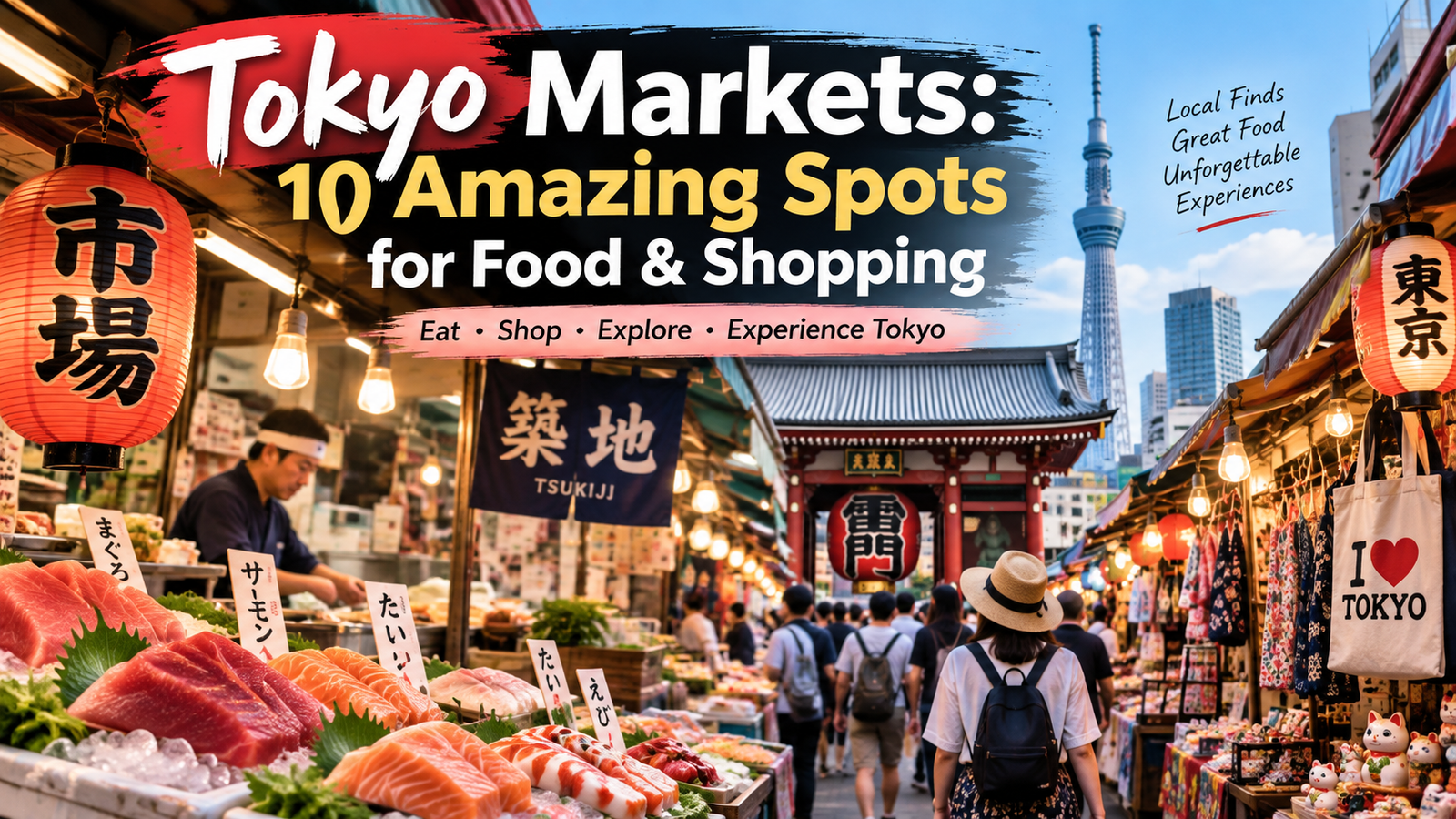
Tokyo Markets: 10 Best Places for Food, Shopping & Hidden Finds
Tokyo markets are where the city becomes more than a collection of skyscrapers, train stations, temples, and shopping malls. They are places where you can watch chefs choose ingredients, discover handmade goods, taste inexpensive street food, browse fabrics, buy Japanese kitchenware, and experience neighborhoods that still feel deeply connected to everyday life. Tokyo markets range from famous food destinations such as Tsukiji and Toyosu to lively shopping streets such as Ameyoko, Yanaka Ginza, Kappabashi, and Sunamachi Ginza Tokyo Culture
For first-time visitors, Tokyo’s market scene can be confusing because the word “market” covers several different experiences. Some are wholesale food markets. Some are traditional shopping streets known as shotengai. Others specialize in kitchenware, textiles, antiques, snacks, or local products.
This guide explains the different types of Tokyo markets, the best places for different travelers, what to buy, when to go, how to avoid common mistakes, and how to plan a market-focused Tokyo itinerary without wasting valuable vacation time.
Quick Summary of Tokyo Markets
Tokyo markets are not one single category. They form a network of food markets, specialty shopping districts, traditional shopping streets, craft areas, and neighborhood commercial streets.
If you want the fastest possible recommendation, use this guide:
- Best overall food market experience: Tsukiji Outer Market
- Best for seeing the modern wholesale market: Toyosu Market
- Best for affordable food and lively shopping: Ameyoko
- Best for traditional local atmosphere: Yanaka Ginza
- Best for Japanese kitchenware: Kappabashi Kitchenware Town
- Best for fabrics and sewing supplies: Nippori Textile Town
- Best for local everyday shopping: Sunamachi Ginza
- Best for traditional souvenirs: Nakamise in Asakusa
- Best for retro neighborhood shopping: Sugamo Jizo-dori
- Best for bargain-oriented local shopping: Musashi Koyama Shopping Street
The important point is that these destinations should not all be judged by the same standard. A traveler looking for tuna and sushi should not choose a market in the same way as someone searching for Japanese ceramics or vintage-inspired clothing.
What Makes Tokyo Markets Special?
Tokyo is one of the world’s great shopping cities, but its market culture has a different character from the luxury shopping districts of Ginza or the giant commercial centers of Shinjuku and Shibuya.
Markets and neighborhood shopping streets are often built around specialized communities.
A seafood market exists because restaurants and food businesses need ingredients. A textile district exists because designers, tailors, hobbyists, and manufacturers need fabric and sewing materials. A kitchenware district exists because professional cooks and ordinary households need tools.
This creates a useful difference.
You are not simply walking through stores designed for tourists. In many Tokyo markets, the products have a practical purpose beyond tourism.
That is why a market visit can reveal something about how Tokyo works.
At Tsukiji, for example, you can see the continuing relationship between food professionals, specialist retailers, restaurants, and visitors. The Tsukiji Outer Market describes itself as a food town where visitors can shop, eat, and experience traditional food culture. Its current shopping categories include seafood, meat, vegetables, dried foods, processed foods, kitchenware, knives, tableware, and other products.
The same principle appears elsewhere.
Kappabashi is not simply a souvenir street with Japanese-themed objects. It is a specialized district for cooking equipment, with approximately 160 shops selling items ranging from knives and crockery to professional equipment and realistic plastic food samples.
Nippori Textile Town serves another specialist community. Its approximately one-kilometer district includes around 90 stores selling fabrics, buttons, traditional textiles, and sewing supplies to both individual hobbyists and wholesale buyers.
This specialization is one of the biggest reasons Tokyo markets remain interesting even for repeat visitors.
Understanding the Different Types of Tokyo Markets
Before choosing a market, understand what kind of market you are actually visiting.
Wholesale Food Markets
Wholesale markets are designed primarily around the professional food industry.
Toyosu is the clearest example. The Tokyo Metropolitan Wholesale Market at Toyosu opened in 2018 after the relocation of the central wholesale market functions from Tsukiji. Visitors can access observation areas, restaurants, shops, and viewing areas for the tuna auction.
The experience is more structured and modern than the old image many people have of Tsukiji.
Outer Markets
Tsukiji Outer Market is different.
The wholesale fish market that operated next door moved to Toyosu, but the surrounding commercial district remained active. GO TOKYO currently describes Tsukiji Outer Market as a food destination with around 460 shops selling seafood, seasonings, kitchen utensils, tableware, and other products.
This makes Tsukiji especially useful for travelers who want to combine food, shopping, and sightseeing.
Traditional Shopping Streets
Tokyo’s shotengai are neighborhood shopping streets where independent stores, food vendors, restaurants, and daily-life businesses serve local communities.
Yanaka Ginza is a good example. It has small independent shops selling daily foods, ready-to-eat items, tea, traditional sweets, and other goods.
These streets may not look like conventional tourist markets, but that is exactly why they can be valuable.
Specialty Markets and Districts
Some Tokyo market experiences are built around a single product category.
Kappabashi specializes in cooking-related goods.
Nippori specializes in textiles.
These are excellent destinations when your goal is specific rather than simply “go shopping.”
1. Tsukiji Outer Market
If someone asks for the best Tokyo markets for a first visit, Tsukiji Outer Market is one of the easiest recommendations.
The reason is simple: it combines several experiences in one compact area.
You can eat breakfast, browse seafood, buy Japanese food ingredients, look at knives and kitchenware, pick up seasonings, and explore narrow streets filled with specialist shops.
The official Tsukiji Outer Market describes the district as a place where visitors can shop, eat, and experience Japanese food culture. It includes fresh seafood and processed fish, meat, vegetables, dried foods, traditional processed foods, kitchenware, knives, tableware, and restaurants.
Why Tsukiji Is Best for Food Lovers
Tsukiji works particularly well for travelers who want to understand Japanese food beyond sushi.
You can find seafood, dried ingredients, bonito flakes, seaweed, green tea, pickles, tamagoyaki, seasonings, and many other food products.
The market’s official site notes that visitors can find everything from tuna and other seafood to semi-dried fish and other traditional products.
This creates a useful strategy: do not arrive with the mindset that you need to eat sushi and leave.
Instead, explore the ingredients.
Look at the dried seafood. Notice the packaging. Ask about unfamiliar ingredients. Observe how specialist stores present products.
That turns shopping into a cultural experience.
Best Time to Visit Tsukiji
Morning is generally the best time if food is your priority.
However, there is an important distinction between “early” and “too early.”
The market’s current guidance says professional buyers have priority until 9:00 a.m., and visitors should avoid obstructing people who are working.
That means tourists should behave differently from professional buyers.
If you arrive very early, stay aware of people moving quickly with business to conduct.
What to Buy at Tsukiji
Good options include:
- Japanese seasonings
- Dried seafood
- Seaweed
- Bonito flakes
- Tea
- Pickles
- Kitchen utensils
- Japanese tableware
- Food-related souvenirs
- Packaged ingredients
- Carefully selected seafood products
If you want a practical souvenir rather than another decorative object, a small Japanese kitchen item can be an excellent choice.
2. Toyosu Market
Toyosu is the market to visit when you want to understand Tokyo’s modern wholesale seafood system.
The Tokyo Metropolitan Wholesale Market Toyosu Market opened on October 11, 2018. Visitors can see the market from observation corridors and visit restaurants and shops. The tuna auction can also be viewed from designated areas, with the observation deck requiring advance reservation.
GO TOKYO describes Toyosu as one of the world’s largest fish markets and notes that the site is nearly twice the size of its predecessor in Tsukiji.
Toyosu vs Tsukiji
This is one of the most common questions for travelers.
The simplest answer is:
Choose Tsukiji for atmosphere and street-level food culture. Choose Toyosu for the modern wholesale-market experience and auction viewing.
They are not interchangeable.
Tsukiji’s outer district feels like a traditional food neighborhood.
Toyosu feels more like a purpose-built modern market facility.
Who Should Visit Toyosu?
Toyosu is particularly suitable for:
- Seafood enthusiasts
- Photographers
- First-time Tokyo visitors
- Travelers interested in Japanese food logistics
- Families who prefer organized facilities
- People who want to see the tuna auction environment
If your priority is eating your way through small market streets, Tsukiji may feel more satisfying.
If your priority is understanding the modern wholesale market, Toyosu deserves a place on your itinerary.
3. Ameyoko
Ameyoko, between Ueno and Okachimachi, is one of Tokyo’s most energetic shopping areas.
The official Ameyoko site says more than 400 shops operate along approximately 500 meters between Ueno and Okachimachi stations. The district also has historical roots in the post-World War II black-market economy and evolved into one of Tokyo’s distinctive shopping streets.
That history helps explain the atmosphere.
Ameyoko feels different from polished department-store shopping.
It is busy, colorful, practical, and energetic.
What Can You Buy at Ameyoko?
Depending on the shop, you can find:
- Food
- Snacks
- Seafood
- Dried products
- Clothing
- Cosmetics
- Shoes
- Household products
- Souvenirs
- Specialty goods
The variety is one of Ameyoko’s strengths.
You can come here without a detailed shopping list and still find something interesting.
Why Ameyoko Is Good for Budget Travelers
If your goal is to explore Tokyo without spending luxury-shopping money, Ameyoko can be a useful stop.
The key is to compare products rather than assuming every item is automatically a bargain.
Markets reward curiosity.
Look at multiple stores, understand what you are buying, and do not let aggressive-looking displays pressure you into a purchase.
4. Yanaka Ginza
Yanaka Ginza offers something different from the major tourist markets.
It gives visitors a chance to experience the atmosphere of an old-fashioned Tokyo shopping street.
GO TOKYO describes Yanaka Ginza as a traditional shotengai with independent stores selling meat, fish, vegetables, ready-to-eat foods, tea, and traditional Japanese sweets.
The appeal is not simply shopping.
It is the feeling of neighborhood life.
Why Yanaka Ginza Is Great for Slow Travelers
If you dislike rushing between attractions, Yanaka Ginza is an excellent choice.
You can walk slowly, buy a snack, observe local storefronts, explore nearby streets, and combine the visit with Yanaka and Nippori.
The area is also useful for photographers because the architecture, signs, shopfronts, and narrow streets provide a more intimate view of Tokyo than large commercial districts.
Best for Families
Yanaka Ginza can also work for families because it is less focused on one specific shopping category.
Parents can browse food and small goods while children experience the street atmosphere and snacks.
As always, crowd awareness matters, especially on narrow streets.
5. Kappabashi Kitchenware Town
Kappabashi is one of the most fascinating Tokyo markets for cooks.
It is essentially a giant specialist shopping district devoted to food preparation and restaurant supplies.
GO TOKYO reports approximately 160 shops in the main road and side streets, offering Japanese knives, lacquerware, professional stoves, crockery, kitchen tools, and realistic plastic food samples.
Why Kappabashi Is Different
Imagine walking into a neighborhood where nearly every other store seems to answer the question:
“What does a restaurant need?”
That is Kappabashi.
The district is useful for both professionals and amateurs.
You can find:
- Japanese knives
- Chopsticks
- Ceramic plates
- Bowls
- Tea equipment
- Cooking utensils
- Restaurant signs
- Food molds
- Baking tools
- Plastic food displays
- Storage equipment
- Serving items
Best Tokyo Market for Chefs
Professional chefs can spend hours here.
But you do not need to be a professional.
A home cook can find a small ceramic bowl, tea cup, cooking utensil, or knife that becomes a useful reminder of the trip.
The district also has a strong visual identity. Giant kitchen-related objects and detailed storefronts make the walk itself interesting.
Buying Japanese Knives
Knife shopping requires more care than buying a souvenir.
Consider:
- Blade type
- Steel type
- Size
- Maintenance requirements
- Intended food
- Handle style
- Shipping options
- Airline rules
- Local laws where you live
If you are buying an expensive knife, ask the retailer about care and transportation before completing the purchase.
Some Kappabashi shops also provide international shipping services; individual store policies vary. GO TOKYO specifically notes international shipping availability at Jikko Cutlery Tokyo Kappabashi.
6. Nippori Textile Town
Nippori Textile Town is one of the best Tokyo markets for designers, sewing enthusiasts, cosplayers, DIY hobbyists, and anyone who appreciates Japanese textiles.
The district stretches for roughly one kilometer and includes approximately 90 stores. These businesses sell fabrics, buttons, traditional textiles, and other sewing supplies in both personal and wholesale quantities.
Why Designers Should Visit Nippori
Tokyo is known for fashion, but fashion is not only about finished clothing.
It is also about materials.
Nippori gives you access to fabrics and components that can become something entirely new.
For designers, that makes the district more than a shopping destination. It can be a source of ideas.
You might find:
- Japanese cotton
- Traditional-pattern fabrics
- Buttons
- Sewing accessories
- Decorative materials
- Craft supplies
- Fabric remnants
- Wholesale quantities
Best for Creative Travelers
Nippori is especially good for travelers who prefer souvenirs that can be transformed into something personal.
Instead of buying a finished souvenir, you can buy a piece of material and turn it into clothing, bags, home décor, or craft projects later.
That creates a different kind of travel memory.
7. Sunamachi Ginza Shopping District
Sunamachi Ginza is a strong choice when you want a more local and budget-friendly shopping experience.
GO TOKYO describes it as a 670-meter-long shopping street filled with family-run businesses and food vendors. The area is known for inexpensive snacks, including oden and yakitori, as well as shops selling kitchenware, paper goods, and other small items.
Why Sunamachi Ginza Is Worth the Trip
Sunamachi Ginza does not have the same international fame as Tsukiji.
That can be an advantage.
It offers a chance to experience a less polished, more neighborhood-oriented side of Tokyo.
The street is especially appealing if you want:
- Affordable snacks
- Local atmosphere
- Small family-run shops
- Traditional shopping-street culture
- A break from major tourist districts
Best for Budget Food
Sunamachi Ginza is useful for travelers who want to sample small foods without building an expensive restaurant itinerary.
Instead of sitting down for one large meal, you can explore smaller portions and experience different flavors.
8. Nakamise Shopping Street
Nakamise is one of the most famous shopping streets in Asakusa.
The approximately 250-meter avenue leads toward Sensoji and has around 90 stalls selling souvenirs, traditional goods, and snacks.
What Makes Nakamise Special?
Its biggest advantage is context.
You are not shopping in isolation.
You are walking toward one of Tokyo’s most historic Buddhist temple complexes while browsing traditional goods.
You can find:
- Traditional snacks
- Japanese souvenirs
- Kimono accessories
- Wooden dolls
- Small crafts
- Decorative goods
- Traditional-style gifts
Best for First-Time Visitors
If this is your first trip to Tokyo and your itinerary already includes Asakusa, Nakamise is an easy addition.
It is especially good for travelers who want classic Japanese souvenirs without spending half a day traveling across the city.
However, because of its popularity, expect crowds.
9. Sugamo Jizo-dori
Sugamo is sometimes described as “Harajuku for grandmothers,” but that nickname should not make you think it is only for older visitors.
The neighborhood offers an interesting look at Tokyo’s traditional shopping culture.
GO TOKYO describes Jizo-dori as the heart of Sugamo, with retro stores and street vendors selling crafts, snacks, and souvenirs at relatively low prices.
Why Sugamo Is Unique
Sugamo is a reminder that Tokyo’s consumer culture is not built only around teenagers and young professionals.
The neighborhood has a strong connection with older residents and traditional everyday shopping.
Visitors can discover:
- Traditional snacks
- Clothing
- Crafts
- Household items
- Souvenirs
- Local foods
The nearby Togenuki Jizo Koganji Temple adds a cultural dimension to the visit.
Best for Travelers Seeking Authentic Neighborhood Life
If you want a market experience that feels less like a tourist attraction and more like a living neighborhood, Sugamo is worth considering.
10. Musashi Koyama Shopping Street
Musashi Koyama Shopping Street offers another perspective on everyday Tokyo.
GO TOKYO describes it as an 800-meter-long covered shopping street opened in 1956, with produce, fashion, food, and other affordable goods.
Why Musashi Koyama Is Different
Tokyo’s major shopping districts often focus on aspiration.
Musashi Koyama focuses more heavily on everyday life.
That distinction matters.
A traveler interested in understanding how ordinary residents shop can learn more here than from a luxury department store.
The covered arcade also makes it a practical choice when weather becomes a problem.
10 Tokyo Market Destinations Compared
The following comparison treats the ten destinations as market brands or shopping destinations. They are not all formal wholesale markets, so the comparison focuses on the experience each destination provides.
| Market destination | Best for | Main products/experience | Atmosphere | Best traveler |
|---|---|---|---|---|
| Tsukiji Outer Market | Food | Seafood, ingredients, kitchenware, snacks | Busy, historic, culinary | Food lovers |
| Toyosu Market | Seafood culture | Wholesale seafood, tuna auction viewing, restaurants | Modern, organized | First-time visitors, seafood fans |
| Ameyoko | Bargains | Food, clothing, daily goods, souvenirs | Energetic, crowded | Budget travelers |
| Yanaka Ginza | Local life | Food, sweets, daily goods | Retro, relaxed | Slow travelers |
| Kappabashi | Kitchenware | Knives, ceramics, cooking tools | Specialist, practical | Chefs and home cooks |
| Nippori Textile Town | Fabrics | Textiles, buttons, sewing goods | Creative, specialist | Designers and hobbyists |
| Sunamachi Ginza | Local food | Snacks, prepared foods, small goods | Friendly, neighborhood | Budget food travelers |
| Nakamise | Souvenirs | Traditional goods, snacks, crafts | Historic, tourist-friendly | First-time tourists |
| Sugamo Jizo-dori | Traditional shopping | Snacks, clothing, crafts | Retro, community-focused | Culture seekers |
| Musashi Koyama | Everyday shopping | Food, fashion, household goods | Local, covered arcade | Independent travelers |
The table highlights an important lesson: there is no single best Tokyo market for everyone.
The best market is determined by your purpose.
Best Tokyo Markets for Different Travelers
Best Tokyo Markets for First-Time Visitors
If you have only one or two market opportunities during your first Tokyo trip, prioritize Tsukiji and either Nakamise or Ameyoko.
Tsukiji gives you food culture.
Nakamise gives you traditional Asakusa.
Ameyoko gives you energetic everyday shopping.
Your decision should depend on the rest of your itinerary.
If you are already visiting Asakusa, Nakamise is almost effortless to include.
If you are staying around Ueno, Ameyoko is exceptionally convenient.
If you want a dedicated morning food experience, Tsukiji is the stronger choice.
Best Tokyo Markets for Food Lovers
Food travelers should prioritize:
- Tsukiji Outer Market
- Toyosu Market
- Ameyoko
- Sunamachi Ginza
- Yanaka Ginza
Tsukiji is the strongest all-around choice because of its range.
Toyosu is better for the wholesale-market story.
Ameyoko is better for variety and energy.
Sunamachi Ginza is useful for inexpensive local-style food.
Yanaka Ginza is better for a relaxed neighborhood food experience.
Best Tokyo Markets for Families
Families should consider:
- Tsukiji
- Kappabashi
- Nakamise
- Yanaka Ginza
- Ameyoko
Kappabashi can be surprisingly entertaining for children because of its giant restaurant displays and realistic plastic food samples.
Nakamise works well when combined with Sensoji.
Tsukiji offers lots of visual activity and food choices, but narrow streets can become challenging with large strollers.
Best Tokyo Markets for Couples
Couples may enjoy:
- Tsukiji
- Yanaka Ginza
- Kappabashi
- Nakamise
- Ameyoko
For a slower date-style experience, Yanaka Ginza is particularly attractive.
For food-focused couples, Tsukiji is easier.
For couples interested in cooking or Japanese homeware, Kappabashi can turn shopping into a shared experience.
Best Tokyo Markets for Photographers
Photographers should look beyond the famous names.
Good options include:
- Ameyoko
- Yanaka Ginza
- Nakamise
- Sugamo
- Sunamachi Ginza
- Kappabashi
Each offers different visual material.
Ameyoko gives you movement, signs, crowds, and commercial energy.
Yanaka gives you old neighborhood textures.
Kappabashi gives you oversized storefront objects and unusual displays.
Nakamise provides a historic setting.
What to Buy at Tokyo Markets
Tokyo markets are excellent for practical souvenirs.
Instead of buying the same mass-produced item available at an airport shop, consider purchasing something connected to the market itself.
Food Souvenirs
Good choices include:
- Tea
- Seaweed
- Seasonings
- Dried foods
- Rice-related ingredients
- Japanese sweets
- Packaged snacks
- Pickles
Check import rules in your home country before purchasing food products.
Kitchen Souvenirs
Kappabashi and Tsukiji are excellent for:
- Chopsticks
- Small bowls
- Ceramic cups
- Kitchen tools
- Serving dishes
- Tea accessories
Textile Souvenirs
Nippori is ideal for:
- Fabric
- Traditional patterns
- Sewing accessories
- Buttons
- Craft materials
Traditional Gifts
Nakamise, Yanaka Ginza, and Sugamo can be better choices for:
- Traditional sweets
- Small crafts
- Decorative objects
- Japanese-style accessories
- Local gifts
How to Plan a Tokyo Markets Day
One of the biggest mistakes travelers make is trying to visit too many markets in one day.
Tokyo’s size makes that inefficient.
Instead, group markets geographically.
Morning: Tsukiji
Start with breakfast and food exploration.
Tsukiji is particularly suitable for morning visits because food businesses are active early and the atmosphere changes as the day progresses.
The official market calendar distinguishes professional buyer hours and public buyer hours, reinforcing the importance of visiting respectfully during the morning working period.
Late Morning: Ginza
After Tsukiji, walk or travel toward Ginza.
You can shift from traditional food culture to modern Tokyo shopping.
Afternoon: Asakusa and Kappabashi
Visit Sensoji and Nakamise before walking toward Kappabashi.
This creates one of the strongest combinations for travelers interested in traditional Tokyo and Japanese food culture.
Evening: Ueno and Ameyoko
Finish around Ueno.
Ameyoko is well suited to a lively late-day shopping experience.
This route allows you to experience several different forms of Tokyo commerce without constantly crossing the city.
How Early Should You Visit Tokyo Markets?
There is no universal answer.
It depends on the market.
Tsukiji rewards morning visitors, particularly food-focused travelers.
Toyosu requires more planning if your goal is auction viewing.
Neighborhood shopping streets generally have more flexible schedules.
Kappabashi is better approached during normal shop hours rather than at dawn.
Nippori also works best when specialist shops are open.
The biggest lesson is to check individual store schedules before traveling.
Tsukiji itself specifically warns that individual shops have different business hours. Its official information center also publishes its own hours separately from individual businesses.
Tokyo Market Etiquette
Good etiquette matters because many markets are working commercial environments, not theme parks.
Do Not Block Workers
If people are carrying products, pushing carts, or moving quickly, step aside.
This is particularly important in Tsukiji.
Ask Before Taking Photos
Not every shop wants unrestricted photography.
Tsukiji’s official visitor guidance specifically advises visitors to ask before photographing shops.
Do Not Touch Food Without Permission
Food displays are commercial products.
Tsukiji specifically advises visitors not to touch or poke food products because doing so can reduce their commercial value.
Avoid Walking While Eating
Eating while walking may seem natural to tourists, but some market areas ask visitors to eat inside designated areas or directly in front of the relevant store.
Again, Tsukiji explicitly advises visitors to remain inside eateries or designated eating areas rather than wandering while eating.
Keep Your Bags Small
Large luggage can create serious problems in narrow market streets.
Tsukiji recommends leaving large luggage behind and provides coin-operated lockers through its facilities.
Should You Bargain at Tokyo Markets?
Usually, do not assume that bargaining is expected.
Tsukiji’s official guidance specifically says bargaining is not customary there because carefully selected products are already sold at wholesale-oriented prices.
That does not mean every Tokyo market has identical pricing practices.
Instead, use normal shopping etiquette.
If the price is displayed, assume that is the price unless the seller indicates otherwise.
If you want to compare prices, do so politely.
Cash or Card at Tokyo Markets?
Payment methods vary by business.
Large and tourist-oriented locations may offer more card and electronic payment options, while smaller independent businesses can be more limited.
Do not rely entirely on one payment method.
A practical market strategy is to carry:
- A primary payment card
- A backup payment card
- Some Japanese yen
- A secure wallet
Always confirm current payment options for the specific store when buying expensive items.
How to Avoid Tourist Traps
Not every market item is a bargain simply because it is sold in a market.
A market atmosphere can create excitement, which sometimes makes travelers purchase things they do not need.
Use this simple test:
Would I still want this item if I saw it in a normal shop?
If the answer is yes, consider buying it.
If the answer is no, take a photograph and continue walking.
For expensive goods, compare several stores.
For specialty products, ask questions.
For food, check packaging and storage requirements.
Common Mistakes When Visiting Tokyo Markets
Mistake 1: Treating Every Market as a Food Market
Tokyo markets are much broader than seafood and street food.
Kappabashi is about kitchenware.
Nippori is about textiles.
Neighborhood shopping streets are about everyday life.
Choose based on your interests.
Mistake 2: Visiting Too Late
Some food-focused markets are much more interesting earlier in the day.
If food is your priority, do not automatically schedule the market for late afternoon.
Mistake 3: Trying to See Everything
Tokyo rewards depth rather than frantic checklist tourism.
One market explored properly can be more memorable than five markets visited for twenty minutes each.
Mistake 4: Carrying Large Luggage
This is particularly problematic in narrow shopping streets.
Use luggage storage where practical.
Mistake 5: Ignoring Store Hours
A market district may technically be open while many individual shops are closed.
Always check the specific stores you care about.
Mistake 6: Assuming the Famous Market Is Automatically the Best
Popularity does not equal suitability.
A designer may enjoy Nippori more than Tsukiji.
A chef may prefer Kappabashi.
A budget traveler may enjoy Ameyoko.
A traveler seeking local life may prefer Yanaka Ginza.
Pros and Cons of Tokyo Markets
Advantages
Tokyo markets offer several major benefits.
First, they provide access to specialized products.
Second, they create opportunities for cultural observation.
Third, they often combine shopping with food.
Fourth, they can provide souvenirs that feel more meaningful than generic tourist products.
Fifth, they allow visitors to experience different neighborhoods.
The diversity is especially important.
One day of market exploration can show you several versions of Tokyo: professional food culture, traditional commerce, neighborhood life, crafts, fashion materials, and modern urban shopping.
Disadvantages
Markets can also be challenging.
Crowds can be heavy.
Some streets are narrow.
Store hours vary.
Language barriers may occur.
Prices can vary significantly between products.
Some market districts are less convenient to reach than major tourist centers.
And not every market is suitable for every traveler.
The solution is preparation rather than avoidance.
A Better Way to Explore Tokyo Markets
Instead of asking:
“Which Tokyo market is the best?”
Ask:
“What do I want my market visit to accomplish?”
This produces much better results.
If the answer is “eat fresh seafood,” choose Tsukiji.
If it is “see a wholesale seafood market,” choose Toyosu.
If it is “find inexpensive snacks,” consider Ameyoko or Sunamachi Ginza.
If it is “buy Japanese knives,” choose Kappabashi.
If it is “find fabric,” go to Nippori.
If it is “experience old Tokyo,” consider Yanaka Ginza or Sugamo.
If it is “buy traditional souvenirs near a major attraction,” choose Nakamise.
This purpose-first approach is one of the easiest ways to make a Tokyo shopping itinerary more efficient.
Tokyo Markets for Different Budgets
Budget Travelers
Prioritize:
- Ameyoko
- Sunamachi Ginza
- Yanaka Ginza
- Sugamo
These destinations can provide inexpensive food and everyday shopping opportunities.
Mid-Range Travelers
Combine:
- Tsukiji
- Kappabashi
- Yanaka Ginza
- Ameyoko
This creates a balance of food, shopping, and culture.
Premium Shoppers
Consider combining specialist markets with luxury shopping districts.
For example, you could buy high-quality Japanese kitchenware in Kappabashi and then explore Ginza for premium retail.
The contrast can actually make both experiences more interesting.
Tokyo Markets for International Visitors
Travelers from outside Japan should think about three practical issues: payment, luggage, and customs.
Payment
Carry more than one payment method.
Luggage
Do not carry large suitcases through narrow shopping streets when avoidable.
Customs
Food, plants, animal products, and certain goods may be subject to import restrictions in your destination country.
Research your country’s customs requirements before purchasing items that may be regulated.
Tokyo Markets and Sustainable Shopping
Markets can support a more thoughtful approach to shopping.
Buying a durable kitchen tool that you will use for years can be more meaningful than buying several disposable souvenirs.
Similarly, purchasing fabric from a specialist textile district can become a creative project rather than a one-time decorative object.
However, “market shopping” should not automatically be described as sustainable.
Sustainability depends on what you purchase, how it is produced, how far it travels, how long you use it, and whether you actually need it.
The strongest strategy is simple:
Buy fewer things, but buy things you genuinely value and can use.
Tokyo Markets and the Future of Shopping
Tokyo’s traditional shopping streets face the same broad pressures affecting neighborhood retail in many cities.
Supermarkets, online shopping, chain stores, changing demographics, rising operating costs, and changing consumer habits can challenge small independent businesses.
Yet Tokyo’s markets and shotengai have another advantage: experience.
Online shopping can deliver a product.
It cannot easily reproduce the experience of walking through a crowded market, smelling grilled food, seeing specialist products, talking to a shopkeeper, or discovering an unexpected item.
That experiential quality may become increasingly important.
Yanaka Ginza is a useful example. GO TOKYO notes that many traditional shopping streets have been affected by supermarkets and chain stores, yet Yanaka Ginza remains a thriving example of the traditional shotengai model.
This suggests an important future trend.
The strongest markets may not compete with online retail by trying to become online stores.
They may compete by becoming better physical experiences.
Future Trends in Tokyo Markets
More International-Friendly Shopping
Tourism is likely to continue influencing major market districts.
More multilingual information, digital payments, tax-refund services, shipping options, and visitor guidance can make specialist markets easier for international travelers to use.
Tsukiji already provides an information center with multilingual assistance, maps, currency exchange facilities, lockers, and other visitor services.
More Experience-Based Tourism
Travelers increasingly want activities rather than simple sightseeing.
Markets naturally fit this trend.
A visitor can:
- Learn about Japanese ingredients
- Watch food preparation
- Participate in cooking-related experiences
- Shop for craft materials
- Explore local neighborhoods
- Taste small foods
- Meet specialist retailers
This makes markets valuable beyond shopping itself.
Continued Interest in Specialist Craft
Tokyo’s specialist districts are particularly well positioned for travelers who want authentic objects with a story.
Kappabashi and Nippori demonstrate how specialization can become a tourism attraction without abandoning the original commercial purpose of the district.
Digital Discovery, Physical Experience
People may increasingly discover shops online before visiting them in person.
That does not necessarily weaken markets.
In some cases, digital discovery can make physical visits more intentional.
A traveler researching Japanese knives may identify a few stores online and then visit Kappabashi with a clear purpose.
This creates a hybrid model: digital research before the trip, physical discovery during the trip.
A One-Day Tokyo Markets Itinerary
If you want to dedicate one day to markets, avoid trying to visit all ten.
A realistic route could look like this:
Morning: Tsukiji Outer Market
Start with breakfast.
Explore seafood and specialty food stores.
Spend time walking through the side streets.
Buy small food souvenirs if appropriate.
Late Morning: Ginza
Move toward Ginza.
Use this as a transition from traditional market culture to modern Tokyo shopping.
Afternoon: Asakusa
Travel to Asakusa.
Visit Sensoji and Nakamise.
Take your time with traditional souvenirs.
Late Afternoon: Kappabashi
Walk or travel toward Kappabashi.
Browse knives, ceramics, kitchen tools, and restaurant supplies.
Evening: Ameyoko
Finish around Ueno.
Explore Ameyoko for snacks, shopping, and the lively atmosphere.
This route gives you four very different commercial experiences without requiring you to travel to distant parts of Tokyo repeatedly.
A Two-Day Tokyo Market Itinerary
If you have more time, split the experience.
Day One: Food and Historic Tokyo
Visit:
Tsukiji → Ginza → Asakusa → Kappabashi → Ueno/Ameyoko
This is ideal for first-time visitors.
Day Two: Local Tokyo
Visit:
Nippori Textile Town → Yanaka Ginza → Sugamo → another neighborhood shopping street
This second day is slower and more local.
It is particularly useful for repeat visitors who have already seen Shibuya, Shinjuku, Harajuku, and Asakusa.
How Long Should You Spend at Tokyo Markets?
A quick stop can take 30–60 minutes.
A serious market visit can easily take two to three hours.
Specialist districts such as Kappabashi and Nippori deserve more time if you have a specific shopping objective.
A useful rule is:
- 30–45 minutes: quick look
- 1–2 hours: normal visit
- 2–3 hours: food plus shopping
- Half day: detailed exploration and multiple nearby attractions
Do not underestimate shopping time.
A market that looks small on a map may contain dozens or hundreds of businesses.
What Should You Not Buy at Tokyo Markets?
Avoid purchasing something simply because it looks “Japanese.”
The best souvenir is not necessarily the most stereotypically Japanese object.
Think about usefulness.
A ceramic bowl you use every week may create more lasting memories than a decorative object that sits in storage.
Similarly, a fabric purchased in Nippori may become a bag, garment, or home decoration months later.
The value of a market purchase is often connected to what happens after you return home.
Is Tsukiji Still Worth Visiting After the Fish Market Moved?
Yes.
This is one of the biggest misconceptions about Tokyo markets.
The wholesale fish market moved to Toyosu, but Tsukiji Outer Market continued operating.
GO TOKYO currently describes Tsukiji Outer Market as a lively destination with around 460 shops.
The official Tsukiji site also makes clear that the outer market remains a place for fresh seafood, food ingredients, kitchenware, restaurants, and cultural experiences.
Therefore, visiting Tsukiji today should not be thought of as visiting an abandoned former fish market.
It is better understood as visiting a historic food district that evolved after the wholesale market relocated.
Is Toyosu Better Than Tsukiji?
Neither is universally better.
Toyosu is better for seeing the modern wholesale market environment and tuna auction viewing.
Tsukiji is better for street-level food exploration, specialist stores, restaurants, and the atmosphere of an established food neighborhood.
For travelers with enough time, visiting both can be worthwhile because the contrast tells a more complete story.
Are Tokyo Markets Good for Souvenirs?
Yes, especially if you want souvenirs that are useful or connected to Japanese culture.
Good choices include:
- Tea
- Ceramics
- Kitchen tools
- Chopsticks
- Fabric
- Packaged foods
- Traditional sweets
- Small craft items
- Food-related products
The strongest strategy is to choose an item connected to your interests.
A cook should look at Kappabashi.
A designer should explore Nippori.
A food lover should explore Tsukiji.
A traveler interested in traditional neighborhoods should consider Yanaka Ginza or Sugamo.
Frequently Asked Questions About Tokyo Markets
What are the best Tokyo markets for first-time visitors?
Tsukiji Outer Market, Ameyoko, Nakamise, and Toyosu are strong choices for first-time visitors. Tsukiji is especially versatile because it combines food, shopping, restaurants, and traditional market culture.
Is Tsukiji Market still open?
Tsukiji’s former inner wholesale market moved to Toyosu, but Tsukiji Outer Market remains active. The outer market currently includes hundreds of shops selling food, seafood, kitchenware, tableware, and other products.
What is the difference between Tsukiji and Toyosu?
Toyosu is the modern Tokyo Metropolitan Wholesale Market where the wholesale fish-market functions moved in 2018. Tsukiji Outer Market is the surrounding historic food district that continued after the relocation.
Which Tokyo market is best for seafood?
Tsukiji Outer Market is one of the best choices for visitors who want seafood-focused shopping and dining. Toyosu is better if your main interest is the wholesale seafood market and tuna auction viewing.
Which Tokyo market is best for Japanese knives?
Kappabashi Kitchenware Town is one of the best destinations for Japanese knives and cooking equipment. The district contains many specialist kitchenware stores, including retailers offering Japanese-made knives and related services.
Where should I go in Tokyo for Japanese fabric?
Nippori Textile Town is the strongest choice. Its approximately one-kilometer district contains around 90 textile and fabric stores serving both individual hobbyists and wholesale buyers.
Which Tokyo market is best for cheap food?
Ameyoko and Sunamachi Ginza are good options for travelers looking for affordable food and shopping. Sunamachi Ginza is particularly known for inexpensive snacks and family-run businesses.
Is Ameyoko good for tourists?
Yes. Ameyoko is one of Tokyo’s most energetic shopping districts, with more than 400 shops along approximately 500 meters between Ueno and Okachimachi. It is especially good for travelers who enjoy food, bargain-oriented shopping, and lively street scenes.
Is Yanaka Ginza worth visiting?
Yes, especially if you want a slower and more traditional neighborhood experience. Yanaka Ginza has independent shops selling food, sweets, tea, daily necessities, and ready-to-eat products.
Is Kappabashi only for professional chefs?
No. Kappabashi serves both professional and amateur cooks. Visitors can purchase kitchen tools, ceramics, knives, tableware, and other cooking-related products.
Can tourists buy from Tokyo wholesale markets?
Some areas and stores accommodate public shoppers, but wholesale-market facilities and individual businesses have their own rules. Toyosu provides visitor-accessible areas, restaurants, and shops, while Tsukiji Outer Market includes retailers serving visitors.
Do Tokyo markets accept credit cards?
Payment methods vary by shop. Do not assume that every small independent vendor accepts cards. Carry a backup payment method and some Japanese yen.
Should I bring luggage to Tokyo markets?
Avoid large luggage when possible. Narrow streets and crowds can make large bags inconvenient, and Tsukiji specifically recommends leaving large luggage behind when exploring the market.
Can I eat while walking around Tokyo markets?
Rules and customs vary, but visitors should follow the guidance of each market. Tsukiji specifically advises people to eat inside eateries or designated areas rather than walking around while eating.
Can I bargain at Tokyo markets?
Do not assume bargaining is expected. At Tsukiji, official guidance specifically says bargaining is not customary.
What is the best Tokyo market for traditional souvenirs?
Nakamise is an excellent choice because it combines traditional goods and snacks with the historic setting of Asakusa and Sensoji.
What is the best Tokyo market for local neighborhood culture?
Yanaka Ginza, Sugamo Jizo-dori, Sunamachi Ginza, and Musashi Koyama are strong choices because they emphasize neighborhood shopping and everyday life rather than only tourist-oriented retail.
How many Tokyo markets should I visit in one day?
Two to four destinations is usually more realistic than trying to visit all ten. Choose markets that are geographically close and have complementary experiences.
What is the best Tokyo market for photographers?
Ameyoko, Yanaka Ginza, Nakamise, Kappabashi, and Sugamo all offer distinctive visual environments. Choose based on whether you prefer crowds, historic streets, commercial signs, traditional architecture, or specialist storefronts.
Final Thoughts on Tokyo Markets
Tokyo markets show a side of the city that is easy to miss when an itinerary focuses only on famous landmarks.
Skyscrapers show Tokyo’s modern ambition.
Temples show its historical depth.
Markets show how people actually buy, sell, cook, create, and live.
That is why Tokyo markets deserve more than a quick shopping stop.
Tsukiji demonstrates the continuing importance of food culture. Toyosu shows how a major wholesale market can operate in a modern facility. Ameyoko captures the energy of everyday commerce. Yanaka Ginza shows how traditional shopping streets can remain relevant. Kappabashi reveals an entire world built around cooking. Nippori demonstrates the importance of materials and craftsmanship.
The biggest mistake is searching for one universally “best” market.
There isn’t one.
Instead, choose the market that matches your purpose.
If you want seafood, go toward Tsukiji or Toyosu.
If you want bargains and lively shopping, explore Ameyoko.
If you want traditional neighborhood culture, consider Yanaka Ginza or Sugamo.
If you want Japanese kitchenware, make time for Kappabashi.
If you want textiles, head to Nippori.
If you want a traditional souvenir stop during an Asakusa visit, explore Nakamise.
And if you want to see how ordinary Tokyo shopping works away from the biggest tourist routes, explore neighborhood shotengai such as Sunamachi Ginza or Musashi Koyama.