
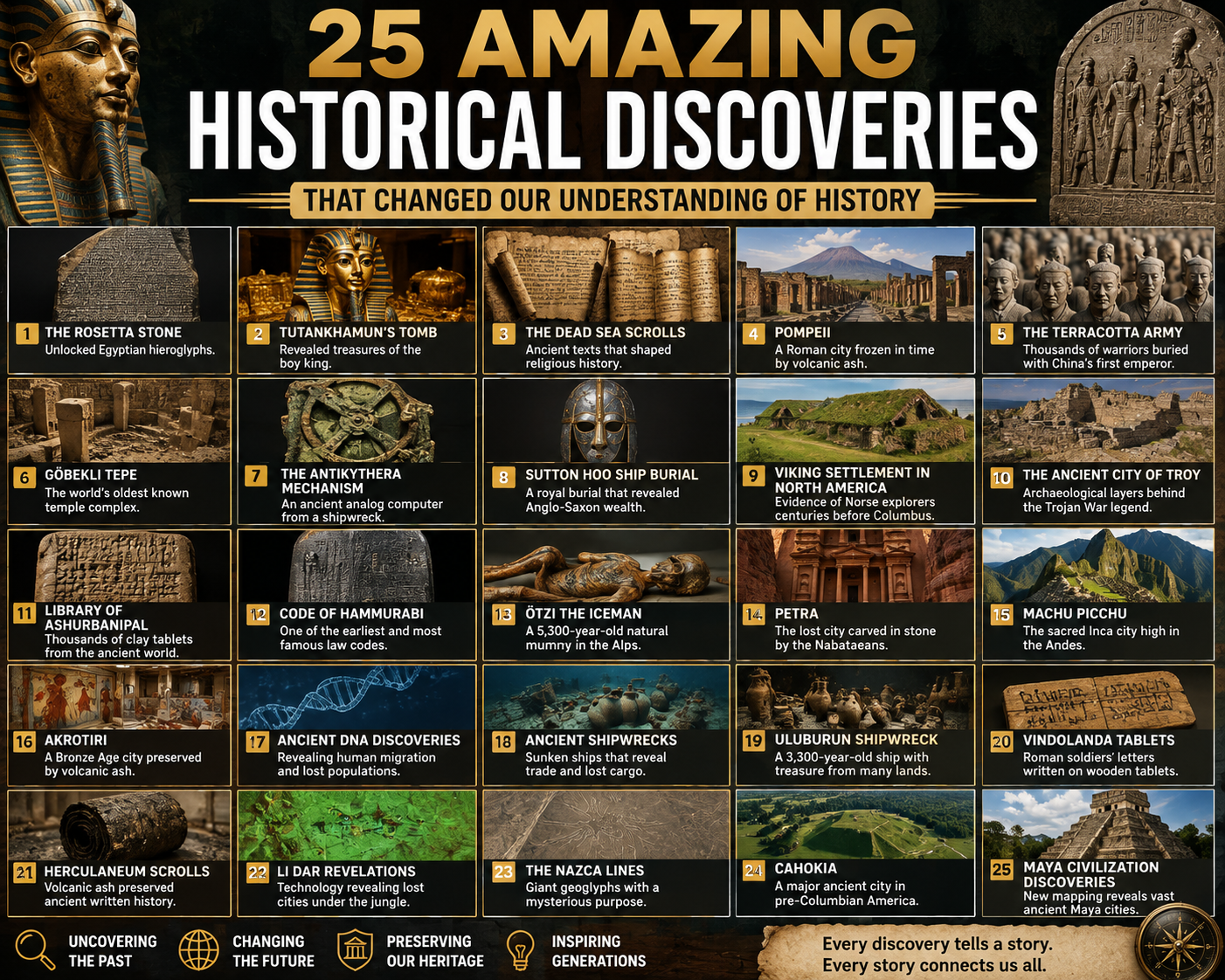
Historical Discoveries: 25 Incredible Finds That Changed What We Know About the Past
historical discoveries is not simply a collection of dates printed in textbooks. Much of what we know about the past has been reconstructed from incomplete evidence. A building may survive while its builders remain unknown. A manuscript may preserve a language that had been forgotten. A burial site may reveal diet, disease, migration, social hierarchy, or family relationships. Every discovery adds another piece to the puzzle. And sometimes, the new piece does not fit the picture historians previously imagined Cultural
Why Non-Invasive Archaeology Is Becoming More Important
Traditional excavation is destructive.
Once archaeologists remove an archaeological layer, they cannot put it back exactly as it was.
That creates an important responsibility.
Researchers increasingly want to understand what lies beneath the surface before deciding whether excavation is necessary.
Non-invasive techniques can help.
Examples include:
- LiDAR
- Magnetometry
- Ground-penetrating radar
- Photogrammetry
- Satellite imaging
The future of archaeology may therefore involve less digging and more intelligent surveying.
How to Evaluate a New Historical Discovery
When you read a headline saying:
“Archaeologists Discover Evidence That Changes History!”
Do not immediately accept the claim.
Ask several questions.
What Was Actually Found?
Is it:
- A building?
- A tool?
- A burial?
- An inscription?
- A laboratory result?
- A fragment?
- A statistical pattern?
How Old Is It?
Look for the dating method.
Where Was It Found?
Context matters enormously.
Who Conducted the Research?
Was the work performed by trained archaeologists, historians, scientists, or another qualified research team?
Has the Research Been Reviewed?
Peer review does not guarantee that a conclusion is correct, but it provides an important quality-control process.
Is the Interpretation Certain?
A discovery can be real while its interpretation remains uncertain.
This distinction is critical.
Common Mistakes When Reading Historical Discovery Stories
Mistake 1: Confusing Discovery With Interpretation
Finding an object is one thing.
Determining what it means is another.
Solution
Separate:
Evidence
from
Interpretation
Mistake 2: Assuming the Oldest Object Is the Most Important
Age alone does not determine historical importance.
A relatively recent document may completely transform understanding of a major event.
Solution
Focus on information value, not simply age.
Mistake 3: Treating Archaeological Dating as Exact
Many dating methods produce ranges.
Solution
Understand that archaeology often works with probability and uncertainty.
Mistake 4: Believing Every “Lost Civilization” Story
Popular media sometimes exaggerates archaeological findings.
Solution
Look for evidence from credible archaeological research.
Mistake 5: Ignoring Context
An isolated artifact can be difficult to interpret.
Solution
Ask where, how, and alongside what it was discovered.
Mistake 6: Treating Ancient Societies as Monolithic
Civilizations changed over time.
Solution
Pay attention to chronological differences, regional variation, and social diversity.
The Difference Between Evidence and Storytelling
Historical research requires storytelling, but evidence must come first.
Imagine researchers discover:
- A foreign coin
- Imported pottery
- Local agricultural tools
One interpretation might be that the settlement participated in long-distance trade.
That is reasonable.
But saying:
“This proves that an international merchant community lived here”
would require additional evidence.
Good historical writing communicates the difference.
Pros and Cons of Historical Discoveries
Advantages
They Expand Knowledge
Discoveries can add information that was previously unavailable.
They Challenge Assumptions
New evidence can correct outdated interpretations.
They Preserve Cultural Memory
Archaeological and documentary evidence helps communities understand their heritage.
They Improve Education
Discoveries make history tangible.
They Encourage Scientific Innovation
Historical research drives development of imaging, dating, conservation, and analytical technologies.
They Connect Different Disciplines
Modern historical research can combine:
- Archaeology
- Biology
- Chemistry
- Geography
- Anthropology
- Linguistics
- Computer science
Challenges
Excavation Can Damage Evidence
Removing artifacts changes their archaeological context.
Looting Destroys Information
An illegally excavated artifact may lose much of its historical value because its original context is unknown.
Political Disputes Can Complicate Research
Heritage can become connected to modern national, cultural, and political identities.
Interpretation Can Change
New evidence may force researchers to revise previous conclusions.
Technology Can Be Misinterpreted
Advanced tools produce data, but data still requires expert interpretation.
The Problem of Archaeological Looting
Looting is one of the greatest threats to historical knowledge.
An artifact removed illegally from a site may eventually enter a private collection.
The object itself may survive.
But the information surrounding it may be permanently lost.
Researchers may never know:
- Exactly where it was buried
- What objects were nearby
- Which layer contained it
- Who used it
- What activity occurred around it
That context can be more valuable than the artifact itself.
Why Museums Matter
Museums can preserve, document, study, and publicly interpret historical objects.
A strong museum does more than display artifacts behind glass.
It can provide:
- Provenance
- Conservation
- Research
- Education
- Digital access
- Historical context
Museums also face difficult questions about ownership, cultural heritage, repatriation, and colonial-era collecting.
These debates are increasingly important in modern heritage management.
Ten Major Organizations and Platforms in Historical Research
The request for a “brands” comparison makes more sense in historical research when applied to major organizations and public-facing institutions that contribute to archaeological, historical, scientific, or heritage knowledge.
| Organization | Main Area | Major Strength | Useful For |
|---|---|---|---|
| UNESCO | World heritage | International heritage framework | Heritage sites and preservation |
| Smithsonian Institution | Museums and research | Broad multidisciplinary research | History, archaeology, anthropology |
| British Museum | Global collections | Extensive historical collections | Ancient civilizations and material culture |
| The Metropolitan Museum of Art | Art and culture | Large global art collection | Art history and cultural heritage |
| National Geographic | Exploration and science communication | Public-facing discoveries | Exploration and historical storytelling |
| American Museum of Natural History | Science and anthropology | Human and natural history research | Anthropology and archaeology |
| Archaeological Institute of America | Archaeology | Archaeological scholarship and education | Archaeology enthusiasts and researchers |
| British Library | Manuscripts and archives | Major documentary collections | Historical texts and manuscripts |
| Library of Congress | Archives and knowledge | Vast documentary resources | Historical documents and research |
| Smithsonian Libraries and Archives | Research collections | Historical scientific materials | Research and primary sources |
These organizations serve different purposes, so they should not be judged simply by popularity.
Historical Discoveries for Different Audiences
Historical information becomes more useful when presented according to the reader’s needs.
Historical Discoveries for Students
Students should focus on:
- Context
- Primary evidence
- Chronology
- Cause and effect
- Competing interpretations
Historical Discoveries for Beginners
Beginners benefit from:
- Simple explanations
- Timelines
- Maps
- Photographs
- Definitions
- Examples
Historical Discoveries for Researchers
Researchers may need:
- Primary sources
- Excavation reports
- Dating methods
- Provenance
- Peer-reviewed research
- Methodological details
Historical Discoveries for Travelers
Travelers can focus on:
- Historical sites
- Museums
- Ancient cities
- Local heritage
- Cultural traditions
Historical Discoveries for History Enthusiasts
Enthusiasts may enjoy:
- Unsolved questions
- New archaeological theories
- Ancient technology
- Lost manuscripts
- Historical mysteries
- New scientific methods
Problem-Solving Modifiers for Historical Research
Search intent can change dramatically when a modifier is added.
For example:
Historical discoveries
is broad.
But:
historical discoveries for students
has a clear educational purpose.
Other useful modifiers include:
- historical discoveries explained
- historical discoveries for beginners
- famous historical discoveries
- archaeological discoveries
- ancient historical discoveries
- recent archaeological discoveries
- historical discoveries in Europe
- historical discoveries in Asia
- historical discoveries in Africa
- historical discoveries in the Americas
- historical discoveries that changed history
- historical discoveries about ancient civilizations
- historical discoveries using DNA
- historical discoveries using LiDAR
- historical discoveries for kids
- historical discoveries for researchers
These modifiers reflect different information needs.
Why Historical Discoveries Are Still Happening
Some people imagine archaeology as a field that has already uncovered the important sites.
That is far from true.
Huge areas of the world remain poorly surveyed.
Some archaeological evidence is hidden beneath:
- Forests
- Deserts
- Water
- Cities
- Farmland
- Mountains
- Sediment
- Volcanic deposits
Even well-known sites continue to produce new information.
Modern technologies can reveal patterns that earlier researchers could not see.
Underwater Archaeology
Oceans and lakes contain enormous amounts of historical evidence.
Underwater archaeology can investigate:
- Shipwrecks
- Sunken settlements
- Ports
- Cargo
- Ancient harbors
- Maritime infrastructure
Sea-level changes are particularly important.
Land that was inhabited thousands of years ago may now be underwater.
This means some important chapters of human history could literally be sitting beneath the sea.
Climate Change and Historical Discoveries
Environmental changes can expose archaeological evidence.
Melting ice can reveal:
- Ancient tools
- Clothing
- Hunting equipment
- Biological remains
Changing landscapes can also expose archaeological sites.
But climate change can simultaneously threaten cultural heritage.
Once organic materials are exposed to air, they may deteriorate quickly.
This creates an urgent conservation challenge.
What Future Historical Discoveries May Reveal
Future research may significantly improve our understanding of:
Ancient Migration
DNA and isotope analysis may reveal more detailed movement patterns.
Ancient Diet
Chemical analysis of human remains can reconstruct aspects of food consumption.
Ancient Diseases
DNA and skeletal analysis can reveal how diseases affected populations.
Lost Settlements
LiDAR and satellite technology may identify previously unknown settlements.
Ancient Climate
Tree rings, sediments, pollen, and other environmental evidence can reconstruct past climates.
Ancient Technology
Microscopic and chemical analysis can reveal manufacturing techniques invisible to the naked eye.
Artificial Intelligence and the Future of Historical Research
AI could become particularly useful where researchers face enormous quantities of data.
Potential applications include:
- Pattern recognition
- Image analysis
- Manuscript transcription
- Language comparison
- Artifact classification
- Landscape mapping
- Database analysis
However, AI should be treated as an analytical tool rather than an automatic historian.
AI can identify patterns.
Humans still need to evaluate:
- Context
- Reliability
- Bias
- Historical meaning
- Alternative explanations
The Future May Be Less About Finding and More About Understanding
For much of archaeology’s history, discovery often meant physically finding something.
Today, the definition is changing.
Researchers may already possess an artifact but discover something new about it through:
- DNA analysis
- 3D scanning
- Chemical testing
- Digital imaging
- Machine learning
- Microscopy
This creates an important idea:
The next great historical discovery may already be sitting in a museum collection.
The breakthrough may come from a new question or a new technology.
How to Research Historical Discoveries Responsibly
If you are writing or studying historical discoveries, follow a disciplined process.
Step 1: Define the Discovery
Determine exactly what was found.
Step 2: Establish the Date
Identify the approximate historical period.
Step 3: Identify the Location
Geography can reveal trade, migration, environment, and cultural connections.
Step 4: Examine the Evidence
Determine what physical or documentary evidence exists.
Step 5: Read Multiple Interpretations
Historical questions often have competing explanations.
Step 6: Identify Uncertainty
Do not present theories as proven facts.
Step 7: Consider Modern Context
Ask whether political, cultural, or institutional factors influence how the discovery is presented.
Step 8: Explain Why It Matters
The reader should understand the significance, not just the object itself.
A Simple Framework for Understanding Any Historical Discovery
Use this six-question framework:
What?
What was discovered?
Where?
Where was it found?
When?
When was it created or used?
Who?
Who created, used, or interacted with it?
How?
How did researchers identify and analyze it?
Why?
Why does it change or improve our understanding?
This framework works for almost every historical discovery.
Common Challenges in Historical Research
Missing Evidence
History is incomplete.
Many objects and documents have disappeared.
Solution
Researchers combine different evidence types.
Biased Sources
Ancient rulers often wrote about themselves in ways designed to glorify their achievements.
Solution
Compare official records with archaeological evidence and other sources.
Preservation Problems
Organic materials can decay.
Solution
Use conservation science and specialized storage.
Language Barriers
Ancient languages may be difficult or impossible to interpret.
Solution
Compare scripts, bilingual texts, linguistic patterns, and computational methods.
Uncertain Dating
Some objects are difficult to date precisely.
Solution
Combine multiple dating techniques where possible.
Historical Discoveries and the Problem of “Mystery”
Mystery attracts readers.
But mystery should not replace evidence.
A responsible historical article can say:
“Researchers are still debating the purpose of this structure.”
That is more trustworthy than:
“Scientists have no idea what this mysterious structure was for.”
The first acknowledges uncertainty.
The second exaggerates it.
Why Ordinary Objects Can Be More Valuable Than Treasure
Gold attracts attention.
But historically, a simple object can be more informative.
For example:
- A shopping list
- A farming tool
- A child’s toy
- A broken cooking vessel
- A letter
- A shoe
- A food residue
These objects can reveal everyday life.
The history of humanity is not only the history of kings.
It is also the history of farmers, workers, merchants, children, craftspeople, soldiers, families, and travelers.
The Human Story Behind Historical Discoveries
Every archaeological object was connected to a person.
A ceramic vessel was made by someone.
A road was constructed by workers.
A letter was written because somebody wanted to communicate.
A burial represents an individual and a community.
This perspective can make historical discoveries more meaningful.
Instead of seeing an artifact as simply “old,” researchers can ask:
What human activity produced this object?
That question often leads to richer history.
The Biggest Lesson From Historical Discoveries
Perhaps the most important lesson is that history is not fixed.
Textbooks provide interpretations based on the evidence available when they were written.
New evidence can change those interpretations.
That does not mean historical knowledge is unreliable.
It means historical knowledge is self-correcting.
A strong historical conclusion should be willing to change when better evidence appears.
Future Trends in Historical Discoveries
The next generation of historical research is likely to be shaped by several major trends.
More Remote Sensing
Large archaeological landscapes will increasingly be surveyed without excavation.
More Ancient DNA
Genetic evidence will continue to refine migration and population histories.
More Digital Reconstruction
Lost buildings and archaeological sites will be reconstructed in three dimensions.
More Museum Digitization
Collections that were previously accessible only to specialists may become searchable online.
More Interdisciplinary Research
Historians, archaeologists, geneticists, chemists, geographers, and computer scientists will increasingly work together.
Greater Attention to Ordinary People
Researchers will continue moving beyond royal history toward everyday life.
Stronger Heritage Protection
As technology makes discoveries easier, protecting sites from looting and destruction will become even more important.
What Historical Discoveries Could Look Like in 20 Years
By the middle of the 21st century, researchers may routinely combine:
- Satellite imagery
- LiDAR
- AI
- Ancient DNA
- Isotope analysis
- Environmental data
- 3D models
- Historical texts
A single archaeological site could therefore be analyzed simultaneously as:
- A physical landscape
- A biological population
- An economic network
- An environmental system
- A technological center
- A cultural community
This represents a major shift from traditional archaeology.
How to Create Better Historical Discovery Content
For bloggers, educators, and publishers, the most successful historical content should avoid simply repeating famous facts.
Instead, ask:
What did researchers previously believe?
What changed?
What evidence caused the change?
What remains uncertain?
This creates a narrative.
For example:
Researchers once believed X.
Then:
A discovery revealed Y.
Then:
Scientists analyzed the evidence.
Then:
The evidence challenged the older interpretation.
Finally:
Researchers now consider several possibilities.
This structure is educational, engaging, and intellectually honest.
FAQs
What is the most important historical discovery?
There is no single universally accepted answer. Discoveries such as the Rosetta Stone, Dead Sea Scrolls, ancient DNA evidence, major archaeological sites, and important manuscripts have each transformed different areas of historical knowledge.
What is an archaeological discovery?
An archaeological discovery is the identification or recovery of physical evidence associated with past human activity. It can include buildings, tools, pottery, burials, roads, inscriptions, settlements, and other remains.
Why are historical discoveries important?
They provide evidence that helps researchers understand how people lived, migrated, traded, organized societies, created technology, practiced religion, and interacted with their environment.
Can historical discoveries change history?
Yes. New evidence can challenge existing interpretations and lead historians to revise explanations of events, civilizations, migrations, technologies, and cultural relationships.
Are historical discoveries still being made?
Yes. New sites and artifacts continue to be discovered, while modern technologies also allow researchers to make new discoveries within objects and sites that have already been known for decades.
How does archaeology help historians?
Archaeology provides physical evidence that can complement, confirm, challenge, or sometimes replace written sources.
What is the difference between history and archaeology?
History traditionally relies heavily on written and documentary evidence, while archaeology studies physical remains of past human activity. Modern research increasingly combines both.
How do scientists date historical artifacts?
Researchers use methods such as radiocarbon dating, dendrochronology, stratigraphy, thermoluminescence, historical comparison, and other specialized techniques depending on the material and period.
Why is context important in archaeology?
Context tells researchers where an artifact was found, what surrounded it, which layer contained it, and how it relates to other evidence. Without context, much of an artifact’s historical meaning can be lost.
What is ancient DNA?
Ancient DNA is genetic material recovered from archaeological remains. Scientists can use it to investigate population history, relationships, migration, disease, and other biological questions.
Can technology discover hidden archaeological sites?
Yes. Tools such as LiDAR, satellite imagery, ground-penetrating radar, and aerial photography can identify archaeological features that are difficult to see from the ground.
What is the role of museums in historical research?
Museums preserve, document, conserve, research, and interpret historical objects. Their collections can provide important evidence for researchers and educational opportunities for the public.
Why are shipwrecks important historical discoveries?
Shipwrecks can preserve cargo, ship construction, tools, food, coins, and other objects together in a relatively concentrated context. This can provide valuable evidence about ancient trade and maritime activity.
Are all historical discoveries completely understood?
No. A discovery may be securely authenticated and dated while its purpose or meaning remains debated.
Why do historical interpretations change?
Interpretations change when researchers discover new evidence, develop better analytical techniques, reinterpret existing sources, or identify weaknesses in older explanations.
What are some of the biggest threats to archaeological discoveries?
Major threats include looting, illegal excavation, construction, climate change, erosion, natural disasters, war, pollution, and inadequate conservation.
Can an ordinary object become an important historical discovery?
Absolutely. Everyday objects such as tools, food remains, letters, toys, clothing, and household items can provide valuable information about ordinary people’s lives.
What will future historical discoveries focus on?
Future research will likely place increasing emphasis on ancient DNA, remote sensing, artificial intelligence, environmental archaeology, underwater archaeology, digital reconstruction, and the study of everyday life.Conclusion
Historical discoveries give humanity something incredibly valuable: evidence about where we came from. From the Rosetta Stone and ancient manuscripts to shipwrecks, buried cities, preserved bodies, DNA samples, monumental architecture, and landscapes revealed through modern scanning technology, each discovery adds another piece to an incomplete historical puzzle. Some discoveries confirm what researchers already suspected, while others force historians to rethink assumptions that seemed certain for generations.






2 Comments