Tokyo ATMs: 10 Best Options for Foreign Cards, Fees and Easy Cash Withdrawals
Imagine arriving at Haneda Airport after a long flight. You need Japanese Tokyo ATMs yen for a small restaurant, a train ticket or a traditional shopping street, but the first ATM you try rejects your overseas bank card. You have money in your account, yet you cannot withdraw it. This can happen because not every Japanese ATM accepts foreign-issued cards Tokyo Tunnels
Understanding Tokyo’s ATM Network
Why cash remains useful in Tokyo
Tokyo is a modern city with extensive digital payment infrastructure. International cards are accepted at many hotels, department stores, large retailers and restaurants.
Nevertheless, cash remains useful for smaller purchases and businesses that do not accept every payment method.
You may need yen for:
- Small restaurants and neighbourhood food shops.
- Traditional markets and independent retailers.
- Certain temple and shrine facilities.
- Coin-operated lockers and some vending machines.
- Small purchases at local attractions.
- Unexpected transport or travel expenses.
Tokyo is not a cash-only city, but relying entirely on digital payments can create avoidable problems.
Why some Japanese ATMs reject foreign cards
Japanese banks operate different ATM networks. A machine may work perfectly with a domestic bank card while rejecting an overseas-issued debit card.
Common reasons include:
- The ATM does not support your card network.
- International withdrawals are disabled by your bank.
- You have reached your daily cash withdrawal limit.
- Your bank has blocked the transaction for security reasons.
- The ATM is temporarily unavailable.
- Your card’s PIN or transaction settings are incompatible with the machine.
The best approach is to choose an ATM that explicitly supports international cards rather than repeatedly trying incompatible machines.
How much cash should you carry?
Your cash requirements depend on your accommodation, itinerary, shopping plans and preferred payment methods.
As a general budgeting example, a solo traveller might carry ¥5,000–¥10,000 for routine small expenses and withdraw additional money when needed. Travellers visiting traditional markets or places with limited card acceptance may prefer a larger reserve.
This is a planning suggestion, not an official requirement. Keep your money secure and avoid carrying your entire travel budget in cash.
The 10 Best ATM Brands and Options to Know in Tokyo
Different ATM networks offer different levels of international-card support, transaction limits and convenience. The following options are worth knowing before your trip.
1. Seven Bank
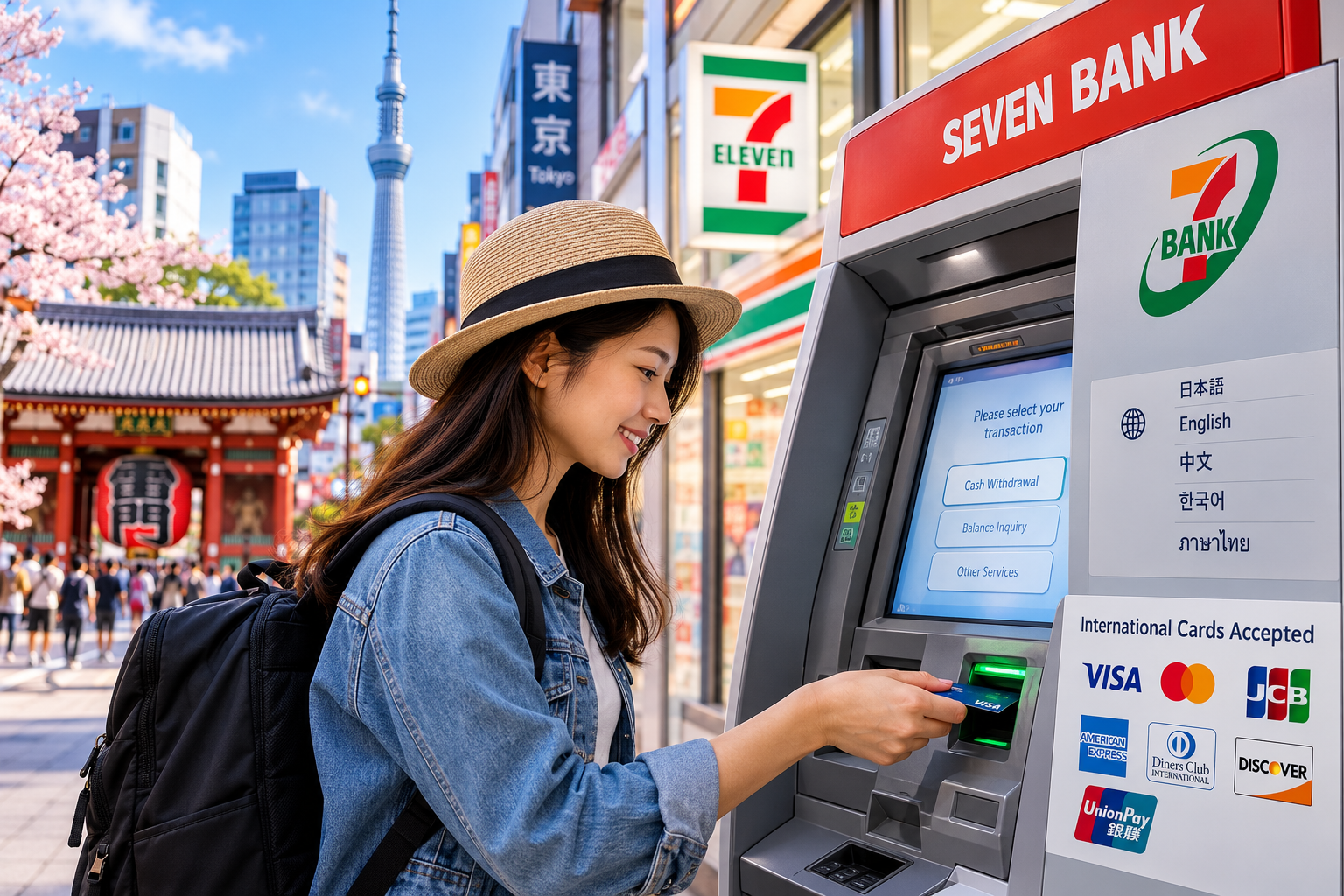
Seven Bank ATMs are widely associated with 7-Eleven convenience stores and are a practical starting point for many international visitors.
The network supports several major overseas card networks, including Visa, Mastercard, American Express, JCB, Discover, UnionPay and Diners Club, although individual cards may still be declined.
The published transaction limit for most overseas-card withdrawals is up to ¥100,000, subject to card type and other conditions.
Best for: First-time visitors, travellers who need convenient access to cash and people who prefer multilingual instructions.
Main advantage: Broad international-card support and convenient locations.
Main limitation: Your bank may impose a lower withdrawal limit or additional fees.
2. Japan Post Bank
Japan Post Bank ATMs are available at post offices and selected other locations.
The network supports several international card systems, including Visa, PLUS, Mastercard, Maestro, Cirrus, JCB, UnionPay and Discover, subject to the card and machine.
The published single-withdrawal limit for overseas cards is ¥50,000. Certain cards incur an ATM fee of ¥220 per withdrawal.
Best for: Travellers near post offices who need an alternative to convenience-store ATMs.
Main advantage: An established banking network.
Main limitation: Opening hours may be more restricted than those of convenience-store ATMs.
3. Lawson Bank
Lawson Bank ATMs are found in participating Lawson convenience stores.
The international service supports selected overseas-issued Visa, Mastercard, JCB and UnionPay cards. Its published overseas-card withdrawal limit is ¥50,000 per transaction.
Best for: Visitors who find a Lawson store nearby.
Main advantage: Convenient access in many urban neighbourhoods.
Main limitation: Not every machine necessarily supports international cards, and fees may vary.
4. E-net
E-net operates shared ATMs in selected FamilyMart stores, Don Quijote locations and other retail facilities.
Its international service lists Visa, Mastercard, UnionPay and JCB. Published withdrawal limits can reach ¥100,000 per transaction, subject to card type and other restrictions.
Best for: Travellers near participating convenience stores and retailers.
Main advantage: An additional option when another ATM network is unavailable.
Main limitation: Location, fees and card compatibility must be checked individually.
5. AEON Bank
AEON Bank ATMs are available at selected shopping centres, retail facilities and other locations.
The international-card service supports selected Visa, Mastercard, Maestro, Cirrus, PLUS, JCB, Discover and UnionPay cards. The published overseas-card withdrawal limit is ¥50,000 per transaction.
Best for: Travellers visiting large shopping centres or looking for alternatives to convenience-store ATMs.
Main advantage: Useful locations in retail areas.
Main limitation: International-card support and operating hours vary by machine.
6. Mizuho Bank
Mizuho Bank operates a large domestic banking and ATM network.
Its ATMs may be convenient when you are near a branch, but international visitors should not assume that every machine accepts overseas-issued debit cards.
Best for: Travellers near a participating branch who have verified international-card compatibility.
Main advantage: An established banking network.
Main limitation: Overseas-card acceptance must be confirmed.
7. MUFG Bank
Mitsubishi UFJ Financial Group operates one of Japan’s major banking networks.
Its ATMs are useful for domestic banking, but their suitability for international visitors depends on the machine’s supported networks and current service arrangements.
Best for: Travellers who have confirmed that their card works at a particular ATM.
Main advantage: Extensive domestic banking infrastructure.
Main limitation: Not every machine should be assumed to accept foreign-issued cards.
8. SMBC
Sumitomo Mitsui Banking Corporation operates branches and ATMs throughout Japan.
For international visitors, the important consideration is whether the particular ATM supports the card being used.
Best for: Travellers near a participating SMBC ATM who have checked international access.
Main advantage: An established banking network.
Main limitation: Overseas-card compatibility is not universal.
9. Resona Bank
Resona Bank operates branches and ATMs in the Tokyo metropolitan area and other parts of Japan.
Its network may be convenient when you are already near a branch, but international visitors should verify foreign-card acceptance before relying on it.
Best for: Travellers near a Resona location who have confirmed compatibility.
Main advantage: An additional banking option.
Main limitation: International-card support must be checked.
10. Airport ATM facilities
Haneda and Narita airports provide ATM facilities operated by different banks and financial service providers.
These machines can be useful immediately after landing, particularly if you need yen for transport, food or small purchases.
Best for: Visitors who arrive without Japanese cash.
Main advantage: Convenient access before travelling into central Tokyo.
Main limitation: Fees, transaction limits and supported card networks vary by operator.
Tokyo ATM comparison table
| ATM network | Where to look | Published overseas-card limit | Main consideration |
|---|---|---|---|
| Seven Bank | 7-Eleven and selected facilities | Up to ¥100,000 for most overseas-card withdrawals | Broad international-card support |
| Japan Post Bank | Post offices and selected facilities | ¥50,000 | Certain cards incur a ¥220 fee |
| Lawson Bank | Participating Lawson stores | ¥50,000 | Check the machine’s supported cards |
| E-net | Selected convenience stores and retailers | Up to ¥100,000, subject to card type | Fees and compatibility vary |
| AEON Bank | Shopping centres and selected facilities | ¥50,000 | Check international access |
| Mizuho Bank | Bank branches and selected ATMs | Verify locally | International compatibility varies |
| MUFG Bank | Bank branches and selected ATMs | Verify locally | Check overseas-card support |
| SMBC | Bank branches and selected ATMs | Verify locally | Check machine-specific terms |
| Resona Bank | Bank branches and selected ATMs | Verify locally | Check international compatibility |
| Airport ATM facilities | Haneda and Narita terminals | Depends on operator | Convenient for initial cash |
These figures are operator-level guidelines, not guaranteed limits for every card. Your bank may impose lower limits, and additional restrictions may apply.
Where to Find ATMs Around Tokyo
Haneda and Narita airports
Airport ATMs are useful if you arrive without Japanese currency.
Before withdrawing:
- Confirm that the ATM supports your card.
- Check the displayed transaction fee.
- Review any currency-conversion offer.
- Withdraw enough for immediate expenses without automatically taking out your entire travel budget.
Haneda is closer to central Tokyo than Narita for many destinations, but the most convenient ATM depends on your terminal and onward journey.
Shinjuku
Shinjuku is a major transport, shopping and accommodation district. Convenience stores provide useful places to look for Seven Bank and other participating ATM networks.
Large railway stations have multiple exits and complex underground passages, so an ATM a short distance outside the station may be easier to reach than one inside a busy concourse.
Shibuya
Shibuya attracts shoppers, tourists and nightlife visitors. Convenience stores around its main streets can provide convenient cash access.
If you plan to stay out late, identify an alternative ATM before leaving the main shopping area. A particular machine may be temporarily unavailable or may not support your card.
Tokyo Station and Marunouchi
Tokyo Station connects major railway services and is surrounded by hotels, shopping facilities and offices.
ATMs can be found in commercial buildings, convenience stores and nearby facilities. However, building access hours and ATM operating hours may differ.
Asakusa
Asakusa is popular for traditional shopping streets, temples and local food. Some independent businesses may prefer cash or accept fewer payment methods.
Consider withdrawing enough money before exploring if you expect to make several small purchases.
Akihabara and Ueno
Akihabara is known for electronics shopping, while Ueno has markets and busy shopping streets.
Many larger retailers accept cards, but smaller businesses may have different payment policies. Carry a modest amount of yen and a backup payment method.
How to find a suitable ATM
Use a map or the relevant ATM operator’s location service to find a machine near your hotel, station or destination.
Before setting off, check:
- Whether the ATM accepts your card network.
- Its opening hours.
- The applicable withdrawal fee.
- The machine’s location inside a station or building.
- Whether an alternative ATM is nearby.
Tokyo ATM Fees: How Much Does a Withdrawal Cost?
The cost of withdrawing cash can include several separate charges. The ATM’s displayed fee may represent only one part of the total.
1. ATM operator fee
Some ATM operators charge a fee for overseas-card withdrawals. Japan Post Bank, for example, states that certain overseas cards incur a ¥220 fee per withdrawal.
Other operators may apply fees according to the card type, amount or transaction conditions.
2. Your home bank’s withdrawal fee
Your bank may charge a fixed fee or a percentage for withdrawing money abroad.
Some accounts offer fee-free international withdrawals, while others charge for every transaction.
3. Currency conversion costs
Your withdrawal is converted from Japanese yen into your account’s currency.
The final cost may depend on your bank’s exchange rate, card network arrangements and any foreign transaction charges.
4. Dynamic currency conversion
Some ATMs offer to convert the transaction into your home currency immediately.
This may seem convenient because you can see an amount in familiar currency, but the exchange rate offered by the ATM may be less favourable than the rate available through your card issuer.
Always compare the displayed terms before accepting a conversion offer.
Example: comparing two withdrawals
Assume an ATM charges ¥220 and your home bank charges ¥300 per withdrawal. These figures are illustrative, not a quote for a specific card.
| Detail | Withdrawal A | Withdrawal B |
|---|---|---|
| Cash withdrawn | ¥10,000 | ¥30,000 |
| ATM fee | ¥220 | ¥220 |
| Home-bank fee | ¥300 | ¥300 |
| Total assumed fees | ¥520 | ¥520 |
| Fees as a percentage of cash | 5.2% | About 1.73% |
When fees are fixed per transaction, fewer appropriately sized withdrawals can reduce the percentage cost.
However, withdrawing too much cash can increase the risk of loss or theft. Choose an amount that balances cost, convenience and security.
How to calculate your withdrawal cost
Your overall cost may include:
- The ATM operator fee.
- Your bank’s international withdrawal fee.
- Any foreign transaction fee.
- The exchange-rate margin.
- Other charges specified by your card issuer.
Check your card’s terms before travelling. A card that reimburses ATM fees may be cheaper than one that does not, even when both use the same machine.
Is a credit card suitable for ATM withdrawals?
A credit card withdrawal may be treated as a cash advance. Depending on your card agreement, it can involve an additional fee and interest from the date of the transaction.
For routine travel spending, an international debit card with transparent withdrawal fees is often more straightforward.
How to Withdraw Money from a Tokyo ATM
Using an ATM is usually simple once you have found a compatible machine.
Step 1: Check your card Tokyo ATMs
Look at your physical card for the Visa, Mastercard, PLUS, Cirrus, JCB or other network logo.
Compare it with the symbols displayed on the ATM. If the machine does not support your card, choose another one.
Step 2: Insert your card Tokyo ATMs
Follow the on-screen instructions. Some machines may support different card insertion methods or contactless transactions.
Keep your card in sight throughout the process.
Step 3: Select English Tokyo ATMs
Many tourist-oriented ATMs provide English-language instructions. The available languages depend on the operator and machine.
Step 4: Choose cash withdrawal Tokyo ATMs
Select the option labelled Withdrawal or Cash Withdrawal.
The wording may differ between machines.
Step 5: Select your account type Tokyo ATMs
The ATM may ask whether you want to withdraw from a checking, savings or another account type.
Choose the option that matches your card and account instructions. If you are uncertain, consult your bank.
Step 6: Enter your PIN Tokyo ATMs
Enter your ATM PIN carefully and shield the keypad with your hand.
Do not repeatedly guess if you have forgotten your PIN, because your bank may block the card after unsuccessful attempts.
Step 7: Enter the amount Tokyo ATMs
Select a preset amount or enter your preferred amount if the machine permits it.
If your request is rejected, you may have exceeded the ATM’s transaction limit, your available balance or your bank’s daily withdrawal limit.
Step 8: Review fees and conversion Tokyo ATMs
Read the screen before confirming.
If the machine offers to convert the withdrawal into your home currency, compare the displayed rate and charges. Choosing Japanese yen and allowing your card issuer to perform the conversion is often a sensible starting point, but your bank’s own terms still matter.
Step 9: Collect your cash, card and receipt Tokyo ATMs
Wait until the transaction finishes. Collect your money and card, and retain the receipt if you need it for budgeting or expense reporting.
Step 10: Secure your money Tokyo ATMs
Put your cash and card away before leaving the ATM. Avoid counting a large withdrawal in a crowded public area.
If the machine retains your card, contact the ATM operator and your bank immediately.
How to Avoid Poor Exchange Rates Tokyo ATMs
Exchange-rate decisions can have a bigger financial impact than a small ATM fee, especially on larger withdrawals.
Choose Japanese yen when appropriate Tokyo ATMs
Suppose your home account is in US dollars, British pounds, euros or Pakistani rupees and you withdraw ¥20,000.
The ATM may offer to convert the withdrawal into your home currency. Alternatively, it may process the transaction in yen and let your bank or card network handle conversion.
These are different arrangements.
With dynamic currency conversion, the ATM or its conversion provider sets the displayed rate. With a yen-denominated transaction, your card issuer generally applies its own conversion arrangements.
Unless you have confirmed that the ATM’s offer is competitive, selecting Japanese yen is often the better starting point.
This does not guarantee the lowest cost because your bank may apply its own foreign transaction fees or conversion margin.
Compare the total cost, not just the ATM fee Tokyo ATMs
A machine may charge a relatively low fee while offering a less favourable exchange rate.
For example, a ¥220 transaction fee is easy to see on the screen. A percentage difference in the exchange rate may be less obvious but can cost more on a larger withdrawal.
Why your bank statement may differ Tokyo ATMs
The final amount charged to your account may differ from your estimate because of:
- The exchange rate applied when the transaction is processed.
- Fees charged by your card issuer.
- Network conversion arrangements.
- Separate foreign transaction charges.
Keep your receipt until the transaction appears on your bank statement.
Which ATM Is Best for Your Situation?
For first-time visitors Tokyo ATMs
Start with a Seven Bank ATM if it supports your card. Its international-card services and multilingual instructions make it a practical option.
For late-night withdrawals Tokyo ATMs
Look for a participating convenience-store ATM. Check the specific machine’s service hours because maintenance and card-network restrictions can still apply.
For lower withdrawal costs Tokyo ATMs
Compare the displayed ATM fee with your bank’s overseas withdrawal fee and exchange-rate policy. No single network is automatically the cheapest for everyone.
For shopping trips Tokyo ATMs
AEON Bank and E-net may be useful alternatives when their machines are available at the shopping facilities you visit.
For post-office locations Tokyo ATMs
Japan Post Bank is worth considering when you are near a post office. Check opening hours and fees before relying on it.
Cash, Cards and Transport IC Cards: What Should You Use?
Cash withdrawals are only one part of managing money in Tokyo. A practical payment strategy combines several methods.
Cash Tokyo ATMs
Cash is useful at smaller businesses, traditional markets and some facilities that do not accept international cards.
Its main disadvantage is that lost cash is difficult to recover.
International debit cards Tokyo ATMs
Debit cards provide access to funds in your bank account. Costs depend on your account’s overseas withdrawal fees, conversion arrangements and daily limits.
Before travelling, make sure international withdrawals are enabled and that you know your PIN.
Credit cards Tokyo ATMs
Credit cards are convenient for hotels, shopping, restaurants and many larger businesses.
However, acceptance varies by merchant, and cash withdrawals may be expensive if treated as cash advances.
Suica and PASMO Tokyo ATMs
Suica and PASMO are transport IC cards that can also be used at participating convenience stores, vending machines and other businesses.
They can reduce the need to purchase individual train tickets, but they do not replace cash everywhere. Some card purchase and top-up methods require cash.
Mobile payments Tokyo ATMs
Mobile wallets can be convenient, but international visitors should not assume that every payment app or digital wallet used at home will work everywhere in Japan.
Compatibility depends on the device, card issuer, payment service and merchant.
A practical payment combination Tokyo ATMs
For most visitors, a useful combination is:
- One international debit card for cash withdrawals.
- A separate backup card.
- A modest amount of Japanese yen.
- A Suica or PASMO card for eligible transport and purchases.
This approach offers flexibility without requiring you to carry a large cash balance.
Common Tokyo ATM Problems and Their Solutions
Problem 1: Your foreign card is declined Tokyo ATMs
Possible causes include an unsupported card network, disabled international withdrawals, insufficient available funds or a bank security block.
Solution:
- Check the ATM’s supported card logos.
- Confirm international withdrawals are enabled.
- Check your balance and cash withdrawal limit.
- Try another compatible ATM.
- Contact your bank if the problem continues.
A declined transaction does not necessarily mean your account has insufficient funds.
Problem 2: Your PIN is rejected Tokyo ATMs
Check that you are using your ATM PIN rather than your online banking password or card security code.
If you are unsure of the PIN, stop trying and contact your card issuer through its official app or customer service.
Problem 3: The withdrawal limit is too low Tokyo ATMs
Your limit may be set by the ATM operator, card network, issuing bank or account settings.
Seven Bank publishes a limit of up to ¥100,000 for most overseas-card withdrawals, while Japan Post Bank and AEON Bank publish a ¥50,000 limit.
If the ATM rejects your requested amount, try a smaller withdrawal if appropriate. Remember that multiple transactions may result in multiple fees.
Problem 4: The ATM is unavailable at night Tokyo ATMs
A convenience store may remain open while its ATM is temporarily unavailable.
Identify an alternative ATM network before you urgently need cash. Do not assume that every ATM in a 24-hour store provides uninterrupted service.
Problem 5: You cannot understand the screen Tokyo ATMs
Look for a language-selection option near the start of the transaction.
If you cannot understand the fees or currency-conversion terms, cancel the transaction and choose another machine. Never confirm a financial transaction you do not understand.
Problem 6: The ATM retains your card Tokyo ATMs
Contact the ATM operator immediately and notify your bank.
Ask your issuer whether the card should be blocked or replaced. Keep any receipt or reference number and use another payment method while the issue is resolved.
Problem 7: Your account is charged but no cash appears Tokyo ATMs
Do not immediately repeat the withdrawal.
Check your banking app to see whether the transaction is pending or completed. Keep the receipt, record the machine’s location and transaction time, and contact the ATM operator and card issuer.
The time required to resolve the problem can vary.
ATM Safety Tips for Visitors
Tokyo is widely regarded as a relatively safe destination, but ordinary financial precautions remain important.
Protect your PIN Tokyo ATMs
Cover the keypad when entering your PIN, even if no one appears to be watching.
Use a recognised ATM Tokyo ATMs
Prefer machines inside established convenience stores, banks, airports or shopping centres. Avoid unfamiliar machines that appear tampered with or request unusual information.
Keep your cash private Tokyo ATMs
Put your money away before leaving the ATM. Avoid displaying your entire cash balance while shopping.
Carry a backup payment method Tokyo ATMs
Keep your backup card separate from your primary card. If your wallet is lost, a second payment method can help you access funds.
Check your transactions Tokyo ATMs
Enable banking notifications if available. Review your account after withdrawals and report transactions you do not recognise.
Save your bank’s contact details Tokyo ATMs
Store your bank’s international contact number somewhere separate from your wallet. This can be useful if your card is lost, stolen or blocked.
Advantages and Disadvantages of Using ATMs in Tokyo
| Advantages Tokyo ATMs | Disadvantages Tokyo ATMs |
|---|---|
| Convenient access to Japanese yen | Not every machine accepts foreign cards |
| Convenience-store ATMs are widely available | Operator and bank fees can accumulate |
| Some networks provide multilingual instructions | Transaction limits vary |
| Cash can be withdrawn when needed | Currency-conversion choices can be confusing |
| Receipts can help with budgeting | Temporary outages and maintenance can occur |
| ATMs complement cashless payments | Credit card withdrawals may be expensive |
The balanced view Tokyo ATMs
ATMs are a practical way to obtain Japanese yen, especially when your home bank offers reasonable international withdrawal terms.
However, relying on one card or one ATM network can create problems if the card is blocked, lost or incompatible with a particular machine.
Prepare before departure, identify suitable ATM networks and keep a backup payment method available.
Tokyo ATMs for Different Types of Travellers
First-time international tourists Tokyo ATMs
Start by locating a Seven Bank ATM and checking the supported card symbols. Make a modest initial withdrawal so you can confirm that your card works and understand the transaction fees.
Budget travellers and backpackers Tokyo ATMs
Focus on the total cost of obtaining cash.
If your bank charges a fixed fee for each withdrawal, fewer appropriately sized withdrawals may reduce costs. Avoid withdrawing money simply because an ATM is convenient.
Families travelling with children Tokyo ATMs
Families may prefer to carry a reasonable cash reserve for meals, small purchases and unexpected expenses.
Keep emergency cash separate from your main wallet and ensure at least one adult has access to an independent backup payment method.
Business travellers Tokyo ATMs
Business travellers may need receipts and predictable access to funds.
Use a card with transparent international charges, retain receipts when required for expense reporting and check whether your employer has a preferred travel payment method.
Long-term visitors and international students Tokyo ATMs
People staying in Japan for several months may eventually qualify to open a local bank account, depending on their residence status and eligibility.
Until then, international cards can help provide access to funds. Review recurring withdrawal charges because small fees can accumulate over a longer stay.
Visitors travelling from Pakistan Tokyo ATMs
If your home account is in Pakistani rupees, your bank’s international withdrawal rules and currency-conversion arrangements are especially important.
Before departure:
- Confirm that your debit card supports international cash withdrawals.
- Ask about overseas transaction fees and cash withdrawal limits.
- Check whether international usage must be enabled.
- Understand how transactions in yen are converted into your account currency.
- Carry a second eligible payment method if possible.
Not every Pakistani-issued card will work simply because it carries an international network logo. Acceptance depends on the ATM and your issuing bank.
Travellers who prefer cashless payments Tokyo ATMs
Cards and compatible mobile wallets can cover many everyday purchases in Tokyo.
However, cash may still be needed at certain independent businesses and facilities. Keeping a small emergency cash reserve provides additional flexibility.
How Much Yen Should You Withdraw?
The amount of cash you need depends on your travel style, length of stay and planned activities.
Consider these factors:
- How many meals will you pay for in cash?
- Will you visit markets or small independent businesses?
- How much of your transport will be paid electronically?
- Does your bank charge a fixed fee per withdrawal?
- Will you travel beyond central Tokyo?
For example, a traveller spending three days in Tokyo might plan for ¥5,000 per day in cash, plus a ¥2,000 emergency reserve.
That would produce a planned cash requirement of ¥17,000 before subtracting any yen already carried.
This is an illustrative budget, not a prediction of actual spending. Travellers who pay for most purchases electronically may need substantially less.
Future Trends in Tokyo’s ATM and Payment Landscape
Japan’s payment landscape continues to evolve. International visitors have access to a range of card payments, digital wallets and cash withdrawal services, while ATMs remain useful for accessing physical currency.
Greater use of cashless payments
As more businesses accept digital payments, some travellers may need fewer ATM withdrawals. Cash will remain useful wherever a business does not support a visitor’s preferred payment method.
Continued importance of international-card support
Convenient access to money is important for international tourism. ATM operators have an incentive to provide clear instructions and support widely used international card networks.
However, compatibility will continue to depend on the operator, machine and issuing bank.
Better multilingual experiences
Clearer instructions and multilingual interfaces can make financial transactions easier for visitors unfamiliar with Japanese banking terminology.
More attention to fee transparency
Travellers are increasingly aware of withdrawal fees, conversion margins and dynamic currency conversion. Clear fee disclosures help people compare the true cost of obtaining cash.
Cash and digital payments will coexist
The most practical expectation is that visitors will continue using a combination of cash, cards, transport IC cards and compatible digital payment methods.
For travellers, flexibility is more valuable than depending on a single payment technology.
FAQs
Which ATM is best for foreigners in Tokyo?
Seven Bank ATMs in 7-Eleven stores are a strong first choice because they support many major international card networks and provide multilingual instructions. Japan Post Bank, Lawson Bank and E-net are useful alternatives.
Can I use my Visa or Mastercard in Tokyo?
Yes, many Japanese ATMs accept overseas-issued Visa and Mastercard cards. However, acceptance is not guaranteed at every machine, and your bank must permit international withdrawals.
Are Tokyo ATMs open 24 hours?
Many convenience-store ATMs provide extended or around-the-clock access. Other machines may have restricted hours or maintenance periods. Check the specific machine before relying on it late at night.
How much cash can I withdraw from a Tokyo ATM?
It depends on the network and your card. Seven Bank publishes a limit of up to ¥100,000 per transaction for most overseas-card withdrawals, while Japan Post Bank and AEON Bank publish a ¥50,000 limit. Your bank may impose a lower limit.
Do Tokyo ATMs charge foreign withdrawal fees?
Some do. Certain overseas cards incur a ¥220 fee at Japan Post Bank ATMs. Your home bank may charge additional fees, so check both sets of terms.
Can I withdraw yen using a Pakistani debit card?
Potentially, provided your card supports international withdrawals, the ATM accepts its network and your bank authorises the transaction. Check your bank’s overseas usage settings, fees and withdrawal limits before travelling.
Should I choose yen or my home currency?
When given a choice, selecting Japanese yen and allowing your card issuer to handle the conversion is often a sensible starting point. Compare the displayed rate and charges before accepting an ATM’s conversion offer.
Can I use a credit card to withdraw cash?
Some credit cards support cash advances, but these may involve additional fees and interest from the transaction date. Check your card agreement before using this feature.
Are there ATMs at Haneda and Narita airports?
Yes, both airports have ATM facilities. The available operators, accepted cards and locations vary, so check the machine’s international-card symbols before withdrawing.
Can I find ATMs near Tokyo train stations?
Yes. ATMs are available in many station areas, commercial buildings and nearby convenience stores. However, not every machine accepts foreign cards, and operating hours vary.
Is exchanging money better than using an ATM?
It depends on your home bank’s fees, the ATM’s charges and the exchange rate offered by a currency exchange service. Compare the total cost rather than assuming either method is always cheaper.
Can I use Apple Pay or Google Pay instead of withdrawing cash?
You can use compatible digital wallets at participating merchants, but acceptance depends on the device, payment card, service and merchant. Carry a physical card and some cash as backups.
What if the ATM charges my account but does not dispense cash?
Keep your receipt, record the machine’s location and transaction time, and contact the ATM operator and card issuer. Avoid immediately repeating the transaction until you have checked its status.
Are Japanese bank ATMs better than convenience-store ATMs?
Not necessarily. Convenience-store networks are often easier for international visitors to use, while some domestic bank ATMs may not accept overseas-issued cards. Choose based on verified compatibility, fees and operating hours.
Conclusion
Finding an ATM in Tokyo is usually straightforward once you know where to look. The key is to choose a compatible machine, understand the fees and keep a backup payment method available. Seven Bank ATMs are a practical starting point for many international visitors. Japan Post Bank, Lawson Bank, E-net and AEON Bank offer additional options depending on location and card compatibility.