Tokyo Passes: 10 Best Options to Save Money and Explore Tokyo Smarter
Planning a Tokyo trip can feel overwhelming. The city has an enormous public transportation network, hundreds of attractions, and countless neighborhoods that can easily fill a week or more. For first-time visitors, one of the biggest questions is whether buying a Tokyo pass will actually save money or simply add another travel expense. Tokyo passes can save travelers money and time when their included attractions or transportation match their itinerary, but there is no single pass that is best for every visitor. The smartest approach is to choose a pass based on where you plan to go, how frequently you will travel, and which attractions you genuinely want to visit Tokyo Landscapes
What Are Tokyo Passes?
Tokyo passes are prepaid travel products that provide access to transportation, attractions, sightseeing services, or combinations of these services for a defined period.
Depending on the product, a pass might provide:
- Unlimited subway travel
- Unlimited travel on selected railway lines
- Access to tourist attractions
- Sightseeing bus transportation
- Discounts at participating facilities
- Airport-to-city transportation
- Entry to multiple attractions
- Regional transportation outside central Tokyo
The important point is that “Tokyo pass” does not describe one specific product.
Instead, it is a broad term used by travelers to describe several different types of tickets.
Transportation Passes
Transportation passes are designed for travelers who expect to use public transportation frequently.
Some cover Tokyo Metro and Toei Subway services, while others are limited to particular railway operators or geographic areas.
Attraction Passes
Attraction passes bundle admission to multiple tourist attractions.
These can be valuable for travelers who plan to visit several participating attractions in a short period.
Combination Passes
Combination products may include transportation together with attraction admission, sightseeing buses or other tourist services.
These can be convenient because travelers do not have to purchase every component separately.
Why Tokyo Passes Can Be Confusing
Tokyo has one of the world’s most extensive urban transportation systems.
Several railway companies operate different services, including:
- Tokyo Metro
- Toei Subway
- JR East
- Private railway operators
- Airport railway services
- Regional railway companies
This means a pass covering one network does not necessarily cover another.
For example, a subway pass may be excellent for moving between Ginza, Asakusa, Ueno and Shibuya using eligible subway routes, but it may not cover every JR journey.
This is one of the biggest mistakes international visitors make.
Unlimited Does Not Always Mean Everything
The word “unlimited” sounds attractive, but it needs context.
An unlimited subway ticket generally means unlimited rides within the participating subway network during its validity period.
It does not necessarily mean:
- Unlimited JR travel
- Unlimited airport transportation
- Unlimited travel to Tokyo Disneyland
- Unlimited travel throughout Greater Tokyo
- Unlimited travel on private railway lines
Always check the participating operators before purchasing.
The 10 Tokyo Passes and Travel Products Worth Comparing
The following comparison covers widely relevant pass categories and products that travelers may encounter when planning Tokyo trips.
Availability, eligibility, pricing and included services can change, so travelers should verify current conditions before purchase.
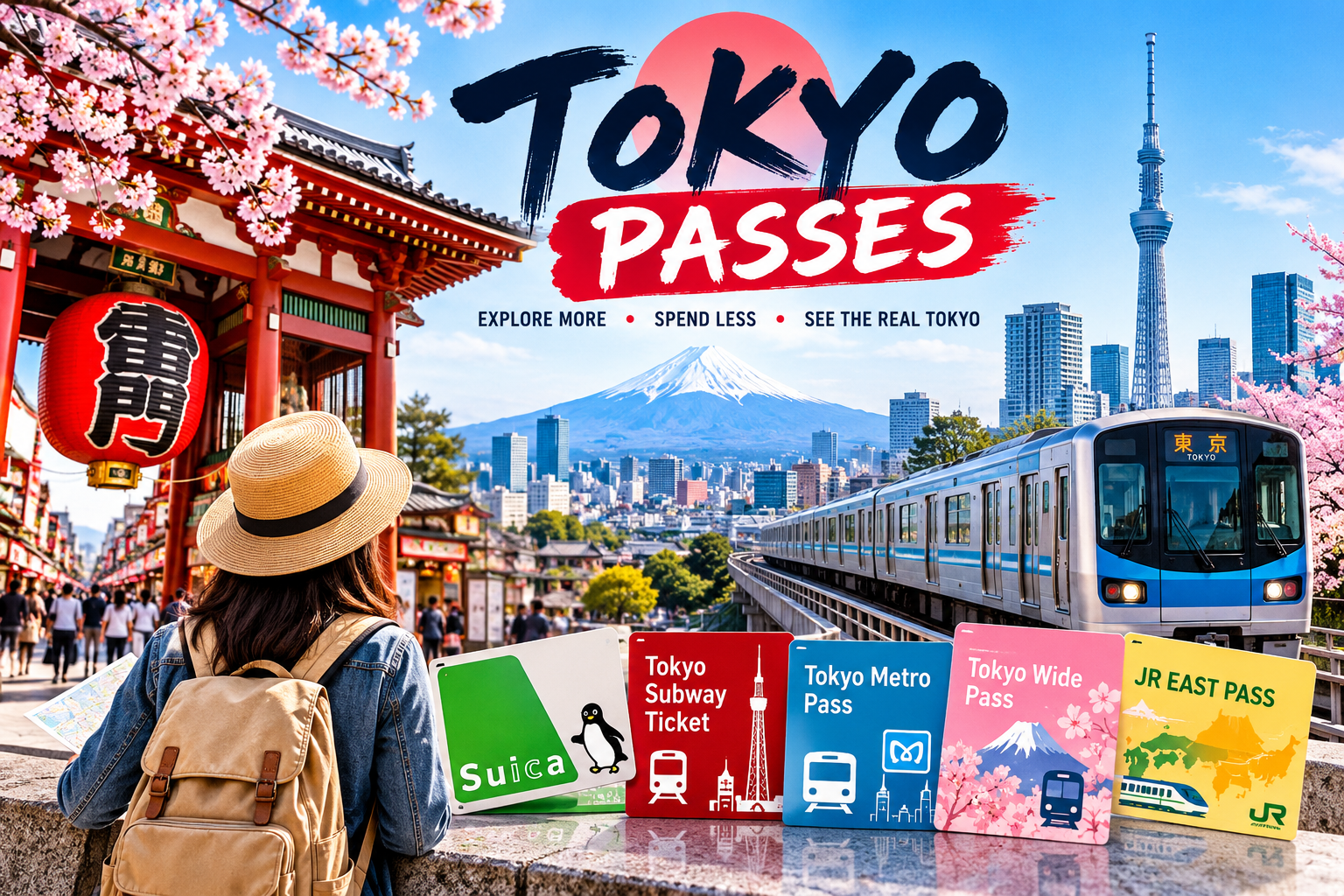
Tokyo Subway Ticket
The Tokyo Subway Ticket is one of the most recognizable options for visitors who expect to spend much of their trip traveling by subway.
It can be particularly useful when your itinerary involves several subway-accessible neighborhoods in a single day.
Who Should Consider It?
This type of ticket can work well for:
- First-time visitors
- Short city breaks
- Travelers staying near subway stations
- Visitors planning several subway journeys per day
- Tourists moving between multiple central Tokyo neighborhoods
When It Makes Sense
Imagine a visitor staying near Ueno.
During one day they might travel to:
- Asakusa
- Ginza
- Omotesando
- Shinjuku
- Akihabara
- Ueno
If several of those journeys can be made using eligible subway services, an unlimited subway ticket may provide useful value and convenience.
When It May Not Be Worth It
If you make only two or three journeys in a day, paying for unlimited travel may not provide meaningful savings.
An IC card can sometimes be simpler.
Tokyo Metro 24, 48 and 72-Hour Tickets
Tokyo Metro offers visitor-oriented time-based subway ticket options.
The key advantage is straightforward: you pay for a defined period and can use eligible Tokyo Metro services during that validity period.
24-Hour Tickets
A 24-hour option can suit visitors who have a concentrated sightseeing day.
It is especially useful when your hotel and attractions are close to Tokyo Metro stations.
48-Hour Tickets
A 48-hour ticket can be attractive for travelers with a busy two-day itinerary.
Instead of thinking about individual fares for every trip, you can focus on your sightseeing schedule.
72-Hour Tickets
A three-day option may appeal to visitors spending several consecutive days exploring central Tokyo.
However, do not assume that a three-day pass automatically saves money.
The correct question is:
How many eligible rides will I actually make?
Toei One-Day Pass
Tokyo’s Toei network includes subway services as well as other transportation services.
A Toei-focused pass can be useful when your itinerary naturally aligns with those routes.
Best Uses
It can make sense for travelers visiting areas connected by Toei services and who expect frequent journeys during the validity period.
However, a traveler whose itinerary mainly uses Tokyo Metro routes may find another option more appropriate.
Tokyo 1-Day Ticket
A broader Tokyo transportation ticket can be useful for visitors who want more flexibility than a single-network pass provides.
The main advantage is network coverage.
The disadvantage is that broader coverage usually requires travelers to understand exactly which services are included.
The Important Question
Before purchasing, look at your planned routes.
Do not start with:
“Which pass should I buy?”
Start with:
“Which transportation services will I use?”
Then choose the pass.
Greater Tokyo Pass
Travelers planning to explore areas outside central Tokyo may encounter broader regional transportation products.
These can be useful for trips involving multiple private railway networks and destinations around the Greater Tokyo region.
Who Benefits Most?
Regional transportation passes are more likely to make sense for:
- Longer stays
- Travelers taking several regional excursions
- Visitors exploring destinations outside the central Tokyo sightseeing zone
- Travelers who prefer a single pass for several eligible journeys
Who Probably Does Not Need One?
If your entire trip involves:
- Shibuya
- Shinjuku
- Harajuku
- Asakusa
- Ginza
- Ueno
then a regional pass may be unnecessary.
JR Tokyo Wide Pass
The JR Tokyo Wide Pass is a different type of product because its strength is regional exploration rather than ordinary central-Tokyo sightseeing.
It can be particularly interesting for travelers considering destinations outside Tokyo within the area covered by the pass.
Why Day Trips Change the Calculation
Tokyo is an excellent base for day trips.
Depending on the season and itinerary, travelers may consider destinations such as:
- Nikko
- Kawaguchiko
- Gala Yuzawa
- Ibaraki-area destinations
- Other regional locations covered by applicable JR services
The value of a regional JR pass can therefore be much greater when you are making substantial journeys outside the city.
Central Tokyo vs Regional Travel
This is an important distinction.
A traveler spending three days inside Tokyo may get little benefit from a regional pass.
A traveler using the same three days for multiple long-distance excursions may find the economics very different.
Tokyo Pass
The term “Tokyo Pass” is also associated with attraction-focused sightseeing products.
These products are fundamentally different from subway passes.
Instead of paying primarily for transportation, you are paying for access to participating attractions.
How Attraction Passes Work
An attraction pass may provide access to a selection of participating locations during a specified period.
The potential benefit is that buying several admissions individually may cost more than the bundled product.
The Catch
You need to visit enough attractions to justify the pass.
This is where many tourists make a mistake.
They see a long attraction list and think:
“I could visit all of these.”
In reality, Tokyo’s attractions can take substantial time.
A museum might take two hours.
A major observation deck may require travel and waiting.
A cultural attraction may take several hours.
Trying to maximize a pass can turn a vacation into a checklist.
Tokyo Hop-on Hop-off Bus Tickets
Sightseeing buses are another option worth considering.
They are not always the fastest way to move around Tokyo, but they offer a different experience.
Why Tourists Like Them
A sightseeing bus can provide:
- Easy orientation
- Preplanned sightseeing routes
- Views from above street level
- Less navigation stress
- Commentary on some services
- Convenient access to major tourist areas
The Main Disadvantage
Tokyo traffic can make buses slower than rail.
If your objective is simply to reach a destination quickly, trains and subways are usually more efficient.
If your objective is sightseeing while traveling, the calculation changes.
Airport Transportation Tickets
Airport transportation deserves separate consideration.
Visitors arriving at Haneda or Narita may encounter different railway and bus products designed specifically for airport transfers.
These are often more useful when purchased according to your actual airport and hotel location rather than simply selecting a general Tokyo pass.
Haneda Airport
Haneda is relatively close to central Tokyo.
Depending on where you are staying, several transportation options may be available.
Narita Airport
Narita is considerably farther from central Tokyo.
The airport transfer can therefore become a more significant part of your transportation budget.
This is why airport transportation should be calculated separately from your daily sightseeing costs.
Tokyo Passes for Different Types of Travelers
There is no universal best pass.
The ideal option depends on the traveler.
Tokyo Passes for First-Time Visitors
First-time visitors often benefit from simplicity.
A combination of an IC card and occasional tourist tickets may be easier than trying to optimize every journey.
Tokyo Passes for Families
Families should consider walking distances and the number of journeys required by children.
A pass can be valuable if everyone is making frequent eligible trips.
But family itineraries often include attractions where admission costs are more important than transportation costs.
Tokyo Passes for Couples
Couples can benefit from attraction passes if both people want to visit several included attractions.
However, couples should compare the total price against buying individual tickets.
Tokyo Passes for Budget Travelers
Budget travelers should calculate before purchasing.
A cheap pass is not necessarily a money-saving pass.
The best budget strategy is usually to avoid paying for transportation or attractions you will not use.
Tokyo Passes for Senior Travelers
Older travelers may place more value on convenience and minimizing complicated ticket purchases.
A slightly more expensive pass may sometimes be worthwhile if it simplifies transportation.
Tokyo Passes for Families With Young Children
Families with young children should avoid creating an itinerary that requires excessive transfers.
A transportation pass does not compensate for a poorly designed itinerary.
Group attractions geographically whenever possible.
Tokyo Passes by Travel Problem
Instead of choosing a pass based on its popularity, choose it according to your problem.
Problem: Too Many Subway Journeys
Consider an eligible subway pass.
Problem: Too Many Attraction Admissions
Consider an attraction-focused pass.
Problem: Several Regional Day Trips
Investigate regional JR or private railway passes.
Problem: Airport Transportation Confusion
Choose an airport transfer based on your arrival airport and hotel location.
Problem: Navigation Stress
A sightseeing bus or straightforward transportation combination may be preferable.
How to Calculate Whether a Tokyo Pass Is Worth It
This is the most useful skill a Tokyo visitor can learn.
Do not rely solely on travel blogs saying a pass is “great value.”
Calculate it yourself.
Step 1: Write Down Your Daily Destinations
For example:
- Hotel
- Asakusa
- Ueno
- Ginza
- Shibuya
- Shinjuku
Step 2: Determine Which Transport You Need
Identify whether each journey uses:
- Tokyo Metro
- Toei Subway
- JR
- Private railway
- Bus
- Airport service
Step 3: Estimate Individual Costs
Add the approximate cost of the journeys you actually expect to make.
Step 4: Compare With the Pass
Use this simple calculation:
Pass value = expected eligible transportation cost − pass price
For attraction passes:
Pass value = individual attraction admission total − pass price
Step 5: Consider Convenience
Money is not the only factor.
A pass that costs approximately the same as individual tickets might still be worthwhile if it makes your trip easier.
A Simple Example
Suppose a traveler expects to make several eligible subway journeys during one busy sightseeing day.
Buying individual fares may be inexpensive if the traveler makes only a few journeys.
But if the itinerary involves repeated subway travel across several neighborhoods, an unlimited ticket could become more attractive.
The important thing is to calculate actual usage rather than theoretical maximum usage.
The Hidden Cost of Trying to “Use” a Pass
There is a psychological trap with unlimited passes.
Once travelers purchase one, they sometimes feel they need to maximize it.
This can lead to unnecessary travel.
For example, someone might take an extra train ride simply because they have “unlimited” travel.
That journey has no financial benefit if it causes:
- Fatigue
- Lost sightseeing time
- Extra walking
- Unnecessary transfers
A pass should serve your itinerary, not control it.
Tokyo Passes and IC Cards
IC cards are among the simplest tools for Tokyo transportation.
Rather than buying an unlimited pass, travelers can use a rechargeable IC card for eligible journeys.
This can be particularly convenient when your itinerary crosses different transportation operators.
Why IC Cards Are Flexible
You generally do not need to decide your entire transportation strategy in advance.
You simply pay for eligible journeys as you travel.
When an IC Card Is Better
Consider an IC card when:
- You have a relaxed itinerary
- You expect only a few journeys each day
- Your routes use multiple operators
- You do not want to calculate pass validity
- You value flexibility
Tokyo Passes and Walking
Walking is an underrated factor in pass calculations.
Tokyo’s neighborhoods are often highly walkable.
You may discover that two attractions are close enough to walk between them.
That means you do not necessarily need unlimited train travel.
Example
Suppose your itinerary includes:
- Meiji Shrine
- Takeshita Street
- Omotesando
- Shibuya
These can potentially be combined into a logical walking itinerary.
Instead of taking multiple short train rides, you can walk between several locations.
This saves transportation costs and gives you more opportunities to experience Tokyo’s streets.
Neighborhood Planning Can Save More Than a Pass
One of the biggest secrets of affordable Tokyo travel is geographic planning.
Rather than visiting attractions randomly, organize your day by area.
Asakusa Day
Combine attractions around Asakusa and nearby eastern Tokyo.
Shibuya and Harajuku Day
Combine:
- Shibuya
- Harajuku
- Omotesando
- Meiji Shrine
Ueno and Akihabara Day
These areas can work well together depending on your interests.
Tokyo Station and Ginza Day
These neighborhoods can also be grouped into a convenient sightseeing day.
The result is fewer transportation journeys.
That can make an expensive pass unnecessary.
Common Mistakes When Buying Tokyo Passes
Mistake 1: Buying a Pass Before Planning
Do not buy a pass simply because you saw it recommended online.
Plan your itinerary first.
Mistake 2: Assuming Every Train Is Included
Tokyo has multiple operators.
Check the coverage.
Mistake 3: Confusing JR With Subway
JR and subway systems are not interchangeable.
A subway pass does not automatically cover JR trains.
Mistake 4: Ignoring Validity Rules
Some passes are valid for calendar days while others use a specific number of hours.
This difference can affect value.
Mistake 5: Trying to Visit Too Many Attractions
A pass should not encourage rushed sightseeing.
Mistake 6: Forgetting Airport Travel
Airport transfers may not be included.
Mistake 7: Buying Based on Maximum Possible Value
Theoretical value is irrelevant if you do not actually use the included services.
How to Maximize a Tokyo Pass
Start Early
If your pass is time-limited, starting early can increase the number of useful journeys within its validity period.
Group Attractions
Visit nearby attractions together.
Use Included Attractions Strategically
If an attraction requires a reservation, book it before building the rest of your day around the pass.
Avoid Unnecessary Backtracking
Tokyo is large enough that crossing the city repeatedly can waste hours.
Check Last Train Times
Unlimited travel does not mean trains operate all night.
Pros of Tokyo Passes
Tokyo passes can offer several advantages.
Predictable Spending
You know your transportation or attraction costs in advance.
Convenience
You may not need to purchase individual tickets repeatedly.
Potential Savings
Heavy users can save money compared with buying individual tickets.
Better Trip Planning
A pass can encourage travelers to organize their sightseeing efficiently.
Tourist-Friendly Options
Many products are specifically designed for international visitors.
Cons of Tokyo Passes
Not Every Route Is Covered
This is probably the biggest disadvantage.
Unused Value
If you do not use enough services, the pass may cost more than individual tickets.
Restrictions
Some passes have geographical, operator or attraction restrictions.
Overplanning
Unlimited access can tempt travelers to create unrealistic itineraries.
Changing Plans
A pass can become less valuable when weather, fatigue or unexpected changes alter your schedule.
Are Tokyo Passes Worth It?
The honest answer is:
Sometimes.
A Tokyo pass is worth considering when your itinerary contains enough included transportation or attractions to exceed the pass price.
It is less attractive when:
- You walk frequently
- Your hotel is centrally located
- You make only a few journeys each day
- Your destinations use different transportation operators
- You prefer spontaneous travel
Best Tokyo Pass Strategy for a 3-Day Trip
A three-day Tokyo vacation is common among international visitors.
A practical approach is to divide your itinerary by geography.
Day One
Focus on one major area, such as eastern Tokyo.
Day Two Tokyo passes
Explore western Tokyo.
Day Three Tokyo passes
Use the day for either additional city sightseeing or a regional excursion.
After planning the itinerary, calculate transportation costs.
Only then choose a pass.
Best Tokyo Pass Strategy for a 5-Day Trip
Five days provide more flexibility.
You can dedicate individual days to:
- Traditional Tokyo
- Modern Tokyo
- Shopping
- Museums
- Entertainment
- A regional day trip
A transportation pass may be useful for certain heavy-travel days rather than the entire trip.
This is an important strategy:
You do not necessarily need the same transportation ticket every day.
Best Tokyo Pass Strategy for a 7-Day Trip
For a week-long trip, combining different transportation methods can be more economical.
For example:
- Use an IC card on light days
- Use a subway pass on heavy subway days
- Use a regional pass for an excursion
- Purchase individual attraction tickets where appropriate
This flexible approach can outperform buying one large pass.
Tokyo Passes for International Visitors
International travelers should pay particular attention to:
- Eligibility
- Passport requirements
- Pickup procedures
- Digital versus physical tickets
- Reservation requirements
- Validity periods
- Refund conditions
Some tourist products are designed specifically for overseas visitors.
Always verify current eligibility before purchase.
Tokyo Passes for Different Budgets
Budget Travelers Tokyo passes
Prioritize:
- Walking
- IC cards
- Free attractions
- Neighborhood sightseeing
- Carefully selected day passes
Mid-Range Travelers Tokyo passes
Consider combining:
- Transportation passes
- Paid attractions
- Observation decks
- Museums
- Guided experiences
Luxury Travelers Tokyo passes
Convenience may be more important than absolute savings.
In this case, transportation simplicity, reserved seats and private transfers may sometimes be more valuable than maximizing a pass.
Tokyo Passes and Seasonal Travel
Your pass strategy can change depending on the season.
Spring Tokyo passes
Cherry blossom season can produce crowded attractions and busy transportation.
Avoid creating overly ambitious schedules.
Summer Tokyo passes
Heat and humidity make walking more tiring.
A transportation pass may become more useful simply because you want to reduce outdoor walking.
Autumn Tokyo passes
Comfortable weather can make walking between neighborhoods more enjoyable.
Winter Tokyo passes
Shorter daylight hours can change sightseeing schedules.
Pass validity should be considered alongside opening times.
Future Trends in Tokyo Passes
Tokyo’s tourism market continues to become increasingly digital.
Travelers can expect greater integration between:
- Mobile ticketing
- Digital attraction reservations
- Transportation apps
- QR-code admission
- Multilingual travel services
- Personalized itineraries
The future of Tokyo passes is likely to become less about a single physical ticket and more about integrated travel platforms.
Personalized Travel Bundles Tokyo passes
One potential direction is greater personalization.
Instead of purchasing a generic pass, travelers may increasingly receive combinations based on:
- Trip length
- Hotel location
- Preferred attractions
- Transportation patterns
- Traveler age
- Travel season
More Digital Ticketing Tokyo passes
Mobile ticketing is likely to continue expanding.
This can reduce the need for physical tickets and make transportation more convenient for international visitors.
The Most Important Question to Ask Before Buying
Forget the question:
“What is the best Tokyo pass?”
Ask this instead:
“Which pass best matches my exact Tokyo itinerary?”
That small change can save both money and time.
A Practical Tokyo Pass Decision Checklist
Before purchasing any pass, ask:
- Where am I staying?
- Which neighborhoods am I visiting?
- How many train journeys will I make?
- Which operators will I use?
- Am I using JR?
- Am I using Tokyo Metro?
- Am I using Toei Subway?
- Do I have regional day trips?
- Which attractions require admission?
- Are those attractions included?
- How long is the pass valid?
- Does validity begin immediately?
- Are reservations required?
- Is the pass available to international visitors?
- Would an IC card be simpler?
- How much would individual tickets cost?
If you can answer these questions, choosing a Tokyo pass becomes much easier.
FAQs
What is the best Tokyo pass for first-time visitors?
There is no single best option. First-time visitors should compare their planned subway, JR and private railway journeys before choosing a pass.
Is a Tokyo pass worth buying?
It can be, particularly if you make many eligible journeys or visit several included attractions. If you travel only a few times each day, individual fares or an IC card may be better.
Does a Tokyo Subway Pass include JR trains?
Generally, no. Subway passes and JR services are separate transportation systems, so always check the specific coverage of your ticket.
Does a Tokyo pass include airport transportation?
Not automatically. Airport transportation depends on the particular product. Check whether your airport route is explicitly included.
Is an IC card better than a Tokyo pass?
For flexible travel, an IC card can be easier. For very frequent eligible travel during a short period, an unlimited pass may provide better value.
Can I use a Tokyo pass for Tokyo Disneyland?
Do not assume so. Tokyo Disneyland transportation and admission are separate considerations, and you should check the exact transportation coverage of your pass.
How many days should I buy a Tokyo pass for?
Buy only as many days as make financial sense. A three-day trip does not necessarily require a three-day pass.
Are Tokyo passes available to foreign tourists?
Many visitor-oriented products are specifically designed for international travelers, but eligibility varies by product.
Can I combine different Tokyo passes?
Yes, depending on the products. You may use an attraction ticket on one day, an eligible transportation pass on another day, and an IC card throughout your trip.
Should I buy a Tokyo pass before arriving in Japan?
It depends on the product. Some tickets are available online, while others may have specific purchase or pickup requirements. Check the current official conditions before your trip.
Are Tokyo passes cheaper than individual tickets?
They can be, but not always. The answer depends on the number of eligible journeys or attractions you actually use.
What is the biggest mistake tourists make with Tokyo passes?
The biggest mistake is buying a pass first and planning the trip afterward. Plan your itinerary first, calculate your likely usage, and then choose the ticket.
Conclusion
Tokyo is one of the easiest major cities in the world to explore by public transportation, but its enormous network can make ticket selection confusing. Tokyo passes solve part of that problem by offering unlimited or bundled access, but their value depends entirely on how well they match your trip. For a busy subway-based itinerary, an appropriate subway ticket can be extremely convenient. For attraction-focused sightseeing, a multi-attraction product may reduce admission costs. For travelers venturing beyond the city, regional rail passes can become more relevant. And for visitors who want maximum flexibility, an IC card can remain one of the simplest solutions.