Tokyo Metro: The Ultimate Guide to Lines, Stations, Tickets, Fares and Easy Travel
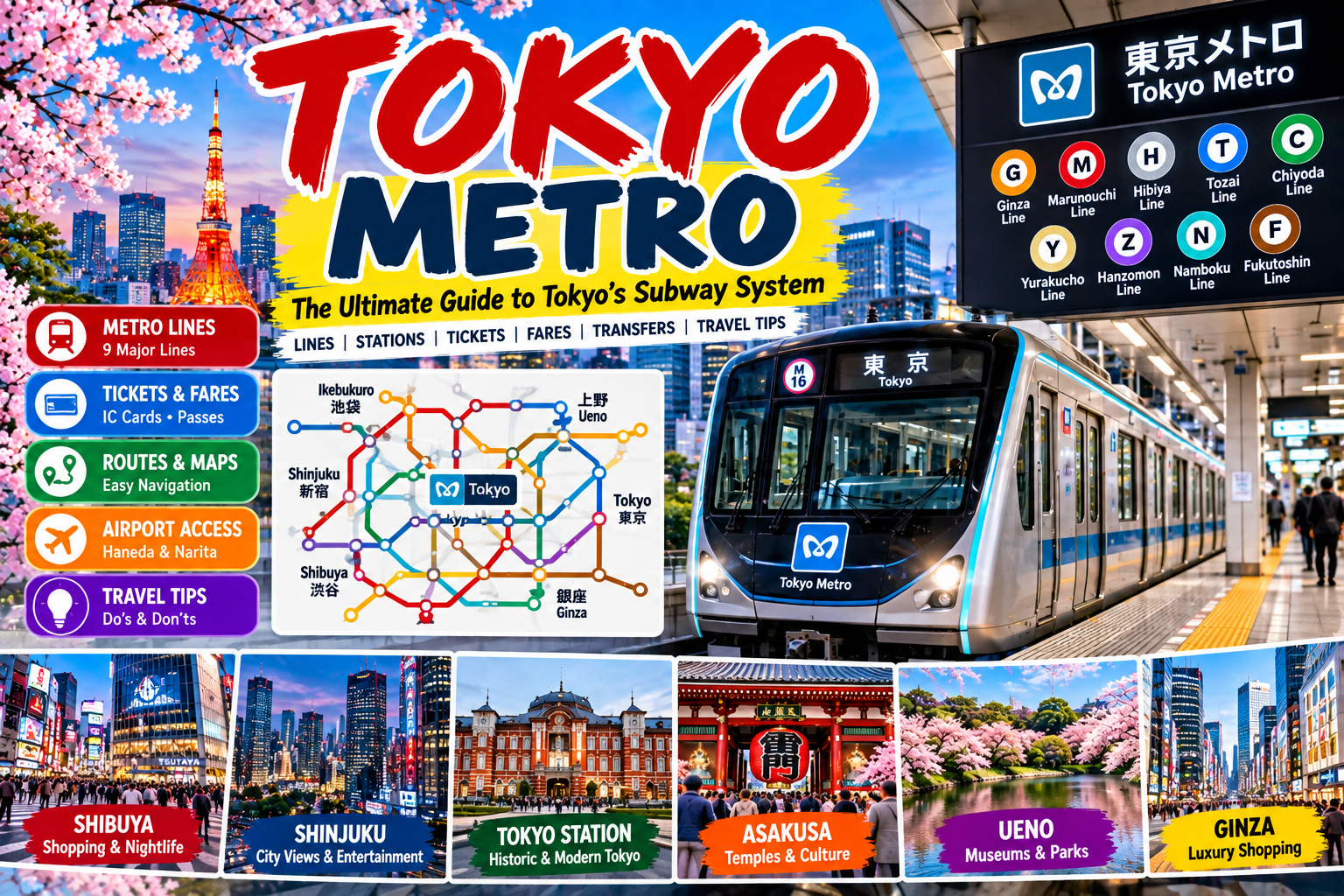
Tokyo Metro is one of the most important subway networks in Tokyo, connecting major tourist districts, business centres, shopping areas, cultural attractions and residential neighbourhoods through an extensive underground rail network. For travellers, understanding Tokyo Metro means learning its lines, station codes, ticketing system, transfers, train directions and practical station navigation rather than memorising the entire network Tokyo Alternative
What Is Tokyo Metro?
Understanding Tokyo Metro
Tokyo Metro is a major subway operator serving Tokyo.
It operates a network of underground railway lines connecting many central Tokyo neighbourhoods and important destinations.
Tokyo Metro is different from:
- JR East
- Toei Subway
- Private railway companies
- Airport railway operators
- Regional railway networks
This distinction is important because Tokyo has several independent transportation operators.
A journey can sometimes involve Tokyo Metro only, while another journey may require Tokyo Metro plus JR or Toei Subway.
Why Tokyo Metro Matters to Tourists
Tokyo Metro is particularly useful for sightseeing because its network reaches many popular destinations.
Travellers can use Tokyo Metro to access areas associated with:
- Shopping
- Food
- Culture
- Museums
- Business
- Nightlife
- Entertainment
- Traditional attractions
- Modern architecture
- Residential neighbourhoods
For tourists, Tokyo Metro often provides a practical alternative to taxis and private vehicles.
Tokyo Metro Versus Tokyo Subway
People frequently use the terms “Tokyo Metro” and “Tokyo subway” interchangeably.
Technically, Tokyo Metro is one operator within Tokyo’s broader subway system.
The other major subway operator is Toei Subway.
Therefore:
Tokyo subway = broader system
Tokyo Metro = specific subway operator
Understanding this distinction can prevent confusion when purchasing tickets or planning transfers.
The History and Development of Tokyo Metro
From Early Underground Railways to a Modern Network
Tokyo’s subway development began more than a century ago as the city expanded and surface transportation became increasingly important.
Over time, underground railway routes were developed to connect growing commercial and residential areas.
The network evolved alongside Tokyo itself.
As Tokyo became a global economic centre, subway transportation became increasingly important for moving large numbers of people through densely developed urban districts.
Why Underground Transportation Became Essential
Tokyo has limited road space compared with its enormous population and economic activity.
An underground railway allows thousands of passengers to travel without requiring additional road capacity for every passenger.
This helps explain why Tokyo Metro remains so important to the city’s transportation structure.
Tokyo Metro Today
Modern Tokyo Metro combines:
- Extensive station networks
- Digital passenger information
- Multilingual signage
- Electronic ticketing
- Smartphone-compatible travel options
- Accessibility improvements
- Automated railway technology
- Advanced passenger information
The result is a system that can appear complex while remaining highly structured.
Tokyo Metro Lines
Tokyo Metro Ginza Line
The Ginza Line is one of Tokyo Metro’s most famous routes.
It serves important central Tokyo areas and is particularly useful for tourists.
Key areas associated with the Ginza Line include:
- Shibuya
- Omotesando
- Ginza
- Ueno
- Asakusa
The line is especially useful for visitors who want to combine modern shopping areas with traditional Tokyo.
Tokyo Metro Marunouchi Line
The Marunouchi Line connects important central Tokyo districts.
It is useful for destinations around:
- Tokyo
- Ginza
- Otemachi
- Shinjuku
- Ikebukuro
The Marunouchi Line can be particularly valuable for travellers staying in or visiting central Tokyo.
Tokyo Metro Hibiya Line
The Hibiya Line serves several major districts.
It provides access toward areas such as:
- Ueno
- Akihabara area
- Ginza
- Roppongi
- Ebisu
This makes the Hibiya Line useful for both tourists and commuters.
Tokyo Metro Tozai Line
The Tozai Line connects eastern and western parts of Tokyo.
It is an important commuter route and can be useful for travellers exploring areas away from the most traditional tourist corridors.
Tokyo Metro Chiyoda Line
The Chiyoda Line serves several central Tokyo districts.
It provides access to areas around:
- Omotesando
- Harajuku area
- Kasumigaseki
- Otemachi
- Nezu
The line can be especially useful for visitors exploring cultural and residential neighbourhoods.
Tokyo Metro Yurakucho Line
The Yurakucho Line connects areas including central Tokyo and southeastern parts of the metropolitan area.
It is useful for travellers visiting districts around:
- Yurakucho
- Ginza area
- Ikebukuro
- Toyosu area
Tokyo Metro Hanzomon Line
The Hanzomon Line is useful for connecting central Tokyo with districts such as:
- Shibuya
- Omotesando area
- Aoyama
- Otemachi
- Tokyo Skytree area
It can be helpful when travelling between western and eastern Tokyo.
Tokyo Metro Namboku Line
The Namboku Line serves several central and northern areas.
It is useful for passengers travelling through districts that are less frequently visited by first-time tourists.
Tokyo Metro Fukutoshin Line
The Fukutoshin Line is particularly useful for travelling through western central Tokyo.
It serves areas associated with:
- Shibuya
- Shinjuku-sanchome
- Ikebukuro
Its connections with other railway services also make it useful for longer journeys.
Tokyo Metro Station Codes
What Are Tokyo Metro Station Codes?
Tokyo Metro uses station identification codes to help passengers identify stations.
These codes combine a line letter with a station number.
For international visitors, this can be easier to recognise than Japanese station names.
Why Station Codes Help Tourists
Suppose you cannot pronounce a station name correctly.
You can still look for:
- The line colour
- The line letter
- The station number
- The destination displayed on signs
This makes Tokyo Metro more accessible to international travellers.
Use the Station Code With the Station Name
The best approach is to recognise both.
For example, remember the written station name while using the station code as a visual confirmation.
How Tokyo Metro Stations Work
Entering a Tokyo Metro Station
Tokyo Metro entrances are generally marked clearly.
Look for Tokyo Metro branding and the relevant station information.
Some stations have multiple entrances located on different streets.
Ticket Gates
After purchasing a ticket or using an IC card, passengers pass through ticket gates.
Keep your card or ticket accessible until you have completed the journey.
Finding the Platform
Once inside, follow signs showing:
- Line name
- Line colour
- Direction
- Destination
- Platform number
Finding the Correct Direction
A common mistake is to identify the correct line but board the train travelling in the wrong direction.
Always check the terminal destination or direction shown on the signs.
Tokyo Metro Tickets
Single Journey Tickets
Traditional tickets can be purchased from ticket machines.
They can be useful if you only make a small number of journeys.
However, many visitors find IC cards more convenient.
IC Cards on Tokyo Metro
IC cards can simplify transportation because passengers generally tap when entering and exiting.
Common transportation IC systems include:
- Suica
- PASMO
Their use across compatible networks makes them particularly convenient for tourists who combine Tokyo Metro with other transportation.
Mobile IC Cards
Travellers with compatible smartphones or devices may be able to use digital versions of transportation IC cards.
This can reduce the need to carry a physical card.
Availability and setup requirements can vary depending on device, region and current service conditions.
Tokyo Metro Fares
How Tokyo Metro Fares Work
Tokyo Metro fares are generally determined according to the journey.
The amount you pay depends on factors such as:
- Starting station
- Destination
- Distance
- Ticket type
- Applicable travel pass
Why IC Cards Are Convenient
With an IC card, passengers do not need to calculate every journey manually.
Simply tap at the appropriate gates and the system handles the fare.
Should You Buy a Day Pass?
A Tokyo Metro day pass may be worthwhile for visitors making multiple eligible journeys.
However, do not automatically assume a pass saves money.
Calculate the number of journeys you expect to make.
When a Pass Makes Sense
A pass can make sense when:
- You have many Tokyo Metro journeys planned
- Your attractions are spread across several Metro lines
- You want predictable transportation spending
- The pass covers your planned routes
When an IC Card May Be Better
An IC card may be more flexible when:
- You use several transport operators
- You walk between nearby attractions
- Your itinerary changes frequently
- You make only a few railway journeys
Tokyo Metro and Other Railway Operators
Tokyo Metro and JR East
JR East and Tokyo Metro are separate operators.
A route may require one or the other depending on your destination.
Sometimes both provide alternative routes.
Tokyo Metro and Toei Subway
Tokyo Metro and Toei Subway operate different subway networks.
They connect at numerous interchange stations.
Travellers should check whether a route crosses from one network to another.
Tokyo Metro and Private Railways
Tokyo Metro also connects with private railway services.
These connections can make it possible to travel from central Tokyo into suburban areas without changing transportation modes as frequently as you might expect.
Tokyo Metro for Tourists
Tokyo Metro for First-Time Visitors
First-time visitors should focus on destinations rather than memorising every line.
For each trip, identify:
- Your starting station
- Your destination
- The Metro line
- Direction
- Transfer station if needed
- Exit number or exit name
That is usually enough.
Tokyo Metro for Solo Travellers
Solo travellers can often navigate Tokyo Metro efficiently with an IC card and smartphone.
A good strategy is to check your route before entering the station.
Tokyo Metro for Couples
Couples can combine several nearby destinations in one day.
For example:
- Morning in Asakusa
- Afternoon around Ginza
- Evening in Shibuya
The exact route depends on the day’s attractions, but Tokyo Metro makes this style of itinerary practical.
Tokyo Metro for Families
Families should consider:
- Elevator availability
- Transfer distances
- Crowded periods
- Stroller access
- Toilets
- Food options
- Luggage
A route with fewer transfers can be preferable to one that saves only a few minutes.
Tokyo Metro for Senior Travellers
Senior travellers may benefit from selecting routes with:
- Fewer transfers
- Accessible stations
- Elevators
- Escalators
- Clear platform information
- Convenient seating
Comfort should be part of route planning.
Tokyo Metro for Popular Tourist Destinations
Tokyo Metro to Asakusa
Asakusa is one of the most popular traditional areas in Tokyo.
Visitors can explore:
- Senso-ji
- Nakamise shopping streets
- Traditional restaurants
- Riverside areas
- Historic streets
Tokyo Metro provides convenient access to this part of the city.
Tokyo Metro to Ginza
Ginza is famous for:
- Luxury shopping
- Department stores
- Restaurants
- Cafés
- Architecture
- Entertainment
The Ginza Line makes the area particularly easy to reach.
Tokyo Metro to Shibuya
Shibuya is one of Tokyo’s most famous modern districts.
It is known for:
- Shibuya Crossing
- Shopping
- Fashion
- Restaurants
- Nightlife
- Entertainment
Several railway operators serve Shibuya, making route selection important.
Tokyo Metro to Ueno
Ueno is useful for:
- Museums
- Ueno Park
- Markets
- Family attractions
- Cultural experiences
The Hibiya and Ginza lines provide Metro access to the broader Ueno area.
Tokyo Metro to Roppongi
Roppongi is associated with:
- Nightlife
- Restaurants
- Art
- Modern architecture
- International businesses
The Hibiya Line provides access to the area.
Tokyo Metro to Omotesando
Omotesando is famous for:
- Fashion
- Design
- Architecture
- Cafés
- Luxury brands
It is also close to Harajuku and Aoyama.
Tokyo Metro to Akihabara
Akihabara is famous for:
- Electronics
- Anime
- Manga
- Gaming
- Japanese pop culture
Although JR services are especially prominent at Akihabara Station, Tokyo Metro can also be useful depending on your starting point.
Tokyo Metro and Airport Travel
Tokyo Metro From Haneda Airport
Haneda Airport is not directly served by Tokyo Metro itself.
Travellers generally use other railway or transportation operators to connect from the airport to Tokyo’s Metro network.
This distinction is important.
Do not assume every airport train is a Tokyo Metro train simply because it connects conveniently with Metro stations.
Tokyo Metro From Narita Airport
Narita Airport also uses other railway operators for its main airport rail connections.
Travellers can transfer to Tokyo Metro after reaching suitable central stations.
The Smart Airport Strategy
When arriving at an airport, think about the complete journey rather than only the first train.
For example:
Airport → railway connection → Tokyo Metro → hotel
This can be easier than trying to find a direct Metro service where none exists.
Tokyo Metro and Station Exits
Why Exit Numbers Matter
A major Tokyo station can have many exits.
Two exits from the same station may place you several minutes apart on the surface.
For tourists, choosing the correct exit can save significant walking time.
Check the Exit Before Leaving the Station
If your destination is:
- A hotel
- Restaurant
- Shopping centre
- Tourist attraction
- Office
- Museum
check which exit is recommended.
The Wrong Exit Can Change Your Journey
You might technically arrive at the correct station but still find yourself far from the destination.
This is especially common around large commercial districts.
Tokyo Metro Transfers
What Is a Metro Transfer?
A transfer occurs when you leave one train service and change to another line.
Tokyo Metro has numerous transfer stations.
How to Make Transfers Easier
Before leaving your train, check:
- Connecting line
- Direction
- Platform
- Station signs
- Estimated walking time
Avoid Unnecessary Transfers
If two routes are available, consider the number of transfers as part of your decision.
One direct train can be more comfortable than two trains with long walks between platforms.
Tokyo Metro and Rush Hour
Why Tokyo Metro Gets Crowded
Tokyo is a major employment and business centre.
During weekday commuting periods, large numbers of workers use the subway network.
Why Tourists Should Care
Tourists carrying:
- Suitcases
- Backpacks
- Shopping bags
- Strollers
- Camera equipment
may find crowded trains uncomfortable.
How to Avoid the Worst Crowds
If your schedule allows:
- Start sightseeing slightly later
- Travel outside peak commuter periods
- Avoid unnecessary cross-city journeys during commuting hours
- Use luggage delivery services
- Stay near your destination
Tokyo Metro Etiquette
Queue Before Boarding
Stand behind the platform markings and wait for passengers to exit.
Do Not Block Train Doors
If you are not getting off, move away from the doors when possible.
Keep Conversations Quiet
Tokyo public transportation generally has a relatively quiet atmosphere.
Manage Your Backpack
In crowded trains, consider holding a large backpack in front of you rather than leaving it on your back.
Respect Priority Seating
Priority seating areas are intended for passengers who may need them, including older people, pregnant passengers and people with disabilities or other needs.
Tokyo Metro With Luggage
Small Bags
Small backpacks and cabin-size luggage are generally easier to manage.
Large Suitcases
Large suitcases can become difficult during crowded periods.
Try to travel outside the busiest commuter times.
Luggage Delivery
Travellers staying in hotels may consider luggage forwarding services when appropriate.
This can eliminate the need to carry heavy luggage through large stations.
Tokyo Metro Accessibility
Wheelchair Access
Many stations provide accessible routes, but the easiest route may not always be the shortest route.
Travellers using wheelchairs should check accessible station information in advance.
Elevators
Elevators may be located away from the most obvious entrance or platform route.
Allow extra time.
Travelling With a Stroller
Families should consider station accessibility before choosing a route.
An extra transfer can be inconvenient if it involves difficult stairs or long corridors.
Tokyo Metro During Different Seasons
Tokyo Metro in Spring
Spring brings pleasant sightseeing opportunities but also attracts large numbers of visitors.
Popular stations near parks and cherry blossom areas can become particularly busy.
Tokyo Metro in Summer
Tokyo’s summer heat and humidity can make long outdoor walks uncomfortable.
Choosing stations near attractions can help reduce exposure to the heat.
Tokyo Metro in Autumn
Autumn is an excellent period for sightseeing, but popular areas can become busy during peak foliage periods.
Tokyo Metro in Winter
Winter generally offers cooler weather and shorter daylight hours.
Plan your railway journeys around daylight when visiting outdoor attractions.
Tokyo Metro and Japanese Railway Culture
Punctuality
Japanese railway culture is widely associated with punctual service.
Passengers are accustomed to structured boarding and orderly platform behaviour.
Quiet Public Transportation
The relatively quiet atmosphere on trains can be surprising for international visitors.
It reflects broader expectations around public behaviour in shared spaces.
Station Culture
Tokyo Metro stations are not simply transport points.
Many contain:
- Restaurants
- Convenience stores
- Shops
- ATMs
- Toilets
- Underground walkways
- Commercial spaces
This makes stations important parts of Tokyo’s urban environment.
Tokyo Metro for Budget Travellers
Reduce Transportation Costs
Budget travellers can reduce unnecessary spending by planning neighbourhood-based itineraries.
Instead of travelling:
Shibuya → Asakusa → Shinjuku → Odaiba → Ueno
in a single day, group nearby attractions together.
Walk Between Nearby Attractions
Tokyo is highly walkable in many districts.
Use Tokyo Metro for longer connections and walking for shorter ones.
Compare Passes Before Buying
Do not buy a pass simply because it is marketed as a money-saving product.
Calculate your expected trips first.
Tokyo Metro for Business Travellers
Business District Connections
Tokyo Metro provides convenient access to major business districts.
Areas such as:
- Otemachi
- Nihombashi
- Ginza
- Kasumigaseki
- Roppongi
- Akasaka
are connected through Tokyo’s extensive subway system.
Saving Time on Business Trips
Business travellers should consider accommodation near a Metro station that provides convenient access to meetings.
A five-minute difference each morning can become significant over a week.
Tokyo Metro for Digital Nomads
Why Metro Matters for Remote Workers
Digital workers often move between:
- Hotels
- Cafés
- Coworking spaces
- Meetings
- Restaurants
Tokyo Metro provides convenient connections between many central neighbourhoods.
Choosing Accommodation
A hotel near a station with multiple line connections can be particularly useful.
However, station size matters too.
A smaller station with direct access may sometimes be more convenient than a huge interchange station.
Tokyo Metro and Food Tourism
Eating Near Metro Stations
Tokyo’s food culture is closely connected to its neighbourhoods.
Visitors can use Metro stations to explore:
- Ramen shops
- Sushi restaurants
- Izakayas
- Bakeries
- Cafés
- Department-store food halls
- Street food areas
Station-Based Food Planning
A practical strategy is to choose a food district near the day’s railway route.
This avoids unnecessary travel.
Tokyo Metro and Shopping
Ginza Shopping
Ginza provides easy access to luxury and department-store shopping.
Omotesando Shopping
Omotesando combines fashion, architecture and cafés.
Ueno Shopping
Ueno is known for markets and more varied shopping experiences.
Shibuya Shopping
Shibuya is ideal for modern fashion, entertainment and youth culture.
Akihabara Shopping
Akihabara remains a major destination for electronics and Japanese pop culture.
Tokyo Metro and Nightlife
Travelling to Nightlife Districts
Metro services can help visitors reach entertainment districts in the evening.
However, travellers should always check the last train before staying out late.
The Last Train Problem
Tokyo’s subway is not a 24-hour service.
Missing the final train can result in:
- Long waits
- Expensive taxi rides
- Unplanned accommodation
- Difficult late-night travel
Make the last train part of your evening plan.
Common Tokyo Metro Mistakes
Mistake 1: Confusing Tokyo Metro With All Tokyo Railways
Tokyo Metro is only one part of Tokyo’s wider rail network.
Solution: Check the operator before planning your route.
Mistake 2: Looking Only at the Station Name
A station may have multiple lines and exits.
Solution: Check the line, station code and exit.
Mistake 3: Boarding the Wrong Direction
Passengers sometimes enter the correct line but choose the wrong platform.
Solution: Check the terminal destination.
Mistake 4: Ignoring Transfer Walking Time
A transfer can involve a long walk.
Solution: Consider transfer complexity, not just the number of stops.
Mistake 5: Buying a Pass Without Calculating
A pass is not automatically cheaper.
Solution: Estimate your journeys first.
Mistake 6: Carrying Huge Luggage During Rush Hour
Large suitcases can make crowded trains difficult.
Solution: Travel outside peak periods or forward your luggage.
Mistake 7: Choosing the Wrong Station Exit
This can create unnecessary walking.
Solution: Check the recommended exit before leaving the station.
Mistake 8: Forgetting the Last Train
Late-night travellers can become stranded.
Solution: Check the final service before going out.
Practical Tokyo Metro Travel Strategy
The 5-Step Tokyo Metro Method
Use this simple method for every journey:
1. Find your starting station.
2. Find your destination.
3. Identify the Tokyo Metro line.
4. Check the direction and transfers.
5. Confirm the station exit.
This is often all a tourist needs.
The 10-Minute Preparation Rule
Before leaving your hotel, spend a few minutes checking:
- Route
- Station
- Line
- Direction
- Transfer
- Exit
- Last train
This small preparation step can save considerable time later.
Tokyo Metro Station Navigation Tips
Follow Colour Coding
Each Metro line has its own visual identity.
Use the line colour as a quick confirmation.
Follow Letter Codes
Line letters and station numbers provide another layer of navigation.
Read the Large Signs
Do not rely only on your phone.
Tokyo stations have extensive directional signage.
Ask Station Staff
If you are genuinely lost, station staff can help direct passengers.
Having your destination written down can make communication easier.
Tokyo Metro for Photography
Best Railway Photography Practices
Railway photography can be enjoyable, but passengers should always follow station rules.
Avoid:
- Entering restricted areas
- Leaning over platforms
- Blocking passengers
- Standing in dangerous positions
- Ignoring staff instructions
Urban Railway Photography
Tokyo offers many visual opportunities involving:
- Trains
- Station architecture
- Underground passages
- Railway crossings
- City skylines
- Platforms
- Urban neighbourhoods
Tokyo Metro and Sustainability
Why Subways Matter for Urban Sustainability
High-capacity public transportation can move large numbers of people without requiring individual cars.
This is particularly valuable in a dense metropolitan environment.
Tokyo Metro and Reduced Car Dependence
Visitors can explore large parts of Tokyo without renting a vehicle.
That reduces the need to navigate:
- Traffic
- Parking
- Fuel
- Road tolls
- Urban driving restrictions
Tokyo Metro Versus Driving
Advantages of Tokyo Metro
Tokyo Metro offers:
- Convenient urban connections
- No parking problems
- No driving stress
- Predictable routes
- Frequent services
- Access to central districts
Advantages of Driving
Driving may be useful for:
- Remote areas
- Large groups
- Heavy luggage
- Certain day trips
- Mobility requirements
For central Tokyo sightseeing, however, many visitors find rail travel more practical.
Tokyo Metro Versus Taxis
When Tokyo Metro Wins
Metro travel can be particularly useful when travelling between busy central districts.
When a Taxi Wins
A taxi can make sense when:
- You have several large bags
- You are travelling with young children
- You are returning very late
- Your destination is far from a station
- You have mobility concerns
The ideal Tokyo travel strategy can combine both.
Tokyo Metro Versus Buses
Metro Advantages
Tokyo Metro generally provides faster movement across major central corridors.
Bus Advantages
Buses can reach streets and neighbourhoods not directly served by Metro stations.
For comprehensive Tokyo travel, combining railways and buses can be more effective than relying on one transportation method.
Ten Major Tokyo Metro-Related Transport Brands and Operators Compared
| Brand / Operator | Main Role | Best For | Useful Areas / Connections | Typical Traveller |
|---|---|---|---|---|
| Tokyo Metro | Subway network | Central Tokyo travel | Ginza, Shibuya, Asakusa, Ueno and more | Tourists and commuters |
| Toei Subway | Metropolitan subway | Additional subway coverage | Shinjuku, Asakusa, Roppongi area and more | Tourists and residents |
| JR East | Major railway network | Central and regional travel | Tokyo, Shinjuku, Shibuya, Ueno and beyond | Tourists and commuters |
| Tokyu | Private railway | Southern Tokyo | Shibuya and surrounding areas | Tourists and residents |
| Keio | Private railway | Western Tokyo | Shinjuku and western suburbs | Tourists and commuters |
| Odakyu | Private railway | Western Tokyo and day trips | Shinjuku, Hakone connections | Tourists and day-trippers |
| Seibu | Private railway | Northwest Tokyo | Ikebukuro and western/northern suburbs | Residents and visitors |
| Tobu | Private railway | Eastern/northern areas | Skytree area and regional destinations | Tourists and commuters |
| Keisei | Private railway | Airport travel | Narita Airport and eastern Tokyo | International travellers |
| Yurikamome | Automated transit | Tokyo Bay | Odaiba and waterfront districts | Tourists and families |
Tokyo Metro Travel Plans by Traveller Type
Tokyo Metro for Budget Travellers
Prioritise:
- IC card travel
- Walking
- Neighbourhood-based sightseeing
- Free attractions
- Accommodation near stations
Tokyo Metro for Families
Prioritise:
- Fewer transfers
- Elevators
- Toilets
- Off-peak travel
- Comfortable stations
Tokyo Metro for Couples
Prioritise:
- Neighbourhood combinations
- Restaurants
- Evening attractions
- Scenic routes
- Convenient return routes
Tokyo Metro for Senior Travellers
Prioritise:
- Accessible stations
- Fewer transfers
- Shorter walking distances
- Comfortable timing
Tokyo Metro for Business Travellers
Prioritise:
- Hotel location
- Meeting locations
- Direct routes
- Predictable journey times
Tokyo Metro for Solo Travellers
Prioritise:
- Easy routes
- Digital navigation
- IC cards
- Station exit planning
Tokyo Metro Travel Hacks
Hack 1: Save Your Hotel Station
Knowing your hotel station makes returning easier.
Hack 2: Save the Correct Exit
If your hotel recommends a specific exit, save it in your phone.
Hack 3: Avoid Unnecessary Backtracking
Plan sightseeing geographically.
Hack 4: Use Walking Strategically
Walking between two nearby districts may be faster than returning underground.
Hack 5: Check the Last Train
Especially important after nightlife or evening events.
Hack 6: Carry a Portable Charger
Large stations and navigation apps can consume phone battery quickly.
Hack 7: Keep an Offline Backup
Save essential hotel and destination information offline.
Hack 8: Learn Your Line Colour
This gives you a fast visual reference inside stations.
Tokyo Metro for International Visitors
Is Tokyo Metro Tourist-Friendly?
Yes, but the network can take some practice.
The extensive signage, station codes and route information help international visitors navigate the system.
Do You Need Japanese?
No.
Knowing Japanese can help, but it is not essential for most tourist journeys.
What Should You Learn Before Arriving?
Learn:
- Your hotel station
- Major destination names
- Basic station terminology
- How IC cards work
- How to identify your line
- How to identify direction
Tokyo Metro and Technology
Digital Navigation
Smartphones have transformed how visitors use Tokyo Metro.
Instead of carrying a paper map and calculating every journey manually, travellers can use digital route information.
Mobile Payments
Digital transportation cards and mobile payment technology can make railway travel more convenient for compatible devices.
Digital Station Information
Modern passenger information systems increasingly help travellers identify:
- Train destinations
- Service information
- Transfers
- Platform information
- Station facilities
Future Trends in Tokyo Meitro
Smarter Stations
Future Metro development is likely to continue focusing on digital information, passenger flow and automation.
Contactless Travel
Contactless payment and mobile ticketing are expected to remain important areas of transportation development.
Improved Accessibility
Barrier-free transportation remains a major priority for modern urban railway systems.
Future improvements may include:
- Better elevators
- Improved accessible routes
- Platform safety
- More intuitive navigation
- Better multilingual information
AI and Passenger Information
Artificial intelligence and advanced digital systems may increasingly support:
- Route recommendations
- Crowd information
- Multilingual assistance
- Disruption communication
- Passenger-flow management
Sustainable Transportation
Tokyo Mietro is likely to remain central to Tokyo’s strategy for moving people efficiently through a dense urban environment.
Original Insights Most Tokyo Meitro Guides Miss
The Best Route Is Not Always the Fastest Route
A route that saves four minutes but requires two difficult transfers may be worse for a traveller carrying luggage.
Consider:
Time + walking + transfers + comfort
rather than time alone.
The Best Station Is Not Always the Nearest Station
Two stations may be close geographically but very different in terms of railway connections.
A slightly longer walk can sometimes provide a much easier journey.
Exit Selection Is a Major Travel Skill
Visitors often spend time learning railway lines but ignore station exits.
In reality, the final exit can determine whether a destination is five minutes away or twenty minutes away.
Your Hotel Location Determines Your Railway Experience
Choosing accommodation near a useful Metro or railway station can make the entire Tokyo trip easier.
Tokyo Meitro Can Shape Your Itinerary
Instead of asking:
“What attractions should I visit?”
consider asking:
“Which attractions can I comfortably combine on the same railway route?”
This approach can create a much more efficient itinerary.
Tokyo Mtro One-Day Sample Itinerary
Morning: Asakusa
Begin with traditional Tokyo.
Explore temples, shopping streets and local food.
Midday: Ueno
Travel toward Ueno for museums, parks and shopping.
Afternoon: Ginza
Continue toward Ginza for shopping, architecture and cafés.
Evening: Shibuya
Finish the day in Shibuya for food, shopping and city views.
This itinerary demonstrates how Metro and other Tokyo transportation services can connect contrasting sides of the city.
Tokyo Meitro Two-Day Sample Strategy
Day One: Traditional and Central Tokyo
Focus on:
- Asakusa
- Ueno
- Ginza
- Tokyo Station area
Day Two: Modern Tokyo
Focus on:
- Omotesando
- Shibuya
- Roppongi
- Other nearby central districts
The objective is to minimise unnecessary cross-city travel.
Tokyo Meitro Checklist
Before Your Journey
Check:
- Starting station
- Destination
- Metro line
- Direction
- Transfer
- Station exit
- Operating status
- Last train
During Your Journey
Remember:
- Queue properly
- Keep luggage controlled
- Listen to announcements
- Check station signs
- Prepare before your stop
After Arrival
Check:
- Exit number
- Walking direction
- Destination address
- Nearby landmarks
FAQs
What Is Tokyo Meitro?
Tokyo Meitro is one of the principal subway operators serving Tokyo. It operates multiple underground lines connecting central Tokyo with numerous important districts.
Is Tokyo Meitro the Same as the Tokyo Subway?
Not exactly. Tokyo Meitro is one subway operator, while Tokyo’s broader subway system also includes Toei Subway.
How Many Tokyo Meitro Lines Are There?
Tokyo Meitro operates nine main subway lines: Ginza, Marunouchi, Hibiya, Tozai, Chiyoda, Yurakucho, Hanzomon, Namboku and Fukutoshin.
Is Tokyo Meitro Easy for Tourists?
Yes. Although the network can initially look complicated, station codes, line colours, multilingual signs and digital navigation make it manageable for international visitors.
What Is the Best Tokyo Meitro Line for Tourists?
There is no single best line for every traveller. The most useful line depends on your hotel and the attractions you plan to visit.
Can I Use Suica on Tokyo Meitro?
Compatible transportation IC cards such as Suica can generally be used on Tokyo Meitro and many other participating transportation services, subject to current card and service availability.
Can I Use PASMO on Tokyo Meitro?
PASMO is designed for use across compatible public transportation services, including Tokyo Meitro.
Is Tokyo Meitro Expensive?
Tokyo Meitro fares depend on the journey. For many visitors, Metro travel is a practical way to move around central Tokyo without the expense of frequent taxis.
Should I Buy a Tokyo Meitro Pass?
A pass may be useful if you plan enough eligible journeys to make its price worthwhile. If your itinerary is flexible or includes several operators, an IC card may provide greater convenience.
Does Tokyo Meitro Go to Narita Airport?
Tokyo Meitro itself does not operate a direct Narita Airport railway service. Travellers normally use another railway operator for the airport connection and transfer to Tokyo Meitro where appropriate.
Does Tokyo Meitro Go to Haneda Airport?
Tokyo Meitro does not directly operate the main Haneda Airport railway connection. Travellers can use other railway services and transfer to Metro lines.
Is Tokyo Meitro Different From JR?
Yes. Tokyo Meitro and JR East are separate railway operators with different networks, although their services connect at numerous stations.
Is Tokyo Meitro Different From Toei Subway?
Yes. Tokyo Meitro and Toei Subway are separate subway networks.
Can I Use Tokyo Meitro With a Day Pass?
Some transport passes provide unlimited or defined travel on eligible Tokyo Meitro services. Always check exactly which services and operators the pass covers.
Are Tokyo Meitro Stations in English?
Major stations generally provide substantial English-language information alongside Japanese signage. Smaller facilities may have less extensive multilingual information.
What Are the Busiest Tokyo Meitro Stations?
Several central interchange stations are extremely busy, particularly those serving major commercial and business districts.
Can I Take Tokyo Meitro With Children?
Yes. Families use Tokyo Meitro extensively. Travelling outside the busiest commuter periods can make journeys more comfortable.
Can I Take a Stroller on Tokyo Meitro?
Yes, but station accessibility and crowd levels should be considered. Routes with elevators and fewer transfers can be easier for families.
Can Wheelchair Users Use Tokyo Meitro?
Many Tokyo Meitro stations provide accessible facilities, although accessibility routes may require additional planning.
Can I Take Large Suitcases on Tokyo Metiro?
Yes, but large luggage can be difficult during crowded periods. Travelling outside rush hours and considering luggage forwarding can help.
Does Tokyo Run 24 Hours?
No. Tokyo Meiitro services generally operate according to scheduled service hours rather than operating continuously through the night.
What Happens If I Miss the Last Tokyo Meitro Train?
Depending on your location and destination, you may need to use a taxi, night bus where available or another late-night transportation option.
Is Tokyo Meitro Safe?
Tokyo Meitro is widely used by residents and visitors. Passengers should follow normal public transportation safety practices and station instructions.
How Do I Find the Correct Tokyo Meitro Platform?
Follow the line name, colour, station code, destination and directional signs throughout the station.
What If I Take the Wrong Tokyo Meitro Train?
Stay calm. Get off at a suitable station, check the route again and travel in the correct direction.
Why Are Tokyo Meitro Stations So Large?
Tokyo’s high population density and enormous passenger demand require large stations, transfer corridors and extensive underground infrastructure.
Is Tokyo Meitro Good for Tourists on a Budget?
Yes. It can be an efficient way to move around central Tokyo while avoiding many taxi costs.
What Is the Most Important Tokyo Meitro Tip?
Do not focus only on the train. Check the operator, line, direction, transfer and station exit before starting the journey.
Conclusion
Tokyo Meitro is one of the most useful transportation systems for discovering the Japanese capital, particularly for travellers who want to explore multiple neighbourhoods without relying heavily on taxis or private vehicles. Although the Tokyo Metiro network may appear complicated at first, its structure becomes much easier once visitors understand the individual lines, station codes, directions, transfers and ticketing options. The most successful Tokyo Metiro travellers do not attempt to memorise the entire network; instead, they learn how to solve one journey at a time. Using an IC card, checking the correct station exit, avoiding unnecessary transfers, travelling outside peak commuter periods and grouping attractions by neighbourhood can transform a stressful-looking subway map into a practical travel tool