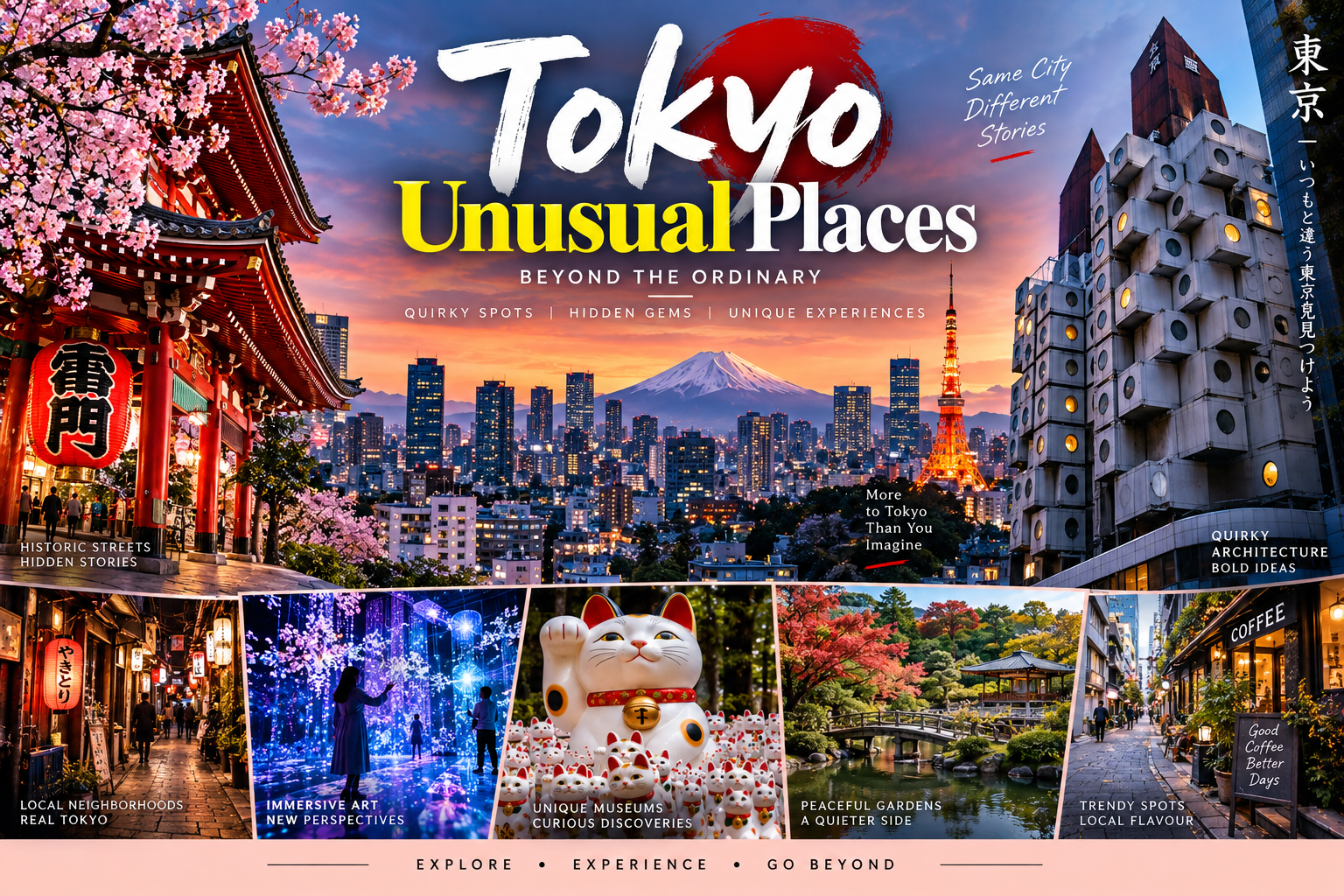
Tokyo Unusual Places: 40+ Unique, Strange & Hidden Spots to Explore
What if your idea of Tokyo goes far beyond neon streets, giant shopping districts, famous temples, and crowded tourist attractions? Tokyo unusual places reveal a fascinating side of Japan’s capital where strange architecture, miniature museums, eccentric cultural spaces, quiet neighborhoods, unexpected landscapes, historic streets, and highly specialized local experiences exist alongside one of the world’s biggest urban environments. The most memorable unusual places in Tokyo are often not the attractions with the biggest signs; they are the places that make you stop and think, How does this exist in the middle of Tokyo? Tokyo Temple
What Makes a Place Unusual in Tokyo?
An unusual place does not necessarily have to be strange, mysterious, or completely unknown.
For this article, an unusual Tokyo destination can be unusual because of its:
- Architecture
- History
- Cultural significance
- Location
- Design
- Concept
- Neighborhood atmosphere
- Natural environment
- Museum collection
- Local tradition
- Relationship with the surrounding city
This broader definition is important.
Some of Tokyo’s most interesting unusual places are famous among residents but unfamiliar to international tourists.
Others have become popular online but remain unusual because the experience itself is unlike conventional sightseeing.
Why Tokyo Has So Many Unusual Places
Tokyo Was Built in Layers
Tokyo’s current identity is the result of centuries of development.
Historic neighborhoods, temples, canals, railway lines, postwar buildings, modern skyscrapers, shopping streets, parks, and residential areas were constructed at different periods.
Instead of replacing everything with something new, Tokyo often absorbed new development around existing structures.
That created extraordinary contrasts.
A traditional wooden building can exist near a modern apartment tower.
A small shrine can sit between commercial buildings.
An old shopping street can survive beside a major railway station.
These contrasts create many of the city’s unusual destinations.
Tokyo’s Neighborhoods Have Distinct Personalities
Tokyo is frequently described as one city, but that description can be misleading.
Areas such as Yanaka, Shimokitazawa, Jimbocho, Kagurazaka, Kiyosumi-Shirakawa, Koenji, Shibamata, and Setagaya can feel dramatically different.
For travelers, this means that discovering unusual places often requires exploring neighborhoods rather than searching only for individual attractions.
Japanese Design Encourages Specialization
Tokyo contains businesses, museums, stores, cafés, galleries, and cultural spaces built around extremely specific interests.
This creates a fascinating travel opportunity.
If you have an unusual hobby, there is a reasonable chance that Tokyo has a neighborhood, store, museum, or community connected to it.
Tokyo Unusual Places for Architecture Lovers
Nakagin Capsule Tower’s Architectural Legacy
The Nakagin Capsule Tower became one of the most recognizable examples of Japanese Metabolism architecture.
Although the original building was demolished, its architectural legacy remains important when studying unusual Tokyo architecture.
The structure represented an ambitious idea: buildings could potentially evolve by replacing individual modules rather than treating architecture as completely static.
For architecture enthusiasts, its importance extends beyond whether the building can still be visited.
It represents a period when Japanese architects imagined radically different ways of designing cities.
Tokyo International Forum
The Tokyo International Forum is a striking example of modern urban architecture.
Its large glass structure creates an unusual sense of openness within a dense metropolitan environment.
It is especially interesting for photographers and architecture enthusiasts because of its enormous internal volume, structural geometry, and changing natural light.
Mode Gakuen Cocoon Tower
The Cocoon Tower is one of Tokyo’s most visually distinctive modern buildings.
Its curved exterior gives it a strong identity among the surrounding architecture.
The building is particularly interesting because it demonstrates how educational architecture can become an urban landmark.
Tokyo Metropolitan Government Building
The Tokyo Metropolitan Government Building is a familiar landmark, but it can still be included in an unusual architecture itinerary because of its scale and distinctive design.
The observation areas have traditionally provided visitors with elevated city views without requiring the type of attraction experience associated with dedicated observation towers.
The surrounding Shinjuku skyline also demonstrates Tokyo’s ability to transform ordinary urban infrastructure into a dramatic visual environment.
Tokyo Unusual Places for History Lovers
Yanaka
Yanaka is one of the best places to explore a more traditional urban atmosphere.
The neighborhood contains temples, cemeteries, narrow streets, small businesses, traditional buildings, and local shopping areas.
Its unusual quality comes from the contrast.
You are still in Tokyo, but the visual rhythm is completely different from Shinjuku or Shibuya.
Nezu
Nezu offers another perspective on historic Tokyo.
The area is associated with traditional streets, religious architecture, and older residential development.
Visitors who walk slowly can discover details that are easy to miss when traveling directly between major tourist attractions.
Shibamata
Shibamata is particularly valuable for travelers who want to experience a historic neighborhood outside Tokyo’s standard international tourist circuit.
Its traditional streets and temple-centered environment create a strong sense of local identity.
The area is also associated with Japanese popular culture and traditional neighborhood life.
Sugamo
Sugamo provides another fascinating look at Tokyo.
It is sometimes associated with older generations and traditional shopping culture.
Rather than seeing that as a limitation, travelers can use Sugamo to understand how different generations interact with urban commercial spaces.
This makes it particularly interesting for cultural travelers.
Tokyo Unusual Places for Strange and Specialized Museums
Meguro Parasitological Museum
The Meguro Parasitological Museum is one of Tokyo’s most unusual specialist museums.
Its collection focuses on parasites and parasitology.
The museum demonstrates an important feature of Tokyo culture: highly specialized subjects can have their own dedicated institutions.
It is not necessarily suitable for every visitor, particularly those uncomfortable with medical or biological displays.
For science enthusiasts, however, it offers a distinctly different museum experience.
Intermediatheque
Intermediatheque combines elements of natural history, science, culture, design, and collecting.
The atmosphere can feel very different from a conventional museum.
Rather than simply presenting a straightforward historical narrative, the space encourages visitors to think about how objects are classified, displayed, and interpreted.
Tokyo Water Science Museum
For families and science enthusiasts, water-related educational attractions can provide an unusual perspective on the city’s infrastructure.
Tokyo’s enormous population depends on complex systems that most tourists rarely see.
Understanding water, sanitation, transportation, and infrastructure can make the city itself feel like an enormous technological system.
Tokyo Unusual Places for Digital and Immersive Experiences
teamLab Borderless
teamLab’s immersive digital environments became internationally recognized for turning exhibition spaces into interactive visual experiences.
The attraction represents an important shift in how museums and art spaces can function.
Instead of standing in front of a painting, visitors can move through an environment where light, sound, movement, and digital imagery interact.
teamLab Planets
teamLab Planets takes the immersive concept further through spaces designed around movement and sensory experience.
Visitors should follow the venue’s current guidance regarding clothing, accessibility, and the nature of the installations.
These experiences demonstrate how Tokyo’s relationship with technology is not limited to electronics or transportation.
Technology is also being used as an artistic medium.
Tokyo Unusual Places for Traditional Culture
Nezu Shrine
Nezu Shrine provides a traditional cultural environment within a dense modern city.
Its architecture, pathways, gates, and seasonal scenery make it especially attractive to travelers interested in Japanese cultural heritage.
Gotokuji Temple
Gotokuji is strongly associated with the beckoning cat tradition.
The temple has become increasingly popular among international travelers, but its cultural and historical context remains more interesting than simply photographing the cat figures.
Travelers should treat the temple as a religious space first and a photo opportunity second.
Hie Shrine
Hie Shrine provides another example of traditional religious architecture existing within a modern business district.
The contrast between the shrine and surrounding high-rise development is one of the most interesting aspects.
It demonstrates how Tokyo preserves cultural spaces inside rapidly changing urban environments.
Tokyo Unusual Places for Urban Exploration
Omoide Yokocho
Omoide Yokocho is famous, but its narrow-scale urban environment remains unusual compared with modern Tokyo.
The compact lanes demonstrate a different form of urban development.
The important experience is visual and atmospheric as much as culinary.
Golden Gai
Golden Gai is one of Shinjuku’s most distinctive compact districts.
Its narrow lanes and tiny establishments contrast dramatically with the enormous buildings surrounding it.
Visitors should remember that many businesses are extremely small, and some have limited seating.
Respecting house rules is essential.
Koenji
Koenji is an excellent neighborhood for travelers interested in independent culture.
The area has connections with:
- Vintage clothing
- Music
- Small live venues
- Independent shops
- Local restaurants
- Alternative fashion
Its unusual quality comes from its community character rather than a single landmark.
Shimokitazawa
Shimokitazawa offers a similar lesson.
It is a neighborhood where independent retail, music, theater, cafés, vintage stores, and creative businesses interact.
The area is increasingly popular, but it remains valuable for understanding Tokyo’s youth-oriented creative culture.
Tokyo Unusual Places for Nature Lovers
Todoroki Valley
Todoroki Valley is one of Tokyo’s most surprising green spaces.
The surrounding metropolitan environment makes the natural setting feel unexpected.
A visitor can move from dense urban streets into a greener landscape within a relatively short distance.
This makes Todoroki particularly attractive to travelers who need a break from concrete and crowds.
Institute for Nature Study
The Institute for Nature Study provides an unusual example of natural habitat existing within the metropolitan environment.
It is particularly interesting for people who want to understand how ecological spaces can survive within a major urban area.
Kiyosumi Gardens
Kiyosumi Gardens demonstrates how traditional Japanese landscape design can create an entirely different atmosphere from the city outside.
The experience is not about finding the most dramatic view.
It is about composition.
Water, rocks, trees, bridges, paths, and seasonal changes work together.
Tokyo Unusual Places for Neighborhood Exploration
Kiyosumi-Shirakawa
Kiyosumi-Shirakawa combines traditional neighborhoods with contemporary café and creative culture.
It has become particularly known for specialty coffee.
The interesting part is how a neighborhood can evolve without completely losing its existing identity.
Kagurazaka
Kagurazaka provides an unusual combination of historic streets, restaurants, cultural influences, and contemporary Tokyo life.
Its smaller lanes are especially atmospheric.
Jimbocho
Jimbocho is unusual because of its concentration of specialist bookstores.
A visitor who enjoys books can easily spend several hours browsing.
The neighborhood demonstrates how physical specialist retail can remain culturally significant even in a highly digital city.
Sangenjaya
Sangenjaya offers another example of neighborhood Tokyo.
It is less about major monuments and more about local restaurants, shops, streets, and everyday urban life.
Tokyo Unusual Places for Train Enthusiasts
Railway Crossings
Tokyo contains numerous railway crossings and bridges that reveal how deeply rail transportation is integrated into daily life.
For train enthusiasts, the experience is not simply watching trains.
It is understanding how railway infrastructure shapes neighborhoods.
Train Station Architecture
Major stations such as Shinjuku and Tokyo Station are obvious examples, but smaller stations can be even more interesting.
Look at:
- Station entrances
- Platforms
- Overpasses
- Retail areas
- Pedestrian flows
- Railway bridges
- Adjacent neighborhoods
The station often acts as the center of a local urban ecosystem.
Tokyo Unusual Places for Street Photography
Yanaka Backstreets
Yanaka provides traditional architectural details and changing elevations that can create strong compositions.
Kagurazaka Lanes
The narrow streets and combination of traditional and modern architecture make Kagurazaka particularly interesting around evening.
Koenji
Koenji offers colorful storefronts, vintage businesses, music culture, and everyday street scenes.
Kiyosumi-Shirakawa
The neighborhood is useful for photographers interested in combining industrial structures, modern cafés, traditional buildings, and greenery.
Tokyo Unusual Places for Couples
Unusual travel does not have to mean extreme travel.
For couples, some of the best unusual experiences are simply different from the standard itinerary.
Quiet Garden Walks
Gardens provide opportunities for conversation and photography without the pressure of moving constantly.
Historic Neighborhoods
Yanaka and Kagurazaka are suitable for slow walking.
Independent Cafés
A small café can sometimes create a more memorable experience than a major attraction.
Evening Architecture Walks
Tokyo’s combination of modern buildings and older streets becomes particularly atmospheric after sunset.
Tokyo Unusual Places for Solo Travelers
Solo travelers have an advantage when exploring unusual Tokyo.
You can change plans easily.
You can spend two hours in a bookstore.
You can stop at a tiny café.
You can follow an interesting street.
You can leave a crowded location immediately.
Best Solo Experiences
Consider:
- Specialist museums
- Book districts
- Architecture walks
- Gardens
- Neighborhood shopping streets
- Photography walks
- Local cafés
- Train exploration
The most important rule is to leave room for spontaneity.
Tokyo Unusual Places for Families
Families often benefit from attractions that are interactive or visually engaging.
Science and Technology
Science-focused museums and interactive exhibitions can make Tokyo’s infrastructure and technology accessible to children.
Parks and Gardens
Parks provide space to slow down after crowded sightseeing.
Immersive Art
Digital art experiences can be particularly engaging for children, although age restrictions and venue requirements should be checked before visiting.
Tokyo Unusual Places for Older Travelers
Older travelers may prefer unusual places that offer cultural depth without requiring extremely long walking routes.
Gardens, museums, historic neighborhoods, and carefully planned architectural routes can provide a good balance.
The best strategy is to select one compact area rather than trying to visit many distant locations.
Tokyo Unusual Places for Budget Travelers
Unusual experiences do not necessarily require a large budget.
Some of the most interesting activities involve:
- Walking
- Public parks
- Neighborhood exploration
- Architecture
- Historic streets
- Public cultural spaces
- Shopping street exploration
- Free viewing areas
The main expense may simply be transportation and food.
Tokyo Unusual Places for Luxury Travelers
Luxury travelers can also benefit from unusual Tokyo.
Instead of choosing only high-end shopping districts, consider private or customized cultural experiences.
A personalized itinerary could combine:
- Architecture
- Traditional crafts
- Private cultural tours
- Gardens
- Specialty dining
- Neighborhood exploration
- Boutique shopping
The key is access and context rather than simply price.
Tokyo Unusual Places for Food Lovers
Neighborhood Shopping Streets
Local shopping streets can provide insight into everyday Japanese food culture.
Specialty Cafés
Tokyo’s café culture is extremely diverse.
Explore neighborhoods rather than only famous destinations.
Traditional Restaurants
Small restaurants can offer a more intimate experience, but visitors should understand that some establishments have limited seating and may operate differently from international restaurants.
Tokyo Unusual Places for Anime and Pop Culture Fans
Nakano Broadway
Nakano Broadway is associated with collectibles, manga, anime-related merchandise, vintage items, and specialist stores.
It provides a fascinating look at the collector economy.
Ikebukuro
Ikebukuro has developed a strong connection with anime, manga, games, and related pop culture.
For visitors interested in Japanese entertainment culture, it offers a different perspective from the more widely recognized Akihabara experience.
Akihabara’s Side Streets
Akihabara is no longer unusual in the conventional sense.
However, its specialist stores and smaller side streets can still provide experiences that differ substantially from mainstream electronics shopping.
Tokyo Unusual Places for Art Lovers
Small Galleries
Tokyo’s independent gallery scene can be rewarding for travelers who enjoy contemporary art.
Instead of visiting only large museums, explore neighborhoods where smaller galleries operate.
Design Stores
Japanese design often combines simplicity, function, materials, and craftsmanship.
Specialist design stores can therefore become cultural experiences in themselves.
Tokyo Unusual Places for Architecture and Design
Tokyo’s architecture is particularly unusual because there is no single dominant visual style.
You may encounter:
- Minimalist concrete
- Traditional wooden structures
- Glass towers
- Metabolism-inspired buildings
- Tiny houses
- Modern apartments
- Commercial signage
- Historic architecture
This makes walking through Tokyo almost like visiting an open-air architecture exhibition.
Tokyo Unusual Places for Travelers Who Hate Crowds
If crowds are your main travel problem, avoid building your entire itinerary around the most famous stations.
Instead:
- Travel early.
- Visit smaller neighborhoods.
- Explore gardens on weekdays where practical.
- Use side streets.
- Choose one district per half-day.
- Avoid major attraction entrances during peak periods.
- Build flexible alternatives into your itinerary.
The goal is not complete isolation.
Tokyo is a major city.
The goal is better crowd management.
Tokyo Unusual Places for First-Time Visitors
First-time travelers should not feel pressured to avoid famous Tokyo attractions.
A better strategy is to combine familiar and unusual experiences.
For example:
Morning: Major landmark.
Afternoon: Historic neighborhood.
Evening: Independent district.
This gives you both the classic Tokyo experience and a more personal one.
Tokyo Unusual Places for Repeat Visitors
Repeat visitors have more freedom.
You can skip the standard attractions and focus entirely on:
- Neighborhood culture
- Specialist museums
- Architecture
- Gardens
- Independent shops
- Local food
- Small galleries
- Northern Tokyo
- Eastern Tokyo
- Residential districts
This is where Tokyo becomes particularly rewarding.
How to Find More Unusual Places in Tokyo
Search by Neighborhood Instead of Attraction
Rather than searching only for “things to do in Tokyo,” search for individual neighborhoods.
This can reveal smaller destinations.
Search by Interest
Use your personal interests as the filter.
Examples include:
- Tokyo unusual places for photographers
- Tokyo unusual places for architecture lovers
- Tokyo unusual places for families
- Tokyo unusual museums
- Tokyo hidden gardens
- Tokyo unusual neighborhoods
- Tokyo historical streets
- Tokyo unique experiences
These problem-solving modifiers produce more targeted results.
Follow Small Streets
Major roads are useful for navigation.
Small streets are often where discovery happens.
Look for Specialist Stores
Specialization is a major part of Tokyo’s retail culture.
A shop that seems ordinary from outside may focus on an incredibly specific subject.
A One-Day Tokyo Unusual Places Itinerary
Morning: Yanaka and Nezu
Begin with a traditional neighborhood.
Walk slowly.
Visit cultural sites.
Explore local streets.
Lunch: Local Neighborhood
Choose a suitable restaurant in the area.
Afternoon: Jimbocho
Explore bookstores and surrounding architecture.
Late Afternoon: Ochanomizu
Walk toward the bridges and urban infrastructure.
Evening: Kagurazaka
Finish with a relaxed neighborhood walk and dinner.
This itinerary works because the areas can be connected without attempting to cover the entire city.
A Three-Day Tokyo Unusual Places Itinerary
Day One: Historic Tokyo
Visit:
- Yanaka
- Nezu
- Sendagi
- Shibamata or another historic district
Focus on history and neighborhood culture.
Day Two: Creative Tokyo
Visit:
- Kiyosumi-Shirakawa
- Shimokitazawa
- Koenji
Focus on independent culture, cafés, design, music, and local businesses.
Day Three: Strange and Specialized Tokyo
Visit:
- A specialist museum
- A digital art experience
- Nakano
- An unusual architecture destination
Focus on Tokyo’s modern and unconventional side.
Common Mistakes When Visiting Tokyo Unusual Places
Mistake 1: Expecting Every Place to Be Completely Unknown
If a location is published online, other travelers may know about it too.
“Unusual” is more useful than “secret.”
Mistake 2: Visiting Only for Photographs
A photograph can be impressive while the actual experience is short.
Research why the place exists.
Understand its history.
That creates a better trip.
Mistake 3: Ignoring Neighborhood Etiquette
Some unusual places are located in residential communities.
Do not treat homes and local streets like theme parks.
Mistake 4: Overplanning
Trying to visit 10 unusual places in one day defeats the purpose.
Slow exploration is often better.
Mistake 5: Ignoring Opening Hours
Small museums and businesses can have unusual schedules.
Always verify information before traveling.
Mistake 6: Assuming Every Attraction Is Suitable for Children
Some specialist museums or cultural spaces may be more appropriate for adults or older children.
Check suitability before visiting.
Mistake 7: Forgetting the Weather
Tokyo’s summers can be hot and humid.
Rain can change outdoor plans.
Winter daylight is limited.
Seasonal planning matters.
Pros of Exploring Tokyo Unusual Places
More Personal Experiences
You can create an itinerary based on your interests rather than following a standard route.
Better Understanding of Local Life
Neighborhood exploration provides context that major attractions cannot always provide.
Greater Variety
Tokyo’s unusual places can include science, architecture, history, nature, art, food, and pop culture.
Excellent Photography Opportunities
Contrasts between old and new Tokyo are particularly valuable for photographers.
Opportunities for Repeat Visitors
Even travelers who have visited Tokyo several times can continue discovering new neighborhoods.
Cons of Exploring Tokyo Unusual Places
Some Places Are Difficult to Reach
A location may require multiple train changes or additional walking.
Information May Be Limited
Smaller attractions may not provide extensive information in English.
Opening Times Can Be Restrictive
Small businesses and museums may close on particular days.
Some Places May Be Overhyped
Online content can make a place appear more extraordinary than it feels in person.
Residential Areas Require Sensitivity
Not every visually interesting location should become a tourist attraction.
How to Explore Unusual Tokyo Responsibly
Respect Residents
Keep voices low and avoid obstructing entrances.
Follow Photography Rules
If photography is restricted, follow the rules.
Support Local Businesses
When appropriate, purchase something from independent stores or eat at local businesses.
Avoid Creating New Crowds
Do not block narrow streets for group photographs.
Leave Places as You Found Them
Do not touch, move, or remove cultural objects.
The Difference Between Unusual and Hidden Tokyo
These terms are often used interchangeably, but they have different meanings.
A hidden place generally emphasizes low visibility or low tourist awareness.
An unusual place emphasizes the nature of the experience.
A specialist museum may be well known but still unusual.
A residential neighborhood may be hidden from tourists but not unusual to residents.
A famous building may be visually unusual even though millions know about it.
For SEO and travel planning, “Tokyo unusual places” is therefore a particularly useful concept because it allows a broader range of experiences.
Why Unusual Tokyo Experiences Can Be More Memorable
Travel memories are not always created by the biggest attractions.
Sometimes they come from unexpected moments.
A bookstore you discovered by accident.
A quiet street after rain.
A tiny restaurant you noticed while walking.
A traditional building surrounded by modern towers.
A garden hidden behind an ordinary-looking entrance.
These moments create stories.
And stories are often what people remember longest.
Tokyo Unusual Places and Social Media
Social media has changed how travelers discover places.
This has advantages.
A small neighborhood can gain international recognition.
Independent businesses can reach travelers.
Unusual museums can attract new audiences.
But there are also risks.
A previously quiet place can suddenly become overcrowded.
Residents may experience increased noise.
Visitors may focus on one photograph instead of understanding the location.
The future of travel therefore requires a balance between discovery and responsibility.
Future Trends in Tokyo Unusual Places
Neighborhood-Based Travel Will Continue Growing
Travelers are increasingly interested in exploring complete districts instead of checking off individual landmarks.
This approach is likely to remain important because it creates longer, deeper experiences.
Personalized Itineraries Will Become More Common
Technology will increasingly help travelers build routes based on interests.
A photography enthusiast could receive an architecture-focused route.
A family could receive a child-friendly route.
A history enthusiast could receive a heritage-focused itinerary.
AI Will Change Travel Discovery
Artificial intelligence can help travelers identify connections between places that conventional travel guides may overlook.
For example, an itinerary could connect:
- Architecture
- History
- Food
- Transportation
- Local culture
The challenge will be ensuring that automated recommendations do not send large numbers of visitors to fragile residential locations.
Responsible Tourism Will Become More Important
As unusual places become easier to discover, responsible travel practices will become increasingly important.
Physical Experiences Will Remain Valuable
Despite digital travel tools, travelers still want physical experiences.
Walking through a neighborhood, entering a garden, browsing a bookstore, or eating in a small restaurant cannot be completely replaced by a screen.
Ten Travel Brands and Services for Planning Unusual Tokyo Trips
Different travel services serve different purposes. They should be viewed as planning tools rather than identical alternatives.
| Brand | Primary Function | Useful for Tokyo Unusual Places | Suitable Traveler | Main Limitation |
|---|---|---|---|---|
| Google Maps | Maps and navigation | Finding neighborhoods, shops and local attractions | Independent travelers | Popular results can dominate |
| Tripadvisor | Reviews and attraction research | Discovering visitor-rated attractions | First-time visitors | Can emphasize popular destinations |
| Booking.com | Accommodation | Finding hotels near unusual neighborhoods | All travelers | Primarily accommodation focused |
| Expedia | Flights, hotels and travel planning | Building broader trips | International travelers | Less focused on micro-neighborhood discovery |
| Agoda | Accommodation | Hotel searches across Tokyo | Budget and international travelers | Primarily accommodation oriented |
| Airbnb | Accommodation and experiences | Neighborhood-based travel | Couples and longer stays | Listings and experiences vary |
| Japan Travel by NAVITIME | Japan travel and transport planning | Navigating Tokyo’s complex transport network | Independent travelers | Best suited to travelers comfortable with public transportation |
| Rakuten Travel | Japan travel services | Accommodation and domestic travel planning | Japan-focused travelers | International users may find it less familiar |
| GO | Taxi transportation | Short transfers between unusual destinations | Travelers seeking convenience | Transportation rather than sightseeing |
| Japan Guide | Japan destination information | Researching neighborhoods and attractions | Independent travelers | Coverage varies by location |
The best approach is to combine several types of resources.
Use maps for navigation.
Use travel platforms for accommodation.
Use transport tools for route planning.
Use official attraction information for opening times, admission rules, and temporary closures.
Tokyo Unusual Places by Traveler Problem
If You Have Seen the Main Tourist Attractions
Explore Yanaka, Shibamata, Jimbocho, Koenji, Kiyosumi-Shirakawa, and other neighborhood-focused destinations.
If You Hate Crowds Tokyo unusual places
Travel early, visit on appropriate weekdays, and choose residential or garden areas rather than the most famous tourist hubs.
If You Want Strange Museums Tokyo unusual places
Look for specialist institutions rather than conventional national museums.
If You Want Local Culture Tokyo unusual places
Spend more time in shopping streets and neighborhoods.
If You Travel With Children Tokyo unusual places
Choose interactive museums, science attractions, parks, gardens, and immersive experiences.
If You Are a Photographer Tokyo unusual places
Focus on neighborhoods where traditional and modern architecture meet.
If You Have a Small Budget Tokyo unusual places
Prioritize walking routes, parks, public spaces, neighborhood exploration, and carefully selected cultural attractions.
If You Have Only One Day Tokyo unusual places
Choose one compact area instead of trying to cross the entire city.
Practical Checklist Before Visiting an Unusual Tokyo Place
Research Tokyo unusual places
Check:
- Location
- Opening hours
- Admission
- Accessibility
- Photography rules
- Weather
- Transportation
- Nearby alternatives
Plan Transportation Tokyo unusual places
Identify:
- Nearest station
- Walking distance
- Transfer requirements
- Last train considerations
Plan Food Tokyo unusual places
Small neighborhoods may not have the same density of international restaurants as major tourist districts.
Plan Time Tokyo unusual places
Give yourself more time than the map suggests.
Walking slowly is part of the experience.
FAQs
What are the most unusual places in Tokyo?
Tokyo has an enormous variety of unusual destinations, including specialist museums, immersive art spaces, historic neighborhoods, unusual architecture, traditional gardens, railway-related locations, collector districts, and tiny cultural institutions.
What is the strangest place to visit in Tokyo?
There is no universally strangest destination because “strange” depends on personal interests. Specialist museums and highly specific cultural attractions are often among the most unusual experiences for international visitors.
Are Tokyo unusual places suitable for first-time visitors?
Yes. However, first-time visitors may benefit from combining unusual destinations with several classic Tokyo landmarks.
What are the best unusual places in Tokyo for couples?
Historic neighborhoods, quiet gardens, atmospheric streets, independent cafés, and evening architecture walks can work particularly well for couples.
What are the best unusual places in Tokyo for families?
Interactive museums, science attractions, gardens, parks, and immersive art experiences can be suitable choices depending on children’s ages and the venue’s current rules.
What are the best unusual places in Tokyo for photographers?
Yanaka, Kagurazaka, Koenji, Kiyosumi-Shirakawa, traditional shopping streets, railway areas, bridges, and architecture-focused routes offer diverse photography opportunities.
Are unusual places in Tokyo expensive?
Not necessarily. Some attractions charge admission, but many neighborhood walks, parks, streets, architecture routes, and public spaces can be explored at little or no cost.
Can I find unusual places near Shibuya?
Yes. Shibuya itself contains smaller streets and independent businesses, while nearby neighborhoods provide additional opportunities for less conventional exploration.
Is Nakano worth visiting for unusual Tokyo experiences?
Nakano can be particularly interesting for visitors interested in collectibles, entertainment culture, specialist stores, and Japanese pop culture.
Is Yanaka an unusual place in Tokyo?
Yanaka is not unknown, but it provides a distinctly different experience from Tokyo’s modern commercial centers because of its historic atmosphere, temples, cemetery, traditional streets, and independent businesses.
What is unusual about Jimbocho?
Jimbocho is unusual because of its concentration of specialist bookstores and its strong connection with publishing, literature, education, and intellectual culture.
Where can I see traditional Tokyo without leaving the city?
Neighborhoods such as Yanaka, Nezu, Shibamata, and parts of Kagurazaka provide opportunities to experience older architectural and cultural environments within metropolitan Tokyo.
What unusual Tokyo places are good for solo travelers?
Specialist museums, bookstores, gardens, photography walks, neighborhood shopping streets, cafés, and architecture routes are particularly flexible for solo travelers.
What unusual Tokyo places are good for repeat visitors?
Repeat visitors can explore neighborhoods such as Koenji, Kiyosumi-Shirakawa, Shibamata, Jimbocho, Setagaya, and northern or eastern Tokyo.
When should I visit unusual places in Tokyo?
The ideal time depends on the location. Early mornings are often useful for quieter outdoor exploration, while seasonal conditions should be considered for gardens and walking routes.
Do I need Japanese to explore unusual Tokyo?
No, but basic Japanese phrases and translation tools can be useful, particularly in smaller neighborhoods where English information may be limited.
Are Tokyo unusual places safe?
Tokyo is widely regarded as a highly organized major city, but travelers should still follow normal urban safety practices, pay attention to surroundings, and respect local rules.
Can I visit unusual Tokyo places using public transportation?
Yes. Tokyo’s extensive public transportation network makes many neighborhoods accessible, although some smaller destinations require additional walking.
How many unusual places should I visit in one day?
Two or three connected areas are often more practical than trying to visit a large number of distant destinations.
What should I avoid when exploring unusual Tokyo neighborhoods?
Avoid trespassing, photographing people inappropriately, blocking narrow streets, creating noise in residential areas, and treating private homes as attractions.
What is the biggest advantage of exploring unusual Tokyo?
The biggest benefit is perspective. Instead of seeing Tokyo only through famous landmarks, you experience how history, culture, technology, commerce, nature, and everyday life coexist.
Conclusion
Tokyo unusual places offer a completely different way to understand Japan’s capital. The city becomes much more interesting when you stop viewing it as a checklist of famous attractions and begin exploring it as a collection of neighborhoods, communities, architectural experiments, cultural institutions, gardens, specialist museums, independent businesses, and unexpected spaces.The most rewarding unusual places are not necessarily the strangest or the most obscure. They are the places that change your understanding of Tokyo.