Tokyo Hiking: 15 Best Trails, Tips & Hidden Gems
Have you ever looked at Tokyo’s endless skyline and wondered where the city suddenly turns into forest, mountains, waterfalls, and quiet trails? Tokyo hiking offers an unusually easy way to experience both sides of Japan’s capital: a fast-moving metropolis and a surprisingly green mountain region within easy reach of the city. For first-time hikers, Mt. Takao is the easiest starting point, while Mt. Mitake, Mt. Jinba, Okutama, and other western Tokyo routes offer progressively more nature, elevation, and adventure Tokyo Property
Tokyo is often introduced through Shibuya crossings, neon streets, temples, sushi counters, shopping districts, and futuristic architecture. Yet the western side of the Tokyo metropolis tells a completely different story. Forested mountains rise beyond the urban core, trails wind through cedar and broadleaf forests, and traditional shrines sit quietly above valleys.
The result is a hiking destination that works for almost every type of traveler.
You can spend a morning climbing a mountain and be back in the city for dinner. You can take a cable car partway up a mountain if you do not want a demanding ascent. You can choose a family-friendly trail, a quiet forest walk, a photography route, or a longer mountain traverse.
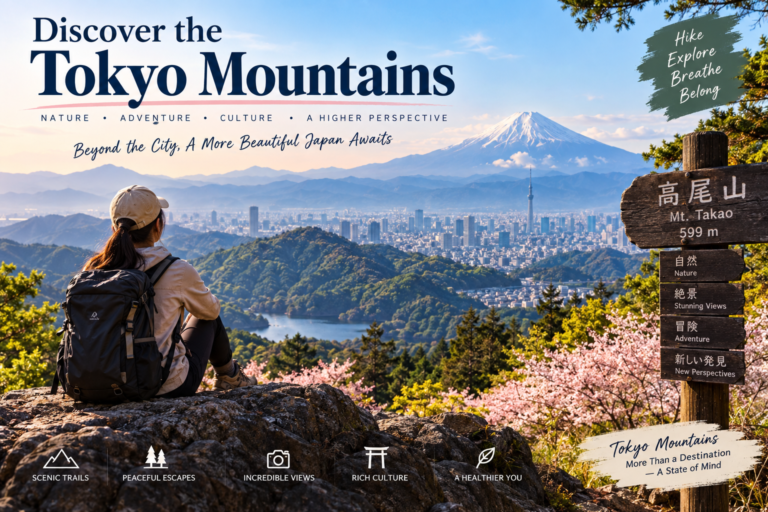
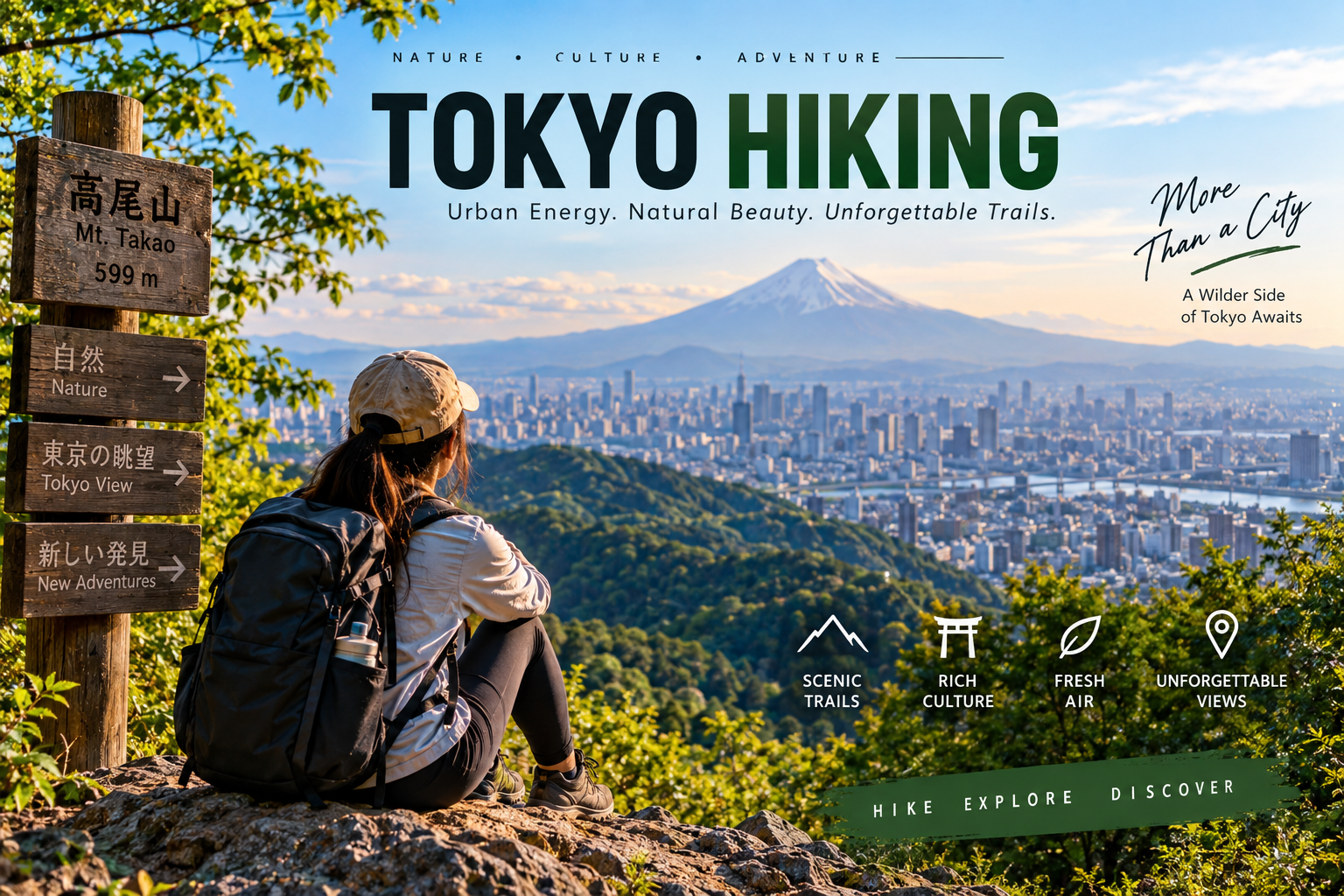
The best-known example is Mt. Takao, a 599-meter mountain in Hachioji that can be reached from central Tokyo in roughly an hour. Japan’s official tourism organization describes it as one of the country’s most accessible famous peaks, with several hiking routes and views toward Mt. Fuji on clear days.
But Tokyo hiking is much bigger than Mt. Takao.
This guide explains where to go, when to hike, what to pack, how to choose a route, what mistakes to avoid, which outdoor brands are worth considering, and how to build a Tokyo hiking day that feels like an adventure rather than simply another tourist attraction.
Why Tokyo Is an Excellent Hiking Destination
One of Tokyo’s biggest advantages for hikers is accessibility.
In many major world cities, serious hiking requires renting a car, traveling several hours, or staying overnight outside the metropolitan area. Tokyo is different. Its western mountains can often be reached by public transportation, allowing visitors to combine hiking with a normal city itinerary.
That makes Tokyo particularly attractive to international travelers.
You might spend Friday exploring Shinjuku, Saturday hiking Mt. Takao, and Saturday evening enjoying Tokyo’s restaurants and nightlife. The contrast is part of the experience.
Official Tokyo tourism information highlights mountains and nature areas around western Tokyo including Mt. Takao, Mt. Mitake, Mt. Hinode, Mt. Odake, Mt. Oyama, the Akigawa Valley, and other outdoor destinations.
Tokyo hiking is not just one type of experience
The term “Tokyo hiking” covers several very different experiences.
A beginner may want:
- A well-marked trail
- Easy public transportation
- Restaurants and toilets nearby
- A relatively short hike
- Optional cable-car access
- Scenic viewpoints
An intermediate hiker may prefer:
- Longer routes
- Greater elevation gain
- Forest trails
- Fewer crowds
- Mountain ridges
- Connected peaks
A photographer may prioritize:
- Sunrise
- Autumn foliage
- Waterfalls
- Fuji views
- Forest textures
- Traditional shrines
A family may care more about:
- Safe walking surfaces
- Rest stops
- Flexible route lengths
- Food facilities
- Cable cars or chairlifts
- Easy transportation
Tokyo can accommodate all of these preferences.
Best Time for Tokyo Hiking
Tokyo has four distinct seasons, and each changes the hiking experience.
There is no single “best” month for every trail. Instead, the best season depends on what you want to see and how much heat, rain, cold, or crowding you are willing to tolerate.
Spring hiking in Tokyo
Spring is one of the most attractive seasons for Tokyo hiking.
Temperatures become comfortable, vegetation becomes increasingly green, and some mountain areas provide opportunities to see cherry blossoms.
Mt. Takao is particularly appealing in spring, and official Tokyo tourism information notes that its cherry blossoms generally appear somewhat later than those in central Tokyo.
Spring is also useful for hikers who dislike extreme summer heat.
However, popular trails can become busy during weekends and peak blossom periods.
If your schedule is flexible, a weekday morning is usually a smarter choice than a weekend afternoon.
Summer hiking in Tokyo
Summer can be beautiful but challenging.
Tokyo’s heat and humidity can make even a moderate climb feel much harder than expected. Forest trails provide shade, but shade does not eliminate humidity or dehydration risk.
Start early.
This is one of the most important Tokyo hiking recommendations for summer.
A trail that feels pleasant at 7:00 a.m. may feel considerably harder several hours later.
Carry enough water, wear breathable clothing, protect your skin from the sun, and check the weather forecast before departure.
Some mountain destinations also offer attractions that make summer appealing. For example, Mt. Takao’s Beer Mount operates seasonally at around 500 meters and combines mountain scenery with food and drinks.
Autumn hiking in Tokyo
Autumn is arguably the most visually impressive hiking season.
The forests around western Tokyo develop rich seasonal colors, particularly in November in areas such as Mt. Takao.
The downside is popularity.
GO TOKYO specifically warns that Mt. Takao can become crowded during the peak autumn foliage period and recommends weekdays when possible.
For photographers, autumn mornings are especially attractive because early light can produce dramatic contrast between colorful leaves and mountain shadows.
Winter hiking in Tokyo
Winter can offer some of the clearest views.
On a cold, clear day, distant mountains and Mt. Fuji can become more visible.
However, winter hiking requires greater attention to temperature, daylight, clothing, and trail conditions.
Some higher or shaded areas may be colder and potentially slippery even when central Tokyo feels comfortable.
Do not assume that because Tokyo is a major city, its mountain trails will have urban conditions.
Mountain weather can change quickly.
Mt. Takao: The Best Starting Point for Tokyo Hiking
If you have never hiked around Tokyo before, Mt. Takao should usually be your first choice.
The mountain rises to 599 meters and is accessible from Takaosanguchi Station. Japan’s National Tourism Organization lists a representative route at approximately 6 kilometers with an estimated duration of about two hours, although actual times depend on route and pace.
The mountain’s greatest strength is flexibility.
You do not have to commit to a difficult mountain expedition.
There are multiple routes, and visitors can combine walking with the cable car or chairlift.
That makes Mt. Takao suitable for mixed groups where one person wants a serious hike and another prefers something easier.
Why Mt. Takao works for beginners
Mt. Takao provides something rare: a genuine mountain experience without requiring a complicated expedition plan.
You can reach the mountain by train, walk toward the trails, choose a route, climb toward the summit, enjoy the scenery, and return to the city the same day.
Trail No. 1 is especially popular and provides access to several of the mountain’s major attractions.
The route also passes cultural and natural features rather than being simply a climb from point A to point B.
Mt. Takao Trail No. 1
Trail No. 1 is the classic route.
It is among the easiest choices for first-time visitors and connects hikers with several of the mountain’s main attractions.
The route is popular precisely because it combines accessibility with sightseeing.
Along the way, hikers can encounter:
- Forest scenery
- Mt. Takao’s religious heritage
- Yakuoin Temple
- The famous Takosugi cedar
- Mountain viewpoints
- Restaurants and food stops
- Access to the summit
Japan’s official tourism itinerary describes Trail No. 1 as taking roughly 100 minutes to reach the summit under its stated itinerary conditions.
Mt. Takao Trail No. 4
Trail No. 4 is worth considering if you want something different from the main route.
One of its attractions is a suspension bridge.
The route gives hikers a different perspective on the mountain and can feel more like a forest hike than the heavily developed main approach.
Mt. Takao Trail No. 6
Trail No. 6 provides another option for visitors looking for a more natural-feeling route.
It passes Biwa Waterfall, which adds a water feature to the hiking experience.
Japan’s National Tourism Organization identifies Trail No. 6 as a route passing the waterfall, while noting that the various trails provide different themes and experiences.
Mt. Takao and Mt. Fuji views
One of the strongest reasons to hike Mt. Takao is the possibility of seeing Mt. Fuji.
But remember the critical word: possibility.
Mountain views depend on visibility.
A clear winter morning may produce dramatically better long-distance views than a humid summer afternoon.
If Mt. Fuji is important to your trip, plan around weather and visibility rather than assuming that reaching the summit guarantees a Fuji view.
Takao Visitor Center
The Takao Visitor Center is located near the summit and can be particularly useful for hikers who want local information.
The center provides information about routes, seasonal hiking opportunities, plants, and wildlife, and it also offers guided walks at certain times.
This is one of the most useful stops for travelers who want to understand the environment rather than simply photograph it.
Mt. Mitake: A Quieter Alternative
If Mt. Takao feels too tourist-oriented, consider Mt. Mitake.
Mt. Mitake reaches 929 meters and is one of Tokyo’s major hiking destinations.
Japan’s National Tourism Organization describes it as a beginner-friendly destination with a hiking circuit of roughly 6–8 kilometers taking around three to four hours, depending on the route and conditions.
The experience is different from Mt. Takao.
Mt. Mitake combines mountain scenery with religious heritage, waterfalls, forests, and the famous Rock Garden.
Musashi Mitake Shrine
The mountain has a long spiritual history.
Musashi Mitake Shrine sits near the summit area and is one of the defining features of the destination.
This creates an interesting combination of physical hiking and cultural exploration.
You are not simply climbing a mountain; you are moving through a landscape shaped by centuries of Japanese religious traditions.
The Rock Garden
The Rock Garden is one of Mt. Mitake’s most memorable sections.
The environment is characterized by moss-covered rocks, forest, and streams.
It feels considerably more remote than many travelers expect from a destination within the Tokyo metropolitan area.
Nanayo Falls and Ayahiro Falls
Waterfalls add another dimension to the hike.
The official JNTO hiking information identifies Nanayo Falls and Ayahiro Falls among the natural attractions around Mt. Mitake.
For photographers, these areas can be especially rewarding because they provide variety.
Instead of photographing only mountain views, you can capture:
- Water
- Moss
- Rocks
- Trees
- Shrines
- Forest paths
- Seasonal colors
Mt. Jinba: For a Longer Mountain Day
Mt. Jinba reaches approximately 855 meters and is located in the western Tokyo region around Hachioji.
GO TOKYO identifies Mt. Jinba as one of Hachioji’s popular hiking destinations alongside Mt. Takao.
Compared with Mt. Takao, Mt. Jinba is better suited to hikers who want a more substantial mountain outing.
It is especially interesting for people who have already completed easier Tokyo hikes and want to increase distance or elevation.
The important lesson is not to judge a hike only by peak height.
An 855-meter mountain is not automatically “hard” or “easy.” Difficulty depends on:
- Total elevation gain
- Distance
- Trail surface
- Weather
- Temperature
- Route direction
- Descents
- Your fitness
- Pack weight
A long descent can be more tiring than the climb.
Okutama: Tokyo’s Bigger Outdoor Escape
For hikers who want a stronger feeling of wilderness, Okutama is one of the most important areas to explore.
Okutama lies in western Tokyo and provides access to mountains, forests, rivers, valleys, and outdoor activities.
This is where Tokyo hiking starts to feel less like a city day trip and more like a genuine mountain adventure.
Why Okutama is different
Mt. Takao is convenient.
Okutama is immersive.
That distinction matters.
You may spend more time traveling to your trailhead, but you can gain a much stronger sense of being surrounded by nature.
GO TOKYO describes the Okutama area as part of Tokyo’s great outdoors and highlights mountain and adventure attractions in the region.
Okutama for intermediate hikers
Intermediate hikers can use Okutama as a gateway to longer routes and more demanding terrain.
However, route planning becomes more important.
Do not treat an Okutama hike like a casual walk around a city park.
Check:
- Trail condition
- Weather
- Transportation times
- Last train or bus
- Daylight
- Water availability
- Route closures
- Emergency options
The farther you move from the most developed tourist areas, the more self-sufficient you should become.
Other Tokyo Hiking Areas Worth Exploring
Tokyo’s hiking options extend well beyond the famous mountains.
Mt. Hinode
Mt. Hinode provides a scenic mountain experience and can be combined with other western Tokyo attractions.
It is worth considering if you want something beyond the standard Takao itinerary.
Mt. Odake
Mt. Odake is a stronger choice for experienced hikers looking for a more serious mountain experience.
Routes can be longer and more demanding than beginner-oriented trails.
Akigawa Valley
The Akigawa area is attractive for travelers who prefer valleys, rivers, forests, and relaxed outdoor experiences rather than simply reaching a summit.
Komine Park
Komine Park near Akiruno provides hiking opportunities and nature-based activities.
GO TOKYO describes the park as having a large hiking course and notes its location within reach of Musashi-Itsukaichi Station.
Tokyo Hiking for Beginners
A common mistake among first-time hikers is choosing a route based only on photographs.
A beautiful photograph tells you almost nothing about:
- Elevation gain
- Trail surface
- Humidity
- Distance
- Descents
- Navigation
- Weather
Instead, use a difficulty framework.
Level 1: Urban nature walker
Choose this level if you rarely hike.
Look for:
- Short routes
- Developed paths
- Easy transport
- Nearby facilities
- Minimal elevation
Level 2: Beginner mountain hiker
You are comfortable walking several hours and climbing moderate slopes.
Mt. Takao is ideal.
Start with Trail No. 1 or use the cable car or chairlift to reduce the ascent.
Level 3: Intermediate hiker
You regularly walk or hike and are comfortable with longer distances.
Consider Mt. Mitake, Mt. Jinba, or longer routes around western Tokyo.
Level 4: Experienced mountain hiker
You are comfortable with significant elevation, changing weather, route planning, and less-developed terrain.
Explore longer Okutama routes and mountain combinations.
Do not confuse confidence with experience.
A traveler who has completed several gym workouts may still be unprepared for a long mountain descent.
What to Wear for Tokyo Hiking
You do not need a full mountaineering wardrobe for an easy Mt. Takao hike.
However, the right clothing becomes increasingly important as difficulty increases.
Shoes
For easy trails, supportive walking shoes or trail shoes may be sufficient.
For rocky, muddy, steep, or longer trails, hiking shoes with good grip become more valuable.
Avoid wearing smooth-soled casual sneakers on challenging trails.
Clothing layers
Layering is more useful than one heavy jacket.
A practical system is:
- Moisture-managing base layer
- Lightweight insulating layer
- Weather-resistant outer layer
This allows you to adjust as your body temperature changes.
Rain protection
Weather can change.
A lightweight rain shell is usually more useful than carrying a large umbrella on a mountain trail.
Sun protection
Even forest trails can expose you to sunlight.
Consider:
- Hat
- Sunglasses
- Sunscreen
- Lightweight long sleeves
What to Pack for a Tokyo Hiking Day
For an easy hike, your pack can remain small.
A practical checklist includes:
- Water
- Small snacks
- Phone
- Portable charger
- Map or navigation app
- Rain layer
- Basic first-aid supplies
- Tissues
- Small towel
- Cash or payment method
- Identification
- Emergency contact information
For longer hikes, add appropriate navigation, extra food, more water capacity, insulation, and emergency equipment.
How much water should you carry?
There is no universal number because water requirements depend on temperature, distance, pace, body size, and availability of refill points.
The key principle is simple:
Never assume that water will be available just because the trail is popular.
Check the route beforehand.
In hot weather, underestimate your water needs at your own risk.
How to Plan a Tokyo Hiking Day
A successful hiking day starts before you reach the trailhead.
Step 1: Choose your difficulty
Do not begin with “Which mountain looks beautiful?”
Begin with:
How difficult a hike do I actually want today?
Step 2: Check the weather
Look beyond the temperature.
Check:
- Rain probability
- Wind
- Humidity
- Visibility
- Thunderstorm risk
- Temperature at higher elevations
Step 3: Calculate transportation
Tokyo’s rail network makes hiking accessible, but mountain transportation can involve multiple connections.
Check the complete route.
Do not plan your hike around an arrival time while ignoring the return journey.
Step 4: Start earlier than you think
Early starts provide several advantages:
- Cooler temperatures
- Better light
- Fewer people
- More time for unexpected delays
- Greater daylight margin
- Better photography opportunities
Step 5: Build in extra time
A route described as two hours does not necessarily mean your personal experience will take exactly two hours.
Allow time for:
- Photos
- Food
- Rest
- Navigation
- Crowds
- Slow companions
- Trail conditions
Tokyo Hiking Safety
Tokyo hiking is generally accessible, but mountains are still mountains.
Do not let the city’s excellent transportation system create a false sense of security.
Stay on established trails
Shortcuts may appear tempting.
Do not create your own route simply because a slope looks climbable.
Respect weather changes
Clouds can reduce visibility.
Rain can transform dirt into mud and rocks into slippery surfaces.
Protect your phone battery
A phone can be a valuable navigation and emergency tool.
A dead battery removes one of your useful safety resources.
Carry a power bank on longer hikes.
Tell someone your plan
For longer or less familiar routes, share your itinerary with someone.
Include:
- Trailhead
- Planned route
- Expected return
- Accommodation or meeting point
Do not underestimate the descent
This deserves special attention.
Many hikers focus entirely on reaching the summit.
But descending places significant stress on the knees and can become dangerous when fatigue sets in.
Keep your pace controlled.
Common Tokyo Hiking Mistakes
Mistake 1: Hiking only for the summit
A mountain is not just its peak.
Some of Tokyo’s best hiking experiences happen between the trailhead and summit.
Slow down.
Look at the forest.
Notice the sounds.
Watch how the landscape changes with elevation.
Mistake 2: Visiting only at midday
Midday often means more heat and more people.
Early morning can completely change the experience.
Mistake 3: Wearing unsuitable shoes
Fashionable sneakers may work for city sightseeing but can become uncomfortable or slippery on mountain trails.
Mistake 4: Forgetting the return journey
This is especially important in more remote western Tokyo.
Your hiking route should include the way back.
Mistake 5: Assuming every trail is beginner-friendly
A famous mountain may contain both easy and challenging routes.
Always identify the exact trail.
Mistake 6: Ignoring seasonal conditions
The same route can feel dramatically different in summer rain, autumn crowds, winter cold, or spring mud.
Tokyo Hiking With Children
Tokyo hiking can be an excellent family activity.
Mt. Takao is particularly convenient because families can combine hiking with cable-car or chairlift access and other attractions.
GO TOKYO specifically notes that the combination of trails, cable car, and chairlift makes Mt. Takao suitable for groups that include children or older travelers.
For children, consider:
- Shorter routes
- Frequent breaks
- Snacks
- Water
- Comfortable shoes
- Weather-appropriate clothing
- A flexible turnaround point
Do not make reaching the summit the only measure of success.
For a child, discovering a waterfall, spotting an animal, crossing a bridge, or eating a mountain snack can be more memorable than reaching the highest point.
Tokyo Hiking for Older Travelers
Older hikers should choose routes based on mobility, balance, cardiovascular fitness, and comfort rather than age alone.
Mt. Takao’s infrastructure makes it particularly adaptable.
A traveler can use transportation to reduce part of the ascent and then walk a shorter section.
The important thing is to preserve flexibility.
Choose a route where you can turn around without creating a dangerous situation.
Tokyo Hiking for Photographers
Tokyo hiking offers a surprisingly broad photography palette.
Forest photography
Use the trail itself as a leading line.
A winding path naturally directs attention deeper into the image.
Mountain photography
For distant views, atmospheric conditions matter.
Clear, cool mornings often provide better visibility than humid afternoons.
Waterfall photography
Use slower shutter speeds carefully if you have the equipment and stable support.
But do not compromise your footing to capture a photograph.
Cultural photography
Shrines, temple architecture, gates, stone markers, and mountain traditions create opportunities for images that tell a story rather than simply showing scenery.
Autumn photography
Autumn is one of the strongest seasons for color.
Go early if possible.
The same trail can look completely different before and after peak foliage.
Tokyo Hiking and Japanese Culture
One of the most interesting aspects of hiking around Tokyo is the relationship between nature and spirituality.
Mountains in Japan have historically been connected with religious practice.
Mt. Mitake is a clear example.
Mt. Takao also combines natural landscapes with Yakuoin Temple and traditions involving mountain worship.
That means hiking can become a cultural experience.
The mountain is not simply scenery.
It is part of a living cultural landscape.
Travelers should therefore behave respectfully around shrines and temples.
Follow posted rules, avoid blocking worshippers, and remember that religious sites are not merely photo backgrounds.
Tokyo Hiking and Sustainable Tourism
Popular trails face a basic challenge:
The more successful a hiking destination becomes, the greater the pressure on its natural environment.
Crowding can contribute to:
- Trail erosion
- Litter
- Vegetation damage
- Noise
- Wildlife disturbance
- Pressure on local facilities
Responsible hikers can help.
Stay on designated trails
Walking outside marked paths can damage vegetation and accelerate erosion.
Carry out your waste
If you bring something onto the mountain, be prepared to carry it back.
Keep noise reasonable
Forests are habitats, not outdoor concert venues.
Respect wildlife
Do not feed animals or attempt to approach them closely.
Support local communities
Eat at local establishments, use local transportation, and consider visiting regional museums or cultural attractions.
The goal should not be to “conquer” a mountain.
The better goal is to experience it without leaving unnecessary damage behind.
Pros and Cons of Tokyo Hiking
Advantages of Tokyo hiking
Tokyo hiking has several major advantages.
Accessibility is probably the biggest.
You can reach significant natural areas without abandoning the city entirely.
Variety is another major advantage.
There are easy walks, moderate hikes, longer mountain routes, waterfalls, forests, cultural sites, and scenic viewpoints.
Seasonality also makes the activity rewarding throughout much of the year.
Cultural depth separates Tokyo hiking from many generic outdoor destinations.
And finally, hiking provides a completely different perspective on Tokyo.
Disadvantages of Tokyo hiking
The biggest drawback is crowding on famous trails.
Mt. Takao’s popularity is a perfect example.
Another limitation is weather.
Summer heat and humidity can be difficult.
Some western Tokyo routes also require more complicated transportation.
Finally, travelers who expect untouched wilderness immediately after leaving Shinjuku may find the most accessible trails more developed than expected.
The solution is not to reject Tokyo hiking.
Instead, move progressively farther from the busiest routes.
10 Outdoor Brands Worth Considering for Tokyo Hiking
Choosing hiking gear does not require buying the most expensive equipment.
For Tokyo’s easier trails, comfort and suitability matter more than brand prestige.
The following brands are useful reference points for different budgets and hiking styles.
| Brand | Best Known For | Best For Tokyo Hiking | Price Position | Main Strength |
|---|---|---|---|---|
| The North Face | Outdoor clothing and footwear | Beginners to advanced | Mid–Premium | Broad product range |
| Patagonia | Outdoor clothing | Eco-conscious hikers | Premium | Durable apparel and sustainability focus |
| Arc’teryx | Technical outdoor equipment | Serious hikers | Premium | Technical performance |
| Columbia | Outdoor clothing and footwear | Beginners and families | Mid | Good everyday versatility |
| Salomon | Trail footwear | Trail hikers | Mid–Premium | Grip and trail-focused footwear |
| Merrell | Hiking shoes and boots | Beginners/intermediate | Mid | Comfortable hiking footwear |
| Montbell | Japanese outdoor gear | Tokyo/Japan hikers | Mid | Lightweight and Japan-focused range |
| Osprey | Hiking backpacks | Day hikers/intermediate | Mid–Premium | Backpack design |
| Gregory | Hiking packs | Intermediate/serious hikers | Premium | Carry comfort |
| KEEN | Outdoor footwear | Casual hikers/families | Mid | Comfortable, practical footwear |
Which brand is best for beginners?
There is no single winner.
For a first Mt. Takao hike, a comfortable trail shoe from a reputable outdoor brand may be more useful than an expensive technical boot.
For longer Okutama routes, footwear grip, ankle support, pack comfort, and weather protection become increasingly important.
Why Japanese outdoor brands deserve attention
International travelers often overlook Japanese outdoor companies.
Brands such as Montbell have products designed with the Japanese outdoor market in mind.
This can be particularly useful when traveling in Japan because lightweight clothing, rain protection, compact gear, and efficient layering are practical in Japan’s varied conditions.
Tokyo Hiking Gear by Traveler Type
For beginners
Focus on:
- Comfortable shoes
- Water
- Small backpack
- Rain shell
- Phone
- Basic snacks
Do not overspend.
For photographers
Add:
- Camera
- Extra battery
- Lens protection
- Small tripod if appropriate
- Waterproof camera protection
But remember that hiking gear should remain manageable.
For families
Prioritize:
- Lightweight packs
- Water
- Snacks
- Sun protection
- Rain gear
- Extra clothing for children
For intermediate hikers
Consider:
- Trail shoes
- Technical layers
- Larger daypack
- Trekking poles
- Navigation backup
- Emergency supplies
A Simple Tokyo Hiking Budget
One reason Tokyo hiking is attractive is that the hiking itself can be inexpensive.
Your major costs may come from:
- Train fares
- Bus fares
- Cable car or chairlift if used
- Food
- Drinks
- Optional attractions
- Gear
If you already own hiking shoes and clothing, a basic day hike can be relatively affordable compared with other Tokyo tourist activities.
However, do not choose a route solely because it is cheap.
The right route is the one that matches your time, fitness, weather, and experience.
A One-Day Mt. Takao Itinerary
A practical beginner itinerary could look like this:
Morning
Leave central Tokyo early and travel toward Takaosanguchi.
Arrive before the busiest part of the day.
Late morning
Walk toward the trailhead and begin your selected route.
Take time to explore rather than rushing.
Midday
Reach the summit area.
Eat, rest, and enjoy the views if conditions are clear.
Afternoon
Descend using a different route where practical, or combine walking with the cable car or chairlift depending on your plan.
Late afternoon
Visit the Takao 599 Museum near the station if time and interest allow. The museum focuses on the area’s flora and fauna and is only a short walk from Takaosanguchi Station.
Evening
Finish the day with a meal or hot spring experience around Mt. Takao before returning to central Tokyo.
This approach turns hiking into a complete day rather than simply checking a mountain off a list.
A One-Day Mt. Mitake Itinerary
For a more nature-focused day:
Morning
Travel toward Mt. Mitake and begin your ascent.
Use the available mountain transportation if appropriate.
Late morning
Explore the shrine area.
Afternoon
Continue toward the Rock Garden and waterfalls.
Late afternoon
Begin your return before daylight becomes limited.
Evening
Return toward central Tokyo.
Mt. Mitake’s representative hiking circuit is longer than a simple Mt. Takao introduction, so allow more time. JNTO gives approximately 3.5 hours for its listed circuit, while noting that actual timing varies.
How to Make Tokyo Hiking More Memorable
The best Tokyo hiking experience is not necessarily the longest.
Try creating a theme.
The photography hike
Choose one visual goal.
For example:
“Today I am photographing autumn colors.”
This makes the walk more intentional.
The culture hike
Focus on:
- Shrines
- Temples
- Mountain traditions
- Historic paths
- Local food
The fitness hike
Track:
- Distance
- Elevation
- Pace
- Heart rate if desired
The family discovery hike
Create a simple nature challenge:
- Find three different leaves
- Identify birds
- Photograph interesting trees
- Find a stream
- Count bridges
This turns walking into exploration.
Tokyo Hiking vs. Tokyo City Sightseeing
The two experiences complement each other.
City sightseeing gives you Tokyo’s human energy.
Hiking gives you its natural rhythm.
In the city, your attention moves quickly from train platforms to buildings to restaurants to shops.
On a trail, the pace changes.
You notice birds.
You notice wind.
You notice the slope.
You notice how long it takes to walk 500 meters.
That contrast can make your entire Tokyo trip feel more balanced.
The Hidden Advantage of Hiking in Tokyo
There is a deeper reason to include hiking in a Tokyo itinerary.
It gives travelers a chance to understand the geography of the metropolis.
Tokyo is often imagined as an enormous urban plain.
But western Tokyo reaches into mountain landscapes.
Hachioji, for example, is surrounded by mountains, including Mt. Takao and Mt. Jinba.
This changes the mental map of Tokyo.
Instead of thinking of Tokyo as only a dense city, you begin to see it as a metropolitan region containing urban, suburban, rural, forest, river, and mountain environments.
That is one of the most rewarding insights a traveler can take home.
Future Trends in Tokyo Hiking
Tokyo hiking is likely to become increasingly attractive as travelers search for experiences beyond conventional sightseeing.
Several trends are especially important.
More demand for slow travel
Travelers increasingly want experiences rather than simple attraction lists.
Hiking naturally supports this.
You cannot rush through a forest in the same way you rush through a shopping district.
More interest in wellness travel
Walking, nature, fresh air, and hot springs fit naturally into wellness-oriented travel.
Mt. Takao is particularly suitable because visitors can combine hiking with a post-hike hot spring experience.
Growth of micro-adventures
Not every adventure needs to last a week.
A half-day or one-day mountain trip can provide a meaningful escape from a major city.
Tokyo’s transportation network makes this particularly practical.
Better digital trail planning
Smartphones and mapping tools are making route planning easier.
But technology should support, not replace, preparation.
Battery failure, poor reception, incorrect route assumptions, or outdated information can still create problems.
More responsible tourism
As nature destinations become more popular, sustainable visitor behavior will become increasingly important.
The future of Tokyo hiking should not simply mean more hikers.
It should mean better-managed trails and more responsible hikers.
Frequently Asked Questions About Tokyo Hiking
Is Tokyo good for hiking?
Yes. Tokyo has numerous hiking opportunities, particularly in its western and mountainous areas. Mt. Takao, Mt. Mitake, Mt. Jinba, Mt. Hinode, Mt. Odake, and the Okutama region provide options ranging from easy day hikes to more demanding mountain routes. GO TOKYO specifically highlights hiking and trekking opportunities across these areas.
What is the best hike in Tokyo for beginners?
Mt. Takao is usually the best starting point because it is easy to reach, has several routes, and offers infrastructure such as a cable car and chairlift. The mountain’s highest point is 599 meters.
How long does it take to hike Mt. Takao?
Timing depends heavily on the route and pace. JNTO lists approximately two hours for its representative 6-kilometer hiking course, while other official itineraries describe Trail No. 1 as taking around 100 minutes to the summit under their stated conditions.
Can you see Mt. Fuji from Tokyo hiking trails?
Yes, Mt. Fuji can be visible from Mt. Takao and other viewpoints under suitable weather and visibility conditions. However, Fuji views are never guaranteed, so hikers should check conditions and understand that haze, clouds, and weather can obscure the mountain.
Is Mt. Takao crowded?
It can be, particularly on weekends and during popular seasonal periods such as autumn foliage. GO TOKYO recommends visiting on a weekday when possible.
Is Mt. Mitake suitable for beginners?
Yes, depending on the route. JNTO describes Mt. Mitake as suitable for beginners and provides a representative circuit of roughly 7.8 kilometers with an estimated duration of about 3.5 hours.
Is hiking in Tokyo free?
Many trails themselves do not require an admission fee, but transportation, cable cars, chairlifts, food, museums, hot springs, and other optional attractions may cost money. Always check the specific destination before traveling.
Can I hike Tokyo mountains without a car?
Yes. This is one of Tokyo hiking’s greatest advantages. Mt. Takao and Mt. Mitake are both accessible using public transportation, although some routes require transfers or local buses.
What should I wear for hiking in Tokyo?
For easy trails, comfortable walking or trail shoes, breathable clothing, and weather protection are usually sufficient. For longer or more technical routes, use hiking footwear with suitable grip, layered clothing, rain protection, and appropriate mountain equipment.
What is the best season for Tokyo hiking?
Spring and autumn are especially attractive for comfortable temperatures and seasonal scenery. Autumn is particularly popular for foliage around Mt. Takao. Winter can provide clearer views, while summer can be hot and humid and requires careful hydration and timing.
Can children hike Mt. Takao?
Yes. Mt. Takao’s accessibility and transportation options make it one of the more family-friendly mountain experiences near Tokyo. The cable car and chairlift can reduce the physical demands of reaching higher sections.
Is hiking in Tokyo safe?
Hiking can be safe when you choose a route appropriate for your experience, check weather conditions, carry adequate supplies, remain on established trails, and allow enough time for the return journey. Mountain environments still carry risks even when they are close to a major city.
Do I need hiking boots for Mt. Takao?
Not necessarily for easier routes and good weather. Comfortable shoes with reliable grip can be sufficient for many beginner routes. However, footwear requirements increase with trail difficulty, wet conditions, distance, and elevation.
Is Tokyo hiking suitable for solo travelers?
Yes, especially on popular and well-established routes. Solo hikers should still tell someone their plans, check weather and trail conditions, carry navigation and emergency supplies, and avoid taking unnecessary risks.
Conclusion: Tokyo Hiking Is the Side of Tokyo Many Travelers Miss
Tokyo is not only a city of skyscrapers, train stations, shopping streets, temples, restaurants, and nightlife.
Beyond the dense urban center is a surprisingly extensive mountain landscape.
For first-time visitors, Mt. Takao is the logical starting point. For travelers seeking a quieter and more cultural experience, Mt. Mitake is an excellent next step. More experienced hikers can explore Mt. Jinba, Mt. Odake, Okutama, and longer western Tokyo routes.
The smartest approach is to match the mountain with your ability rather than choosing the destination based only on its popularity.