Tokyo Historical Sites: 25 Incredible Places That Reveal Japan’s Past
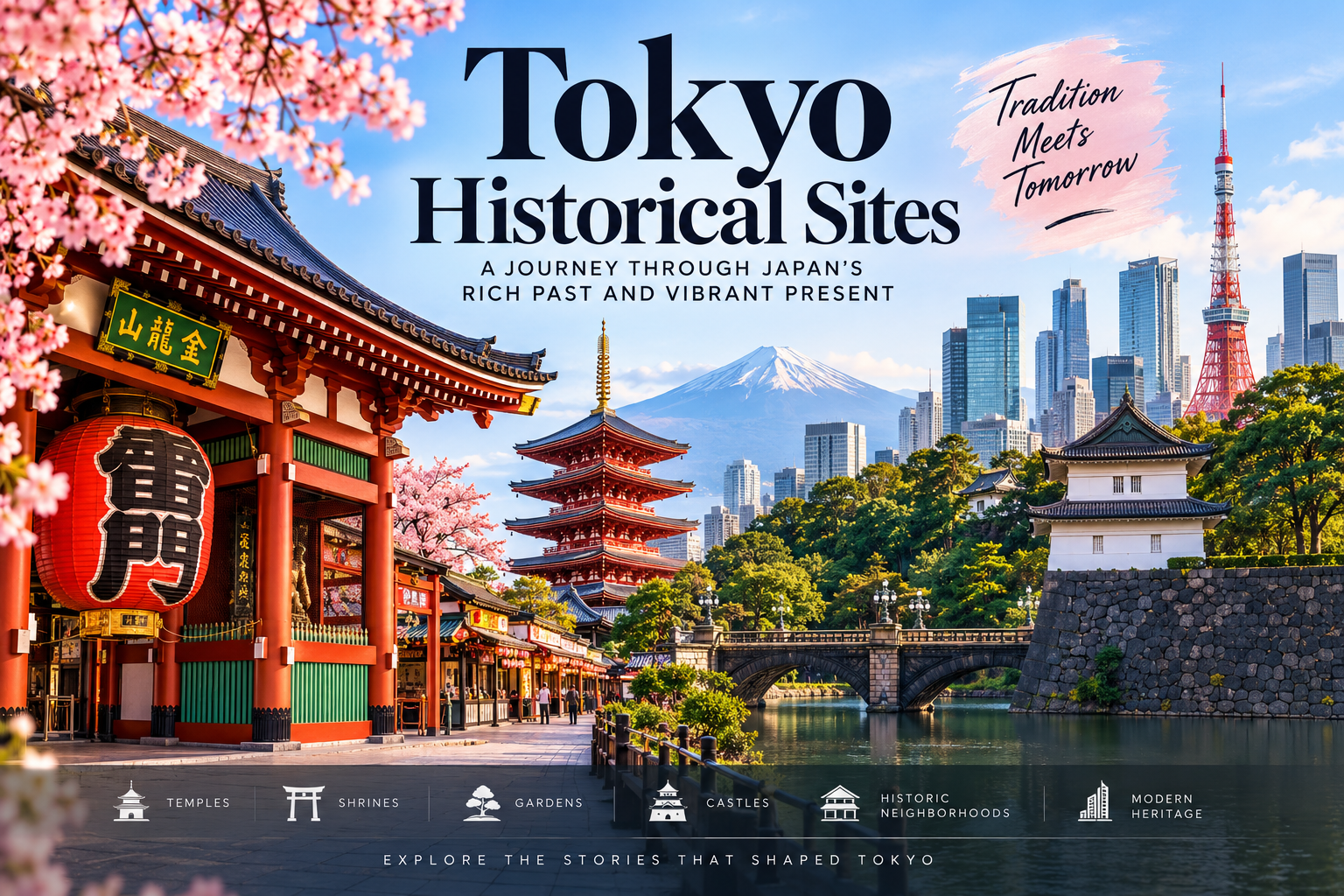
Tokyo historical sites offer a remarkable journey through centuries of Japanese history, from ancient Buddhist temples and samurai-era landmarks to imperial gardens, traditional neighborhoods, and modern buildings shaped by the past. Whether you are a first-time visitor, a history enthusiast, or a traveler looking for authentic cultural experiences, Tokyo’s historical places reveal how the city transformed from Edo into one of the world’s most influential capitals Tokyo Temples
Tokyo is often described as a city of contrasts. Shiny skyscrapers stand beside quiet shrines. Crowded train stations lead to peaceful gardens. Traditional wooden houses survive only a short walk from some of the world’s busiest commercial districts.
That contrast is one of the best reasons to explore Tokyo historical sites.
The city does not preserve its history in only one neighborhood or one museum. Instead, history is woven into streets, temples, gardens, bridges, shrines, former castle grounds, railway architecture, and residential districts.
A traveler who looks beyond Tokyo’s famous shopping areas can discover a much deeper story.
Quick Summary of Tokyo Historical Sites
| Historical Site | Historical Importance | Best For | Suggested Time |
|---|---|---|---|
| Senso-ji | Ancient Buddhist temple tradition | First-time visitors | 1–2 hours |
| Imperial Palace | Former Edo Castle grounds | History and gardens | 2–3 hours |
| Meiji Jingu | Shinto and modern imperial history | Culture and nature | 1–2 hours |
| Nezu Shrine | Traditional shrine architecture | Photography | 1 hour |
| Zojo-ji | Tokugawa-era connections | History and architecture | 1 hour |
| Yanaka | Traditional Tokyo atmosphere | Walking | 2–4 hours |
| Ueno Park | Cultural and historical district | Families and museums | 3–5 hours |
| Koishikawa Korakuen | Edo-period garden | Gardens | 1–2 hours |
| Hamarikyu Gardens | Daimyo garden heritage | Relaxation | 1–2 hours |
| Kanda Shrine | Historic Shinto tradition | Culture | 1 hour |
| Sengaku-ji | Famous samurai history | History lovers | 1 hour |
| Rikugien | Edo garden design | Nature and history | 1–2 hours |
| Tokyo Station | Meiji-era modernization | Architecture | 1 hour |
| Kyu-Furukawa Gardens | Western and Japanese design | Gardens | 1–2 hours |
| Gotoku-ji | Temple associated with maneki-neko tradition | Culture | 1 hour |
Why Tokyo Historical Sites Are Worth Visiting
Tokyo’s historical attractions are valuable because they tell different parts of the same story.
A temple can explain the development of Buddhism in Japan. A garden can reveal how powerful families spent their leisure time. A shrine can show the importance of Shinto traditions. An old neighborhood can demonstrate how ordinary people lived.
Together, these places create a much richer understanding of Tokyo.
The most interesting part is that many historical sites are still active.
People do not simply visit them as archaeological ruins. They pray at shrines, walk through gardens, celebrate festivals, buy traditional goods, attend ceremonies, and live in neighborhoods shaped by earlier generations.
This makes Tokyo history feel alive rather than frozen.
Understanding Tokyo Before You Visit
To understand Tokyo historical sites, it helps to understand the city’s earlier identity.
Tokyo was known as Edo for much of its premodern history. Under the Tokugawa shogunate, Edo developed into a major political and economic center.
The Tokugawa government established its political headquarters at Edo Castle, and the city grew around this center of power.
Samurai, merchants, craftsmen, religious institutions, and ordinary residents all contributed to the development of Edo.
By the nineteenth century, Edo had become one of the largest cities in the world.
In 1868, the Meiji government moved the imperial capital from Kyoto to Tokyo, and Edo was renamed Tokyo.
This transition marked the beginning of another major chapter.
Japan entered a period of rapid modernization, and Tokyo became the center of political, economic, industrial, and cultural transformation.
However, modernization did not erase everything that came before.
Many temples, shrines, gardens, streets, and neighborhood traditions survived.
That is why Tokyo can feel both extremely modern and surprisingly historic.
1. Senso-ji Temple
Senso-ji in Asakusa is one of the most recognizable Tokyo historical sites.
Its history is closely connected with the development of Asakusa as a religious and commercial district.
The approach to the temple begins at Kaminarimon, the famous Thunder Gate. Visitors then walk along Nakamise, a traditional shopping street leading toward the main temple complex.
The route itself is part of the experience.
Rather than entering a quiet archaeological site, you move through a lively urban environment filled with shops, food stalls, souvenirs, and visitors.
Senso-ji is particularly valuable for travelers who want their first introduction to traditional Tokyo.
The temple demonstrates how religion, commerce, tourism, and neighborhood life can exist together.
What to See at Senso-ji
Look for Kaminarimon, Nakamise, the main hall, and the surrounding temple grounds.
Take your time rather than rushing directly to the main hall.
The surrounding streets of Asakusa also contain older architectural details and traditional businesses.
2. Imperial Palace and Former Edo Castle
The Imperial Palace occupies a site with deep connections to Tokyo’s political history.
The grounds were formerly associated with Edo Castle, the powerful center of the Tokugawa shogunate.
Although much of the original castle complex no longer exists, historical traces remain throughout the area.
The palace district demonstrates the transition from the political world of the shoguns to modern imperial Tokyo.
Visitors can explore publicly accessible areas and gardens, while access to some palace sections is restricted.
Why the Imperial Palace Matters
The importance of this location is not limited to architecture.
It represents a major transformation in Japanese history.
The same broad area that once served as the center of Tokugawa political power later became associated with the modern imperial state.
That makes the Imperial Palace one of the most meaningful Tokyo historical sites for understanding political change.
3. Meiji Jingu
Meiji Jingu offers a different type of historical experience.
The shrine is dedicated to Emperor Meiji and Empress Shoken and is surrounded by a large forested area.
Walking toward the shrine can feel surprisingly distant from the energy of nearby Harajuku.
That contrast is part of its appeal.
The shrine represents the Meiji period, when Japan underwent enormous political, social, economic, and technological change.
What Makes Meiji Jingu Special
The combination of religious architecture, forest, ceremonies, and modern city surroundings creates a unique experience.
Visitors should remember that Meiji Jingu remains a functioning Shinto shrine.
It is not simply a tourist attraction.
Respectful behavior is therefore important.
4. Nezu Shrine
Nezu Shrine is one of the most attractive historical shrines in Tokyo.
Located in the Bunkyo area, the shrine is known for traditional architecture and its peaceful atmosphere.
Its grounds provide an opportunity to experience a quieter side of Tokyo.
The shrine is particularly interesting for photographers because of its gates, pathways, vegetation, and traditional design.
Best Time to Visit Nezu Shrine
Spring is especially popular because of the shrine’s azalea displays.
However, visiting outside the busiest periods can provide a calmer experience.
If your goal is to understand traditional shrine architecture rather than simply take photographs, spend time observing the layout and religious details.
5. Zojo-ji Temple
Zojo-ji stands near Tokyo Tower, creating one of the city’s most memorable combinations of old and new.
The temple has strong historical associations with the Tokugawa family and served as an important temple of the Tokugawa era.
Its location provides an excellent example of Tokyo’s layered identity.
A visitor can stand in a historic Buddhist setting while seeing one of the city’s most recognizable modern landmarks nearby.
Why Visit Zojo-ji
Zojo-ji is especially useful for travelers interested in the relationship between religion and political power during the Edo period.
The temple also provides a strong example of how Tokyo’s historic landscape has been integrated into the modern city.
6. Yanaka
Yanaka is not one single monument.
It is a historic neighborhood experience.
The area is known for traditional streets, temples, small businesses, residential lanes, and an atmosphere that feels different from Tokyo’s major commercial districts.
Walking through Yanaka can help travelers imagine what parts of older Tokyo may have felt like.
The area also has a strong connection with the city’s Buddhist temple culture.
Explore Yanaka on Foot
A walking route through Yanaka can include temples, Yanaka Cemetery, local shops, and Yanaka Ginza.
The best strategy is to avoid rushing.
Instead of treating Yanaka as a checklist destination, allow yourself time to explore side streets.
7. Ueno Park
Ueno Park is one of Tokyo’s major cultural and historical areas.
The park contains museums, religious sites, monuments, and spaces that connect modern Tokyo with earlier history.
The area was historically associated with Kaneiji, an important temple complex during the Edo period.
Today, Ueno combines public recreation with cultural institutions.
Why Ueno Is Important
Ueno demonstrates how historic religious land was transformed into a modern public cultural district.
It is therefore useful for understanding not only what survived in Tokyo but also how the city changed.
8. Kiyomizu Kannon-do
Located within the Ueno area, Kiyomizu Kannon-do is a historic Buddhist temple connected with the former Kaneiji complex.
Its architecture and elevated position offer a quieter experience compared with some of Tokyo’s more crowded attractions.
The temple provides another opportunity to understand how religious institutions shaped Edo’s urban landscape.
9. Kaneiji Temple Area
Kaneiji once held significant religious and political importance in Edo.
Its historical story is particularly interesting because the temple was connected to the Tokugawa regime and the powerful temple networks of the period.
The Battle of Ueno during the Boshin War also affected this area.
Today, only parts of the former complex remain.
This makes the site a useful reminder that historical landscapes are often incomplete.
What survives can sometimes tell you as much as what disappeared.
10. Koishikawa Korakuen Gardens
Koishikawa Korakuen is one of Tokyo’s important traditional landscape gardens.
The garden reflects the sophisticated design principles used by feudal elites during the Edo period.
Its paths, ponds, bridges, plants, and carefully arranged views were designed to create changing scenes as visitors moved through the landscape.
Understanding Edo Garden Design
Traditional Japanese gardens often use controlled composition rather than natural wilderness.
A pond may represent a larger body of water.
A carefully positioned bridge can frame a view.
A hill can create perspective.
The garden becomes a form of visual storytelling.
This makes Koishikawa Korakuen more than a pleasant green space.
It is a historical document expressed through landscape design.
11. Hamarikyu Gardens
Hamarikyu Gardens sits close to Tokyo’s modern business districts but preserves the atmosphere of an earlier elite landscape.
The garden has connections with the Tokugawa family and later became part of the imperial household before opening to the public.
Its location near Tokyo Bay is especially important to its design.
Why Hamarikyu Is Different
Hamarikyu demonstrates how political power, landscape design, and water were connected.
The garden was not simply created for beauty.
It reflected the status and lifestyle of powerful figures.
Today, its surroundings provide a fascinating contrast between historical gardens and modern skyscrapers.
12. Kanda Shrine
Kanda Shrine, also known as Kanda Myojin, has a long history and remains an important Shinto institution.
Its location near Akihabara creates another classic Tokyo contrast.
Traditional religious culture exists alongside electronics stores, gaming culture, and modern technology businesses.
The shrine’s festivals are particularly important to its identity.
Kanda Shrine for Modern Travelers
Kanda Shrine is useful for visitors interested in how traditional institutions adapt to modern communities.
It is not unusual for contemporary visitors to connect with the shrine through both traditional customs and modern interests.
13. Hie Shrine
Hie Shrine is another important Shinto site in central Tokyo.
It is particularly known for its association with political and urban Tokyo.
The shrine provides a peaceful break from the surrounding government and business districts.
Its famous stairway and traditional architecture make it an attractive stop for visitors exploring central Tokyo.
14. Sengaku-ji Temple
Sengaku-ji is one of the most significant Tokyo historical sites for travelers interested in samurai history.
The temple is closely associated with the story of the Forty-seven Ronin, one of Japan’s most famous historical narratives.
The story concerns loyalty, revenge, duty, and the complex social code of the samurai era.
Why the Forty-seven Ronin Story Matters
Whether viewed as an inspiring example of loyalty or as a complicated historical episode, the story reveals important ideas about social status, obligation, honor, and justice in Tokugawa Japan.
Visiting Sengaku-ji gives travelers a physical location through which to explore those themes.
15. Rikugien Gardens
Rikugien is another outstanding example of Edo-period garden design.
The garden was created for a powerful feudal lord and reflects carefully planned landscape aesthetics.
Walking through Rikugien feels very different from walking through a modern city park.
The experience changes with every turn because the garden was designed around controlled views and movement.
A Better Way to Experience Rikugien
Do not simply walk around the perimeter.
Pause at different viewpoints.
Observe how water, trees, bridges, paths, and buildings interact.
The garden is best understood as a sequence rather than a single photograph.
16. Kyu-Furukawa Gardens
Kyu-Furukawa Gardens offer an unusual combination of Western-style architecture and Japanese garden design.
The property reflects the changing tastes and international influences of modernizing Japan.
This combination makes it especially valuable for understanding the transition from traditional Edo culture toward modern Tokyo.
Why the Design Matters
Rather than replacing Japanese traditions completely, modern Japanese architecture often combined domestic design principles with foreign influences.
Kyu-Furukawa Gardens provide a clear example of this cultural interaction.
17. Gotoku-ji Temple
Gotoku-ji is widely associated with the maneki-neko, or beckoning cat, tradition.
The temple has become popular with visitors because of the many cat figures found around the grounds.
For travelers, the site offers a memorable way to connect popular Japanese culture with religious tradition.
However, it is important not to reduce the temple entirely to the cat symbolism.
Gotoku-ji is also a Buddhist temple with its own historical story and religious significance.
18. Tokyo Station
Tokyo Station is one of the city’s most important architectural landmarks.
The station is strongly connected with Japan’s modernization and the development of the railway network.
Its historic Marunouchi facade reflects the architectural ambitions of early modern Tokyo.
Tokyo Station and Modern Japan
Railways transformed Japan by making movement of people and goods faster and more efficient.
Tokyo Station became part of this larger national transformation.
Today, millions of people pass through the broader station area, making it an excellent example of how historical architecture can remain part of everyday urban life.
19. Marunouchi
Marunouchi is not simply a business district.
Its development is closely connected to the area surrounding the former Edo Castle and the modernization of Tokyo.
The district today contains major offices, commercial facilities, and historic architectural elements.
Walking through Marunouchi can help travelers see how Tokyo converted former political landscapes into modern economic centers.
20. National Diet Building Area
The National Diet Building and surrounding government district provide insight into Japan’s modern political development.
Although the area is not an Edo-period attraction, it belongs in a broader exploration of Tokyo’s historical development.
The architecture reflects Japan’s modern constitutional and governmental institutions.
This is an important reminder that Tokyo history did not end with the samurai era.
21. Fukagawa Fudoson
Fukagawa Fudoson is a Buddhist temple in the Monzen-Nakacho area.
The surrounding district retains connections to traditional temple-town culture.
For visitors seeking a less obvious historical destination, Fukagawa offers a chance to explore a different side of Tokyo.
The neighborhood atmosphere can be more important than any single monument.
22. Kanda and Nihonbashi Historic Areas
Nihonbashi has played an important role in Tokyo’s commercial development.
The area was historically connected with major transportation routes and commerce.
Nihonbashi also represents the relationship between infrastructure and economic growth.
The historic bridge area is especially useful for travelers interested in how Edo developed into a commercial center.
23. Asakusa Historic Streets
Asakusa deserves attention beyond Senso-ji itself.
The surrounding streets preserve layers of traditional entertainment, commerce, food culture, and religious life.
A visitor who spends several hours exploring Asakusa can discover a much broader historical landscape.
What to Explore
Walk beyond the main temple approach.
Look at smaller streets, traditional shops, neighborhood restaurants, and older buildings.
This is where the historical character of Asakusa becomes more apparent.
24. Akihabara and Kanda Historical Contrast
Akihabara is famous worldwide for electronics, anime, gaming, and pop culture.
Yet its relationship with nearby Kanda reveals something interesting about Tokyo.
Modern culture did not appear in isolation.
It developed within an older urban landscape shaped by commerce, transportation, religion, and neighborhood communities.
Exploring both districts can therefore create an excellent historical contrast.
25. Yanaka Cemetery and Traditional Temple Districts
Yanaka Cemetery and the surrounding temple districts provide a quieter way to experience Tokyo’s past.
The area contains graves, religious buildings, trees, pathways, and residential streets.
It demonstrates how memorial spaces have remained part of the city’s urban fabric.
For respectful visitors, this can be one of the most reflective experiences among Tokyo historical sites.
How Tokyo Historical Sites Tell One Connected Story
A common mistake is to visit historical attractions as isolated locations.
A better approach is to connect them.
Senso-ji shows the importance of religious and commercial life.
Edo Castle explains political power.
Koishikawa Korakuen and Rikugien demonstrate elite garden culture.
Sengaku-ji introduces samurai narratives.
Tokyo Station shows modernization.
Meiji Jingu represents the Meiji era.
Yanaka reveals neighborhood continuity.
Together, these places form a historical timeline.
Tokyo Historical Sites by Historical Period
Ancient and Early Religious Heritage
Some of Tokyo’s religious institutions have histories extending far beyond the modern city.
These sites help visitors understand the role of Buddhism and Shinto in Japanese society.
Edo Period
The Edo period is essential to understanding Tokyo.
Former castle grounds, gardens, temples, shrines, and neighborhood structures all provide clues about life under the Tokugawa shogunate.
Meiji Period
The Meiji period introduced dramatic political and technological changes.
Tokyo became the capital of a rapidly modernizing nation.
Meiji Jingu, Tokyo Station, and other modern-era landmarks help explain this transformation.
Twentieth-Century Tokyo
Tokyo experienced enormous change during the twentieth century.
Earthquakes, war, reconstruction, economic growth, and urban development repeatedly reshaped the city.
Understanding this period explains why Tokyo has relatively few intact buildings from certain historical periods compared with some older Japanese cities.
Best Tokyo Historical Sites for First-Time Visitors
If you have never explored Tokyo’s history, begin with a balanced route.
A strong first itinerary could include Senso-ji, the Imperial Palace area, Meiji Jingu, and Tokyo Station.
These four destinations reveal different chapters of Tokyo’s story.
Senso-ji introduces traditional religious culture.
The Imperial Palace connects you with Edo’s political center.
Meiji Jingu introduces modern imperial history.
Tokyo Station represents modernization.
Best Tokyo Historical Sites for Families
Families may prefer destinations where history is combined with open spaces and interactive experiences.
Ueno Park, Senso-ji, Hamarikyu Gardens, and the Imperial Palace area can work well.
Children may respond better when history is connected to physical places rather than long museum explanations.
Ask questions while walking.
Who lived here?
Why was this garden built?
Why are there gates?
Why did people travel through this area?
These questions can turn sightseeing into informal learning.
Best Tokyo Historical Sites for Photography
Photographers may enjoy Nezu Shrine, Senso-ji, Zojo-ji, Rikugien, Koishikawa Korakuen, and Yanaka.
However, good historical photography requires more than finding a famous landmark.
Look for relationships between old and new.
A traditional gate against a modern skyline can communicate Tokyo’s history more effectively than a close-up of the gate alone.
Best Tokyo Historical Sites for Couples
Couples looking for a quieter cultural experience can consider Rikugien, Hamarikyu Gardens, Yanaka, Nezu Shrine, and Zojo-ji.
Gardens are particularly suitable for slower exploration.
Instead of trying to visit as many sites as possible, choose two or three and spend more time at each.
Best Tokyo Historical Sites for Budget Travelers
Many shrines and neighborhood walks can be explored without expensive admission fees.
Walking through Yanaka, exploring Asakusa, visiting shrine grounds, and viewing exterior architecture around historic districts can provide substantial historical value at low cost.
A budget history trip does not need to mean a shallow trip.
The key is choosing locations where the neighborhood itself is part of the attraction.
A One-Day Tokyo Historical Sites Itinerary
Start your morning in Asakusa.
Explore Senso-ji and the surrounding streets before the busiest part of the day.
Continue toward Ueno and explore its historic and cultural district.
In the afternoon, travel toward the Imperial Palace area.
Finish around Tokyo Station and Marunouchi.
This itinerary gives you religious history, Edo history, cultural development, and modern architecture in one day.
A Two-Day Historical Tokyo Itinerary
Day One
Begin with Senso-ji and Asakusa.
Continue to Ueno and Yanaka.
Spend the late afternoon exploring Yanaka’s streets and temple district.
Day Two
Start at Meiji Jingu.
Continue toward the Imperial Palace.
Visit Tokyo Station and Marunouchi.
Finish at Zojo-ji for a memorable old-and-new Tokyo contrast.
A Three-Day Tokyo Historical Itinerary
Day One
Explore Asakusa, Senso-ji, and nearby historic neighborhoods.
Day Two
Visit the Imperial Palace area, Tokyo Station, Marunouchi, and central shrines.
Day Three
Explore Yanaka, Nezu Shrine, Rikugien, or Koishikawa Korakuen.
This slower schedule gives you more time to understand the locations instead of simply collecting photographs.
10 Historic Tokyo Experiences and Landmark Options Compared
Historical sites are not technically “brands,” but travelers often compare destinations in the same way they compare travel experiences. The following table provides 10 recognizable Tokyo historical experiences and landmarks for planning purposes.
| Experience or Landmark | Historical Focus | Atmosphere | Best For |
|---|---|---|---|
| Senso-ji | Buddhist and Edo-era heritage | Busy and traditional | First-time visitors |
| Imperial Palace | Edo Castle and political history | Formal and spacious | History travelers |
| Meiji Jingu | Meiji-era religious history | Forested and peaceful | Culture lovers |
| Zojo-ji | Tokugawa and Buddhist history | Historic with city views | Photographers |
| Yanaka | Traditional neighborhood life | Quiet and local | Walkers |
| Ueno | Religious and cultural history | Busy but spacious | Families |
| Rikugien | Edo garden culture | Calm and elegant | Couples |
| Hamarikyu | Daimyo and garden history | Urban and peaceful | Relaxation |
| Sengaku-ji | Samurai history | Reflective | History enthusiasts |
| Tokyo Station | Modernization and rail history | Urban and impressive | Architecture lovers |
How to Visit Tokyo Historical Sites Respectfully
Historical attractions are also religious and community spaces.
At shrines, observe local customs.
Avoid loud conversations around worship areas.
Do not block pathways for photographs.
Follow posted photography rules.
At temples and cemeteries, behave respectfully.
Remember that people may be visiting these places for religious reasons, not tourism.
This simple approach improves the experience for everyone.
Common Mistakes When Visiting Tokyo Historical Sites
Trying to Visit Too Many Places
Tokyo is enormous.
Trying to visit ten historical sites in one day usually creates a rushed experience.
Choose fewer destinations and spend more time understanding them.
Ignoring the Neighborhood
A famous temple is only part of the historical experience.
Explore nearby streets.
Many historical details exist outside the official attraction.
Visiting Only at Midday
Popular sites can become extremely busy.
Early morning is often better for travelers who want quieter surroundings.
Treating Religious Sites Like Photo Sets
Photography is important, but these are active religious spaces.
Take photographs without disrupting worshippers or ceremonies.
Assuming Every Old-Looking Building Is Ancient
Tokyo has experienced earthquakes, fires, war, redevelopment, and reconstruction.
Some buildings may look traditional while being relatively recent.
Always distinguish historical appearance from documented age.
The Pros and Cons of Exploring Tokyo Historical Sites
Advantages
Tokyo offers exceptional variety.
You can experience temples, shrines, gardens, political landmarks, neighborhoods, and modern architecture within the same trip.
Many historical sites are accessible by public transportation.
The city also allows visitors to compare different historical periods within a short distance.
Challenges
Tokyo is highly urbanized.
Some historic locations are surrounded by modern development.
Crowds can also affect the experience.
Another challenge is that Tokyo’s history can be difficult to understand without context.
A temple alone may not explain why it matters.
This is why reading a little background before visiting can significantly improve the experience.
How to Get More Historical Value From Your Trip
Before visiting a site, learn three things.
First, find out when it was established or became important.
Second, identify the people or institutions connected to it.
Third, understand what changed around it.
This simple method turns sightseeing into historical investigation.
For example, when visiting a garden, ask who built it and why.
When visiting a shrine, ask how its role changed over time.
When walking through a neighborhood, ask why that neighborhood survived.
These questions create a deeper travel experience.
The Hidden Importance of Rebuilding in Tokyo
One of the most important facts about Tokyo’s historical landscape is that survival and reconstruction are different things.
Tokyo has been repeatedly affected by natural disasters, fires, war, and redevelopment.
As a result, some important structures have been rebuilt.
That does not necessarily make them historically meaningless.
A rebuilt temple or shrine can continue an architectural tradition, religious function, and cultural memory even when the original physical structure is gone.
This is an important distinction for international visitors.
Historical authenticity can exist through continuity of place, function, tradition, and design, not only through untouched materials.
Tokyo Historical Sites and Natural Disasters
Earthquakes have played a major role in Tokyo’s history.
The Great Kanto Earthquake of 1923 caused enormous destruction across the region.
The disaster changed urban planning, architecture, infrastructure, and public policy.
For travelers, this history explains why Tokyo’s built environment contains such a complicated mixture of old, reconstructed, and modern structures.
The lesson is important.
Tokyo’s history is not simply about preserving the past.
It is also about rebuilding after disruption.
Tokyo Historical Sites and World War II
World War II also had a major impact on Tokyo.
Air raids caused extensive destruction in the city.
This is another reason why visitors may find fewer surviving historic structures in some parts of Tokyo than they expected.
Yet cultural traditions, religious institutions, neighborhoods, and urban layouts sometimes survived or were reconstructed.
The result is a city where history often exists through layers rather than perfect preservation.
Tokyo’s Old and New Architecture
Perhaps the easiest way to understand Tokyo is to look at its skyline.
Historic temples can sit beside office towers.
Traditional gardens can be surrounded by skyscrapers.
Old shopping streets can exist near enormous railway stations.
This is not an accident.
It reflects Tokyo’s long process of adaptation.
The city has repeatedly incorporated new technology, new architecture, new economic activities, and new lifestyles without completely eliminating older traditions.
Future of Tokyo Historical Sites
The future of Tokyo’s historic attractions will likely depend on balancing preservation with urban pressure.
Tokyo needs modern infrastructure and housing.
At the same time, historic neighborhoods and cultural institutions provide identity that cannot easily be recreated.
Digital technology may also change how visitors experience these sites.
Virtual guides, multilingual interpretation, augmented reality, digital archives, and interactive maps can make complex history easier to understand.
However, technology should support physical heritage rather than replace it.
The strongest future experience will probably combine accurate digital information with real-world exploration.
Why Slow Travel Works Especially Well in Tokyo
Tokyo rewards travelers who slow down.
A fast itinerary may allow you to see more landmarks.
A slower itinerary allows you to understand more.
Instead of visiting five temples for twenty minutes each, choose two and spend an hour learning about their surroundings.
Walk between nearby attractions when practical.
Notice street layouts.
Look at small shrines.
Read historical plaques.
Observe how residents use the neighborhood.
These small details often become the most memorable parts of a Tokyo history trip.
Practical Tips for Visiting Tokyo Historical Sites
Wear comfortable walking shoes.
Many historical districts involve walking through streets, gardens, and temple grounds.
Check opening hours before visiting gardens and paid attractions.
Respect religious customs.
Carry a small amount of cash because some smaller establishments may have limited payment options.
Avoid planning every minute.
Tokyo’s transportation system makes it tempting to create extremely packed itineraries.
Leave space for unexpected discoveries.
Most importantly, research the history of your chosen destinations before you arrive.
Even ten minutes of preparation can make a major difference.
Frequently Asked Questions About Tokyo Historical Sites
What is the most famous historical site in Tokyo?
Senso-ji is one of Tokyo’s best-known historical and religious attractions. Its temple grounds, Kaminarimon, and traditional shopping approach make it a popular starting point for visitors.
What are the best Tokyo historical sites for first-time visitors?
Senso-ji, the Imperial Palace area, Meiji Jingu, Zojo-ji, and Tokyo Station provide a strong introduction to different periods of Tokyo’s history.
Are there free Tokyo historical sites?
Yes. Many shrine grounds, neighborhood walks, exterior landmarks, and public areas can be explored for free. Some gardens and attractions charge admission.
How many historical sites can you visit in one day?
Three to five locations can be realistic depending on distance, opening hours, crowd levels, and how much time you want to spend at each destination.
Is Tokyo good for history lovers?
Absolutely. Tokyo provides history from multiple periods, including religious heritage, Edo culture, samurai history, imperial history, modernization, wartime destruction, reconstruction, and contemporary urban development.
What is the best historical neighborhood in Tokyo?
Yanaka is one of the strongest choices for travelers looking for traditional streets, temples, residential areas, and a slower atmosphere.
Is the Imperial Palace a historical site?
Yes. The Imperial Palace occupies the former Edo Castle area and is closely connected to Tokyo’s political and imperial history.
Which Tokyo historical site is best for samurai history?
Sengaku-ji is particularly important because of its association with the Forty-seven Ronin story.
Which historical site is best for gardens?
Koishikawa Korakuen and Rikugien are excellent choices for travelers interested in Edo-period garden design. Hamarikyu Gardens offers another important historical landscape experience.
Can I visit Tokyo historical sites with children?
Yes. Ueno Park, Senso-ji, gardens, and historic neighborhoods can work particularly well for families because they combine history with outdoor exploration.
Are Tokyo historical sites crowded?
Popular attractions such as Senso-ji can become very busy, particularly during peak travel periods. Early visits and less famous sites can provide a quieter experience.
Do I need a guide to understand Tokyo history?
A guide is not essential, but historical background can greatly improve your experience. Even basic research can help explain why a particular temple, garden, or neighborhood matters.
Conclusion
Tokyo historical sites are much more than a collection of old temples, shrines, gardens, and buildings. They are pieces of a much larger story about political power, religion, commerce, samurai culture, modernization, disaster, reconstruction, and the continuous reinvention of one of the world’s greatest cities.
The most rewarding way to explore Tokyo’s history is to look for connections. See the former Edo Castle area, then visit a traditional temple. Walk through an old neighborhood, then compare it with a modern business district. Visit a peaceful garden and consider who designed it, who used it, and why it survived.
Tokyo’s history is not hidden in one place. It is spread across the city, waiting to be discovered one street, shrine, garden, temple, and neighborhood at a time.