
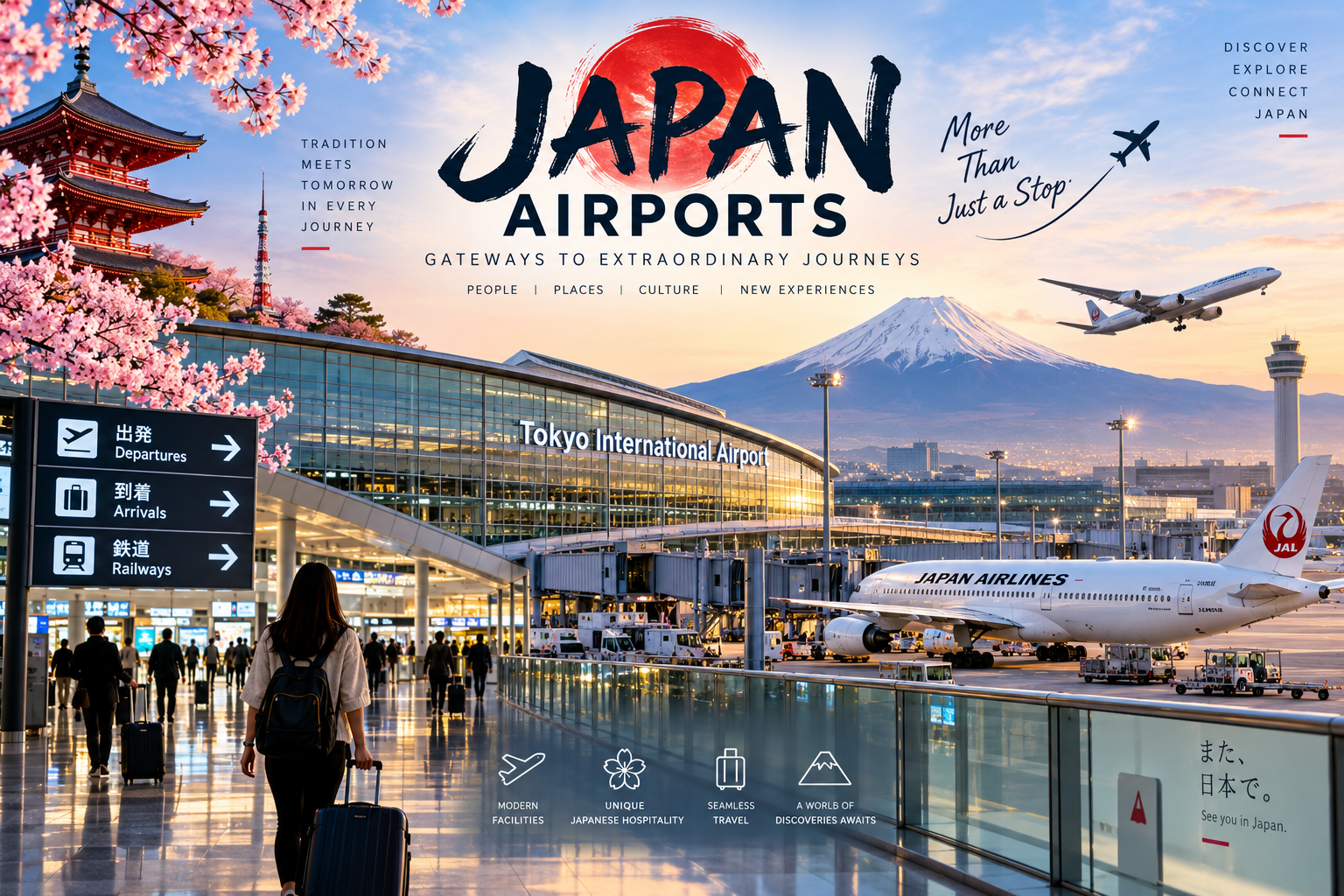
Japan Airports: 10 Best Airports in Japan for Easy Travel in 2026
Japan is famous for efficient transportation, and its airports are a major part of that system. However, Japan airports are not interchangeable. Haneda can be extremely convenient for Tokyo, Narita serves as another major Tokyo gateway, Kansai International Airport is a key entry point for Osaka and the Kansai region, while airports such as Fukuoka, New Chitose, Chubu Centrair, Naha, Hiroshima, Sendai, and Kagoshima connect travelers to different parts of the country Zopalno Number Flight
Japan airports range from huge international gateways to highly efficient regional airports, and choosing the right one can save time, money, and unnecessary transfers. The best airport depends on your destination, airline, domestic connection, terminal, transportation plans, and the region you want to explore.
For first-time visitors, the biggest mistake is often choosing an airport based only on the city name. Tokyo has two major international airports, for example, but their locations and transportation options can make a noticeable difference to the beginning or end of a trip.
This guide explains the major Japan airports, how they differ, which airports are best for different travelers, how airport transfers work, what mistakes to avoid, and what the future of Japanese airport travel may look like.
Understanding Japan Airports
Japan has a large network of airports serving its major metropolitan areas, islands, tourism destinations, and remote communities. Some are designed primarily around domestic travel, while others handle substantial international traffic.
The country’s geography makes airports particularly important. Japan stretches from Hokkaido in the north to Okinawa in the south, with mountainous terrain and many islands. Although the railway network is excellent, flying can be the most practical option when traveling between distant regions.
For example, traveling from Tokyo to Kyoto is usually straightforward by high-speed train, but traveling from Tokyo to Hokkaido, Okinawa, Kyushu, or some smaller islands can make air travel much more attractive.
Japanese airports also vary dramatically in character. A major international hub can contain multiple terminals, extensive shopping areas, lounges, rail connections, buses, hotels, restaurants, and transfer facilities. A smaller regional airport may be much easier to navigate but offer fewer international connections.
This means that airport choice should be treated as part of your itinerary rather than as a simple flight-booking decision.
The Two Main Tokyo Airports
Haneda Airport
Haneda Airport, officially Tokyo International Airport, is one of the most important airports for travelers visiting Tokyo.
Its greatest advantage is location. Haneda is much closer to central Tokyo than Narita, making it particularly attractive for travelers whose priority is reaching areas such as Shinagawa, Shibuya, Shinjuku, Ginza, Tokyo Station, or other central districts quickly.
Haneda has both domestic and international operations, and its domestic network makes it an important connection point for travelers continuing to other Japanese cities.
The airport is also well connected to Tokyo’s urban transportation system.
For international visitors, Haneda can be especially convenient when the goal is to minimize the amount of time between landing and reaching a hotel.
Why Choose Haneda?
Haneda is generally attractive for:
- Travelers staying in central Tokyo
- Business travelers
- Short Tokyo trips
- Travelers making domestic connections
- Passengers who value convenient rail access
- Visitors who want to minimize airport-to-city travel time
One important point is that flight availability and airline schedules can matter more than airport preference. A slightly less convenient airport may still be the better choice if it offers a significantly better schedule or fare.
Narita International Airport
Narita International Airport is another major gateway for the Tokyo metropolitan area.
Despite commonly being called the “Tokyo” airport, Narita is geographically outside central Tokyo. That means travelers should include airport transfer time in their planning.
Narita has historically played a major role in international aviation and continues to serve numerous international routes.
The airport is particularly useful when your airline, fare, or schedule makes Narita the better option.
Narita is connected with Tokyo by several rail and bus services, making the journey into the city relatively straightforward when planned in advance.
Haneda vs Narita
The choice between the two can be simplified:
| Factor | Haneda | Narita |
|---|---|---|
| Location relative to central Tokyo | More convenient | Farther away |
| Domestic network | Very strong | Strong |
| International network | Extensive | Extensive |
| City transfer | Usually shorter | Usually longer |
| Best for | Central Tokyo convenience | Wider international choice and specific routes |
| Planning priority | Flight + city location | Flight + transfer time |
The important lesson is that neither airport is automatically “the best.” The best airport is the one that fits your entire itinerary.
Kansai International Airport
Kansai International Airport is one of the most important airports for western Japan.
It serves the Kansai region, including Osaka, Kyoto, Kobe, and surrounding destinations.
For international travelers visiting Osaka or Kyoto, Kansai International Airport can be an extremely practical gateway.
One of its major advantages is its transportation network. Travelers can use trains, buses, taxis, rental cars, and other transportation options. The airport’s official access information also provides route planning for public transportation, cars, taxis, rental cars, and inter-terminal transfers.
Why Kansai Airport Is Important
Kansai is particularly useful for travelers planning:
- Osaka trips
- Kyoto trips
- Nara trips
- Kobe trips
- Western Japan itineraries
- Multi-city Kansai vacations
- International-to-domestic connections within western Japan
A common planning mistake is to think of Kyoto as requiring a Kyoto airport. In reality, Kansai International Airport is one of the principal international gateways used to reach Kyoto.
Terminal Planning at Kansai
Kansai has multiple terminal facilities, so travelers should check their airline and flight information before heading to the airport.
This is especially important when traveling with low-cost carriers or connecting between flights.
Do not simply type “Kansai Airport” into your navigation app and assume you are finished. Check the terminal shown by your airline or booking confirmation.
Chubu Centrair International Airport
Chubu Centrair International Airport serves the Chubu region and is the principal airport for travelers visiting Nagoya and surrounding areas.
It is located on an artificial island near Nagoya and is well integrated with rail, bus, road, and high-speed ferry connections.
Centrair currently operates Terminal 1 and Terminal 2. The airport specifically advises passengers to check their airline in advance because airlines can operate from different terminals.
What Makes Centrair Different?
One of the most useful features of Centrair is its integrated transportation system.
The Access Plaza connects travelers with trains, buses, taxis, cars, and high-speed boats.
For travelers using Terminal 2, the airport provides a free shuttle bus between Terminal 1 and Terminal 2 at approximately 15-minute intervals. The terminals are also connected by a walking route of about 10 minutes.
This makes Centrair a useful example of how airport design can influence the travel experience.
Who Should Use Chubu Centrair?
Centrair is especially useful for:
- Nagoya visitors
- Toyota and central Aichi business travelers
- Travelers exploring the Chubu region
- International travelers entering through Nagoya
- Passengers connecting through Nagoya
- Travelers visiting attractions around central Japan
Fukuoka Airport
Fukuoka Airport is one of the most convenient airports for travelers visiting Kyushu.
Fukuoka is a major city and transportation center, and its airport is unusually convenient for reaching the urban area.
The airport has separate domestic and international passenger terminal buildings. Travelers should pay attention to this distinction when arranging transportation or meeting someone at the airport.
The official airport information warns that the domestic and international terminals are separated by the runway area and are roughly a 15-minute drive apart.
Why Fukuoka Airport Is Popular
Fukuoka is useful for travelers exploring:
- Fukuoka City
- Hakata
- Kyushu
- Nagasaki
- Kumamoto
- Beppu
- Oita
- Kagoshima
- Regional Japanese destinations
The airport’s transportation connections also make it practical for travelers who want to move quickly into Fukuoka.
The airport provides bus connections to places including Hakata Station and Tenjin, among other destinations.
The Fukuoka Terminal Mistake
One of the most important things to remember is that “Fukuoka Airport” does not mean all airport facilities are in one compact building.
If you are arriving internationally and transferring to a domestic flight, check how the transfer between terminals works and allow enough time.
This is an excellent example of why terminal information can be just as important as airport information.
New Chitose Airport
New Chitose Airport is the principal airport serving the Sapporo area and is a major gateway to Hokkaido.
For travelers visiting Hokkaido, New Chitose is usually one of the most important airport options to consider.
Hokkaido is famous for skiing, winter scenery, national parks, seafood, summer landscapes, and outdoor tourism. Because of the island’s size, airport choice can have a significant effect on the overall itinerary.
Why New Chitose Is Important
The airport is useful for travelers visiting:
- Sapporo
- Otaru
- Niseko
- Furano
- Biei
- Lake Shikotsu
- Other Hokkaido destinations
However, Hokkaido is enormous. Do not assume that flying into New Chitose means every destination is close.
If your itinerary focuses on eastern or northern Hokkaido, another regional airport may sometimes make more sense.
Winter Travelers Need Extra Planning
Winter travel introduces another consideration: weather.
Snow and severe winter conditions can affect flights and surface transportation.
If your trip includes skiing or an important event, build some flexibility into the schedule.
A traveler who plans a flight, train, ski transfer, hotel check-in, and return flight with zero margin has created a fragile itinerary.
Naha Airport
Naha Airport is the major gateway to Okinawa.
Okinawa is geographically separated from Japan’s main islands, so air travel plays a particularly important role.
Naha is useful for travelers visiting:
- Naha City
- Okinawa Main Island
- Beach resorts
- Cultural attractions
- Diving destinations
- Family vacation areas
It is also an important domestic aviation hub.
Travelers planning to visit smaller Okinawan islands should check whether they need to connect through Naha or can fly directly from another Japanese airport.
Hiroshima Airport
Hiroshima Airport provides access to Hiroshima Prefecture and western parts of Japan.
It can be useful for travelers combining Hiroshima with destinations such as Miyajima and other parts of the Chugoku region.
However, airport distance from the city should be considered when comparing flight options with rail travel.
For some travelers, arriving by train may provide a more direct city-center experience.
This highlights a broader Japan travel principle:
The cheapest flight is not always the cheapest journey.
If a flight saves ¥5,000 but requires expensive transportation, extra time, and a complicated connection, the apparent saving may disappear.
Sendai Airport
Sendai Airport is an important gateway to the Tohoku region.
It serves travelers visiting Sendai and surrounding areas and can be useful for exploring northern Honshu.
Sendai itself is an important regional center, while Tohoku offers a different travel experience from the heavily visited Tokyo-Kyoto-Osaka route.
Travelers looking for quieter destinations, regional food, nature, hot springs, and cultural experiences may find the region particularly interesting.
Kagoshima Airport
Kagoshima Airport serves southern Kyushu.
Kagoshima is known for its volcanic landscapes, hot springs, islands, and distinctive regional culture.
The airport can be useful for travelers planning trips around southern Kyushu rather than simply visiting the major northern cities.
Travelers heading toward areas such as Kagoshima City, Kirishima, or nearby island destinations should compare flight schedules, airport transfers, and rail connections before choosing their arrival airport.
10 Major Japan Airports Compared
The following comparison focuses on practical travel roles rather than attempting to rank airports by a single universal score.
| Airport | Main Region | Best For | International Role | Domestic Connectivity | Key Advantage |
|---|---|---|---|---|---|
| Haneda Airport | Tokyo | Central Tokyo | Very strong | Excellent | Convenient Tokyo access |
| Narita International Airport | Greater Tokyo | International travel | Very strong | Strong | Extensive international network |
| Kansai International Airport | Osaka/Kansai | Osaka and Kyoto | Very strong | Strong | Kansai gateway |
| Chubu Centrair | Nagoya/Chubu | Nagoya | Strong | Strong | Integrated transport |
| Fukuoka Airport | Kyushu | Fukuoka and Kyushu | Strong | Excellent | Major Kyushu gateway |
| New Chitose | Hokkaido | Sapporo/Hokkaido | Strong | Excellent | Hokkaido access |
| Naha Airport | Okinawa | Okinawa | Strong regional role | Excellent | Okinawa hub |
| Hiroshima Airport | Chugoku | Hiroshima region | Moderate | Strong | Western Honshu access |
| Sendai Airport | Tohoku | Sendai/Tohoku | Regional | Strong | Tohoku gateway |
| Kagoshima Airport | Southern Kyushu | Kagoshima | Regional | Strong | Southern Kyushu access |
Airline schedules change frequently, so travelers should always confirm current routes and terminal information before booking or traveling.
Choosing the Best Japan Airport for Your Trip
Best Japan Airport for First-Time Visitors
For first-time visitors, the best airport usually depends on the route.
If the itinerary begins in Tokyo, compare Haneda and Narita.
If the itinerary begins in Osaka or Kyoto, Kansai International Airport is often the natural choice.
If the trip starts in Hokkaido, New Chitose is a logical gateway.
If the trip starts in Kyushu, Fukuoka may be the best option for northern Kyushu, while Kagoshima can make more sense for the south.
Best Airport for Families
Families should prioritize simplicity.
Consider:
- Number of transfers
- Walking distance
- Terminal layout
- Luggage
- Child facilities
- Airport transportation
- Arrival time
- Hotel distance
An airport that saves 30 minutes of flying but adds two complicated transfers may not be the best family option.
Best Airport for Business Travelers
Business travelers usually benefit from:
- Frequent flights
- Reliable transportation
- Convenient city access
- Airport lounges
- Fast security and immigration processes
- Flexible flight schedules
Haneda can be particularly attractive for central Tokyo business travel because of its proximity to the city.
Best Airport for Budget Travelers
Budget travelers should compare the total trip cost, not just airfare.
Calculate:
Flight price + airport transportation + baggage + meals + transfer costs + time cost
A flight costing less may become more expensive once airport transportation is included.
Best Airport for International Travelers
International travelers should pay attention to:
- Immigration
- Customs
- International terminal
- Connecting flight requirements
- Airline partnerships
- Baggage transfer rules
- Minimum connection time
- Domestic terminal transfer
Do not assume that two flights on the same ticket automatically mean your luggage will be transferred or that you can remain airside.
Always confirm the airline’s current transfer procedure.
How to Navigate Japan Airports Like a Local
Check the Terminal Before Leaving Your Hotel
This is one of the easiest ways to avoid unnecessary stress.
Your flight confirmation may show:
- Airport
- Terminal
- Airline
- Flight number
- Departure time
Check all of them.
Airport terminal assignments can change, and some airports have multiple passenger buildings.
Arrive Earlier for International Flights
International travel generally requires more steps than domestic travel.
You may need:
- Check-in
- Baggage drop
- Security
- Immigration
- Customs procedures
- Gate transfer
- Boarding
The exact recommended arrival time depends on the airline, airport, route, and travel period.
During busy holiday seasons, allow additional time.
Keep Your Passport Accessible
Do not bury your passport at the bottom of your luggage.
You may need it repeatedly.
A small travel document organizer can make airport movement easier.
Use Airport Signs
Japanese airports are generally designed with clear directional signs, often using Japanese and English.
Look for signs indicating:
- Arrivals
- Departures
- Immigration
- Customs
- Baggage claim
- Railways
- Buses
- Taxis
- Transfers
- Information desks
Many airports also use icons, making navigation easier for international visitors.
Airport Transportation in Japan
One of the biggest strengths of Japan airports is the range of transportation options.
Trains
Trains are often the first choice for travelers heading toward major Japanese cities.
They can offer:
- Predictable travel times
- Frequent departures
- Comfortable seating
- Easy connections
- Convenient city-center access
However, not every airport has a direct train to every destination.
Check the exact route rather than assuming that “there is a train.”
Airport Buses
Airport limousine buses can be useful when traveling with heavy luggage.
They can sometimes take you directly to major hotels or transportation hubs without requiring multiple transfers.
This can be particularly useful for:
- Families
- Elderly travelers
- Travelers with large luggage
- First-time visitors
- People staying away from major train stations
Taxis
Taxis are convenient but usually more expensive than public transportation.
They make the most sense when:
- You have substantial luggage
- You are traveling with several people
- Your hotel is difficult to reach
- You arrive late
- Public transportation is unavailable
Rental Cars
Rental cars are useful for regional exploration, especially outside large cities.
They can be particularly valuable in places where public transportation is less frequent.
However, renting a car just to travel around Tokyo, Osaka, or Kyoto can be unnecessary.
Domestic Connections at Japan Airports
Connecting between an international and domestic flight requires special attention.
Allow Enough Connection Time
Never plan a connection based solely on the scheduled flight duration.
You may need to:
- Leave the aircraft.
- Complete immigration.
- Collect luggage.
- Pass customs.
- Move to another terminal.
- Check in again.
- Drop baggage.
- Pass security.
- Find the departure gate.
The exact process depends on the airport, airline, ticket arrangement, and whether baggage is checked through.
Separate Tickets Need Extra Caution
Suppose you book:
- Flight A independently
- Flight B independently
If Flight A is delayed, the airline operating Flight B may not be responsible for your missed flight.
This is one of the biggest risks of creating your own airport connection.
If possible, use a protected connection or leave a substantial buffer.
Japan Airport Services for International Travelers
Modern Japanese airports typically provide a wide range of services.
These may include:
- Wi-Fi
- Currency exchange
- ATMs
- Restaurants
- Convenience stores
- Baggage services
- Lockers
- Prayer or quiet spaces at some airports
- Nursing facilities
- Wheelchair assistance
- Information desks
- Lounges
- Shopping
- Car rental services
Centrair, for example, provides ATMs across airport areas and offers accessibility facilities, Wi-Fi, wheelchairs, stroller services, baggage lockers, and other traveler services.
The availability of a particular service can vary by terminal.
Japan Airports and Accessibility
Travelers with mobility requirements should research airport accessibility before the trip.
Look for:
- Wheelchair assistance
- Elevators
- Accessible toilets
- Barrier-free routes
- Assistance counters
- Accessible transportation
- Boarding assistance
Travelers should also contact their airline in advance when they require special assistance.
This is especially important for travelers who need help moving between terminals or boarding an aircraft.
Food and Shopping at Japan Airports
Japanese airports are often destinations in their own right.
Large airports may feature:
- Sushi
- Ramen
- Curry
- Bakery items
- Regional specialties
- Japanese sweets
- Souvenirs
- Duty-free products
- Electronics
- Fashion
- Travel goods
Airport shopping can be useful for last-minute gifts, but prices are not always lower than those found elsewhere.
If you are buying food or souvenirs, compare prices when possible.
Regional airports can also be a good place to discover local products from the area you are visiting.
The Hidden Value of Regional Japan Airports
Many travelers focus only on Tokyo, Osaka, and Kyoto.
That creates a blind spot.
Regional Japan airports can open the door to places that receive fewer international visitors.
For example, flying into a regional airport may allow a traveler to build an itinerary around:
- Local festivals
- Mountain villages
- Hot springs
- Regional cuisine
- Coastal towns
- Historic districts
- National parks
- Ski destinations
- Island communities
This can produce a more distinctive trip than following the standard Tokyo-Kyoto-Osaka route.
Japan Airports for Different Traveler Problems
If You Hate Long Transfers
Prioritize an airport with direct rail or bus access to your hotel area.
If You Travel With Heavy Luggage
Consider airport buses or direct transportation rather than multiple train transfers.
If You Have a Tight Schedule
Choose the airport that minimizes total ground transportation time.
If You Are Traveling With Children
Look for simpler terminal layouts, family facilities, direct transportation, and reasonable connection times.
If You Are Traveling During Winter
Build extra flexibility into the itinerary, especially when visiting Hokkaido or other areas affected by snow.
If You Are Traveling on Separate Tickets
Leave a much larger buffer than you would for a protected connection.
If You Want to Explore Rural Japan
Look beyond the biggest international gateways and consider regional airports.
Common Mistakes at Japan Airports
Mistake 1: Assuming Tokyo Has Only One Airport
Tokyo has two major airports serving the metropolitan area.
Always check whether your flight arrives at Haneda or Narita.
Mistake 2: Ignoring Terminal Information
An airport name alone may not be enough.
Check the terminal before traveling.
Mistake 3: Booking the Cheapest Flight Without Checking Ground Transport
The cheapest airfare can become an expensive journey.
Compare the complete transportation cost.
Mistake 4: Leaving Too Little Time for a Transfer
International arrivals can require immigration, baggage collection, customs, terminal transfers, and security.
Never build a connection based on ideal conditions.
Mistake 5: Confusing Domestic and International Terminals
Some airports have physically separated domestic and international facilities.
Fukuoka is a particularly important example because its domestic and international passenger buildings are separated by the runway area.
Mistake 6: Assuming Every Train Runs Late at Night
Airport rail services have schedules.
If your flight lands late, check the last train and alternative transportation before departure.
Mistake 7: Depending Entirely on Your Phone
Battery problems can turn a simple journey into a difficult one.
Keep:
- Hotel address
- Flight number
- Airport name
- Train information
- Emergency contact details
available offline.
Pros and Cons of Japan Airports
Advantages
Japan airports offer several major advantages.
Excellent transportation: Major airports are connected to railways, buses, taxis, and roads.
Strong organization: Clear signs and structured passenger flows make many airports relatively easy to navigate.
Regional connectivity: Airports make it practical to travel across a geographically long country.
International access: Major gateways connect Japan with destinations across Asia, North America, Europe, Oceania, and beyond.
Useful services: Travelers can often find restaurants, ATMs, Wi-Fi, luggage facilities, shopping, and information services.
Domestic flight options: Domestic aviation makes distant destinations accessible without spending an entire day on surface transportation.
Disadvantages
There are also limitations.
Airport distance: Some airports are far from the city they serve.
Terminal complexity: Large airports can be confusing for first-time visitors.
Transfer costs: Getting from the airport to the city can add significant expense.
Separate terminals: Some airports have facilities that require additional transportation.
Weather disruption: Snow, storms, typhoons, and other conditions can affect flights.
Schedule dependency: Regional airports may offer fewer daily flights than major hubs.
Japan Airports vs Shinkansen Travel
One of the most interesting decisions for travelers is whether to fly or take the Shinkansen.
Consider these factors:
| Factor | Air Travel | Shinkansen |
|---|---|---|
| City-center convenience | Depends on airport | Often excellent |
| Long-distance travel | Strong | Strong |
| Airport security | Required | Simpler |
| Luggage | Airline rules apply | Usually more flexible |
| Remote regions | Often better | May require connections |
| Major city pairs | Depends on route | Often very competitive |
| Weather exposure | Flight disruption possible | Rail disruption possible |
| Booking flexibility | Varies | Varies |
For many major city-center journeys, the train can be competitive once airport transportation and airport processing are included.
For long-distance island or regional travel, flying can be more efficient.
The best choice depends on the door-to-door journey, not simply the time in the air.
A Better Airport-Selection Framework
Instead of asking:
“Which Japan airport is best?”
Ask five questions:
Question 1: Where Am I Sleeping?
Your hotel location should influence airport selection.
Question 2: How Am I Getting There?
Check the exact train, bus, or road journey.
Question 3: What Is My Next Destination?
If you are immediately connecting to another region, choose an airport that makes the next leg easier.
Question 4: How Much Luggage Do I Have?
Heavy luggage can change the best transportation choice.
Question 5: How Valuable Is My Time?
A slightly more expensive flight may be worth it if it saves hours of transfers.
This framework is more useful than simply comparing ticket prices.
Japan Airports and Sustainable Travel
Air travel has an environmental cost, and travelers increasingly consider sustainability when planning trips.
Japan’s extensive railway system gives travelers an important alternative to domestic aviation on suitable routes.
A balanced approach is to choose rail where it is convenient and practical while using aircraft for routes where flying provides a meaningful geographic advantage.
Airports themselves are also under pressure to improve energy efficiency, reduce emissions, modernize ground operations, and respond to changing environmental expectations.
Future airport development will likely involve not only larger passenger volumes but also more efficient infrastructure.
Technology at Japan Airports
Airport technology is changing the passenger experience.
Travelers are increasingly encountering:
- Automated check-in
- Electronic boarding systems
- Self-service baggage processes
- Biometric technologies
- Digital flight information
- Mobile travel tools
- Automated immigration systems
- Real-time transportation information
The goal is simple: reduce queues while maintaining security.
However, technology should support rather than replace basic preparation.
A traveler who knows the terminal and transportation route will usually have a smoother experience than someone who relies entirely on automation.
The Future of Japan Airports
More Automation
Automation will likely continue expanding across check-in, baggage, immigration, and boarding.
The main benefit is reducing repetitive manual processes.
Greater International Connectivity
Japan’s tourism sector has strong incentives to maintain and expand international connectivity.
Major gateways are likely to remain important for inbound tourism and business travel.
Stronger Regional Tourism
Regional airports could become increasingly important as Japan encourages travelers to explore beyond the most famous destinations.
This may distribute tourism spending more widely.
Smarter Airport Transportation
Airport railways, buses, taxis, and digital route-planning systems are likely to become increasingly integrated.
The future airport experience may feel less like a separate transportation building and more like a seamless connection between air travel and the national transport network.
Better Passenger Personalization
Digital systems may increasingly provide travelers with customized information based on:
- Flight status
- Terminal
- Boarding gate
- Baggage
- Transportation
- Weather
- Connection time
This could be particularly valuable in large airports.
How to Prepare Before Flying Through a Japan Airport
Use this checklist before leaving your hotel.
Before Departure
- Confirm airport name.
- Confirm terminal.
- Confirm airline.
- Check flight status.
- Check baggage allowance.
- Check airport transportation.
- Check train or bus departure times.
- Keep passport accessible.
- Charge your phone.
- Download important documents offline.
- Keep your hotel address available.
- Allow additional time during busy periods.
Before a Domestic Connection
- Confirm whether baggage is transferred.
- Check whether you must change terminals.
- Confirm the minimum connection requirement.
- Understand whether you need to pass security again.
- Avoid unnecessarily tight connections.
Before Leaving the Airport
- Collect all luggage.
- Confirm transportation.
- Check the correct station or bus stop.
- Keep your hotel address ready.
- Verify the destination before boarding.
Japan Airports for First-Time International Visitors
First-time visitors should not feel overwhelmed by the size of Japanese airports.
A simple process works well:
- Follow arrival signs.
- Complete immigration.
- Collect baggage.
- Complete customs procedures.
- Find the transportation area.
- Confirm the correct train or bus.
- Travel to your hotel.
- Keep your airport information until the return journey.
If you become confused, use the airport information counter.
There is no advantage in pretending you understand a complicated transfer when asking for help can solve the problem in minutes.
Centrair, for example, provides information counters and assistance services, including wheelchair and stroller support.
What Makes Japan Airports Different?
Japan’s airports reflect a broader feature of the country’s transportation culture: connections matter.
The airport is not simply the place where an airplane arrives.
It is part of a wider network connecting:
- Aircraft
- Railways
- Buses
- Taxis
- Roads
- Hotels
- Tourist destinations
- Regional communities
This is why airport selection can influence an entire trip.
A good airport decision reduces friction.
A poor airport decision creates unnecessary transfers, costs, and stress.
Practical Examples of Better Airport Planning
Example 1: Tokyo Weekend Trip
A traveler has three nights in Tokyo.
If their international flight is available at Haneda at a reasonable price, its proximity to central Tokyo can make it attractive because less time may be spent traveling between the airport and hotel.
Example 2: Osaka and Kyoto Trip
A traveler wants to visit Osaka, Kyoto, and Nara.
Kansai International Airport is a logical airport to investigate because it serves the wider Kansai region.
Example 3: Hokkaido Winter Vacation
A traveler is visiting Sapporo and skiing in the surrounding region.
New Chitose is an obvious airport to compare, but the traveler should also consider winter weather, ground transportation, and the exact location of the ski resort.
Example 4: Kyushu Adventure
A traveler wants to explore Fukuoka, Nagasaki, and Kumamoto.
Fukuoka can be a useful entry point because of its role as a major Kyushu transportation hub.
Example 5: Southern Kyushu
A traveler focuses on Kagoshima and nearby destinations.
Kagoshima Airport may be more logical than flying into northern Kyushu and traveling south by surface transportation.
Frequently Asked Questions About Japan Airports
How many airports are there in Japan?
Japan has a large network of airports serving major cities, regional communities, islands, and remote areas. The exact number depends on how airports and aerodromes are classified, so travelers should focus on the airports relevant to their itinerary rather than relying on one headline number.
What are the main international airports in Japan?
Major international gateways include Haneda, Narita, Kansai International, Chubu Centrair, Fukuoka, New Chitose, and Naha, although international service levels vary by airport and season.
Which airport is best for Tokyo?
Haneda is often the most convenient for travelers staying in central Tokyo because of its location and transportation connections. Narita remains an important international gateway and may be the better option depending on airline, route, fare, and schedule.
Is Narita or Haneda better?
Neither is universally better. Haneda generally offers a location advantage for central Tokyo, while Narita provides a major international gateway with a broad selection of routes. Compare the flight schedule, price, and total airport-to-hotel journey.
Which airport should I use for Kyoto?
Kansai International Airport is the main international airport commonly used for travelers visiting Kyoto.
Which airport is best for Osaka?
Kansai International Airport is a major international gateway for Osaka and the surrounding Kansai region.
Which airport is best for Nagoya?
Chubu Centrair International Airport is the principal airport serving Nagoya and the surrounding Chubu region.
Which airport is best for Sapporo?
New Chitose Airport is the principal gateway for Sapporo and is one of the most important airports for Hokkaido travel.
Which airport is best for Fukuoka?
Fukuoka Airport is the main airport serving Fukuoka and is a major gateway for Kyushu.
Are Japan airports easy to navigate?
Major Japan airports are generally well organized and provide extensive signage and passenger information. However, large airports can still be complicated, particularly when changing terminals or making international-to-domestic connections.
Do Japan airports have English signs?
Major Japanese airports generally provide English alongside Japanese, particularly in areas used by international travelers. Travelers should still check terminal and transportation details before arrival.
How early should I arrive at a Japan airport?
The appropriate arrival time depends on the airport, airline, route, baggage, and whether the flight is domestic or international. International flights generally require more preparation, so travelers should follow their airline’s recommended arrival time and allow extra time during busy periods.
Can I sleep at Japan airports?
Some airports provide areas or facilities suitable for extended stays, but overnight access varies by terminal and airport. Travelers should check the specific airport’s current operating hours and available accommodation before relying on an overnight airport stay.
Are there hotels near Japan airports?
Major airports and metropolitan gateways often have hotels nearby, ranging from budget accommodation to full-service properties. Staying near the airport can be useful for early-morning departures or late-night arrivals.
Can I exchange money at Japanese airports?
Major airports generally offer currency exchange services and ATMs. However, exchange rates and fees vary, so travelers should compare options and maintain access to a suitable payment method.
Can I use international credit cards in Japan airports?
International cards are commonly accepted at many airport businesses, but acceptance can vary. Keeping some backup payment method is sensible.
Are airport trains easy to use in Japan?
Major airport rail systems are generally well organized, but travelers should confirm the destination, train type, platform, ticket requirements, and operating hours.
Should I use a taxi from a Japan airport?
A taxi can be useful when traveling with heavy luggage, with a family, late at night, or when your destination is poorly served by public transportation. For many travelers, trains or airport buses are more economical.
Is flying better than the Shinkansen in Japan?
It depends on the route. For city-center journeys between major destinations, the Shinkansen can be highly competitive because it avoids airport transfers and airport processing. For distant islands or regions, flying can save substantial time.
Conclusion: Choosing the Right Japan Airport
Japan airports are much more than arrival and departure points. They are strategic gateways into different regions of the country, and choosing the right one can significantly improve the quality of your trip.
The most important lesson is simple: do not choose an airport based only on airfare or the city name.
Look at the complete journey.
Consider the airport location, terminal, flight schedule, transportation, baggage, connections, hotel location, and the region you actually want to explore.
Haneda is particularly attractive for many Tokyo travelers. Narita remains a major international gateway. Kansai is central to Osaka and Kyoto travel. Centrair serves Nagoya and the Chubu region. Fukuoka is a powerful gateway to Kyushu. New Chitose opens the door to Hokkaido, while Naha is essential for Okinawa travel. Regional airports such as Hiroshima, Sendai, and Kagoshima can provide more direct access to specific areas.