
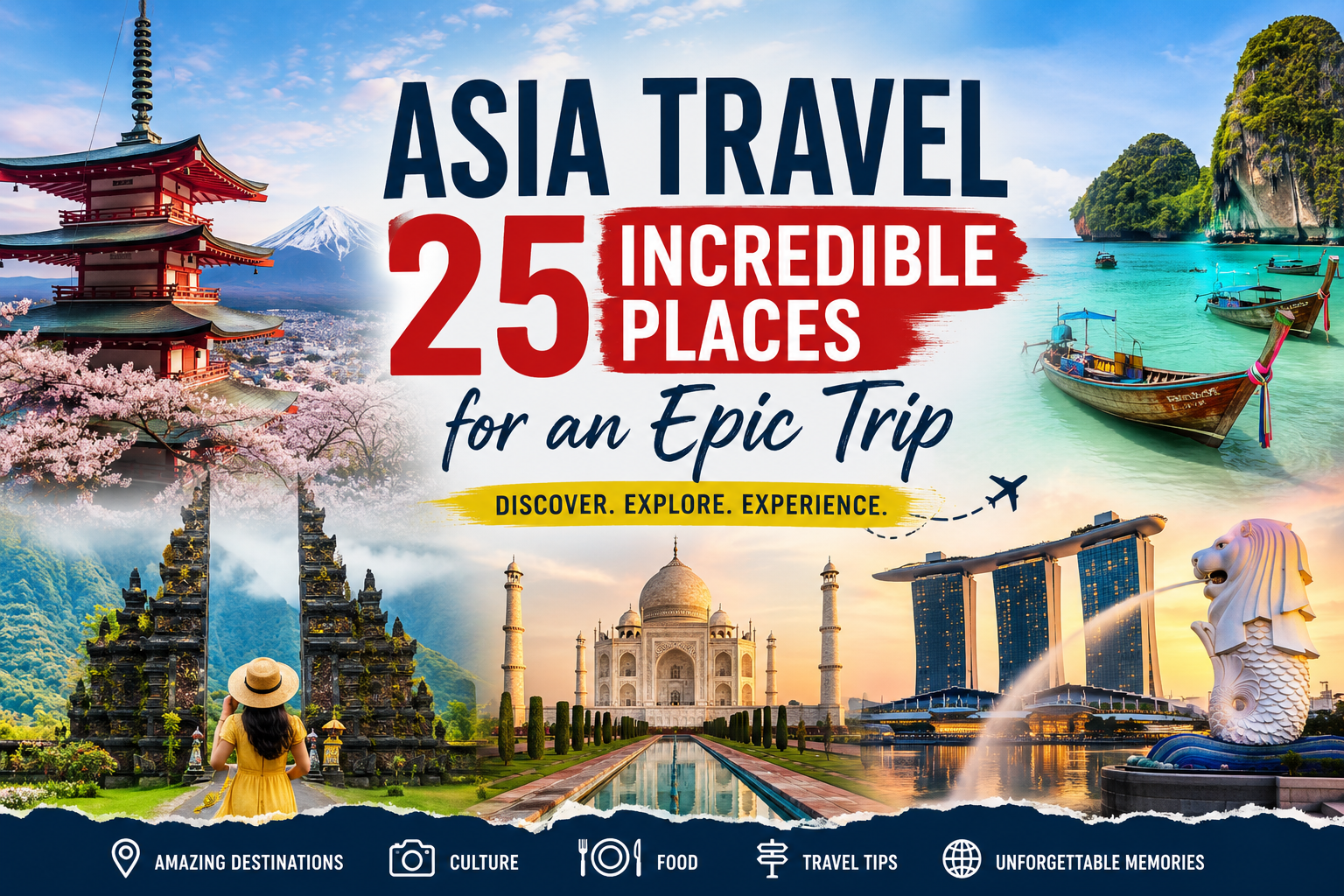
Asia Travel: 25+ Unforgettable Destinations, Smart Planning Tips & the Ultimate 2026 Guide
Asia travel offers an extraordinary combination of cultural diversity, natural beauty, affordability, history, food, adventure, and modern infrastructure, making it suitable for almost every type of traveler. From Japan and South Korea to Thailand, Vietnam, Indonesia, India, Nepal, Malaysia, Singapore, and beyond, the challenge is rarely finding somewhere interesting—it is choosing where to go and planning the trip intelligently Adventure Travel
The biggest mistake travelers make is treating Asia as one destination. Asia is enormous. Its countries differ dramatically in climate, transportation, visa requirements, languages, costs, customs, landscapes, and travel styles,a two-week trip through Japan is completely different from two weeks in Thailand. A family holiday in Singapore requires a different strategy from a backpacking route through Vietnam. A luxury trip through the Maldives has almost nothing in common with a trekking adventure in Nepal.
What Makes Asia Travel Unique?
Asia is not simply a collection of tourist attractions. It is a continent where ancient traditions and modern lifestyles often exist within the same neighborhood.
You can watch commuters move through Tokyo’s highly organized railway system in the morning, visit a centuries-old temple in the afternoon, and eat at a tiny neighborhood restaurant at night.
In another part of the continent, you might wake up beside rice terraces, take a motorbike through rural roads, visit a Buddhist monastery, and finish the day at a night market.
This range creates several major advantages for travelers.
Extraordinary cultural diversity
Asia includes dozens of countries and thousands of cultural traditions.
Travelers can experience:
- Japanese tea culture
- Korean food and contemporary culture
- Indian festivals and historic architecture
- Thai Buddhist traditions
- Vietnamese street food
- Indonesian island culture
- Nepalese mountain communities
- Malaysian multicultural cities
- Singapore’s modern urban environment
- Central Asian landscapes and Silk Road heritage
- Middle Eastern history and desert landscapes
- South Asian hospitality and cuisine
The experience can change dramatically after only a few hours of travel.
A wide range of budgets
Asia can work for travelers with very different budgets.
A backpacker might use hostels, public transportation, local restaurants, and budget guesthouses.
A mid-range traveler might choose comfortable hotels, private transfers, organized tours, and better restaurants.
Luxury travelers can find high-end resorts, private villas, premium rail journeys, fine dining, private guides, and personalized experiences.
This flexibility is one reason Asia remains attractive to both younger travelers and experienced travelers seeking value.
Incredible food
Food is one of the strongest reasons to visit Asia.
Some travelers plan entire trips around cuisine.
Thailand is famous for dishes such as pad thai, green curry, tom yum, and mango sticky rice.
Japan offers sushi, ramen, tempura, yakitori, udon, soba, and regional specialties.
Vietnam is known for pho, banh mi, fresh herbs, and regional noodle dishes.
India offers enormous regional variation, from Punjabi and Rajasthani cuisine to South Indian dosas, Bengali seafood, Gujarati vegetarian food, and Himalayan dishes.
Korea offers barbecue, bibimbap, noodles, fermented foods, stews, and an extensive street-food culture.
Indonesia, Malaysia, Singapore, Nepal, Sri Lanka, China, and many other destinations add even more variety.
The important lesson is simple:
Do not judge a country’s food culture by a few dishes you have tried abroad.
Eating regional food in its place of origin can be an entirely different experience.
Best Asia Travel Destinations for First-Time Visitors
There is no single “best” Asian country.
The best destination depends on your priorities.
However, several countries are especially useful for first-time Asia travelers because they combine strong tourism infrastructure with diverse experiences.
Japan
Japan is one of Asia’s most complete travel destinations.
A first trip might combine Tokyo, Kyoto, Osaka, and Hiroshima, while longer journeys can include Hokkaido, Okinawa, the Japanese Alps, Kanazawa, Takayama, or smaller rural destinations.
Why visit Japan?
Japan is particularly appealing for travelers interested in:
- History
- Food
- Technology
- Architecture
- Public transportation
- Anime and pop culture
- Mountains
- Gardens
- Traditional villages
- Shopping
- Luxury travel
- Solo travel
Tokyo provides an enormous urban experience, while Kyoto offers a very different atmosphere with temples, gardens, traditional neighborhoods, and historic architecture.
The Japan travel planning mistake
Many first-time visitors try to see too much.
Tokyo → Kyoto → Osaka → Hiroshima → Mount Fuji → Sapporo → Okinawa in a short trip may look exciting on paper.
In reality, frequent hotel changes can turn a vacation into a transportation project.
A better approach is to choose two or three geographic clusters.
For example:
Tokyo + Kyoto + Osaka
or:
Tokyo + Hakone + Kyoto
or:
Osaka + Kyoto + Hiroshima
Slow travel often produces better memories than collecting destinations.
Thailand
Thailand is one of the most versatile choices for Asia travel.
It can work for:
- Backpackers
- Couples
- Families
- Luxury travelers
- Food lovers
- Beach travelers
- First-time international travelers
Bangkok offers temples, markets, shopping, restaurants, nightlife, and modern urban life.
Chiang Mai provides a slower northern experience with temples, mountains, markets, and cultural attractions.
Southern Thailand adds beaches and islands.
Popular areas include Phuket, Krabi, Koh Samui, Koh Phangan, Koh Tao, and numerous smaller islands.
Thailand’s biggest advantage
Thailand makes it relatively easy to combine different travel styles.
You could spend:
- 3 days in Bangkok
- 3 days in Chiang Mai
- 4 days in southern Thailand
- 2 days relaxing on an island
That creates a balanced vacation without requiring complicated logistics.
Vietnam
Vietnam is an excellent choice for travelers who want strong food culture, history, landscapes, and good value.
A classic route can include:
- Hanoi
- Ha Long Bay or another northern destination
- Central Vietnam
- Hoi An
- Da Nang
- Ho Chi Minh City
- Mekong Delta
Vietnam also rewards travelers who move beyond the major tourist circuit.
Northern mountain regions can provide a very different experience from the busy cities.
Why Vietnam stands out
Vietnam combines:
Food + history + scenery + cities + beaches + affordability
That combination makes it particularly attractive to younger travelers, couples, backpackers, and independent travelers.
Indonesia
Indonesia is much more than Bali.
Bali remains popular for good reasons, but the country contains thousands of islands and dramatically different landscapes.
Travelers can explore:
- Bali
- Java
- Lombok
- Flores
- Komodo
- Sumatra
- Sulawesi
- Raja Ampat
Bali is convenient for first-time visitors, while other islands can provide more remote experiences.
Bali versus wider Indonesia
If you want:
- Cafés
- Wellness
- Resorts
- Surfing
- Digital-nomad infrastructure
- Restaurants
- Easy tourism services
Bali can be a strong choice.
If you want:
- Wildlife
- Diving
- Remote islands
- Volcanoes
- Cultural immersion
- Less developed destinations
look beyond Bali.
South Korea
South Korea is an increasingly attractive destination for travelers interested in contemporary culture.
Seoul combines:
- Modern architecture
- Historic palaces
- Shopping
- Cafés
- Korean food
- Beauty and fashion
- Music and entertainment
- Technology
Busan provides beaches, seafood, markets, and a more coastal atmosphere.
Jeju Island adds volcanic landscapes and outdoor experiences.
South Korea is especially appealing to travelers interested in Korean popular culture, food, design, fashion, photography, and urban travel.
Singapore
Singapore is small compared with many Asian destinations, but that is part of its advantage.
It is particularly suitable for:
- Families
- First-time Asia travelers
- Short trips
- Luxury travelers
- Business travelers
- Travelers who value efficient transportation
Singapore combines multiple cultural influences with modern infrastructure.
You can explore Chinatown, Little India, Kampong Glam, Marina Bay, gardens, museums, shopping areas, and food centers within a relatively compact geographic area.
The Singapore advantage
Singapore can work extremely well as:
A destination + an Asia gateway
A traveler might combine Singapore with Malaysia, Indonesia, Thailand, or another regional destination.
Malaysia
Malaysia is often underrated by travelers planning their first Asian holiday.
Kuala Lumpur provides modern city attractions, shopping, food, and multicultural neighborhoods.
Penang is particularly interesting for food and heritage.
Langkawi offers beaches and nature.
Borneo introduces rainforest and wildlife experiences.
Why Malaysia deserves more attention
Malaysia combines several advantages:
- Multicultural society
- Strong food culture
- Modern cities
- Tropical islands
- Nature
- Generally useful regional transport connections
- Wide accommodation choices
It can also be a practical choice for travelers who want a mix of urban and natural experiences.
Nepal
Nepal is one of Asia’s strongest destinations for mountain lovers.
The Himalayas provide the obvious attraction, but Nepal is not only about trekking.
Travelers can explore:
- Kathmandu
- Pokhara
- Chitwan
- Mountain villages
- Buddhist and Hindu heritage sites
- Trekking routes
- Adventure activities
Popular trekking regions include Everest and Annapurna.
Nepal for non-trekkers
You do not need to be an experienced mountaineer to enjoy Nepal.
A trip can include:
- Cultural sightseeing
- Scenic drives
- Short hikes
- Mountain viewpoints
- Wildlife experiences
- Wellness
- Photography
However, serious high-altitude trekking requires careful preparation, appropriate acclimatization, weather awareness, and professional guidance when necessary.
India
India can feel less like one destination and more like several countries within one national border.
Northern India, southern India, western India, northeastern India, and Himalayan regions can all provide radically different experiences.
Travelers can choose among:
- Historic cities
- Beaches
- Mountains
- Wildlife
- Spiritual travel
- Food tourism
- Luxury heritage hotels
- Desert landscapes
- Tea regions
- Cultural festivals
The India planning rule
Do not attempt to see the entire country during one short trip.
Instead, choose a region.
For example:
Delhi + Agra + Jaipur
offers a very different experience from:
Kerala + Tamil Nadu
or:
Mumbai + Goa
Regional travel creates more depth and less exhaustion.
Asia Travel by Region
One of the easiest ways to plan an Asian trip is to stop thinking country by country and start thinking region by region.
East Asia
East Asia generally includes destinations such as:
- Japan
- South Korea
- China
- Taiwan
- Mongolia
Travel here can be ideal for travelers interested in technology, history, food, urban culture, mountains, and efficient transport.
Best for
- First-time independent travelers
- Food lovers
- Urban explorers
- Photographers
- History enthusiasts
- Solo travelers
Southeast Asia
Southeast Asia includes destinations such as:
- Thailand
- Vietnam
- Malaysia
- Singapore
- Indonesia
- Philippines
- Cambodia
- Laos
- Myanmar
- Brunei
- Timor-Leste
The region is particularly popular for backpacking, beach travel, food tourism, cultural experiences, and affordable independent travel.
Best for
- Budget travelers
- Backpackers
- Couples
- Beach lovers
- Food travelers
- Digital nomads
- Adventure travelers
South Asia
South Asia includes:
- India
- Pakistan
- Nepal
- Sri Lanka
- Bangladesh
- Bhutan
- Maldives
The region offers extraordinary cultural diversity.
Travelers can move from Himalayan landscapes to tropical beaches, historic cities, deserts, tea plantations, ancient religious sites, and wildlife reserves.
Best for
- Culture
- History
- Mountains
- Spiritual journeys
- Food
- Wildlife
- Luxury resorts
Central Asia
Central Asia is increasingly interesting for adventurous travelers.
Destinations include:
- Kazakhstan
- Kyrgyzstan
- Uzbekistan
- Tajikistan
- Turkmenistan
This region offers Silk Road history, mountains, vast landscapes, architecture, local traditions, and a travel experience that can feel very different from mainstream Southeast Asian tourism.
Best for
- Adventure travelers
- History enthusiasts
- Photographers
- Experienced travelers
- Off-the-beaten-path explorers
West Asia and the Middle East
West Asia offers ancient civilizations, deserts, mountains, historic cities, religious heritage, modern architecture, and luxury travel.
Potential destinations include:
- Türkiye
- Jordan
- Saudi Arabia
- Oman
- United Arab Emirates
- Qatar
- Armenia
- Georgia
- Azerbaijan
Travel rules, cultural expectations, and entry requirements vary considerably, so travelers should check current official information before booking.
How to Choose the Right Asian Destination
A useful way to choose a destination is to score it across five factors.
The 5C Asia Travel Framework
1. Climate
Ask:
What weather do I actually want?
Do you want:
- Snow?
- Tropical heat?
- Dry desert weather?
- Mild spring temperatures?
- Cooler mountain air?
Asia’s climate varies enormously.
2. Cost
Calculate the entire trip rather than just hotel prices.
Your real cost includes:
- Flights
- Accommodation
- Food
- Local transportation
- Attractions
- Tours
- Travel insurance
- Visa fees
- SIM/eSIM
- Airport transfers
- Emergency money
3. Connectivity
A destination that looks cheap can become expensive if reaching it requires several complicated transfers.
Consider:
- Direct flights
- Trains
- Buses
- Ferries
- Domestic flights
- Airport connections
4. Culture
Ask what kind of cultural experience you want.
For example:
- Ancient temples
- Modern pop culture
- Religious heritage
- Indigenous communities
- Food traditions
- Colonial architecture
- Rural life
5. Comfort
Be honest about your preferred travel style.
Some travelers enjoy:
- Hostels
- Night buses
- Street food
- Long train rides
Others prefer:
- Private rooms
- Air-conditioned transport
- Premium hotels
- Organized tours
Neither approach is “better.”
The best trip is one that fits you.
Best Time to Travel in Asia
There is no universal “best month” for Asia travel.
The continent is too large.
Instead, think in terms of destination + season.
Japan
Spring is famous for cherry blossoms, while autumn is popular for foliage.
Summer can be hot and humid in many areas, while winter offers skiing and snow experiences in appropriate regions.
Practical advice
If you want famous seasonal experiences, expect greater demand.
Book strategically rather than assuming the cheapest period will have the best conditions.
Thailand
Thailand has regional differences in weather.
The best travel period depends on whether you are visiting Bangkok, northern Thailand, the Andaman coast, or the Gulf islands.
Do not assume that “Thailand weather” is identical everywhere.
Vietnam
Vietnam’s geography creates significant regional climate differences.
Northern, central, and southern Vietnam can experience different weather patterns at the same time.
This makes route planning particularly important.
Indonesia
Indonesia is tropical, but rainfall and weather patterns vary by island and region.
If your priority is beaches, diving, hiking, or wildlife, check conditions for the specific island rather than using a generic Indonesia weather calendar.
How Long Should an Asia Trip Be?
The ideal length depends on whether you are visiting one country or combining several.
5–7 days
Choose one city or one compact region.
Examples:
- Tokyo
- Singapore
- Seoul
- Bangkok
- Bali
- Dubai
- Kuala Lumpur
Do not attempt five countries in seven days.
10–14 days
This is a strong length for one country.
Examples:
Japan: Tokyo + Kyoto + Osaka
Thailand: Bangkok + Chiang Mai + southern beaches
Vietnam: Hanoi + central Vietnam + Ho Chi Minh City
South Korea: Seoul + Busan + Jeju
3–4 weeks
A longer trip makes regional travel more practical.
You can consider:
- Thailand + Malaysia
- Singapore + Malaysia
- Vietnam + Cambodia
- Japan + South Korea
- India regional circuit
- Nepal + northern India
1–3 months
At this stage, slow travel becomes much more attractive.
Instead of constantly moving, stay several nights in each location.
This can reduce:
- Transportation costs
- Packing time
- Airport stress
- Accommodation changes
It can also increase cultural depth.
Asia Travel on a Budget
Asia has destinations at many price levels, but “cheap Asia” is an oversimplification.
Major cities can be expensive.
Popular islands can become expensive during peak periods.
Luxury resorts can cost more than hotels in Europe or North America.
The key is understanding where your money goes.
Budget categories
A useful budget structure is:
| Category | Budget Strategy | Comfort Strategy |
|---|---|---|
| Accommodation | Hostels/guesthouses | Hotels |
| Food | Local restaurants | Mid-range restaurants |
| Transport | Public transport | Private transfers |
| Attractions | Self-guided | Guided experiences |
| Flights | Flexible dates | Convenient schedules |
| Activities | Free/local | Premium tours |
The biggest budget mistake
Many travelers focus heavily on hotel price while ignoring transportation.
A $30 cheaper hotel that requires expensive daily transfers may not actually save money.
How to Travel Around Asia
Transportation is one of Asia’s greatest strengths.
But the best transportation method differs by country.
Trains
Rail travel can be excellent in several parts of Asia.
Japan is famous for its extensive railway system.
China has a major high-speed rail network.
South Korea also offers efficient rail connections.
India has an enormous railway network with many classes and route types.
When trains are best
Choose trains when:
- The route is well connected
- The station is centrally located
- The journey is scenic
- Airport procedures would take longer
- You want to avoid short-haul flights
Buses
Buses can be useful in countries where rail infrastructure is limited or where mountainous routes make road travel practical.
However, quality varies.
Check:
- Journey length
- Safety reputation
- Departure location
- Arrival location
- Luggage rules
- Overnight conditions
Ferries
Island travel often requires ferries.
This is especially important in:
- Indonesia
- Thailand
- Philippines
- Malaysia
- Japan
Always leave a reasonable buffer when connecting ferries with flights.
Weather can affect maritime schedules.
Domestic flights
Domestic flights can save significant time in large countries.
But add the full airport time:
Hotel → airport → check-in → security → flight → baggage → airport transfer → hotel
A six-hour train journey may sometimes be more convenient than a short flight once the complete process is considered.
Asia Travel for Different Types of Travelers
Asia Travel for Solo Travelers
Asia can be highly rewarding for solo travelers because many destinations offer extensive tourist infrastructure.
Good solo-trip considerations include:
- Reliable public transport
- Walkable areas
- Social hostels
- Group tours
- Good mobile connectivity
- Plenty of food choices
However, solo travelers should still research local safety conditions and cultural norms.
Asia Travel for Couples
Couples can build trips around:
- Beaches
- Food
- Boutique hotels
- Scenic trains
- Wellness
- Cultural experiences
- Romantic cities
- Private tours
Japan, Thailand, Indonesia, Vietnam, Sri Lanka, the Maldives, and many other destinations offer different versions of romantic travel.
Asia Travel for Families
Families should prioritize:
- Transportation convenience
- Hotel location
- Healthcare access
- Food availability
- Child-friendly activities
- Heat and weather
- Travel time
A family trip should not necessarily follow the same itinerary as a backpacker.
A 12-hour overnight bus may save money but create unnecessary stress for a family with young children.
Asia Travel for Seniors
Older travelers can have excellent experiences in Asia, but itinerary design matters.
Consider:
- Shorter travel days
- Convenient hotels
- Elevators
- Private transfers when useful
- Medical access
- Travel insurance
- Rest days
Do not build an itinerary around the maximum number of attractions.
Build it around comfort.
Asia Travel for Digital Nomads
Some Asian destinations have become popular with remote workers because of:
- Internet connectivity
- Cafés
- Coworking spaces
- International communities
- Accommodation options
- Food variety
But digital nomads should distinguish between being able to work from somewhere and having legal permission to work there.
Always verify current visa and immigration rules.
Asia Travel for Budget Travelers
Budget travel does not mean sacrificing every comfort.
Instead, use the high-value / low-cost principle.
Spend more on things that genuinely improve your experience.
For example:
- Upgrade a long train journey.
- Save money on a hotel room you only use for sleeping.
- Spend more on a memorable local food experience.
- Use public transport where it is convenient.
- Pay for a guide when historical context adds real value.
This produces a better trip than trying to minimize every single expense.
Asia Travel for Luxury Travelers
Asia has one of the world’s broadest luxury travel markets.
Luxury experiences can include:
- Private villas
- Island resorts
- Heritage hotels
- Private guides
- Chauffeur services
- Premium rail journeys
- Wellness retreats
- Fine dining
- Yacht experiences
- Personalized cultural tours
Luxury travel is increasingly moving beyond simply having an expensive hotel room.
The stronger trend is toward privacy + personalization + authentic experiences.
Asia Travel for Food Lovers
Food travelers should avoid eating only in famous restaurants.
Try:
- Local breakfast
- Markets
- Neighborhood restaurants
- Regional specialties
- Street food where appropriate
- Cooking classes
- Food tours
- Seasonal dishes
A useful food strategy
During each destination, try to identify:
One famous dish + one regional specialty + one everyday local meal.
This gives you a more complete picture of the food culture.
Asia Travel and Cultural Etiquette
One of the easiest ways to improve your experience is to learn a few local customs.
Temples and religious sites
Depending on the destination, visitors may need to:
- Dress modestly
- Remove shoes
- Avoid touching religious objects
- Avoid inappropriate photography
- Speak quietly
- Follow posted instructions
Rules vary.
Do not assume that a practice from one country applies across Asia.
Photography
Always think before photographing:
- Religious ceremonies
- Monks
- Children
- Private homes
- Military or government facilities
- People working
- Indigenous communities
When in doubt, ask.
Food etiquette
Table customs can vary significantly.
Observe the people around you.
If you are unsure how something is eaten, watching your host or asking politely is usually better than guessing.
Visas, Passports, and Entry Requirements
Visa rules are one of the areas where travelers should avoid relying on old blog posts.
Requirements can change.
Depending on your nationality and destination, you may encounter:
- Visa-free entry
- Visa on arrival
- Electronic visas
- Electronic travel authorizations
- Consular visas
- Transit requirements
- Passport validity rules
- Proof-of-onward-travel requirements
The smart approach
Before booking a non-refundable trip, check:
- Your passport validity
- Official immigration information
- Embassy or consular information
- Entry requirements
- Transit requirements
- Health documentation if applicable
Do not assume that another traveler’s passport has the same requirements as yours.
Travel Insurance for Asia
Travel insurance should be considered part of trip planning rather than an optional extra.
Look at coverage for:
- Medical emergencies
- Hospital treatment
- Trip cancellation
- Trip interruption
- Lost baggage
- Delayed flights
- Emergency evacuation
- Adventure activities
The cheapest policy is not necessarily the best policy.
Read exclusions.
This is especially important if your trip includes:
- Trekking
- Diving
- Motorbike riding
- Skiing
- High-altitude travel
- Water sports
Mobile Data and Internet in Asia
Staying connected is easier than ever, but the best solution varies.
Options include:
- Physical SIM cards
- eSIMs
- International roaming
- Pocket Wi-Fi
- Hotel Wi-Fi
Before purchasing anything, check whether your phone is:
- Unlocked
- eSIM compatible
- Compatible with local network bands
Download offline essentials
Before leaving your hotel or airport, consider downloading:
- Offline maps
- Hotel address
- Booking confirmations
- Passport scans
- Translation resources
- Emergency contacts
- Transport information
Internet access can fail exactly when you need it most.
How to Pack for Asia Travel
Packing depends heavily on your route.
But a flexible Asia packing list usually includes:
- Lightweight clothing
- Comfortable walking shoes
- Small day bag
- Universal power adapter
- Portable charger
- Reusable water bottle
- Basic medication
- Travel documents
- Rain protection
- Sun protection
- Small first-aid kit
For religious or conservative destinations, add clothing that provides more coverage.
For mountain destinations, bring appropriate layers.
For tropical destinations, prioritize breathable clothing.
The One-Bag Advantage
For multi-country Asia travel, traveling light can be a major advantage.
Every time you change destinations, a large suitcase creates friction.
A smaller bag can make:
- Trains easier
- Buses easier
- Stairs easier
- Ferries easier
- Walking easier
- Hotel changes easier
You do not need to become an extreme minimalist.
Just pack for the actual trip rather than the imaginary emergencies.
Common Asia Travel Mistakes
Mistake 1: Trying to see too many countries
Five countries in ten days sounds impressive.
It usually produces fatigue.
Solution
Choose fewer places and stay longer.
Mistake 2: Ignoring the weather
A beautiful destination can be disappointing if you arrive during unfavorable seasonal conditions.
Solution
Research the specific region, not just the country.
Mistake 3: Booking everything too early
Some travelers create rigid itineraries months in advance.
This can eliminate flexibility.
Solution
Lock in the important components:
- International flights
- Popular accommodation
- Required visas
- Time-sensitive attractions
Leave room for spontaneous experiences where practical.
Mistake 4: Booking everything at the cheapest price
The cheapest option may have hidden costs.
Solution
Compare total value.
Consider:
- Location
- Transport
- Cancellation rules
- Reviews
- Taxes
- Luggage
- Transfers
Mistake 5: Assuming street food is automatically safe
Street food can be fantastic, but hygiene varies.
Solution
Look for:
- High customer turnover
- Freshly prepared food
- Proper cooking temperatures
- Clean preparation areas
- Good local reputation
Use your judgment.
Mistake 6: Ignoring local holidays
Festivals and national holidays can dramatically affect:
- Hotel availability
- Transport
- Prices
- Opening hours
- Crowds
But they can also create some of the most memorable travel experiences.
Pros and Cons of Asia Travel
| Advantages | Challenges |
|---|---|
| Huge cultural diversity | Long distances |
| Wide budget range | Complex visa rules |
| Excellent food | Climate differences |
| Many transport options | Language barriers in some areas |
| Historic attractions | Crowds at major sites |
| Beaches and mountains | Seasonal weather |
| Strong value in many destinations | Rapidly changing tourism hotspots |
| Luxury and budget choices | Different cultural expectations |
| Many family-friendly destinations | Travel fatigue on ambitious routes |
The important point is that most disadvantages can be managed through planning.
Sustainable Asia Travel
Sustainable travel is becoming increasingly important.
But sustainability should not simply mean carrying a reusable bottle.
It involves asking:
Where does my tourism money go?
A traveler can support local communities by choosing:
- Locally owned accommodation
- Independent restaurants
- Local guides
- Community tourism
- Small businesses
- Local crafts
- Responsible wildlife experiences
UN Tourism’s Best Tourism Villages program increasingly highlights rural destinations where tourism supports cultural preservation, local economies, community participation, and environmental sustainability. The 2026 network has grown to 319 rural destinations across 65 countries, showing the increasing institutional focus on community-centered tourism.
This matters because the future of Asian tourism is unlikely to depend only on major capitals and famous beaches.
Smaller communities can become part of the tourism economy when visitor growth is managed responsibly.
Rural Asia Travel: The Opportunity Most Travelers Miss
Major cities are convenient.
But rural destinations often provide something cities cannot:
context.
A village can show you:
- How food is produced
- How traditional crafts are made
- How architecture responds to climate
- How communities organize daily life
- How landscapes shape culture
Recent UN Tourism examples illustrate how rural tourism can move beyond sightseeing. In Krupa na Vrbasu, for example, tourism development helped expand visitor stays, local accommodation, guided experiences, food offerings, and community participation.
Similarly, Dhordo in India’s Gujarat region shows how cultural recognition, local accommodation, crafts, festivals, and destination development can turn a rural location into a major tourism attraction.
These examples suggest a useful travel principle:
The most memorable destination may not be the most famous one.
Asia Travel and Overtourism
Some Asian destinations face enormous visitor pressure.
Popular areas can experience:
- Traffic
- Waste
- Housing pressure
- Crowded attractions
- Environmental damage
- Higher local prices
- Visitor frustration
Travelers can help reduce pressure by:
- Visiting outside peak times
- Staying longer
- Exploring secondary destinations
- Supporting local businesses
- Avoiding unnecessary single-use products
- Following local rules
- Not entering restricted areas
- Choosing responsible wildlife experiences
The goal is not to stop traveling.
The goal is to travel in ways that allow destinations to remain enjoyable for residents and visitors.
How to Build the Perfect Asia Itinerary
Here is a practical seven-step system.
Step 1: Choose your travel purpose
Pick your top three:
- Food
- Culture
- Nature
- Beaches
- Adventure
- Shopping
- History
- Wellness
- Nightlife
- Photography
- Family time
Step 2: Choose one region
Do not begin with twenty countries.
Begin with one region.
Step 3: Pick two or three anchor destinations
These are the places you really want to experience.
Step 4: Add one flexible destination
Leave one part of your trip open.
This allows you to adjust based on:
- Weather
- Recommendations
- Energy
- Transport
- Unexpected discoveries
Step 5: Calculate transfer time
Do not count a travel day as a sightseeing day.
A destination change may consume most of the day.
Step 6: Build recovery time
Every trip needs breathing room.
A good itinerary should not look like a spreadsheet filled from morning to midnight.
Step 7: Keep one “nothing planned” block
Some of the best travel memories happen when there is no schedule.
Sample Asia Travel Itineraries
7-Day Japan Itinerary
Days 1–3: Tokyo
Day 4: Travel to Kyoto
Days 5–6: Kyoto
Day 7: Osaka or departure
This is intentionally simple.
10-Day Thailand Itinerary
Days 1–3: Bangkok
Days 4–6: Chiang Mai
Days 7–10: Southern Thailand
Adjust the southern destination according to season and interests.
14-Day Vietnam Itinerary
Days 1–3: Hanoi
Days 4–5: Northern scenic destination
Days 6–8: Central Vietnam
Days 9–11: Ho Chi Minh City
Days 12–14: Southern Vietnam or Mekong region
14-Day Japan Alternative
For travelers who dislike constant movement:
Days 1–5: Tokyo
Days 6–10: Kyoto
Days 11–14: Osaka and nearby destinations
This can be more relaxing than trying to cover half the country.
Ten Travel Brands and Platforms Worth Comparing
Travelers often use several companies during a single Asia trip rather than relying on one provider.
The following comparison is designed as a planning reference, not as a ranking. Availability, pricing, inventory, cancellation policies, and regional coverage can change.
| Brand | Main Use | Best For | Strength | Potential Limitation |
|---|---|---|---|---|
| Booking.com | Hotels and accommodation | Most travelers | Large accommodation inventory | Property quality varies |
| Agoda | Hotels and stays | Asia-focused travelers | Strong presence across Asian markets | Compare cancellation terms carefully |
| Trip.com | Flights, hotels, rail and travel services | Multi-service Asia trips | Broad Asian travel ecosystem | Policies differ by booking |
| Skyscanner | Flight comparison | Flexible travelers | Useful for comparing routes | Booking often happens elsewhere |
| Klook | Activities and transport | Attractions and experiences | Strong Asian activity coverage | Not every local operator is listed |
| GetYourGuide | Tours and activities | Guided experiences | Broad tour selection | Experience quality varies by operator |
| Lonely Planet | Travel guides | Independent travelers | Destination research | Information can change after publication |
| Airalo | eSIM/mobile data | Connected travelers | Convenient digital SIM approach | Coverage depends on local networks |
| Emirates | International flights | Long-haul travelers | Extensive global network | May not be the cheapest route |
| Qatar Airways | International flights | Long-haul travelers | Strong international connectivity | Route availability varies |
How to use travel brands intelligently
Do not assume the first search result is the best option.
Compare:
Price + location + cancellation + baggage + transfer time + reviews
A slightly more expensive booking can be better value if it has flexible cancellation or a better location.
Demographic and Problem-Solving Asia Travel Keywords
Travel content becomes much more useful when it answers the exact problem a traveler has.
Instead of targeting only “Asia travel,” consider specific modifiers.
For beginners
- Asia travel for beginners
- first time Asia travel
- best Asian countries for first-time travelers
- easy Asia destinations for beginners
- Asia travel itinerary for beginners
For families
- Asia travel with kids
- best family destinations in Asia
- family-friendly Asia itinerary
- affordable Asia family vacation
- best Asian countries for families
For couples
- romantic Asia travel
- best Asian countries for couples
- Asia honeymoon destinations
- affordable romantic destinations in Asia
- luxury Asia travel for couples
For seniors
- Asia travel for seniors
- easy Asian destinations for older travelers
- comfortable Asia travel itinerary
- best Asian cities for seniors
- senior-friendly Asia vacations
For solo travelers
- solo travel in Asia
- safest Asian countries for solo travelers
- Asia travel itinerary for solo travelers
- affordable solo travel Asia
- best Asian cities for solo travelers
For budget travelers
- cheap Asia travel
- budget travel in Asia
- affordable Asian countries
- Asia backpacking itinerary
- low-cost Asia travel destinations
For luxury travelers
- luxury Asia travel
- best luxury destinations in Asia
- luxury resorts in Asia
- private Asia travel itinerary
- luxury Asian honeymoon destinations
For food travelers
- best food destinations in Asia
- Asia food travel
- Asian street food travel
- culinary travel in Asia
- best Asian cities for food lovers
For digital nomads
- best places to work remotely in Asia
- Asia travel for digital nomads
- affordable Asian cities for remote workers
- best Asian cities for digital nomads
These modifiers create stronger search intent because they connect a broad topic with a specific traveler problem.
How AI and Search Are Changing Asia Travel Planning
Travel planning is becoming increasingly personalized.
Instead of searching only:
“Best places in Asia”
travelers increasingly ask questions such as:
- Where should I go in Asia in November with a small budget?
- What is the best Asian destination for a family with young children?
- Where can I combine beaches and culture in two weeks?
- Which Asian country is easiest for a first-time traveler?
- Where should I travel in Asia if I hate long bus journeys?
This creates an important shift.
The future of travel content will not simply be about listing destinations.
It will be about solving travel decisions.
A strong travel guide should therefore answer:
Who is this destination for?
When should they visit?
What problems might they encounter?
How much movement is required?
What alternatives exist?
The Future of Asia Travel
Several trends are likely to shape Asia travel in the coming years.
1. Longer stays
Travelers increasingly have reasons to spend more time in fewer places.
Longer stays can reduce transportation stress and create deeper local experiences.
2. Secondary destinations
Famous destinations will remain popular.
But travelers increasingly have incentives to discover alternatives.
This can help distribute tourism income.
3. Rural experiences
Rural tourism is receiving greater institutional attention.
UN Tourism’s work across Asia-Pacific emphasizes product development, community-based tourism, sustainability, and stronger rural tourism strategies.
4. Experience over sightseeing
Travelers increasingly want to do something rather than simply photograph something.
Examples include:
- Cooking
- Craft workshops
- Hiking
- Cycling
- Local festivals
- Food tours
- Farm experiences
- Traditional arts
5. Wellness travel
Asia is already strong in:
- Spas
- Yoga
- Meditation
- Retreats
- Traditional wellness practices
- Nature-based relaxation
The wellness sector is likely to become even more integrated with mainstream travel.
6. Responsible wildlife tourism
Travelers are becoming more aware of the difference between observing wildlife responsibly and participating in experiences that may harm animals.
The stronger future model is likely to emphasize:
- Conservation
- Education
- Habitat protection
- Responsible observation
- Local employment
7. Smarter travel technology
AI, digital maps, translation tools, eSIMs, mobile booking, digital payments, and personalized itinerary tools will continue reducing friction.
But technology will not replace judgment.
A navigation app cannot tell you whether a particular cultural experience is respectful.
A booking platform cannot guarantee that every local operator matches your expectations.
Human judgment remains essential.
How to Make Asia Travel More Meaningful
A memorable trip is rarely determined by the number of landmarks you visit.
It is more often shaped by small moments.
A conversation with a restaurant owner.
A train ride through the countryside.
A morning market.
A quiet temple before the crowds arrive.
A meal you cannot pronounce but never forget.
A village guide explaining something that was invisible in the guidebook.
These experiences happen when travelers leave enough space for them.
Try the 70/20/10 rule
A useful planning framework is:
70% planned
Flights, hotels, important reservations, major destinations.
20% flexible
Day trips, restaurants, activities, secondary destinations.
10% completely spontaneous
No schedule.
No checklist.
Just exploration.
This balance can make a structured trip feel much more adventurous.
Asia Travel Safety: A Practical Approach
No destination should be described as universally “safe” or “unsafe.”
Safety depends on:
- Destination
- Neighborhood
- Season
- Personal behavior
- Transportation
- Local conditions
- Weather
- Political circumstances
- Individual health and mobility
Before traveling, check current official travel advisories and local guidance.
Basic precautions
Keep:
- Passport secure
- Digital copies of important documents
- Emergency contacts
- Travel insurance details
- Hotel information
- Some backup payment method
Avoid carrying all your cash and cards in one location.
Use reputable transportation where possible.
Follow local laws.
Asia Travel and Money
Payment systems differ dramatically.
Some places are heavily cashless.
Others still rely significantly on cash.
Carry a combination of:
- Credit/debit card
- Some local cash
- Backup card
- Mobile payment where supported
Notify your bank about international travel when necessary.
Check foreign transaction fees.
Keep emergency funds separate from your everyday wallet.
The Most Important Asia Travel Lesson
The most important lesson is not to create the “perfect” itinerary.
It is to create the right itinerary for you.
A traveler who loves food may remember a three-hour market tour more than ten famous monuments.
A mountain lover may prefer one long hike to five city attractions.
A family may value a convenient hotel more than an Instagram-famous location.
A luxury traveler may prioritize privacy.
A backpacker may prioritize social experiences.
There is no universally correct way to travel.
Quick Summary: Asia Travel at a Glance
| Question | Practical Answer |
|---|---|
| Best Asian country? | Depends on your interests |
| Best for beginners? | Japan, Thailand, Singapore, Malaysia and other well-developed tourist destinations can be good starting points |
| Best for food? | Japan, Thailand, Vietnam, India, Korea, Malaysia, Singapore and many others |
| Best for beaches? | Thailand, Indonesia, Philippines, Maldives and many regional alternatives |
| Best for mountains? | Nepal, Japan, Pakistan, India, Bhutan and Central Asia |
| Best for culture? | Almost everywhere; choose based on the history and traditions you want |
| Best for families? | Singapore, Japan, Malaysia, Thailand and suitable resort destinations can work well |
| Best for backpacking? | Southeast Asia remains especially popular |
| Best for luxury? | Asia offers luxury options ranging from Japan and Singapore to Maldives, Thailand, Indonesia and the Middle East |
| Best travel duration? | 7 days for one compact destination; 10–14 days for a country; longer for multi-country travel |
| Biggest mistake? | Trying to see too much |
| Best planning rule? | Match destination, season, budget and travel style |
Conclusion:
Asia travel is not one type of holiday.
It can be a luxury resort escape, a backpacking adventure, a family vacation, a food journey, a cultural expedition, a mountain trek, a wellness retreat, a city break, or a slow journey through rural communities.
That flexibility is Asia’s greatest strength.
But it also creates the biggest planning challenge.
The smartest traveler does not ask, “How many places can I visit?”
They ask:
“What experience do I want to remember?”
Once you know that, the rest becomes easier.