
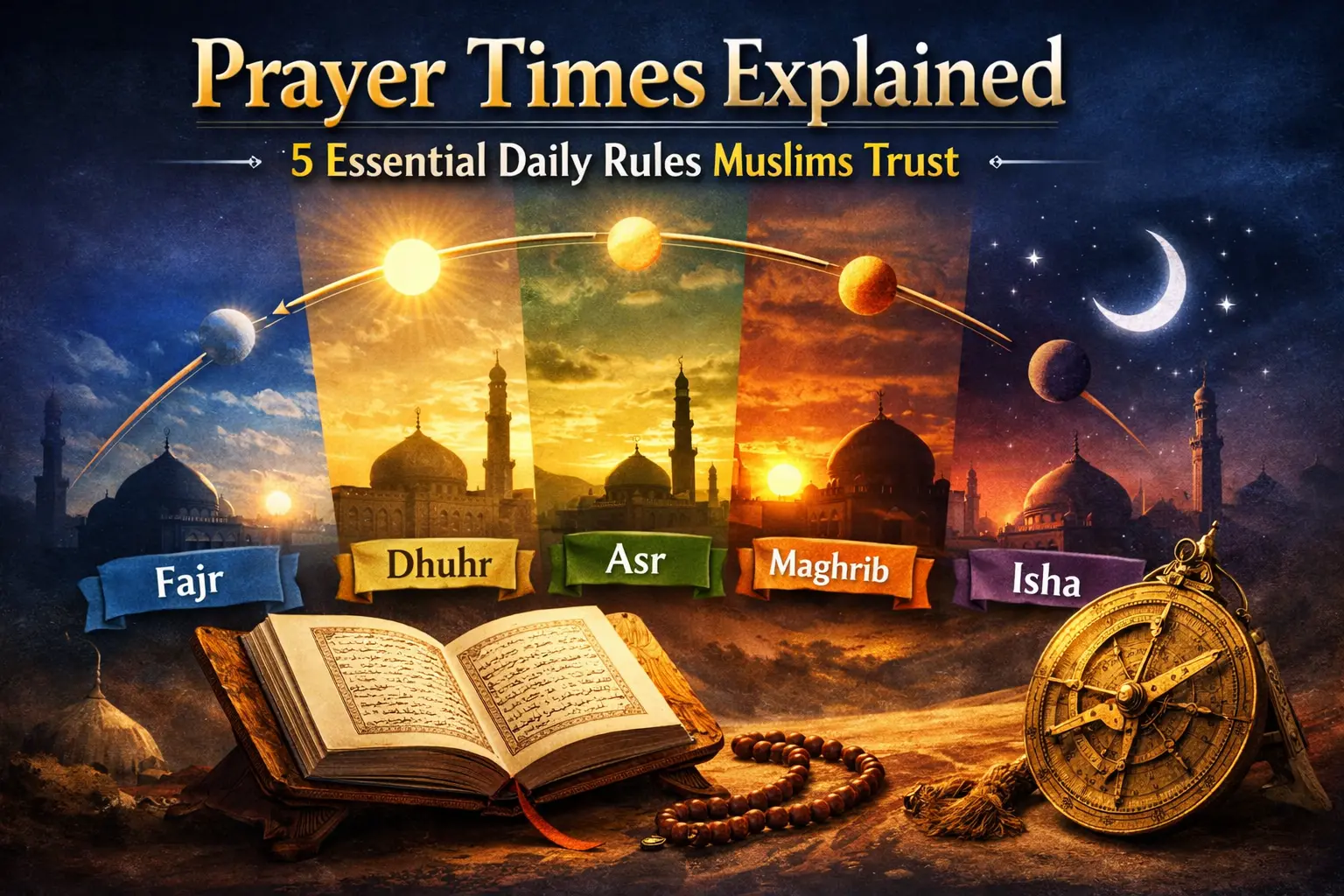
Prayer Times: Complete, Authoritative, and Structured Explanation
Prayer times are fixed daily periods defined by Islamic law for performing obligatory prayers. Authoritative definitions originate from the Qur’an and authenticated prophetic traditions recorded in Sahih al-Bukhari and Sahih Muslim. Islamic jurists systematized these times using observable solar events. Modern calculation methods preserve the same legal foundations while applying astronomical science.
Prayer times are not symbolic. Each prayer has a precise beginning and end determined by the sun’s position relative to the horizon. This structure creates a legally binding daily schedule observed consistently across regions, cultures, and centuries.
Definition and Scope of Prayer Times:
Prayer times refer to five obligatory intervals: Fajr, Dhuhr, Asr, Maghrib, and Isha. Each interval is a legally defined window during which a specific prayer becomes valid. Performing prayer before its start time or after its end time invalidates the act according to scholarly consensus.
The legal authority for prayer times rests on direct textual evidence and continuous scholarly transmission. The system integrates astronomy, geography, and jurisprudence without altering original definitions.
See More: Nova Scola as a Modern Educational Knowledge System
Source Authority for Prayer Time Determination:
Islamic law derives prayer time rules from primary and secondary sources.
Primary sources include:
-
The Qur’an
-
Prophetic explanations by Muhammad
Secondary sources include:
-
Classical jurisprudence (fiqh)
-
Scholarly consensus (ijma‘)
-
Empirical observation of solar movement
Institutions such as the Muslim World League and Islamic Society of North America publish standardized calculation parameters derived from these sources.
Breakdown of the Five Daily Prayer Times:
Fajr Prayer Time:
Fajr prayer time begins at true dawn. True dawn appears as horizontal light spreading across the eastern horizon. This phenomenon is known as al-fajr al-sadiq. Authenticated narrations distinguish it from false dawn, which rises vertically and disappears.
Fajr ends at sunrise. Sunrise occurs when the sun’s upper edge becomes visible above the horizon. Astronomical calculation represents Fajr using solar depression angles ranging from 15° to 18° below the horizon, depending on scholarly authority.
Dhuhr Prayer Time:
Dhuhr prayer time begins immediately after the sun passes its highest point in the sky, known as solar zenith. This moment is called zawal al-shams. The sun’s movement westward marks the legal start of Dhuhr.
Dhuhr ends when Asr begins. The beginning of Dhuhr is uniform across all schools of law and calculated using longitude and the equation of time.
Asr Prayer Time:
Asr prayer time begins based on shadow length. Islamic jurisprudence defines two valid methods:
-
Majority schools (Shafi‘i, Maliki, Hanbali): shadow equals object height plus noon shadow.
-
Hanafi school: shadow equals twice the object height plus noon shadow.
Both methods originate from authenticated narrations and juristic interpretation. Prayer calendars clearly label which method is applied.
Asr ends at sunset.
Maghrib Prayer Time:
Maghrib prayer time begins immediately after sunset. Sunset occurs when the sun fully disappears below the horizon. There is no delay or buffer between sunset and the start of Maghrib.
Maghrib ends when twilight disappears. Jurists differ on whether this twilight refers to red or white twilight, which affects the exact end of Maghrib and the start of Isha.
Isha Prayer Time:
Isha prayer time begins after twilight vanishes. The majority of scholars define twilight as the red glow remaining after sunset. Some juristic interpretations also reference white twilight.
Astronomical models express Isha using solar depression angles similar to Fajr. Isha ends at true dawn.
Prayer Times and Astronomical Calculation:
Prayer times rely on consistent solar mechanics. Calculations incorporate:
-
Latitude
-
Longitude
-
Elevation
-
Date
-
Time zone
High-latitude regions experience extended twilight or absent night. Islamic jurists addressed this issue using estimation methods based on the nearest valid day or region. These methods preserve legal continuity.
See More: Conceptual Meaning and Academic Scope
Prayer Times Table (General Reference):
| Prayer | Start Definition | End Definition |
|---|---|---|
| Fajr | True dawn | Sunrise |
| Dhuhr | After solar noon | Start of Asr |
| Asr | Defined shadow length | Sunset |
| Maghrib | Sunset | Disappearance of twilight |
| Isha | End of twilight | True dawn |
This table reflects universally accepted legal principles, not local clock times.
Institutional Standardization of Prayer Times:
Authorities publish prayer schedules to ensure communal consistency. The Umm al-Qura University provides parameters widely used in the Arabian Peninsula. Government and scholarly bodies align these parameters with jurisprudential standards.
Calendars specify:
-
Fajr angle
-
Isha angle
-
Asr method
-
High-latitude adjustment
Transparency in parameters ensures legal reliability.
Practical Application of Prayer Times:
Daily practice depends on verified calendars, mosque announcements, or configured calculation tools. Travelers adjust times based on new longitude. Aviation contexts apply estimation methods recognized by jurists.
Accuracy requires reliance on trusted authorities rather than arbitrary settings.
Relationship Between Prayer Times and Islamic Law:
Prayer times function as legal causes (asbab) for worship. Time validity precedes prayer validity. This principle applies uniformly across schools of law.
Disagreements occur only where textual evidence permits interpretation. These differences remain documented and limited.
FAQs:
What defines true dawn in Islamic law?
True dawn is horizontal light spreading along the horizon. This definition appears in authenticated prophetic narrations and distinguishes legal Fajr from false dawn.
Why do prayer times differ by location?
Prayer times depend on solar position. Latitude and longitude directly affect sunrise, sunset, and twilight duration.
Are prayer times based on clocks or the sun?
Prayer times are based on solar signs. Clocks only approximate these signs for convenience.
Why does Asr time differ between schools?
Asr differences arise from varying interpretations of shadow-related narrations. Both methods trace back to early jurisprudence.
How are prayer times handled in extreme latitudes?
Jurists apply estimation methods grounded in proximity to valid solar cycles. These methods maintain continuity of obligation.
Key Characteristics of Prayer Times:
-
Define daily worship structure
-
Depend on observable solar events
-
Derive from authenticated sources
-
Apply consistently across regions
-
Integrate astronomy and law
Conclusion:
Prayer times represent a complete, closed system grounded in scripture, prophetic explanation, jurisprudence, and astronomy. The system remains unchanged in principle while adaptable in calculation. This integration ensures accuracy, continuity, and universal applicability without altering foundational definitions.