Tokyo Skyline: 15 Best Views, Iconic Towers and Breathtaking Cityscapes
What makes the Tokyo skyline so unforgettable? Is it the graceful silhouette of Tokyo Tower, the extraordinary height of Tokyo Skytree, the glittering lights of Shinjuku or the way Mount Fuji sometimes appears beyond a seemingly endless sea of buildings? The Tokyo skyline is one of the world’s most distinctive urban landscapes, combining futuristic skyscrapers, historic landmarks, illuminated bridges and distant mountain views. From world-famous observation decks to quieter riverside viewpoints, Tokyo offers remarkable opportunities to experience, photograph and understand one of the most dynamic cityscapes in the world Tokyo Driving
Understanding the Tokyo Skyline
What Defines the Tokyo Skyline?
Unlike cities whose skylines are dominated by a single financial district, Tokyo has several distinct clusters of tall buildings spread across a vast metropolitan area.
This distribution creates a layered cityscape. A viewpoint in Shinjuku presents a different composition from one in Roppongi, while a view across Tokyo Bay highlights bridges, waterfront developments and open space.
Several features define Tokyo’s urban silhouette:
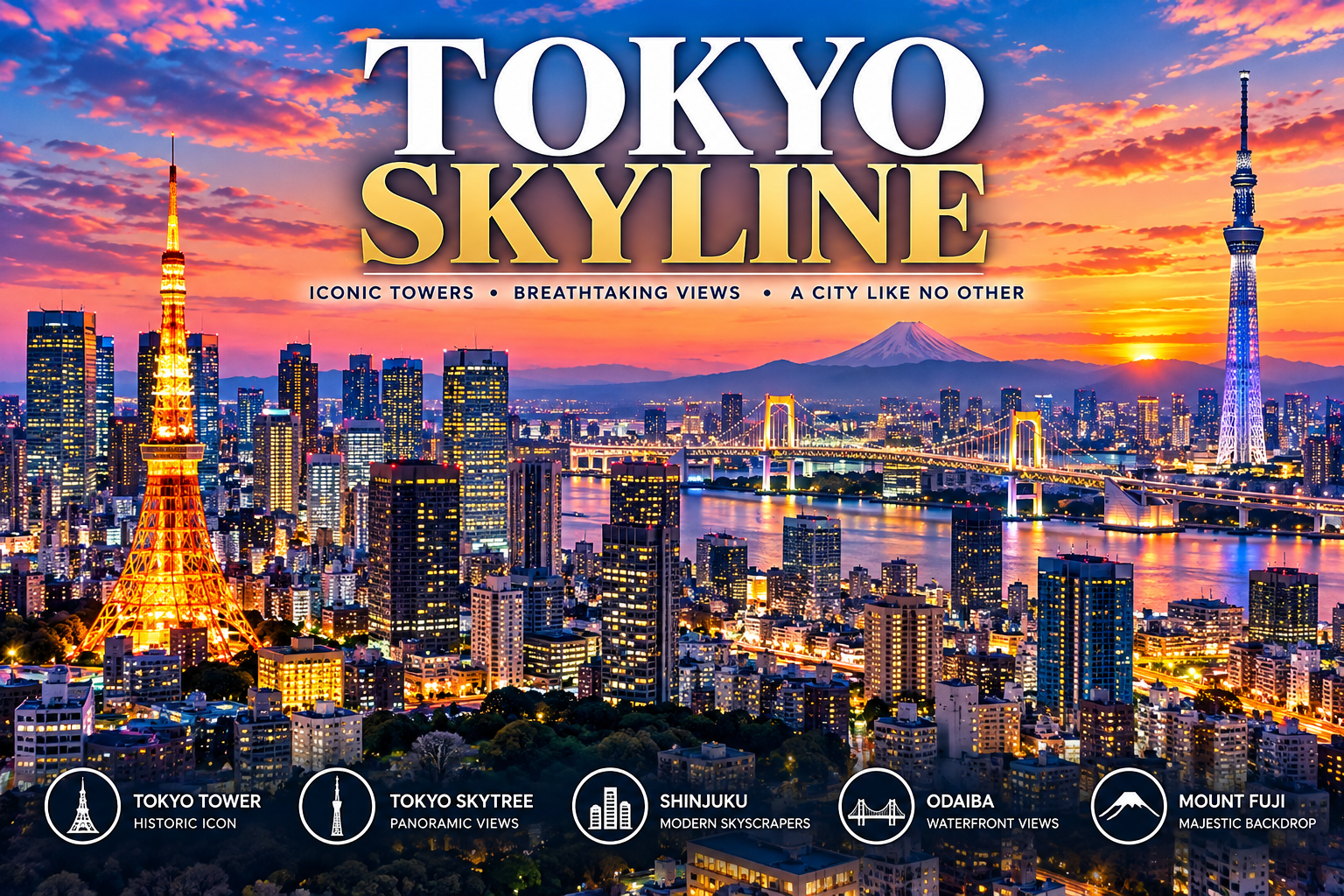
- Tokyo Tower: A landmark with a distinctive red-and-white appearance.
- Tokyo Skytree: A towering broadcasting and observation structure visible from many parts of the city.
- Shinjuku skyscrapers: Dense groups of modern office buildings and hotels.
- Marunouchi and Tokyo Station: A combination of contemporary high-rises and historic railway architecture.
- Roppongi Hills and Azabudai Hills: Modern developments with prominent buildings and viewing opportunities.
- Tokyo Bay waterfront: A mixture of bridges, high-rises and expansive water views.
- Mount Fuji: A distant natural landmark visible from selected locations on clear days.
The skyline changes with distance, weather, daylight and viewing angle. This variety is one reason visitors often enjoy seeing Tokyo from several different locations rather than relying on one observation deck.
How Tokyo’s Skyline Developed
Tokyo’s architectural development reflects the changing needs of one of the world’s largest metropolitan areas.
The Edo Period and Early Urban Development
During the Edo period, Tokyo was organised around castles, temples, residences, commercial areas and waterways. The urban landscape was much lower than today’s city, with important buildings defined by traditional Japanese architectural forms.
The skyline of that era was shaped more by rooflines, temples and natural features than by tall commercial buildings.
Modernisation and Early Skyscrapers
As Japan modernised, Tokyo gradually adopted new construction methods and architectural styles. Commercial buildings, railway infrastructure and modern public facilities transformed parts of the city.
Advances in engineering, building materials and earthquake-resistant construction eventually made taller buildings increasingly practical.
Postwar Reconstruction and Economic Growth
Reconstruction following the Second World War reshaped much of Tokyo. Economic expansion created demand for offices, hotels, housing and transport infrastructure.
As the city developed, high-rise buildings became increasingly prominent in business districts and major commercial centres.
Contemporary Tokyo
Today’s skyline combines offices, residential towers, hotels, observation structures and mixed-use developments.
New projects often integrate transport connections, public spaces, shopping, dining and environmental features. This approach means that a major development can change not only the skyline but also how people use the surrounding neighbourhood.
15 Best Places to See the Tokyo Skyline
1. Tokyo Skytree
Tokyo Skytree is one of the most recognisable features of the modern Tokyo skyline. Its slender structure rises above the surrounding urban landscape, making it a prominent landmark for visitors and photographers.
The tower is especially useful for understanding Tokyo’s enormous scale. From its observation facilities, visitors can look across dense neighbourhoods, river corridors, commercial districts and distant horizons.
On clear days, Mount Fuji may be visible, although visibility depends on atmospheric conditions and the season.
The elevated perspective also reveals how Tokyo’s buildings are distributed across the city rather than concentrated in one small downtown area.
Why visit Tokyo Skytree?
- Panoramic views across metropolitan Tokyo.
- A memorable experience for first-time visitors.
- Opportunities to observe the city’s urban geography.
- Excellent views of the surrounding Sumida area.
- Dining and shopping opportunities in the wider complex.
Best for: First-time visitors, families, architecture enthusiasts and travellers seeking a classic observation-deck experience.
2. Tokyo Tower
Tokyo Tower remains one of Japan’s most recognisable landmarks. Its red-and-white structure creates a distinctive silhouette, particularly when illuminated after sunset.
Although newer buildings have transformed the surrounding skyline, Tokyo Tower retains a strong visual connection to Tokyo’s postwar development and modern identity.
From its observation areas, visitors can view nearby skyscrapers, urban neighbourhoods and, in favourable conditions, more distant landscapes.
Its location also makes it useful for combining skyline sightseeing with visits to nearby districts and attractions.
Why visit Tokyo Tower?
- A classic symbol of Tokyo.
- Recognisable views for travel photography.
- A different perspective from Tokyo Skytree.
- Attractive illumination after dark.
- A convenient addition to central Tokyo sightseeing.
Best for: Couples, photographers, history enthusiasts and first-time visitors.
3. Shibuya Sky
Shibuya Sky provides an elevated view of one of Tokyo’s busiest commercial districts.
The surrounding neighbourhood is known for its famous pedestrian crossing, shopping streets, entertainment venues and dense urban activity. From above, these busy streets become part of a much wider cityscape.
The rooftop viewing area offers an open-air perspective that can feel different from an enclosed observation deck. Views change throughout the day as the light shifts across the buildings.
Sunset is particularly popular because visitors may experience daylight, colourful skies and the first appearance of city lights during a single visit.
Planning tip: Check entry arrangements, weather restrictions and photography rules before visiting. Popular time slots may require advance booking.
Best for: Young travellers, couples, photographers and visitors who enjoy contemporary urban culture.
4. Tokyo Metropolitan Government Building
The Tokyo Metropolitan Government Building is an important landmark in the Shinjuku skyline.
Its observation facilities have long attracted visitors interested in panoramic views of Tokyo. Depending on operating arrangements, public access may be available without the admission charge associated with some commercial observation decks.
From the upper levels, visitors can observe Shinjuku’s skyscraper district, surrounding neighbourhoods and the broader metropolitan landscape.
The experience is also useful for understanding the scale of Tokyo’s administrative and commercial centre.
Why consider it?
- An accessible introduction to elevated city views.
- A useful stop while exploring Shinjuku.
- Opportunities to observe modern Japanese architecture.
- Potentially lower sightseeing costs than some paid observation decks.
Check the latest opening hours, maintenance closures and access conditions before visiting.
Best for: Budget-conscious travellers, solo visitors and architecture enthusiasts.
5. Roppongi Hills Mori Tower
Roppongi Hills is a major mixed-use development combining offices, retail, dining, cultural facilities and residential spaces.
Its observation facilities provide a valuable perspective on central Tokyo, including views of Tokyo Tower and the surrounding high-rise districts.
The area offers a different atmosphere from Shinjuku. Rather than focusing exclusively on dense office towers, the surrounding development combines urban architecture with cultural and leisure activities.
Depending on current access arrangements, visitors may be able to combine skyline viewing with art exhibitions or other attractions within the complex.
Best for: Architecture enthusiasts, couples, visitors interested in art and travellers seeking central Tokyo views.
6. Azabudai Hills
Azabudai Hills represents a contemporary approach to urban development, bringing together high-rise architecture, landscaped public spaces, retail, dining and other facilities.
Its buildings contribute to the changing central Tokyo skyline and illustrate the trend towards mixed-use neighbourhoods.
The surrounding area also offers views of Tokyo Tower and nearby architectural landmarks from selected public spaces.
Access to particular upper-level viewing areas may depend on venue rules, reservations or admission arrangements. Visitors should distinguish between publicly accessible spaces and facilities requiring tickets or reservations.
Best for: Travellers interested in contemporary architecture, urban planning and modern Tokyo.
7. Shinjuku Skyscraper District
Shinjuku is one of Tokyo’s most recognisable high-rise districts. Its skyline includes office towers, hotels and large commercial buildings.
Walking through the area provides a ground-level understanding of the buildings’ scale, while selected observation facilities offer wider views across the metropolitan landscape.
The district is especially atmospheric after dark, when illuminated offices and surrounding streets create a layered urban scene.
For photographers, the most interesting images may come from combining the buildings with streets, pedestrian spaces and railway infrastructure rather than photographing the towers in isolation.
Best for: Urban explorers, architecture enthusiasts and photographers.
8. Marunouchi and Tokyo Station
The Marunouchi district presents a different side of the Tokyo skyline.
Modern office towers rise around Tokyo Station, whose historic red-brick station building provides a strong architectural contrast.
This combination of old and new illustrates how Tokyo incorporates heritage structures into an evolving business district.
The surrounding streets and public spaces offer opportunities to photograph high-rises without relying entirely on observation decks.
Best for: Architecture enthusiasts, business travellers and visitors interested in historic and contemporary design.
9. Odaiba Waterfront
Odaiba offers a broad perspective across Tokyo Bay, with waterfront developments, bridges and the surrounding city forming the skyline.
Unlike inland viewpoints dominated by closely packed buildings, Odaiba benefits from open water and wider sightlines.
Rainbow Bridge is a major visual feature of the area, particularly after dark when illumination creates reflections across the bay.
The waterfront also provides opportunities for walking, dining and photographing Tokyo from ground level.
Best for: Families, couples, waterfront photographers and travellers seeking open views.
10. Rainbow Bridge Viewpoints
Rainbow Bridge is a major piece of infrastructure connecting parts of the Tokyo waterfront. Its structure forms an important part of the city’s visual identity.
The bridge is particularly striking when viewed from suitable waterfront locations in Odaiba or other areas around Tokyo Bay.
The experience depends on the viewing position. A photograph taken from a distant promenade may capture the entire bridge, while a closer viewpoint may emphasise its structural details.
Visitors should use designated pedestrian areas and observe any restrictions that apply to bridge access.
Best for: Night photography, engineering enthusiasts and visitors interested in Tokyo Bay.
11. Ebisu Garden Place
Ebisu Garden Place offers a more relaxed setting for experiencing Tokyo’s architecture and urban atmosphere.
The development combines commercial spaces, dining and public areas. Its buildings contribute to the wider cityscape, while the surrounding district provides a contrast to the intensity of Shinjuku and Shibuya.
It may not offer the same panoramic height as a dedicated observation deck, but it can be a rewarding stop for travellers who enjoy architecture, cafés and leisurely urban exploration.
Best for: Couples, food enthusiasts and visitors seeking a less hectic atmosphere.
12. Caretta Shiodome Area
Shiodome is known for its modern office buildings and proximity to the waterfront and Hama-rikyu Gardens.
The district illustrates how high-rise development has transformed parts of central Tokyo while maintaining connections to older landscapes and traditional gardens.
Selected upper-level venues in the area may offer views across the surrounding buildings and towards the bay, depending on access arrangements.
Before visiting a specific viewing location, confirm that it is open to the public and whether a purchase or reservation is required.
Best for: Architecture enthusiasts, business travellers and visitors exploring central Tokyo.
13. Bunkyo Civic Center
Bunkyo Civic Center has been known as a useful location for viewing Tokyo from an elevated public building.
Its perspective can include surrounding residential areas, central Tokyo landmarks and, when conditions permit, Mount Fuji.
A viewpoint like this can be valuable because it reveals more than the famous skyscraper clusters. It also shows how residential neighbourhoods, schools, roads and other everyday urban spaces fit into the wider metropolitan landscape.
Check current access arrangements before planning a visit.
Best for: Budget travellers, photographers and visitors interested in Tokyo’s broader urban geography.
14. Tokyo Bay Dinner and Observation Experiences
Some restaurants, hotels and venues around Tokyo Bay provide elevated views of the waterfront and city lights.
These experiences combine skyline appreciation with dining or a special occasion. They can be particularly appealing for couples and travellers who prefer to enjoy the city from a comfortable indoor setting.
However, not every restaurant has unrestricted panoramic views. Building orientation, window placement, floor level and surrounding construction all influence what guests can see.
When making a reservation, check whether skyline-facing seating can be requested and whether any minimum spending requirements apply.
Best for: Couples, special occasions and travellers who enjoy dining with a view.
15. Mount Fuji Viewpoints Across Tokyo
Mount Fuji is not part of Tokyo’s built skyline, but its distant silhouette can create one of the most memorable compositions in the metropolitan landscape.
On clear days, selected elevated viewpoints offer the possibility of seeing the mountain beyond Tokyo’s buildings.
Visibility is influenced by haze, cloud cover, season and weather. Cooler, clearer conditions may provide better opportunities, but no viewpoint can guarantee a sighting.
For photographers, the contrast between Tokyo’s dense urban landscape and Mount Fuji’s natural form creates a distinctive image of modern Japan.
Best for: Landscape photographers, repeat visitors and travellers seeking a wider view of the Japanese environment.
The Best Time to See the Tokyo Skyline
Sunrise: Quiet Streets and Soft Light
Sunrise can provide a peaceful atmosphere before the city reaches its busiest hours.
The early light may illuminate building facades gradually, while traffic and pedestrian activity are often less intense than later in the day.
Sunrise is particularly useful for photographers who want cleaner compositions and fewer people in the foreground.
However, many observation decks and indoor venues do not open early enough for sunrise. Check opening times and consider outdoor public viewpoints where access is permitted.
Daytime: Architectural Detail and Urban Scale
Daytime is ideal for studying building shapes, street layouts and the relationship between different districts.
Visibility varies with humidity, haze, clouds and air quality. Even on a sunny day, distant landmarks may appear faint.
If your main goal is to understand Tokyo’s geography, daytime observation is often more informative than night viewing.
Sunset: Colourful Skies and Changing Light
Sunset is one of the most popular times to experience the Tokyo skyline.
The sky may shift through orange, pink and purple tones as the sun sets behind the city. Buildings gradually become illuminated, creating a transition from natural light to urban lighting.
Popular observation decks can become busy during this period, so arrive early and check whether your ticket permits entry at the desired time.
Night: Tokyo’s Illuminated Cityscape
At night, the skyline becomes a composition of illuminated buildings, transport routes and waterfront reflections.
Shinjuku offers dense high-rise scenery, while Tokyo Bay provides a more open view of illuminated bridges and buildings.
Night photography requires attention to glass reflections, camera stability and exposure. Indoor observation decks may be comfortable but can introduce reflections, while outdoor viewing areas may be windier.
Seasonal Differences
Spring can bring comfortable sightseeing conditions and changing light, while summer often features longer daylight hours but increased humidity and haze.
Autumn may offer pleasant temperatures and clearer days, although conditions vary. Winter can provide particularly clear distant views on suitable days, but outdoor observation areas may feel cold.
The best season depends on whether you prioritise weather, visibility, seasonal scenery or the atmosphere of the city after dark.
Tokyo Skyline Photography Guide
Choosing the Right Viewpoint for Your Photograph
The best skyline photograph depends on the story you want to tell.
A photograph of Tokyo Skytree can communicate height and engineering, while a wide image of Shinjuku can emphasise the density of the city. A waterfront composition may feel calmer because the water creates space between the viewer and the buildings.
Before choosing a location, decide whether you want a close-up architectural image, a wide panoramic photograph or a picture that combines the skyline with people and everyday city life.
For a balanced photography itinerary, consider visiting two or three different types of locations rather than several observation decks that offer similar views.
Best Camera Settings for Tokyo Skyline Photography
Camera settings depend on the available light, the equipment you use and whether the viewpoint is indoors or outdoors.
For daytime photography, a relatively low ISO can help preserve image quality. A moderate aperture can keep much of the cityscape sharp, while a faster shutter speed is useful if you are photographing moving subjects.
For night photography, a tripod can help when it is permitted. If tripods are prohibited or you are shooting through glass, increase the ISO as needed and use a shutter speed that avoids camera shake.
Smartphone users can often produce excellent skyline photographs by cleaning the lens, stabilising the phone and avoiding excessive digital zoom.
How to Photograph Tokyo Tower
Tokyo Tower is particularly recognisable because of its distinctive shape and colour.
Rather than photographing it only from a distance, experiment with compositions that include nearby buildings, streets, gardens or trees. These elements can create depth and help communicate the tower’s position within the city.
At night, avoid overexposing the illuminated structure. If your camera offers exposure compensation, try a slightly darker exposure to preserve detail in bright areas.
How to Photograph Tokyo Skytree
Tokyo Skytree is tall enough that it can be difficult to fit the entire structure into a photograph from nearby streets.
Move farther away when possible, use a wider focal length or deliberately frame only part of the tower to emphasise its height.
Riverside locations can provide useful compositions because the surrounding landscape offers more room to frame the structure.
How to Photograph the Skyline at Night
Night photography is not simply a matter of increasing brightness. Too much exposure can turn building lights into featureless white areas, while reflections from observation-deck windows can reduce contrast.
Use these techniques:
- Clean your camera lens before shooting.
- Keep the camera close to the glass without touching it where doing so is prohibited.
- Wear dark clothing if reflections from indoor lighting are a problem.
- Focus carefully on distant buildings.
- Avoid digital zoom when it significantly reduces detail.
- Take several exposures rather than relying on one photograph.
A useful creative technique is to photograph the same view shortly before sunset and again after dark. The first image captures architectural detail, while the second emphasises the illuminated city.
Ethical and Practical Photography
Respect signs restricting photography, tripods or commercial equipment. Avoid blocking other visitors at popular observation points, and do not enter private property to obtain a better view.
If you photograph identifiable people, consider their privacy, especially when creating commercial content.
For travel bloggers, record the date, time and viewpoint alongside each image. This makes it easier to write accurate captions and explain why the scene may look different under other weather conditions.
Tokyo Skyline Architecture: The Buildings Behind the View
Earthquake-Resistant Design
Tokyo lies in a seismically active region, making earthquake engineering an important part of building design.
Modern structures may use systems such as reinforced structural frames, seismic isolation and energy-dissipating devices, depending on their design and requirements.
These technologies can help buildings respond to earthquake forces, but their performance depends on the building, the event and the specific engineering system.
The skyline therefore represents not just architectural ambition but also the practical challenge of constructing a dense city in an earthquake-prone environment.
High-Rise Engineering and Urban Density
Tokyo’s limited central land and extensive transport network have encouraged the development of high-density districts.
High-rise buildings allow offices, homes, hotels and other uses to occupy relatively small land footprints. When combined with rail connections and walkable public spaces, these developments can support large numbers of people without requiring every journey to depend on a car.
However, density also creates challenges, including crowded public spaces, construction impacts and the need for careful infrastructure planning.
Mixed-Use Developments
Many contemporary Tokyo developments combine offices, residential spaces, shopping, dining, cultural facilities and public areas.
This arrangement can allow people to work, live and spend leisure time within the same district.
From a skyline perspective, mixed-use developments often create visually prominent clusters of buildings. From an urban-planning perspective, their success depends on how well they connect with surrounding neighbourhoods and public transport.
The Role of Public Spaces
A skyline is not only something viewed from above. Parks, riverside promenades, plazas and pedestrian streets determine how people experience tall buildings at ground level.
A building can look impressive from an observation deck but feel disconnected from its surroundings if its entrances, public spaces and pedestrian routes are poorly designed.
Tokyo’s most engaging urban areas often combine prominent architecture with accessible streets and places where visitors can stop, walk and observe the city.
Tokyo Skyline Compared With Other Famous Cityscapes
Tokyo vs New York City
New York is known for the concentrated skyscraper landscape of Manhattan, where prominent towers form a strong vertical profile.
Tokyo’s skyline is more distributed across several major districts. Its composition combines very tall landmarks with extensive neighbourhoods, transport infrastructure and numerous smaller building clusters.
New York may be easier to recognise through its iconic central skyline, while Tokyo offers a broader range of urban compositions depending on the viewpoint.
Tokyo vs Hong Kong
Hong Kong’s skyline is strongly associated with Victoria Harbour, steep surrounding hills and dense clusters of high-rise buildings.
Tokyo offers a different balance of inland districts, major towers, residential areas and waterfront development. Its scale is also experienced across a much wider metropolitan area.
Both cities provide spectacular nighttime views, but the geography and distribution of buildings produce distinct visual identities.
Tokyo vs Shanghai
Shanghai’s Pudong district features prominent modern towers that create a recognisable skyline beside the Huangpu River.
Tokyo’s skyline includes a larger variety of districts with different architectural periods and urban functions. Rather than relying on one defining financial district, Tokyo’s identity emerges through multiple clusters of buildings and infrastructure.
Tokyo vs Singapore
Singapore combines high-rise architecture with a highly visible waterfront and a strong emphasis on landscaped public spaces.
Tokyo’s skyline is more varied across its extensive metropolitan area, with historic neighbourhoods and major commercial centres creating different architectural experiences.
For travellers, the choice between these cities depends on personal preference: Tokyo offers a broad mix of urban forms, while Singapore often provides a more concentrated waterfront composition.
Why Tokyo’s Skyline Stands Out
Tokyo’s defining feature is variety. It can appear futuristic from one viewpoint, traditional from another and surprisingly residential from a third.
The skyline changes as you move through the city. This means the best way to appreciate it is not simply to seek the tallest building, but to explore different perspectives and understand how each district contributes to the metropolitan landscape.
Ten Tokyo Skyline Brands and Attractions Compared
The following comparison focuses on well-known landmarks, developments and observation experiences that help visitors understand Tokyo’s skyline. These are not all competing brands; some are towers, some are urban developments and others are observation facilities.
| Landmark or destination Tokyo skyline | Main appeal Tokyo skyline | Best suited for Tokyo skyline |
|---|---|---|
| 1. Tokyo Skytree | Elevated panoramic city views | First-time visitors |
| 2. Tokyo Tower | Historic landmark and illuminated views | Classic Tokyo photography |
| 3. Shibuya Sky | Open-air city views | Sunset and urban photography |
| 4. Tokyo Metropolitan Government Building | Public observation facilities | Budget-conscious visitors |
| 5. Roppongi Hills Mori Tower | Central skyline and cultural attractions | Art and architecture enthusiasts |
| 6. Azabudai Hills | Contemporary mixed-use architecture | Modern urban design |
| 7. Shinjuku skyscraper district | Dense cluster of high-rise buildings | Cityscape photography |
| 8. Marunouchi and Tokyo Station | Historic and contemporary architecture | Architecture and history |
| 9. Odaiba waterfront | Tokyo Bay and Rainbow Bridge scenery | Families and waterfront views |
| 10. Bunkyo Civic Center | Elevated perspective across Tokyo | Visitors seeking an alternative viewpoint |
How to Choose the Best Skyline Attraction Tokyo skyline
If this is your first visit, choose one major observation deck and one ground-level viewpoint. This provides both a panoramic understanding of the city and a closer experience of its architecture.
For example, Tokyo Skytree can provide an elevated view, while a walk through Marunouchi reveals how buildings relate to streets and public spaces.
If you prefer sunset photography, research entry arrangements at Shibuya Sky or another suitable elevated venue. For waterfront scenery, consider Odaiba and its views across Tokyo Bay.
Check opening hours, ticket availability, access restrictions and weather conditions before visiting any attraction.
Tokyo Skyline for Different Types of Travellers
Tokyo Skyline for First-Time Visitors
First-time visitors should prioritise recognisable landmarks and viewpoints that fit naturally into a broader sightseeing itinerary.
Tokyo Skytree and Tokyo Tower provide two different perspectives, while Shibuya and Shinjuku help explain the city’s contemporary urban identity.
Avoid trying to visit every observation deck during a short stay. One or two well-chosen viewpoints can provide a more enjoyable experience.
Tokyo Skyline for Couples
Couples may enjoy sunset views, illuminated towers or a meal at a venue overlooking the city.
The atmosphere depends on the location. An open-air rooftop can feel exciting and lively, while an indoor restaurant may provide a more relaxed setting.
Reserve popular time slots when necessary and confirm whether skyline-facing seating can be requested.
Tokyo Skyline for Families With Children
Families may prefer observation facilities with straightforward access, toilets and nearby dining or indoor activities.
Tokyo Skytree’s wider commercial complex can make it convenient to combine skyline viewing with shopping and food. Other attractions may be more suitable depending on children’s ages and the weather.
Check ticket prices, entry arrangements and accessibility before travelling.
Tokyo Skyline for Solo Travellers
Solo travellers have the flexibility to visit viewpoints at quieter times and spend longer photographing architectural details.
A combination of public viewpoints, riverside walks and neighbourhood exploration can provide an interesting experience without requiring expensive tickets for every location.
Tokyo Skyline for Budget Travellers
A memorable skyline experience does not necessarily require several paid observation decks.
Publicly accessible viewpoints, selected government observation facilities and ground-level locations can provide impressive scenery. Confirm opening arrangements before visiting and allow for transportation costs.
Spend money selectively on the viewpoint that best matches your interests.
Tokyo Skyline for Photographers and Content Creators
Photographers should choose locations based on light, viewing direction, access and the subjects they want to capture.
Sunset and nighttime images may require advance planning, while daytime visits are useful for architectural detail.
Content creators should also consider how a location appears in vertical and horizontal formats. A tall landmark may suit a vertical image, while a wide panorama may communicate the city’s scale more effectively.
Tokyo Skyline for Architecture Enthusiasts
Architecture enthusiasts should combine observation decks with ground-level walks through districts such as Shinjuku, Marunouchi and Roppongi.
This approach reveals more about materials, building entrances, public spaces and the relationship between old and new structures than an elevated view alone.
Practical Tips for Planning a Tokyo Skyline Tour
Plan Around Geography Tokyo skyline
Tokyo is extensive, and visiting viewpoints in distant districts can consume valuable time.
Group attractions by area rather than travelling across the city repeatedly. For example, explore Shinjuku’s skyscrapers and observation facilities together, then dedicate another part of your itinerary to Tokyo Tower and nearby districts.
Check Visibility Before Paying for Tickets Tokyo skyline
A high observation deck cannot guarantee a clear view of distant landmarks.
Clouds, haze, humidity and atmospheric conditions can obscure Mount Fuji and other distant features. Check the forecast and any available visibility information before choosing a day for panoramic photography.
If the weather is poor, consider an indoor architectural attraction or a ground-level urban walk instead.
Book Popular Observation Decks Carefully Tokyo skyline
Some observation experiences use timed entry or have limited capacity during popular periods.
Check the official ticketing arrangements and understand whether tickets are refundable or can be changed if your plans change.
Arriving early can provide more time to explore the viewing area, particularly if you want to photograph the skyline during several lighting conditions.
Check Opening Hours and Access Tokyo skyline
Opening hours can vary by season, maintenance schedule and special events. Some public observation areas may close temporarily or have restricted access.
Do not assume that a venue will be open simply because it has historically been a popular viewpoint.
Dress for the Weather Tokyo skyline
Outdoor observation areas can be windy, even when street-level conditions are comfortable.
Bring suitable clothing for the season and consider rain protection when the forecast suggests changing conditions.
In summer, carry water and sun protection for outdoor locations. In winter, warm layers can make a substantial difference during extended photography sessions.
Use Public Transportation Tokyo skyline
Tokyo’s rail network makes it practical to visit many skyline attractions without relying on taxis or private vehicles.
Check the nearest station and the walking route to the entrance. Large developments may have several exits, and the closest station is not always the most convenient route to the viewpoint.
Allow additional time when visiting unfamiliar stations or changing between rail lines.
Build Flexibility Into Your Schedule Tokyo skyline
Avoid placing every skyline visit on one tightly scheduled day.
If cloud cover obscures the view, you may be able to move an outdoor or panoramic visit to another day. Flexibility is particularly useful for travellers hoping to photograph Mount Fuji or capture a specific sunset.
Common Tokyo Skyline Viewing Mistakes and Solutions
Visiting Only One Viewpoint Tokyo skyline
One observation deck cannot represent the entire city. Different districts reveal different architectural patterns, and some of Tokyo’s most interesting scenery is visible from street level.
Solution: Combine an elevated viewpoint with a neighbourhood walk or waterfront stop.
Expecting Mount Fuji to Be Visible Every Day Tokyo skyline
Mount Fuji’s visibility depends on atmospheric conditions, clouds and distance.
Solution: Treat a Mount Fuji sighting as a bonus rather than the sole reason for booking a ticket. Check visibility forecasts when available.
Arriving Too Late for Sunset Tokyo skyline
Popular observation decks may become busy before sunset, and some use timed entry.
Solution: Check sunset times, reserve an appropriate slot and arrive with enough time to find a suitable viewing position.
Ignoring Window Reflections Tokyo skyline
Indoor observation decks may have glass that reflects lights and people inside the building.
Solution: Look for suitable viewing angles, reduce reflections where permitted and check whether outdoor access is available.
Underestimating Travel Time Tokyo skyline
Tokyo’s size and complex stations can make journeys between districts longer than expected.
Solution: Group nearby attractions and allow time for station navigation, ticket collection and walking.
Assuming Every Rooftop Is Open to the Public Tokyo skyline
Some rooftop spaces are private, restricted or accessible only to customers of a particular venue.
Solution: Confirm public access and any purchase requirements before travelling.
Focusing Only on Tall Buildings Tokyo skyline
A skyline photograph may become repetitive if it contains only towers.
Solution: Include rivers, roads, bridges, gardens or people to create depth and show how the city functions.
Pros and Cons of Exploring the Tokyo Skyline
Advantages Tokyo skyline
The Tokyo skyline offers a remarkable range of visual experiences. Visitors can compare historic landmarks with modern skyscrapers, enjoy elevated panoramic views and explore illuminated waterfront districts.
The variety of observation locations means that travellers can choose experiences suited to their interests and budgets. Public viewpoints and ground-level locations can also provide rewarding scenery without requiring multiple paid tickets.
For photographers, the changing light creates opportunities throughout the day. For architecture enthusiasts, the city reveals different construction periods and urban planning approaches.
Disadvantages Tokyo skyline
Popular observation decks can be crowded, especially around sunset, weekends and holiday periods. Ticket costs can also add up if visitors choose several paid attractions.
Visibility is another limitation. Haze, clouds and rain can reduce distant views, and a paid ticket does not guarantee ideal photographic conditions.
Finally, Tokyo’s size can make it difficult to visit many viewpoints in a short period. Travellers who try to see everything may spend too much time in transit rather than enjoying the scenery.
Is the Tokyo Skyline Worth Exploring?
Absolutely, especially if you appreciate architecture, photography or city travel. The skyline is not simply a collection of tall buildings; it reflects Tokyo’s history, transport network, economic development and changing approach to urban design.
The most rewarding experience usually combines one elevated viewpoint with time spent exploring the surrounding district.
Future Trends in the Tokyo Skyline
More Sustainable High-Rise Buildings Tokyo skyline
Environmental performance is likely to remain an important consideration in future urban development.
New and renovated buildings may incorporate energy-efficient systems, improved insulation, renewable energy technologies and more sophisticated building management.
The effectiveness of these measures depends on design, construction, maintenance and how buildings are used. A modern appearance alone does not guarantee strong environmental performance.
Greener Urban Developments Tokyo skyline
Future projects may continue integrating trees, landscaped terraces, public gardens and pedestrian-friendly spaces into high-density districts.
These features can improve the experience of urban spaces and provide a contrast with glass-and-steel architecture.
Their success depends on long-term maintenance, access, climate conditions and how well green spaces connect with the surrounding neighbourhood.
Changing Architectural Silhouettes Tokyo skyline
New developments will continue to alter the city’s visual composition, although the pace and location of construction will vary.
As existing buildings are renovated or replaced, Tokyo’s skyline will continue reflecting changes in business activity, housing demand, engineering and urban planning.
Smarter Building Technology Tokyo skyline
Digital building systems may improve energy management, maintenance planning and the operation of large facilities.
Technologies that help manage lighting, cooling, lifts and other building systems could influence how high-rise developments operate.
The challenge is to ensure that technological improvements produce practical benefits rather than simply adding complexity.
Greater Attention to Resilience Tokyo skyline
Earthquake preparedness, extreme weather and infrastructure reliability will remain important considerations in Tokyo’s future development.
Building standards, engineering systems, emergency planning and maintenance all contribute to resilience. No single technology can eliminate every risk, so the performance of a building depends on a broader approach to safety.
More Integrated Public Spaces Tokyo skyline
Future urban developments may place greater emphasis on connecting transport, housing, offices, shopping and public spaces.
If these connections are well designed, visitors may find it easier to move between skyline viewpoints, neighbourhood attractions and public transportation.
This integration can make Tokyo more enjoyable to explore at street level as well as from above.
FAQs
What is the most famous landmark in the Tokyo skyline?
Tokyo Tower and Tokyo Skytree are two of the city’s most recognisable landmarks. Tokyo Tower is known for its red-and-white structure, while Tokyo Skytree is famous for its exceptional height and observation facilities.
Where is the best place to see the Tokyo skyline?
Tokyo Skytree, Shibuya Sky, Tokyo Tower and the Tokyo Metropolitan Government Building are popular options for elevated views. Odaiba is a strong choice for waterfront scenery, while Shinjuku offers impressive views of dense skyscraper clusters.
What is the best time to see the Tokyo skyline?
Sunset is popular because the changing light creates colourful skies before the buildings illuminate after dark. Daytime is better for observing architectural details, while nighttime offers illuminated cityscapes.
Can you see Mount Fuji from Tokyo?
Yes, Mount Fuji can be visible from selected Tokyo viewpoints on clear days. Visibility depends on weather, atmospheric conditions, cloud cover and the viewing direction.
Is Tokyo Skytree worth visiting?
Tokyo Skytree is worth considering if you want panoramic views, a recognisable landmark and access to surrounding shopping and dining facilities. The experience is especially appealing to first-time visitors, although visibility and crowd levels can affect the visit.
Is Tokyo Tower better than Tokyo Skytree?
The choice depends on your preferences. Tokyo Tower offers a classic view of a historic landmark, while Tokyo Skytree provides a different elevated perspective of the metropolitan area. Visiting both can be rewarding if you have enough time.
Is Shibuya Sky good for photography?
Shibuya Sky is popular for open-air urban photography and sunset views. Check ticket availability, weather restrictions and photography rules before visiting, particularly during busy periods.
Can you see the Tokyo skyline for free?
Yes. Selected public observation facilities, waterfront areas, public spaces and street-level viewpoints offer skyline scenery without requiring a paid observation-deck ticket. Access conditions and opening hours vary.
Which Tokyo skyline viewpoint is best for couples?
Couples may enjoy sunset views from Shibuya Sky, panoramic scenery from Tokyo Skytree or evening views around Tokyo Tower. Restaurants with skyline-facing seating can also provide a memorable experience.
Which Tokyo skyline viewpoint is best for families?
Tokyo Skytree can be convenient because the surrounding complex offers shopping, dining and other activities. Families should compare ticket prices, accessibility, facilities and travel time before deciding.
Where can I photograph Tokyo Tower?
Tokyo Tower can be photographed from selected nearby streets, parks and elevated viewpoints around central Tokyo. The best location depends on whether you want the complete structure, architectural detail or the tower framed by surrounding buildings.
Where can I photograph Tokyo Skytree?
Riverside areas around the Sumida River provide opportunities to photograph Tokyo Skytree against the surrounding urban landscape. More distant viewpoints may make it easier to capture the full structure.
Is the Tokyo skyline beautiful at night?
Yes. Illuminated skyscrapers, bridges and waterfront developments create a distinctive nighttime atmosphere. Shinjuku and Tokyo Bay offer contrasting experiences, from dense city lights to broad reflections across the water.
How many days do you need to explore the Tokyo skyline?
One day is sufficient to visit one or two major viewpoints and explore a nearby district. Two or three days allow more flexibility for different neighbourhoods, photography conditions and waterfront scenery.
What should I bring when visiting Tokyo observation decks?
Bring a phone or camera, suitable clothing and any tickets or reservation details you need. Outdoor viewing areas may be windy, and weather conditions can change during the day.
Are Tokyo skyline viewpoints wheelchair accessible?
Accessibility varies by attraction. Many modern facilities provide lifts and accessible routes, but visitors should confirm entrance arrangements, accessible toilets and viewing-area access with the specific venue.
What is the best Tokyo skyline viewpoint for budget travellers?
The Tokyo Metropolitan Government Building’s observation facilities have been a popular option for budget-conscious visitors. Check current public access, opening times and any temporary closures before planning a visit.
Which Tokyo district has the most skyscrapers?
Shinjuku is one of Tokyo’s most recognisable skyscraper districts, with numerous office buildings and hotels. Other important high-rise areas include Marunouchi, Roppongi and parts of the waterfront.
Does Tokyo have a single central skyline?
No. Tokyo has several major clusters of tall buildings distributed across different districts. This creates a more varied metropolitan skyline than a city dominated by one concentrated central business district.
How is Tokyo’s skyline likely to change in the future?
Future development will depend on economic conditions, housing demand, infrastructure investment, engineering advances and urban planning. New buildings, greener developments and renovated districts will continue influencing the city’s appearance.
Conclusion
The Tokyo skyline captures the character of a city that continually balances history, modern architecture, technological development and everyday urban life. From the distinctive silhouette of Tokyo Tower to the panoramic heights of Tokyo Skytree, every viewpoint reveals a different part of the metropolitan landscape. For first-time visitors, an observation deck offers an excellent introduction to Tokyo’s scale. Photographers may prefer sunset or nighttime views, while architecture enthusiasts can gain a deeper understanding by walking through districts such as Shinjuku, Marunouchi and Roppongi. Families can choose convenient attractions with nearby facilities, and budget-conscious travellers can explore public viewpoints and waterfront areas.