
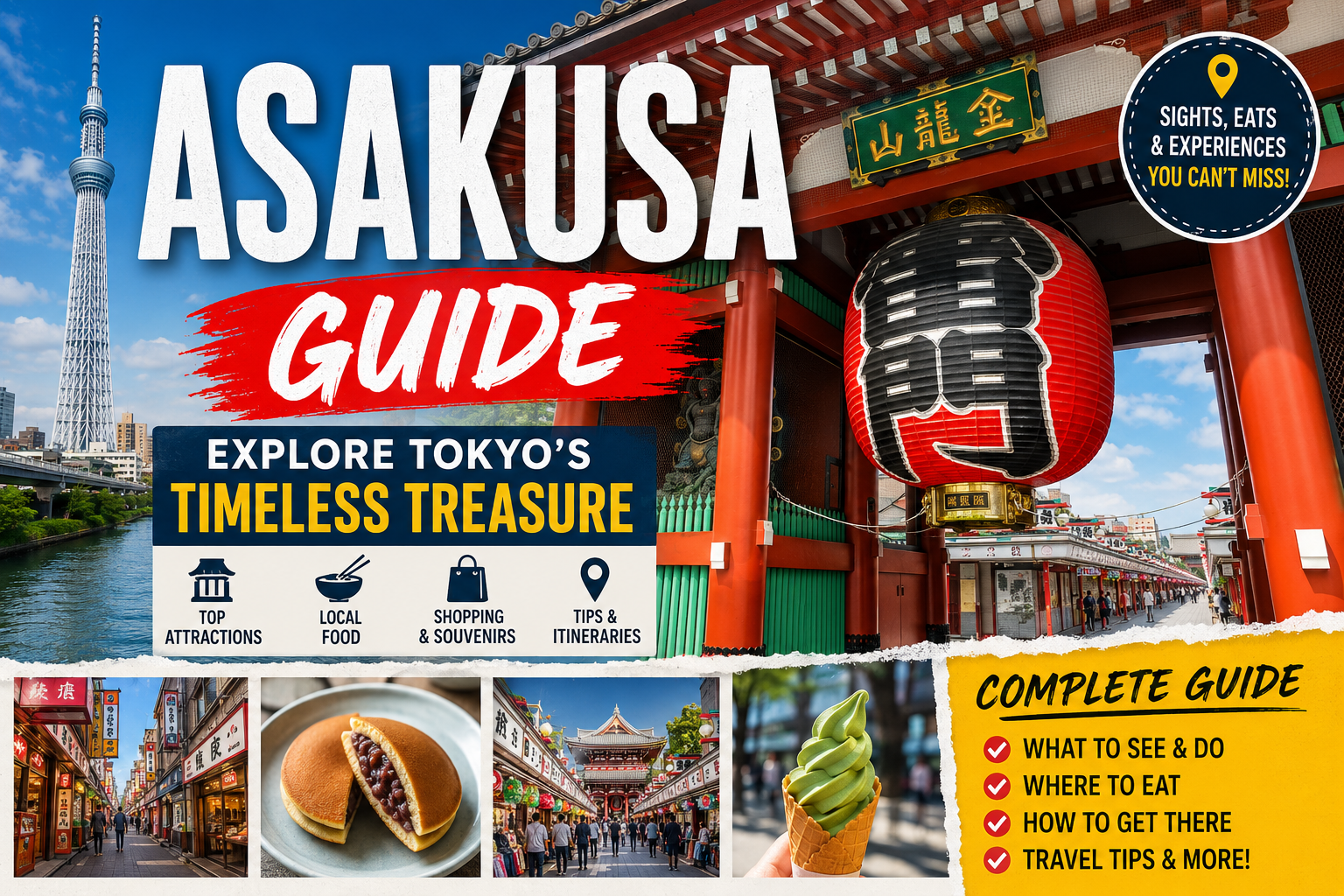
Asakusa Guide: 25+ Best Things to Do, See, Eat & Experience in Tokyo
Asakusa is one of the best places in Tokyo to experience the city’s historic character, with Sensoji Temple, Kaminarimon Gate, Nakamise shopping street, traditional food, entertainment, and the Sumida River forming its cultural core. The best way to explore Asakusa is not simply to photograph Sensoji and leave, but to slow down, walk beyond the main temple route, eat local specialties, explore the surrounding streets, and combine the historic district with the waterfront and nearby Tokyo Skytree area Kyoto
This Asakusa guide explains how to experience the district thoughtfully, whether you have two hours, half a day, a full day, or several days in Tokyo.
Quick Summary: Asakusa at a Glance
| Travel Question | Quick Answer |
|---|---|
| Where is Asakusa? | Eastern Tokyo, in Taito City |
| What is Asakusa famous for? | Sensoji Temple, Kaminarimon Gate, Nakamise, traditional culture and food |
| Best attraction | Sensoji Temple |
| Best photo spot | Kaminarimon Gate |
| Best shopping street | Nakamise-dori |
| Best area for a traditional atmosphere | Around Sensoji and the smaller surrounding streets |
| Best riverside attraction | Sumida River and Sumida Park |
| Nearby modern landmark | Tokyo Skytree |
| Best for families | Sensoji, Hanayashiki, Sumida River, Skytree |
| Best for photographers | Kaminarimon, Nakamise, Sensoji, river bridges and night streets |
| Best for food lovers | Nakamise, Hoppy Street, local restaurants and nearby Kappabashi |
| Recommended visit length | Half a day to one full day |
| Can you visit at night? | Yes, and the atmosphere is very different from daytime |
| Is Asakusa good for first-time visitors? | Yes |
| Is Asakusa only about temples? | No |
What Is Asakusa?
Asakusa is a historic neighborhood in Tokyo’s Taito City. It developed around Sensoji Temple and became an important center of popular culture, entertainment, commerce, religion, and traditional downtown life.
Unlike parts of Tokyo dominated by skyscrapers, luxury shopping, and huge railway stations, Asakusa has retained a stronger shitamachi atmosphere.
The word shitamachi is commonly associated with Tokyo’s traditional downtown neighborhoods and their local community culture.
That character is one of Asakusa’s greatest strengths.
The area combines:
- Buddhist temple culture
- Shinto traditions
- Traditional Japanese sweets
- Street food
- Souvenir shopping
- Artisan goods
- Historic entertainment
- Modern hotels
- Riverside recreation
- Contemporary restaurants
- Family attractions
- Traditional festivals
- Tokyo skyline views
The official Tokyo tourism guide describes Asakusa as a district centered around Sensoji, Kaminarimon and Nakamise, while also emphasizing its connection to the Sumida River and traditional Japanese arts and crafts.
This combination makes Asakusa unusually useful for travelers.
You do not have to choose between “old Japan” and “modern Tokyo.”
You can experience both within the same afternoon.
A Brief History of Asakusa
Sensoji Is the Heart of the District
Sensoji is the defining landmark of Asakusa and is widely recognized as Tokyo’s oldest temple.
The temple’s history reaches far beyond the modern city. Over time, the area surrounding Sensoji developed into a major center of activity.
According to Sensoji’s official history, important structures in the temple complex have repeatedly been destroyed and rebuilt, including during major fires and the 1945 Tokyo air raid. The current Main Hall was rebuilt in 1958 after being destroyed during the war.
This history is important because Asakusa’s charm is not simply about surviving old buildings.
It is about continuity.
The neighborhood has repeatedly changed while maintaining its cultural identity.
The Edo Connection
During the Edo period, Tokyo developed as a major political and commercial center, and Asakusa became an important downtown district.
Entertainment, religious activity, markets and everyday commerce helped make the area popular.
Today, visitors can still see elements of that historical role in:
- Traditional restaurants
- Festival culture
- Small shops
- Performing arts
- Temple and shrine traditions
- Street layouts
- Old-fashioned entertainment
- Local crafts
GO TOKYO notes that Asakusa’s development as a temple town around Sensoji began long before the Edo period and that the neighborhood continues to preserve elements of traditional downtown Tokyo culture.
The 10 Essential Places to See in Asakusa
1. Sensoji Temple
If you only have time for one attraction, make it Sensoji.
The temple complex includes several important structures, including:
- Kaminarimon Gate
- Nakamise Shopping Street
- Hozo-mon Gate
- Main Hall
- Five-Storied Pagoda
- Asakusa Shrine
- Niten-mon Gate
- Denboin and its garden
- Bentendo Hall
Sensoji’s official site identifies the Main Hall, Five-Storied Pagoda, Hozo-mon, Kaminarimon, Nakamise and other structures as important parts of the temple complex.
Why Sensoji Is More Than a Photo Opportunity
Many tourists walk through the temple quickly.
That is a mistake.
Look at the architectural details.
Notice the roof proportions.
Watch worshippers.
Observe the incense area.
Look at the gates.
Pay attention to how the atmosphere changes as you move deeper into the complex.
You will get a much better understanding of why Sensoji remains central to Asakusa.
2. Kaminarimon Gate
Kaminarimon means “Thunder Gate.”
It is one of Tokyo’s most recognizable landmarks and the classic entrance to Sensoji.
The enormous red lantern is the feature most visitors immediately recognize.
The gate also contains statues associated with wind and thunder, reflecting its traditional religious symbolism. Sensoji’s official history states that the gate was originally built in 942 and that the current structure was rebuilt in 1960 after previous destruction.
GO TOKYO recommends seeing Kaminarimon when it is illuminated at night, when the daytime crowds have reduced.
Photography Tip
Do not photograph only the front.
Stand farther away and include the surrounding street.
Then return at night.
The same gate can look completely different under evening lighting.
3. Nakamise Shopping Street
Nakamise is the traditional shopping street connecting Kaminarimon with the Hozo-mon Gate.
It is approximately 250 meters long and has around 90 shops and stalls selling souvenirs, traditional products, snacks and other goods.
You can find items such as:
- Japanese sweets
- Rice crackers
- Traditional toys
- Kimono-related goods
- Wooden crafts
- Fans
- Decorative items
- Souvenirs
- Traditional clothing accessories
Should You Shop at Nakamise?
Yes, but shop intelligently.
The first shop you see does not have to be your final purchase.
Walk the entire street first.
Compare products.
Look at craftsmanship.
Consider whether the item is genuinely useful or simply convenient because it is sitting in front of you.
A Hidden Nighttime Detail
Nakamise is worth visiting twice.
During the day it is busy, colorful and energetic.
At night, many shops close, but the shutters feature painted scenes. GO TOKYO specifically highlights the shutter murals as a reason to return after dinner.
This is an excellent example of an Asakusa experience that many rushed tourists miss.
4. Asakusa Shrine
Asakusa Shrine sits close to Sensoji and offers a useful cultural contrast.
Sensoji is a Buddhist temple.
Asakusa Shrine is a Shinto shrine.
The shrine honors three men associated with the origins of Sensoji: the two fishermen brothers Hinokuma Hamanari and Takenari, and Hajino Nakatomo.
This makes visiting both places particularly valuable for travelers who want to understand Japan’s religious landscape.
You do not need to turn the visit into a complicated academic exercise.
Simply recognize that temple and shrine traditions are distinct, even when they exist next to each other.
5. Sumida River
The Sumida River provides one of the best ways to escape the busiest streets of central Asakusa.
Walk toward the river after visiting Sensoji.
The change can be surprisingly dramatic.
The temple district is dense and energetic.
The riverfront feels open.
You can see:
- Bridges
- Boats
- Tokyo Skytree
- Riverside parks
- Modern buildings
- Historic neighborhoods
GO TOKYO identifies the Sumida River as one of the defining features of Asakusa and highlights river cruises and riverside landmarks as key experiences.
6. Sumida Park
Sumida Park is only a short walk from Asakusa Station.
It provides river views, walking paths and seasonal scenery.
The park is particularly famous during cherry blossom season, when the riverside becomes a major viewing area. GO TOKYO notes that the park also hosts major annual fireworks and offers views toward Tokyo Skytree.
Best Use of Sumida Park
You do not need a complicated plan.
Grab a drink or snack.
Walk along the river.
Find a bench.
Look toward the skyline.
It is an excellent reset after several crowded streets.
7. Sumida River Walk
One of the most useful modern developments for visitors is the Sumida River Walk.
It connects the Asakusa side of the river with the Tokyo Skytree area and TOKYO mizumachi.
This means you can combine:
Asakusa → Sumida River → Tokyo Skytree
without making the journey entirely dependent on trains.
GO TOKYO specifically describes the Sumida River Walk as a pedestrian connection between Asakusa and Tokyo Skytree Town.
This is one of the best examples of how modern infrastructure can strengthen rather than erase a historic neighborhood.
8. Asakusa Hanayashiki
Traveling with children?
Do not automatically assume Asakusa is only for adults interested in temples.
Hanayashiki provides an entirely different side of the district.
It is Japan’s oldest amusement park, with origins dating to 1853. The park today combines retro amusement-park attractions with its historic identity.
The attraction is especially interesting because it feels completely different from Tokyo’s giant modern theme parks.
It is compact.
It is nostalgic.
It is closely connected to the neighborhood.
And it gives families something to do between cultural stops.
9. Asakusa Culture Tourist Information Center
Located across from Kaminarimon, the Asakusa Culture Tourist Information Center is useful even if you have already researched your trip.
Its modern architecture contrasts sharply with the traditional surroundings.
It is also a practical starting point for visitors who need:
- Maps
- Local information
- Transport guidance
- Accommodation information
- Cultural activity information
- Language assistance
The center also has an observation area with views over Kaminarimon, Sensoji, the Sumida River and Tokyo Skytree.
Why This Spot Is Underrated
Many travelers think tourist information centers are only for people who failed to plan.
That is outdated thinking.
A neighborhood information center can provide information about temporary events, local changes and smaller attractions that may not appear in your original itinerary.
10. Tokyo Skytree
Tokyo Skytree is technically across the Sumida River from the core of Asakusa, but it fits naturally into an Asakusa itinerary.
At 634 meters, Tokyo Skytree is the world’s tallest freestanding broadcasting tower, according to GO TOKYO.
The easiest strategy is often:
Morning Asakusa → Sensoji → Lunch → Riverside Walk → Skytree
This gives you a strong contrast between historic Tokyo and modern Tokyo.
What to Do in Asakusa Beyond the Famous Attractions
The biggest mistake in an Asakusa itinerary is treating the neighborhood like a checklist.
The famous attractions are important.
But the spaces between them are equally valuable.
Explore the Smaller Streets
Leave the main tourist route.
Walk several blocks away from Nakamise.
You will find:
- Smaller restaurants
- Local businesses
- Traditional shops
- Residential streets
- Small temples
- Craft stores
- Cafés
- Bars
- Retro architecture
The experience becomes less polished and more neighborhood-oriented.
That is exactly what many travelers are looking for when they say they want to experience “authentic Tokyo.”
Experience Traditional Japanese Food
Asakusa is one of the better places in Tokyo to explore traditional snacks and local-style dining.
Common foods associated with the area include:
Ningyo-yaki
Small doll-shaped cakes usually associated with sweet fillings.
They are popular as a snack and souvenir.
Kaminari-okoshi
A traditional puffed-rice confection associated strongly with Asakusa.
Tokiwado Kaminari-Okoshi has been making the confection for more than 200 years, according to the Asakusa Tourism Federation. Its products include multiple flavors as well as ningyo-yaki and senbei.
Senbei
Japanese rice crackers are another easy snack to try while walking.
Tempura
Asakusa has a long association with traditional Japanese dining, including tempura restaurants.
Soba
For travelers wanting a simple Japanese meal, soba is an excellent choice.
Unagi
Grilled eel is another traditional food to consider when looking for a more substantial meal.
Hoppy Street and Asakusa’s Entertainment Culture
Hoppy Street is associated with Asakusa’s casual drinking and dining scene.
This side of Asakusa is very different from the temple grounds.
That contrast is part of the neighborhood’s appeal.
You can go from:
Temple → traditional sweets → shopping → casual izakaya → riverside walk
within the same day.
The neighborhood therefore works well for travelers who want culture without spending the entire day inside museums.
Explore Kappabashi Kitchen Town
Kappabashi is just outside the main Asakusa sightseeing core but fits naturally into an extended itinerary.
The area is famous for restaurant supplies and kitchen-related shopping.
You can find:
- Knives
- Cooking utensils
- Tableware
- Restaurant equipment
- Japanese ceramics
- Food displays
- Kitchen accessories
For food lovers, photographers and home cooks, Kappabashi can be more memorable than another generic shopping mall.
The Best Asakusa Itinerary for First-Time Visitors
Two-Hour Asakusa Itinerary
If you have only two hours, focus on the essentials.
Route
- Asakusa Station
- Kaminarimon Gate
- Nakamise
- Sensoji
- Asakusa Shrine
- Walk toward Sumida River
This gives you the historical core.
Do not spend all your time shopping.
Half-Day Asakusa Itinerary
A four-to-five-hour visit gives you much more flexibility.
Morning
Start at Kaminarimon.
Walk through Nakamise.
Spend time at Sensoji.
Visit Asakusa Shrine.
Lunch
Choose a local restaurant rather than immediately returning to a global chain.
Afternoon
Walk toward Sumida Park.
Cross the Sumida River Walk.
Continue toward Tokyo Skytree.
This itinerary balances:
- History
- Religion
- Food
- Shopping
- Walking
- Modern Tokyo
Full-Day Asakusa Itinerary
For a full day, slow down.
8:00–9:00
Begin near Sensoji.
Early morning is usually much calmer than the middle of the day.
9:00–10:30
Explore Sensoji and Asakusa Shrine.
10:30–11:30
Walk Nakamise and nearby streets.
11:30–13:00
Have lunch.
13:00–14:30
Explore Hanayashiki, Kappabashi or local shops.
14:30–16:00
Walk toward Sumida River.
16:00–18:00
Cross the Sumida River Walk toward Tokyo Skytree.
Evening
Return toward Asakusa or stay near the river for sunset and nighttime views.
Then revisit Sensoji.
This final step is important.
Asakusa after dark is not simply Asakusa with fewer people.
It is a different experience.
The Best Time to Visit Asakusa
There is no single perfect time.
It depends on what you want.
Early Morning
Best for:
- Photography
- Quiet temple atmosphere
- Fewer crowds
- Relaxed walking
- Architecture
If photography is your priority, morning is usually a much better choice than midday.
Late Morning
Best for:
- Shopping
- Food
- General sightseeing
More businesses will be active, but crowds increase.
Afternoon
Best for:
- Families
- Shopping
- Combining attractions
- Hanayashiki
- Longer itineraries
Evening
Best for:
- Temple illumination
- Riverside views
- Dinner
- Night photography
- Shutter paintings at Nakamise
GO TOKYO specifically recommends experiencing Kaminarimon and Nakamise after dark because the atmosphere changes when the daytime crowds disappear.
Asakusa by Season
Spring
Spring is one of the most attractive times to visit because of cherry blossoms.
Sumida Park and the riverbanks become especially popular.
The wider Sumida River area also hosts seasonal cherry blossom events.
Spring Advantage
Beautiful scenery.
Spring Disadvantage
Crowds.
If visiting during peak blossom periods, start early.
Summer
Summer brings festivals and traditional events but can be hot and humid.
One notable example is the Sumida River Toro Nagashi lantern-floating ceremony, a summer tradition connected with remembrance and prayers for peace.
Summer Strategy
Do the outdoor walking early.
Use indoor attractions during the hottest part of the afternoon.
Return to the river after sunset.
Autumn
Autumn is excellent for walking.
Temperatures can be more comfortable than summer, and the combination of historic architecture and seasonal foliage creates strong photography opportunities.
Winter
Winter can be underrated.
Cold weather means fewer casual tourists at certain times, while clear conditions can provide excellent views.
The temple area also has a special atmosphere during the New Year period, although major holiday periods can be extremely busy.
Asakusa for Different Types of Travelers
Asakusa for First-Time Tokyo Visitors
Asakusa is one of the strongest choices for first-time visitors because it provides an immediate introduction to traditional Tokyo.
You can understand several major themes of Japan in one neighborhood:
- Religion
- Food
- History
- Shopping
- Architecture
- Public transport
- Festivals
- Modern development
Asakusa for Families
Families should consider:
- Sensoji
- Hanayashiki
- Sumida Park
- Sumida River
- Tokyo Skytree
- Food markets and shops
- Short river cruises
The advantage is variety.
A child who gets bored at a temple can enjoy an amusement park or riverside activity later.
Asakusa for Couples
Couples can create a slower itinerary.
Try:
Temple in the morning → traditional lunch → shopping → river walk → Skytree sunset → evening Asakusa
The riverfront becomes particularly attractive around sunset.
Asakusa for Solo Travelers
Solo travelers benefit from the district’s walkability.
You can stop whenever you want.
Eat at a counter.
Photograph architecture.
Spend an hour inside a shop.
Sit beside the river.
There is no need to maintain a strict schedule.
Asakusa for Senior Travelers
The main attraction area is accessible, but a full day of walking can be tiring.
Use a slower route.
Prioritize:
- Kaminarimon
- Sensoji
- Asakusa Shrine
- Lunch
- One additional attraction
- Riverside rest
Do not attempt to see every street.
Asakusa for Photographers
Asakusa is exceptionally photogenic because it offers different visual layers.
Classic Shots
- Kaminarimon lantern
- Nakamise
- Sensoji Main Hall
- Five-Storied Pagoda
- Asakusa Shrine
Modern Contrast
- Tokyo Skytree
- Sumida River
- Bridges
- Contemporary buildings
Street Photography
- Shopfronts
- Traditional goods
- Food preparation
- Rickshaws
- Local streets
- Evening restaurants
Night Photography
Return after dark.
The crowds change.
The light changes.
The temple becomes more dramatic.
Nakamise’s shutter artwork becomes visible.
Asakusa for Food Lovers
Food-focused visitors should not treat Asakusa as simply a street-food stop.
Build a food strategy.
Morning
Try a traditional Japanese breakfast or café.
Midday
Choose tempura, soba, unagi or another local specialty.
Afternoon
Snack on:
- Ningyo-yaki
- Kaminari-okoshi
- Senbei
- Japanese sweets
Evening
Explore izakaya-style dining or a traditional restaurant.
This approach creates a better food experience than trying to eat everything from one tourist street.
Asakusa for Budget Travelers
Asakusa can be surprisingly manageable for budget travelers.
The best free or low-cost experiences include:
- Walking around Sensoji
- Kaminarimon photography
- Nakamise browsing
- Asakusa Shrine
- Sumida Park
- Sumida River Walk
- Exploring neighborhood streets
- Visiting the tourist center observation area when available
You can spend very little on sightseeing and reserve your budget for food.
Asakusa for Luxury Travelers
Luxury travelers can use Asakusa differently.
Stay in a higher-end property with views.
Book premium dining.
Take a private cultural tour.
Explore traditional crafts.
Combine Asakusa with a river cruise.
Visit Tokyo Skytree.
The district’s appeal is not limited to budget tourism.
10 Accommodation Brands and Hotel Options to Compare in Asakusa
Accommodation prices change dramatically by season, weekends, holidays and booking dates, so the table below focuses on positioning and traveler fit rather than fixed prices.
| Hotel / Brand | Best For | Main Strength | Potential Limitation | Best Match |
|---|---|---|---|---|
| APA Hotel | Budget-conscious travelers | Large chain and practical locations | Rooms can be compact | Short stays |
| Toyoko Inn | Value travelers | Familiar business-hotel format | Some locations are outside the immediate core | Budget/business |
| Hotel Gracery Asakusa | First-time visitors | Very close to Kaminarimon and station | Standard city-hotel feel | Couples/first timers |
| Asakusa Tobu Hotel | Transport-focused travelers | Excellent station access | Can cost more during peak dates | Families/couples |
| Onyado Nono Asakusa | Japanese-style experience | Tatami atmosphere and bath facilities | Japanese-style design is not for everyone | Culture seekers |
| MIMARU SUITES Tokyo Asakusa | Families/groups | Large multi-bedroom suites and kitchens | Higher total room cost | Families/groups |
| THE GATE HOTEL KAMINARIMON | Premium travelers | Views and rooftop experience | Premium pricing | Couples/luxury |
| K’s House Tokyo Oasis | Backpackers/flexible travelers | Private rooms and dormitory options | Hostel atmosphere | Solo/budget |
| Richmond Hotel Premier Asakusa | Comfortable sightseeing base | Central location and views in some rooms | Usually above basic business-hotel pricing | Couples/families |
| Hotel Keihan Asakusa | Families and practical travelers | Multiple room sizes and modern facilities | Tsukuba Express is its closest station | Families/groups |
Hotel Gracery Asakusa is about a few minutes from Asakusa Station and very close to Kaminarimon, making it particularly convenient for sightseeing.
The Tobu hotel is also positioned directly in the Asakusa sightseeing area, with easy access to the station and the Sumida River Walk toward Skytree.
Onyado Nono Asakusa provides a more Japanese-style atmosphere, including tatami-style areas and bathing facilities, making it useful for travelers who want their accommodation to feel connected to the destination.
MIMARU SUITES Tokyo Asakusa is particularly interesting for families and groups because its suites include two or more bedrooms, kitchens and substantially more living space than typical Tokyo hotel rooms.
THE GATE HOTEL KAMINARIMON is a stronger premium option, with guest-only rooftop space and views toward Sensoji and Tokyo Skytree.
K’s House Tokyo Oasis offers both private rooms and dormitories, making it more flexible for backpackers, solo travelers and budget-conscious visitors.
APA operates multiple properties in the broader Asakusa, Ryogoku and Asakusabashi area, while Toyoko Inn continues to operate Asakusa-area properties; travelers should check the specific property’s current status because individual hotels can temporarily close for renovations.
Hotel Keihan Asakusa is another useful choice, especially for travelers who want larger room categories; its current room selection includes family-oriented options and a renovated design inspired by Taisho-era aesthetics.
How to Choose Where to Stay in Asakusa
Do not simply search for “cheap hotel in Asakusa.”
Instead, match the hotel to your problem.
If Your Problem Is Transportation
Choose somewhere close to a useful station.
This matters especially when you have luggage.
If Your Problem Is Small Rooms
Look for family rooms, suites or apartment-style accommodation.
MIMARU is particularly relevant here.
If Your Problem Is Wanting Japanese Atmosphere
Consider a Japanese-style hotel such as Onyado Nono.
If Your Problem Is a Limited Budget
Compare business hotels and hostels.
If Your Problem Is Wanting a View
Look at properties with dedicated upper-floor or rooftop viewpoints.
THE GATE HOTEL is one example.
If Your Problem Is Traveling With Children
Prioritize:
- Room size
- Bed configuration
- Laundry
- Station access
- Nearby restaurants
- Elevator access
- Family rooms
Do not choose purely based on the number of stars.
How to Get Around Asakusa
One reason Asakusa works so well as a tourist district is that its core is highly walkable.
Major transport options include:
- Tokyo Metro Ginza Line
- Toei Asakusa Line
- Tobu Skytree Line
- Tsukuba Express
GO TOKYO lists these routes as key access options for Nakamise and the Asakusa area.
Walking
Walking is the best option inside the historic core.
You will see more.
You will discover side streets.
You can stop whenever you want.
Train
Use trains when moving from Asakusa to another part of Tokyo.
Water
The Sumida River offers another transportation and sightseeing option through boat services and cruises.
How Long Should You Spend in Asakusa?
1–2 Hours
Enough for:
- Kaminarimon
- Nakamise
- Sensoji
3–5 Hours
Enough for:
- Temple
- Shopping
- Food
- Asakusa Shrine
- River
Full Day
Ideal for:
- Slow exploration
- Food
- Shopping
- Hanayashiki
- River
- Skytree
- Night photography
Two Days
Useful if you want to combine:
- Asakusa
- Kappabashi
- Skytree
- Museums
- Traditional experiences
- Food exploration
- Slow neighborhood walks
For most tourists, half a day to one full day is the sweet spot.
Common Asakusa Mistakes and How to Avoid Them
Mistake 1: Visiting Only at Midday
The most crowded period can make the area feel overwhelming.
Solution
Arrive early.
Then return after dark.
Mistake 2: Spending the Entire Visit on Nakamise
Nakamise is excellent, but it is only one part of Asakusa.
Solution
Walk beyond the shopping street.
Mistake 3: Treating Sensoji Like a Photo Set
Taking one photograph and leaving means missing much of the experience.
Solution
Spend time observing the temple complex.
Mistake 4: Ignoring Asakusa Shrine
Some visitors assume it is simply another part of Sensoji.
Solution
Learn the basic distinction between Buddhist temple and Shinto shrine.
Mistake 5: Ignoring the River
The river is one of Asakusa’s defining geographic features.
Solution
Walk to Sumida Park.
Mistake 6: Overplanning Every Minute
Asakusa rewards spontaneous walking.
Solution
Keep at least one or two hours unplanned.
Mistake 7: Assuming “Authentic” Means “Tourist-Free”
Asakusa is famous.
It will have tourists.
Solution
Accept that the historic core is popular, then explore side streets to find a quieter neighborhood atmosphere.
Mistake 8: Buying the First Souvenir You See
Nakamise has many choices.
Solution
Walk first.
Compare later.
Mistake 9: Forgetting That Tokyo Is Huge
You may enjoy Asakusa so much that you underestimate the time required to reach other districts.
Solution
Group nearby attractions together.
For example:
Asakusa + Skytree + Sumida River
works naturally.
Mistake 10: Not Checking Current Opening Information
Restaurants, shops, attractions and seasonal events can change their hours.
Solution
Check official websites shortly before your visit.
This is especially important for seasonal events and special attractions.
Pros and Cons of Visiting Asakusa
Advantages
Strong Historical Character
Asakusa provides one of Tokyo’s clearest introductions to traditional downtown culture.
Excellent First-Timer Experience
The district is easy to understand geographically.
Great Photography
Traditional buildings and modern skyline views coexist.
Family-Friendly
Temples, parks, food and amusement attractions create variety.
Good Food
Traditional sweets and Japanese dining are major attractions.
Walkable Core
Many major attractions are close together.
Excellent Contrast With Modern Tokyo
Skytree and the Sumida River provide a modern counterpoint.
Disadvantages
Crowds
The most famous streets can become extremely busy.
Tourist-Oriented Shopping
Some parts of Nakamise are designed primarily for visitors.
Limited Nightlife Compared With Shinjuku or Shibuya
Asakusa has evening entertainment, but it is not Tokyo’s primary nightlife district.
Walking Can Become Tiring
A full-day itinerary can involve substantial walking.
Not Every Restaurant Is a Hidden Gem
Popularity means some places are heavily tourist-focused.
The Best Asakusa Strategy: The Three-Layer Method
A useful way to understand Asakusa is to divide your visit into three layers.
Layer One: Iconic Asakusa
See:
- Kaminarimon
- Nakamise
- Sensoji
- Asakusa Shrine
This gives you the recognizable image of Asakusa.
Layer Two: Local Asakusa
Explore:
- Smaller streets
- Restaurants
- Traditional stores
- Hoppy Street
- Hanayashiki
- Kappabashi
This gives you neighborhood character.
Layer Three: Modern Asakusa
Experience:
- Sumida River
- Sumida River Walk
- Tokyo Skytree
- Contemporary hotels
- Modern restaurants
This gives you the modern context.
The result is much richer than simply visiting one temple.
A Problem-Solving Guide for Different Travelers
“I Have Only 90 Minutes”
Do:
Kaminarimon → Nakamise → Sensoji
Skip shopping unless something genuinely interests you.
“I Hate Crowds”
Visit early morning or evening.
Explore side streets.
Avoid spending your entire visit on Nakamise.
“I Love Japanese Culture”
Prioritize:
Sensoji → Asakusa Shrine → Traditional food → Crafts → Local streets
“I Am Traveling With Kids”
Try:
Sensoji → lunch → Hanayashiki → Sumida River → Skytree
“I Am a Photographer”
Visit twice:
Early morning + after dark
“I Love Food”
Spend less time rushing between attractions and more time exploring traditional food streets and local restaurants.
“I Want a Luxury Experience”
Choose premium accommodation, private experiences and higher-end dining while using the historic streets as your outdoor cultural itinerary.
“I Am on a Tight Budget”
Focus on walking attractions and spend selectively on food.
“I Am Visiting Tokyo for the First Time”
Asakusa should be high on your list.
How Asakusa Compares With Other Famous Tokyo Areas
Asakusa is not necessarily “better” than Shibuya, Shinjuku, Ginza or Harajuku.
It is different.
| Tokyo Area | Main Character | Best For |
|---|---|---|
| Asakusa | Traditional downtown Tokyo | History and culture |
| Shibuya | Modern youth culture | Shopping and nightlife |
| Shinjuku | Huge urban center | Nightlife and entertainment |
| Harajuku | Fashion and youth culture | Street fashion |
| Ginza | Luxury and sophistication | Shopping and dining |
| Ueno | Museums and traditional downtown | Culture and families |
| Akihabara | Electronics and anime | Pop culture |
| Odaiba | Modern waterfront | Families and skyline |
| Tokyo Station | Business and architecture | Transport and central access |
This is why Asakusa works particularly well as one part of a larger Tokyo itinerary.
Unique Experiences Most Asakusa Guides Miss
Watch the Neighborhood Change Over the Day
Instead of asking, “What should I see?”
Ask:
“How does Asakusa change from morning to night?”
Early morning:
Quiet.
Midday:
Crowded.
Late afternoon:
Relaxed.
Evening:
Atmospheric.
Night:
Illuminated and surprisingly calm in places.
This creates a richer travel experience.
Use Bridges as Photography Locations
The bridges around the Sumida River can provide strong views of Tokyo Skytree and the river.
For example, GO TOKYO highlights Kototoi Bridge for views toward Tokyo Skytree, especially at night, while Komagata Bridge provides another distinctive perspective.
This is a useful photography lesson:
Do not always photograph the landmark from directly in front of it.
Sometimes the best image comes from the surrounding landscape.
Experience Traditional Events
Asakusa and the wider Taito area host traditional cultural events throughout the year.
Examples include:
- Cherry blossom festivals
- Horseback archery
- Lantern-floating ceremonies
- Temple events
- Shrine festivals
GO TOKYO documents Asakusa’s annual yabusame event and describes its connection to Edo-period traditions.
Because event schedules change, travelers should check the official event listing before planning around a particular festival.
Asakusa and the Future of Tokyo Tourism
Asakusa’s future is especially interesting because it sits at the intersection of two competing forces.
One force is preservation.
The other is modernization.
The district’s appeal comes from its historic identity.
But visitors increasingly expect:
- Better transport
- Digital information
- Multilingual services
- Modern hotels
- Convenient shopping
- Accessible facilities
- Family-friendly infrastructure
- Better walking routes
The Sumida River Walk is a good example of this evolution.
Rather than replacing Asakusa’s history, it creates a new connection between the historic district and Tokyo Skytree.
Future Trends Travelers Should Watch
More Demand for Experiential Travel
Travelers increasingly want to participate rather than simply observe.
Expect continued interest in:
- Cooking experiences
- Traditional crafts
- Guided neighborhood walks
- Kimono experiences
- Cultural performances
- Food tours
- Artisan workshops
More Interest in Night Tourism
Asakusa is particularly suited to evening tourism because temple illumination, river views and quieter streets create a different atmosphere.
Stronger Asakusa–Skytree Connection
The physical and tourism connection between Asakusa and Tokyo Skytree is likely to remain important.
More Family-Oriented Accommodation
Properties offering larger rooms and suites can become increasingly valuable as international family travel grows.
MIMARU SUITES Tokyo Asakusa is a good example of this direction, with multi-bedroom suites designed around family and group travel.
Preservation Will Become More Important
The more popular Asakusa becomes, the more important responsible tourism will be.
Travelers should:
- Respect temple rules
- Avoid blocking narrow streets
- Dispose of waste properly
- Avoid entering private areas
- Follow photography restrictions
- Keep noise down in residential areas
- Respect worshippers
Responsible Tourism in Asakusa
Asakusa is not an open-air theme park.
People live and work here.
Religious sites are active places of worship.
That means tourists should behave accordingly.
Follow Temple and Shrine Etiquette
Watch what local visitors do.
Do not touch objects unnecessarily.
Respect signs.
Keep voices low in religious spaces.
Be Careful With Photography
Do not block entrances for photographs.
Avoid photographing people closely without permission.
Eat Responsibly
If a street vendor asks visitors not to eat while walking, follow the local instruction.
Respect Residential Areas
A quiet residential lane is not automatically a sightseeing attraction.
What to Pack for an Asakusa Day
You do not need special equipment.
But these items help:
- Comfortable walking shoes
- Portable phone battery
- Reusable water bottle
- Small umbrella when weather requires it
- Light bag
- Cash and payment cards
- Comfortable clothing
- Smartphone for maps
The biggest mistake is wearing uncomfortable shoes.
Asakusa rewards walking.
Is Asakusa Worth Visiting?
Yes.
But the reason is more nuanced than “because Sensoji is famous.”
Asakusa is valuable because it compresses several dimensions of Tokyo into one manageable district.
You can see a historic temple.
Then a modern tower.
Eat a traditional sweet.
Then walk along a contemporary riverside development.
Visit a Shinto shrine.
Then enter a retro amusement park.
Buy a traditional souvenir.
Then return to a modern hotel.
That contrast is the real Asakusa experience.
Is Asakusa Worth Staying Overnight?
For many travelers, yes.
Staying overnight provides one major advantage:
You can experience Asakusa before and after the biggest crowds.
A day trip visitor may arrive at 10:00 AM and leave at 5:00 PM.
A hotel guest can see:
- Early morning Sensoji
- Quiet streets
- Evening Nakamise shutters
- Nighttime Kaminarimon
- Riverside after dark
- Local restaurants after the day-trippers leave
That changes the quality of the experience.
Best Area to Stay in Asakusa
Near Kaminarimon
Best for first-time visitors.
You will be close to:
- Sensoji
- Nakamise
- Asakusa Station
- Restaurants
- Tourist services
Near Asakusa Station
Best for transportation.
Near Hanayashiki
Good for families and visitors who like a lively neighborhood atmosphere.
Toward Kuramae
Better if you want a slightly less tourist-focused atmosphere while remaining close to Asakusa.
Near the Sumida River
Best for:
- River walks
- Skytree views
- Relaxed evenings
- Photography
A Perfect One-Day Asakusa Plan
Here is a practical route for a first visit.
Morning
Start at Kaminarimon.
Walk through Nakamise.
Visit Sensoji.
Visit Asakusa Shrine.
Late Morning
Explore smaller streets around the temple.
Try a traditional snack.
Lunch
Eat at a local Japanese restaurant.
Afternoon
Choose one:
- Hanayashiki
- Kappabashi
- Traditional shopping
- Cultural experience
Late Afternoon
Walk to Sumida Park.
Enjoy the river.
Evening
Cross Sumida River Walk.
Visit Tokyo Skytree.
Night
Return to Asakusa.
See Kaminarimon and Sensoji illuminated.
Walk around Nakamise to see the shutter artwork.
Have dinner.
This route avoids the common mistake of trying to cover every attraction.
A Better Way to Think About Asakusa
The best Asakusa itinerary is not a list.
It is a story.
Chapter One: Arrival
Kaminarimon introduces you to the district.
Chapter Two: Tradition
Nakamise and Sensoji reveal the historical identity.
Chapter Three: Everyday Life
Side streets and restaurants show how the neighborhood functions today.
Chapter Four: Water
The Sumida River explains the geography of Asakusa.
Chapter Five: Modern Tokyo
Skytree shows how dramatically Tokyo has changed.
Chapter Six: Night
Returning to the temple after dark brings the story full circle.
That is why a slower itinerary often creates better memories than a faster one.
FAQs About Asakusa
What is Asakusa famous for?
Asakusa is best known for Sensoji Temple, Kaminarimon Gate, Nakamise shopping street, traditional food, historic downtown culture and its location beside the Sumida River.
Is Asakusa worth visiting for first-time visitors?
Yes. It provides an accessible introduction to traditional Tokyo while also offering modern attractions, restaurants, shopping and transport connections.
How many hours do you need in Asakusa?
Two hours is enough for the major highlights, but four to eight hours is better if you want food, shopping, the river and additional attractions.
What is the best time to visit Asakusa?
Early morning is excellent for quieter temple visits and photography. Evening is also valuable because Kaminarimon, Sensoji and Nakamise have a different atmosphere after dark.
Can you visit Sensoji at night?
Yes. Even when individual facilities have their own operating hours, the exterior temple area provides a very different nighttime atmosphere.
Always check current official information if you plan to enter specific buildings or attend a special event.
Is Asakusa good for families?
Yes. Families can combine cultural attractions with Hanayashiki, Sumida Park, the river and Tokyo Skytree.
Is Asakusa expensive?
It can be expensive or affordable depending on your choices. Walking around the major landmarks costs little, while accommodation, restaurants and premium experiences can significantly increase the budget.
What should I buy in Asakusa?
Popular choices include Japanese sweets, rice crackers, traditional toys, crafts, fans, clothing accessories and other Japanese souvenirs.
What food should I try in Asakusa?
Consider ningyo-yaki, kaminari-okoshi, senbei, tempura, soba, unagi and other traditional Japanese dishes.
Is Asakusa walkable?
Yes. The central sightseeing area is highly suitable for walking. The main challenge is not navigation but distance and crowds.
Can you walk from Asakusa to Tokyo Skytree?
Yes. The Sumida River Walk provides a pedestrian connection between Asakusa and the Tokyo Skytree area.
Is Tokyo Skytree in Asakusa?
Tokyo Skytree is in the neighboring Oshiage/Sumida area rather than the historic core of Asakusa, but it is close enough to combine naturally with an Asakusa itinerary.
Is Asakusa better in the morning or evening?
They serve different purposes.
Morning is better for calm sightseeing.
Evening is better for atmosphere and illuminated views.
The ideal answer is to visit both.
Is Nakamise only for tourists?
Nakamise is strongly oriented toward visitors, but it is also a historic shopping street with traditional goods and snacks. It remains an important part of the Sensoji approach.
What is the difference between Sensoji and Asakusa Shrine?
Sensoji is a Buddhist temple, while Asakusa Shrine is a Shinto shrine. They are located very close to each other and are connected historically through the origins of Sensoji.
Can you visit Asakusa without entering a temple?
Yes. You can enjoy the streets, food, shops, river, parks, bridges and modern attractions without spending much time inside religious buildings.
Is Asakusa good for photography?
Very much so. The district offers traditional architecture, street scenes, food, riverside views, bridges and Tokyo Skytree perspectives.
Should you stay in Asakusa or Shinjuku?
Choose Asakusa if you prefer traditional atmosphere, historic attractions and a calmer neighborhood feel. Choose Shinjuku if nightlife, major shopping and central urban energy are higher priorities.
Conclusion
Asakusa is not simply a place to photograph Tokyo’s famous red lantern.
It is one of the city’s best examples of how history and modern life can exist together.
You can walk through a centuries-old temple district in the morning and see one of the world’s most recognizable modern towers in the afternoon.
You can eat a traditional Japanese sweet, shop for crafts, visit a shrine, walk beside a major river and finish the day under the lights of Sensoji.
That combination is what makes Asakusa special.
