Urban Travel: 15 Smart Tips for Exploring Cities Safely and Efficiently
Have you ever arrived in a huge city and realized that the hardest part was not deciding where to go, but figuring out how to move, what to prioritize, and how to experience the place without spending the entire trip in traffic? Urban travel is the art of exploring cities through a combination of walking, public transportation, local experiences, cultural attractions, food, neighborhoods, and smart planning. The best urban travel experiences do not require seeing everything; they come from understanding how a city works and choosing experiences that fit your time, budget, interests, and travel style Historical Discoveries
What Is Urban Travel?
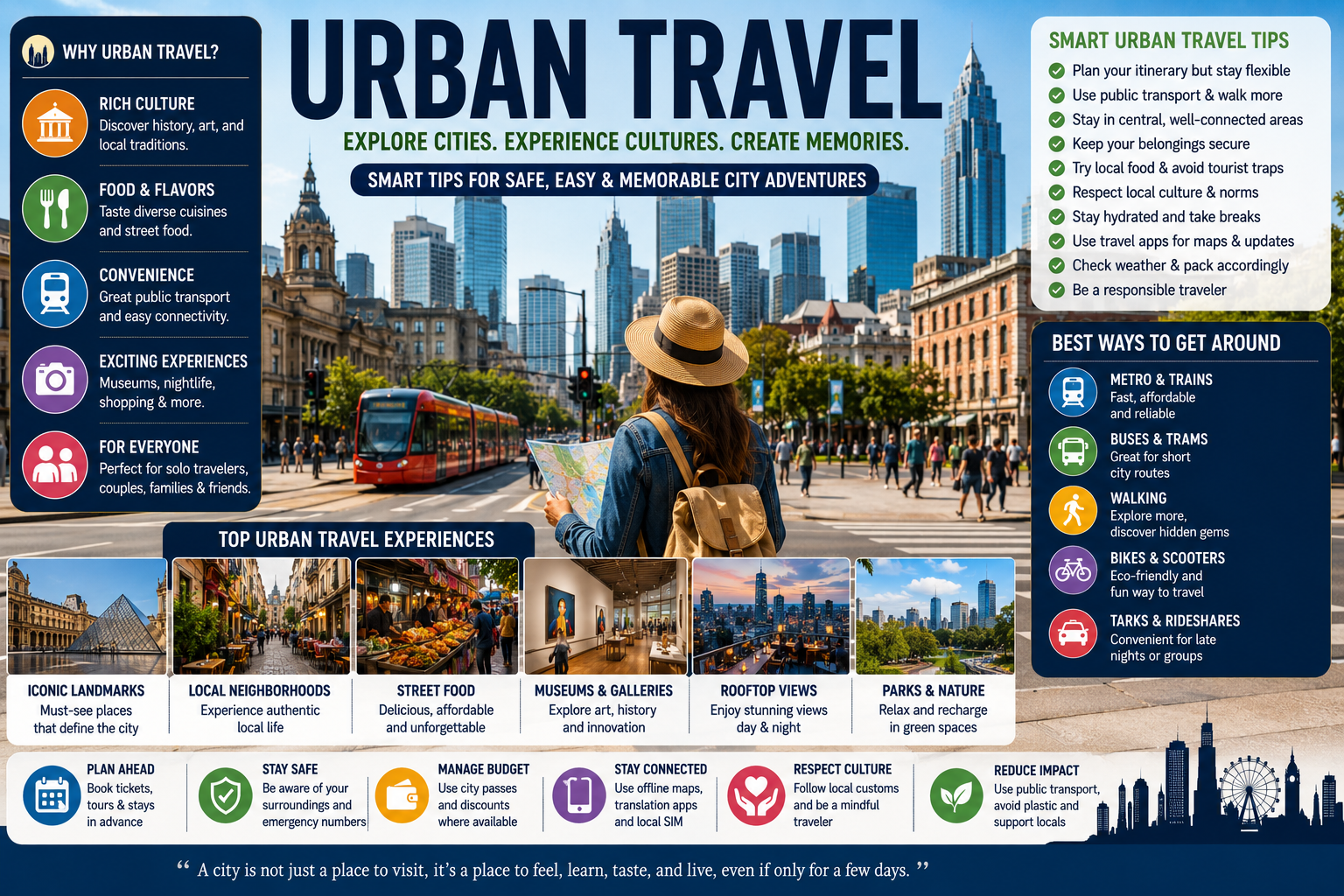
Urban travel refers to tourism and movement within cities and metropolitan areas. It includes sightseeing, cultural tourism, business travel, city breaks, food tourism, shopping, entertainment, historical exploration, public transportation, walking tours, and neighborhood discovery.
Unlike travel focused mainly on beaches, mountains, forests, or remote destinations, urban travel takes place within built environments.
The city itself becomes part of the attraction.
The Main Elements of Urban Travel
Urban travel typically combines several interconnected elements.
These include:
- Transportation
- Accommodation
- Attractions
- Food and restaurants
- Culture and history
- Shopping
- Entertainment
- Architecture
- Public spaces
- Local neighborhoods
- Safety
- Digital travel tools
- Budget management
- Sustainable travel practices
The strongest urban itineraries connect these elements instead of treating them as separate activities.
For example, a traveler interested in architecture might select a hotel in a historic district, walk between architectural landmarks, use public transportation for distant areas, eat at neighborhood restaurants, and finish the evening at a viewpoint.
That is urban travel as an integrated experience.
Why Urban Travel Continues to Attract Travelers
Cities have always attracted travelers because they concentrate economic, cultural, political, historical, and creative activity.
Modern urban travel adds another advantage: convenience.
Cities Offer High Experience Density
A traveler can often experience many different activities within a relatively short distance.
A single neighborhood may contain:
- Historic buildings
- Restaurants
- Cafés
- Museums
- Shops
- Parks
- Religious sites
- Galleries
- Markets
- Public squares
This density makes cities particularly attractive for short trips.
Cities Offer Different Travel Styles
Urban travel is not limited to one type of traveler.
A luxury traveler may seek premium hotels, fine dining, private guides, and exclusive cultural experiences.
A backpacker may prioritize affordable accommodation, public transportation, street food, and free attractions.
A family may focus on convenient transportation, parks, museums, and child-friendly activities.
A solo traveler may prefer walkable neighborhoods, social spaces, and flexible schedules.
A business traveler may value airport connections, reliable internet, restaurants, and efficient transportation.
The same city can accommodate all of these styles.
How to Choose an Urban Travel Destination
Choosing a city should begin with your purpose rather than its popularity.
A famous destination is not automatically the best destination for every traveler.
Start With Your Main Travel Goal
Ask yourself what you want from the trip.
Are you looking for:
- History?
- Food?
- Shopping?
- Art?
- Architecture?
- Nightlife?
- Nature within a city?
- Business opportunities?
- Family entertainment?
- Luxury?
- Adventure?
- Relaxation?
- Photography?
- Cultural immersion?
Your answer should influence the destination.
Consider the City’s Size
Large metropolitan areas can offer extraordinary variety, but they can also consume considerable time through transportation.
Compact cities can be easier to explore during a short vacation.
A large city may require neighborhood-based planning, while a smaller city may allow you to walk between several major attractions.
Consider Transportation Before Booking
Transportation should be part of destination selection.
Research how travelers normally move around the city.
A destination with an efficient metro or tram network can be easier to explore than a city where traffic congestion makes every journey unpredictable.
Understanding Urban Geography Before You Travel
One of the most overlooked aspects of urban travel is geography.
A map is not simply a list of attractions. It is a representation of how your time will be spent.
Think in Neighborhoods
Instead of planning your trip attraction by attraction, divide the city into geographic zones.
For example, one day might focus on the historic center, another on a museum district, and another on a modern shopping and business area.
This reduces unnecessary transportation.
Understand Natural and Built Barriers
Rivers, highways, railway lines, airports, hills, restricted areas, and large parks can make short distances surprisingly difficult to cross.
Always consider actual travel routes rather than straight-line distances.
Identify Your Base
Your accommodation becomes the center of your travel map.
A well-connected base can make the entire trip easier.
Look for access to major transportation routes and the areas you expect to visit most often.
Walking as the Foundation of Urban Travel
Walking remains one of the most valuable ways to explore a city.
It costs little, provides exercise, and reveals details that can easily disappear when traveling by vehicle.
Why Walking Changes the Travel Experience
A train takes you from one station to another.
Walking shows you what exists between those stations.
You may notice a bakery, historic doorway, street mural, neighborhood park, local bookstore, small market, or architectural detail.
These observations often become part of the emotional memory of a trip.
Plan Walkable Routes
Do not simply choose the longest walking route because it appears interesting.
Consider:
- Weather
- Terrain
- Sidewalk quality
- Traffic
- Crowds
- Personal fitness
- Time available
- Luggage
- Daylight
A 20-minute walk can be enjoyable.
A two-hour walk in extreme heat while carrying a backpack can quickly become unpleasant.
Public Transportation and Urban Travel
Public transportation is one of the defining features of modern city travel.
Metro systems, buses, trams, commuter trains, ferries, and other services can allow travelers to cover large distances efficiently.
Learn the Transportation System Before Arrival
You do not need to memorize an entire network.
Learn the basics.
Find out:
- Which lines serve the city center
- How airport transfers work
- How fares are paid
- Whether contactless payment is available
- Whether travel cards exist
- Whether tickets are time-based or zone-based
- When services normally operate
- What happens during late-night travel
Do Not Automatically Buy Tourist Passes
Tourist transportation passes can be useful, but they are not automatically cheaper.
Calculate how many journeys you are realistically going to make.
If you plan to walk extensively, a multi-day pass may provide little value.
Understand Peak Travel Periods
Urban transportation can become crowded during commuting hours.
If your itinerary is flexible, visiting major attractions outside peak commuting periods can make the journey more comfortable.
Choosing the Right Accommodation for Urban Travel
Accommodation affects more than sleep.
It influences your transportation costs, daily schedule, energy levels, and overall convenience.
Location Often Matters More Than Luxury
A modest hotel in a well-connected neighborhood can sometimes be more useful than a luxurious property located far from the areas you want to explore.
Consider the total experience.
If a remote hotel requires a long commute several times per day, the savings may not justify the lost time.
Choose Accommodation According to Your Itinerary
If museums are your priority, staying near a cultural district may be useful.
If nightlife matters, consider the evening transportation situation.
If you are traveling with children, look for convenient access and quieter surroundings.
If you have an early flight, airport transportation may become more important than central location.
Check the Neighborhood, Not Just the Property
Look at the surrounding streets.
Consider restaurants, supermarkets, pharmacies, public transportation, lighting, pedestrian access, and general activity.
The hotel itself is only one part of the accommodation decision.
Urban Travel and Food Experiences
Food is one of the fastest ways to understand a city.
A city’s cuisine often reflects its history, migration patterns, geography, religion, agriculture, trade, and economic development.
Explore Beyond Tourist Restaurants
Popular tourist restaurants can be excellent, but they should not be your only option.
Try to explore:
- Local cafés
- Neighborhood restaurants
- Food markets
- Bakeries
- Street food
- Traditional eateries
- Regional specialties
- Food halls
Use Geography to Plan Meals
If you are exploring a particular neighborhood, research food options there rather than traveling across the city simply for one restaurant.
This saves time and allows food to become part of your geographic exploration.
Be Open to Local Specialties
Travel is an opportunity to try something you cannot easily find at home.
You do not have to like everything.
The goal is to experience something different.
Cultural Exploration in Urban Travel
A city is not simply its landmarks.
Its culture is found in everyday life.
Visit Museums Strategically
Museums can consume several hours.
If you have limited time, research collections and identify the sections most relevant to your interests.
Do not feel obligated to see every room.
Explore Religious and Historical Sites Respectfully
Historic temples, mosques, churches, synagogues, shrines, and other religious locations can be important parts of urban heritage.
Visitors should follow local rules regarding clothing, photography, noise, entry areas, and behavior.
Learn Basic Local Etiquette
Even a few simple phrases or cultural practices can improve interactions.
Learning how to greet people, thank someone, ask permission, or behave appropriately in public spaces shows respect.
Urban Travel for First-Time Visitors
First-time travelers often make the mistake of building their entire itinerary around famous attractions.
A better approach is to combine iconic sights with ordinary city life.
See the Major Landmark
If a landmark is genuinely important to you, see it.
You do not need to avoid famous attractions simply because they are touristy.
The key is balance.
Add One Local Experience
After seeing a major attraction, explore the neighborhood around it.
Visit a local café.
Walk through a market.
Sit in a public square.
Observe everyday life.
This gives the trip greater depth.
Urban Travel for Families
Family travel requires a different approach.
Children may not enjoy an itinerary designed entirely around museums and monuments.
Choose Convenient Accommodation
Families often benefit from accommodation near public transportation and restaurants.
A property with additional space can also make longer stays easier.
Build Breaks Into the Day
Children need downtime.
A practical family itinerary might include one major attraction in the morning, lunch, a park or relaxed activity, and one smaller activity later.
Mix Education With Entertainment
History can become more engaging when combined with interactive museums, storytelling, local food, architecture, or hands-on experiences.
The objective is not to turn the trip into school.
It is to make learning part of the adventure.
Urban Travel for Solo Travelers
Solo urban travel provides freedom.
You can change your itinerary without negotiating with anyone else.
Take Advantage of Flexibility
If you discover a neighborhood you love, you can stay longer.
If a museum does not interest you, you can leave.
If you want to eat early or late, you can change your schedule.
Pay Attention to Personal Safety
Solo travelers should maintain greater awareness of transportation, accommodation location, belongings, and nighttime movement.
It is sensible to keep someone informed about your general itinerary when traveling alone.
Urban Travel for Couples
Couples often benefit from combining planned highlights with unstructured time.
Avoid Creating a Competitive Itinerary
You do not need to prove how much you can see.
A slower afternoon can be more enjoyable than racing through multiple attractions.
Choose Shared Experiences
Consider:
- Food tours
- Scenic walks
- Boat rides
- Cultural performances
- Cooking experiences
- Museums
- Historic neighborhoods
- Rooftop viewpoints
- Local markets
The best activity is usually the one both travelers genuinely enjoy.
Urban Travel for Older Travelers
Age should not prevent anyone from enjoying cities.
However, itinerary design becomes particularly important.
Reduce Unnecessary Walking
Use transportation strategically.
There is no prize for walking every kilometer.
Consider Accessibility
Before booking, check accessibility features, elevator availability, stairs, transportation access, and walking conditions.
Plan Rest Periods
A slower itinerary may allow you to enjoy attractions more deeply.
Quality matters more than quantity.
Urban Travel for Budget Travelers
Cities can be expensive, but they also offer many ways to control costs.
Focus on Free Experiences
Many cities have free or low-cost:
- Parks
- Walking routes
- Public squares
- Historic streets
- Markets
- Public art
- Beaches
- Viewpoints
- Cultural events
Research these before arrival.
Compare Total Daily Costs
Instead of asking only, “How much is the hotel?” consider the daily travel budget.
Estimate:
Accommodation + transportation + food + attractions + shopping + emergency allowance.
This produces a more realistic travel budget.
Use Local Food Strategically
A mix of restaurants, markets, cafés, bakeries, and casual meals can keep costs manageable while providing variety.
Urban Travel on a Luxury Budget
Luxury urban travel is not necessarily about maximizing spending.
The greatest luxury can be time.
Reduce Friction
Luxury travelers may prioritize:
- Central accommodation
- Private transfers
- Premium transportation
- Personalized guides
- Fine dining
- Spa experiences
- Exclusive tours
- Flexible reservations
The objective is often to make movement and decision-making easier.
Choose Quality Over Quantity
Instead of booking five premium experiences, choose two or three that genuinely interest you.
A private architectural tour may be more memorable than several generic activities.
Urban Travel and Travel Safety
Cities are generally designed for large populations, but visitors should still take sensible precautions.
Protect Important Belongings
Keep passports, phones, payment cards, and other important items secure.
Be particularly attentive in crowded transportation areas and heavily visited tourist locations.
Research Local Laws
Laws and customs differ between countries and cities.
Rules concerning photography, public behavior, alcohol, dress, transportation, demonstrations, drones, and restricted areas can vary.
Have an Emergency Plan
Know how to contact local emergency services.
Keep your accommodation details accessible.
For international travel, understand how to contact your embassy or consular services if needed.
Do Not Let Safety Concerns Destroy the Experience
Responsible travel is about awareness, not constant fear.
Learn the local environment and behave sensibly.
Urban Travel and Digital Technology
Technology has transformed the way travelers navigate cities.
Digital Maps
Navigation applications make it easier to find attractions, transportation stations, restaurants, and hotels.
Download important information where offline functionality is available.
Translation Tools
Translation applications can help with menus, signs, directions, and basic communication.
However, technology should complement human interaction rather than replace it.
Digital Tickets
Many attractions and transportation systems now support digital tickets.
Keep important reservations accessible and maintain backup information when practical.
Mobile Payments
Digital wallets and contactless payments can simplify urban travel in destinations where they are widely accepted.
Nevertheless, carrying a backup payment method is wise.
Artificial Intelligence and the Future of Urban Travel Planning
Artificial intelligence is becoming increasingly useful for travel planning.
AI can help organize attractions, create sample itineraries, identify geographic clusters, suggest activities based on interests, and adapt plans to different budgets.
However, travelers should understand an important limitation.
AI-generated information may not reflect current conditions.
Opening hours, ticket prices, transportation schedules, entry requirements, local restrictions, and temporary closures can change.
AI is best used as an organizational and brainstorming tool.
Time-sensitive information should be checked against current official sources.
Sustainable Urban Travel
Cities face complex challenges related to tourism, congestion, housing, waste, emissions, and pressure on local infrastructure.
Travelers can make more responsible choices.
Use Public Transportation
When practical, trains, metros, buses, trams, ferries, and walking can reduce reliance on private vehicles.
Stay in Established Accommodation
Responsible travelers should understand local accommodation rules and avoid contributing to illegal or harmful tourism practices.
Support Local Businesses
Spending money with local restaurants, independent shops, cultural organizations, guides, and markets can help distribute tourism benefits.
Respect Residential Areas
A neighborhood is someone’s home.
Keep noise reasonable, follow local rules, avoid trespassing, and behave respectfully when photographing people or private property.
The Best Way to Build an Urban Travel Itinerary
A good itinerary should be structured but flexible.
Start With Three Priorities
Identify three experiences you genuinely care about.
Everything else is optional.
Group Activities Geographically
Look at a map.
Place nearby activities on the same day.
This simple technique can save hours.
Add Flexible Blocks
Leave time for meals, rest, shopping, unexpected discoveries, and transportation delays.
Avoid Back-to-Back Reservations
If every activity is timed, one delay can disrupt the entire day.
Give yourself breathing room.
A Practical Three-Day Urban Travel Framework
A three-day itinerary can work for many cities.
Day One: Orientation and Neighborhood Discovery
Use the first day to understand your surroundings.
Explore your neighborhood, see one major landmark, eat a local meal, and get familiar with public transportation.
Day Two: Major Attractions
Use the second day for your highest-priority attractions.
Start early when practical and group activities geographically.
Day Three: Culture and Local Life
Use the final day for a museum, market, neighborhood, park, food experience, or another activity that allows you to experience the city at a slower pace.
Common Urban Travel Mistakes
Urban travel mistakes are often small individually but expensive in terms of time.
Mistake: Booking the Cheapest Hotel
The cheapest hotel is not necessarily the cheapest overall option.
Solution: Calculate transportation time and daily travel costs before booking.
Mistake: Planning Too Many Attractions
More attractions do not automatically create a better trip.
Solution: Choose priorities and leave flexible time.
Mistake: Ignoring Geography
Travelers sometimes move from one side of a city to another multiple times.
Solution: Plan by neighborhood.
Mistake: Forgetting Meal Times
Popular restaurants may require reservations or have long queues.
Solution: Research food options before your busiest days.
Mistake: Depending Entirely on a Smartphone
Phones can run out of battery, lose connectivity, or malfunction.
Solution: Keep essential addresses, reservations, emergency information, and backup payment options available.
Mistake: Ignoring Weather
A city itinerary built entirely around outdoor attractions can fail during bad weather.
Solution: Have indoor alternatives.
Mistake: Treating Tourist Areas as the Whole City
Major attractions are only one part of urban life.
Solution: Explore at least one ordinary neighborhood beyond the main tourist zone.
Urban Travel During Different Seasons
Season affects the city experience.
Spring Urban Travel
Spring can offer pleasant conditions in many destinations, but weather varies considerably by region.
It can be a useful period for walking-based itineraries when temperatures are comfortable.
Summer Urban Travel
Summer can bring longer days and vibrant events but may also bring heat, crowds, and higher travel demand.
Travelers should plan hydration, shade, air-conditioned breaks, and early or late outdoor activities in hot destinations.
Autumn Urban Travel
Autumn can provide changing scenery and comfortable temperatures in many regions.
It is particularly attractive for travelers interested in walking, food, culture, and photography.
Winter Urban Travel
Winter city travel can offer seasonal markets, cultural events, indoor attractions, and different atmospheric experiences.
However, shorter daylight hours and weather disruptions require more careful planning.
Urban Travel and Photography
Cities provide endless photographic opportunities.
Look Beyond Famous Landmarks
Instead of photographing only major monuments, look for:
- Street scenes
- Architecture
- Public transportation
- Markets
- Doorways
- Bridges
- Local food
- Public art
- Neighborhood details
- Reflections
- Night scenes
Respect People
Do not assume everyone wants to be photographed.
When photographing identifiable individuals in situations where permission is appropriate, ask first.
Respect local cultural expectations.
Urban Travel for Food Lovers
Food-focused urban travel deserves its own strategy.
Research Local Specialties
Before arrival, identify dishes associated with the city or region.
Then find places where those foods are commonly prepared.
Explore Different Price Levels
Try a mixture of:
- Street food
- Bakeries
- Markets
- Casual restaurants
- Traditional restaurants
- Fine dining
This creates a more complete culinary picture.
Do Not Ignore Breakfast
Breakfast can reveal everyday local habits.
A morning market or neighborhood café can sometimes provide a more authentic experience than an expensive dinner in a tourist district.
Urban Travel and Nightlife
Nighttime changes the personality of a city.
Restaurants, markets, entertainment districts, concerts, theaters, and illuminated landmarks can create completely different experiences after dark.
Plan Night Transportation
Before staying out late, understand how you will return to your accommodation.
Check public transportation operating periods and legitimate taxi or ride options.
Choose the Right Nightlife Style
Nightlife can mean:
- Restaurants
- Cafés
- Live music
- Theater
- Cultural performances
- Night markets
- Bars
- Clubs
- Evening walks
You do not have to choose the loudest option to experience the city at night.
Urban Travel and Shopping
Cities can be excellent shopping destinations.
Distinguish Shopping Types
Before traveling, decide whether you want:
- Luxury brands
- Local designers
- Vintage products
- Crafts
- Souvenirs
- Electronics
- Fashion
- Food products
- Traditional goods
This makes your shopping strategy more efficient.
Understand Customs Rules
International travelers should understand what items they can legally bring home and whether taxes, restrictions, or declarations apply.
Do not assume an item is permitted simply because it is sold openly in a destination.
Ten Major Travel Brands for Urban Travel
Travelers use different brands for accommodation, booking, transportation, reviews, and travel planning. The following comparison focuses on the role each brand can play rather than claiming that one company is universally best.
| Brand | Main Travel Role | Best For | Key Strength | What to Check |
|---|---|---|---|---|
| Booking.com | Accommodation and travel booking | Broad hotel and property searches | Large range of accommodation | Cancellation conditions and total price |
| Expedia | Travel booking | Hotels, flights and packages | Convenient combined-trip planning | Fare and package conditions |
| Airbnb | Alternative accommodation | Apartment-style and unique stays | Residential-style options | Local rules, fees and cancellation terms |
| Marriott | Hotels | Upscale and luxury urban stays | Large international hotel portfolio | Individual property location and rates |
| Hilton | Hotels | Leisure and business travelers | Broad global hotel network | Property-specific amenities |
| Hyatt | Hotels and resorts | Premium urban stays | Strong upscale portfolio | Availability and location |
| Accor | Hotels | European and global city travel | Multiple hotel brands and price levels | Differences between individual properties |
| IHG Hotels & Resorts | Hotels | Frequent travelers | Broad range of hotel categories | Brand and property differences |
| Tripadvisor | Travel research | Reviews and destination research | Large amount of traveler feedback | Review dates and individual context |
| Hostelworld | Hostels | Budget and social travelers | Hostel-focused platform | Property rules and room type |
The correct choice depends on the traveler. A solo backpacker and a luxury family traveler should not necessarily use the same accommodation strategy.
Urban Travel Trends to Watch
Urban travel continues to evolve as technology, transportation, climate concerns, and traveler expectations change.
More Neighborhood-Based Exploration
Travelers increasingly want experiences beyond the traditional list of famous attractions.
Neighborhood restaurants, independent businesses, markets, creative districts, and local cultural experiences can make trips feel more distinctive.
Slower Urban Travel
Some travelers are shifting away from trying to see everything.
Staying longer in one city allows visitors to explore more deeply while reducing the pressure of constant movement.
Flexible Itineraries
Travelers increasingly expect the ability to change plans according to weather, crowds, mood, and availability.
Flexible bookings and adaptable travel planning can therefore become more valuable.
Smart Mobility
Cities are experimenting with different forms of urban transportation, including electric mobility, improved public transit, cycling infrastructure, pedestrian areas, and integrated transportation systems.
Travelers will increasingly benefit from understanding how these systems work.
Personalized Travel Planning
Digital tools can increasingly tailor recommendations based on interests, budgets, mobility preferences, travel companions, and available time.
The challenge will be balancing personalization with accurate, current information.
The Future of Urban Travel
The future of urban travel is likely to focus less on simply moving tourists between landmarks and more on improving the overall relationship between visitors and cities.
Cities May Become More Walkable
Urban planning in many locations is increasingly concerned with pedestrians, public transportation, cycling, and public spaces.
For travelers, this can create more enjoyable ways to experience destinations.
Tourism May Become More Distributed
Popular attractions can become overcrowded when visitors concentrate in a small number of locations.
Cities and tourism businesses have incentives to encourage visitors to explore a wider range of neighborhoods.
This could create new opportunities for travelers who want less conventional experiences.
Technology Will Become More Invisible
Future travel technology may increasingly work in the background.
Instead of opening multiple applications manually, travelers may receive more integrated information about transportation, reservations, maps, payments, and itinerary changes.
However, human judgment will remain important.
Technology can recommend a route.
It cannot fully understand why you might prefer a quiet street over a faster one.
How to Make Urban Travel More Meaningful
The deepest urban travel experiences often come from slowing down enough to notice.
Spend Time in Public Spaces
A public square, park, waterfront, or market can reveal more about local life than another famous attraction.
Watch how people use the space.
Observe how the neighborhood changes throughout the day.
Learn the City’s Story
Before visiting, learn a little about the city’s history.
You do not need an academic course.
Understanding major historical events, migration, architecture, political developments, and cultural traditions can change how you see ordinary streets.
Speak With People
A short conversation can become one of the strongest memories of a trip.
Be respectful and curious.
Do not treat local people as travel attractions.
A Simple Urban Travel Checklist
Before leaving home, review the following:
- Passport and required travel documents
- Entry requirements
- Accommodation confirmation
- Transportation information
- Travel insurance information
- Payment cards
- Backup payment method
- Local currency where appropriate
- Smartphone and charger
- Power bank
- Travel adapter
- Important addresses
- Emergency contact information
- Weather forecast
- Local transportation information
- Major attraction reservations
- Basic local etiquette
- Appropriate clothing
- Necessary medications and personal items
This simple checklist can prevent many avoidable problems.
FAQs
What does urban travel mean?
Urban travel means exploring and moving through cities for leisure, culture, business, food, entertainment, history, shopping, or other purposes. It commonly includes walking, public transportation, sightseeing, neighborhood exploration, and local experiences.
What is the best way to travel around a city?
The best method depends on the destination. Walking is excellent for compact areas, while metros, buses, trams, trains, and other public transportation can be more efficient for longer distances. Taxis or private transportation can be useful in situations where public transit is unavailable or impractical.
Is urban travel expensive?
Urban travel can range from budget-friendly to extremely expensive. Accommodation, food, transportation, attractions, travel dates, and destination popularity have significant effects on cost. Careful planning can make many cities accessible to different budgets.
How can I save money while traveling in a city?
Use public transportation, walk where practical, compare accommodation locations, explore free attractions, eat at a mix of local restaurants and markets, and calculate total daily costs before booking. Traveling outside the busiest periods may also provide better value.
How many days are enough for urban travel?
There is no universal answer. Two or three days can provide a useful introduction to a compact city, while large metropolitan areas may require several days or more. The right length depends on the city’s size and your interests.
Should I stay in the city center?
Not always. A central location can save transportation time, but a property outside the center can provide better value if it has convenient public transportation. Compare travel time, transportation costs, neighborhood quality, and accommodation price.
Is walking important in urban travel?
Yes. Walking can reveal neighborhood details, architecture, local businesses, public spaces, and everyday life that may be missed when traveling by vehicle. However, walking should be balanced with transportation and adapted to weather, terrain, distance, and personal ability.
How can I stay safe during urban travel?
Research local conditions, protect important belongings, understand local laws, use legitimate transportation services, maintain awareness in crowded areas, and keep emergency information accessible. Solo travelers should take additional care with nighttime transportation and accommodation location.
Is public transportation safe for tourists?
Public transportation is widely used by residents and visitors in cities around the world. Travelers should learn the local system, follow normal personal-security precautions, and understand ticketing and operating procedures.
What should I pack for urban travel?
Pack according to climate and trip length. Comfortable walking shoes, versatile clothing, travel documents, chargers, a power bank, appropriate adapters, personal items, and a secure method for carrying valuables are useful for many urban trips.
What is the biggest urban travel mistake?
One of the biggest mistakes is overplanning. Trying to visit too many attractions can turn a vacation into a race. A better approach is to select a few priorities, group activities by location, and leave time for food, rest, transportation, and spontaneous exploration.
Is urban travel sustainable?
Urban travel can be made more sustainable by using public transportation, walking, staying longer when practical, supporting local businesses, reducing waste, respecting residential communities, and choosing responsible accommodation and activities.
Can families enjoy urban travel?
Yes. Families can enjoy city travel when itineraries are designed around reasonable walking distances, convenient transportation, child-friendly attractions, regular breaks, and flexible schedules.
Is urban travel suitable for solo travelers?
Urban destinations can be particularly suitable for solo travelers because public transportation and a wide range of activities make independent exploration practical. Travelers should still consider local safety conditions and maintain sensible precautions.
Can urban travel be luxurious?
Yes. Luxury urban travel can include premium accommodation, fine dining, private transportation, personalized guides, cultural experiences, wellness services, and exclusive activities. Luxury is often most valuable when it saves time and reduces travel friction.
Conclusion
Urban travel offers an extraordinary way to explore the world because cities bring together history, culture, food, architecture, technology, transportation, entertainment, business, and everyday human life. A successful urban trip begins before you arrive. Choosing the right destination, researching neighborhoods, understanding transportation, selecting a practical accommodation location, and identifying your priorities can dramatically improve the experience. Once you arrive, resist the temptation to turn the city into a checklist. Walk when practical