Italy Travel: The Ultimate 2026 Guide to the Best Places, Itineraries, Food, Costs & Smart Travel Tips
Italy travel offers an unusually diverse combination of history, art, architecture, food, landscapes, cities, coastlines, and local cultures, making it possible to build completely different vacations within the same country. The smartest way to experience Italy is not to rush through every famous destination, but to choose a realistic route, travel between regions efficiently, understand seasonal differences, and leave enough time to experience everyday Italian life Foreign Travel
Understanding Italy Before You Travel
Italy sits in southern Europe and stretches from the Alps in the north to the Mediterranean islands and southern regions.
Its geography explains much of its diversity.
The north includes major economic centers, Alpine landscapes, lakes, vineyards, and elegant cities.
Central Italy contains Tuscany, Umbria, Lazio, and some of the country’s most important Renaissance and Roman heritage.
The south offers a different rhythm, with coastal landscapes, historic towns, distinctive cuisine, archaeological sites, and warmer Mediterranean influences.
The islands of Sicily and Sardinia add another layer entirely.
This means a traveler visiting Italy for ten days is not really choosing between “Italy” and “Italy.”
They are choosing between several possible versions of Italy.
Italy’s Major Travel Regions
For practical trip planning, travelers can think about Italy through broad regional groups.
| Region | What It Is Best Known For |
|---|---|
| Lazio | Rome, ancient history, Vatican City |
| Tuscany | Florence, Siena, vineyards, countryside |
| Veneto | Venice, Verona, Dolomites access |
| Lombardy | Milan, Lake Como, fashion and business |
| Campania | Naples, Pompeii, Amalfi Coast, Capri |
| Liguria | Cinque Terre, Genoa, Mediterranean coast |
| Emilia-Romagna | Bologna, Parma, Modena, food culture |
| Piedmont | Turin, wine, Alps, gastronomy |
| Sicily | Palermo, Mount Etna, archaeology, beaches |
| Sardinia | Beaches, Mediterranean landscapes, coastal travel |
| Puglia | Bari, Lecce, trulli, Adriatic and Ionian coasts |
| Umbria | Hill towns, nature, religious heritage |
| Trentino-Alto Adige | Alps, skiing, lakes, hiking |
| Friuli-Venezia Giulia | Mountains, wine, northeastern culture |
| Calabria | Beaches, mountains, southern Italian culture |
| Basilicata | Matera and rugged landscapes |
This regional diversity is one of Italy’s greatest strengths.
It is also the reason you should avoid building an itinerary simply by connecting famous names on a map.
Why Italy Is Such a Strong Travel Destination
Italy succeeds because different types of travelers can find completely different reasons to visit.
A history enthusiast can spend weeks exploring archaeological sites.
An art lover can build an entire journey around Renaissance and Baroque masterpieces.
A food traveler can plan routes around regional cuisine.
A beach traveler can explore islands and Mediterranean coastlines.
A fashion enthusiast can focus on Milan.
A wine traveler can explore Tuscany, Piedmont, Veneto, or other wine-producing areas.
A family can combine cities with parks, beaches, interactive museums, and countryside stays.
A couple can create a romantic route through lakes, villages, vineyards, and coastal towns.
A solo traveler can explore cities by train and join local experiences along the way.
Italy is therefore less like one destination and more like a travel platform containing dozens of different vacations.
Best Places to Visit in Italy
There is no single list of “best” Italian destinations because the right destination depends on your interests.
Still, several places deserve special attention for first-time visitors.
Rome
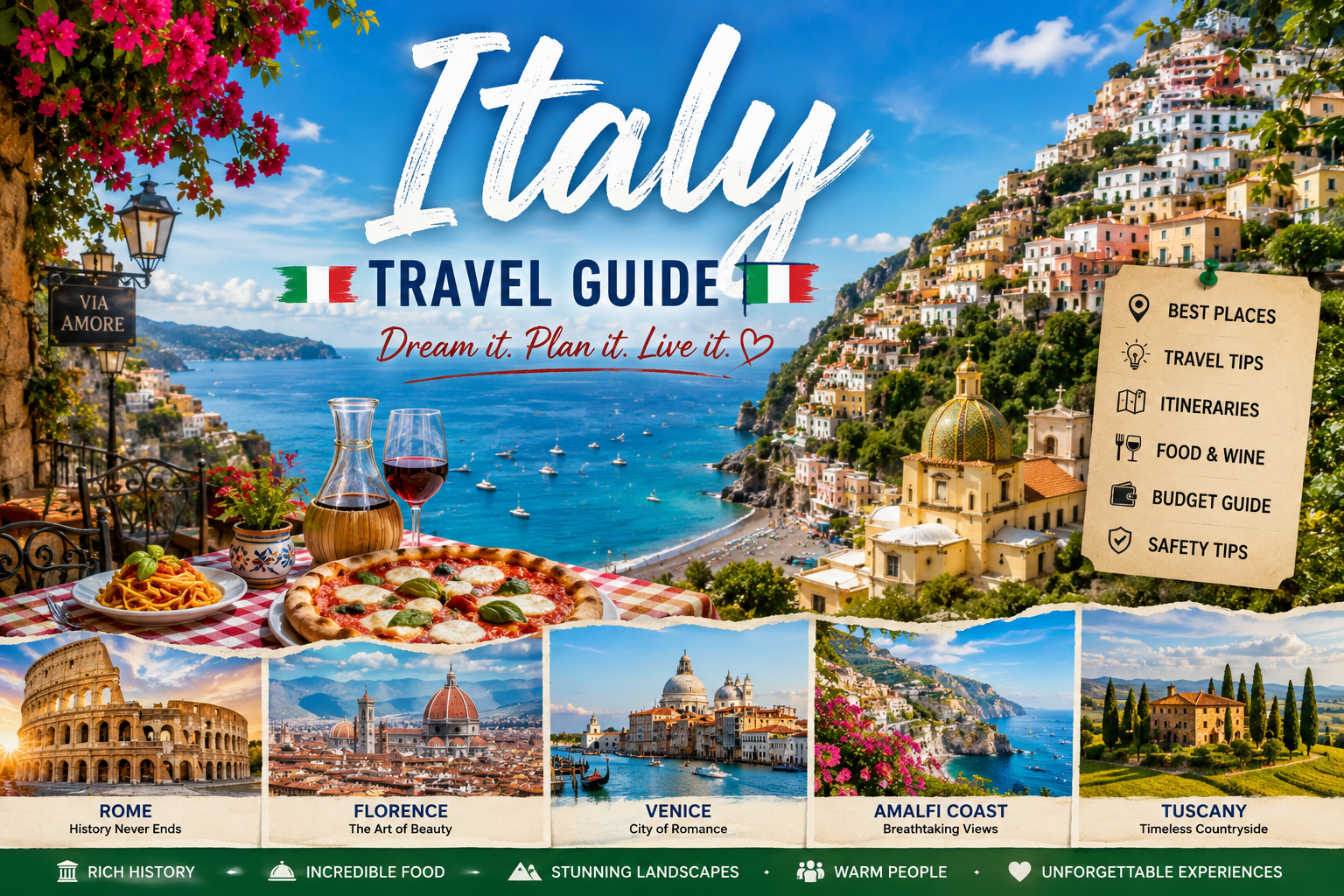
Rome is often the logical starting point for first-time Italy travel because it combines ancient history, art, architecture, food, religion, museums, neighborhoods, and modern city life.
The official Italian tourism portal describes Rome as a city where historical exploration is deeply embedded in the urban environment and highlights its connection with Vatican City.
Rome is not a city you should try to conquer in one day.
The historic center alone can absorb hours.
What to See in Rome
Major experiences include:
- Colosseum
- Roman Forum
- Pantheon
- Trevi Fountain
- Piazza Navona
- Vatican Museums
- St. Peter’s Basilica
- Trastevere
- Villa Borghese
- Capitoline Hill
- Spanish Steps
But the real strength of Rome is the space between the landmarks.
Walk.
Stop for coffee.
Explore a side street.
Visit a neighborhood market.
Eat a simple Roman pasta.
Watch evening life around a piazza.
That is how Rome becomes more than a list of monuments.
How Long Should You Stay in Rome?
For a first visit, three to four full days is a practical starting point.
Two days can cover the major highlights, but the schedule will be demanding.
Five or more days allow you to slow down and explore neighborhoods and less obvious attractions.
Florence
Florence is one of the world’s most important destinations for Renaissance art and architecture.
The city is compact compared with Rome, which makes it particularly attractive for travelers who enjoy walking.
The official Italian tourism network identifies Florence as one of Italy’s major destinations for sustainable tourism and highlights its art, historic center, craftsmanship, food, wine, and relationship with the Tuscan countryside.
Why Visit Florence?
Florence works especially well for:
- art lovers
- architecture enthusiasts
- couples
- photographers
- history travelers
- food travelers
- short city breaks
Florence Highlights
Consider:
- Uffizi Gallery
- Accademia Gallery
- Florence Cathedral
- Ponte Vecchio
- Piazza della Signoria
- Palazzo Vecchio
- Boboli Gardens
- Oltrarno
- Piazzale Michelangelo
One of Florence’s greatest advantages is its scale.
You can experience major cultural attractions without constantly relying on public transportation.
Venice
Venice is unlike almost any other major tourist destination.
Its canals, bridges, historic architecture, islands, and unusual urban design create an experience that cannot easily be replicated elsewhere.
But Venice requires strategic timing.
The most famous areas can become intensely busy.
How to Experience Venice Better
Wake early.
Walk before the busiest period.
Explore beyond the main tourist corridors.
Consider visiting smaller islands such as Murano or Burano.
Stay overnight if your budget allows.
Venice becomes a different city after many day visitors leave.
Venice Beyond the Photograph
The biggest mistake is treating Venice as a backdrop.
Its architecture, water system, neighborhoods, churches, workshops, markets, and maritime history deserve attention.
The slower you explore, the more interesting it becomes.
Milan
Milan is Italy’s modern, commercial, design, and fashion powerhouse.
It is especially attractive for:
- fashion travelers
- shopping
- architecture
- business travel
- contemporary art
- design
- food
- football
The city also works well as a gateway to northern Italy.
From Milan, travelers can reach destinations around the Italian Lakes and other northern regions.
Milan Highlights
Consider:
- Duomo di Milano
- Galleria Vittorio Emanuele II
- Brera
- Navigli
- Sforza Castle
- La Scala
- modern Porta Nuova
- fashion districts
Milan is a good example of why Italy should not be reduced to ancient history.
It represents another side of the country.
Naples
Naples offers a more energetic and sometimes chaotic experience.
Its historic center, food culture, waterfront, architecture, and proximity to major archaeological and coastal attractions make it an important southern base.
The official Italian tourism portal highlights Naples as a cultural hub shaped by centuries of interaction among different peoples and points to its food, historic center, architecture, and natural setting.
Why Visit Naples?
Naples is ideal for travelers interested in:
- pizza
- archaeology
- southern Italian culture
- street life
- history
- day trips
- Mount Vesuvius
- Pompeii
Naples can feel more intense than Florence or northern Italian cities.
That is part of its character.
The Amalfi Coast
The Amalfi Coast is one of Italy’s most famous coastal areas.
Its dramatic cliffs, colorful villages, Mediterranean scenery, and winding roads create an extraordinary landscape.
But the destination comes with practical challenges.
What Makes the Amalfi Coast Difficult?
During peak periods, travelers may encounter:
- traffic
- crowded buses
- expensive accommodation
- limited parking
- narrow roads
- difficult luggage transfers
- high demand for ferries and tours
The solution is not necessarily to avoid it.
Instead, plan carefully.
Amalfi Coast Strategy
Consider staying in a location that fits your itinerary rather than simply choosing the most famous village.
Use boats where practical.
Avoid trying to drive everywhere during peak periods.
Travel outside the busiest months when your schedule allows.
And do not assume that a short geographic distance means a short travel time.
Cinque Terre
Cinque Terre consists of five coastal villages connected by hiking routes and railway connections.
The destination is especially appealing to:
- photographers
- hikers
- couples
- coastal travelers
- short-break visitors
Its compact appearance on a map can be misleading.
Terrain matters.
Walking between villages can involve significant elevation changes.
If mobility is a concern, use trains and research accessibility before planning long hikes.
Tuscany
Tuscany is not simply Florence.
The countryside is an attraction in itself.
Think:
- vineyards
- olive groves
- hill towns
- farmhouses
- rural roads
- historic villages
- wineries
- local food
Tuscany is ideal for slower travel.
Instead of moving hotels every night, consider staying in one base and exploring outward.
Tuscany for Couples
A countryside stay can provide:
- scenic breakfasts
- vineyard visits
- long lunches
- sunset drives
- village walks
- wine experiences
Tuscany for Families
Look for:
- farm stays
- swimming pools
- larger rooms
- outdoor space
- easy parking
The countryside often provides more flexibility than dense city centers.
Sicily
Sicily deserves its own trip.
Trying to fit Sicily into a short mainland Italy itinerary can create unnecessary travel fatigue.
The island combines:
- ancient Greek heritage
- Roman archaeology
- Baroque towns
- beaches
- mountains
- volcanoes
- distinctive food
- multicultural history
Palermo
Palermo provides an introduction to Sicily’s complex cultural history.
Catania
Catania works well as a base for exploring eastern Sicily and Mount Etna.
Taormina
Taormina offers dramatic scenery and a strong tourism infrastructure.
Syracuse
Syracuse combines archaeological heritage with coastal atmosphere.
Agrigento
The Valley of the Temples provides one of Sicily’s major archaeological experiences.
Sicily is particularly rewarding for travelers who have already experienced Italy’s classic northern and central route.
Puglia
Puglia is an increasingly attractive option for travelers seeking a slower southern Italian experience.
The region is known for:
- whitewashed towns
- trulli
- olive groves
- beaches
- local food
- historic architecture
- coastal landscapes
The Italian Ministry of Tourism has specifically highlighted southern Italy and Puglia’s growth and emphasized the importance of diversifying tourism beyond beach travel and encouraging more year-round visitation.
That makes Puglia particularly interesting for travelers who want to go beyond the traditional Rome-Florence-Venice circuit.
Sardinia
Sardinia is a strong choice for travelers primarily interested in beaches and Mediterranean landscapes.
But the island offers more than beaches.
You can also explore:
- mountain landscapes
- archaeological sites
- villages
- local food
- coastal hiking
- traditional culture
For a beach-focused trip, Sardinia can be a better choice than trying to combine several major cities with short beach stops.
The Italian Lakes
Northern Italy’s lakes provide a different type of travel experience.
Lake Como, Lake Garda, and Lake Maggiore are particularly well known.
They work well for:
- couples
- luxury travelers
- photographers
- outdoor enthusiasts
- relaxed vacations
Lake travel is often slower than city travel.
That is a feature, not a weakness.
The Dolomites
Travelers interested in mountains should consider the Dolomites.
The region is excellent for:
- hiking
- skiing
- photography
- scenic drives
- mountain villages
- outdoor adventures
A major advantage of Italy is that you can combine mountain travel with urban culture within the same national trip.
Best Time to Visit Italy
There is no universal best month.
The best time depends on where you are going and what you want to do.
Spring
Spring can provide an excellent balance of:
- pleasant temperatures
- blooming landscapes
- longer days
- cultural sightseeing
- fewer extreme summer conditions
It is particularly attractive for city travel and countryside exploration.
Summer
Summer is popular because of school holidays and beach travel.
It can be excellent for:
- coastal destinations
- islands
- mountain trips
- outdoor evenings
But major tourist cities can be extremely busy.
Heat can also affect sightseeing.
Summer Strategy
Start sightseeing early.
Take a midday break.
Return to outdoor attractions later in the day.
Book important attractions ahead.
Drink water regularly.
Autumn
Autumn is one of the most interesting periods for Italy travel.
It can offer:
- comfortable temperatures
- harvest experiences
- food festivals
- wine tourism
- fewer peak-season crowds in some areas
Winter
Winter is excellent for travelers who enjoy:
- Christmas markets
- museums
- city breaks
- skiing
- lower-season travel
- festive atmosphere
Some coastal destinations become much quieter.
That can be either an advantage or disadvantage depending on your expectations.
Why Shoulder Season May Be the Smartest Choice
Italy’s tourism industry is actively emphasizing year-round travel.
Official Ministry of Tourism data showed positive growth during traditionally quieter months, and the government has allocated €109 million toward projects designed to promote year-round tourism, digital innovation, energy efficiency, and less congested travel periods.
This is important for travelers.
Shoulder season can potentially provide a better balance between:
weather + availability + price + crowd levels
rather than maximizing one factor.
How to Plan an Italy Travel Itinerary
The most common itinerary mistake is trying to see too much.
A traveler might plan:
Rome → Florence → Venice → Milan → Cinque Terre → Amalfi → Naples → Sicily
in ten days.
That is not a vacation.
It is a transportation project.
A Better Rule
Think in terms of travel clusters.
For example:
Rome + Florence + Venice
is a coherent first-time route.
Or:
Naples + Pompeii + Amalfi Coast
is a strong southern route.
Or:
Milan + Lake Como + Dolomites
creates a northern itinerary.
Or:
Palermo + Agrigento + Catania + Syracuse
can become a dedicated Sicily journey.
A 7-Day Italy Itinerary
For first-time visitors, a week can work well if you stay focused.
Days 1–3: Rome
Explore ancient Rome, Vatican City, historic neighborhoods, and local food.
Days 4–5: Florence
Travel by train and explore Florence’s historic center and major museums.
Days 6–7: Venice
Finish with Venice and allow time for slower exploration.
This route is compact enough to be realistic while still introducing three very different Italian cities.
A 10-Day Italy Itinerary
A ten-day trip provides more flexibility.
One option is:
Rome → Florence → Tuscany → Venice
This adds countryside time without creating excessive transportation.
Another option:
Rome → Naples → Amalfi Coast → Florence
This route emphasizes southern Italy and central Italy.
The correct choice depends on your priorities.
A 14-Day Italy Itinerary
Two weeks allow you to add more depth.
Possible route:
Rome → Florence → Tuscany → Venice → Milan → Lake Como
Or:
Rome → Naples → Amalfi Coast → Florence → Venice
Or:
Rome → Florence → Sicily
The third option involves more transportation but can work if Sicily is a major priority.
Italy by Train: One of the Best Ways to Travel
Rail travel is one of Italy’s major advantages.
High-speed trains connect major cities, making it possible to travel between major destinations without relying entirely on cars.
For city-to-city travel, trains can often be more convenient than flying because you avoid airport transfers and lengthy airport procedures.
Why Train Travel Works
You can:
- arrive in city centers
- avoid parking
- work or relax during travel
- carry luggage more easily than on some flights
- combine multiple cities efficiently
When a Car Makes More Sense
A rental car becomes more useful when exploring:
- rural Tuscany
- countryside villages
- parts of Puglia
- remote mountain regions
- areas with limited public transport
The important distinction is:
Do not rent a car simply because you are traveling in Italy.
Rent one because your specific route requires it.
Driving in Italy: What Travelers Should Know
Driving can be enjoyable, but cities are not always the ideal place to drive.
Historic centers may have restricted traffic zones.
Parking can be difficult.
Roads can be narrow.
Coastal roads can be challenging.
Better Strategy
Use trains between major cities.
Rent a car only for countryside sections.
Return the car before entering a major city when practical.
This reduces both cost and stress.
Italian Food: A Journey Within the Journey
Food may be one of the strongest reasons to travel through Italy.
But there is a major misconception:
There is no single Italian cuisine.
Italy has regional food traditions.
Roman Food
Look for dishes such as:
- carbonara
- cacio e pepe
- amatriciana
- supplì
Neapolitan Food
Think:
- pizza
- seafood
- pasta dishes
- sfogliatella
Tuscan Food
Expect:
- hearty soups
- grilled meats
- beans
- rustic bread
- regional wines
Emilian Food
This region is famous for:
- pasta
- Parmigiano Reggiano
- balsamic traditions
- cured meats
- tortellini
Sicilian Food
Sicily adds:
- arancini
- cannoli
- seafood
- citrus
- pistachios
- eggplant-based dishes
The best Italy food experience comes from eating regionally.
How to Eat Like a More Informed Traveler
Do not spend every meal searching for the most famous restaurant.
Instead, ask:
What does this region produce?
What dishes are traditional here?
What do people eat at this time of day?
Which ingredients are local?
What is the seasonal specialty?
This approach turns eating into cultural exploration.
Italian Coffee Culture
Coffee is an important part of everyday life.
You do not need to become an expert.
Simply observe how locals order and consume coffee.
A quick espresso can be a social ritual rather than a long café session.
In tourist-heavy areas, prices and service models can differ significantly from neighborhood cafés.
Understanding basic local habits helps you avoid confusion.
Wine Travel in Italy
Italy’s wine regions offer enormous variety.
Travelers can explore:
- Tuscany
- Piedmont
- Veneto
- Sicily
- Puglia
- Friuli
- Alto Adige
A wine-focused itinerary should consider transportation carefully.
If you are tasting wine, avoid planning a self-drive day.
Use organized transport or arrange a driver.
Italy Travel on Different Budgets
Italy can be expensive, but it does not have to be inaccessible.
Your biggest cost drivers are usually:
- accommodation
- transportation
- dining
- attractions
- season
- destination
Budget Italy Travel
Budget travelers can save through:
- hostels
- guesthouses
- local restaurants
- supermarkets
- free walking routes
- public transportation
- shoulder-season travel
- advance booking
Budget Principle
Spend money on experiences that matter to you.
Save money on things that do not.
Mid-Range Italy Travel
Mid-range travelers have more flexibility.
You can combine:
- comfortable hotels
- trains
- paid museums
- occasional taxis
- local restaurants
- guided experiences
This is arguably the easiest category for Italy because it allows comfort without requiring luxury prices.
Luxury Italy Travel
Luxury travel in Italy can be highly experience-oriented.
Options include:
- boutique hotels
- luxury resorts
- private guides
- private transfers
- vineyard experiences
- yacht trips
- fine dining
- fashion experiences
- private cultural tours
The best luxury itinerary reduces friction.
You are paying less for “more things” and more for convenience, privacy, access, and time.
Italy Travel for Families
Families should resist the temptation to reproduce an adult itinerary.
Children may not appreciate six hours of churches and museums.
Instead, combine:
- major landmarks
- parks
- gelato stops
- interactive museums
- short walks
- open spaces
- family-friendly restaurants
Family Accommodation
Consider:
- family rooms
- apartments
- kitchen facilities
- laundry access
- elevators
- nearby grocery stores
Convenience often matters more than luxury.
Italy Travel for Couples
Italy is naturally suited to couples because of its:
- food
- scenery
- historic towns
- lakes
- vineyards
- coastal destinations
- cultural experiences
But romance does not require an expensive itinerary.
A simple countryside dinner can be more memorable than a luxury restaurant.
Good Couple Routes
Consider:
Florence + Tuscany
Milan + Lake Como
Rome + Amalfi Coast
Venice + Dolomites
The best choice depends on whether you want culture, scenery, food, or relaxation.
Italy Travel for Solo Travelers
Italy can work well for solo travelers because major cities are connected by rail and offer extensive tourism infrastructure.
Solo travelers should consider:
- central but safe accommodation
- walking tours
- group food experiences
- train travel
- hostels or social hotels
- smaller group excursions
Avoid building a schedule that leaves no time for spontaneous exploration.
Solo travel becomes more enjoyable when you allow yourself to change plans.
Italy Travel for Seniors
Older travelers should pay particular attention to:
- stairs
- cobblestones
- hotel elevators
- train station access
- walking distances
- heat
- luggage
A slower itinerary is often a better itinerary.
Instead of three cities in five days, consider two.
Quality beats quantity.
Italy Travel for Muslim and Halal Travelers
Italy has a growing range of international dining options, particularly in major cities.
Travelers seeking halal food should research restaurants in advance and confirm current halal practices directly with the establishment.
Large cities such as Rome, Milan, Florence, and Naples generally provide more international dining choices than small rural towns.
Travelers should also consider prayer facilities and access to suitable food when planning longer countryside routes.
Italy Travel Safety
Italy is generally a major international tourist destination with extensive tourism infrastructure, but travelers should still use ordinary precautions.
Protect Your Belongings
Be especially attentive in:
- crowded train stations
- busy public transport
- major tourist attractions
- crowded squares
- large events
Keep Documents Secure
Carry copies of important documents separately from the originals.
Use Official Transport
Use recognized taxi and transport services.
Be Careful With Unofficial Offers
If someone aggressively approaches you offering transportation, tours, tickets, or other services, verify the provider before paying.
Watch Your Luggage
Do not leave bags unattended in stations, restaurants, or public spaces.
Italy Travel and Visa Considerations
Visa requirements depend on your nationality, passport, residence status, and purpose of travel.
Travelers should always verify requirements using official government or European Union sources before booking non-refundable arrangements.
For visa-exempt travelers entering the relevant European countries, the EU’s ETIAS system is scheduled to begin operations in the last quarter of 2026. The official EU site states that ETIAS will apply to visa-exempt nationals traveling for short stays and generally permits stays of up to 90 days in a 180-day period.
The exact implementation date should be checked before travel because European entry systems can change.
Do not rely on an old blog post for immigration rules.
How to Avoid Italy Travel Mistakes
Mistake: Trying to Visit Too Many Cities Italy travel
The most common problem is overplanning.
Solution Italy travel
Choose two or three major bases and explore nearby areas from them.
Mistake: Visiting Only Famous Attractions Italy travel
Famous attractions are worth visiting, but they are not the whole country.
Solution Italy travel
Add neighborhoods, markets, local restaurants, parks, villages, and smaller cultural sites.
Mistake: Visiting Italy Only in Peak Summer Italy travel
Summer can be wonderful, but it can also mean intense heat and heavy demand.
Solution Italy travel
Consider spring or autumn when suitable for your destination.
Mistake: Renting a Car for the Whole Trip Italy travel
Cars can create unnecessary problems in major cities.
Solution Italy travel
Use trains between major urban centers and rent a car only where useful.
Mistake: Booking Every Night in a Different City Italy travel
Frequent hotel changes consume time.
Solution Italy travel
Stay multiple nights in each base.
Mistake: Ignoring Local Travel Time Italy travel
A destination may appear close on a map but require a complicated route.
Solution Italy travel
Research actual door-to-door travel time.
Mistake: Eating Only Near Tourist Attractions Italy travel
Restaurants beside famous monuments often compete primarily for tourist traffic.
Solution Italy travel
Walk into residential neighborhoods and research local dining areas.
Mistake: Planning Every Minute Italy travel
Unexpected discoveries are part of Italy.
Solution Italy travel
Leave empty blocks in your schedule.
Mistake: Assuming Every Region Feels the Same Italy travel
Italy is culturally diverse.
Solution Italy travel
Treat each region as its own travel experience.
Mistake: Ignoring Sustainable Travel Italy travel
Overcrowded destinations can experience pressure on infrastructure and local communities.
Solution Italy travel
Travel during less congested periods, use public transport where practical, stay longer, and explore secondary destinations.
Italy’s official sustainable tourism network currently focuses on Milan, Venice, Florence, Rome, and Naples, with an emphasis on balancing tourism’s economic and cultural benefits with environmental and heritage protection.
Pros and Cons of Italy Travel
Advantages Italy travel
Italy offers:
- extraordinary historical heritage
- world-class art
- regional cuisines
- excellent major-city rail connections
- diverse landscapes
- beaches
- mountains
- islands
- wine regions
- romantic destinations
- family-friendly experiences
- luxury tourism
- budget possibilities
- year-round travel opportunities
Challenges Italy travel
Travelers may encounter:
- peak-season crowds
- expensive accommodation in popular areas
- heat during summer
- transportation disruptions
- complicated driving conditions
- steep terrain
- tourist traps
- long museum queues
- regional differences
- accommodation availability issues
The solution is not to eliminate these challenges.
It is to plan around them.
Ten Travel Brands and Platforms to Compare for Italy
Different travel platforms solve different problems. Rather than choosing one “best” brand, compare them according to what you need.
| Brand | Best For | Main Strength | Potential Limitation | Best For |
|---|---|---|---|---|
| Booking.com | Hotels | Huge accommodation selection | Property policies vary | General travelers |
| Expedia | Travel packages | Flights and hotels together | Package value varies | Convenience-focused travelers |
| Airbnb | Apartments and homes | Longer stays and local-style accommodation | Quality varies by property | Families and groups |
| Hostelworld | Hostels | Strong budget and social inventory | Less useful for luxury travel | Solo travelers |
| GetYourGuide | Tours | Broad activity selection | Tour quality varies | First-time visitors |
| Viator | Experiences | Wide tour marketplace | Compare inclusions carefully | Experience seekers |
| Tripadvisor | Research | Large review database | Reviews need context | Research-focused travelers |
| Google Maps | Navigation | Maps and local discovery | Business information can change | Almost everyone |
| Rome2Rio | Transport planning | Compares transport options | Verify final schedules and fares | Multi-city travelers |
| Lonely Planet | Destination research | Established travel editorial content | Current details should be verified | Independent travelers |
The key lesson is that no single platform should be treated as the entire travel-planning system.
Use maps for navigation.
Use booking platforms for accommodation.
Use official sources for entry requirements.
Use transport operators for final schedules.
Use reviews for opinions rather than absolute truth.
Italy Travel by Problem-Solving Need
A strong Italy itinerary should solve a specific travel problem.
Italy Travel for First-Time Visitors
Focus on:
- Rome
- Florence
- Venice
- high-speed trains
- major attractions
- basic Italian phrases
- food
- neighborhoods
Avoid adding too many destinations.
Italy Travel for Short Trips
Choose one region.
A three-day trip to Rome is better than a three-day attempt to see all of Italy.
Italy Travel for Budget Travelers
Consider:
- hostels
- local eateries
- public transportation
- free attractions
- shoulder season
- longer stays in fewer locations
Italy Travel for Luxury Travelers
Prioritize:
- boutique hotels
- private transfers
- private guides
- vineyard experiences
- premium dining
- scenic resorts
Italy Travel for Food Lovers
Build the route around regions.
For example:
Bologna → Parma → Modena
creates a very different trip from:
Naples → Palermo → Catania
Italy Travel for Outdoor Travelers
Consider:
- Dolomites
- Italian Lakes
- Alps
- Sardinia
- Sicily
- coastal hiking
- Tuscan countryside
Italy Travel and the Rise of Sustainable Tourism
One of the most important changes in modern Italian tourism is the shift from simply attracting more visitors toward managing where and when visitors travel.
Italy’s Ministry of Tourism has been supporting initiatives designed to encourage tourism throughout the year, reduce seasonal pressure, improve energy efficiency, and introduce digital innovation into tourism businesses.
This matters to travelers because the future of Italy travel may increasingly involve:
- secondary destinations
- shoulder-season travel
- longer stays
- regional experiences
- public transportation
- locally owned businesses
- smaller towns
- countryside tourism
Travelers can benefit from this shift too.
Instead of standing in a huge summer crowd at a famous landmark, you may discover a quieter historic town with excellent food and a stronger sense of place.
Italy Travel and the Made in Italy travel Experience
Italy’s international appeal is not limited to tourism.
Fashion, design, food, furniture, craftsmanship, automotive heritage, and lifestyle all contribute to the country’s global identity.
Italy’s Ministry of Tourism reported in 2026 that Made in Italy-related tourism generated an estimated €13.9 billion in tourism spending, including €3.3 billion from the luxury segment, and said that more than 42% of international tourists identified Made in Italy as a travel motivation.
This explains why Italy is particularly powerful for travelers interested in:
- fashion
- design
- food
- shopping
- craftsmanship
- luxury
- architecture
A traveler can therefore build an Italy itinerary around interests rather than geography alone.
How Technology Is Changing Italy Travel
Travel planning has become increasingly digital.
Visitors can use smartphones for:
- train tickets
- hotel bookings
- digital maps
- translation
- attraction reservations
- restaurant discovery
- weather
- payment
- travel documentation
Artificial intelligence can also help travelers create personalized routes.
But technology should not replace official verification.
For example, an AI tool might suggest that a museum is open every Monday because that was historically true.
The official museum website may now say otherwise.
The safest workflow is:
Discover with technology → verify with official sources → travel with flexibility.
The Future of Italy Travel
Italy’s tourism future is likely to be shaped by several major trends.
More Year-Round Travel Italy travel
Official tourism data already shows strong growth outside the traditional summer period. The Ministry reported that January 2026 arrivals increased 4.28% and overnight stays increased 6.07% compared with January 2025.
This suggests that travelers are increasingly comfortable visiting Italy beyond peak summer.
Greater Interest in Southern Italy
Southern destinations are receiving increasing attention.
Puglia, Calabria, Sicily, Campania, and Basilicata offer opportunities for travelers seeking alternatives to the classic northern route.
The Ministry has specifically described southern Italy as an important growth asset and highlighted diversification beyond beach tourism.
More Personalized Trips Italy travel
Instead of generic “Italy in seven days” packages, travelers will increasingly create trips around:
- food
- fashion
- art
- hiking
- wine
- beaches
- family
- wellness
- architecture
- photography
The destination becomes personalized around the traveler.
Climate-Aware Planning Italy travel
Heat, rainfall, drought, wildfires, and changing weather patterns can influence travel decisions.
Future Italy guides will likely provide more practical seasonal planning rather than simply describing “high season” and “low season.”
Smart Tourism Infrastructure Italy travel
Italy is investing in tourism digitalization and energy efficiency.
The €109 million tourism measure announced in 2026 includes support for digitalization, automation, energy efficiency, renewable energy, and projects aimed at encouraging year-round tourism.
For travelers, this may eventually mean:
- smarter booking systems
- better visitor management
- improved infrastructure
- more efficient hotels
- better destination data
- more personalized services
A Practical Italy Travel Checklist
Before departure, review:
- passport validity
- visa or entry requirements
- travel insurance
- flights
- train reservations
- accommodation
- airport transfers
- attraction tickets
- local transport
- weather
- currency
- payment methods
- mobile data
- emergency contacts
- medication
- copies of documents
- restaurant reservations
- local customs
Do not wait until arrival to discover that your most important attraction requires advance booking.
Italy Travel Packing Tips
Packing depends heavily on the season and itinerary.
Essential Items Italy travel
Bring:
- comfortable walking shoes
- lightweight layers
- weather-appropriate clothing
- compact day bag
- reusable water bottle
- universal travel adapter
- power bank
- required medications
- copies of important documents
If Visiting Cities Italy travel
Comfortable shoes are particularly important.
Historic centers can involve long walking days and uneven surfaces.
If Visiting the Coast
Add:
- sun protection
- swimwear
- lightweight clothing
- sandals
- small day bag
If Visiting the Mountains
Pack according to altitude and season rather than assuming the whole country has the same weather.
How to Make Italy Travel More Memorable
The most valuable Italy travel advice is simple:
Do less, but experience it better.
Instead of checking ten attractions off a list, choose three meaningful experiences.
Instead of changing hotels every night, stay longer.
Instead of only eating famous dishes, ask where the dish comes from.
Instead of photographing a neighborhood, walk through it.
Instead of treating transportation as dead time, watch the landscape change outside the train window.
Instead of spending every day in the busiest tourist center, explore the edges of the city.
This is how travel becomes a memory rather than a collection of photographs.
FAQs
What is the best time for Italy travel?
Spring and autumn are often excellent for comfortable sightseeing, while summer is popular for beaches and holidays. Winter can be attractive for cities, Christmas experiences, skiing, and quieter travel.
How many days are enough for Italy?
There is no universal number, but seven to ten days can provide a strong introduction if you focus on a small number of destinations. Two weeks allows significantly more regional depth.
What are the best places to visit in Italy for first-time travelers?
Rome, Florence, and Venice form one of the strongest classic routes. Travelers with more time can add Tuscany, Naples, the Amalfi Coast, Milan, or another region based on their interests.
Is Italy expensive to visit?
Italy can be expensive in major tourist destinations during peak periods, but travelers can reduce costs through shoulder-season travel, public transportation, local restaurants, budget accommodation, and fewer hotel changes.
Is Italy good for families?
Yes. Families can combine historic attractions with parks, beaches, interactive museums, food experiences, and countryside stays. The key is keeping the itinerary flexible.
Is Italy good for solo travelers?
Yes. Major cities have extensive tourism infrastructure and rail connections, and solo travelers can join walking tours, food experiences, group activities, or stay in social accommodation.
Is train travel better than driving in Italy?
For major cities, trains are often more convenient. Cars become more useful in rural areas, countryside destinations, and places with limited public transport.
Do I need a car in Rome?
Usually not for sightseeing within Rome. Public transportation and walking are generally more practical for visitors.
Should I rent a car in Tuscany?
A car can be useful for countryside exploration, vineyards, villages, and rural accommodation. It is less useful if you are spending most of your time in Florence.
Is Venice worth visiting?
Yes, particularly if you are interested in architecture, history, photography, canals, and unique urban environments. Visiting early or outside the busiest periods can improve the experience.
How long should I spend in Florence?
Two to three full days can provide a good first experience, while longer stays allow day trips and slower exploration.
Is the Amalfi Coast worth visiting?
Yes, but travelers should plan transportation, accommodation, and timing carefully because the area can become crowded and expensive during peak periods.
Is Sicily worth adding to a mainland Italy itinerary?
Sicily is worth visiting, but it often deserves its own dedicated trip or a substantial portion of a longer itinerary because the island is large and offers many different experiences.
What Italian food should travelers try?
Regional specialties are the best starting point. Try Roman pasta in Rome, pizza in Naples, Tuscan dishes in Tuscany, Emilia-Romagna’s pasta and food traditions, and Sicilian specialties in Sicily.
How can I avoid crowds in Italy?
Travel during shoulder seasons, start sightseeing early, stay overnight in destinations that receive many day visitors, explore less famous neighborhoods, and consider secondary destinations.
What should I know about Italy’s tourism trends?
Italy is actively promoting year-round tourism, sustainability, digital innovation, and broader distribution of tourism beyond the busiest destinations. Official 2026 data shows continued growth in arrivals and overnight stays.
Will ETIAS affect Italy travel?
For visa-exempt travelers who fall under the system, ETIAS is scheduled to begin operations in the last quarter of 2026. Travelers should check the official EU website for the actual launch date and current requirements before traveling.
Conclusion
Italy travel is more than visiting famous landmarks; it is an opportunity to experience history, art, food, nature, culture, and regional traditions in one remarkable journey. From the ancient streets of Rome and Renaissance treasures of Florence to the canals of Venice, dramatic Amalfi Coast, peaceful Tuscan countryside, and diverse landscapes of Sicily and Puglia, Italy offers something for almost every type of traveler. The best approach is to travel slowly, choose destinations that match your interests, and avoid overcrowding your itinerary. Use trains for major city connections, consider a car for rural areas, explore local cuisine, book popular attractions in advance, and travel during shoulder seasons when possible.