AI Agents: 25 Powerful Ways Intelligent Agents Are Changing Work, Business, and Everyday Life
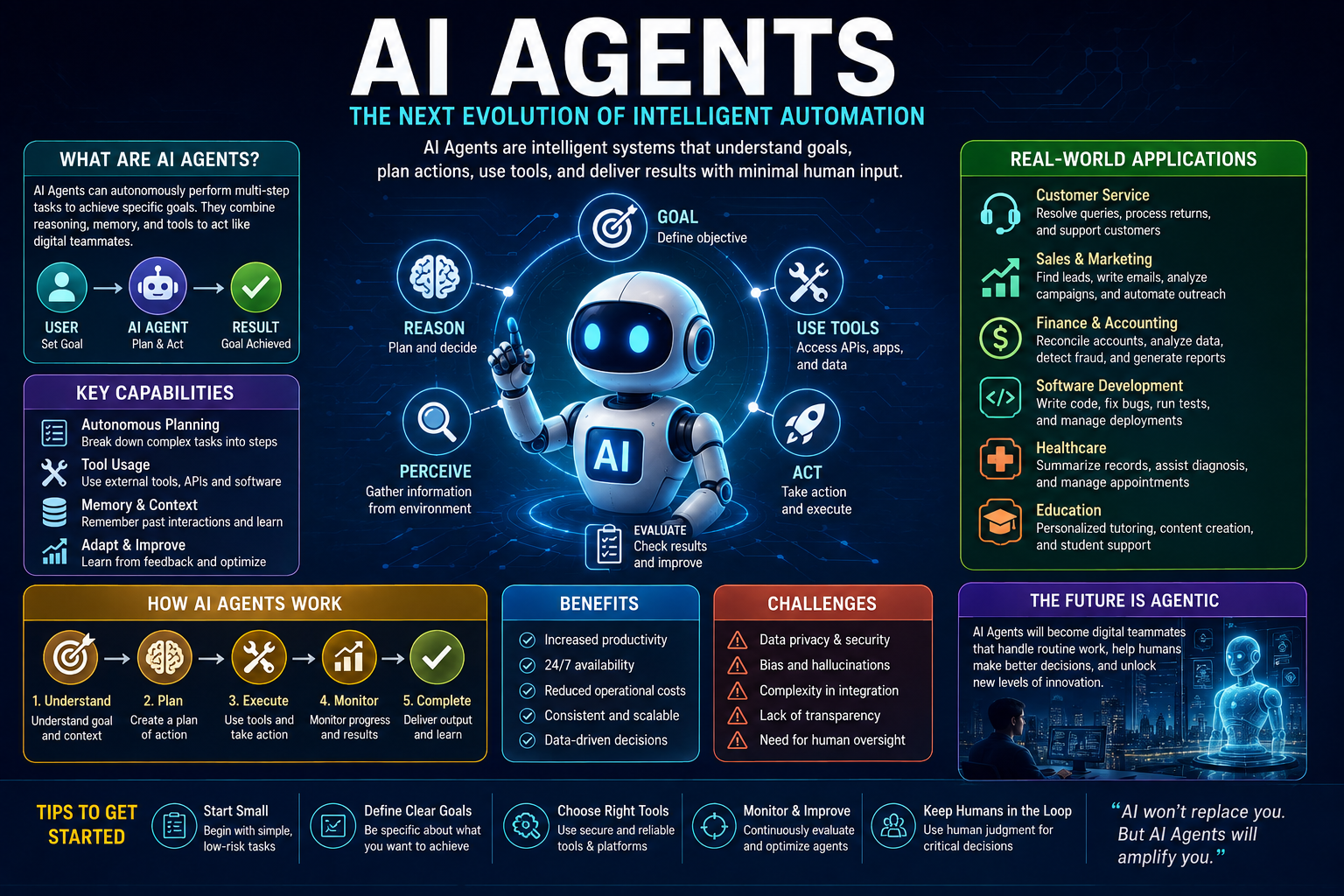
AI agents are intelligent software systems designed to pursue goals by reasoning through tasks, using tools, accessing information, making decisions within defined boundaries, and taking actions. Unlike traditional chatbots that mainly respond to prompts, AI agents can potentially manage multi-step workflows and continue working toward an objective with less human intervention Digital Verden
What Are AI Agents?
AI agents are software systems that use artificial intelligence to pursue a defined objective through a sequence of actions.
A typical agent can involve several components:
- A reasoning or language model
- Instructions or goals
- Memory or context
- Access to tools
- Data sources
- Planning mechanisms
- Action capabilities
- Feedback loops
- Safety controls
- Human approval mechanisms
A simple AI interaction looks like this:
User → Prompt → AI → Answer
An agentic interaction can look more like this:
Goal → Planning → Information gathering → Tool use → Action → Evaluation → Additional action → Result
This distinction is important.
An AI model may know how to write an email.
An AI agent may be able to determine that an email needs to be written, gather the relevant information, draft it, check the recipient, ask for approval, and then send it through an authorized system.
The agent is therefore not simply generating content.
It is participating in a workflow.
How AI Agents Differ From Traditional Chatbots
The words chatbot and AI agent are sometimes used interchangeably, but they describe different levels of capability.
Traditional Chatbots
A traditional chatbot generally:
- Receives a message
- Processes the message
- Generates a response
- Waits for the next message
This can be extremely useful.
Customer-service chatbots, FAQ systems, and AI assistants can answer questions quickly.
However, their operation is usually centered around conversation.
AI Agents
An AI agent is more action-oriented.
It may:
- Understand a goal
- Break a task into smaller steps
- Select tools
- Retrieve information
- Analyze results
- Make intermediate decisions
- Take actions
- Evaluate outcomes
- Continue until the objective is completed or human intervention is required
For example, an ordinary chatbot could answer:
“What are the best ways to reduce business travel expenses?”
An agent could potentially analyze an organization’s approved travel data, identify expensive patterns, compare policy compliance, prepare recommendations, and produce a management report.
The difference is not simply intelligence.
It is agency.
The Core Components of an AI Agent
Understanding the architecture behind AI agents makes the technology much easier to understand.
The Model
The model provides the intelligence used for reasoning, language understanding, planning, and decision-making.
Modern agents can use large language models or other specialized models.
The model does not necessarily perform every task itself.
Instead, it may decide which external capability should perform a task.
The Goal
An agent needs an objective.
Examples include:
- Resolve a customer request
- Research a market
- Prepare a report
- Monitor a system
- Schedule a meeting
- Analyze sales opportunities
- Test software
- Process a document
A poorly defined goal can produce poor results even when the underlying AI model is highly capable.
Tools
Tools give an agent the ability to interact with the outside world.
These can include:
- Search systems
- Databases
- Calculators
- APIs
- Email systems
- Calendars
- Business applications
- Code execution environments
- File systems
- Customer relationship management platforms
Without tools, an agent may be intelligent but limited.
With tools, it can potentially perform meaningful work.
Memory
Some agents maintain information across steps.
Memory can include:
- Current task context
- Previous actions
- User preferences
- Relevant documents
- Past interactions
- Intermediate results
Memory must be designed carefully.
More memory does not automatically mean a better agent.
Incorrect or outdated information can create persistent errors.
Planning
Planning allows an agent to divide a larger objective into smaller tasks.
For example:
Goal: Prepare a competitive market report.
Possible plan:
- Define the market.
- Identify competitors.
- Collect public information.
- Compare product offerings.
- Analyze pricing.
- Identify trends.
- Evaluate risks.
- Create a report.
- Check important claims.
- Present findings.
An advanced agent may revise the plan when new information changes the situation.
Feedback
Agents can use feedback to determine whether an action worked.
For example:
- Agent sends an API request.
- The API returns an error.
- Agent identifies the error.
- Agent modifies the request.
- Agent tries again.
- Agent confirms the result.
This creates an iterative loop.
How AI Agents Work Step by Step
A simplified agent workflow can be understood in eight stages.
Step 1: Receive the Objective
The user or system provides a goal.
Example:
“Prepare a weekly sales summary.”
Step 2: Understand the Context
The agent determines:
- What information is available?
- What systems can it access?
- What constraints exist?
- What output is required?
Step 3: Create a Plan
The agent determines the steps needed.
Step 4: Select Tools
It may choose:
- Database access
- Spreadsheet analysis
- CRM information
- Web research
- Reporting software
Step 5: Execute Actions
The agent performs authorized tasks.
Step 6: Evaluate Results
It checks whether the information or result makes sense.
Step 7: Correct or Continue
If something is missing or incorrect, it may perform another step.
Step 8: Deliver the Result
The final output may be:
- A report
- A completed workflow
- A recommendation
- A message
- A database update
- A software change
- A human approval request
Types of AI Agents
There is no single universal classification, but several categories are useful.
Reactive AI Agents
These respond directly to current input.
They have limited memory and planning.
They are useful for:
- Simple automation
- FAQ systems
- Basic support
- Rule-based decisions
Goal-Based Agents
These work toward a specific objective.
They may plan multiple steps rather than simply reacting.
Planning Agents
These explicitly break large objectives into smaller tasks.
They can be useful for:
- Research
- Project management
- Complex workflows
Tool-Using Agents
These can interact with external tools.
This category is particularly important because tool access turns an AI model from a conversational system into something closer to an operational system.
Multi-Agent Systems
A multi-agent system uses several specialized agents.
For example:
- Research agent
- Data analysis agent
- Writing agent
- Quality-control agent
One agent might gather information while another analyzes it.
Autonomous Agents
Autonomous agents are designed to operate with less direct human instruction.
The word “autonomous” should be used carefully.
Real-world systems generally need boundaries.
An agent allowed to make unlimited decisions can create unacceptable risks.
AI Agents vs AI Assistants
An AI assistant generally helps a human perform tasks.
An AI agent may be designed to perform tasks on the human’s behalf.
For example:
Assistant: “Here are three flight options.”
Agent: “I found three options that match your requirements and prepared the preferred itinerary for your approval.”
The difference can be subtle.
The real dividing line is the level of initiative and action.
AI Agents vs Automation
Traditional automation follows predefined rules.
For example:
When an invoice arrives → extract the amount → save it → notify accounting.
An AI agent can potentially handle situations where the exact workflow is not known in advance.
For example:
“Review incoming supplier documents and determine what needs attention.”
The agent may need to interpret different document formats, identify unusual terms, compare information, and decide what should be escalated.
Traditional automation is predictable.
Agentic automation is more flexible.
That flexibility is also what makes agentic systems harder to control.
Why AI Agents Are Becoming Important
Several technology trends are converging.
Better AI Models
Modern AI systems can understand complex instructions, analyze documents, write code, interpret images, and reason through many types of problems.
Better Tool Integration
Software systems increasingly expose APIs and structured interfaces that allow AI systems to perform actions.
Lower AI Costs
As AI infrastructure becomes more efficient, organizations can experiment with larger numbers of AI-powered workflows.
Improved Context Handling
Agents can work with larger amounts of information than many earlier AI systems.
Business Demand for Automation
Organizations want to increase productivity without necessarily increasing headcount at the same rate.
Together, these factors create an environment in which AI agents become increasingly practical.
AI Agents in Business
Business automation is one of the most important applications.
A company has hundreds or thousands of processes.
Many contain repetitive digital work.
Examples include:
- Reading emails
- Updating databases
- Preparing reports
- Checking documents
- Scheduling meetings
- Summarizing customer interactions
- Reviewing invoices
- Researching prospects
- Preparing proposals
AI agents can potentially coordinate several of these steps.
AI Agents for Customer Service
Customer support is an obvious application.
An agent can potentially:
- Receive a customer question.
- Identify the customer’s account.
- Search approved documentation.
- Understand the problem.
- Check relevant records.
- Suggest a solution.
- Perform an authorized action.
- Escalate complex cases.
This could reduce the number of simple cases requiring human intervention.
Why Human Escalation Matters
Not every customer issue should be automated.
Sensitive situations involving:
- Refund disputes
- Legal concerns
- Financial decisions
- Medical issues
- Account security
may require human involvement.
A strong system does not attempt to automate everything.
It knows when to stop.
AI Agents in Marketing
Marketing involves many repetitive research and operational tasks.
Agents could potentially help with:
- Keyword research
- Competitor analysis
- Content planning
- Audience research
- Campaign monitoring
- Performance reporting
- Social media workflows
- Email campaign preparation
An agent could monitor a campaign and identify changes that deserve attention.
However, automated content production should not replace editorial judgment.
Quality, originality, accuracy, and brand identity still require human oversight.
AI Agents in Sales
Sales teams often spend significant time researching prospects and updating systems.
Agents could potentially:
- Research companies
- Identify relevant contacts
- Summarize company information
- Prepare meeting briefs
- Draft outreach
- Update CRM records
- Analyze sales opportunities
- Recommend follow-up actions
The most valuable use may be reducing administrative work so salespeople can spend more time speaking with customers.
AI Agents in Finance
Finance departments handle structured information, making some processes suitable for automation.
Possible applications include:
- Invoice processing
- Expense categorization
- Financial reporting
- Reconciliation support
- Fraud monitoring
- Budget analysis
- Document review
But financial systems require strict controls.
An agent should not have unrestricted authority over money simply because it can technically access a financial system.
AI Agents in Human Resources
HR departments may use agents for:
- Employee questions
- Policy search
- Interview scheduling
- Document processing
- Onboarding workflows
- Training recommendations
However, hiring and employment decisions can involve sensitive personal information and fairness concerns.
AI should therefore support decision-making without becoming an invisible decision-maker.
AI Agents in Software Development
Software engineering may be one of the most significant areas for agentic AI.
AI coding systems can already assist with:
- Code generation
- Debugging
- Testing
- Documentation
- Refactoring
- Code review
- Repository exploration
Agentic systems can potentially take this further.
Example Development Workflow
A developer could specify:
“Add user authentication to this application.”
An agent might:
- Inspect the codebase.
- Identify the architecture.
- Determine affected files.
- Write code.
- Add tests.
- Run the tests.
- Diagnose failures.
- Modify the implementation.
- Run tests again.
- Prepare a change for human review.
This does not mean developers become unnecessary.
Instead, the role may shift toward architecture, review, security, product thinking, and system design.
AI Agents for Research
Research is naturally multi-step.
A research agent could potentially:
- Define a research question
- Search approved sources
- Collect information
- Compare claims
- Organize evidence
- Identify contradictions
- Produce a structured report
The challenge is verification.
An AI agent that confidently produces an incorrect research report can be more dangerous than one that simply says “I don’t know.”
Human verification remains important for high-stakes research.
AI Agents in Education
Educational agents could act as:
- Tutors
- Study planners
- Research assistants
- Writing coaches
- Language practice partners
A student might say:
“I have an exam in two weeks. Create a study plan based on these topics.”
The agent could organize:
- Daily lessons
- Practice questions
- Revision sessions
- Progress checks
- Weak-topic reviews
The best educational agents should help students learn, not simply give them answers.
AI Agents in Healthcare
Healthcare offers enormous potential but also some of the highest risks.
Possible uses include:
- Administrative workflows
- Medical literature research
- Documentation
- Scheduling
- Patient communication
- Data analysis
- Clinical decision support
Why Healthcare Requires Extra Caution
Healthcare decisions can affect people’s lives.
AI systems need:
- Clinical validation
- Privacy controls
- Human oversight
- Clear accountability
- Appropriate regulatory compliance
A medical AI agent should not be treated like a casual consumer chatbot.
AI Agents in Travel
Travel is another area where agents could become highly useful.
Instead of searching separately for every part of a trip, a traveler could provide:
- Destination
- Budget
- Dates
- Preferences
- Transportation needs
An agent could potentially:
- Research options
- Compare schedules
- Build an itinerary
- Track changes
- Organize reservations
- Recommend alternatives
The important change is moving from searching for information to delegating travel planning.
AI Agents in Logistics
Logistics involves complex decisions.
Agents could potentially optimize:
- Delivery schedules
- Inventory
- Routing
- Supplier communication
- Shipment tracking
- Exception handling
For example, if a shipment is delayed, an agent could identify the affected orders, evaluate alternative transportation options, and prepare recommendations.
AI Agents in Cybersecurity
Cybersecurity may become increasingly agentic.
An AI security agent could monitor:
- Network events
- Login behavior
- System activity
- Alerts
- Vulnerability information
It could potentially investigate suspicious events and recommend or execute predefined responses.
The Security Paradox
AI can strengthen cybersecurity.
AI can also strengthen cyberattacks.
Attackers may use AI for:
- Social engineering
- Automated reconnaissance
- Malicious code generation
- Phishing
- Fraud
Defenders therefore need strong controls around their own AI agents.
AI Agents and Personal Productivity
AI agents may become personal digital workers.
Imagine an agent that manages:
- Calendar
- Reminders
- Notes
- Travel planning
- Personal research
- Document organization
Instead of opening ten applications, you could communicate your objective through one interface.
The Personal AI Operating Layer
A long-term possibility is that AI becomes an orchestration layer across personal software.
Instead of:
Person → App → App → App → App
the workflow could become:
Person → AI agent → Multiple authorized services
This could significantly change how software interfaces are designed.
AI Agents and Small Businesses
Small businesses may benefit disproportionately from AI agents.
A large company can hire specialists for:
- Accounting
- Marketing
- Customer service
- Research
- Sales operations
- IT support
A small company may not have the budget for all of them.
AI agents could provide some capabilities at a lower operational cost.
This could allow small teams to compete with larger organizations.
However, small businesses should be careful about data privacy and vendor dependence.
AI Agents and Freelancers
Freelancers could use agents to reduce administrative work.
Potential tasks include:
- Lead research
- Proposal preparation
- Meeting summaries
- Invoice organization
- Client communication
- Project planning
- Content research
The strongest strategy is not to let AI replace the freelancer’s expertise.
It is to let AI handle low-value administrative work while the freelancer focuses on specialized output.
AI Agents and Creators
Creators can use AI agents for:
- Research
- Content planning
- Trend monitoring
- Editing workflows
- Asset organization
- Audience analysis
But creative differentiation still depends heavily on human taste.
If everyone uses similar agents with similar instructions, content can become increasingly repetitive.
The competitive advantage may therefore move toward unique perspectives and original information.
Ten Major AI Agent and AI Ecosystem Brands
The following companies are important players in different parts of the AI ecosystem. Their products, capabilities, and strategies evolve quickly, so they should not be treated as permanent rankings.
| Brand | Major AI Focus | Agentic Potential | Best Known For |
|---|---|---|---|
| OpenAI | Advanced AI models and agentic systems | High | General-purpose AI and developer ecosystem |
| Microsoft | Enterprise AI and workplace automation | High | Enterprise software and AI integration |
| AI models, cloud and agents | High | Search, cloud, research and AI | |
| Anthropic | Advanced AI models and tool use | High | Claude and enterprise AI |
| Amazon | Cloud AI and enterprise services | High | AWS and business infrastructure |
| NVIDIA | AI computing infrastructure | High | GPUs and AI acceleration |
| Meta | AI models and consumer AI | High | Open AI ecosystem and social platforms |
| Salesforce | CRM-focused AI agents | High | Business and customer relationship systems |
| IBM | Enterprise AI | High | Business automation and governance |
| xAI | Large language models and AI systems | Developing | Grok and large-scale AI development |
The comparison is not a “best company” ranking. These companies operate at different layers of the technology stack.
How to Choose an AI Agent Platform
There is no universally best AI agent platform.
The right option depends on the problem.
For Individual Users
Look for:
- Ease of use
- Tool integration
- Privacy controls
- Reliability
- Cost
- User experience
For Businesses
Look for:
- Security
- Enterprise permissions
- Data governance
- Integration options
- Auditability
- Reliability
- Human approval controls
For Developers
Look for:
- APIs
- Model flexibility
- Tool calling
- Observability
- Evaluation capabilities
- Deployment options
- Cost control
Practical Framework for Building an AI Agent
Before building an agent, define the problem.
Step One: Identify the Repetitive Workflow
Do not begin with:
“We need an AI agent.”
Begin with:
“We have a workflow that takes employees four hours every week.”
Step Two: Measure the Current Process
Determine:
- Time required
- Error rate
- Cost
- Inputs
- Outputs
- Human decisions
Step Three: Identify Suitable Tasks
Good early candidates are:
- Repetitive
- Digital
- Well-defined
- Low-risk
- Easy to verify
Step Four: Add Tools Carefully
Give the agent only the permissions it actually needs.
Step Five: Add Human Approval
Require approval for high-impact actions.
Step Six: Test Edge Cases
Do not test only the normal scenario.
Test:
- Missing data
- Contradictory information
- Malformed inputs
- Unusual requests
- Security attacks
- Tool failures
Step Seven: Measure Performance
Track:
- Accuracy
- Completion rate
- Cost
- Time saved
- Escalation rate
- Error rate
Common Mistakes When Using AI Agents
Giving Too Much Authority
An agent should not automatically receive access to every system.
Use least-privilege permissions.
Defining Goals Poorly
“Improve our business” is not a useful operational objective.
“Identify overdue invoices and prepare a weekly report” is much clearer.
Trusting AI Without Verification
Agents can make incorrect assumptions.
Critical results need validation.
Ignoring Failure Modes
Every agent needs a failure strategy.
What happens if:
- The API is unavailable?
- The information is wrong?
- The agent misunderstands the task?
- The user gives malicious instructions?
Measuring the Wrong Thing
An agent completing more tasks is not necessarily better.
The objective should be meaningful outcomes.
AI Agent Security Risks
Agentic systems introduce risks beyond ordinary chatbots because they can potentially take actions.
Prompt Injection
Malicious instructions can be embedded in content an agent reads.
For example, an agent might retrieve a webpage or document containing instructions that conflict with the user’s actual objective.
Excessive Permissions
If an agent can access too many systems, a single mistake could have a large impact.
Data Leakage
Agents may unintentionally expose confidential information.
Tool Abuse
A compromised agent could potentially misuse connected tools.
Long-Running Errors
An agent that repeats an incorrect decision can amplify a small mistake.
This is why agentic security requires more than model security.
It requires system security.
How to Make AI Agents Safer
Use Least Privilege
Give agents only the permissions required for their task.
Separate Read and Write Access
An agent may need to read financial data without having permission to transfer money.
Require Approval for High-Impact Actions
Human approval can be required for:
- Payments
- Account deletion
- Contract changes
- Public publishing
- Legal actions
Log Agent Activity
Maintain records of:
- Inputs
- Decisions
- Tool calls
- Outputs
- Errors
Use Sandboxes
Test agents in isolated environments before giving them production access.
The Pros of AI Agents
Increased Productivity
Agents can potentially handle repetitive multi-step workflows.
Continuous Operation
Digital agents can operate outside traditional working hours.
Faster Research
Agents can gather and organize information quickly.
Lower Administrative Burden
Employees can spend less time on routine tasks.
Personalization
Agents can adapt workflows to individual users.
Scalability
A software-based agent can potentially support many users simultaneously.
Better Workflow Integration
Agents can connect multiple tools that previously required manual coordination.
The Cons of AI Agents
Hallucinations
AI systems can generate incorrect information.
Unpredictable Behavior
More autonomous systems can produce unexpected actions.
Security Risks
Tool access creates new attack surfaces.
Privacy Concerns
Agents may require access to sensitive information.
Cost
Advanced agentic workflows can require substantial computing and infrastructure.
Complexity
Building reliable agents is harder than creating a simple chatbot.
Accountability
Organizations must determine who is responsible when an automated agent makes a consequential mistake.
AI Agents vs Human Workers
The most useful comparison is not:
AI agents versus humans.
It is:
AI agents plus humans versus humans working alone.
Humans are generally stronger at:
- Context
- Empathy
- Social judgment
- Ambiguous goals
- Responsibility
- Physical adaptability
- Moral reasoning
AI agents are potentially stronger at:
- Speed
- Repetition
- Large-scale information processing
- Consistency
- Digital task execution
- Operating across software systems
The strongest organizations may combine these strengths.
The Future of AI Agents
The next stage of AI development may be less about producing better answers and more about producing better outcomes.
Agents Will Become More Specialized
Instead of one general agent doing everything, businesses may use specialized agents for:
- Finance
- Sales
- Research
- Customer service
- Security
- Engineering
Multi-Agent Systems Will Expand
Different agents may collaborate on complex workflows.
One agent could research.
Another could analyze.
Another could verify.
A fourth could prepare the final output.
Agents Will Use More Tools
The usefulness of an agent will increasingly depend on what it can safely access.
Memory Will Improve
Agents may become better at maintaining useful long-term context.
Human-Agent Collaboration Will Become Normal
Instead of asking whether AI replaces humans, organizations may increasingly ask how to design effective human-agent teams.
AI Agents and the Future of Work
The workplace may become more software-driven.
A manager might supervise:
- Human employees
- AI agents
- Automated workflows
- External AI services
This creates a new management challenge.
Managers may need to understand not only employee performance but also:
- Agent reliability
- Permission systems
- Automation quality
- Data governance
- AI costs
The New Digital Employee
The phrase “digital employee” is sometimes used to describe AI systems that perform structured business tasks.
The concept is useful but should not be interpreted too literally.
AI agents do not have human accountability, experience, or understanding.
They are software systems.
Their authority must therefore come from humans and organizational controls.
AI Agents and the Future of Search
Search may evolve from:
Question → List of webpages
toward:
Goal → Research → Analysis → Action
For example:
Instead of searching for “best laptops for video editing,” a future agent could understand a user’s budget and software requirements, compare available products, identify tradeoffs, and produce a personalized recommendation.
This could fundamentally change how people interact with information.
AI Agents and Software Interfaces
Traditional software assumes users will learn how to operate applications.
Agentic software could allow users to describe what they want and let AI operate multiple applications.
That means the future interface may increasingly be:
Intent → Agent → Software
rather than:
User → Menu → Button → Form → Menu → Button
This could make complex software easier for beginners.
But it also creates a new risk.
When users cannot see the underlying steps, they may not understand what the system actually did.
Transparency will therefore matter.
The Importance of Agent Observability
Traditional software debugging focuses on code.
Agentic systems require additional visibility.
Organizations may need to understand:
- What did the agent see?
- What did it decide?
- Why did it select a tool?
- What information did it use?
- What action did it take?
- What happened afterward?
This creates a new discipline around agent observability and evaluation.
Evaluating an AI Agent
A useful AI agent should be evaluated against real tasks.
Accuracy
Did it produce the correct result?
Reliability
Does it work consistently?
Safety
Does it avoid unauthorized actions?
Efficiency
Does it save time or resources?
Cost
Is the value greater than the operating cost?
Explainability
Can humans understand important decisions?
Recovery
Can the agent recognize and recover from failure?
The Biggest Challenge: Reliability
The central challenge of AI agents is not simply intelligence.
It is reliability.
A human employee may make a mistake.
An AI agent can potentially make the same mistake thousands of times.
Automation therefore magnifies both productivity and errors.
This leads to an important principle:
Never automate an unreliable process simply because AI makes automation possible.
First improve the process.
Then automate it.
The Economics of AI Agents
The economics of agents will depend on several factors.
Cost Per Task
An agent may require multiple model calls and tool interactions.
Human Review Cost
If every agent output requires extensive human checking, the economic benefit may be limited.
Error Cost
A cheap agent that creates expensive mistakes is not actually cheap.
Integration Cost
Connecting an agent to enterprise systems can require significant engineering work.
Maintenance
Agents need:
- Monitoring
- Updates
- Security testing
- Evaluation
- Prompt or policy adjustments
The real cost is therefore not just the AI model.
It is the complete operating system around the agent.
AI Agents for Different Demographics
AI agents will affect different groups differently.
AI Agents for Students
Useful for:
- Study planning
- Research organization
- Practice
- Explanations
- Language learning
The goal should be learning assistance rather than academic dishonesty.
AI Agents for Professionals
Useful for:
- Research
- Meetings
- Documentation
- Data analysis
- Workflow automation
AI Agents for Entrepreneurs
Useful for:
- Market research
- Customer support
- Sales operations
- Competitor analysis
- Business administration
AI Agents for Developers
Useful for:
- Coding
- Testing
- Debugging
- Documentation
- Codebase analysis
AI Agents for Older Adults
Potential applications include:
- Scheduling
- Digital assistance
- Communication
- Information access
- Accessibility support
Systems designed for older users should prioritize simplicity, transparency, privacy, and human support.
Problem-Solving Applications of AI Agents
Problem: Too Many Emails
Agent solution: Categorize messages, identify urgent requests, draft responses, and prepare a daily summary.
Problem: Repetitive Research
Agent solution: Gather information from approved sources and organize findings.
Problem: Complex Scheduling
Agent solution: Coordinate calendars and identify suitable times.
Problem: Customer Support Overload
Agent solution: Resolve routine cases and escalate unusual ones.
Problem: Manual Reporting
Agent solution: Collect data, analyze it, and prepare standardized reports.
Problem: Software Maintenance
Agent solution: Monitor errors, investigate logs, propose fixes, and prepare changes for review.
What AI Agents Cannot Reliably Do
Despite the excitement, AI agents should not be treated as universally autonomous workers.
They may struggle with:
- Ambiguous objectives
- Poor-quality data
- Rare situations
- Long chains of reasoning
- Conflicting instructions
- Hidden context
- Sensitive decisions
- Unclear authority
An agent may appear confident while being wrong.
That makes boundaries essential.
A Practical AI Agent Adoption Strategy
Organizations considering agents can use a simple progression.
Level One: AI Assistance
Use AI to help humans.
Level Two: AI Automation
Automate predictable tasks.
Level Three: Tool-Using Agents
Allow AI to coordinate several digital tools.
Level Four: Supervised Agents
Allow agents to complete larger workflows with human approval.
Level Five: Controlled Autonomy
Allow agents to operate independently within clearly defined boundaries.
Most organizations should move gradually.
There is little value in jumping from a chatbot directly to unrestricted autonomy.
Future Trends to Watch
Agentic Operating Systems
AI may increasingly coordinate applications across a user’s digital environment.
AI-Native Businesses
Some new companies may be designed around AI agents from the beginning rather than adding AI to old workflows.
Multi-Agent Collaboration
Complex work may be divided among specialized AI systems.
Agent-to-Agent Communication
AI systems may eventually communicate directly to complete business processes.
Personal AI Memory
Assistants may maintain more useful long-term context about tasks and preferences.
Physical AI
Agents may increasingly control robots and other physical systems.
AI Governance
Organizations will develop more formal systems for managing agent permissions, monitoring, and accountability.
Agent Security
Security teams will increasingly treat agents as operational identities with access rights.
The Most Important Shift: From Tools to Delegation
The biggest conceptual change created by AI agents may be delegation.
For decades, computers were tools humans operated.
You opened an application.
You clicked buttons.
You entered information.
You followed the workflow.
AI agents reverse part of this relationship.
Instead of learning every application, you may increasingly tell an intelligent system what you want.
The computer determines how to accomplish it.
This could make technology dramatically easier to use.
But it also means users must become better at defining objectives, setting boundaries, and checking results.
What AI Agents Mean for the Future
AI agents could become one of the most important layers between humans and software.
The transition may look something like this:
Personal computers → Web → Mobile apps → Cloud software → AI assistants → AI agents
Each transition changed how people interact with technology.
AI agents could make software less about navigating interfaces and more about expressing intent.
Instead of learning where a feature is located, users may simply describe the outcome they want.
That is powerful.
It is also why agentic AI deserves careful attention.
FAQs
What are AI agents in simple words?
AI agents are software systems that can receive a goal, work through multiple steps, use available tools, and take actions to accomplish that goal. They are more action-oriented than ordinary chatbots.
What is the difference between AI and an AI agent?
AI is a broad field covering technologies that perform tasks associated with intelligence. An AI agent is a system that uses AI to pursue objectives and potentially take actions through tools and connected software.
Are AI agents the same as chatbots?
No. A chatbot primarily focuses on conversation and responses. An AI agent can potentially plan tasks, use tools, make intermediate decisions, and perform actions.
Can AI agents work without humans?
Some agents can operate with limited human intervention, but high-impact systems generally need human oversight, permission controls, monitoring, and clearly defined boundaries.
What can AI agents do?
They can potentially perform research, analyze information, manage workflows, update software, organize documents, handle customer-service tasks, prepare reports, coordinate schedules, and interact with connected applications.
Are AI agents safe?
AI agents can be useful, but they are not automatically safe. Their risks increase when they have access to sensitive information or powerful tools. Strong permissions, monitoring, testing, security controls, and human oversight are important.
Can AI agents replace employees?
AI agents can automate some tasks and change how jobs are performed, but whether they replace entire roles depends on the occupation, technology reliability, economics, regulation, and the importance of human judgment.
What are autonomous AI agents?
Autonomous AI agents are systems designed to complete objectives with less direct human instruction. In practice, useful autonomy usually needs boundaries and permission controls.
What is agentic AI?
Agentic AI generally refers to AI systems designed to pursue goals, make decisions across multiple steps, use tools, and take actions rather than simply producing a single response.
What are multi-agent systems?
Multi-agent systems use multiple AI agents that can specialize in different tasks and potentially collaborate. For example, one agent could research information while another analyzes it and another checks the results.
Are AI agents expensive?
The cost varies considerably. Expenses can include AI model usage, infrastructure, software integration, monitoring, security, maintenance, and human review.
What is the biggest advantage of AI agents?
Their major advantage is the ability to automate multi-step digital work rather than only individual tasks. This could allow people to delegate complete workflows instead of repeatedly instructing software.
What is the biggest risk of AI agents?
One of the biggest risks is automated error at scale. If an agent has incorrect information, excessive permissions, or a poorly defined objective, it can potentially repeat or amplify mistakes.
How should a business start using AI agents?
Start with a repetitive, measurable, low-risk workflow. Define the desired outcome, limit the agent’s permissions, test it thoroughly, measure performance, and add human approval before allowing consequential actions.
Will AI agents become common?
AI agents are likely to become increasingly common as AI models improve, software becomes easier to integrate, and businesses seek greater automation. The speed of adoption will depend on reliability, economics, security, regulation, and user trust.
What skills should people learn because of AI agents?
Useful skills include AI literacy, critical thinking, communication, data literacy, cybersecurity awareness, problem-solving, domain expertise, and the ability to evaluate AI-generated results.
Conclusion
AI agents represent a major evolution in artificial intelligence because they move beyond generating answers toward pursuing goals, using tools, coordinating workflows, and taking actions within defined boundaries. Their potential reaches across business, software development, education, healthcare, finance, marketing, logistics, cybersecurity, travel, research, and personal productivity. However, the most successful AI agents will not necessarily be the systems with the greatest apparent autonomy; they will be the systems that combine useful intelligence with reliability, security, clear permissions, strong evaluation, and appropriate human oversight. As AI models become more capable and software becomes increasingly connected, agents could become a new operating layer between people and digital services.