State Advisory Travel: Complete Guide to Travel Advisories, Safety, and Planning
Traveling to a new destination can be exciting, but good preparation is an important part of every journey. Before booking flights, hotels, tours, or transportation, travelers should understand the conditions of the destination. This is where state advisory travel information can be useful. State advisory travel information helps people understand possible safety, health, weather, security, transportation, and other concerns that may affect a trip. A travel advisory does not always mean that a destination is closed or that nobody should visit. In many cases, it simply tells travelers to take extra care or pay attention to certain conditions Travel Aware
What Is State Advisory Travel?
State advisory travel refers to travel information and official guidance that tells people about conditions that may affect travel to a particular state, country, region, or destination.
A travel advisory may provide information about:
- Personal safety
- Crime
- Political conditions
- Civil unrest
- Terrorism risks
- Health concerns
- Severe weather
- Natural disasters
- Transportation disruptions
- Local laws
- Border conditions
- Environmental hazards
The purpose of state advisory travel information is usually to help people make informed decisions.
A travel advisory is different from a travel ban. An advisory may recommend additional caution without legally stopping someone from traveling. However, some destinations can have actual restrictions, closures, evacuation orders, or entry rules that travelers must follow.
This difference is important.
For example, an advisory might tell travelers to exercise increased caution because of crime. That does not necessarily mean that all travel to that destination is prohibited. Another situation, such as an active natural disaster, could result in roads, airports, parks, or communities being temporarily closed.
Why State Advisory Travel Information Matters
Travelers often spend a lot of time planning where they want to go but may spend less time checking whether conditions are suitable for travel.
This can create unnecessary problems.
State advisory travel information can help travelers understand current conditions before making important decisions.
It may help answer questions such as:
- Is this destination currently suitable for my trip?
- Are there areas I should avoid?
- Is severe weather expected?
- Are there health concerns?
- Is transportation operating normally?
- Are there local security problems?
- Are roads or attractions closed?
- Should I change my travel dates?
- Do I need additional precautions?
Good travel planning is not about being afraid. It is about being informed.
A traveler who knows what to expect can prepare better and respond more calmly if something changes.
Different Levels of Travel Advisories
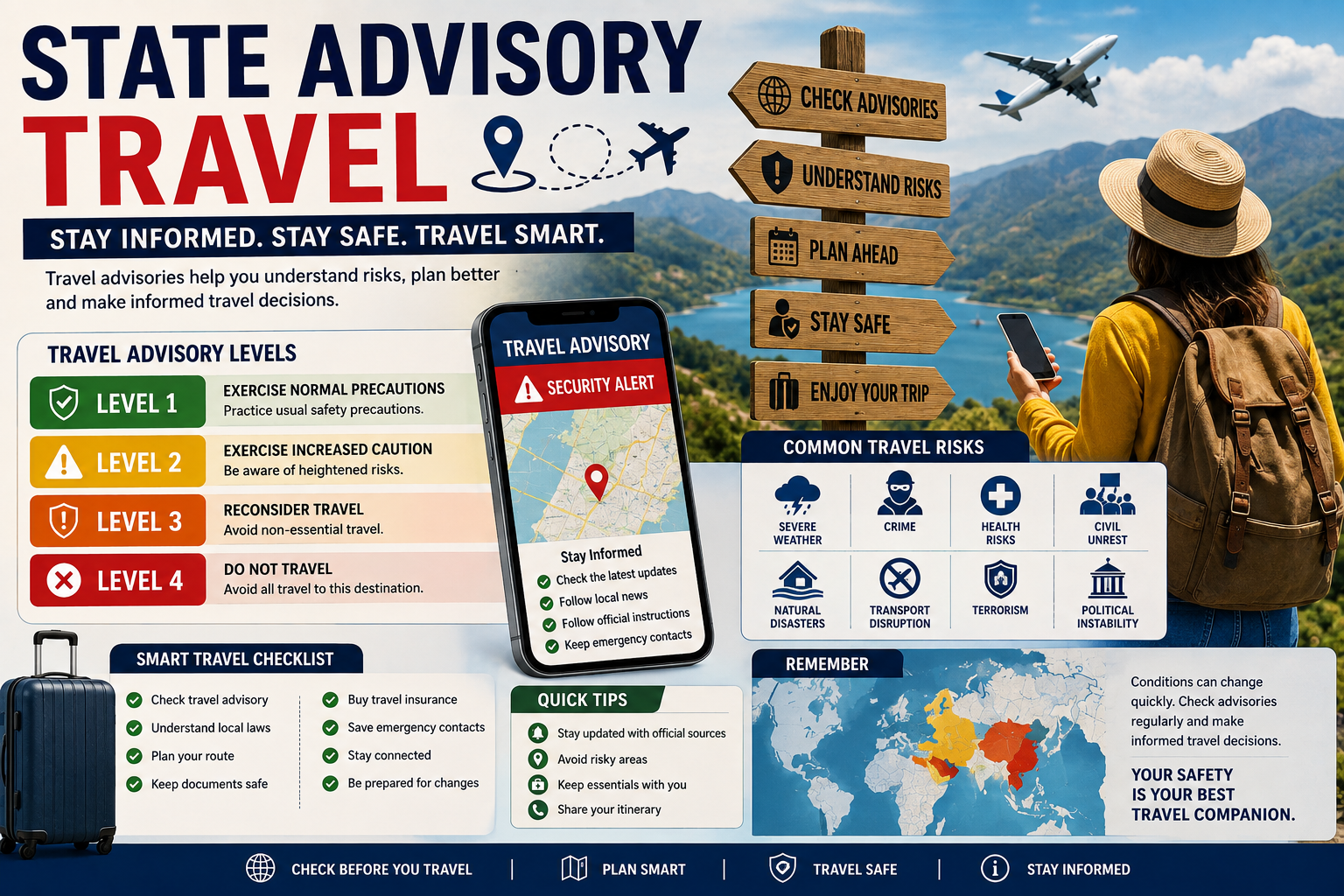
Some government travel advisory systems use levels to describe the general degree of caution travelers should consider.
A common four-level system is:
| Level | General Meaning |
|---|---|
| Level 1 | Exercise normal precautions |
| Level 2 | Exercise increased caution |
| Level 3 | Reconsider travel |
| Level 4 | Do not travel |
These levels are useful, but travelers should not depend on the number alone.
The reason behind the advisory is equally important.
A destination could have an advisory because of a specific region, temporary event, health concern, or security issue. The situation may not affect every city or tourist attraction.
Therefore, state advisory travel research should include reading the complete advisory.
Level 1: Exercise Normal Precautions
Level 1 generally represents the lowest advisory category.
It does not mean that there is absolutely no risk. Normal travel risks such as theft, traffic accidents, bad weather, and other everyday problems can still happen.
Travelers should continue to use normal safety practices.
These include:
- Protecting passports
- Keeping valuables secure
- Following local laws
- Watching personal belongings
- Checking weather
- Using reliable transportation
- Staying aware of surroundings
Level 1 should be viewed as a reminder to maintain normal travel awareness.
Level 2: Exercise Increased Caution
Level 2 means travelers should take additional care.
The advisory may identify a particular reason for increased caution.
For example, there could be concerns involving:
- Crime
- Political conditions
- Health
- Terrorism
- Natural hazards
- Local unrest
Travelers should read the details carefully.
If a warning concerns a specific city or region, it may not apply equally to every part of the country or state.
Level 3: Reconsider Travel
Level 3 is a stronger warning.
It generally means travelers should carefully consider whether the trip is necessary or appropriate under the current conditions.
Before traveling, people should ask:
- Why is the advisory at this level?
- Does it affect my exact destination?
- Can I postpone the trip?
- Does my insurance cover the situation?
- Are transportation services operating?
- What alternatives do I have?
If a traveler decides to continue, they should understand the risks and prepare carefully.
Level 4: Do Not Travel
Level 4 represents the strongest level in systems that use four advisory categories.
It generally means travelers should not travel to the destination because of serious risks.
Possible reasons could include:
- Active conflict
- Serious security threats
- Major civil unrest
- Extreme natural disasters
- Severe health emergencies
- Other significant dangers
Travelers should carefully follow official information in such situations.
How to Check State Advisory Travel Information
One of the most important rules of state advisory travel is to use current information.
Travel conditions can change quickly.
A traveler should:
- Find the official travel advisory source.
- Search for the exact destination.
- Check the date of the advisory.
- Read the complete advisory.
- Identify the reason for the warning.
- Check whether the warning affects the entire destination or only a particular area.
- Review local weather and emergency information.
- Check transportation updates.
- Recheck the information shortly before departure.
Do not depend only on screenshots or social media posts.
An old advisory may no longer describe current conditions.
State Advisory Travel vs Travel Restrictions
Travel advisories and travel restrictions are not the same thing.
An advisory is generally information or guidance about a potential risk. A restriction may be a mandatory legal requirement.
For example, a travel advisory could recommend increased caution because of local crime. That does not necessarily prevent tourists from entering the destination.
A legal restriction could be different.
It might involve:
- A closed road
- A restricted area
- An evacuation order
- An entry requirement
- A border closure
- A temporary park closure
- A quarantine or health requirement when legally applicable
Travelers should follow both advisory information and mandatory rules.
What Can Cause a Travel Advisory?
There are many reasons why authorities may issue or update travel advisories.
Crime and Security
High crime levels can result in warnings about certain neighborhoods or areas.
Travelers may be advised to:
- Avoid isolated locations
- Use reliable transportation
- Keep valuables hidden
- Stay alert in crowded areas
- Avoid walking alone in certain locations
Political Unrest
Protests, demonstrations, strikes, or political instability can affect travel.
Even peaceful demonstrations can sometimes cause:
- Road closures
- Transportation delays
- Crowds
- Unexpected changes
- Temporary access restrictions
Travelers should avoid areas where authorities advise them not to go.
Natural Disasters
Natural disasters are another major reason for travel warnings.
Examples include:
- Hurricanes
- Floods
- Tornadoes
- Wildfires
- Earthquakes
- Landslides
- Severe snowstorms
Natural conditions can change quickly, so travelers should check updates frequently.
Health Concerns
Health advisories may be issued because of:
- Disease outbreaks
- Contaminated water
- Food safety concerns
- Limited medical facilities
- Environmental health risks
Travelers should understand the specific health concern instead of assuming that all travel is unsafe.
Weather-Related State Advisory Travel
Weather can have a major effect on travel.
A destination that is normally safe can become difficult to reach during severe weather.
Before traveling, check:
- Temperature
- Rain
- Snow
- Wind
- Storm warnings
- Flooding
- Road conditions
- Airport conditions
Hurricanes
Hurricanes can affect flights, roads, hotels, beaches, and coastal communities.
If a hurricane is expected, travelers should follow official instructions and monitor updates.
Do not assume that a reservation means you should continue traveling regardless of conditions.
Tornadoes
Tornadoes can develop quickly and may create dangerous conditions.
If authorities issue warnings, travelers should seek appropriate shelter and follow local instructions.
Wildfires
Wildfires can affect air quality, roads, parks, and entire communities.
Tourists should not enter closed areas simply because a map still shows them as tourist attractions.
Winter Storms
Heavy snow and ice can make driving dangerous.
Travelers should check road conditions before starting a road trip and consider postponing travel when authorities recommend avoiding unnecessary journeys.
State Advisory Travel Within the United States
Travel within the United States can also require careful planning.
The country contains many states with different climates, laws, transportation systems, and local conditions.
A traveler moving between several states should check each destination.
For example, a road trip could pass through areas affected by:
- Snow
- Heat
- Wildfires
- Flooding
- Mountain conditions
- Road construction
- Local restrictions
State advisory travel planning is particularly useful for long road trips because conditions can change from one state to another.
International State Advisory Travel
International travelers have additional considerations.
Before visiting another country, check:
- Passport requirements
- Visa requirements
- Entry rules
- Local laws
- Health guidance
- Security conditions
- Transportation
- Weather
- Embassy information
Travelers should also know how to contact their embassy or consular service if a serious problem occurs.
An international traveler may be unfamiliar with the local language and legal system, making preparation even more important.
How Travel Advisories Affect Your Plans
A travel advisory does not automatically mean you must cancel your trip.
Instead, consider what the advisory actually says.
Ask:
Where is the risk?
A warning may affect only a particular city, region, road, or border area.
What is causing the warning?
The reason may tell you whether the problem is temporary, seasonal, or long-term.
When is the risk expected?
Weather warnings may be relevant for a few days, while other situations can continue for longer.
What are the alternatives?
You may be able to change your route, dates, hotel, or activities.
What does your insurance cover?
Check the terms before assuming you can receive a refund.
Travel Insurance and State Advisory Travel
Travel insurance can be useful for unexpected situations, but travelers should understand their policy.
Depending on the policy, coverage may relate to:
- Medical emergencies
- Trip cancellation
- Trip interruption
- Lost luggage
- Delayed luggage
- Emergency transportation
However, policies can have exclusions.
Some policies may treat known events differently from unexpected events. Travelers should read the policy carefully and contact the insurance provider if they are unsure.
A traveler should not assume that a travel advisory automatically means every expense will be reimbursed.
What to Do When an Advisory Changes Before Your Trip
Travel conditions can change between the time you book your trip and your departure date.
If a new advisory appears:
- Read the complete update.
- Check the date.
- Identify the reason.
- Determine whether your exact destination is affected.
- Check your airline or transportation provider.
- Contact your accommodation if necessary.
- Review your insurance policy.
- Consider changing the itinerary.
- Check alternative destinations.
- Continue monitoring official information.
Do not make decisions based only on a headline.
The details may show that the advisory concerns a specific area that you were not planning to visit.
What to Do During a Travel Advisory
If you are already traveling when an advisory is issued, remain calm.
First, understand the reason for the advisory.
Then:
- Follow local authority instructions.
- Avoid restricted areas.
- Keep your phone charged.
- Keep important documents secure.
- Maintain access to money.
- Monitor reliable updates.
- Inform a trusted person about major changes.
- Be ready to change plans if necessary.
If an evacuation order or other mandatory instruction is issued, follow it.
Personal safety should be more important than protecting a hotel booking, sightseeing plan, or other travel expense.
State Advisory Travel and Emergency Planning
Every traveler should have a simple emergency plan.
Your plan can include:
- Emergency contacts
- Accommodation information
- Transportation details
- Insurance information
- Passport details
- Embassy or consular information
- Local emergency services
- Backup payment options
Keep these details accessible.
Do not keep everything in only one place. If your phone is lost or damaged, you should still have access to important information.
State Advisory Travel Safety Checklist
Use this checklist before departure:
- Check the current travel advisory.
- Confirm the date of the advisory.
- Read the complete information.
- Understand why the advisory was issued.
- Check whether it affects your exact destination.
- Check current weather conditions.
- Check transportation updates.
- Review accommodation policies.
- Check travel insurance terms.
- Save emergency contacts.
- Keep copies of important documents.
- Create a backup travel plan.
- Share basic plans with someone you trust.
- Recheck conditions before departure.
State Advisory Travel for Families
Families should pay special attention to travel advisories.
Parents or guardians should consider whether current conditions are suitable for children.
Important factors include:
- Weather
- Transportation
- Medical access
- Accommodation
- Crowded locations
- Outdoor activities
- Distance from emergency services
If a destination has a serious warning, families may decide that postponing the trip is the better choice.
Children may also need additional preparation. Parents should explain basic safety rules and make sure children know what to do if they become separated.
State Advisory Travel for Solo Travelers
Solo travelers should be particularly careful when conditions are uncertain.
When traveling alone:
- Share your itinerary with someone trusted.
- Keep your phone charged.
- Know where your accommodation is.
- Use reliable transportation.
- Avoid unnecessary risks.
- Keep important documents secure.
- Check local updates regularly.
- Have a backup route.
A solo traveler cannot rely on a travel partner to notice problems or help with planning, so preparation becomes even more important.
State Advisory Travel for Road Trips
Road trips can be affected by weather, road closures, construction, fires, floods, and other conditions.
Before driving:
- Check road conditions.
- Check weather.
- Check fuel availability.
- Keep your vehicle in good condition.
- Carry water.
- Keep your phone charged.
- Know alternative routes.
- Avoid closed roads.
- Follow official traffic instructions.
A navigation app may show a road, but that does not always mean the road is currently safe or open.
Always consider official road and emergency information.
Common Mistakes Travelers Make
Many travel problems happen because people rely on assumptions.
Relying on Old Information
An advisory from several months ago may not reflect current conditions.
Always check the latest information.
Looking Only at the Advisory Level
The number alone does not explain the whole situation.
Read the reason and details.
Ignoring Local Updates
National information may not include every local change.
Check local authorities and transportation providers when relevant.
Confusing Advisories With Restrictions
A recommendation and a legal requirement are different.
Know which rules are mandatory.
Assuming the Entire Country Is Unsafe state advisory travel
Some warnings apply only to a specific region.
Read the geographical details.
Ignoring Weather state advisory travel
Weather can change travel conditions quickly.
Check forecasts close to departure and during your trip.
Having No Backup Plan state advisory travel
Flights can be canceled, roads can close, and hotels can become unavailable.
Always have alternatives when possible.
Sharing Unverified Information state advisory travel
Social media can spread old or inaccurate information.
Use reliable official sources when making important travel decisions.
How to Build a Better Travel Plan state advisory travel
A good travel plan should include both normal activities and possible problems.
Start with your main itinerary.
Then identify possible disruptions.
For example:
| Travel Plan | Possible Problem | Backup |
|---|---|---|
| Road trip | Road closure | Alternative route |
| Beach holiday | Storm | Indoor activities |
| Mountain trip | Snow | Lower-altitude destination |
| City tour | Public event | Different attraction |
| Flight | Cancellation | Alternative flight |
| Outdoor activity | Extreme heat | Change activity time |
This simple approach can make state advisory travel planning much stronger.
How Often Should You Check a Travel Advisory?
There is no single schedule for every trip.
However, travelers should check information:
- When first planning the trip
- Before booking when conditions are uncertain
- After booking
- A few days before departure
- Shortly before leaving
- During the trip when conditions may change
If there is severe weather, civil unrest, a natural disaster, or another rapidly changing event, check updates more frequently.
FAQs
What is state advisory travel?
State advisory travel refers to travel guidance and advisory information that helps people understand conditions that may affect their journey to a state, country, region, or destination.
What is a travel advisory?
A travel advisory is information or guidance about potential risks or conditions affecting travelers. It can involve safety, health, weather, crime, political conditions, or other concerns.
What does Level 1 travel advisory mean?
Level 1 generally means travelers should exercise normal precautions. It does not mean there are zero risks.
What does Level 2 mean?
Level 2 generally means travelers should exercise increased caution because of a specific concern identified in the advisory.
What does Level 3 mean?
Level 3 generally advises travelers to reconsider travel because conditions may involve a higher level of risk.
What does Level 4 mean?
Level 4 generally represents the strongest warning and advises people not to travel because of serious risks.
Does a travel advisory mean I cannot travel?
Not necessarily. An advisory is often guidance rather than a legal travel restriction. However, travelers must follow any separate mandatory rules, closures, evacuation orders, or entry restrictions.
Can a travel advisory change quickly?
Yes. Advisories can change when conditions change. Weather, security, health, transportation, and natural disasters can all develop quickly.
Should I cancel my trip because of a travel advisory?
There is no single answer. Read the complete advisory, understand the reason, determine whether it affects your destination, review transportation and insurance policies, and make an informed decision.
Can travel advisories affect travel insurance?
They can, depending on the policy and circumstances. Travelers should read their insurance terms and contact their provider if they are unsure about coverage.
Where should I find reliable travel advisory information?
Use current official government and local authority information. For transportation, also check the airline, airport, road authority, hotel, or other relevant provider.
Conclusion
State advisory travel information is an important tool for anyone who wants to plan a safer and more informed journey. A travel advisory should not automatically create fear. Instead, it should encourage travelers to understand the conditions of their destination. Some advisories involve minor concerns that require extra awareness, while others identify serious risks that may justify changing or postponing travel plans. The best approach to state advisory travel is to look beyond the advisory level. Read why the advisory was issued, check which areas are affected, understand how long the situation may continue, and look at current local information.