
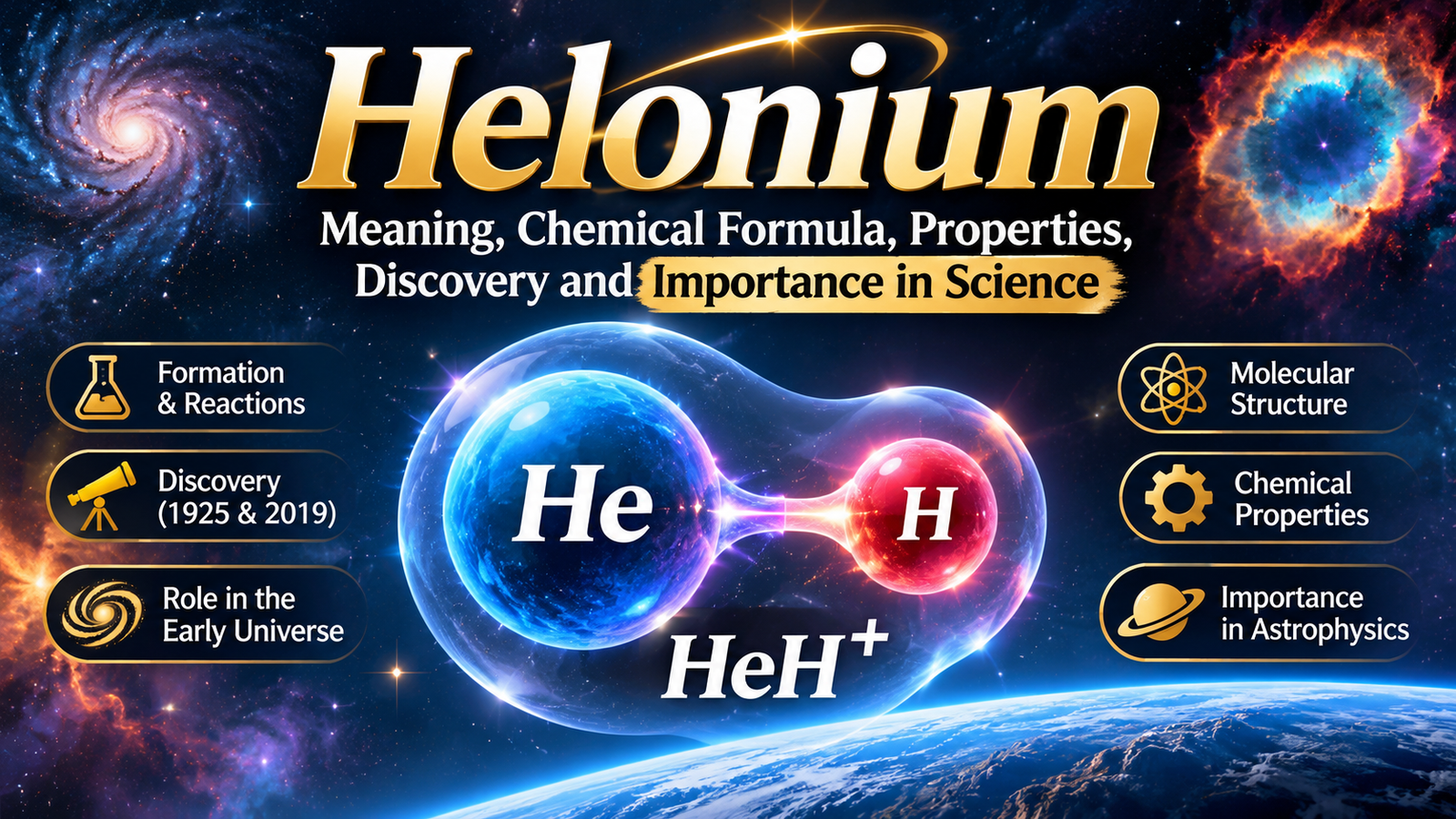
Helonium: Meaning, Chemical Formula, Properties, Discovery and Importance in Science
Helonium is a fascinating term associated with one of the simplest and most unusual molecular ions studied in modern chemistry. It is commonly used in general-interest discussions to refer to the helium hydride ion, written as HeH⁺, which consists of one helium atom bonded to one hydrogen nucleus. Although helium is famous for being chemically unreactive under ordinary conditions, its interaction with hydrogen under suitable conditions produces a positively charged molecular species that has attracted considerable scientific attention. This unusual combination makes Helonium an interesting subject for understanding atomic bonding, molecular chemistry, and the development of the early universe Esucation
The scientific importance of this substance extends far beyond its simple molecular composition. Researchers have investigated its formation, chemical reactions, molecular structure, and behaviour in different environments. The helium hydride ion was identified in laboratory experiments in 1925, but astronomers did not confirm its presence in interstellar space until 2019. This discovery helped scientists investigate the chemical processes that occurred when the universe was young and began developing its first molecular bonds. Understanding its identity, properties, and history provides a useful introduction to the relationship between chemistry and astrophysics.
What Is Helonium?
Helonium Meaning and Scientific Definition
Helonium is a name used in some explanatory chemistry articles for the helium hydride molecular ion, HeH⁺. This species contains a helium nucleus and a hydrogen nucleus held together by a chemical bond, with an overall positive electrical charge. In formal scientific discussions, helium hydride ion is the more established name, while hydridohelium(1+) is a systematic chemical designation. Understanding this distinction is important because Helonium is not the name of a separate element listed on the periodic table. Instead, it describes a molecular ion formed from two of the lightest elements in nature.
The substance is particularly interesting because helium normally has a full outer electron shell, making it exceptionally reluctant to participate in ordinary chemical bonding. However, the formation of a positively charged helium species changes the electronic situation and allows an interaction with hydrogen. The resulting molecular ion has a stable bound electronic ground state, even though it is highly reactive in many chemical environments. Its unusual bonding behaviour makes it valuable for studying fundamental chemical interactions that cannot easily be understood by examining ordinary neutral molecules alone.
What Does the Name Helonium Represent?
The word Helonium is connected linguistically with helium and the chemical naming convention used for certain positively charged molecular species. Chemical names frequently use endings such as “-ium” and “-onium” to describe elements, ions, or groups of atoms, depending on their established nomenclature. This naming pattern can make unfamiliar scientific terms sound like the names of new elements. However, the name alone does not determine whether a substance is an element, compound, molecular ion, or another chemical species. Its actual composition and electronic structure provide the scientific classification.
In discussions of helium hydride chemistry, readers may encounter Helonium alongside the more widely accepted term helium hydride ion. These expressions should not automatically be treated as equally standardized scientific names. The chemical formula HeH⁺ provides a much clearer and more reliable identification because it describes the actual atomic composition and electrical charge. When researching this subject, using both the common search term and the established chemical name helps readers find relevant information without confusing informal terminology with formal chemical nomenclature.
Is Helonium a Real Chemical Substance?
The helium hydride ion represented by HeH⁺ is a real, experimentally studied chemical species rather than a fictional substance. Scientists produced and investigated it in laboratory experiments during the early twentieth century, establishing that helium and hydrogen could form a molecular ion under appropriate conditions. Its existence has subsequently been supported by spectroscopic measurements and theoretical research. The discovery is particularly significant because it demonstrates that even an element as chemically unreactive as helium can participate in a molecular bond when the surrounding physical and electronic conditions are suitable.
The distinction between the real ion and the name Helonium is worth emphasizing. While HeH⁺ is an established chemical species, Helonium is not the official name of a new periodic-table element. The term is primarily encountered in explanatory or online material, whereas scientific publications generally identify the substance as the helium hydride ion. This difference does not make the subject less interesting. Instead, it provides an opportunity to understand how scientific terminology develops and why chemical formulas are often more precise than informal names.
Why Is Helonium Important in Science?
The importance of the helium hydride ion comes from its relationship with the earliest stages of cosmic chemistry. After the Big Bang, the universe contained enormous quantities of hydrogen and helium, but its initial conditions were too hot for ordinary molecular structures to develop. As temperatures decreased, atoms and ions began interacting through chemical processes. HeH⁺ became an important intermediate in these reactions because it provided an early route through which more complicated molecular chemistry could eventually develop.
Modern scientists also study this ion to understand molecular bonding, reaction rates, spectroscopy, and the behaviour of matter under extreme conditions. Its simple two-nucleus structure makes it useful for theoretical calculations, while its distinctive spectral characteristics allow researchers to investigate astronomical environments. The discovery of HeH⁺ outside the laboratory strengthened its importance as a connection between experimental chemistry and observational astronomy. It is therefore a valuable subject for understanding both the smallest molecular interactions and the large-scale chemical history of the universe.
How Helonium Differs From Ordinary Helium
Ordinary helium exists as a neutral atom containing two protons and normally two electrons. Its electrons occupy a filled first energy shell, giving the atom considerable chemical stability and explaining why helium rarely forms conventional compounds under everyday conditions. Helonium, when referring to HeH⁺, has a different electronic arrangement because it contains a positively charged helium-hydrogen molecular system. Its two nuclei share a molecular electron distribution, creating a bound molecular ion rather than an isolated neutral helium atom.
This difference affects the substance’s behaviour, chemical reactions, and physical characteristics. Neutral helium is widely used in balloons, scientific equipment, cooling systems, and specialized industrial applications. The helium hydride ion, by comparison, is mainly important in laboratory research and astrophysical chemistry. It is not a material that people ordinarily encounter in daily life. Comparing these two species demonstrates how changing the number of electrons and introducing another nucleus can produce a completely different chemical system from an otherwise stable noble-gas atom.
What Is the Chemical Formula of Helonium?
Understanding the HeH⁺ Formula
The chemical formula associated with Helonium is HeH⁺. The symbol He represents helium, while H represents hydrogen, and the superscript plus sign indicates that the complete molecular species carries one positive electrical charge. This simple notation communicates the essential composition of the ion without requiring a lengthy description. It also distinguishes the helium hydride ion from neutral helium, ordinary molecular hydrogen, and other hydrogen-containing chemical species. Understanding the formula is the first step toward examining its bonding and chemical behaviour.
The positive charge is an important part of the formula rather than a decorative symbol. It indicates that the molecular system has one fewer electron than the corresponding neutral combination of helium and hydrogen atoms would contain. The resulting electron arrangement permits the formation of a bound molecular ion. Although the formula contains only two element symbols, the electronic interactions between the nuclei and the available electron create a genuine molecular structure. This is why HeH⁺ is studied as an ion with its own chemical and spectroscopic properties.
Chemical Composition of Helonium
The helium hydride ion contains one helium nucleus and one hydrogen nucleus. In its most common form, the hydrogen nucleus is a single proton, while the helium nucleus contains two protons and two neutrons. Together, these nuclei create a two-centre molecular system with an overall nuclear charge of three units. The ion has two electrons, resulting in a total electrical charge of positive one. This composition is particularly simple compared with larger molecules, but it produces a meaningful example of molecular bonding involving a noble gas.
The simplicity of its composition makes the species especially useful in theoretical and experimental chemistry. Researchers can examine how electrons behave between two different atomic nuclei without the additional complexity found in larger molecular systems. The helium nucleus attracts the available electron density strongly, while the hydrogen nucleus also contributes to the molecular interaction. The resulting bond demonstrates that molecular stability depends on the complete electronic structure of a system rather than simply on whether an element is generally considered reactive or unreactive.
Understanding Its Positive Electrical Charge
The positive electrical charge of HeH⁺ results from its electron count relative to its nuclear composition. A neutral helium atom contains two protons and two electrons, while a neutral hydrogen atom contains one proton and one electron. If these atoms were combined without removing an electron, the total system would contain three protons and three electrons. The helium hydride ion instead contains three protons and two electrons, leaving one unit of positive charge. This difference is represented by the plus sign in its chemical formula.
The charge also influences how the ion interacts with other particles. Positively charged species can attract negatively charged electrons and may participate in reactions with neutral atoms or other ions. These interactions are especially important in hot astronomical environments where ionization and recombination occur continuously. The charge is therefore central to understanding how the molecule forms, how it is destroyed, and how its abundance changes in different environments. It also explains why the substance is classified as a molecular cation rather than a neutral compound.
Is Helonium an Element or a Molecular Ion?
Helonium, when used to describe HeH⁺, is a molecular ion and not an individual chemical element. Elements are defined by the number of protons in their atomic nuclei. Helium has an atomic number of two, while hydrogen has an atomic number of one. A molecular ion containing both types of nuclei cannot be classified as a new element because it combines atoms belonging to two existing elements. Its chemical identity comes from the interaction of these nuclei and their electrons.
This distinction is important because unfamiliar chemical names can sometimes create confusion about the periodic table. There is no separate Helonium element with its own atomic number, symbol, or position among the recognized elements. Instead, HeH⁺ belongs to the family of molecular cations studied in physical chemistry and astrophysics. Understanding this classification makes it easier to distinguish between atoms, molecules, ions, and compounds, especially when exploring unusual substances that are rarely encountered in ordinary laboratory or household environments.
Chemical Formula Comparison With Related Species
Several chemical species contain helium or hydrogen, but their formulas describe different electronic structures and chemical identities. Neutral helium is represented by He, while molecular hydrogen is written as H₂. The helium hydride ion is represented by HeH⁺, and neutral helium hydride, which is not the same bound ground-state molecular species, should not be confused with the cation. The positive charge and the presence of two different nuclei make HeH⁺ a distinctive molecular system.
| Chemical species | Formula | General identity |
|---|---|---|
| Helium | He | Neutral noble-gas atom |
| Hydrogen atom | H | Neutral hydrogen atom |
| Molecular hydrogen | H₂ | Neutral diatomic molecule |
| Helium hydride ion | HeH⁺ | Positively charged molecular ion |
| Hydronium | H₃O⁺ | Positively charged polyatomic ion |
| Ammonium | NH₄⁺ | Positively charged polyatomic ion |
These comparisons show why chemical formulas are essential when discussing substances with similar names or related atomic components. Two species can contain familiar elements while having entirely different structures and properties. The formula HeH⁺ identifies the helium hydride ion precisely and helps scientists distinguish it from other hydrogen-containing ions. It also makes communication between chemists, physicists, and astronomers more consistent when discussing observations, reaction mechanisms, and theoretical calculations.
Molecular Structure and Chemical Properties of Helonium
Molecular Structure of HeH⁺
The molecular structure of HeH⁺ is relatively simple because it contains only two nuclei. These nuclei are helium and hydrogen, and the molecular system is arranged along a single internuclear axis. The available electrons occupy a molecular orbital that is influenced by the positive charge of both nuclei. This arrangement produces a bound electronic ground state and gives the ion its distinctive molecular characteristics. Because the structure contains only two atomic centres, researchers can investigate it using highly accurate quantum-mechanical calculations.
Although the molecule is small, its structure is not equivalent to two atoms merely sitting next to one another. The electron distribution changes when the nuclei interact, creating a molecular bonding arrangement that holds the system together. The helium nucleus has a stronger nuclear charge than the hydrogen nucleus, so the electronic distribution is not shared equally in the same way as in a perfectly symmetrical diatomic molecule. This makes HeH⁺ an interesting example for understanding molecular polarity and the influence of different nuclear charges on bonding.
Chemical Bonding Between Helium and Hydrogen
Chemical bonding in HeH⁺ is possible because its molecular electrons experience attractive interactions with both nuclei. In a simplified molecular-orbital description, the electronic distribution occupies a bonding state that lowers the energy of the combined system compared with the separated particles. The result is a stable molecular ion in its ground electronic state. This is especially interesting because helium’s filled electron shell makes ordinary chemical bonding difficult, but ionization and the unusual electron count create conditions in which a bound helium-hydrogen structure can exist.
The bond should not be understood as evidence that helium behaves like a typical reactive metal or nonmetal. Its formation requires particular conditions and involves an ionic molecular system rather than an ordinary neutral compound. The strength and characteristics of the bond are determined by quantum-mechanical interactions, including nuclear attraction, electron distribution, and the energy of the molecular state. Studying these features helps researchers understand why certain unusual molecular ions can exist even when their individual elements are normally associated with very different chemical behaviours.
Electron Configuration and Molecular Stability
The electronic structure of the helium hydride ion is one of the main reasons it attracts attention in theoretical chemistry. Its two electrons occupy the lowest available molecular electronic state, creating a bound configuration. This arrangement allows the ion to exist as a recognizable molecular species rather than immediately separating into independent particles. The molecular orbital is strongly influenced by helium’s nuclear charge, while hydrogen contributes another attractive centre. Quantum-mechanical calculations help researchers determine the energy levels and properties associated with this configuration.
However, the existence of a bound electronic state does not mean the ion is chemically inert or stable in every environment. A molecular ion can remain bound under suitable conditions while reacting rapidly when it encounters other particles. HeH⁺ is especially vulnerable to chemical reactions involving neutral hydrogen and electrons. Its lifetime and abundance therefore depend on the surrounding temperature, particle density, radiation field, and available reaction partners. This distinction between molecular binding and chemical persistence is important when interpreting its presence in space.
Physical and Chemical Properties
The properties of HeH⁺ are different from those of ordinary helium gas because it is a positively charged molecular ion. Its most recognizable characteristics include its two-nucleus structure, positive charge, molecular bonding, and distinctive rotational and vibrational energy levels. These energy levels allow the ion to interact with electromagnetic radiation at characteristic frequencies. Scientists use this behaviour to identify it through spectroscopy, making its spectral signature an important tool for laboratory measurements and astronomical observations.
Its chemical behaviour is strongly influenced by the surrounding environment. In a low-density astronomical region, the ion may survive long enough to produce detectable radiation, while in a region containing abundant reactive hydrogen or electrons it may be destroyed through chemical processes. The ion does not behave like a stable material that can simply be collected and stored under ordinary conditions. Its properties are therefore best understood through molecular physics, laboratory experiments, and models of the environments in which it forms.
Why Is Helonium Highly Reactive?
The helium hydride ion is highly reactive because its positive charge and molecular structure allow it to interact strongly with other particles. In particular, it can participate in reactions with neutral hydrogen, leading to the formation of hydrogen-containing molecular ions and other products. These reactions can occur in astronomical environments where hydrogen is abundant. The ion’s chemical lifetime is consequently controlled by the competition between processes that create it and processes that remove it from the surrounding gas.
Its reactivity also explains why detecting the ion in space required careful astronomical observations. Scientists needed to identify an environment where the production of HeH⁺ could occur efficiently and where the ion would emit radiation that instruments could distinguish from other signals. Planetary nebulae provide suitable conditions because they contain hot ionized regions alongside surrounding gas rich in hydrogen and helium. Understanding its reactivity helps explain why the ion is scientifically important even though it does not accumulate in large quantities in ordinary environments.
How Is Helonium Formed?
Formation Through Chemical Reactions
The formation of HeH⁺ involves interactions between helium-containing species and hydrogen-containing particles. In the early universe, neutral helium atoms could combine with free protons through a process known as radiative association. During this process, the interacting particles form a molecular ion and release excess energy as a photon. The emission of radiation allows the new molecular system to settle into a bound state. This reaction is important because it provides a mechanism through which the first molecular bond in the universe could develop.
The formation process is not restricted to the conditions that existed after the Big Bang. Similar chemical pathways can operate in modern astronomical environments, particularly in regions where energetic radiation produces helium ions and free hydrogen. The exact reaction pathway depends on temperature, particle concentrations, and the surrounding radiation field. Researchers use chemical reaction networks to calculate how quickly the ion forms and how its abundance changes as other reactions take place. These calculations help explain observations from planetary nebulae and other astronomical environments.
Radiative Association of Helium and Hydrogen
Radiative association is a process in which two particles combine to create a molecular species while releasing energy in the form of electromagnetic radiation. For HeH⁺, one important reaction pathway involves neutral helium combining with a proton. The resulting ion releases a photon, allowing the system to lose energy and remain in a bound molecular state. This process was particularly important in the early universe because it provided a route to molecular formation when the available elements and environmental conditions were still relatively simple.
A related formation pathway in present-day astronomical environments involves helium ions reacting with neutral hydrogen. The balance between different formation routes depends on the physical conditions and the chemical composition of the gas. Scientists study these pathways because even small changes in reaction rates can influence predicted molecular abundances. Accurate reaction data are therefore essential for comparing theoretical models with observations. Research into radiative association continues to improve our understanding of how this simple molecular ion forms in different regions of space.
Formation in Laboratory Conditions
Scientists have studied the helium hydride ion in laboratory environments for approximately a century. Early experiments involving helium and hydrogen mixtures provided evidence for its existence, while later research used improved mass spectrometry and spectroscopic techniques to investigate its structure. Laboratory production allows researchers to examine the ion under controlled conditions and compare measurements with predictions from quantum chemistry. These experiments are essential because astronomical observations alone cannot provide every detail about molecular energy levels and reaction mechanisms.
Modern laboratory investigations can use specialized ion sources, controlled gas environments, and high-resolution instruments to study molecular ions. Researchers may generate the required particles, allow them to interact, and then identify the resulting species through their mass or spectral characteristics. Such work helps establish reliable reference data for astronomical research. It also allows scientists to investigate reaction rates and molecular transitions that are difficult to measure directly in distant cosmic environments.
Destruction Through Dissociative Recombination
Dissociative recombination is an important destruction mechanism for molecular ions. It occurs when a positively charged molecular ion captures an electron and subsequently separates into neutral fragments. In the case of helium hydride chemistry, this process can reduce the amount of HeH⁺ present in a gas. Its importance depends on the availability of free electrons and the conditions under which the molecular ion exists. Researchers include this reaction in chemical models because the abundance of an ion is determined by both its formation and destruction.
Other reactions can also remove HeH⁺ from an astronomical environment. One particularly important pathway involves its reaction with neutral hydrogen, which can produce helium and a hydrogen molecular ion. Such processes help connect the chemistry of the helium hydride ion with the development of molecular hydrogen. The balance between different formation and destruction mechanisms influences how long the ion survives and whether it can produce detectable spectral emissions. This is why chemical reaction rates are a major subject of continuing research.
Conditions Required for Helonium Formation
The formation of HeH⁺ depends on the availability of the necessary particles and suitable physical conditions. In the early universe, temperatures gradually decreased after the Big Bang, allowing light elements to recombine and participate in chemical reactions. The resulting environment contained neutral helium and ionized hydrogen, providing the ingredients required for radiative association. The formation of the ion was part of a larger sequence of chemical changes that eventually supported the production of molecular hydrogen.
In modern space, the required conditions can occur in regions containing energetic radiation, ionized gas, and suitable concentrations of hydrogen and helium. Planetary nebulae are particularly interesting because their central hot stars produce strong radiation that affects the surrounding material. Different regions within these nebulae contain different mixtures of neutral atoms and ions. The boundaries between these regions can provide favourable conditions for molecular-ion formation. Understanding these environmental requirements helps astronomers identify where HeH⁺ may exist and how it can be observed.
History and Discovery of Helonium
Early Scientific Research on Helium Hydride
The scientific investigation of helium hydride began during a period when researchers were developing new methods to study atomic and molecular ions. Helium was already known for its unusual chemical stability, but scientists were interested in understanding how it behaved under energetic experimental conditions. Research involving ionized gases and electron-impact processes eventually provided evidence that helium and hydrogen could form a positively charged molecular species. These early investigations helped establish the foundation for modern research into simple molecular ions.
The study of HeH⁺ also became important because its structure offered a useful test for theories of chemical bonding. A system containing only two nuclei and a small number of electrons is comparatively manageable for theoretical calculations. Researchers could therefore examine the relationship between measured properties and predictions from quantum mechanics. Over time, improvements in experimental methods allowed scientists to investigate its spectrum and molecular behaviour more precisely, making it an important subject in physical chemistry.
First Laboratory Production in 1925
The first laboratory discovery of the helium hydride ion dates back to 1925, when T. R. Hogness and E. G. Lunn investigated ion formation in mixtures involving hydrogen and helium. Their research provided early experimental evidence for the existence of HeH⁺. This achievement was important because it showed that helium could participate in a molecular ionic structure under suitable conditions, despite its reputation as a chemically unreactive noble gas. The experiment marked the beginning of a long scientific investigation into the ion’s properties.
The 1925 laboratory discovery should not be confused with its later astronomical detection. Scientists were able to produce and identify the ion in controlled experiments long before they confirmed its presence in space. Laboratory studies established that the molecular species was real, while later research investigated whether it could survive in astronomical environments. This distinction is central to understanding its history. The substance was known to experimental chemists decades before astronomers obtained convincing evidence of its existence outside the laboratory.
Scientific Predictions About Its Existence in Space
After its laboratory identification, researchers began considering whether the helium hydride ion could also occur naturally in interstellar environments. The early universe offered a particularly interesting possibility because its chemical composition was dominated by hydrogen and helium. The ion’s potential role in the development of molecular hydrogen made it important for understanding how the first stages of cosmic chemistry unfolded. Scientists developed theoretical models to estimate its formation, destruction, and abundance under different conditions.
During the late twentieth century, astrochemical research also suggested that planetary nebulae could contain detectable quantities of HeH⁺. These environments have hot central stars that produce intense radiation, creating ionized regions within surrounding gas. Models indicated that interactions between helium and hydrogen in these regions could generate the molecular ion. However, predicting its presence was not enough to establish an astronomical discovery. Researchers still needed instruments capable of detecting its distinctive radiation accurately.
First Astronomical Detection in 2019
A major breakthrough occurred in April 2019 when an international research team reported the first confirmed astronomical detection of HeH⁺ in the planetary nebula NGC 7027. The discovery was published in the scientific journal Nature and represented an important achievement in astrochemistry. The researchers detected the ion’s rotational ground-state transition at a wavelength of approximately 149.1 micrometres. This provided convincing evidence that the molecular ion existed naturally in an astronomical environment rather than only in laboratory experiments.
The detection was significant because scientists had searched for the ion in space for decades. Its predicted spectral signal was difficult to distinguish from other astronomical emissions, and earlier observations had not provided sufficiently convincing evidence. The successful identification helped confirm theoretical predictions about molecular chemistry in planetary nebulae. It also demonstrated how improvements in observational technology can solve scientific questions that remain unanswered for many years.
The Scientists and Technology Behind Its Discovery
The 2019 detection involved the Stratospheric Observatory for Infrared Astronomy, widely known as SOFIA. This airborne observatory carried the German Receiver for Astronomy at Terahertz Frequencies, known as GREAT, which allowed researchers to investigate the characteristic radiation emitted by HeH⁺. Observing from a high-altitude aircraft helped overcome much of the atmospheric absorption that makes certain far-infrared and terahertz wavelengths difficult to study from the ground.
The research team used the instrument to observe the planetary nebula NGC 7027 and identify the expected spectral signal. Their results were published by Rolf Güsten and colleagues in Nature. The discovery connected decades of laboratory and theoretical work with direct astronomical evidence. It also showed the importance of specialized observational equipment in studying molecules that emit radiation at wavelengths that are difficult to access using conventional ground-based telescopes.
Helonium and the Early Universe
The First Molecular Ion After the Big Bang
The helium hydride ion is widely described as the first molecular ion formed during the early chemical history of the universe. After the Big Bang, the universe was extremely hot and dense, preventing stable atoms and molecules from existing in the same way they do today. As expansion continued, temperatures decreased and the light elements produced during primordial nucleosynthesis began undergoing recombination. Neutral helium appeared before hydrogen became predominantly neutral, creating conditions in which helium could interact with free protons.
These interactions allowed the formation of HeH⁺ through radiative association. The ion represented an early step in the development of molecular chemistry because it provided one of the first stable molecular bonds in the young universe. Although it existed in a very different environment from modern chemical laboratories, the basic molecular principles were similar. Studying this early stage helps scientists reconstruct how simple particles gradually developed into the increasingly complex chemical systems found throughout the universe today.
Chemical Conditions in the Early Universe
The early universe contained primarily hydrogen and helium, with much smaller quantities of other light elements. At first, temperatures and radiation levels were so high that neutral atoms could not remain stable for long. As the universe expanded and cooled, electrons began combining with atomic nuclei, allowing neutral atoms to develop. Helium recombined before hydrogen because of its higher ionization energy. This sequence created a period when neutral helium and free protons could coexist.
The availability of these particles made the formation of HeH⁺ possible. The surrounding environment was different from modern planetary nebulae because the early universe was expanding and had a much more uniform distribution of matter. Nevertheless, the same fundamental chemical interactions governed the behaviour of the particles. Researchers use theoretical models to investigate these conditions and determine how molecular ions influenced the transition from an almost entirely atomic universe toward one containing more complex molecular structures.
The Role of Helium and Hydrogen
Hydrogen and helium were the principal building blocks of early cosmic chemistry. Hydrogen provided protons and later neutral atoms, while helium contributed neutral atoms capable of participating in radiative association. Their interactions produced the helium hydride ion, connecting the two most abundant elements in the universe through an early molecular bond. This process demonstrates how a relatively simple combination of particles could initiate a sequence of chemical reactions with important consequences for later cosmic evolution.
The relationship between these elements did not stop with the formation of HeH⁺. The ion could react with neutral hydrogen and contribute to pathways that eventually produced molecular hydrogen. Molecular hydrogen is especially important because it allows gas clouds to lose energy through radiation and become cooler. Cooling supports gravitational contraction and plays an important role in the development of stars. Consequently, understanding the chemistry of hydrogen and helium helps scientists investigate the physical conditions that influenced the earliest generations of stars.
How Helonium Contributed to Molecular Hydrogen Formation
The helium hydride ion played a role in the early reaction network that led toward molecular hydrogen. One important reaction involves HeH⁺ interacting with neutral hydrogen to produce helium and H₂⁺. The hydrogen molecular ion can then participate in further reactions that lead to neutral molecular hydrogen. This provides a chemical connection between the earliest helium-hydrogen molecular system and the later development of one of the universe’s most important molecules.
Molecular hydrogen became essential to the cooling of primordial gas clouds. Unlike atomic hydrogen under certain conditions, molecular hydrogen can release energy through rotational and vibrational transitions. This radiation allows gas to cool, encouraging gravitational collapse in suitable environments. The formation of stars depends on many physical and chemical processes, and HeH⁺ was only one part of the wider network. Nevertheless, investigating this ion helps researchers understand how early molecular reactions contributed to the conditions required for the first stars.
Why Scientists Study Helonium in Cosmology
Cosmologists study the helium hydride ion because it provides information about the earliest chemical reactions in the universe. Its formation and destruction rates influence theoretical calculations of molecular abundances during different stages of cosmic evolution. By comparing chemical models with laboratory measurements and astronomical observations, researchers can improve their understanding of how matter behaved as the universe cooled. The ion is especially useful because its relatively simple structure allows accurate calculations of important molecular properties.
Research into this subject also supports broader investigations of star formation and the development of cosmic structure. The first generations of stars formed in environments that differed significantly from modern galaxies. Their formation depended on how primordial gas cooled and collapsed under gravity. Chemical species such as HeH⁺ and molecular hydrogen contributed to this process by influencing the energy balance of the gas. Studying these reactions helps scientists connect the physics of individual molecules with the evolution of the universe on much larger scales.
Where Is Helonium Found in Space?
Helonium in Planetary Nebulae
Planetary nebulae are among the most important environments for studying the helium hydride ion in the modern universe. These objects develop during the late stages of the evolution of certain stars, when material from the outer layers is expelled into surrounding space. The remaining central stellar core becomes extremely hot and produces intense radiation that ionizes nearby gas. The resulting nebula contains different regions with varying temperatures, densities, and chemical compositions.
These conditions can support the formation of HeH⁺ because helium and hydrogen species are present in regions affected by energetic radiation. The ion is not necessarily distributed evenly throughout the nebula. Instead, its abundance depends on the location of suitable reaction zones and the balance between chemical production and destruction. Planetary nebulae therefore provide natural laboratories in which astronomers can investigate molecular chemistry under conditions that are difficult to reproduce on Earth.
The Discovery of Helonium in NGC 7027
NGC 7027 became especially important in the history of HeH⁺ research because it provided the first confirmed astronomical detection of the ion. This planetary nebula contains a hot central star and a surrounding envelope of gas that has been affected by intense radiation. The combination of ionized and neutral material creates an environment in which helium hydride chemistry can occur. Researchers had identified this object as a promising target for observations based on theoretical predictions.
The 2019 detection confirmed that HeH⁺ existed in this astronomical environment. Its spectral emission was identified at the expected wavelength, providing evidence that the ion was present in the nebula. This achievement helped resolve a longstanding question in astronomy and provided a valuable test for chemical models. NGC 7027 remains an important reference point in discussions of helium hydride research because it connects laboratory measurements, theoretical predictions, and direct astronomical observations.
How the SOFIA Observatory Detected HeH⁺
SOFIA was an airborne astronomical observatory designed to investigate infrared and far-infrared radiation. Its aircraft platform allowed instruments to operate above much of the water vapour in Earth’s atmosphere, which normally absorbs many of the wavelengths needed for such observations. This was particularly important for detecting HeH⁺ because its strong rotational transition occurs in a region of the electromagnetic spectrum that is difficult to observe from many ground-based locations.
The GREAT instrument aboard SOFIA was used to observe the characteristic transition of the ion toward NGC 7027. Researchers analysed the spectral signal and compared it with the expected molecular transition. The resulting observations provided the first convincing astronomical identification of HeH⁺. The discovery illustrates how advances in observational technology can reveal molecules that are otherwise difficult to detect, especially when their signals occur at wavelengths affected by atmospheric absorption.
Infrared Spectroscopy and Astronomical Detection
Spectroscopy is a method of studying matter by examining how it emits or absorbs electromagnetic radiation. Molecules possess specific energy levels associated with their rotation, vibration, and electronic structure. When a molecule moves between these energy levels, it can absorb or release radiation at characteristic frequencies. These spectral features function like identifying signatures, allowing researchers to determine which chemical species may be present in a distant astronomical object.
For HeH⁺, rotational and vibrational transitions provide important observational information. The 2019 discovery relied on its rotational ground-state transition, while subsequent research also investigated vibrational emission from NGC 7027. These observations help researchers understand the ion’s abundance and physical environment. Spectroscopic measurements are particularly valuable because astronomers cannot collect samples directly from distant nebulae. Instead, they use the radiation reaching Earth to investigate the chemical composition and behaviour of matter across space.
Can Helonium Exist in Other Astronomical Environments?
The helium hydride ion is not necessarily limited to planetary nebulae. Theoretical research suggests that it may form in other environments where suitable combinations of helium, hydrogen, ionization, and radiation exist. However, detecting it requires the correct physical conditions and instruments capable of identifying its characteristic spectral transitions. Its abundance can be affected by temperature, density, chemical reactions, and the intensity of the surrounding radiation field.
Researchers continue investigating how this ion behaves in different astronomical environments. Laboratory experiments and computational models help identify possible reaction pathways, while telescopic observations provide evidence about where the species actually occurs. It is important not to assume that every region containing helium and hydrogen will contain detectable HeH⁺. The ion must be produced faster than it is destroyed, and its emission must be strong enough to distinguish from other signals. These requirements make astronomical detection a specialized scientific challenge.
Why Is Helonium Important in Modern Science?
Importance in Molecular Chemistry
The helium hydride ion is valuable in molecular chemistry because it demonstrates how chemical bonding can occur in an unusual system involving a noble gas. Helium’s filled electron shell makes it very different from elements that readily form ordinary chemical compounds. Studying HeH⁺ helps researchers understand how electron distribution, nuclear attraction, and molecular energy levels determine whether a chemical species can exist. Its simple structure also makes it useful for testing theoretical models of molecular bonding.
Research on this ion contributes to the wider understanding of molecular cations and their reactions. Scientists investigate how positive charge influences chemical interactions and how small molecular systems respond to different environmental conditions. The results can be compared with other simple ions to identify common principles governing chemical stability and reactivity. Although the ion has limited direct industrial use, its scientific value is considerable because it provides insight into fundamental chemical behaviour.
Applications in Astrophysics
In astrophysics, HeH⁺ helps researchers understand the chemical composition of nebulae and the early universe. Its spectral emission provides information about regions where helium and hydrogen interact under energetic conditions. Observing the ion allows astronomers to test predictions about molecular formation in planetary nebulae and investigate the physical processes that control chemical abundances. These studies contribute to a broader understanding of how stars and their surrounding environments influence cosmic chemistry.
Its importance also comes from its role in primordial chemical networks. The early universe contained relatively few elements, making the interactions between hydrogen and helium particularly significant. HeH⁺ was part of the sequence of reactions that helped establish pathways toward molecular hydrogen. By studying the ion’s properties and reaction rates, scientists can improve models of how the earliest gas clouds cooled and developed. This makes it a useful connection between molecular-scale science and the large-scale history of cosmic structure.
Role in Quantum Chemistry
Quantum chemistry investigates how electrons and nuclei interact to determine the structure, energy, and properties of chemical systems. HeH⁺ is an especially useful subject because its relatively simple composition makes detailed calculations possible. Researchers can model its molecular orbitals, energy levels, bonding characteristics, and reaction pathways with considerable precision. These calculations can then be compared with experimental measurements to evaluate the accuracy of different theoretical methods.
The study of this ion also helps scientists understand how molecular properties change when a system carries an electrical charge. Charged molecules often behave differently from neutral species, and their interactions can be strongly influenced by surrounding particles. Quantum-chemical models provide a way to examine these effects at a fundamental level. The resulting knowledge can support research into other molecular ions and improve the methods used to investigate chemical reactions in both laboratory and astronomical environments.
Importance in Spectroscopic Research
Spectroscopy is central to the investigation of HeH⁺ because the ion has identifiable rotational and vibrational transitions. Researchers can measure these transitions in laboratory experiments and use them as reference data for astronomical observations. Accurate spectral information is necessary for distinguishing one molecule from another, particularly in complex environments where many different species produce overlapping emissions. The ion’s detection in NGC 7027 demonstrated how spectroscopy can confirm the presence of a molecule in a distant astronomical object.
Further measurements also help scientists understand molecular energy levels and environmental conditions. The intensity and shape of a spectral line can provide information about the abundance, temperature, and movement of the emitting gas. Different transitions may reveal complementary details about the same molecular species. By combining laboratory measurements with astronomical observations, researchers can develop more reliable interpretations of molecular signals and improve their understanding of the chemical processes occurring throughout space.
Understanding the Evolution of the Universe
The study of HeH⁺ contributes to scientific explanations of how the universe changed from a hot, simple environment into one containing stars, galaxies, and increasingly complex chemical structures. Its formation represents an early stage in the development of molecular chemistry after the Big Bang. The reactions involving this ion helped establish pathways toward molecular hydrogen, which later played an important role in the cooling of primordial gas clouds.
Although HeH⁺ alone did not create the structures found in the modern universe, it provides evidence about the chemical processes that contributed to their development. Scientists use it as part of a larger network of reactions that explain the behaviour of early cosmic matter. By understanding the formation and destruction of simple ions, researchers can improve models of the physical conditions that existed before the first stars formed. This makes the ion an important subject in the wider investigation of cosmic evolution.
Helonium vs Other Chemical Substances
Helonium vs Helium
Helonium and helium are related through their chemical composition, but they are not the same species. Helium is a neutral noble-gas atom containing two protons and normally two electrons. It has a filled outer electron shell, which makes it extremely stable and generally unreactive under ordinary conditions. HeH⁺, by contrast, is a positively charged molecular ion containing both helium and hydrogen nuclei. Its electronic structure and chemical behaviour are therefore different from those of an isolated helium atom.
The practical differences are also considerable. Helium is widely used in industrial processes, scientific instruments, medical equipment, and specialized cooling applications. HeH⁺ is primarily investigated in laboratory physics, molecular chemistry, and astrophysics. It is not a replacement for helium and does not have the same everyday applications. Comparing them helps explain how an element can form an unusual molecular ion under particular conditions without losing its identity as part of the larger chemical system.
Helonium vs Helionium
The words Helonium and Helionium can appear similar in online searches, but they should not automatically be treated as interchangeable scientific terms. Helonium is sometimes used informally for the helium hydride ion, HeH⁺, while Helionium may appear as an alternative spelling or an unsupported terminology variation in general-interest content. Neither spelling should be interpreted as proof that a separate chemical element exists under that name.
For accurate scientific research, the chemical formula HeH⁺ is the most useful way to identify the helium hydride ion. Formal chemical nomenclature and peer-reviewed publications generally use helium hydride ion or a systematic designation rather than relying on ambiguous internet terminology. Readers should therefore check the context in which either word appears. This approach prevents confusion between informal naming, fictional terminology, spelling variations, and established chemical species.
Helonium vs Hydronium
Hydronium is a positively charged molecular ion represented by H₃O⁺. It forms when a water molecule accepts a proton and plays an important role in acid-base chemistry, especially in aqueous solutions. The helium hydride ion, represented by HeH⁺, contains one helium nucleus and one hydrogen nucleus. Although both species are positively charged molecular ions, their atomic compositions, molecular structures, and chemical environments are very different.
Hydronium is especially important in everyday chemistry because it helps explain the acidity of water-based solutions. HeH⁺, on the other hand, is primarily studied in molecular physics and astrophysical chemistry. Both examples demonstrate how positively charged molecular systems can form through interactions between particles. Comparing them provides a useful introduction to molecular ions and shows why a shared positive charge does not mean that two substances have the same chemical properties.
Helonium vs Ammonium
Ammonium is a positively charged ion with the formula NH₄⁺. It contains one nitrogen atom and four hydrogen atoms and is commonly encountered in fertilizers, chemical salts, and biological systems. HeH⁺ is much simpler, containing only one helium nucleus and one hydrogen nucleus. The two ions differ considerably in size, bonding arrangement, chemical behaviour, and practical importance. Ammonium is familiar in many industrial and environmental applications, while helium hydride is mainly relevant to specialized scientific research.
The comparison is useful because it demonstrates the variety of molecular ions found in chemistry. Ammonium contains several atoms arranged in a three-dimensional structure, whereas HeH⁺ is a simple two-nucleus system. Both carry an overall positive charge, but their formation mechanisms and chemical reactions are not the same. Understanding these differences helps readers recognize that molecular ions can have widely different structures and behaviours even when they share a common electrical characteristic.
Helonium vs Neutral Helium Hydride
The helium hydride ion HeH⁺ should be distinguished from the idea of a neutral helium hydride species. The plus sign in HeH⁺ indicates that the ion has an overall positive charge, which is essential to its electronic structure and chemical identity. Removing or adding electrons changes the energy and bonding characteristics of a molecular system. Therefore, the presence or absence of an electrical charge cannot be ignored when comparing different helium-hydrogen species.
This distinction is particularly important in scientific writing because similar names can refer to different electronic states or chemical arrangements. HeH⁺ is the established helium hydride molecular cation studied in laboratory experiments and astronomical observations. Discussions of neutral species require separate evidence and precise identification rather than assuming they share all the properties of the ion. Using accurate formulas and clear terminology makes comparisons more reliable and avoids confusion in chemistry and astrophysics.
Common Misconceptions About Helonium
Is Helonium a Chemical Element?
One common misconception is that Helonium represents a newly discovered chemical element. This is incorrect when the term refers to HeH⁺. The helium hydride ion contains nuclei belonging to two existing elements, helium and hydrogen, and therefore cannot be classified as a separate element. Elements are defined by their atomic numbers, which depend on the number of protons in their nuclei. The molecular ion is a combination of these nuclei within a positively charged molecular system.
The confusion often comes from the way unfamiliar chemical names are written. Many legitimate elements and ions have names ending in similar combinations of letters. However, a scientific classification must be based on atomic composition and electronic structure rather than appearance. HeH⁺ is a molecular ion, not a new entry on the periodic table. Recognizing this difference is important for understanding the actual scientific significance of the substance.
Is Helonium the Same as Helium?
Helonium is not the same as neutral helium when the word is used to describe HeH⁺. Helium consists of individual neutral atoms, while the helium hydride ion contains helium and hydrogen nuclei held together in a positively charged molecular structure. Their electron arrangements are different, which produces different chemical properties and behaviour. The fact that both contain helium does not make them identical substances.
Helium is commonly used in applications such as gas mixtures, balloons, cryogenic research, and scientific equipment. HeH⁺ does not share these everyday uses because it is a reactive molecular ion that is primarily investigated under specialized conditions. Understanding the difference helps prevent confusion between a familiar noble gas and a much less familiar molecular species. It also shows how changes in atomic composition and electrical charge can create entirely different chemical identities.
Is Helonium Naturally Found on Earth?
The helium hydride ion is not generally found as a stable, abundant material under ordinary conditions on Earth. Its chemical reactivity means that it can be destroyed through interactions with other particles, particularly in environments containing neutral hydrogen or electrons. This does not mean the ion cannot exist in terrestrial laboratories. Researchers can produce and study it using specialized experimental techniques that create suitable conditions for its formation and detection.
Its natural occurrence is more closely associated with environments where ionization, temperature, and particle concentrations support its formation. Astronomical regions such as planetary nebulae provide examples of these conditions. Laboratory experiments can reproduce some aspects of its chemistry, allowing scientists to measure its molecular properties. Therefore, the correct distinction is between ordinary environmental abundance and the ability to produce or detect the ion under controlled scientific conditions.
Is Helonium a Stable Substance?
The helium hydride ion has a bound molecular ground state, meaning it can exist as a genuine molecular species. However, this does not mean it is chemically stable in every environment. Its lifetime depends on the particles surrounding it and the reactions available to remove it. Reactions with neutral hydrogen and electrons can destroy the ion, while other processes may continuously produce new HeH⁺ molecules in suitable regions.
This difference between molecular binding and environmental stability is important. A molecule may have a stable internal structure but still react rapidly when it encounters other particles. The abundance of HeH⁺ in an astronomical region depends on the balance between its formation and destruction. Researchers therefore study reaction rates and physical conditions to determine where it can survive long enough to produce detectable spectral emissions.
Is Helonium a Fictional or Invented Word?
The term Helonium can be encountered in online explanations, educational articles, and discussions of chemical terminology. However, its use should be separated from the experimentally established existence of the helium hydride ion. The underlying chemical species HeH⁺ is real, but Helonium is not the universally standardized name used in scientific literature. This distinction is especially important when readers encounter different explanations of the word across websites.
Some online sources may also use similar spellings in fictional, creative, or unrelated contexts. Such uses do not establish a scientific meaning. To verify a claim, readers should look for the chemical formula, peer-reviewed publications, and recognized scientific databases. Using the term helium hydride ion alongside the keyword Helonium provides a clearer understanding of the subject and reduces the risk of relying on unsupported definitions.
FAQs About Helonium
What Is Helonium in Simple Words?
Helonium is a term sometimes used for the helium hydride ion, HeH⁺. It is a positively charged molecular species made from helium and hydrogen nuclei and is important in chemistry and astrophysics.
What Is the Chemical Formula of Helonium?
The chemical formula is HeH⁺. The symbols represent helium and hydrogen, while the plus sign indicates that the molecular ion carries one positive electrical charge.
Who Discovered Helonium?
The helium hydride ion was identified in laboratory experiments by T. R. Hogness and E. G. Lunn in 1925. Their work provided early experimental evidence for this unusual molecular ion.
When Was Helonium First Found in Space?
The first confirmed astronomical detection of HeH⁺ was reported in April 2019. Researchers detected it in the planetary nebula NGC 7027 using the SOFIA airborne observatory.
Why Is Helonium Called the First Molecular Ion?
HeH⁺ is described as the first molecular ion because it is thought to have formed during the early chemical development of the universe. Its formation represented one of the earliest molecular bonding processes after the Big Bang.
Is Helonium a Chemical Element?
No. HeH⁺ is a molecular ion containing helium and hydrogen nuclei. It is not a separate element and does not have its own atomic number on the periodic table.
Is Helonium Naturally Found on Earth?
It is not commonly found as an abundant, stable substance under ordinary terrestrial conditions. Scientists can produce and study the ion using specialized laboratory equipment.
Why Is Helonium Important for Understanding the Universe?
The helium hydride ion participated in early cosmic chemical reactions that helped establish pathways toward molecular hydrogen. Studying it helps scientists understand the development of primordial chemistry and the conditions that supported the formation of the first stars.
Is Helonium the Same as Helionium?
The two spellings should not automatically be considered equivalent scientific terms. HeH⁺ is the recognized formula for the helium hydride ion, and readers should use this formula to identify the actual chemical species.
Conclusion
Helonium, when used to describe the helium hydride ion, represents an interesting example of how simple atomic particles can form an unusual molecular system. Its chemical formula, HeH⁺, identifies a positively charged ion containing helium and hydrogen nuclei. Despite helium’s reputation for being chemically unreactive, this molecular species demonstrates that suitable electronic and environmental conditions can allow a noble gas to participate in bonding. Its simple structure makes it valuable for studying molecular orbitals, chemical reactions, spectroscopy, and the fundamental principles of molecular chemistry.
Its historical and astronomical importance makes the subject even more significant. Laboratory research identified the helium hydride ion in 1925, while the first confirmed astronomical detection was reported in 2019 in planetary nebula NGC 7027. The discovery provided evidence supporting decades of theoretical research into the chemistry of space. Its role in early-universe molecular formation also helps scientists understand how hydrogen and helium contributed to the chemical processes that eventually supported molecular hydrogen formation and the cooling of primordial gas clouds.