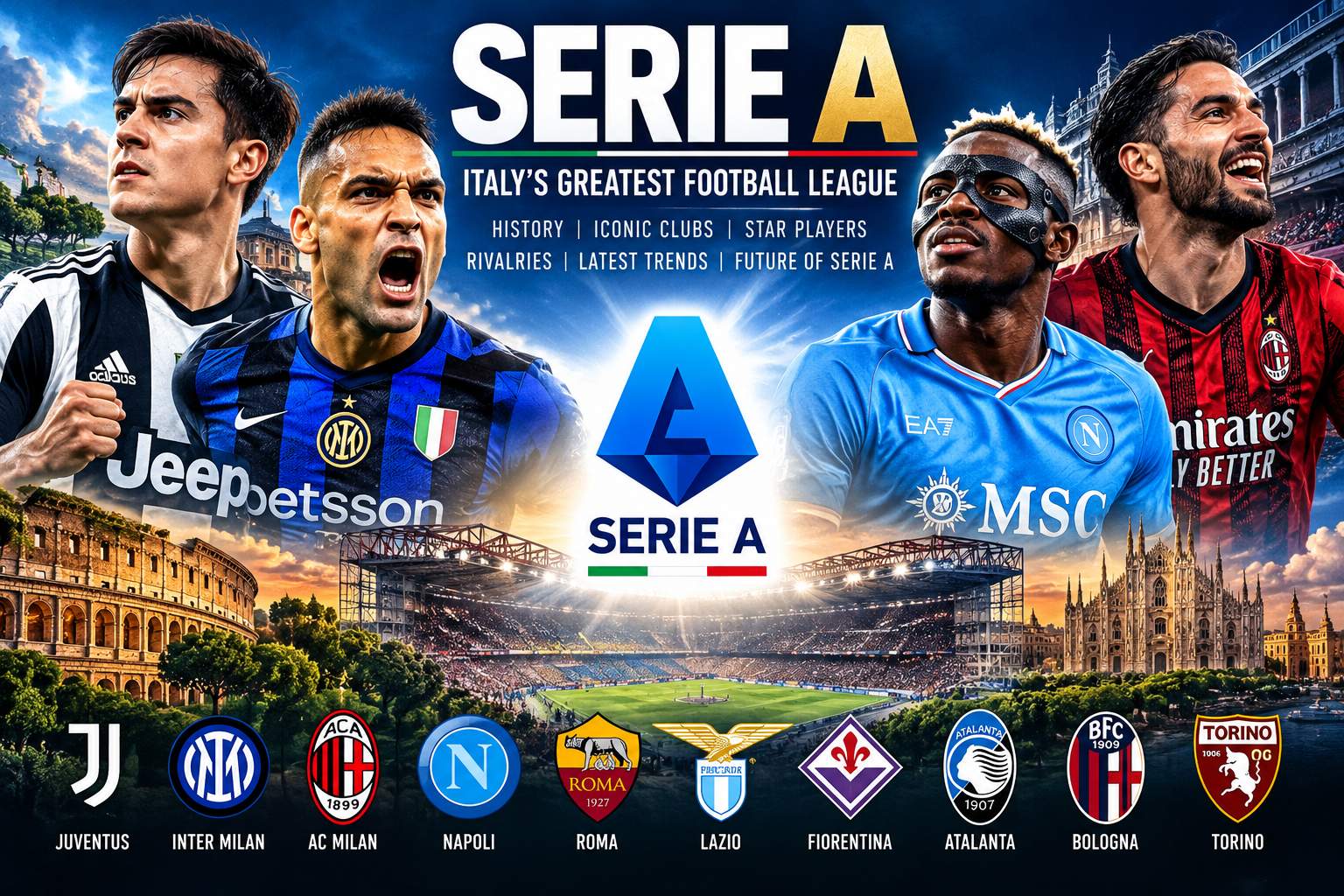
Serie A: The Ultimate Guide to Italy’s Football League, History, Clubs and Rivalries
What makes Italian football so special? Is it the tactical intelligence of its managers, the extraordinary history of its clubs, the passion of its supporters, or the unforgettable rivalries that have shaped generations of football fans? Serie A is Italy’s highest division of professional men’s football and one of Europe’s most historically significant domestic leagues. Known for its tactical traditions, legendary clubs, iconic stadiums and intense rivalries, Serie A offers a distinctive football experience that continues to attract supporters worldwide Tokyo Sports
What Is Serie A?
Serie A is the top tier of Italy’s domestic men’s football league system. It sits above Serie B, the country’s second division, and features clubs competing for the Italian league championship.
The competition is administered by Lega Serie A, the organisation responsible for operating the league and managing important commercial and sporting activities.
The modern national league format began in the 1929–30 season. Since then, Serie A has developed into one of the most recognised competitions in international club football.
How the Serie A Season Works
Serie A traditionally operates with 20 clubs, although the number of participating teams has changed at various points in its history.
In a standard 20-team season:
- Each club plays 19 home matches.
- Each club plays 19 away matches.
- Every team faces the other 19 clubs twice.
- Each club plays 38 league matches.
- A victory earns three points.
- A draw earns one point.
- A defeat earns no points.
The team with the highest points total at the end of the season becomes the Italian league champion.
If clubs finish level on points, the competition’s official tie-breaking rules determine their positions. Italian league regulations have historically given particular importance to head-to-head results, although supporters should consult the rules applicable to the specific season.
The bottom three clubs are generally relegated to Serie B, while promoted clubs move in the opposite direction.
This creates two connected competitions within the same season: the race to win the championship and the struggle to remain in the top division.
Why Every Match Matters
Serie A’s league format rewards consistency rather than success in a single knockout match.
A club can win an important derby and still fall behind in the title race if it repeatedly drops points against lower-ranked opponents.
Similarly, a team with limited financial resources can achieve a successful season by collecting points consistently, defending effectively and making the most of its opportunities.
Consider two hypothetical clubs.
Club A defeats several major rivals but frequently loses against teams near the bottom of the table. Club B rarely produces spectacular victories but consistently wins matches it is expected to win.
Over 38 games, Club B may finish higher because it has converted more opportunities into points.
This is why analysts evaluate league performance across an entire season rather than relying exclusively on memorable matches.
Serie A and European Competitions
Serie A clubs can also qualify for European competitions organised by UEFA.
Depending on Italy’s qualification allocation, league positions and the results of domestic cup competitions, successful clubs may enter:
- The UEFA Champions League.
- The UEFA Europa League.
- The UEFA Conference League.
Qualification places and entry rounds can vary between seasons.
European qualification matters because it provides clubs with additional sporting challenges, international exposure and opportunities to generate revenue.
However, European matches also create scheduling pressures. Clubs must manage player fitness, squad rotation and travel while continuing to compete domestically.
For some teams, balancing these commitments is one of the most difficult parts of a successful season.
The History of Serie A: From Early Italian Football to the Modern Era
Serie A’s history reflects the development of Italian football itself. Its story includes regional rivalries, periods of domestic dominance, legendary international players, tactical innovation and major changes in the business of professional sport.
Before the Modern League
Football spread throughout Italy during the late nineteenth and early twentieth centuries. Clubs emerged in industrial cities, port communities and regional centres, establishing local identities that would later become central to the national game.
Early Italian competitions did not always operate under the same nationwide league structure used today.
Instead, regional competitions and changing tournament formats shaped the sport’s development.
As football became more organised, the need for a national championship grew. The establishment of the modern round-robin Serie A format in 1929–30 marked an important turning point.
It created a more consistent framework for comparing teams from different parts of the country.
The Early Champions
The first modern Serie A championship, held in 1929–30, was won by Ambrosiana, the historical name associated with Inter during that period.
Juventus subsequently established itself as a major force, winning five consecutive championships between 1930–31 and 1934–35.
Torino became another important power, particularly during the 1940s. Its great post-war team achieved four consecutive league titles from 1945–46 through 1948–49.
The tragic 1949 Superga air disaster, which killed many members of Torino’s celebrated team, remains one of the most significant tragedies in Italian sporting history.
The club’s achievements and the loss of its players occupy an important place in the historical memory of Italian football.
The Rise of AC Milan, Inter and Juventus
As the competition developed, several clubs established themselves as long-term national powers.
Juventus built a reputation for sustained domestic success, while AC Milan and Inter became two of the most recognisable names in European club football.
Their success was supported by talented players, ambitious recruitment, influential coaches and increasingly professional club structures.
The Milan clubs also developed an international profile through their performances in European competitions.
Their rivalry became one of the defining features of Italian football, with the Derby della Madonnina providing a stage for some of the country’s most memorable sporting occasions.
Serie A’s Golden Years in the 1980s and 1990s
Many football historians regard the 1980s and 1990s as an especially influential period for Serie A.
The league attracted world-class players from Italy and abroad. Clubs competed fiercely for domestic honours, while European competitions regularly featured Italian sides.
The arrival of international stars strengthened the league’s global appeal.
Players such as Diego Maradona, Marco van Basten, Ruud Gullit, Frank Rijkaard, Roberto Baggio, Paolo Maldini, Franco Baresi and Gabriel Batistuta became closely associated with this era.
Different teams offered different footballing identities.
Some prioritised defensive structure and compact spacing. Others combined technical midfield play with rapid attacking movements. Many developed sophisticated systems for controlling space and limiting opponents’ opportunities.
The result was a competition in which tactical preparation became a major part of the spectacle.
Serie A was not simply a destination for famous footballers. It was also an environment where coaches and players developed ideas that influenced football internationally.
Tactical Influence and Italian Coaching
Italian football developed a strong reputation for defensive organisation, but reducing its history to defending alone would be misleading.
The country’s coaches have contributed to many aspects of the game, including pressing, positional organisation, counterattacking, possession play and the use of flexible formations.
The traditional catenaccio system is often associated with Italian football. Its historical forms emphasised defensive security, close marking and opportunities to attack after winning possession.
However, modern Italian football is much more varied.
Some coaches use aggressive pressing and high defensive lines. Others build patiently from the back or focus on positional rotations that create passing lanes.
The most important continuity is not a single formation or defensive philosophy. It is the emphasis many Italian coaches place on understanding the opponent, preparing specific tactical solutions and managing the details of a match.
The Challenges of the 2000s
The early twenty-first century brought significant changes.
Italian clubs faced financial pressures, changing ownership structures, competition from other European leagues and debates about stadium infrastructure.
The Calciopoli scandal, which emerged in 2006, became a major turning point. It led to disciplinary consequences and changed the competitive landscape of Italian football.
Juventus was relegated to Serie B as part of the sanctions, while other clubs also faced penalties.
The scandal damaged the league’s reputation and highlighted the importance of transparent governance.
Italian football subsequently experienced periods of rebuilding and renewed competitiveness, but debates about financial sustainability and institutional reform continued.
Juventus’ Domestic Dominance in the 2010s
Juventus dominated Italian league football during much of the 2010s, winning nine consecutive Serie A championships from 2011–12 through 2019–20.
This achievement reflected more than individual talent.
The club developed a highly competitive squad, maintained strong recruitment structures and repeatedly adapted to managerial changes.
Its domestic dominance also illustrated how organisational stability can create a long-term advantage in a league where rivals are continually trying to rebuild.
However, the end of Juventus’ winning streak demonstrated that domestic dominance is rarely permanent.
Inter, AC Milan and Napoli subsequently enjoyed championship success, reinforcing the competitive nature of the modern era.
Serie A in the 2020s
The 2020s have brought another period of change.
Inter, AC Milan and Napoli have all won recent championships, while Juventus has remained an important presence in the title conversation.
The 2022–23 season was particularly memorable for Napoli, who secured the club’s first Serie A championship since 1990.
The achievement carried enormous significance for Naples, where football is deeply connected with regional identity and community pride.
Inter won the 2023–24 championship, AC Milan claimed the 2021–22 title, and Napoli followed its 2022–23 triumph by winning again in 2024–25.
Inter then won the 2025–26 championship, finishing the season with 87 points.
These changing champions demonstrate that Serie A continues to evolve rather than remaining permanently controlled by one club.
The league’s official historical records and current standings are available through
How Strong Is Serie A in 2026?
Evaluating a football league requires more than identifying its most famous clubs.
A league’s overall strength can be assessed through several factors:
- The quality and depth of its squads.
- The tactical ability of its coaches.
- The competitiveness of the championship.
- The performance of its clubs in European competitions.
- The development of young players.
- Its financial stability and commercial reach.
- The quality of its stadiums and matchday experience.
Serie A continues to benefit from a rich footballing tradition and a collection of globally recognised clubs.
Its appeal is also supported by the variety of tactical approaches found across the league.
However, Italian football faces challenges involving stadium modernisation, financial competition, player recruitment and the need to develop sustainable commercial revenue.
The league’s long-term position will depend on how effectively clubs combine sporting performance with financial and institutional development.
What the 2025–26 Season Revealed
The 2025–26 season offered several useful examples of the competition’s changing landscape.
Inter finished first with 87 points, scoring 89 goals and conceding 35. Napoli finished second with 76 points, followed by Roma with 73.
Como finished fourth with 71 points, marking an exceptional achievement for a club that had returned to the top flight only recently.
The season’s statistics also illustrated the importance of both attacking and defensive performance.
Inter’s 89 goals demonstrated its offensive productivity, while Como’s 29 goals conceded highlighted the defensive consistency behind its successful campaign.
These numbers do not explain every aspect of performance, but they offer a useful starting point for understanding how clubs build successful seasons.
The official league’s season report recorded 922 goals across 380 matches, an average of approximately 2.43 goals per match.
This figure illustrates an important point: Serie A’s tactical reputation does not mean every game is low-scoring or dominated by defensive football.
Its matches can involve patient build-up, high-intensity pressing, transitions, individual creativity and open attacking exchanges.
Season figures should be dated clearly in published content. They describe 2025–26, not the current 2026–27 standings.
The Biggest Serie A Clubs: Ten Teams Every Football Fan Should Know
Serie A’s identity is shaped by clubs with different histories, regional connections, supporters and playing traditions.
The following comparison focuses on ten notable Italian clubs. It is not a ranking of current team strength, and the descriptions should not be interpreted as guarantees about their present tactics or results.
1. Juventus
Juventus is one of Italy’s most successful and internationally recognised football clubs.
Based in Turin, the club has traditionally been associated with domestic consistency, strong squad planning and high expectations.
Its black-and-white colours are recognised around the world.
Juventus built an extraordinary domestic record through different generations of players and coaches. Its nine consecutive league titles between 2011–12 and 2019–20 remain one of the most notable achievements of the modern Italian league era.
The club has also attracted major international stars and competed regularly in European football.
For new fans, Juventus is a useful club to study when examining how recruitment, organisational stability and sustained performance can support long-term success.
What makes Juventus distinctive?
- A long history of domestic success.
- A strong international supporter base.
- A reputation for competitive ambition.
- Significant influence on Italian football’s modern history.
2. Inter
Inter, officially known as FC Internazionale Milano, is based in Milan and is one of Italy’s major football institutions.
The club is recognised by its blue-and-black colours and has a long record of domestic and European achievements.
Inter’s history includes successful periods under several generations of players and managers.
The club won the treble in 2009–10, capturing Serie A, the Coppa Italia and the UEFA Champions League in the same season.
Inter also won the 2023–24 and 2025–26 Serie A championships.
Its recent title success reinforces its position as one of the leading forces in contemporary Italian football.
What makes Inter distinctive?
- A major role in Milan’s football culture.
- A rich history in domestic and European competitions.
- Strong championship traditions.
- A rivalry with AC Milan that attracts worldwide attention.
3. AC Milan
AC Milan is another historic club from Milan.
Its red-and-black colours are closely associated with some of the most successful teams in European football history.
The club has won numerous Italian league championships and European honours, with celebrated teams across different eras.
Its past includes legendary defenders, creative midfielders and outstanding forwards.
Paolo Maldini, Franco Baresi, Marco van Basten and Kaká are among the names associated with important periods in the club’s history.
AC Milan’s success in European competition helped establish Serie A’s reputation as a destination for elite football talent.
What makes AC Milan distinctive?
- A celebrated European history.
- A global supporter base.
- Famous players from multiple generations.
- A central role in one of football’s biggest city rivalries.
4. Napoli
Napoli represents Naples, a city where football carries considerable emotional and cultural significance.
The club became internationally famous during Diego Maradona’s time in Naples, particularly after winning Italian league championships in 1987 and 1990.
Maradona remains an iconic figure in the city’s sporting history.
Napoli later enjoyed another successful era, culminating in its 2022–23 Serie A championship and its 2024–25 title.
The club’s success is often connected to the passion of its supporters and the strong relationship between the team and its city.
Napoli also provides an interesting case study in squad development, recruitment and the importance of building a team capable of sustaining performance over a long season.
What makes Napoli distinctive?
- A passionate local supporter culture.
- A strong connection with Naples.
- Important periods of domestic success.
- A history associated with some of football’s most memorable individual talents.
5. AS Roma
AS Roma is based in Italy’s capital and has a long history in Italian football.
The club’s identity is closely linked with Rome and its supporters, with the Giallorossi colours forming a central part of its visual identity.
Roma has won Italian league championships and domestic cup honours, while also competing in European competitions.
Its history includes celebrated players such as Francesco Totti and Daniele De Rossi.
Totti, in particular, became a symbol of the club’s identity because of his long association with Roma.
The club’s matches against Lazio are among the most emotionally charged fixtures in Italian football.
What makes Roma distinctive?
- A strong connection with the Italian capital.
- A passionate supporter culture.
- A celebrated history of local football icons.
- One of Italy’s most important city rivalries.
6. Lazio
Lazio is Roma’s other major football club and shares the Italian capital with AS Roma.
The two clubs contest the Derby della Capitale, a fixture that reflects the city’s divided football loyalties.
Lazio has won Serie A championships and domestic cup competitions, including an important league title in 1999–2000.
Its history features influential players, ambitious teams and periods of domestic success.
The club’s blue-and-white colours distinguish it from its city rival.
Lazio is particularly interesting to supporters who want to understand how two clubs in the same city can develop distinct identities and traditions.
What makes Lazio distinctive?
- A long history in Italian football.
- A major role in Rome’s sporting culture.
- A rivalry with AS Roma.
- Periods of success in league and cup competitions.
7. Atalanta
Atalanta is based in Bergamo, in northern Italy.
The club has become especially well known for its modern development model, attacking football during successful periods and ability to compete with wealthier opponents.
Atalanta’s rise demonstrates that financial resources alone do not determine a club’s potential.
Effective scouting, player development, coaching continuity and tactical clarity can help a team challenge more established institutions.
The club’s victory in the 2024 UEFA Europa League was a major milestone in its history.
Atalanta has also become an important example of how clubs can build a distinctive identity through recruitment and development.
Its success provides useful lessons for analysts studying how smaller-market clubs compete at a high level.
What makes Atalanta distinctive?
- Strong player-development traditions.
- A notable modern European achievement.
- A reputation for ambitious football during successful periods.
- An example of the importance of recruitment and coaching.
8. Fiorentina
Fiorentina represents Florence, a city with a rich artistic and cultural heritage.
The club is known for its distinctive purple colours, which have become an important part of its identity.
Fiorentina has won Italian league championships and domestic cup honours, while also participating in European competitions.
Its supporters have maintained a strong connection with the club despite changes in ownership, squad composition and sporting performance.
The club’s history also demonstrates how football institutions can represent cities whose international identities extend far beyond sport.
For visitors and international fans, following Fiorentina can provide a different perspective on Italian football outside the country’s biggest metropolitan centres.
What makes Fiorentina distinctive?
- Its association with Florence.
- Its instantly recognisable purple colours.
- A long history in Italian football.
- A strong regional supporter identity.
9. Bologna
Bologna is one of the historic clubs of Italian football.
Based in the Emilia-Romagna region, the club has won multiple Italian league championships, including several during the earlier decades of the modern competition.
Its history provides a reminder that Serie A’s traditional powers have not always been the same clubs that dominate contemporary headlines.
Bologna has also experienced periods of rebuilding and renewed sporting ambition.
Its performances in recent seasons have helped demonstrate the potential for well-organised clubs to challenge established expectations.
The club is a useful subject for examining recruitment, coaching, squad balance and the relationship between sporting success and financial resources.
What makes Bologna distinctive?
- A historic record in Italian football.
- A strong connection with its home city.
- A history of rebuilding and competitive resurgence.
- A reminder of the league’s broader sporting heritage.
10. Torino
Torino, also known as Torino FC, shares the city of Turin with Juventus.
The club’s history includes the legendary Grande Torino team of the 1940s.
That team achieved remarkable domestic success before the Superga air disaster in 1949, which killed many of its players and staff.
The tragedy remains central to the club’s identity and the wider history of Italian sport.
Torino’s relationship with Juventus creates the Derby della Mole, a rivalry rooted in the football culture of the city.
Although the clubs have experienced different levels of success in the modern era, Torino retains an important historical and cultural place in Italian football.
What makes Torino distinctive?
- A powerful historical legacy.
- The memory of the Grande Torino team.
- A major rivalry with Juventus.
- A distinct identity within Turin’s football culture.
Serie A Club Comparison Table: Ten Major Italian Teams
The following table compares these clubs by location, colours, historical identity and the type of football discussion each can help illustrate.
| Club | City | Traditional colours | Historical distinction | Why fans follow it |
|---|---|---|---|---|
| Juventus | Turin | Black and white | Exceptional domestic championship record | Long-term success and major rivalries |
| Inter | Milan | Blue and black | Domestic and European achievements | Title challenges and Milan rivalry |
| AC Milan | Milan | Red and black | Famous European history | Legendary players and international success |
| Napoli | Naples | Blue and white | Maradona era and modern title-winning periods | City identity and passionate support |
| AS Roma | Rome | Dark red and gold | Capital-city club with iconic players | Derby culture and emotional support |
| Lazio | Rome | Sky blue and white | Major club in Rome’s football history | Rivalry and historical achievements |
| Atalanta | Bergamo | Blue and black | Modern development and European success | Scouting, coaching and ambitious football |
| Fiorentina | Florence | Purple | Distinctive regional identity | Florence’s football culture |
| Bologna | Bologna | Red and blue | Multiple historical league titles | Tradition and competitive resurgence |
| Torino | Turin | Maroon | Grande Torino legacy | History, identity and the Turin derby |
This table describes historical identities rather than current form, squad quality or a definitive ranking. Club colours and kits may vary across alternate and special editions.
The Most Important Serie A Rivalries
Rivalries are a major part of Serie A’s appeal.
They create narratives that extend beyond the league table, connecting football with geography, history, identity and supporter culture.
Some rivalries are rooted in the same city. Others reflect competition between historically successful clubs or regional differences.
The Derby della Madonnina: Inter vs AC Milan
The Milan derby is one of the most famous fixtures in world football.
Inter and AC Milan share the San Siro stadium, although stadium arrangements and future infrastructure plans can change.
Because both clubs represent Milan, their rivalry involves local pride as well as sporting competition.
A derby victory can become a defining moment in a season, particularly when the teams are competing for the championship or European qualification.
The fixture has also featured many legendary players, adding to its international appeal.
For viewers unfamiliar with Italian football, the Milan derby is an excellent introduction to Serie A’s combination of technical ability, tactical preparation and emotional intensity.
The Derby d’Italia: Juventus vs Inter
Juventus and Inter have a long-standing rivalry that has produced many important matches.
The Derby d’Italia is especially significant because both clubs have frequently competed for major domestic honours.
Their encounters can influence the title race, the distribution of European qualification places and the wider perception of which club is strongest during a particular era.
The rivalry also reflects the changing balance of power within Italian football.
Juventus’ domestic dominance in the 2010s, followed by Inter’s championship success, provides a useful context for understanding why their meetings remain important.
The Derby della Capitale: Roma vs Lazio
The Rome derby is one of the most emotionally charged fixtures in Italian football.
AS Roma and Lazio share the same city but have distinct histories, colours and supporter identities.
The match is often important beyond its effect on the league table because local pride plays such a significant role.
For players, coaches and supporters, winning the derby can be a major objective in its own right.
The rivalry also illustrates how football clubs can become powerful symbols of neighbourhoods, communities and local traditions.
The Derby della Mole: Juventus vs Torino
Turin’s derby features Juventus and Torino.
Although Juventus has enjoyed greater domestic success in the modern era, Torino’s historical achievements give the rivalry a significance that extends beyond recent results.
The memory of Grande Torino adds a particularly emotional dimension to the fixture.
The derby also shows that a club’s importance cannot be measured exclusively by the number of recent trophies it has won.
Historical memory, community loyalty and local identity can remain powerful even when the competitive balance changes.
Napoli’s Rivalries
Napoli’s matches against major northern clubs often attract considerable attention because of the historical competition between teams from different regions.
These encounters can carry sporting and cultural significance, although the meaning of each fixture depends on the teams’ circumstances and the wider season.
Napoli’s relationship with its supporters is also an important part of its identity.
The club’s championship successes have repeatedly demonstrated how football can create a shared sense of achievement across a city.
Understanding Serie A’s Playing Style
Serie A has a reputation for tactical sophistication, but the modern league includes many different footballing approaches.
There is no single formation or philosophy that defines every club.
Instead, teams adapt their tactics to the players available, the manager’s preferences, the opposition and the demands of a particular match.
Defensive Organisation
Defensive organisation remains an important subject in Italian football analysis.
A well-organised defence aims to reduce the space available to opponents, protect dangerous areas and prevent attackers from receiving the ball in favourable positions.
This involves more than the actions of the goalkeeper and defenders.
Midfielders must help close passing lanes, forwards may initiate pressing, and the entire team needs to move in coordination.
When one player presses too aggressively without support, opponents can exploit the space left behind.
When the defensive line drops too deeply, the team may invite sustained pressure.
Effective defending therefore requires coordination rather than simply placing more players near the penalty area.
Tactical Flexibility
Managers frequently change formations or player roles depending on the situation.
A team may begin with three central defenders but use its wing-backs to create a five-player defensive line when protecting a lead.
The same team may push those wing-backs forward when attacking.
Likewise, a nominal 4-3-3 formation may become a 3-2-5 structure during possession as a full-back moves into midfield.
Understanding these changes helps explain why formations listed before a match do not always describe what happens on the pitch.
The important question is how players occupy space and respond to different phases of play.
Counterattacking Football
Counterattacking football involves moving quickly into attack after winning possession.
It can be particularly effective against teams that commit many players forward.
A successful counterattack requires more than speed.
Players must recognise the moment to move forward, choose accurate passes and exploit space before the opposition can reorganise.
Some Serie A teams have used counterattacking systems to challenge opponents with greater possession or individual quality.
However, counterattacking is not exclusive to Italian football. It is a widely used approach across modern professional leagues.
Pressing and High Defensive Lines
Modern Serie A also features teams that press opponents aggressively.
Pressing attempts to disrupt the opposition’s build-up, force mistakes and recover possession closer to the opponent’s goal.
A high defensive line can help compress the playing area, making it harder for opponents to pass through midfield.
However, this approach carries risks.
If the press is bypassed, attackers may find space behind the defenders.
Teams that press intensely must also manage fatigue and squad rotation over a long season.
Possession and Build-Up Play
Possession-based teams attempt to control matches through structured passing, intelligent movement and the creation of passing options.
The goal is not simply to keep the ball.
Effective possession should move opponents, create space and produce opportunities to progress towards goal.
A team can dominate possession without creating meaningful chances if its passing lacks penetration.
Conversely, a team with less possession can be highly effective if it creates clear scoring opportunities.
This distinction is important when evaluating match statistics.
Why Tactics Matter to New Fans
Understanding tactics makes Serie A easier to follow.
Instead of watching only the ball, try observing the players away from it.
Ask questions such as:
- How does the team create space for its forwards?
- Which players initiate the press?
- Does the defensive line move together?
- Are full-backs staying deep or moving into midfield?
- How quickly does the team attack after recovering possession?
- What changes after a substitution?
These observations can reveal the strategic contest unfolding behind the most obvious action.
Famous Players Who Shaped Serie A
Serie A’s history is inseparable from the players who made the competition memorable.
Different generations have contributed in different ways, from defensive excellence and midfield creativity to extraordinary goalscoring records.
Diego Maradona
Diego Maradona became an iconic figure at Napoli during the 1980s and early 1990s.
His technical ability, vision and creativity helped transform the club’s sporting history.
Napoli’s championships during his time in the city remain among the most important moments in Italian football.
Maradona’s influence extended beyond the pitch, making him a symbol of pride and achievement for many supporters.
Paolo Maldini
Paolo Maldini spent almost his entire senior career with AC Milan.
He became one of the most respected defenders in football history, known for his positioning, anticipation, composure and leadership.
Maldini’s career illustrates how defensive excellence depends on reading the game as much as making tackles.
His longevity also demonstrates the value of positioning and decision-making in extending a player’s effectiveness at the highest level.
Francesco Totti
Francesco Totti became one of AS Roma’s defining figures.
His creativity, technical quality and long association with the club made him an important symbol of Roman football.
Totti’s career is also a reminder that football legacies can be built through loyalty and cultural connection as well as trophies.
Roberto Baggio
Roberto Baggio was celebrated for his technical ability, close control, creativity and finishing.
He played for several prominent Italian clubs and became one of the country’s most recognisable footballers.
His career demonstrates how individual talent can leave a lasting impression even when a player moves between different teams.
Alessandro Del Piero
Alessandro Del Piero became closely associated with Juventus.
His technical skill, movement and ability to score important goals made him one of the defining players of his generation.
His career also reflects Juventus’ long period of domestic success and its international reputation.
Other Important Names
Serie A’s history also includes players such as Franco Baresi, Gianni Rivera, Giuseppe Meazza, Gianluigi Buffon, Andrea Pirlo, Javier Zanetti, Gabriel Batistuta, Kaka, Zlatan Ibrahimović and Cristiano Ronaldo.
Their careers span different eras and playing styles.
Some became famous for defensive leadership, others for creativity, goalscoring or extraordinary technical quality.
Together, they illustrate why Serie A has played such an important role in the history of international football.
How to Follow Serie A: A Practical Guide for Beginners
New fans do not need to know every historical detail to enjoy Italian football.
A few simple habits can make following the league much easier.
Step 1: Choose a Club That Interests You
Some fans choose a team because of its history, while others are attracted by a particular player, city, kit or playing style.
There is no single correct way to become a supporter.
You might prefer a historically successful club such as Juventus, a team with a major European tradition such as AC Milan, or a club whose recent development interests you, such as Atalanta.
Alternatively, you may simply enjoy watching several teams without committing to one.
The important thing is to find a reason to keep watching.
Step 2: Learn the League Table
The standings show each club’s position, matches played, wins, draws, defeats, goals scored, goals conceded, goal difference and points.
The most important columns for beginners are usually:
- Points: The total earned through wins and draws.
- Matches played: How many league games the team has completed.
- Goal difference: Goals scored minus goals conceded.
- Games in hand: Whether a team has played fewer matches than its rivals.
A club with fewer points but one or two games in hand may still have opportunities to close the gap.
However, those matches must actually be played and won; games in hand do not guarantee future points.
Step 3: Understand the Main Competitions
Serie A is only one part of the Italian football calendar.
The Coppa Italia is a domestic cup competition, while the Supercoppa Italiana is another Italian trophy contested under its applicable competition format.
Serie A clubs may also compete in UEFA’s European tournaments.
Following these competitions helps explain why a team might rotate its squad or approach a particular league fixture differently.
Step 4: Check Fixtures and Results Through Reliable Sources
The official league website is a useful starting point for fixtures, standings, club information and statistics.
Supporters can also consult their chosen broadcaster’s official schedule to learn which matches are available in their country.
Broadcast rights vary internationally, so the provider that shows Serie A in one country may not offer it in another.
Step 5: Watch More Than the Biggest Clubs
Watching matches involving clubs outside the traditional elite can provide a fuller understanding of the league.
Smaller clubs often have different financial constraints, recruitment strategies and tactical priorities.
Their matches can reveal how teams compete against stronger opponents, develop young players and adjust their strategies to remain in the top division.
A league becomes more interesting when supporters understand the challenges facing different types of clubs.
Step 6: Learn Basic Football Statistics
Statistics can help explain performance, but no single number tells the entire story.
Useful measures include:
- Goals scored and conceded.
- Shots and shots on target.
- Expected goals, commonly abbreviated as xG.
- Expected goals against, or xGA.
- Possession percentage.
- Passing accuracy.
- Pressing and ball-recovery measures.
- Set-piece goals.
Expected goals estimate the probability that a shot will result in a goal based on characteristics such as its location and type.
These models can help assess whether a team consistently creates good scoring opportunities.
However, expected goals are estimates, not guarantees. Different statistical providers may use different models, and a high xG total does not automatically mean a team played well in every other aspect.
Step 7: Follow Team News Carefully
Injuries, suspensions, tactical changes and fixture congestion can influence a team’s performance.
When evaluating a match, check whether important players are available and whether the team has recently played demanding fixtures.
Use official club announcements and reputable reporting rather than relying entirely on social media rumours.
Serie A for International Fans: Why the League Has Global Appeal
Serie A attracts viewers from Europe, Asia, Africa, the Americas and other parts of the world.
Its international audience is supported by its history, famous clubs, established rivalries and the worldwide recognition of Italian football culture.
Historical Prestige
Football fans often develop an interest in Serie A through its historical significance.
The league has featured some of the most influential clubs, managers and players in the sport.
Even people who have never visited Italy may recognise the names of Juventus, Inter, AC Milan and Napoli.
This historical recognition gives the competition a strong international identity.
A Distinctive Footballing Culture
Italian football is closely connected with city identity, local traditions, supporter communities and stadium atmospheres.
The emotional importance of a derby or championship can be difficult to understand through statistics alone.
These connections help make Serie A appealing to viewers who want to explore football as a cultural experience rather than simply follow results.
Different Tactical Styles
Serie A offers a wide variety of tactical contests.
Some matches involve intense pressing and quick transitions, while others feature patient possession and carefully organised defending.
This variety creates opportunities for viewers to learn more about football strategy.
For aspiring coaches, players and analysts, watching different teams can be an educational experience.
Italian Cities and Football Tourism
Football can also introduce international visitors to Italian cities.
Milan, Rome, Naples, Turin, Florence and Bergamo all have distinct cultural identities.
A matchday can form part of a wider trip that includes architecture, museums, food and local attractions.
However, attending a match requires planning.
Supporters should verify official ticket availability, stadium entry requirements, transport arrangements and match schedules before travelling.
Fixtures can change, and a ticket should be purchased through the club or an authorised sales channel whenever possible.
The Business of Serie A: Revenue, Recruitment and Sustainability
Professional football is both a sport and a major commercial industry.
Clubs must balance their sporting ambitions with the financial realities of wages, transfers, stadium operations, travel, training facilities and commercial commitments.
Broadcasting Revenue
Broadcasting rights are an important source of income for professional football leagues.
Television and digital distribution allow supporters to watch matches without attending stadiums.
The value of broadcasting depends on audience demand, commercial agreements, market size and competition from other entertainment products.
A strong international audience can improve a league’s commercial position.
However, broadcasting revenue does not automatically guarantee that every club will be financially secure.
How income is distributed and managed is also important.
Commercial Partnerships
Clubs generate commercial revenue through sponsorships, merchandise, licensing, hospitality and partnerships.
Global brands may be attracted to clubs with large international audiences, while regional businesses can benefit from association with local teams.
Commercial success can support investment in players and facilities, but clubs must ensure that spending remains sustainable.
Transfer Strategy
Recruitment is one of the most important decisions a football club makes.
A successful transfer strategy considers much more than a player’s reputation.
Clubs assess age, technical ability, tactical suitability, fitness, salary demands, contract length, resale value and the needs of the existing squad.
A highly talented player may still be a poor signing if the team lacks the tactical structure to use that player’s strengths.
Similarly, a less famous player can become valuable if the club identifies qualities that fit its system.
Atalanta’s development model has helped make scouting and player development important topics in discussions about sustainable club success.
Youth Development
Academies can help clubs develop players who understand the team’s footballing identity from an early age.
Homegrown players may also provide a long-term sporting and financial advantage.
However, youth development requires investment in coaching, facilities, education, medical support and a clear pathway into senior football.
Not every academy graduate will reach the first team, so clubs must balance patience with realistic planning.
Financial Sustainability
Financial sustainability is essential for the long-term health of Italian football.
Clubs must manage their expenditure carefully, comply with applicable regulations and avoid assuming that future sporting success will automatically solve present financial problems.
A club that spends heavily to qualify for European competition may face difficulties if it misses out.
The same principle applies to teams that rely too heavily on transfer income or short-term commercial growth.
Sustainable planning means preparing for multiple possible outcomes rather than depending on one optimistic forecast.
Common Misconceptions About Serie A
Understanding Serie A also means questioning several assumptions that persist about Italian football.
Misconception 1: Serie A Is Only About Defence
Italian football has a strong defensive tradition, but the league cannot be reduced to defensive play.
Modern Serie A teams use a wide range of approaches, including aggressive pressing, possession-based attacks, direct passing and high-intensity transitions.
The tactical approach depends on the manager, the players and the opponent.
A team that defends well may still be highly ambitious in possession.
Misconception 2: Only the Biggest Clubs Matter
Juventus, Inter and AC Milan have enormous historical importance, but they are not the only clubs worth following.
Napoli, Roma, Lazio, Atalanta, Fiorentina, Bologna and Torino have all contributed significantly to Italian football.
Smaller clubs can also produce exciting players, innovative tactics and memorable results.
Following the whole league provides a more accurate picture of its competitive structure.
Misconception 3: Historical Success Guarantees Future Success
A club’s trophy collection does not guarantee its next championship.
Squads change, managers leave, financial circumstances evolve and competitors improve.
Past achievements can create valuable resources and experience, but current performance still depends on preparation and execution.
Misconception 4: Possession Automatically Means Better Football
Possession can help teams control matches, but it does not necessarily indicate attacking effectiveness.
A team can dominate the ball without creating clear chances.
Another team may defend patiently and create dangerous opportunities through quick transitions.
Possession should therefore be evaluated alongside chance quality, territorial control, defensive performance and the context of the match.
Misconception 5: One Statistic Explains Everything
Goals, expected goals, possession and passing accuracy can all be useful.
However, each statistic captures only part of a team’s performance.
A team may create excellent opportunities but lose because of finishing errors or exceptional goalkeeping.
Another may score from a small number of chances without consistently producing the same level of attacking performance.
Good analysis combines statistical evidence with tactical observation and an understanding of context.
The Advantages and Challenges of Following Serie A
Serie A offers a rewarding football experience, but there are also practical limitations and challenges for fans.
Advantages
1. Rich football history
The league has a long tradition of championship competition, legendary players and influential tactical ideas.
2. Famous clubs and rivalries
Its major clubs have strong identities and international recognition.
3. Tactical variety
Supporters can observe different approaches to defending, attacking, pressing and possession.
4. Strong cultural connections
Many clubs are closely connected with their home cities and supporter communities.
5. Opportunities to learn about football
Watching Serie A can help fans understand formations, player roles, recruitment and the strategic side of the sport.
6. A mixture of established and developing teams
The league includes historically successful institutions and clubs seeking to expand their competitive position.
Challenges
1. Uneven financial resources
Clubs do not have equal budgets, which can affect recruitment and squad depth.
2. Stadium modernisation
Infrastructure investment remains an important issue for Italian football.
3. Competition from other leagues
Serie A competes internationally for players, coaches, sponsors and viewers.
4. Fixture congestion
Teams involved in multiple competitions must manage player fatigue and rotation.
5. International broadcasting differences
Fans in different countries may have different legal viewing options, schedules and subscription costs.
6. Changing squad identities
Transfers and managerial appointments can make it harder for casual supporters to follow a team from season to season.
Despite these challenges, Serie A remains a major part of European football and continues to provide compelling sporting narratives.
The Future of Serie A: Trends to Watch
The future of Serie A will depend on how effectively the league and its clubs respond to changes in football, technology, finance and audience behaviour.
The following trends are important areas to monitor rather than guaranteed predictions.
1. Investment in Stadiums and Matchday Experiences
Modern stadiums can improve the experience for supporters and create additional revenue opportunities.
Facilities may include improved seating, hospitality areas, retail spaces, accessibility features and better transport connections.
However, major stadium projects can be expensive and require complex planning.
Clubs must balance the potential benefits with financing, construction costs and the needs of local communities.
2. Data-Driven Recruitment
Football clubs increasingly use performance data to support recruitment and player development.
Data can help identify undervalued players, assess tactical suitability and compare performance across leagues.
However, statistics cannot fully capture every quality that determines success.
Scouting, medical assessment, personality, adaptability and coaching remain important parts of the decision-making process.
The strongest recruitment systems combine quantitative analysis with expert judgement.
3. Youth Development and Homegrown Talent
Developing young players can reduce recruitment costs and create stronger connections between clubs and supporters.
Italy’s long-term competitiveness will benefit if clubs can build effective pathways from youth football into senior teams.
This requires investment in coaching quality, facilities, education and opportunities for meaningful first-team experience.
4. International Digital Audiences
Digital platforms give leagues new ways to reach supporters around the world.
Clubs can use video, interviews, behind-the-scenes content and multilingual communication to build relationships with international audiences.
However, digital reach must translate into meaningful engagement.
Supporters are more likely to remain interested when content is accessible, reliable and connected to the actual sporting experience.
5. Tactical Evolution
The next generation of Serie A coaches will continue to adapt ideas from different footballing traditions.
Teams may combine structured possession with aggressive pressing, flexible defensive systems and rapid transitions.
Tactical trends rarely develop in isolation. Coaches learn from competitors, adapt successful ideas and search for ways to exploit weaknesses.
The result is likely to remain a diverse tactical landscape rather than one universal Italian style.
6. Financial Regulation and Governance
Financial stability will remain an important issue.
Clubs need systems that support responsible expenditure, transparent governance and long-term planning.
Effective regulation can help protect competitions, although rules must also be implemented consistently and clearly.
The challenge is to preserve competitive ambition while discouraging unsustainable financial decisions.
7. Artificial Intelligence and Performance Analysis
Artificial intelligence may increasingly support video analysis, scouting, injury-risk research and tactical preparation.
For example, analysis systems can help staff identify repeated patterns in an opponent’s build-up play or compare how different players respond to pressing situations.
However, these tools have limitations.
Models depend on the quality of their data, and statistical correlations do not always explain the underlying causes of performance.
Human expertise will remain important when interpreting results and deciding how to apply them.
8. Women’s Football and Broader Audience Development
Women’s football in Italy offers additional opportunities for the sport to grow.
Investment in professional structures, youth pathways, facilities and media coverage can support more sustainable development.
Broader participation and accessible coverage may also strengthen football’s connection with new audiences.
Growth will depend on sustained investment rather than attention focused only on major tournaments.
9. Sustainability and Stadium Operations
Environmental sustainability is becoming increasingly relevant to major sporting organisations.
Clubs and stadium operators can examine energy use, transport, waste management and resource consumption.
Large-scale changes require investment and careful planning, but they may also improve operational efficiency.
Football’s international reach gives clubs opportunities to communicate environmental initiatives to large audiences.
10. Preserving Football Heritage While Modernising
Serie A’s history is one of its greatest assets.
Its clubs carry memories of legendary players, historic matches, local traditions and generations of supporters.
Modernisation should not erase these identities.
The strongest future for Italian football may be one that combines better facilities and commercial structures with the traditions that make its clubs distinctive.
Serie A Compared With Other Major European Leagues
Serie A is one of several leading European domestic competitions. Each has its own history, club structures and footballing traditions.
A comparison can help new fans decide which competitions they want to follow.
| League | Country | Known for | What makes it distinctive |
|---|---|---|---|
| Serie A | Italy | Tactical diversity and historic clubs | Deep football heritage and major rivalries |
| Premier League | England | International reach and commercial strength | A broad mix of clubs and highly competitive media environment |
| La Liga | Spain | Technical football and historic rivalries | Strong traditions associated with Spanish club football |
| Bundesliga | Germany | Supporter culture and club traditions | Prominent supporter involvement and a strong football infrastructure |
| Ligue 1 | France | Player development and emerging talent | A major source of young players for European football |
These are broad descriptions rather than absolute rules.
Every league contains teams with different tactics, budgets and player-development models.
It is also difficult to rank leagues using one measure alone. European competition results, financial strength, attendance, player quality and international audiences can produce different conclusions.
For supporters, the best league may simply be the one whose teams, players and footballing culture they find most interesting.
How to Analyse a Serie A Match Like an Expert
You do not need to be a professional analyst to understand the strategic details of a match.
A structured approach can help you identify the factors that shape the result.
Examine the Starting Formations
Begin by identifying each team’s apparent formation.
Remember that the listed formation may change between possession and defensive phases.
Watch whether full-backs move forward, midfielders drop between defenders or forwards move into wider positions.
These movements can reveal how the coach wants the team to control space.
Observe the First Phase of Build-Up
Pay attention to how the team starts attacks from its goalkeeper and defenders.
Does it pass through the centre? Does it use the full-backs? Does it play directly towards a forward?
The answer can reveal how the team responds to pressure and where it tries to create numerical advantages.
Identify the Pressing Triggers
Teams do not always press at maximum intensity.
They may accelerate their pressure when an opponent receives the ball facing the wrong direction, makes a poor touch or passes towards the sideline.
Recognising these moments helps explain why certain turnovers occur.
Watch the Space Between the Lines
One of the most important areas of football is the space between an opponent’s defensive and midfield lines.
Attackers who receive the ball in this area may be able to turn, combine with teammates or play forward.
Defenders try to close these spaces without leaving gaps elsewhere.
Watching these movements can make tactical battles easier to understand.
Review Substitutions and Game Management
Substitutions may be used to introduce fresh energy, improve defensive stability or change the attacking structure.
A coach protecting a narrow lead might introduce a more defensively reliable midfielder.
A team chasing a goal might add another forward or move a creative player into a more central position.
The timing and purpose of substitutions can reveal how the manager interprets the match.
Separate Performance From the Final Result
A team can play well and still lose.
It might create several high-quality chances but fail to convert them.
Alternatively, a team can win through efficient finishing despite producing relatively few opportunities.
This does not mean the result is irrelevant. It means performance analysis should consider the process as well as the outcome.
Serie A for Different Types of Readers
The competition offers something different to different audiences.
For Beginners
Start with the league format, the most famous clubs and the main rivalries.
Choose a few teams to follow and gradually learn their histories.
You do not need to memorise every championship or player record before enjoying the matches.
For Tactical Enthusiasts
Focus on formations, pressing, defensive spacing, transitions and the roles of individual players.
Compare how different managers solve similar problems.
For example, observe how two teams attempt to create chances against a compact defensive block.
For Sports Journalists and Bloggers
Build articles around specific questions rather than repeating general descriptions of clubs.
Possible subjects include:
- How a club’s recruitment strategy has changed.
- Why a particular tactical system suits its squad.
- How youth development affects long-term performance.
- What a season’s statistics reveal about defensive consistency.
- How stadium infrastructure influences matchday revenue.
Use reliable sources, distinguish fact from opinion and date statistics clearly.
For Students of Sports Management
Serie A provides case studies in commercial strategy, governance, branding, recruitment and financial sustainability.
Comparing clubs with different resources can reveal how organisations make decisions under different constraints.
For Travellers
Learn about stadium locations, official ticket channels, local transport and the city’s football culture.
Plan around confirmed fixtures and allow for schedule changes.
A football trip can be a rewarding way to experience Italy, but attendance should never be assumed until tickets and match details are confirmed.
For Parents and Young Football Fans
Serie A can provide opportunities to discuss teamwork, preparation, discipline and sportsmanship.
Watching a match together can also introduce children to geography, history and different cultures.
The most useful conversations focus on the game itself rather than treating winning as the only measure of success.
FAQs
What Is Serie A in Football?
Serie A is Italy’s highest division of professional men’s football. It features leading Italian clubs competing for the national league championship.
Which Country Does Serie A Belong To?
Serie A belongs to Italy. It is part of the Italian domestic football league system and sits above Serie B.
How Many Teams Play in Serie A?
The standard modern format includes 20 teams, with each club playing 38 league matches during a full season.
How Many Matches Does Each Serie A Team Play?
Each team normally plays 38 league matches: 19 at home and 19 away.
How Does a Team Win Serie A?
A team wins the championship by finishing the season with the highest points total under the league’s official rules.
Clubs receive three points for a win, one for a draw and zero for a defeat.
Which Club Has Won the Most Serie A Titles?
Juventus holds the record for the most officially recognised Italian top-flight league championships in the historical record.
The exact total should be checked against the competition’s official records, particularly when distinguishing recognised championships from disputed or historical claims.
Who Won Serie A in 2025–26?
Inter won the 2025–26 Serie A championship, finishing with 87 points after 38 matches.
Which Clubs Won Serie A Before Inter in the 2020s?
AC Milan won the 2021–22 title, Napoli won in 2022–23 and 2024–25, and Inter won in 2023–24 and 2025–26.
What Happens to the Bottom Teams in Serie A?
The bottom three teams are generally relegated to Serie B at the end of the season. The precise promotion and relegation arrangements are governed by the applicable competition regulations.
What Is the Difference Between Serie A and Serie B?
Serie A is Italy’s top division, while Serie B is the second tier.
Clubs can move between the divisions through promotion and relegation.
Why Is Serie A Famous for Tactics?
Italian football has a long history of detailed tactical preparation, defensive organisation and influential coaching systems.
However, modern Serie A includes a wide range of styles, from possession-based football to aggressive pressing and counterattacking.
What Is the Milan Derby?
The Milan derby, also known as the Derby della Madonnina, is the match between Inter and AC Milan.
It is one of the most famous rivalries in world football.
What Is the Rome Derby?
The Derby della Capitale is the rivalry between AS Roma and Lazio, the two major clubs based in Rome.
Is Serie A Still Competitive?
Serie A continues to feature competition among historically successful clubs and teams seeking to improve their position.
The degree of competitiveness varies from season to season and should be assessed using current results rather than historical reputation alone.
How Can International Fans Follow Serie A?
International fans can check the official league website for standings, fixtures and club information, then consult authorised broadcasters in their countries for live coverage.
Broadcast rights and availability vary by region.
Does Serie A Focus Only on Defensive Football?
No. Although defensive organisation has an important place in Italian football history, Serie A includes many approaches to attacking, pressing, possession and transitions.
What Is the Difference Between Serie A and the Coppa Italia?
Serie A is a league competition in which teams accumulate points across the season. The Coppa Italia is a domestic cup competition that follows its own tournament format.
Can Smaller Clubs Compete With the Biggest Serie A Teams?
Yes. Smaller clubs can challenge established powers through effective recruitment, coaching, youth development and tactical organisation.
Their ability to sustain success may depend on squad depth, finances and other factors.
Conclusion
Serie A is more than Italy’s top football league. It is a competition shaped by history, local identity, tactical innovation, commercial development and the ambition of clubs seeking domestic and European success. From Juventus’ remarkable championship record to Inter and AC Milan’s historic rivalry, from Napoli’s passionate football culture to Atalanta’s modern development model, the league offers many different ways to understand the game.