Nail Shapes Explained: Structural Types, Selection Logic, and Professional Nail Design Standards
Nail shapes are engineered edge formations applied to the natural nail plate or artificial enhancements. These formations control pressure distribution, visual proportion, and durability. Structural form determines how force travels through the nail during daily use. Nailpro defines nail form as a core structural element of professional manicuring.
Why Structural Nail Design Matters
Improve durability.
Engineered nail edges reduce fracture points and surface stress.
Control proportion.
Structural design alters finger length perception and balance.
Support function.
Well-matched forms reduce interference during typing and manual tasks.
Source authority: Allure documents the role of structure in manicure longevity.
How Nail Forms Are Categorized
Segment by geometry.
Edge geometry includes flat, curved, tapered, and pointed forms.
Segment by stress flow.
Stress flow follows apex placement and sidewall angle.
Segment by length tolerance.
Short, medium, and extended lengths perform differently under load.
Primary Nail Form Types
Square Form
Describe geometry.
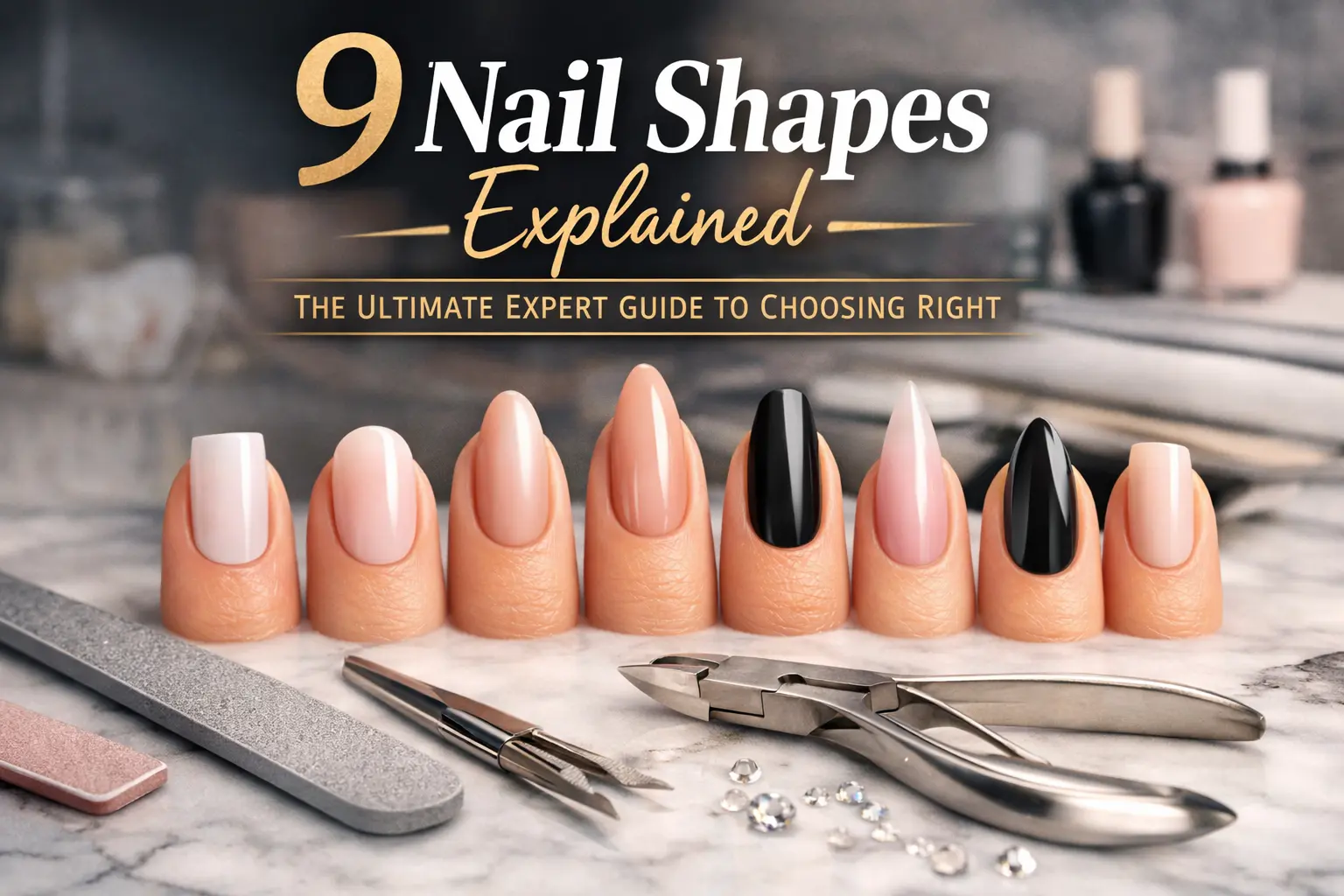
The square form uses parallel sidewalls and a straight free edge.
Explain performance.
This design resists bending at short lengths but exposes corner impact zones.
Identify suitability.
Best suited for wide nail beds and professional environments.
See More: High and Tight Haircut: The Complete Guide to a Clean, Sharp, Timeless Style
Rounded Form
Describe geometry.
The rounded form follows the fingertip curve with softened sidewalls.
Explain performance.
This design minimizes edge catching and stress concentration.
Identify suitability.
Ideal for active routines and natural nail maintenance.
Oval Form
Describe geometry.
The oval form tapers smoothly and finishes with a continuous arc.
Explain performance.
This design evenly distributes force across the perimeter.
Identify suitability.
Effective for creating finger elongation without length dependency.
Almond Form
Describe geometry.
The almond form narrows toward the tip and ends in a soft point.
Explain performance.
This design shifts stress toward the central axis and apex.
Identify suitability.
Appropriate for reinforced systems such as builder gel or acrylic.
Coffin (Ballerina) Form
Describe geometry.
The coffin form tapers inward and terminates with a flat tip.
Explain performance.
This design provides a wide surface for art but increases tip stress.
Identify suitability.
Commonly paired with enhancement overlays for structural support.
Stiletto Form
Describe geometry.
The stiletto form tapers aggressively into a sharp point.
Explain performance.
This design concentrates force at the apex and tip.
Identify suitability.
Used primarily for fashion styling and controlled wear.
Squoval Form
Describe geometry.
The squoval form combines straight edges with rounded corners.
Explain performance.
This design balances strength with reduced corner breakage.
Identify suitability.
Preferred for daily wear and weak natural plates.
Structural Comparison Table
| Nail Form | Edge Style | Stress Distribution | Length Dependency | Durability | Design Surface |
|---|---|---|---|---|---|
| Square | Flat | Moderate | Low | Medium | Medium |
| Rounded | Curved | High | Low | High | Low |
| Oval | Curved taper | High | Low–Medium | High | Medium |
| Almond | Soft point | Medium | Medium | Medium | High |
| Coffin | Flat taper | Medium | Medium–High | Medium | Very High |
| Stiletto | Sharp point | Low | High | Low | High |
| Squoval | Soft flat | High | Low | High | Medium |
How to Select the Correct Nail Form
Based on Nail Bed Anatomy
Evaluate width.
Wide nail beds align with flat-edge designs.
Evaluate length.
Short nail beds benefit from curved perimeter designs.
Based on Lifestyle Demands
Assess activity level.
High-activity routines favor rounded perimeter forms.
Assess maintenance tolerance.
Low-maintenance preferences favor reinforced corners.
Structural Benefits of Each Design
Reduce impact zones.
Curved edges deflect force away from corners.
Control leverage.
Extended tapers increase leverage and require reinforcement.
Stabilize apex placement.
Correct apex alignment supports long-term wear.
Compatibility With Nail Enhancement Systems
Support acrylic overlays.
Acrylic systems stabilize extended tapers and flat tips.
Support builder gels.
Builder gels reinforce moderate tapers and curved forms.
Support natural plates.
Natural nails perform best with rounded or hybrid forms.
Source authority: Cosmopolitan explains enhancement compatibility by structural type.
Design and Art Surface Considerations
Increase canvas area.
Flat tips support encapsulation and graphic patterns.
Enhance symmetry.
Curved perimeters support gradients and minimal designs.
Improve precision.
Straight edges align with geometric styling.
Common Structural Mistakes
Over-thin sidewalls.
Excess filing weakens stress-bearing zones.
Misalign apex.
Incorrect apex placement destabilizes long designs.
Ignore cuticle symmetry.
Asymmetry distorts structural balance.
Maintenance Demand by Structural Type
Lower Maintenance Designs
-
Rounded perimeter form
-
Squoval hybrid form
Higher Maintenance Designs
-
Coffin taper form
-
Stiletto point form
Professional Selection Checklist
-
Analyze plate symmetry
-
Measure free-edge length
-
Identify stress points
-
Match enhancement material
-
Confirm lifestyle alignment
FAQs:
Which nail form offers maximum durability?
Rounded and squoval perimeter designs provide the highest durability due to reduced edge stress.
Which structure minimizes breakage?
Oval perimeter designs minimize breakage through even force distribution.
Which form creates finger elongation?
Tapered designs such as almond-style structures enhance vertical proportion.
Are flat-tip designs stronger than pointed designs?
Flat tip structures provide greater stability than pointed structures due to increased surface area.
Which design supports weak natural nails?
Hybrid forms with rounded corners protect weak nail plates.
See More: A Complete Guide to Cellulogia and Advanced Approaches for Smoother Skin
Conclusion:
Nail shapes define structure, durability, and visual balance in professional nail design. Nail shapes control stress distribution, breakage resistance, and manicure longevity. Nail shapes determine compatibility with natural nails, gel systems, and acrylic enhancements. Nail shapes such as square, round, oval, almond, coffin, stiletto, and squoval represent engineered classifications. Nail shapes remain the core framework for strength, aesthetics, and performance in nail care.